
Key Takeaways
- Separate the audit into four measurement layers—crawl and index health, content quality, real-user field performance, and business outcomes—so exceptions surface as deltas instead of full re-audits every cycle.
- Check crawl and index health first when traffic drops suddenly, since indexation, canonicals, or deployment changes break overnight in ways content quality never does.
- Evaluate content against Helpful Content criteria—originality, completeness, authorship, and intent match—rather than rater guideline checklists, which Google confirms do not directly influence ranking 5.
- Read Core Web Vitals from CrUX field data at the 75th percentile across LCP, INP, and CLS, segmented by template, not from single lab runs that hide slow real-user sessions 7, 9.
- Join GA4 with the client's CRM at the URL level so the audit reports qualified outcomes the client's finance team recognizes, not sessions and rankings the agency picks.
- Triage by symptom before opening the template: aggregate drops go to layer one, flat rankings against active competitors to layer two, converting-page decay to layers three or four.
- Route pattern detection—crawl diffs, CWV pulls, GSC anomaly flags on revenue URLs—to automation, and keep intent judgment, editorial calls, and client narrative with the senior strategist.
- Measure practice capacity in clients whose four layers are actually monitored per senior IC, holding cycle frequency constant so weekly exception reviews are not confused with quarterly audits.
The gap between audit templates and delivery capacity
Most agency SEO practices run on a template that predates the current search environment. A 200-point checklist gets cloned per client, a strategist works through it front-to-back once a quarter, and the output lands in a slide deck that the account team translates into tickets. The format survives because it looks thorough. It fails because thoroughness is not the same as throughput, and search results no longer reward audits that treat every site the same way regardless of where the actual damage is.
The market data tracks the symptom. In CMI's 2025 enterprise research, 37% of enterprise marketers named optimizing for SEO as a challenge, while only 28% rated their content strategy as extremely or very effective 13. That gap sits inside organizations with dedicated content and SEO functions — the ones best resourced to solve it. If in-house teams with budget and staff cannot close the loop, an agency running the same generic template across a client book will not close it either.
The delivery-capacity problem is what makes this a Head of SEO issue rather than a strategist issue. A single IC can produce a comprehensive audit for one client in a week. Ten clients on that cadence means the practice is auditing more than it is executing, and the strategist who ran the audit is the only person who can interpret it. The output does not travel. Exception review does not exist because everything is flagged as an exception.
The reframe worth making: checking SEO optimization at portfolio scale is a measurement architecture problem. Four data layers — crawl and index health, content quality signals, real-user field performance, and business outcomes — need to be separated, instrumented once, and read as deltas rather than re-audited from scratch. The rest of this piece maps that stack, then the triage logic that decides which layer to open first.
The four-layer audit stack
Crawl and index health: what Google can reach
Layer one is the only layer where a page can be perfect and still invisible. If Googlebot cannot reach a URL, render its main content, and store it in the index, none of the downstream work matters. Checking this layer is a systems question, not a page question.
Google's own guidance for developers is unambiguous about the surface area: every page should be reachable through crawlable links, sitemaps should be submitted and current, titles and meta descriptions should be descriptive, and the main text content should be present in the rendered DOM rather than locked behind script that never resolves 2. The Starter Guide adds monitoring in Search Console as the default feedback loop 1. That is the entire mandate. Everything else in a technical audit is instrumentation around those four checks.
At portfolio scale, the useful move is to stop running full crawls as if each one is a discovery exercise. Baseline each client site once. After that, the strategist reads deltas: new orphaned URLs, sitemap entries that stopped returning 200s, indexable pages that dropped out of the Search Console index coverage report, canonical tags that flipped, robots directives that changed. A weekly crawl compared against last week's crawl surfaces the exceptions in minutes.
Three signals do most of the work here.
- First, the ratio of submitted sitemap URLs to indexed URLs, watched over time rather than in a single snapshot.
- Second, log-file evidence that Googlebot is spending its crawl budget on revenue pages rather than faceted duplicates or stale archives.
- Third, render-parity checks confirming the text a user sees matches what Google receives, which is where most JavaScript-heavy client sites quietly break.
If those three signals are green, the strategist closes layer one and moves on. If any of them are red, no content or performance work will compound until the plumbing is fixed.
Content quality signals: what Google can trust
Layer two is where most audits go wrong, because it is the layer teams treat as subjective. It is not. Google's Helpful Content guidance is a specific evaluation framework: assess pages by originality, completeness, and value delivered against the query, and consider who created the content, how it was produced, and why it exists at all 3. Those are checkable attributes, not vibes.
The trap on this layer is the Search Quality Rater Guidelines. Raters evaluate whether ranking systems are producing good results, but Google states plainly that their ratings do not directly influence ranking 4, 5. Building an audit around rater checklists as if they were ranking factors adds work without adding signal. The guidelines are useful as a lens on what quality means; they are not a scoring rubric that maps to positions.
What travels well across a client portfolio is a small set of content-quality deltas the strategist reads at the URL level:
- Pages that used to rank and now do not, sorted by revenue potential.
- Pages with declining engaged sessions on entry from organic.
- Pages where the primary query intent has shifted — informational to transactional, or the reverse — and the page has not been rewritten to match.
- Pages with thin unique text once boilerplate, navigation, and legal copy are subtracted from the body.
Authorship and sourcing get their own pass. Who wrote it, what claim is being made, and whether the supporting evidence is present in the page rather than promised in a linked PDF. For regulated verticals, this pass doubles as a compliance check.
A useful discipline: rank content-layer findings by which pages the business actually monetizes. A category page that converts is worth ten blog posts that rank. The audit output should reflect that hierarchy, not alphabetical order in a spreadsheet.
Field performance: what real users actually experience
Layer three is the one most agencies still measure with the wrong instrument. Lab scores from a single synthetic run are useful for debugging a specific page, but they do not tell the strategist whether the site is passing at the population level. Google uses field data — the experiences of real users, aggregated in the Chrome User Experience Report — to determine whether a site meets Core Web Vitals thresholds 8.
The pass/fail line is precise. A page is considered to have good performance on a Core Web Vital when at least 75% of page views meet the good threshold for that metric, measured across the 28-day CrUX window 7, 9. That single number — the 75th-percentile bar applied to LCP, INP, and CLS — is what the strategist should be reading, not a lab score in the 90s that hides a long tail of slow sessions on real devices and networks.
Instrumenting this layer at portfolio scale is cheaper than most teams assume. Google's web-vitals JavaScript library collects the same metrics Chrome sends to CrUX, which lets an agency stream field data into its own analytics for clients whose CrUX sample is too small to be reliable 8. One implementation per site, then the numbers flow.
The operational read is straightforward. For each client, the dashboard shows the share of URLs passing all three metrics at the 75th percentile, segmented by template — product page, category page, article, landing page. A drop concentrated in one template points to a specific deployment or theme change. A drop spread across templates points to infrastructure. That segmentation is where the strategist earns the review; the collection is where the automation earns its seat.
Lab tools still have a role, but only as the second step: something failed in the field, and the strategist needs a synthetic run to isolate what changed.
 Reinforce the Core Web Vitals 75% threshold cited in the section prose, which defines whether a site passes at the population level.
Business outcomes: what the client actually pays for
Layer four is the one that keeps the retainer. Ranking a page is not the deliverable. Moving qualified traffic to pages that convert into pipeline, calls, bookings, or revenue is.
The instrumentation here is GA4 and the client's CRM or booking system, joined at the URL level. The strategist should be able to see, for each organic landing page, entrances, engaged sessions, conversion events, and — where the CRM is connected — downstream qualified outcomes. Without that join, the audit stops at traffic and the client stops at renewal.
Three views do most of the work on this layer.
- Revenue-page decay: URLs that historically drove qualified conversions and are now shedding either impressions, click-through rate, or on-page conversion rate.
- Query drift: pages ranking for queries that no longer match the offer, usually because the page was rewritten or the SERP intent shifted.
- Conversion-path leakage: organic entrances that reach a converting template but fall out before the event fires, often a symptom of a form, speed, or trust issue rather than an SEO one.
Two constraints keep this layer honest. First, the outcome metric has to be the client's, not the agency's. Sessions and rankings are inputs. Qualified leads, booked appointments, or closed revenue are outputs, and the audit output should be denominated in whichever one the client's finance team recognizes. Second, attribution windows have to be stated. A 30-day last-click view will disagree with a 90-day data-driven view, and the strategist should pick one per client and hold it.
When layer four is instrumented, layers one through three stop being ends in themselves. Crawl health, content quality, and field performance become levers the strategist pulls in service of a business number the client already tracks.
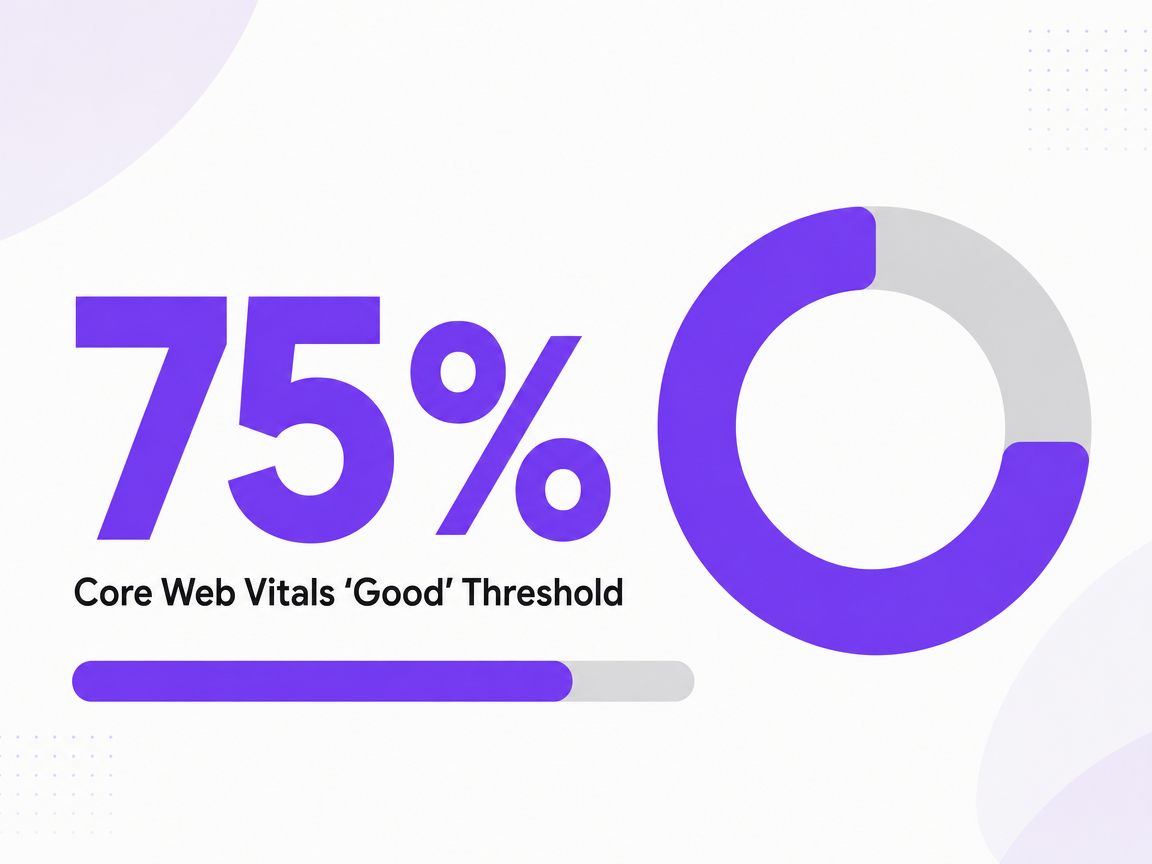 Core Web Vitals 'Good' Threshold
Core Web Vitals 'Good' Threshold
Check SEO optimization impact at scale instantly
Validate and publish real SEO improvements across multiple clients before committing to any new resource allocation.
Triage before template: which layer to check first
The strategist who opens every audit at layer one wastes the client's time on layers two through four half the year. The four-layer stack is the map. Triage is the read before the map gets opened. Symptom first, layer second, template last.
Three symptoms cover most inbound. A traffic drop that shows up in aggregate. Rankings that have gone flat while competitors move. Converting pages that are shedding pipeline while impressions look fine. Each one points to a different layer, and running the wrong layer first is how a week gets burned on a content sprint when the actual break is a canonical tag.
Sudden traffic drops go to layer one. When organic clicks fall off a cliff inside a week, the working assumption is crawl, index, or delivery — not content quality, which does not change overnight. The strategist pulls Search Console index coverage, sitemap status, and recent crawl deltas before touching a page. Google's own guidance treats Search Console as the default feedback loop for this exact reason 1. If the drop lines up with a deployment, a robots change, or a canonical flip, the answer is upstream of the content team.
Flat rankings against active competitors go to layer two. Nothing is broken; the page is no longer the best answer to the query. The strategist reads the SERP, then the page against Helpful Content criteria — originality, completeness, first-hand evidence, and whether the reason the page exists is still legible 3. This is the pass where authorship, sourcing, and intent match get rebuilt, not a technical sweep.
Converting-page decay with stable impressions goes to layer three or four. Users are arriving and leaving before the event fires. Field performance on the specific template comes first — a slow INP on a form page is invisible in a lab score and obvious in CrUX. If field data is clean, the diagnosis moves to layer four: form friction, trust signals, or a mismatch between the query the page ranks for and the offer on the page.
Triage compresses the audit before it starts. The template still runs on a scheduled cadence for baselines. The symptom-driven pass is what earns the retainer between cycles.
The operating-model decision: where AI belongs in the loop
The temptation is to solve audit throughput by buying another tool. The better read is that this is an operating-model choice: what work stays synchronous with a strategist, what work runs in the background and only surfaces exceptions, and what work gets deleted from the audit entirely. AI belongs in the second bucket, not the first.
The productivity math is what makes the shift defensible to the CFO rather than the CMO. McKinsey estimates that sales and marketing account for 28% of the total potential economic value from generative AI, with marketing productivity gains landing in a 5% to 15% range of total marketing spending 11. That range is not a promise about any single agency's P&L; it is a distribution across functions and workflows, and the agencies capturing the upper end of it are the ones redesigning how work moves, not the ones bolting a chatbot onto an existing audit deck. Forrester's 2025 read of US agencies confirms the direction: genAI integration is accelerating across content, media, SEO, and strategy work, with productivity as the stated objective 15.
Three parts of the four-layer stack are natural fits for automated pattern detection.
- Crawl deltas — new orphaned URLs, canonical flips, sitemap 200 rates — are diff problems, not judgment problems.
- CWV field pulls from CrUX and the web-vitals library are collection problems that scale to any number of client properties once instrumented 8.
- GSC anomaly detection — impressions, clicks, or CTR moving outside a rolling band on revenue URLs — is a statistics problem the strategist should not be running by eye.
What the model does not decide: which anomaly matters this week, how to frame it to the client, and whether the fix is worth the sprint. That call stays with the Head of SEO, and the operating model exists to make sure it lands on the calendar with the context already assembled.
Scale SEO Checks Across Clients—No Additional Headcount Required
See how leading agencies automate multi-site SEO audits and optimization reporting with full oversight—reducing manual workload while maintaining strategic quality at scale.
If you manage a client portfolio: audit throughput per strategist
Scope shift: this section is for the Head of SEO reading a book of clients, not a single site. The unit of analysis is the strategist-week, and the question is how many client properties one senior IC can keep instrumented before the audit stops traveling and starts collapsing back into ad-hoc firefighting.
Three operating models set the range.
- Fully manual means the strategist opens each tool per client, runs the crawl, pulls GSC and GA4 by hand, and writes findings from scratch.
- Tool-assisted means the standard stack — a crawler, GSC, GA4, a CWV field source — is wired into a shared dashboard and the strategist reads deltas instead of rebuilding baselines.
- AI-assisted with human approval adds pattern detection on top: anomaly flags on GSC revenue URLs, crawl diff summaries, CWV template segmentation surfaced as ranked exceptions, all routed to the strategist for sign-off before anything reaches the client.
The productivity envelope for the third model is not hypothetical. McKinsey's range for marketing productivity gains from generative AI sits between 5% and 15% of total marketing spending, contingent on workflow redesign rather than tool adoption alone 10. Forrester's 2025 read of US agencies places SEO squarely inside the workflows where that redesign is already happening 15. The table below is a planning frame, not a benchmark. Fill it with the practice's own numbers.
| Operating model | Hours per client per audit cycle | Cycle frequency | Clients one senior strategist can hold |
|---|---|---|---|
| Fully manual | Baseline the practice measures today | Quarterly deep audit | Baseline count |
| Tool-assisted (crawler + GSC + GA4 + CWV dashboard) | Baseline minus collection time | Monthly delta review, quarterly deep | Baseline plus incremental capacity |
| AI-assisted with human approval | Baseline minus collection and first-pass triage | Weekly exception review, monthly delta, quarterly deep | Baseline scaled against the 5–15% productivity range 10 |
Two disciplines keep the model honest. Time the strategist's actual hours against one live client for a full cycle before extrapolating, and hold cycle frequency constant when comparing models — a weekly exception review is not the same product as a quarterly audit, and pretending otherwise inflates the throughput number. The output the Head of SEO defends to the P&L is capacity per senior IC, denominated in clients whose four layers are actually monitored, not in audits filed.
What stays with humans and what does not
The clean split is decisions versus differences. Differences are diffs, deltas, distributions, and anomalies — the kind of work that scales linearly with client count and gets worse the more a strategist does by hand. Decisions are what the client is actually paying a senior IC to make. Confusing the two is how agencies end up with expensive strategists doing collection work and cheap tools making calls they should not make.
Three things stay with humans.
- Intent judgment on individual queries and pages — whether the SERP has shifted from informational to transactional, whether the page still answers the question the searcher is asking, and whether a rewrite is worth the sprint against everything else in the queue.
- Editorial calls on content — originality, sourcing, authorship, and whether a page clears the Helpful Content bar in a way an automated scorer cannot verify 3.
- Client narrative — how the week's exceptions translate into a story the account holder can defend at a QBR.
Three things do not need to.
- Crawl deltas between last week and this week.
- Field-performance pulls from CrUX and the web-vitals library across every client property 8.
- GSC anomaly detection on the revenue-URL set, surfaced as ranked exceptions rather than a wall of charts.
Rater guideline checklists as ranking rubrics belong nowhere in the loop — Google is explicit that rater ratings do not directly influence ranking, and building automated scoring around them adds work without adding signal 5.
The Head of SEO's job is to defend the split. Every audit hour the practice reclaims from collection gets spent on judgment the client renews for.
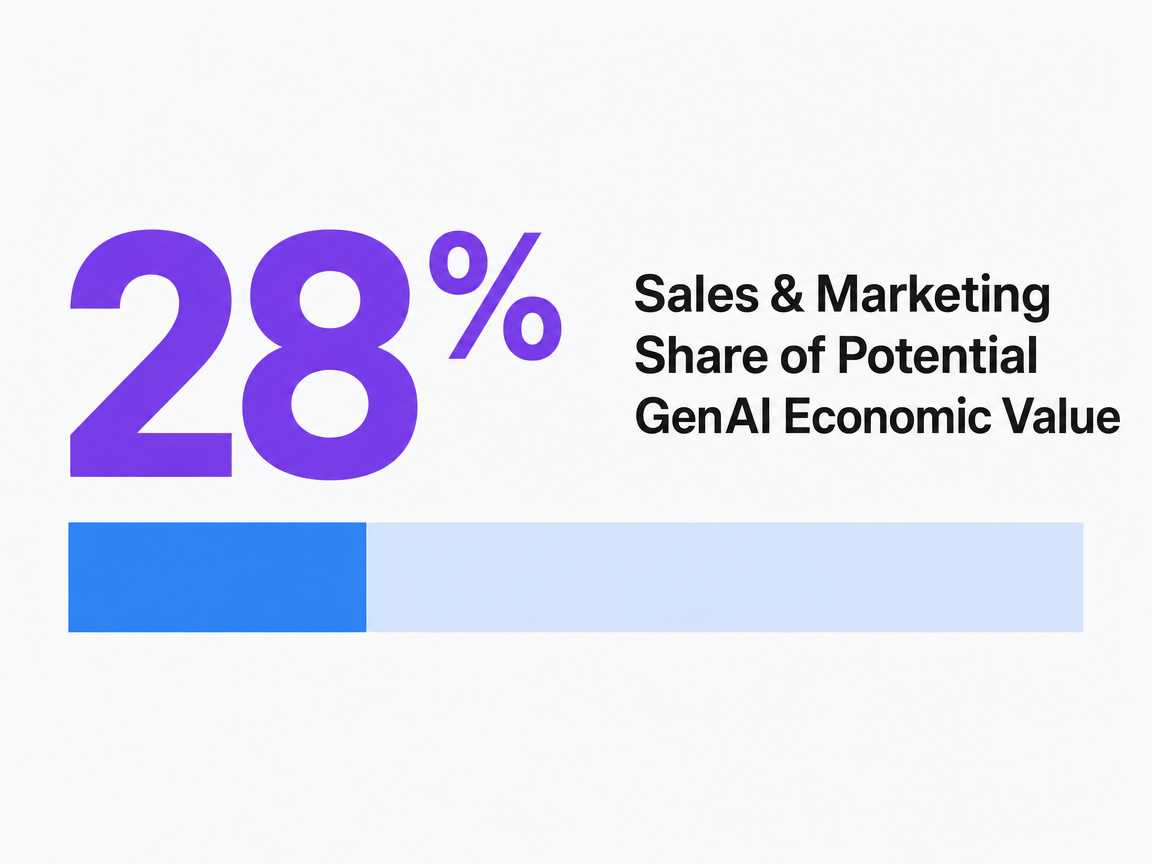 Sales & Marketing Share of Potential GenAI Economic Value
Sales & Marketing Share of Potential GenAI Economic Value
Frequently Asked Questions
References
- 1.Search Engine Optimization (SEO) Starter Guide.
- 2.SEO Guide for Web Developers.
- 3.Creating Helpful, Reliable, People-First Content.
- 4.Search Quality Rater Guidelines: An Overview.
- 5.Search Quality Raters Guidelines update.
- 6.The SEO Starter Guide got a makeover.
- 7.Web Vitals.
- 8.Getting started with measuring Web Vitals.
- 9.How the Core Web Vitals metrics thresholds were defined.
- 10.Economic potential of generative AI.
- 11.AI in the workplace: A report for 2025.
- 12.How generative AI can boost consumer marketing.
- 13.Enterprise Content Marketing Benchmarks, Budgets, and Trends: 2025 Research.
- 14.B2B Content Marketing: 2025 Benchmarks & Trends.
- 15.The State Of Generative AI Inside US Marketing Agencies, 2025.