
Key Takeaways
- Audit SERP composition first by logging every module present, since features like AI Overviews and local packs suppress organic clicks even when position stays constant 10.
- Discover competitors at the URL level, not the domain, and tag publisher type so a forum-heavy ranking set is not confused with entrenched direct-competitor saturation.
- Map dominant intent and cluster query facets from H2s, People Also Ask, and named entities to find subtopics incumbents skipped rather than writing longer versions of what ranks 6.
- Use Search Console as the tiebreaker, reading existing impressions, CTR against observed composition, and adjacent-query surface area before committing production hours 11.
- Prioritize gaps by realistic click opportunity across composition penalty, competitor displaceability, facet opening, and first-party lift, then mark each query pursue, defer, or decline with reasoning that survives a QBR.
- For multi-location portfolios, verify canonicalization, cannibalization, and mobile parity before declaring a gap, since Google may pick its own canonical and indexes the mobile version 15, 16.
- Keep gap-driven production inside policy by requiring named first-hand expertise and a reviewer who can confirm the page answers the query better, not merely at greater length 12, 13.
Why difficulty scores stopped predicting keyword outcomes
A three-digit keyword difficulty score was never an official Google metric, but for years it worked well enough as portfolio triage. That shortcut is now producing systematically wrong bets. Two changes broke it: the ranking page stopped being a list of ten links, and the click stopped being the default outcome of a good ranking.
On the first point, Google's own documentation describes Search as a collection of ranking systems that evaluate concepts, passages, freshness, originality, reviews, and reliability across content types, with no single published formula agencies can reverse-engineer into one score 8. A composite difficulty number compresses page authority, intent match, SERP layout, and content quality into a proxy that treats every keyword as the same shape of problem. It is not.
On the second point, research on 24 SERP features across a large cross-website dataset found that while position remains the dominant CTR determinant, features such as featured answers, local packs, videos, and shopping modules can meaningfully amplify or suppress organic clicks, with page-level features showing an average negative influence on organic CTR 10. A #3 ranking behind an AI Overview, a local pack, and a video carousel is not the same asset as a #3 ranking on a plain SERP, even when the difficulty score is identical.
For an agency running 20 to 150 client accounts, the practical consequence is quiet over-investment in high-difficulty, high-impression keywords that never convert into clicks, and under-investment in queries where competitor intent-fit is weaker than the score suggests. The workflow that follows treats SERP composition, competitor intent-fit, and first-party click data as separate inputs, then recombines them into a defensible prioritization decision an analyst can execute the same way twice.
The five-stage workflow at a glance
The workflow below breaks SERP competition into five artifacts an analyst can produce in sequence, each feeding the next. It replaces the single-score triage with page-and-intent evaluation, which aligns with how Google itself describes ranking: multiple systems examining concepts, passages, freshness, originality, reviews, and reliability across content types 8.
- Stage one is a SERP composition audit. The analyst captures the live result page for the target query and logs every module present: AI Overview, featured snippet, local pack, video carousel, image block, discussions, shopping, People Also Ask. Artifact: a dated SERP screenshot log with a feature checklist.
- Stage two is competitor ranking discovery. The analyst identifies the domains and specific URLs holding the organic positions and any feature slots, then records domain type (national publisher, direct competitor, aggregator, forum, brand site). Artifact: a competitor ranking matrix keyed to URL, not domain.
- Stage three is intent and facet mapping. The analyst classifies the dominant intent the SERP is rewarding and clusters the subtopics competitor pages actually cover. Artifact: a facet cluster map showing which questions, entities, and formats are represented and which are absent.
- Stage four is first-party validation. The analyst pulls Search Console query and page data for the client to check whether the site already earns impressions on adjacent queries and where CTR or position sits relative to the SERP composition observed in stage one. Artifact: a Search Console export tagged to the target query cluster.
- Stage five is gap prioritization. The analyst combines composition, competitor fit, facet coverage, and first-party signal into a single ranked decision: pursue, defer, or decline. Artifact: a prioritized gap sheet with reasoning notes that survive a client QBR.
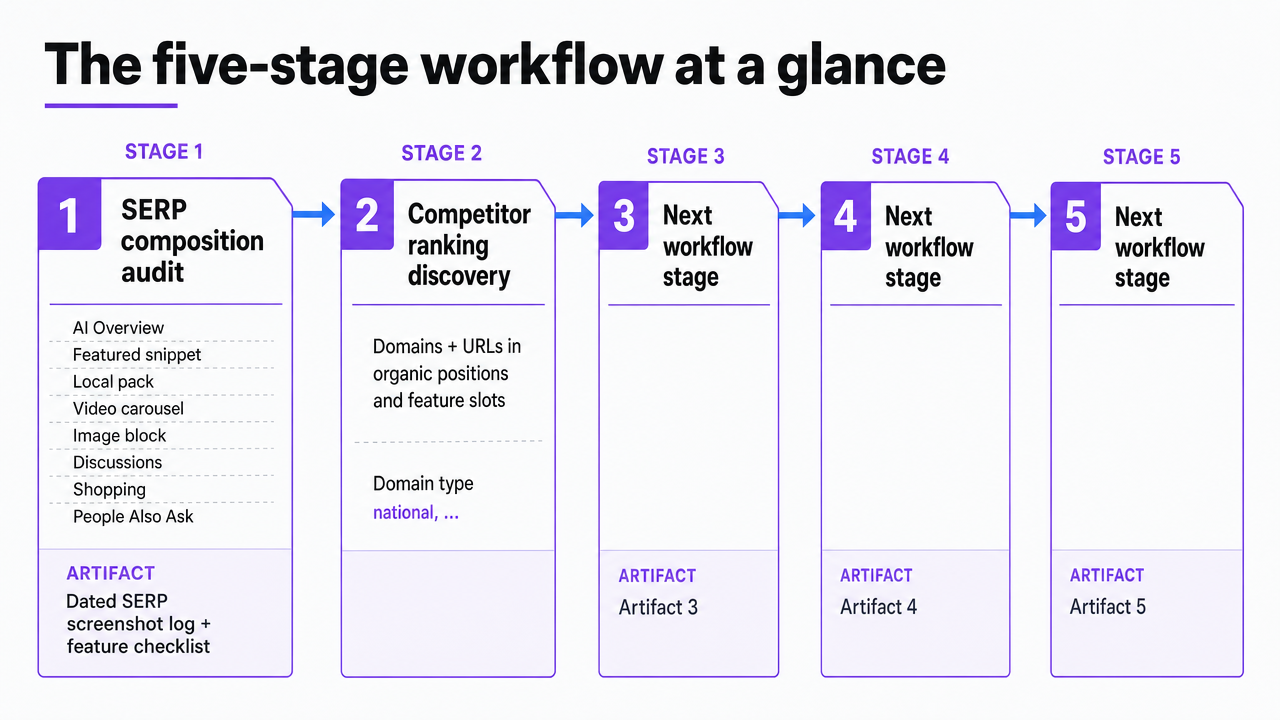 Visualize the sequential five-stage SERP competition workflow described in the section, showing each stage and its artifact
Stage one: audit SERP composition before you rank anyone
Before an analyst evaluates a single competing URL, the result page itself needs to be treated as the primary artifact. Composition determines how much organic click is even available to compete for. Two subsections follow: the first catalogs the modules that consume clicks; the second scores AI Overview exposure with the scope discipline it deserves.
Cataloging features that consume the click
The analyst opens an incognito window, sets location and language to match the client's target market, runs the query, and captures the full SERP as a dated screenshot. The checklist that accompanies the screenshot is not aesthetic. It records presence, order, and vertical position of every module: AI Overview, featured snippet, People Also Ask, local pack, video carousel, image block, shopping module, discussions and forums, sitelinks, top stories, and any knowledge panel. Each module pushes the first organic result further down the viewport, and each has its own click-suppression profile.
The cross-website study of 24 SERP features that anchors this stage is unambiguous on the mechanics. Result position remains the dominant CTR determinant, but SERP features can meaningfully amplify or suppress organic clicks, and page-level features showed an average negative influence on organic CTR across the dataset 10. Translated for portfolio triage: a #2 position on a plain result page and a #2 position beneath an AI Overview, a local pack, and a video carousel are different assets, even when the difficulty score is identical.
Analysts should record two things beyond presence. First, whether the client or a direct competitor already occupies any feature slot, since owning the featured snippet or the local pack changes the opportunity math entirely. Second, whether the SERP layout looks stable across three checks over 48 hours. Volatile compositions signal contested intent and warrant a second pass in stage three.
Scoring AI Overview exposure without overreading it
AI Overviews deserve their own line in the composition log because they change what a good ranking is worth, not just where it sits. The most-cited exposure figure comes from the Reuters Institute's 2025 report: across six countries, 54% of respondents said they had seen an AI-generated answer in response to a search query during the preceding week 1. The scope matters and should stay attached to the number whenever it is used. The sample covered six countries, the queries skewed news-oriented, and the measure was one-week recall, not per-query prevalence.
For service-vertical commercial queries, that figure is a ceiling on cultural familiarity, not a forecast of AI Overview frequency. The operational move is to log AI Overview presence per query in the composition audit, note whether the client's domain is cited within it, and separate impressions, citations, and clicks as distinct outcomes in stage four rather than assuming any of them substitutes for the others.
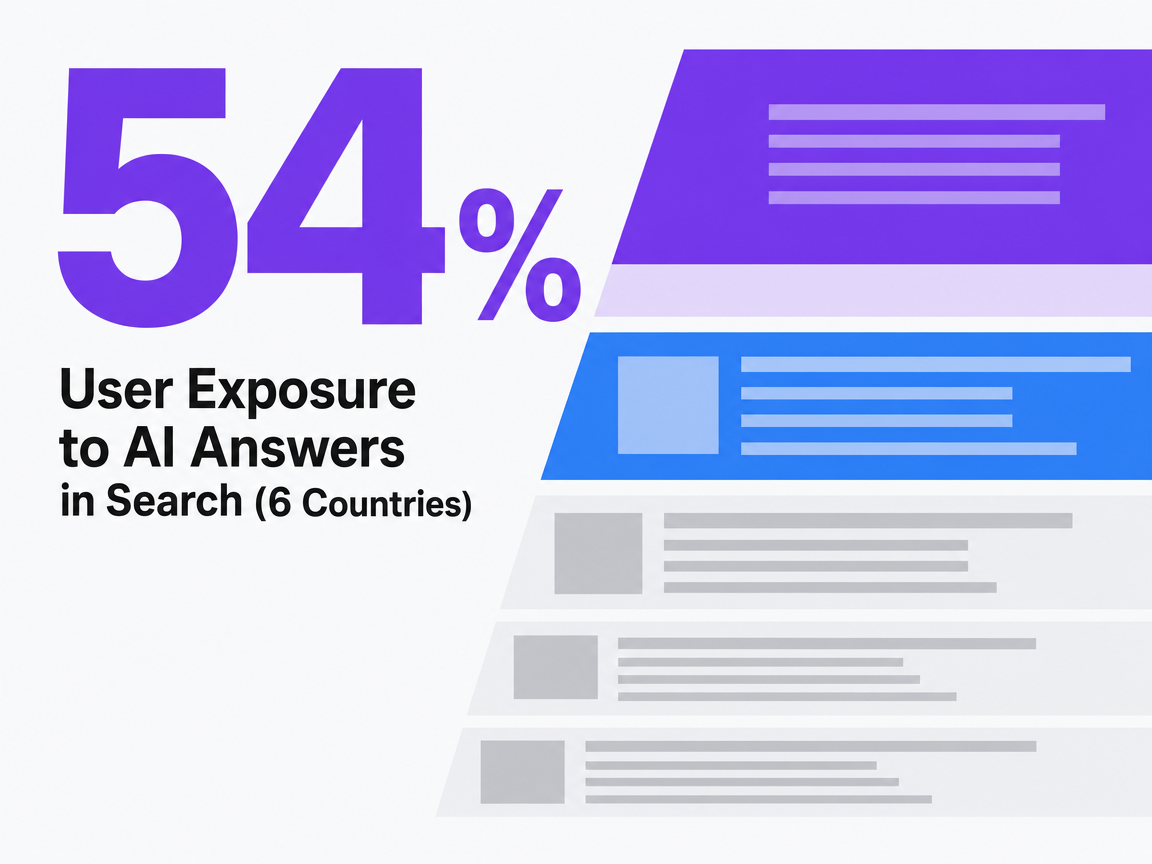 User Exposure to AI Answers in Search (6 Countries)
User Exposure to AI Answers in Search (6 Countries)
Run a Live SERP Competition Audit Instantly
Benchmark your site’s ranking potential and publish actionable keyword gap insights during your risk-free trial.
Stage two: discover who actually competes for the query
The composition audit tells the analyst what the SERP looks like. Stage two answers a narrower question: which specific URLs are competing, and what kind of publisher does each one represent. This distinction matters because domain-level authority metrics obscure the URL-level fit that actually determines whether a client page can displace an incumbent.
The analyst records every organic URL on page one, plus any URL occupying a feature slot noted in stage one. The matrix is keyed to the URL, not the domain. A national publisher's category hub, a national publisher's product review, and a national publisher's editorial explainer are three different competitors even when they share a root domain. Google's ranking documentation reinforces the point: passage ranking evaluates individual sections within a page, and multiple systems assess reviews, freshness, and originality across content types 8. Domain Rating is not the unit of competition. The URL is.
For each URL, the analyst tags publisher type using a fixed vocabulary the team agrees on in advance:
- direct competitor
- adjacent service provider
- national publisher
- aggregator or directory
- forum or community
- brand or manufacturer site
- government or nonprofit
- user-generated platform
The tag drives interpretation later. A ranking set dominated by forums and aggregators signals unresolved user need and a genuine opening for a direct competitor page. A ranking set dominated by well-optimized direct competitors signals a saturated intent that will require differentiated angle or first-hand expertise to crack, not more word count.
Two secondary fields make the matrix useful at portfolio scale. First, publication or last-updated date where visible, since freshness is one of the ranking systems Google names explicitly 8. Second, content format: long-form guide, comparison table, calculator or tool, video, product page, location page. Format concentration is a competitive signal on its own. When eight of ten results are comparison tables and the client's asset is a 3,000-word narrative guide, the competition problem is format mismatch, not authority. The matrix an analyst hands to stage three should let a reviewer answer, in under a minute, who ranks, what kind of page ranks, and how recently each one was refreshed.
Stage three: map intent and query facets against the ranking set
The composition audit and the competitor matrix describe the surface. Stage three interprets it. Two questions drive this stage: what intent is the SERP actually rewarding, and which subtopics do the ranking pages cover, ignore, or misread. The answers determine whether a client page can win the query with a stronger execution of the same intent, or whether the opportunity lies in serving a facet the incumbents skipped.
Classifying dominant intent before comparing coverage
The three-category model, informational seeks knowledge, transactional seeks an offer or vendor, and navigational seeks a known destination, remains the working vocabulary for most portfolio triage 5. It is a starting point, not a verdict. Real queries carry mixed or shifting intent, and the SERP itself is the most reliable evidence of what Google currently reads the dominant intent to be. Query features, ad-click patterns, and the composition of the ranking page together characterize commercial intent more accurately than the query string alone 3.
The analyst assigns one dominant intent to the query and flags any secondary intent visible in the SERP. A ranking set of service-provider pages, local pack, and comparison articles reads transactional with a commercial-research secondary. A ranking set of definitions, explainer articles, and video how-tos reads informational. The classification then gets applied to the client's candidate page. If the intended asset is a service page and the SERP is rewarding explainers, the mismatch is the competition problem, not domain authority.
Facet clustering to find the subtopics competitors skipped
Intent classification tells the analyst which category of page to build. Facet clustering tells the analyst what that page needs to cover. Search systems already treat queries as bundles of subtopics and diversify results accordingly, using query facets to surface the underlying intents present in a ranking set 6. The gap analysis mirrors that logic in reverse: catalog the facets the ranking pages address, then locate the ones they do not.
The practical method is bottom-up. The analyst extracts the H2 and H3 structure from each top-ten URL, pulls the questions in the People Also Ask module, and lists the entities each page names (products, procedures, credentials, locations, price ranges, timelines). Clustering these into subtopic groups produces an intent hierarchy of the query, an approach automated diversification research has shown discriminates useful subtopic structure from noise 7. Facets present on eight of ten pages are table stakes. Facets present on two or three, especially those matching client expertise, are the defensible opening. Facets absent entirely deserve a manual sanity check before the analyst commits production hours.
Stage four: use Search Console as the tiebreaker
Third-party tools estimate. Search Console measures. When the composition audit, the competitor matrix, and the facet map all point toward a candidate keyword, the deciding evidence sits in the client's own Search performance report, which breaks down impressions, clicks, CTR, and average position by query, page, and country 11. The analyst exports the last 90 to 180 days of query data, filters to the target query cluster plus close variants, and reads three signals before committing production hours.
The first signal is whether the client already surfaces on the query at all. A page earning 400 impressions at position 14 with a 0.4% CTR is a different asset than a page with zero impressions on the same term. The first is a refresh candidate. The second is a net-new build, and the composition audit determines whether that build is worth the effort.
The second signal is CTR against the composition observed in stage one. When Search Console shows a position of 6 with a CTR well below the plain-SERP benchmark for that position, the AI Overview, local pack, or video carousel logged in stage one is the likely cause, not the page. Google's guidance confirms that AI-feature appearances are folded into the same Search performance reporting as conventional web results, so impressions on an AI-Overview query and impressions on a plain organic query show up in the same column and require the composition log to interpret 9.
The third signal is adjacent-query surface area. The query filter should include head term variants, question phrasings, and modifier combinations. A client already earning impressions across eight related long-tail queries has demonstrated topical relevance the ranking systems can extend; a client with a single thin surface has not 8. Where third-party tools show a keyword as reachable and Search Console shows no adjacent impressions after 180 days of the site being live and crawled, the tiebreaker resolves against pursuit. The measurement source Google actually uses beats the estimator that reverse-engineers it.
Cut Time Spent on SERP & Keyword Gap Analysis by 70%—Without Adding Headcount
See how agencies are automating competitive SERP analysis and uncovering keyword gaps at scale—enabling strategic oversight and faster execution across multiple clients, all in a single workflow.
Stage five: prioritize gaps by click opportunity, not volume
The final artifact is a ranked decision sheet, and the ranking logic is where most portfolio triage still goes wrong. Search volume is an input, not a verdict. The four earlier stages produce the variables that convert volume into an estimate of clicks a client page can realistically capture, which is the number that should drive production sequencing.
An analyst scores each candidate query on four dimensions:
- Composition penalty comes from stage one: how many click-suppressing modules sit above the first organic result, and whether an AI Overview is present. The cross-website study of 24 SERP features supports weighting this heavily, since page-level features showed an average negative influence on organic CTR even when position was held constant 10.
- Competitor displaceability comes from stage two: a ranking set dominated by forums, aggregators, or stale pages scores higher than one dominated by well-optimized direct competitors.
- Facet opening comes from stage three: queries where the client's expertise maps to underserved subtopics score higher than queries requiring only a longer version of what already ranks 6.
- First-party lift comes from stage four: existing impressions on adjacent queries indicate the ranking systems already read the site as topically relevant 11.
The decision categories are pursue, defer, or decline. Pursue when composition is workable, competitor fit is beatable, a facet opening exists, and first-party signal is present. Defer when three of four hold but one blocker is fixable within a quarter, such as a canonicalization cleanup or a format rebuild. Decline when the SERP is saturated with strong direct competitors, the composition consumes most clicks before position one, and the client shows no adjacent impression base. Impressions, citations, clicks, and downstream conversions are separate outcomes and should be scored separately; a query that produces impressions inside an AI summary but no referral clicks is a brand-visibility asset, not a traffic asset, and belongs in a different column 2. The gap sheet handed to production should carry the reasoning for each verdict in a single line so a client QBR can defend the sequencing without reconstructing the analysis.
If you manage multiple locations: prerequisites before declaring a gap
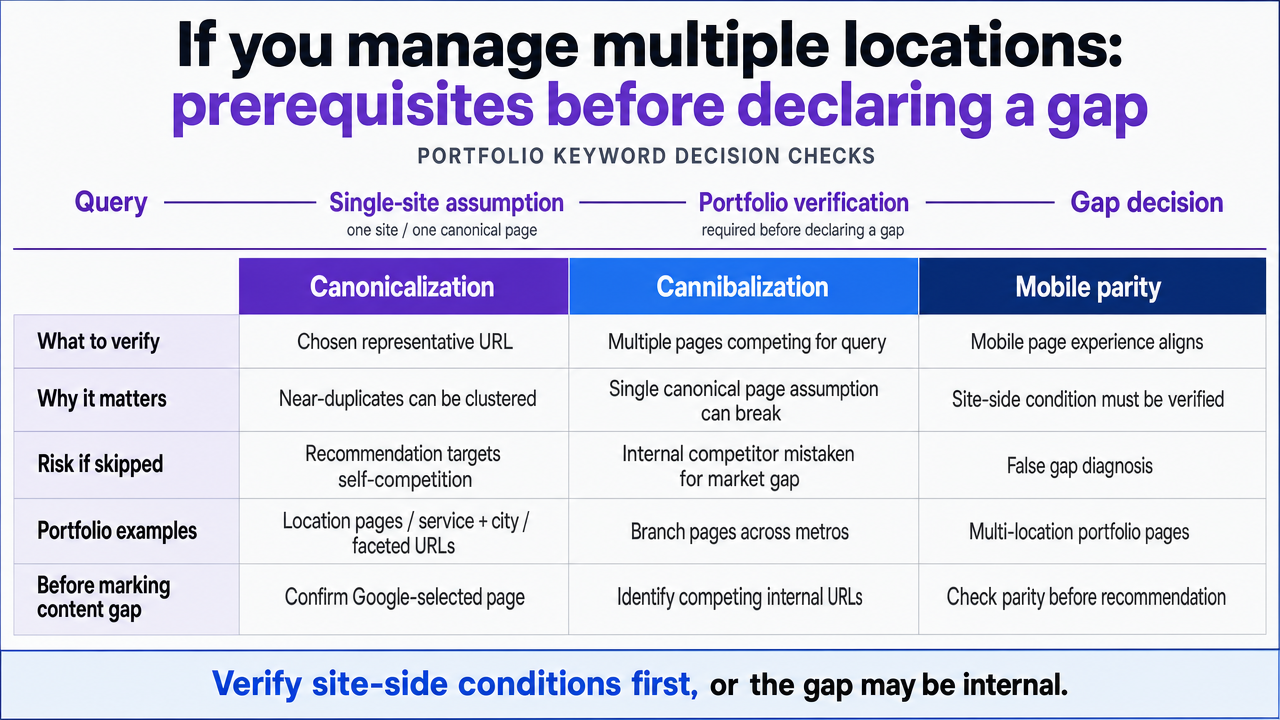
The workflow above assumes a single site competing on a single canonical page per query. That assumption breaks for agencies running multi-location clients, franchise networks, DSO portfolios, or law firms with a branch page for every metro. Before an analyst on a portfolio account writes "content gap" next to a query, three site-side conditions have to be verified. Skip them and the recommendation ships against a self-inflicted competitor rather than an external one.
Canonicalization, cannibalization, and mobile parity checks
The first check is canonicalization. Location pages, service-plus-city permutations, and faceted URLs generate near-duplicates that Google clusters and consolidates. The declared canonical is a signal, not a command; Google can select a different representative URL when it judges another page more complete 15. An analyst who declares a gap on "emergency dental [city]" without first confirming which URL Google treats as canonical across the client's location set may be looking at a cluster where three internal pages are competing with each other for the same slot.
The second check is cannibalization. When Search Console shows two or more URLs from the same domain rotating on the same query at similar positions, the problem is internal competition, not competitor strength. A merge, a redirect, or a scope split usually recovers more click than a new page would earn.
The third check is mobile parity. Google indexes and ranks the mobile version of a site 16. A desktop SERP review can inflate opportunity if the mobile template drops content blocks, internal links, structured data, or the location schema present on desktop. Analysts running the composition audit in stage one should capture the mobile SERP for any query where the client's target page is a location or service-area asset, then compare rendered mobile content against the desktop version before scoring the gap.
Portfolio operations: comparing three decision approaches
The workflow choice determines how many keyword decisions a client team can defend per week. The table below compares three approaches on the variables that actually govern portfolio throughput.
| Approach | Analyst level | Minutes per keyword | Output artifacts | False-positive gap risk ||---|---|---|---|---|| Tool difficulty score only | Junior | 1–3 | Score + volume | High || Manual senior SERP inspection | Senior | 20–45 | Notes, screenshots | Low || Five-stage structured workflow | Junior with senior QA | 8–15 | Composition log, competitor matrix, facet map, Search Console export, gap sheet | Low-moderate |
The structured workflow keeps senior time on QA and edge cases while producing artifacts that survive a client QBR.
 Render the comparison table from the section comparing three keyword decision approaches for portfolio operations
Quality and policy guardrails when scaling the workflow
Running the five-stage workflow across a portfolio invites a specific failure mode: producing pages to fill every identified gap, whether or not each page has something to say. Google's spam-policy documentation is direct on the boundary. Scaled content abuse is defined as generating many pages primarily to manipulate rankings rather than help users, and the policy applies regardless of whether content is produced manually, automatically, or through a combination of methods 13. Volume is not the diagnostic. Purpose, originality, and user value are.
The quality principles that keep gap-driven production on the right side of that line are also documented. Google's guidance on helpful content emphasizes clear site purpose, first-hand expertise, and satisfying the intended audience rather than producing pages to game rankings 12. For agency workflows, that translates into two hard rules at the gap-sheet stage: every pursue decision needs a named source of first-hand expertise on the client side, and every facet cluster needs a reviewer who can confirm the page will answer the query better than what currently ranks, not merely at greater length.
Frequently Asked Questions
References
- 1.Generative AI and news report 2025: How people think about AI’s role in journalism and society.
- 2.Journalism, media, and technology trends and predictions 2025.
- 3.Classifying and Characterizing Query Intent.
- 4.Query Intent Understanding.
- 5.Informational, transactional, and navigational need of information: relevance of search intention in search engine advertising.
- 6.Search Result Diversification Based on Query Facets.
- 7.Low-cost, bottom-up measures for evaluating search result diversification.
- 8.A Guide to Google Search Ranking Systems.
- 9.AI Features and Your Website.
- 10.Beyond Rankings: Exploring the Impact of SERP Features on Organic Click-through Rates.
- 11.How To Use Search Console.
- 12.Creating Helpful, Reliable, People-First Content.
- 13.Google Web Search Spam Policies.
- 14.Technical SEO Techniques and Strategies.
- 15.What is URL Canonicalization.
- 16.Mobile-first Indexing Best Practices.