
Key Takeaways
- Crawl and index coverage decays after launch as dev releases, new templates, and plugin updates drift canonical tags, so agencies need a standing crawl-diff cadence with regressions routed into the same ticket queue as broken tracking.
- JavaScript rebuilds ship without render validation, hiding hydrated content and internal links from crawlers; make rendered-vs-source HTML comparison a pre-launch release gate rather than a post-launch audit.
- Multiple vendors accumulate conflicting schema types across pages, breaking rich-result eligibility and creating FTC exposure on ungoverned review markup; enforce one canonical template per page type, versioned and validated on deploy.
- Publishing YMYL content under generic bylines erodes trust and conversion, since 23.3% of high-risk cardiovascular patient content contains misinformation 5; route every draft to a named credentialed reviewer with credentials and review date on-page.
- Writers default to competitor blogs, brand pages, and social posts for citations, yet medical professionals score 5.63 on trust versus 2.8 for social media 4; require peer-reviewed, government, or professional-association sources at the brief stage.
- Producing lower-quality content shaped for AI extraction creates liability, since credentialed authorship and primary sourcing still drive attribution quality 1; apply one editorial standard across every surface rather than a separate AI track.
- Session-based reporting misses where users actually form intent, given 98% of health information seekers consult search engines before websites 3; add SERP-feature visibility, branded search, and call tracking to report qualified conversations.
- Review gating, undisclosed employee testimonials, AI-generated customer stories, and ungoverned review schema violate the FTC rule effective October 21, 2024 8, 9; document solicitation scripts, consent, and substantiation for every reputation deliverable.
- Accessibility defects logged as UX backlog items weaken both crawler signals and conversions while inviting demand letters 10; move automated scans and WCAG sampling into the same release gate as render validation and schema review.
Where Portfolio ROI Actually Leaks
Client renewals rarely die because a competitor cracked the algorithm. They die because the same delivery mistakes repeat across 40 accounts until reported traffic stops correlating with pipeline. The head of SEO sees the pattern first: a legal client's intake calls flatten while sessions climb, a dental group's local pack visibility improves while booked appointments do not, a behavioral health portfolio publishes 80 posts a quarter with no named clinician on any of them.
Nine mistakes account for most of that leakage, and they cluster into four failure domains rather than nine unrelated issues. Technical fundamentals block crawl, index, and render. Content quality gaps corrode trust in regulated verticals where authorship and sourcing carry measurable weight 2. Measurement setups report sessions instead of qualified pipeline. Compliance and accessibility risks — the FTC reviews rule and ADA web guidance chief among them — sit on SEO roadmaps as legal problems rather than delivery problems 8, 10.
What follows is a diagnostic pass through those nine mistakes, scoped to the economics of running delivery across a portfolio rather than tuning a single site.
Mapping the Nine Mistakes to Four Failure Domains
Grouping the nine mistakes by failure domain matters because each domain has a different owner, cadence, and remediation cost inside an agency. Treating them as a flat checklist obscures who is accountable when a client's pipeline stalls.
Technical fundamentals (Mistakes 1–3) sit with the technical SEO lead and platform engineering: crawl and index coverage, JavaScript render validation, and structured data governance. These fail silently and scale badly across a portfolio. YMYL content quality (Mistakes 4–6) sits with editorial and subject-matter reviewers: named clinical or legal review, authoritative sourcing, and quality controls that extend to AI-answer surfaces. These failures are especially costly in regulated verticals where sourcing directly affects trust 2. Measurement (Mistake 7) sits with analytics: reporting sessions instead of tracking users across search and AI touchpoints into booked pipeline. Compliance and UX (Mistakes 8–9) sit at the intersection of SEO, legal, and design: the FTC reviews rule 8 and ADA web accessibility 10. Assign an owner to each domain before reading the diagnostics that follow.
Technical Fundamentals That Quietly Block Revenue
Mistake 1: Treating Crawl and Index Coverage as a One-Time Audit
Crawl and index coverage decays. A launch-week audit that showed 92% of priority URLs indexed will not hold six months later, after the client's dev team ships a new booking flow, marketing spins up 40 location pages, and a plugin update rewrites canonical tags across the blog. The head of SEO who signs off on an initial technical audit and moves on discovers the drift only when organic sessions to money pages start sliding.
The portfolio pattern is worse than the single-site pattern. Across 40 accounts, coverage regressions surface at different times, in different CMSes, driven by different release calendars. Without a standing crawl-diff cadence — weekly for enterprise sites, monthly for local service clients — the team ends up firefighting index drops after they have already cost bookings.
The remediation is operational, not analytical. Standardize a coverage report that compares indexed URLs against a canonical inventory of revenue-critical pages per account. Route regressions above a defined threshold into the same ticket queue as broken conversion tracking. Treat crawl budget waste on faceted URLs, expired location pages, and staging leaks as billable delivery work, not an occasional cleanup project.
Mistake 2: Shipping JavaScript-Rendered Pages Without Render Validation
Client dev teams ship React and Vue rebuilds on quarterly cycles. SEO gets looped in after launch, when rankings for hero terms have already collapsed because critical content, internal links, or structured data never made it into the rendered HTML that search crawlers evaluate. The audit finds the problem; the client finds the revenue gap first.
Two failure modes recur across a portfolio:
- Content that depends on client-side hydration renders after the crawler has moved on, so product descriptions, service copy, and FAQ content stay invisible to indexing.
- Internal linking rendered only through JavaScript navigation menus fails to distribute authority to deep pages, and category or location templates stop passing signals to the pages they were built to support.
Render validation belongs in the pre-launch checklist for every client redesign, staging push, and framework upgrade. The delivery workflow needs a comparison of rendered HTML against source HTML for a sampled set of revenue pages, run through Google's URL Inspection API or an equivalent rendering service, before code merges to production. Agencies that treat render validation as a post-launch audit rather than a release gate absorb the ranking loss on the client's behalf and rebuild trust that did not need to erode.
Mistake 3: Structured Data Sprawl Without Schema Governance
Structured data multiplies faster than anyone tracks. A legal client accumulates Attorney, LegalService, LocalBusiness, FAQPage, Review, and Article schema across the site, added by three different vendors over two years. A dental group's location pages carry Dentist and MedicalBusiness types plus AggregateRating markup pulled from a review widget the current agency did not install. Nothing is technically broken. Nothing is coherent, either.
Sprawl creates three problems:
- Conflicting types on the same URL confuse eligibility for rich results.
- Review and rating markup that pulls from ungoverned sources creates exposure under the FTC reviews rule when the underlying reviews cannot be substantiated 8.
- Schema that was valid two years ago fails current validation as Google deprecates properties, and no one notices until rich results disappear from the SERP.
Governance means one canonical schema template per page type per client, versioned in the same repository as page templates, validated on every deploy, and inventoried in a portfolio-wide schema register. When a new markup type is proposed — for a product launch, a new service line, an FAQ program — it goes through the same approval path as content, not a paste into Google Tag Manager.
Test AI-driven SEO execution on real campaigns
Experience measurable ranking improvements and workflow efficiency with live content published during your trial period.
YMYL Content Failures That Erode Trust in Regulated Verticals
Mistake 4: Publishing YMYL Content Without Named Clinical or Legal Review
A behavioral health client asks for 12 posts a month on anxiety treatment, medication interactions, and crisis resources. The delivery team assigns a generalist writer, runs the drafts past an editor, and ships them under a generic "Clinical Team" byline that maps to no licensed reviewer. The pages rank. Intake calls do not convert at the rate the traffic implies, and the client's medical director eventually flags three articles for revision after a patient references them in session.
The measurable risk is not theoretical. A 2025 analysis of 1,194 online health information entries for patients at high cardiovascular risk found that 23.3% contained misinformation, only 30.8% were classified as good or excellent quality, and 51.5% were appropriately trusted by readers 5. Content from non-commercial sources scored higher on appropriate trust than content produced with a commercial motive — which is exactly the category most agency-produced YMYL content falls into by default.
Named review changes the delivery workflow rather than the writing tool. Every YMYL draft routes to a credentialed reviewer contracted by the client — a licensed clinician for healthcare, a bar-admitted attorney for legal, a licensed professional for financial services — whose name, credentials, and review date appear on the published page. The reviewer signs off in the same approval queue as SEO and editorial, not in a separate email thread that leaves no audit trail. Agencies that skip this step publish faster and renew worse.
Mistake 5: Citing Commercial and Social Sources in Place of Authoritative Ones
Sourcing patterns inside agency-produced content reveal delivery shortcuts. A senior living blog cites a competitor's blog for statistics on dementia prevalence. A dental group's cavity-prevention article links to a toothpaste brand's marketing page as the source for fluoride guidance. A legal client's estate planning article quotes a personal finance influencer's Instagram post. Each of these choices reflects writer speed, not editorial policy — and each measurably weakens the trust signal the content is supposed to build.
The trust hierarchy is quantified. A 2022 peer-reviewed study measured participant trust in health information sources on a seven-point scale: medical professionals scored 5.63, medical journals 5.49, and government agencies 5.23, while social media scored 2.8 4. The gap between a citation to a peer-reviewed journal and a citation to a social platform is not a matter of style. It is roughly a doubling of measured trust in the source itself.
Sourcing standards belong in the editorial brief, not the writer's judgment. Every YMYL claim requires a citation from a defined authority tier: peer-reviewed research, government agency, professional association, or a named credentialed practitioner. Commercial sources, competitor content, and social posts are not eligible for factual claims. Enforcing this at the brief stage costs less than rewriting a quarter's worth of published articles after a client's compliance review flags them.
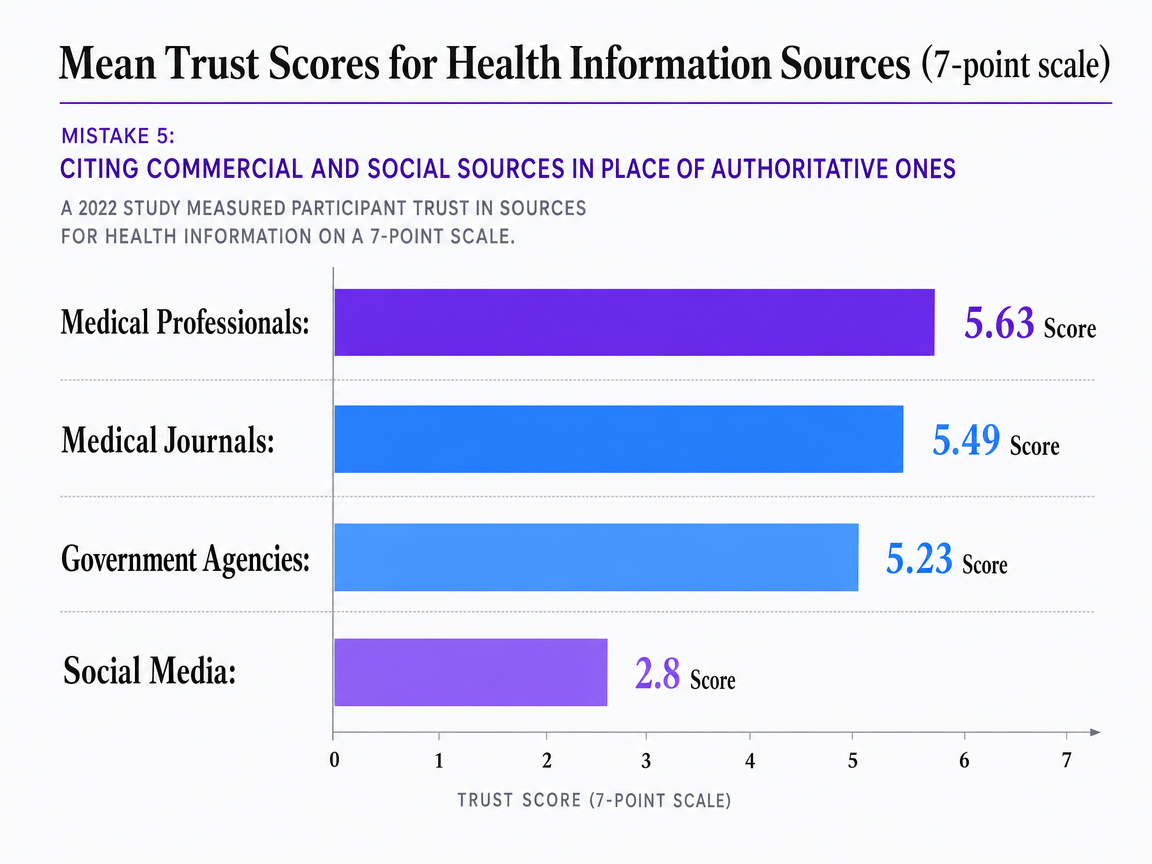 Mean Trust Scores for Health Information Sources (7-point scale)
A 2022 study measured participant trust in various sources for health information on a 7-point scale. Medical professionals were most trusted, while social media was least trusted.
Mistake 6: Optimizing for AI-Answer Surfaces Without the Same Quality Controls
Generative answer surfaces have absorbed a share of the queries that used to end at a client's site, and agencies have responded by producing content shaped to be quoted by AI systems: short definitional paragraphs, list-heavy structures, and question-answer patterns tuned for extraction. The quality bar attached to that content has often dropped, on the assumption that AI surfaces reward structure over rigor.
The evidence disagrees. A 2025 peer-reviewed evaluation of rosacea information across search engines and generative AI platforms found Google achieved the highest mean DISCERN score of 3.33 and a mean JAMA score of 3.70 among the platforms studied, with all evaluated content exceeding recommended public-health reading levels 1. The direction of travel favors sources that AI systems can attribute to credentialed authors, cite cleanly, and verify against structured evidence — the same signals that traditional search rewards in YMYL categories.
Content built for AI extraction still needs named authors, dated reviews, primary-source citations, and readability that matches the intended audience. Agencies producing separate "AI-optimized" content tracks with lower editorial standards are creating the exact liability the FTC and state regulators will examine first when a client's automated answer is quoted back at them in a complaint. One quality standard, applied to every surface, is cheaper to maintain than two.
Measurement Setups That Report Traffic Instead of Pipeline
Mistake 7: Measuring Sessions While Missing the Journey Across Search and AI
A monthly report shows organic sessions up 14% quarter over quarter. The client's intake team reports fewer qualified calls than the same period last year. Both numbers are correct. The measurement setup is what is broken: it counts what lands on the client's domain and ignores what happens on the SERP, in AI-generated answers, and on third-party surfaces where the user forms an intent before ever reaching a tracked page.
The scope of the miss is visible in how people actually search for high-stakes information. A 2025 study of 297 participants seeking health information found that 98% (291 of 297) consulted search engines, while 68.4% (203 of 297) consulted health-related websites directly 3. The gap between the two numbers is where discovery, comparison, and initial trust decisions happen — on results pages, in featured snippets, in People Also Ask boxes, and increasingly in generative answer panels — before a session ever registers in the client's analytics.
Measurement has to expand to match that behavior. SERP-feature visibility for money queries, branded search volume as a proxy for AI-answer exposure, and call tracking with source attribution belong in the same dashboard as sessions and conversions. The reporting question shifts from "how many visits did the site receive" to "how many qualified conversations did the search ecosystem produce for this client this month."
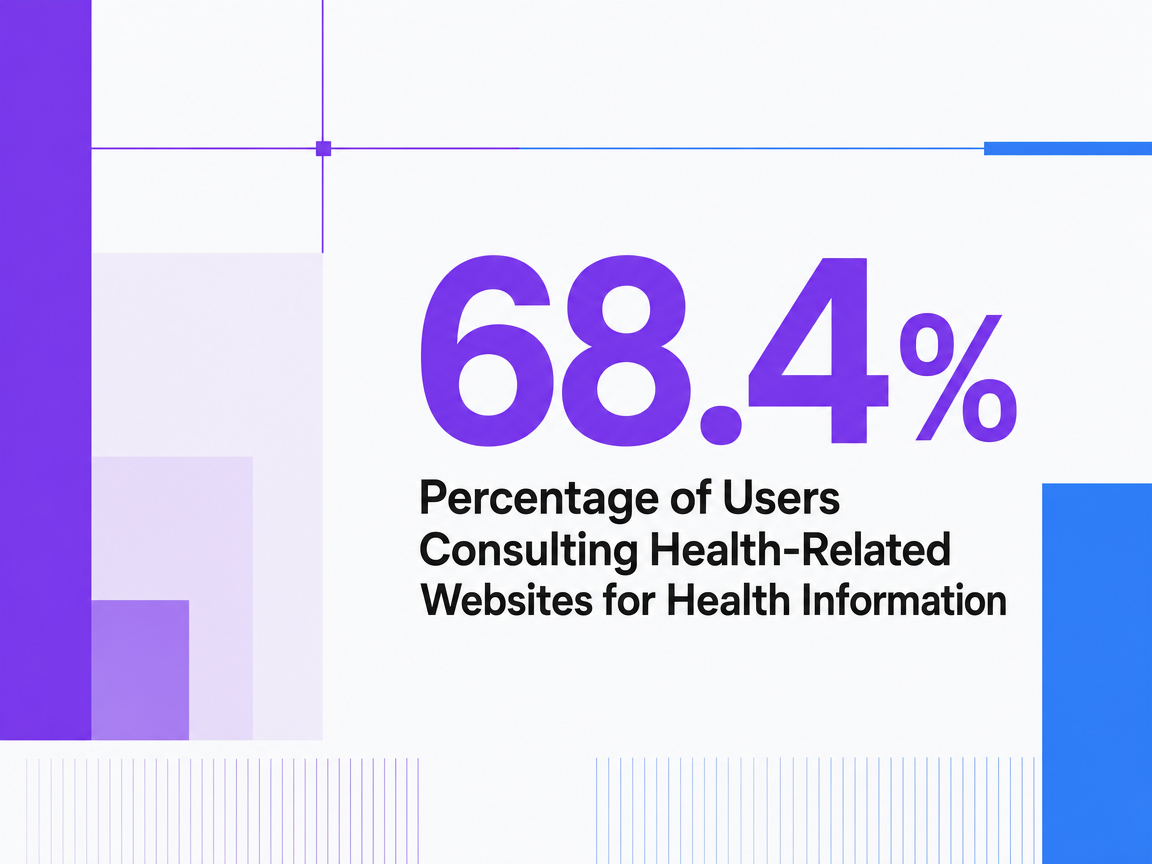 Percentage of Users Consulting Health-Related Websites for Health Information
Percentage of Users Consulting Health-Related Websites for Health Information
Portfolio Economics: Consolidating Technical QA and Measurement Work
This section shifts scope from the single client account to portfolio delivery. The head of SEO managing 40 accounts is not deciding whether to run a crawl-diff or validate a render on one site. The decision is whether the same recurring tasks — coverage reports, render checks, schema validation, conversion attribution reviews, SERP-feature tracking — happen through 40 parallel manual workflows or through one consolidated workflow that touches every account on a defined cadence.
The economics compound quickly. A task that consumes 90 minutes of a specialist's time per account per month is 60 hours across a 40-account portfolio, or roughly a third of one full-time specialist billed against work that produces no strategic recommendation. Multiply across the five or six technical and measurement tasks that recur monthly and the portfolio is absorbing one to two specialist headcount worth of hours in maintenance before any strategy work happens.
The table below uses hours per task as the only variable and holds the portfolio at 40 accounts. It is not a pricing model. It is a way to see where consolidation returns the most capacity.
| Task type | Per-account frequency | Manual specialist hours / account / month | Portfolio hours at 40 accounts |
|---|---|---|---|
| Crawl and index coverage diff | Monthly | 1.5 | 60 |
| Render validation on staging pushes | Per release | 1.0 | 40 |
| Structured data validation and register update | Monthly | 0.75 | 30 |
| SERP-feature and AI-answer visibility tracking | Bi-weekly | 1.25 | 50 |
| Conversion and call-tracking attribution review | Monthly | 1.5 | 60 |
| YMYL reviewer sign-off routing and audit log | Per publish | 1.0 | 40 |
The recurring maintenance total sits near 280 portfolio hours a month before any account receives a strategic recommendation. Consolidating those workflows — through governed automation that surfaces exceptions for human approval rather than requiring manual execution on every account — is the only path to scaling delivery without adding specialist headcount. Hiring more specialists to run the same manual cadence increases cost per account without changing the failure modes that started this diagnostic.
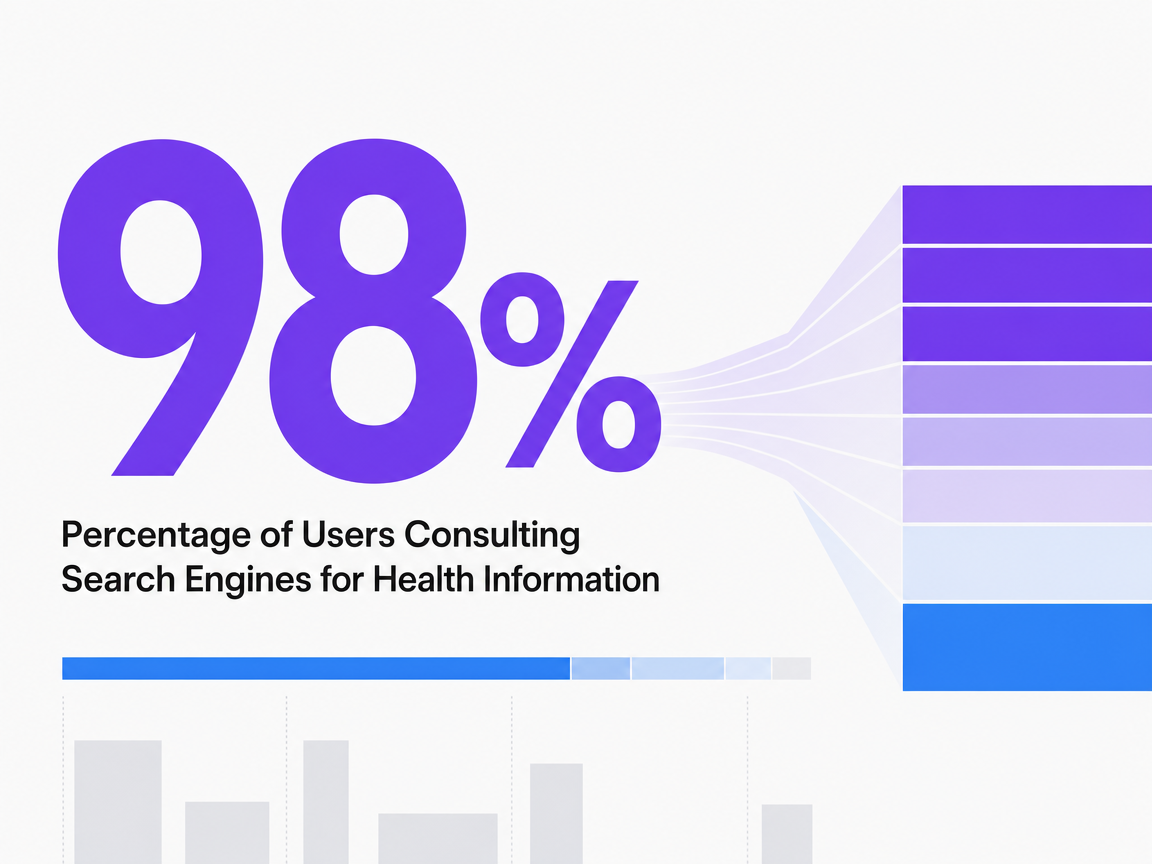 Percentage of Users Consulting Search Engines for Health Information
Percentage of Users Consulting Search Engines for Health Information
Avoid Costly SEO Pitfalls: See How Top Agencies Standardize Quality at Scale
Get a walkthrough of workflow automation and approval-first processes proven to reduce common SEO errors by up to 48% across high-volume client portfolios.
Compliance and UX Risks That Are SEO Problems, Not Legal Ones
Mistake 8: Reputation Programs That Ignore the FTC Reviews Rule
Reputation content sits inside SEO deliverables at most agencies: review acquisition campaigns, local landing pages with embedded testimonials, review schema on service pages, reputation-management blog posts, and case-study libraries. That work now runs into a federal rule with civil-penalty exposure, and the delivery team producing it is often the last to hear about the change.
The FTC's final rule on consumer reviews and testimonials took effect October 21, 2024, and prohibits buying, selling, creating, or disseminating fake or false reviews — including reviews written by nonexistent people, by people without actual experience with the product or service, or by insiders whose relationship is misrepresented 8. The Q&A guidance extends the scope to controlled review websites, undisclosed insider testimonials, review suppression through gating, and AI-generated reviews attributed to fictitious consumers, with courts authorized to impose civil penalties for knowing violations 9.
The delivery patterns this rule reaches are common:
- Review-gating funnels that route unhappy customers to private feedback while pushing satisfied ones to public platforms qualify as suppression.
- Employee reviews published without a clear disclosure of the employment relationship qualify as undisclosed insider testimonials.
- AI-generated "customer story" content dropped onto a location page qualifies as a fabricated review if no real customer stands behind it.
- Review schema pulled from an ungoverned aggregator that mixes fake and real entries carries the same exposure as publishing the reviews directly.
Reputation programs need a governance layer that lives in the same approval workflow as content. Every review acquisition path documents its solicitation script, its incentive disclosure, and its routing logic. Every testimonial published on a client site ties to a named, contactable source with written consent on file. Review schema pulls only from platforms whose content the client can substantiate. Agencies that treat this as the client's legal department's problem inherit the penalty exposure alongside the client when the FTC or a state AG opens the file.
Mistake 9: Treating ADA Web Accessibility as a Post-Launch Enhancement
Accessibility defects show up in SEO audits as small findings: missing alt attributes, form fields without labels, headings that skip levels, tap targets too close together, color-contrast failures on CTAs and body copy. Delivery teams log them in a backlog labeled "UX improvements" and prioritize them behind content and link work. The defects then compound across every new template, campaign landing page, and location rollout the client ships.
The Department of Justice guidance on web accessibility and the ADA treats these as civil-rights and access issues, not visual polish. The guidance uses sufficient color contrast as one concrete example, noting that adequate contrast helps people with limited vision or color blindness read text that uses color 10. The same guidance frames accessibility as an ongoing obligation attached to how a site actually functions for users with disabilities, not as a checklist completed once at launch.
The SEO consequences run in parallel to the compliance ones. Pages that fail on heading structure, semantic HTML, descriptive link text, and alt attributes send weaker signals to crawlers and to assistive technologies at the same time. Templates that fail contrast or tap-target requirements lose conversions from users on mobile devices in real-world lighting, which flattens the engagement metrics the same reports use to justify the SEO investment.
Move accessibility into the same release gate as render validation and schema review. Every new template gets an automated accessibility scan on staging, every content template carries a documented pattern for headings, alt text, and link language, and every quarterly QA cycle samples live pages against WCAG success criteria the client's counsel has adopted as its standard. Accessibility work priced into the recurring delivery scope costs less than remediation after a demand letter arrives.
Replacing Volume Publishing With Governed Approval Workflows
The premise that more content produces more rankings has outlived its usefulness in regulated verticals. Volume publishing without named review, authoritative sourcing, technical QA, and conversion attribution produces the exact liabilities the preceding eight mistakes describe — at scale, across every account on the roster. A meta-narrative systematic review of 153 studies covering 11,785 health websites found that none received an excellent DISCERN rating, with 37% to 79% rated good and the remainder rated poor 2. Baseline quality is the problem the industry has not solved by publishing more.
The replacement is a governed approval workflow, not a bigger content team. Every recommendation — a new article, a schema change, a review acquisition script, a template deployment — carries the strategic reasoning behind it, routes to a named human approver, and executes only after sign-off. Signals from the account (crawl regressions, ranking drops, call-tracking gaps, conversion attribution changes) feed the queue automatically. The approver decides. The system executes. The KPI impact tracks back to the decision, so the next recommendation gets sharper.
This model scales delivery without adding specialists because approval is the constraint, not production. Platforms built on that principle — Vectoron is one category example — consolidate the recurring technical, editorial, and compliance work described throughout this diagnostic into one queue with one audit trail. The nine mistakes stop being nine parallel failure points and start being nine categories of exceptions that surface, get approved or rejected, and get logged against the account they affect.
Frequently Asked Questions
References
- 1.The Reliability Gap: How Traditional Search Engines and Generative AI Platforms Compare in the Quality and Credibility of Online Rosacea Information.
- 2.Can Patients Trust Online Health Information? A Meta-Narrative Systematic Review Addressing the Quality of Health Information on the Internet.
- 3.Online Health Information–Seeking in the Era of Large Language Models.
- 4.Health Information Sourcing and Health Knowledge Quality.
- 5.Appropriate trust in online health information is associated with information source and the absence of misinformation.
- 6.Using the Google™ Search Engine for Health Information.
- 7.Quality of online information for the general public on COVID-19.
- 8.Federal Trade Commission Announces Final Rule Banning Fake Reviews and Testimonials.
- 9.The Consumer Reviews and Testimonials Rule: Questions and Answers.
- 10.Guidance on Web Accessibility and the ADA.