
Key Takeaways
- Manual ChatGPT and Perplexity spot-checks collapse past roughly fifteen clients because four engines multiplied by dozens of prompts leaves no version history a strategist can defend in a QBR.
- Retire referral-click reporting and lead with brand-mention share, since Pew found AI summaries drop traditional clicks to 8% and cited-link clicks to about 1% 4.
- Treat competitive analysis as an evaluation pipeline, borrowing ARES axes — context relevance, faithfulness, and answer relevance — and documenting benchmarks before running a single prompt 13, 1.
- Build a versioned prompt battery of 25 to 50 buyer questions split across informational, comparative, recommendation-seeking, and branded-defense categories so each cycle surfaces a distinct failure mode.
- Report five metrics weekly with rolling diffs: Brand Mention Rate, Average AI Rank Position, Citation Share, Source Overlap, and Sentiment Accuracy, each with a formula an analyst can defend.
- Normalize across ChatGPT, Perplexity, Gemini, and AI Overviews by logging every metric with an engine dimension, using fresh sessions, timestamps, and pinned model versions rather than a blended score.
- Store row-level prompt logs with immutable timestamps and versioned batteries so the diff between cycles — not the raw capture — becomes the client report and audit trail.
- Systematizing capture drops per-client analyst time from three to five hours to under 75 minutes per cycle, reclaiming roughly one full-time strategist across a forty-account roster.
Why manual ChatGPT spot-checks stopped scaling past 15 clients
The math breaks around client fifteen. An analyst opens ChatGPT, types a buyer prompt, screenshots the answer, opens Perplexity, repeats, opens Gemini, repeats, then pastes the same query into Google to see whether an AI Overview fires. Four engines, one prompt, one client. Multiply by twenty prompts and forty accounts and the practice collapses under its own weight — with no version history, no diffable output, and nothing a strategist can defend in a quarterly review.
The surface itself keeps expanding. Google reports that AI Overviews now reach more than 200 countries and territories and drove over a 10% increase in usage for supported query types in its biggest markets 8. That is not a niche feature to spot-check on the side; it is a default answer layer sitting on top of the same queries agencies have tracked for a decade. Forrester frames the same shift more broadly, arguing that search across B2C, B2B, and commerce is being rebuilt around conversational and agentic experiences 11.
Practitioners feel the pressure directly. In Influencer Marketing Hub's benchmark survey, 57.6% of respondents reported a significant increase in SEO competition tied to AI-powered practices 19. That competitive pressure does not resolve with more screenshots. It resolves with a measurement system — fixed prompts, fixed engines, fixed cadence, logged output — that turns ad hoc curiosity into a repeatable benchmark an agency can run across every account on the roster.
The rest of this piece treats that shift as an engineering problem: what to measure, how to normalize across engines, and how the portfolio economics change once the work is systematized rather than performed by hand.
Reframe the deliverable: brand-mention share, not referral clicks
The most defensible AI-search program starts with an uncomfortable admission to the client: the referral-traffic story is dead. Pew's March 2025 browsing study of US users found that visitors clicked a traditional Google result in just 8% of sessions where an AI summary appeared, versus 15% of sessions without one. Clicks on the cited links inside the AI summary itself landed at roughly 1% 4. That is not a rounding error on last year's model — it is the ceiling of what an AI summary sends downstream.
Reframing the deliverable follows directly from that number. If the AI answer is the destination for a growing share of buyer research, then the competitive question is not "who ranks above us for this keyword." It is who gets named, cited, and characterized inside the answer itself. Brand-mention share becomes the primary metric. Referral traffic becomes a secondary signal, worth logging but not worth defending in a QBR as the headline outcome.
Two moves come out of this reframe. First, agencies should retire the AI-visibility slide that leads with sessions from AI referrers and lead instead with mention rate, citation share, and the sentiment of how the brand is described when it does appear. Second, the client conversation shifts from "how much traffic did we recover" to "how often does the engine recommend us versus the three competitors we care about, and what sources is it pulling from to make that call." That second question is measurable, diffable week over week, and directly connected to purchase-stage influence rather than to a click that increasingly does not happen.
The rest of the measurement system follows this reframe. Every metric introduced later — mention rate, average AI rank, citation share, source overlap — exists because clicks alone no longer describe what an engine is doing to a brand's position in a buyer's shortlist.
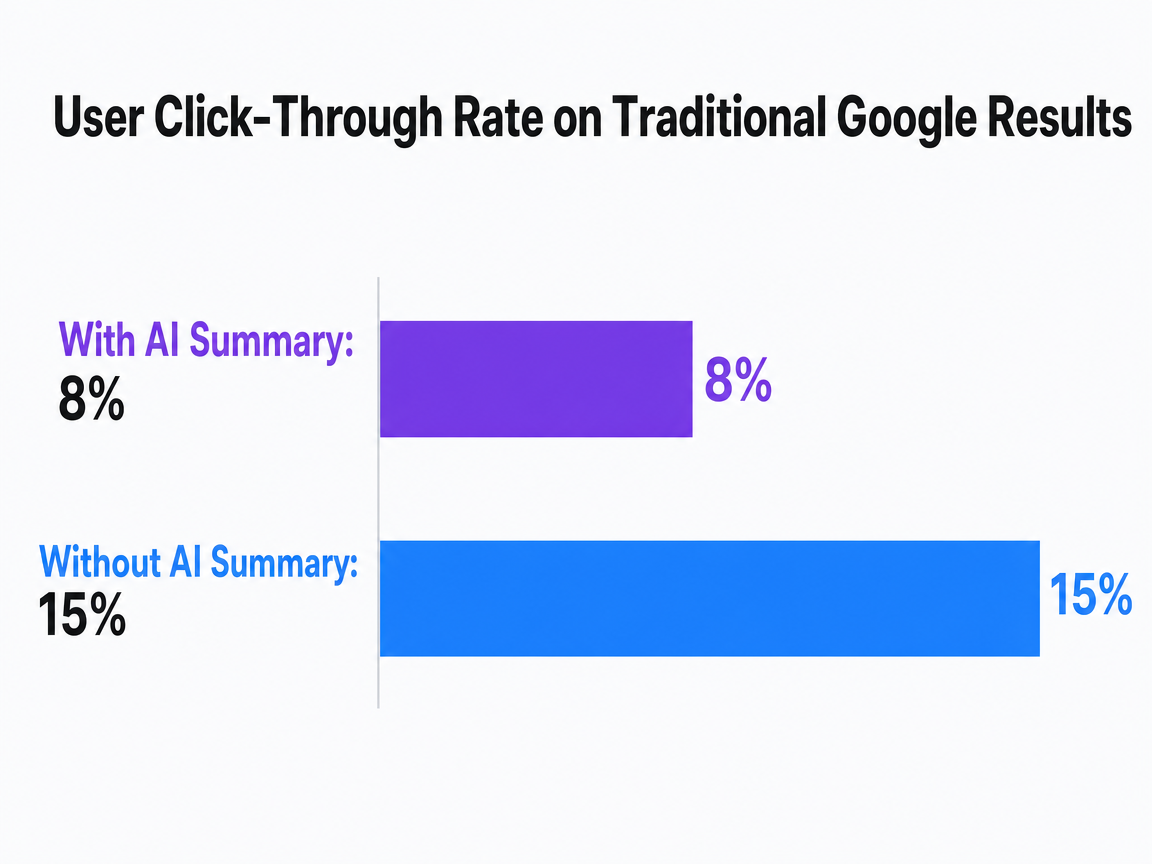 User Click-Through Rate on Traditional Google Results
Compares the percentage of user visits where a traditional search result was clicked, contrasting sessions that included an AI summary with those that did not.
Treat AI-search analysis as an evaluation engineering problem
Most agency AI-visibility programs stall for the same reason: they were built as a marketing tactic when they should have been built as an evaluation pipeline. The discipline already exists. Retrieval-augmented generation researchers have spent years figuring out how to score whether a model is pulling the right sources and answering faithfully. National standards bodies have published detailed guidance on how to design benchmarks that hold up to scrutiny. Both bodies of work map cleanly onto the question an agency now has to answer weekly: is this client getting recommended, and by what source path.
Borrow the RAG evaluation stack: context, faithfulness, relevance
ARES, the peer-reviewed automated evaluation framework from NAACL 2024, scores retrieval-augmented systems on three axes that translate directly to competitive analysis: context relevance, answer faithfulness, and answer relevance 13. An agency running an AI-search program is measuring the same three things, just from the outside of the model.
Context relevance becomes source-overlap analysis. When Perplexity answers a comparative buyer prompt, which domains did it pull from — and does the client's site appear among them, or only competitors and third-party review roundups? Answer faithfulness becomes sentiment and characterization tracking. When the client is named, is the description accurate, hedged, or actively negative compared to how competitors are framed? Answer relevance becomes recommendation share. Did the engine answer the prompt with a shortlist, and if so, where did the client land within it?
Framing the work this way changes what an analyst logs. Instead of pasting a screenshot into a doc, the pipeline records the prompt, the engine, the timestamp, the full answer text, the cited sources, and a scored judgment on each of the three axes. ARES demonstrated that this kind of evaluation is workable with only a few hundred human annotations per system 13— a threshold that maps neatly to the volume of prompts a typical client program will run in a quarter.
Define objectives and benchmarks before running a single prompt
NIST's draft on automated benchmark evaluations makes the point every agency skips: benchmarks should be structured and verifiable, and evaluators should document exactly what each benchmark measures before running it 1. Applied to competitive analysis, that means writing down — per client — what the program is trying to detect and what would count as a change worth reporting.
For most agency programs, the objectives collapse to four concrete questions:
- Does the client appear in the shortlist when a buyer prompt asks for a recommendation in the category?
- When the client appears, is the characterization competitive with the two or three named alternatives?
- Which third-party sources are the engines drawing on to build that shortlist?
- How do those answers shift week over week as competitors publish, get covered, or update their positioning?
Each question maps to a metric introduced in the next section, and each metric has a defined pass condition documented in the client's benchmark spec before the first prompt runs. That upfront documentation is what separates a defensible program from a set of screenshots. It is also what makes the output diffable — because the definition of "improved" was fixed at the start of the quarter, not negotiated at the QBR.
Experience AI-Powered Competitive Analysis at Scale
Test advanced competitive tracking workflows and publish actionable insights with full platform access—no limitations, no delays.
Build the prompt battery: informational, comparative, recommendation, branded-defense
A prompt battery is the fixed set of buyer questions an agency runs against every engine, every cycle, for a given client. It is the equivalent of a keyword tracking list — except the units are natural-language prompts, and the payload is an answer, not a ranking. Four categories cover most of what a competitive program needs to detect, and each category exists to surface a different failure mode.
Informational prompts : Establish topical presence. These are the category-defining questions a buyer types before they know which vendors exist: "what is HIPAA-compliant call tracking," "how does behavioral health intake software handle referrals." The client may or may not appear here, and that is the point — informational prompts measure whether the engine treats the client as part of the category conversation at all, or only as a footnote when named directly.
Comparative prompts : Pit named alternatives against each other: "X versus Y for multi-location dental practices," "pros and cons of Z compared to its main competitors." These prompts expose sentiment framing and source overlap most directly. When the engine assembles a comparison, which third-party review sites, analyst summaries, and forum threads is it pulling from? That source list is the shortlist agencies target when they extend coverage.
Recommendation-seeking prompts : The highest-stakes category: "recommend the best three tools for [job the client does]," "which vendors should a mid-size firm evaluate for [use case]." This is where Brand Mention Rate lives — how often the engine names the client versus competitors when a buyer explicitly asks for a shortlist 18. A client absent from this category is invisible at the moment of purchase intent, regardless of how well it ranks in classic SERPs.
Branded-defense prompts : Probe how the engine describes the client when named: "is [client] any good," "problems with [client]," "[client] vs [competitor]." These prompts catch outdated characterizations, negative review aggregation, and competitor comparison content the client has no control over. They are the AI-search analog to reputation monitoring, and they are the prompts most likely to produce an urgent flag mid-cycle.
Sizing the battery is a client-by-client decision, but 25 to 50 prompts split roughly 30/30/25/15 across the four categories covers most B2B and service-vertical accounts without pushing analyst-review time past what portfolio economics can absorb. The battery gets versioned like code — dated, checked in, and diffed when new competitors emerge or category language shifts — so week-over-week comparisons stay valid. Industry-Lens frames the workflow identically: define buyer prompts, run them across multiple engines on a schedule, log cited domains and brands, and diff week-over-week 14. The battery is what makes that loop repeatable across every account on the roster.
The metric taxonomy that survives a QBR
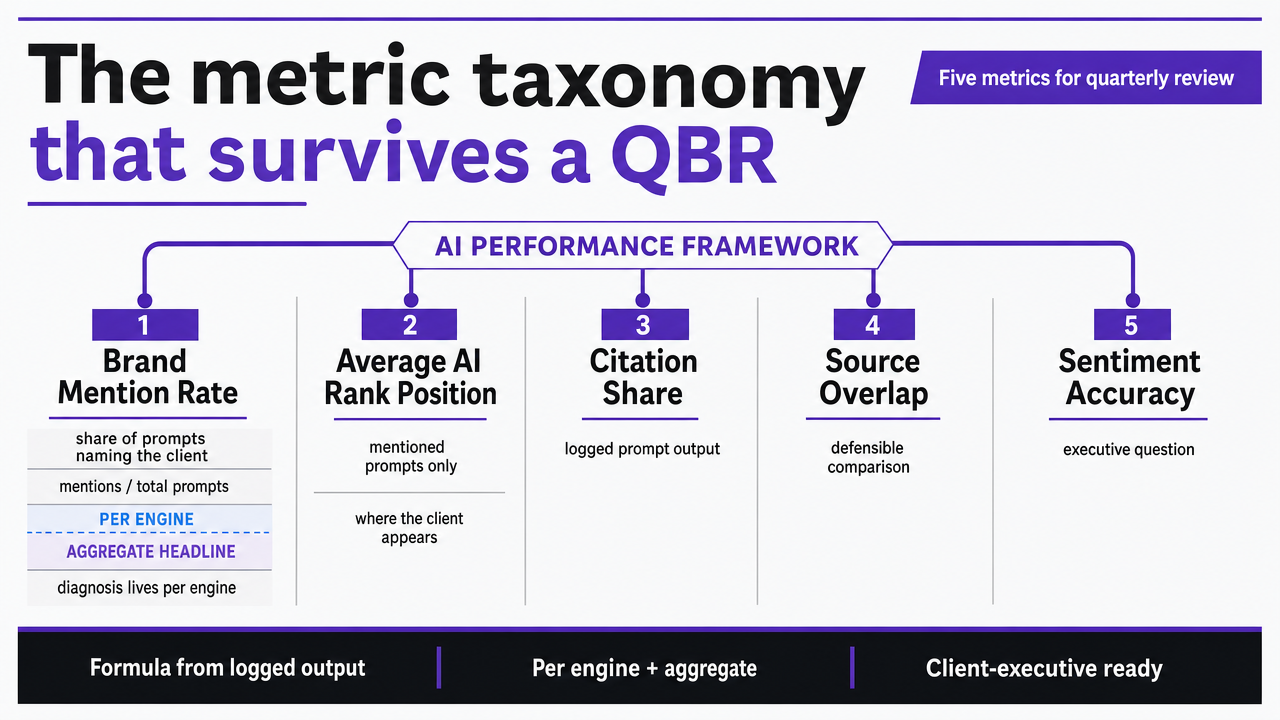
Five metrics carry the weight of an AI-search program in a quarterly review. Each one has a formula an analyst can compute from the logged prompt output, and each one answers a question a client executive will actually ask.
Brand Mention Rate : The share of prompts in the battery where the engine names the client at all. Formula: mentions divided by total prompts run per engine per cycle. Idea2Grow defines this as how often an AI model recommends a competitor versus the client for a specific prompt, and pairs it with Average AI Rank Position and Citation Context as the core benchmarking trio 18. Track it per engine and in aggregate — the aggregate number is the headline, the per-engine number is where the diagnosis lives.
Average AI Rank Position : Applies only to the subset of prompts where the client is mentioned. When the engine returns a shortlist or ranked recommendation, where does the client land? A client that appears in 60% of recommendation prompts but always in position five is a different problem than one that appears 30% of the time but always in position one. Both numbers belong on the report.
Citation Share : Counts how often the client's own domain appears in the engine's cited sources, versus competitor domains and neutral third parties. This is the closest analog to classic backlink authority in the AI-search context — and often the earliest indicator that content investment is compounding, since citation share tends to shift before mention rate does.
Source Overlap : Measures which third-party domains the engines lean on across the category. Compute it as the set of domains cited in 20% or more of the prompts in a client's battery. That set becomes the target list for PR, guest coverage, and review-site work — the "steal the coverage" move where the goal is to place the client into the same sources the engines already trust.
Sentiment Accuracy : Scores whether the engine's characterization of the client, when named, matches how the client actually positions itself. Rate each mention on a three-point scale — accurate, hedged, or misaligned — and report the distribution. This is the metric that catches outdated product descriptions, stale competitive comparisons, and inherited reputation issues from old review content.
Report all five weekly or bi-weekly with a rolling four-cycle diff. The formulas are boring on purpose. Boring metrics are the ones that hold up when a CMO asks how the number was computed.
Normalize across ChatGPT, Perplexity, Gemini, and AI Overviews
The same prompt returns different competitor sets on each engine, and that is not a bug to solve — it is a signal to log.
- ChatGPT tends to synthesize a shortlist from training data plus whatever browsing context the account allows.
- Perplexity leans hard on live citations, so its answers move faster when new coverage lands.
- Gemini pulls from Google's index and reasons over it, with AI Mode adding follow-up turns and multimodal inputs 9.
- Google AI Overviews sit inside classic search and fire on a subset of queries — Google itself notes the feature covers only supported query types even in its biggest markets 8.
Four engines, four retrieval behaviors, four different answers to the same question.
Normalization starts by refusing to average across engines in the headline number. A single "AI visibility score" that blends all four hides where the client is actually winning or losing. Instead, log every metric — mention rate, rank position, citation share, source overlap, sentiment — with an engine dimension attached, and report the per-engine breakdown alongside the roll-up. The roll-up answers "are we trending up." The breakdown answers "where do we intervene."
Three normalization rules keep the cross-engine comparison honest:
- Run each prompt in a fresh session with no personalization or memory carrying over — otherwise ChatGPT's answer reflects the analyst's history, not a buyer's cold query.
- Timestamp every capture and pin the model version when the engine exposes it, because a Gemini answer from last Tuesday and one from this Tuesday may be different models.
- Treat Google AI Overviews as a conditional signal: log whether the Overview fired at all for the prompt, then log the content when it did. A prompt that stops triggering an Overview is a competitive event worth reporting, not a null row to drop.
The engines also weight sources differently, and that is where source-overlap analysis earns its keep. Perplexity's citations are visible on the page. ChatGPT's browsing citations, when present, are inline. Gemini surfaces web links in AI Mode. Google's Search Console now reports page appearances in AI responses and the countries they appeared in, giving agencies a first-party signal to reconcile against the third-party captures 7. Cross-referencing the two reveals when an engine cites a client's page without the client's classic ranking moving — a pattern that shows up more often than most agencies expect once the logging is in place.
See How Leading Agencies Automate Competitive Analysis for AI Search at Scale
Request a walkthrough of advanced workflows that extract, track, and operationalize competitor intelligence across AI search platforms—without expanding your analyst team or losing strategic control.
Logging, versioning, and the diff that becomes the client report
The measurement system is only as defensible as its record. Every prompt run needs to land in a structured store — not a doc, not a screenshot folder — with fields an analyst can query later:
- prompt ID
- prompt text
- category
- engine
- model version when exposed
- timestamp
- full answer text
- cited URLs
- extracted brand mentions
- a scored value for each metric in the taxonomy
That row-level log is the primary artifact. The client report is a view on top of it.
Versioning applies to two things: the battery and the answers. The battery gets a version number that increments whenever a prompt is added, retired, or reworded, so that any week-over-week comparison references the same battery version on both sides of the diff. The answers get immutable timestamps, because an engine's response to the same prompt last Tuesday and this Tuesday are separate observations — not an update to a single record. NIST's automated benchmarking guidance makes the same argument for evaluation validity: benchmarks should be structured and verifiable, with documentation of exactly what each one measures before it runs 1. The version stamp is what makes that documentation binding after the fact.
The diff is where the report writes itself. Compare cycle N to cycle N-1 across every metric, flag any prompt where mention rate, rank position, or sentiment shifted more than a defined threshold, and surface the top three source-overlap changes — new domains the engines started citing, and old ones they stopped. That flagged list becomes the analyst's review queue, not the raw log. What ships to the client is the diff plus a short narrative explaining the two or three changes that actually moved the account, with links back to the underlying prompts and captures for anyone who wants to audit the work.
If you manage 15+ client accounts: the portfolio economics of systematized analysis
The audience shifts here. Everything above applies to a single client program; the numbers below are for the head of SEO running fifteen to eighty of them at once, where the question is not whether the methodology works but whether the labor model does.
Start with the manual baseline. A prompt battery of 25 to 50 buyer questions, run across four engines with fresh sessions and captured output, absorbs three to five analyst hours per client per cycle before any interpretation happens. That is capture time alone — not scoring, not diffing, not writing the client-facing narrative. At a bi-weekly cadence across forty accounts, the capture layer alone consumes 120 to 200 analyst hours every two weeks. A single senior analyst does not have that capacity, which is why most agencies quietly drop to monthly or skip engines, and why the resulting reports read as anecdote rather than benchmark.
Systematized analysis inverts the ratio. When prompt execution, logging, and metric computation run as a scheduled pipeline, per-client analyst time collapses to the review-and-narrative layer — flagged diffs, sentiment spot-checks on misaligned mentions, and the two-paragraph explanation of what moved. Realistic budget: 45 to 75 minutes per client per cycle. Across forty accounts, the same bi-weekly rhythm now runs in 30 to 50 hours instead of 120 to 200.
| Portfolio operating model | Analyst hours per client per cycle | Cycle cost at 40 clients, bi-weekly |
|---|---|---|
| Manual capture across 4 engines | 3.0 – 5.0 hrs | 120 – 200 hrs |
| Scheduled pipeline, analyst reviews diffs only | 0.75 – 1.25 hrs | 30 – 50 hrs |
| Reclaimed analyst capacity per cycle | — | ~90 – 150 hrs |
Reclaimed capacity is the argument to the COO. Ninety to one hundred fifty analyst hours every two weeks is roughly one full-time strategist redirected from screenshotting to interpretation — the work clients are actually paying for. The tooling question stops being "can we afford this" and becomes "what does an extra strategist's capacity cost us if we do not." McKinsey's broader read on marketing operations reaches the same conclusion from a different direction: generative AI's near-term return in marketing comes from automating the analysis and experimentation layer so human judgment concentrates on strategy 20.
Two portfolio guardrails matter:
- The prompt battery should be templated at the vertical level, not custom per client — a legal services template, a behavioral health template, a home services template — with per-client overrides for named competitors and product terms. That is what makes the marginal cost of adding client forty-one close to zero.
- The scoring rubric for sentiment and mention accuracy needs a written definition that any analyst on the team applies identically, or the diff loses meaning across the roster.
NIST's benchmarking guidance is blunt on this point: benchmarks must be structured and verifiable, with documented definitions of what each one measures, or the results do not compose 1. At portfolio scale, that documentation is not a compliance exercise. It is what lets a report from client twelve mean the same thing as a report from client thirty-eight.
Where automation stops and human validation starts
The pipeline captures, scores, and diffs. It does not decide what any of that means. Three review points still belong to a human, and skipping them is how a systematized program starts producing confident garbage.
Sentiment scoring is the first. A rubric can rate a mention as accurate, hedged, or misaligned, but the call on whether "strong regional presence" reads as praise or as a ceiling in a category dominated by national brands is judgment work. Analysts should spot-check a sample of scored mentions each cycle and reconcile the rubric when the model consistently misreads tone.
The second is source-overlap interpretation. The pipeline surfaces which domains the engines cite most often; a strategist decides which of those are worth chasing. A forum thread cited three times this quarter is not the same target as an analyst report cited twice, and no automated score captures that. Search Engine Land makes the same point about AI-assisted competitor work generally: the tooling compresses the manual synthesis, but interpreting intent and validating whether an opportunity fits the business still sits with the human 15.
The third is the client narrative. The diff produces flagged rows. Which two or three of those actually explain the account's quarter — and which are noise from a model version change — is the strategist's call, and it is the part of the deliverable clients are paying for.
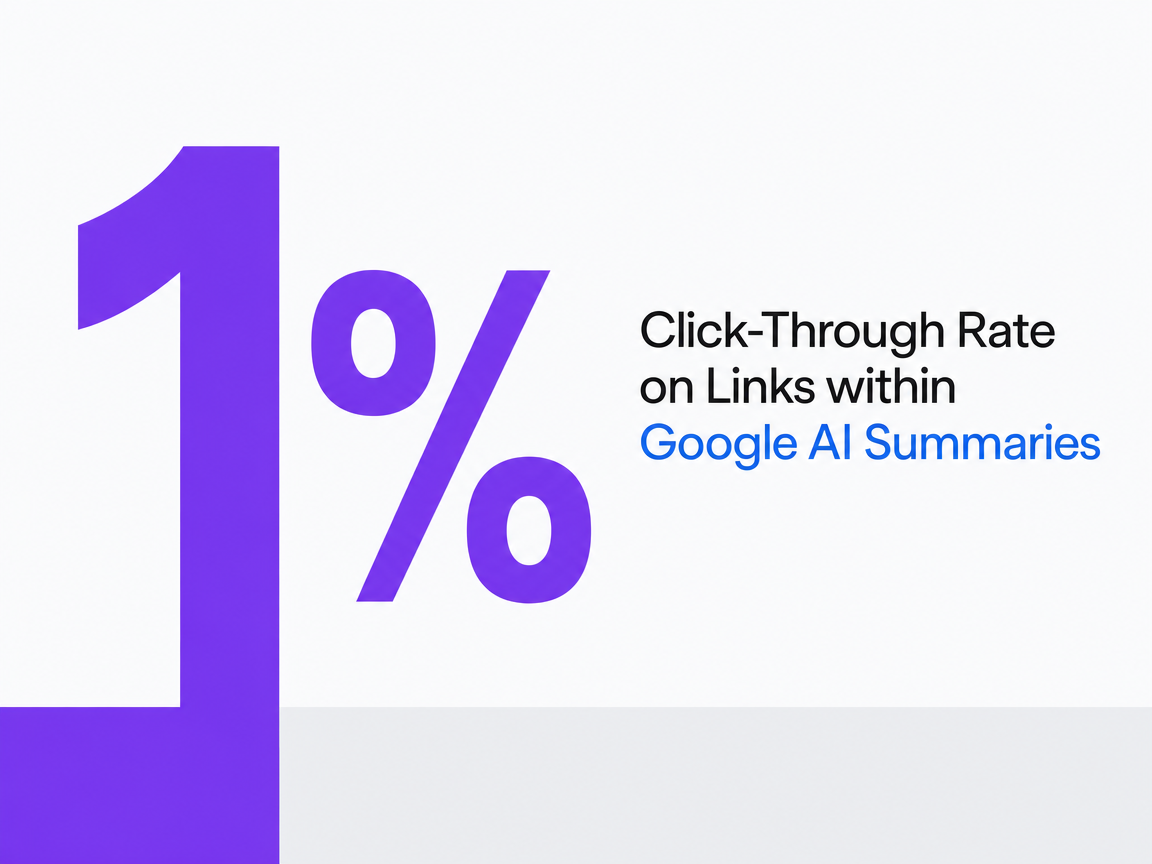 Click-Through Rate on Links within Google AI Summaries
Click-Through Rate on Links within Google AI Summaries
Frequently Asked Questions
References
- 1.Practices for Automated Benchmark Evaluations of Language Models.
- 2.NIST AI Measurement and Evaluation Projects.
- 3.2024 NIST Generative AI (GenAI): Evaluation Plan for Text-to-Text Discriminators.
- 4.Do people click on links in Google AI summaries?.
- 5.Pew Research Center AI browsing report.
- 6.Americans have mixed feelings about AI summaries in search results.
- 7.New opportunities, control and insights for website owners.
- 8.AI Overviews expand to over 200 countries and territories.
- 9.Expanding AI Overviews and introducing AI Mode.
- 10.Generative AI in Search: Let Google do the searching for you.
- 11.GenAI Forever Changes All Forms Of Search.
- 12.The economic potential of generative AI: The next productivity frontier.
- 13.ARES: An Automated Evaluation Framework for Retrieval-Augmented Generation Systems.
- 14.AI Search Competitive Analysis Tools.
- 15.How to run an AI-assisted SEO competitor analysis that actually works.
- 16.Study: AI Traffic Grew 796% & Out-Converts Organic Search.
- 17.How Gen AI Is Revolutionising Search (And Your SEO Strategy).
- 18.Top AI Search Visibility Tools for Competitor Benchmarking.
- 19.AI SEO Benchmark Report: Key Stats & Insights.
- 20.Marketing and sales soar with generative AI.
- 21.Generative AI Will Transform Search And Discovery.