
Key Takeaways
- Portfolio-scale competitor work fails without reproducible scaffolding: fixed query sets, consistent evaluation definitions, and change logs that make month-over-month comparison possible 1.
- Six evaluation layers organize the method—visibility, technical accessibility, content differentiation, authority, user experience, and business outcomes—each with its own evidence standard and review gate.
- Compliance belongs inside the audit, not after it: FTC review rules, endorsement guidance, comparative-claim standards, and copyright boundaries decide which competitor patterns are safe to replicate 6, 11.
- Focus next on prioritization and governance—ranked work queues weighted by lead impact, with human review gating AI-assisted detection before any recommendation reaches a client 9, 5.
Why Portfolio-Scale Competitor Work Breaks Without a System
Most agency competitor analysis works at one client. It stops working at twenty. A strategist runs a thorough SERP sweep for a flagship law firm, builds a thoughtful gap deck, and ships recommendations the client acts on. Three weeks later, the same strategist is asked to produce something equivalent for a DSO, a behavioral health group, and two home-services brands, and the output quietly degrades into keyword exports with highlighter marks.
The failure is not analyst skill. It is the absence of a reproducible method. NIST's web-search evaluation work makes the point for a different domain but the principle transfers: meaningful comparison across systems and time requires fixed snapshots, consistent query sets, defined evaluation criteria, and change logs that let one period be read against another 1. Without that scaffolding, each client audit becomes a bespoke artifact that cannot be stacked, re-run, or defended six months later when a ranking shifts and the client wants to know what changed.
Heads of SEO running 15 to 60 accounts need an operating system, not another audit template. The sections that follow describe one: six evaluation layers, a consolidated compliance checkpoint, a governance model for AI-assisted review, and the operator economics that decide whether the method actually scales.
Benchmarking, Not Spying: Reframing the Discipline
The word "competitor analysis" invites bad habits. It suggests surveillance: pull their keywords, screenshot their pages, note their H2s, repeat. That mental model produces decks, not systems. It also produces outputs that cannot be compared across clients or across quarters, because the inputs change every time an analyst opens a browser.
A benchmarking posture is different. The question stops being "what are they doing?" and becomes "what do we measure, against what reference, on what cadence, with what review gate?" NIST's web-search evaluation work frames the discipline cleanly: meaningful comparison requires a defined corpus, consistent query sets, stable evaluation definitions, and change logs that let one period be read against another 1. The source predates modern SERPs by decades, but the methodological point travels. Agencies that cannot answer "what changed since last month, and by how much?" are running audits, not benchmarks.
Six layers organize the rest of this piece: visibility, technical accessibility, content differentiation, authority, user experience, and business outcomes. Each layer has its own inputs, its own evidence standard, and its own review gate before findings become client-facing recommendations. Treated together, they turn competitor websites into a reference frame rather than a wish list. Treated separately or skipped, they produce the same decks that stopped scaling at client eight.
The Six Evaluation Layers
Visibility: Rank-Position Benchmarking Against SERP Reality
Visibility work starts with a fixed query set per client, not a tool's auto-suggested keyword universe. The set should be curated once, versioned, and re-run on cadence so position changes mean something. A query that moves from position 11 to position 7 matters more than a query that moves from 42 to 38, and the method should encode that difference before an analyst opens a report.
The rhetorical case for position obsession rests on observed behavior. A browser-log study of Google and Bing users found 97.11% of Google clicks and 99.49% of Bing clicks landed on first-page results, with the top five Google positions accounting for more than 86% of clicks 7. The sample is specific—desktop browser logs across a defined user panel, measured before the current wave of AI overviews reshaped many SERPs—so the numbers are directional benchmarks, not universal CTR curves. The strategic implication survives the caveat: first-page coverage and top-five coverage are the thresholds worth tracking, and anything below the fold is a visibility signal, not a visibility outcome.
For a portfolio operator, the deliverable is a share-of-voice matrix per client that holds the query set constant across months. Each row is a tracked query, each column is a competitor domain, and the cell records position plus SERP feature presence (map pack, People Also Ask, AI overview inclusion). Change logs sit next to the matrix. When a client asks what moved last month, the answer is a diff, not a narrative.
Technical Accessibility: Crawl, Render, and ADA Exposure
Technical audits of competitor sites usually stop at crawl stats and Core Web Vitals. That leaves a layer of exposure unexamined. Accessibility is both a ranking-adjacent signal through usability and a legal surface area, particularly for law firms, dental groups, behavioral health networks, and senior-living operators whose audiences include users with disabilities and whose public-facing status invites scrutiny.
The Department of Justice's web accessibility guidance identifies WCAG and Section 508 as the useful technical references and calls out alt text, heading structure, captions, color contrast, form labels, and keyboard navigation as common gaps on business websites 12. A competitor audit should score these elements on a sample of high-intent pages—service pages, intake forms, provider bios, location pages—rather than on a homepage alone. The homepage is almost always the most polished page on a site; the pages that convert are usually the ones with inherited templates and uncaptioned video.
Pair the accessibility pass with the standard technical checks: render-blocking resources, hydration patterns on JavaScript frameworks, structured-data validity, canonical consistency, and internal-link reachability. The output is a two-column scorecard per competitor: technical hygiene on one side, accessibility exposure on the other. Clients in regulated verticals treat the second column as a competitive signal rather than a nice-to-have, because a competitor's unresolved WCAG failures are also a competitive opening to publish accessible equivalents of pages they rank for today.
Content Differentiation: Extracting Patterns Without Copying Expression
Content audits fail in two directions. They either produce a bullet list of competitor H2s that becomes a brief to mimic those H2s, or they produce qualitative notes that no one can operationalize. A benchmarking posture extracts patterns—query coverage, format choices, depth, update cadence, proof elements—without reaching for the prose itself.
The legal line is explicit. The U.S. Copyright Office states that website content may be registrable when it contains sufficient original authorship, while copyright protects expression rather than ideas, systems, or methods 11. A competitor's decision to answer six specific sub-questions on a page is a fact about their content strategy. The way they phrased the answers is protected expression. Scalable agencies encode that distinction in their brief templates so a strategist handing work to a writer passes along the structural pattern and the evidence requirements, not the source paragraphs.
What to extract: query-to-URL mapping, average word count by intent class, presence of original data or imagery, schema types deployed, internal-link patterns to money pages, and the frequency of updates. What to avoid: lifting phrasing, replicating distinctive imagery, or absorbing testimonial language. The extraction output per competitor is a one-page content profile that a brief writer can read in under two minutes and translate into an original asset. Treat the profile as a reference, not a template.
Authority: Reading Link and Entity Signals as a Portfolio
Authority analysis at scale is less about pulling backlink exports and more about identifying patterns a strategist can act on. For each competitor, the useful outputs are the referring-domain cohorts (publications, associations, directories, local partners), the anchor-text distribution against brand versus commercial terms, and the entity associations surfacing in knowledge-panel sources and Wikipedia-adjacent references.
Portfolio operators get leverage by clustering competitors across clients in the same vertical. A dental group's five-city competitor set often links to the same regional parenting publications, state dental associations, and local news verticals that other DSO clients could pursue. Mapping those cohorts once and reusing the map across accounts turns a per-client discovery task into a cross-client inventory.
The review gate matters here. Link opportunities surfaced from a competitor's profile should be filtered against the client's own disavow history, prior outreach records, and brand-safety thresholds before they enter an outreach queue. Skipping that filter produces duplicate pitches to publishers who already declined, or worse, pitches to properties the client has formally distanced from. The authority layer is where sloppy automation shows up fastest in client inboxes.
User Experience: Auditing the Conversion Path, Not the Pageview
Service-business SEO lives or dies on what happens after the click. A visibility win that routes traffic into a landing page where the primary call-to-action is buried under three accordion sections is a visibility loss translated into a conversion loss. UX auditing of competitor sites should therefore follow task completion, not aesthetics.
NIST's WebMetrics work and its user-centered usability research both argue for measurement-driven evaluation of task completion, information findability, and navigation that reflects user information-seeking rather than internal organizational structure 2, 3. Translated to a competitor audit, the method is: pick the two or three jobs a prospect is trying to complete (book a consultation, request a quote, verify insurance acceptance, schedule a tour), then walk each competitor site through those jobs on mobile and desktop, scoring friction at each step.
Deliverables stay compact. For each competitor, record the number of clicks to primary conversion, the presence and clarity of trust signals on the conversion page, the form length, phone-click placement, and chat availability. Across a competitor set, the pattern that emerges—short forms with pre-qualifying questions, click-to-call above the fold, insurance badges on first scroll—becomes the UX brief for the client's own conversion pages.
Business Outcomes: Tying Competitor Signals to Lead Quality
The last layer is the one agencies tend to skip because it is the hardest to systematize. Visibility, technical, content, authority, and UX findings only matter if they move the metrics the client actually pays for: qualified calls, booked consultations, cost per lead, pipeline. Competitor analysis that cannot connect to those outcomes becomes vanity reporting.
The U.S. Digital Analytics Program framework points at the right primitives: top referring search terms, low-CTR queries, no-result site searches, engagement by page, and customer-satisfaction signals 9. The framework was built for public-sector sites, so commercial adaptation means layering in lead quality, call-tracking classifications, and revenue-stage attribution. The adaptation is not optional. A competitor outranking a client on a high-volume term that converts at 0.3% is a lower priority than a competitor outranking them on a low-volume term that converts at 8%.
Scorecard output per client: a prioritized list of competitor gaps weighted by estimated lead impact, not by estimated traffic impact. That weighting is what turns the six-layer audit from a report into a work queue.
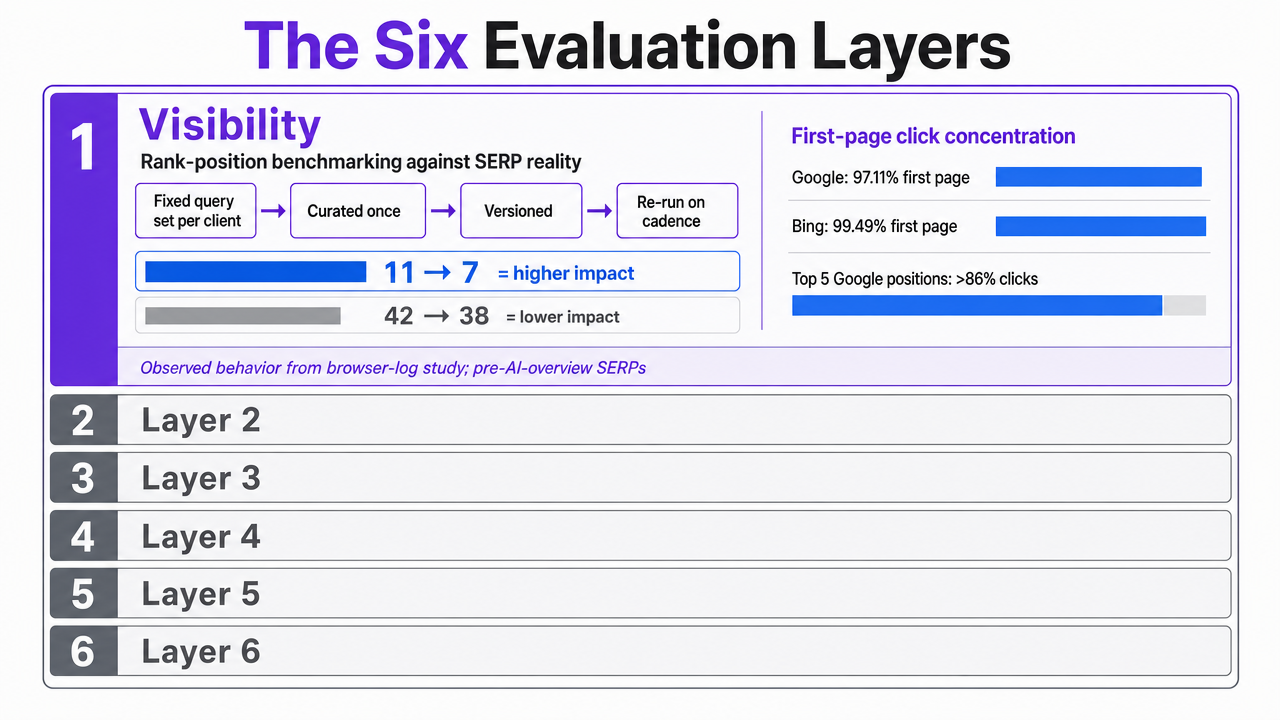 Visualize the six evaluation layers framework introduced in this section, giving readers a scannable reference for the structure that organizes the rest of the article
Test live competitor insights in your workflow
Validate your SEO strategy using real competitor data and publish outcomes before committing long term.
The Compliance Layer Most Competitor Analyses Skip
Competitor audits that scrape testimonials, mirror comparison tables, or quote a rival's About page without a second thought are shipping client liability alongside their recommendations. The compliance surface area is wider than most strategists assume, and it tightened in late 2024.
The FTC's Consumer Reviews and Testimonials Rule took effect October 21, 2024, and the agency has stated that advertising agencies, PR firms, review brokers, and reputation-management companies can be liable for creating or selling fake or false reviews 6. Updated endorsement guidance covers incentivized testimonials, employee endorsements, fake negative reviews, virtual influencers, and AI avatars, with clear-and-conspicuous disclosure of material connections treated as non-negotiable 14, 15. When a competitor's review strategy looks enviable, the audit question is not "how do we match it?" but "is this compliant, and can our client substantiate the same pattern?" A persuasive testimonial wall built on undisclosed incentives is a model to document, not to replicate.
Three other boundaries belong in the same checkpoint. Comparative advertising claims—including the kind that live on competitor-comparison landing pages—must meet the same truthfulness and substantiation standards as any other advertising, and a rival's public claim is not evidence a client can borrow 10. Native advertising, advertorials, and sponsored content on competitor sites must be audited for disclosure clarity before any pattern is adopted; the FTC treats promotional content as deceptive when it implies independence 13. And the Copyright Office's position is that website content may be registrable when it contains sufficient original authorship, with protection extending to expression rather than ideas, systems, or methods 11. Extract the pattern; write the prose.
Build this into the review gate once. One compliance checklist, applied uniformly across the portfolio, costs less than one FTC inquiry.
AI-Search and Source-Safety Review in High-Stakes Verticals
Competitor analysis in healthcare, behavioral health, dental, and senior-living accounts now has to account for a surface that did not exist three years ago: the AI-generated answer. When a competitor is cited inside an AI overview or chat response, the reference carries different weight than a blue link. It is read as endorsement. And the source quality of what the AI system pulls alongside that citation becomes part of the client's reputational environment, whether the client controls it or not.
A peer-reviewed study comparing generative search experiences on medical queries found links to illegal online pharmacies in 24% of Bing Chat responses versus 6% of Google SGE responses in the examined sample 8. The scope is narrow—selected medical queries, specific systems, a defined evaluation period—and the numbers should not be read as a current overall safety ranking of either engine. The strategic implication is what travels: for high-stakes verticals, AI-search competitor analysis must include a source-safety pass on the co-cited results, not just a visibility check on whether the client appears.
Operational translation: when auditing a competitor's AI-overview presence, record which other sources appear in the same response, flag any that would create brand-adjacency risk for the client, and feed that list into the content and digital-PR queue. Visibility in a dangerous neighborhood is not a win.
If You Manage a Portfolio: The Operator Economics of Systematization
For agencies running portfolios of 20 or more clients, the math on competitor analysis changes. The bespoke audit model that justified itself at five accounts quietly erodes margin at twenty-five, because the analyst hours do not scale linearly—they scale with the number of unique input templates each strategist is maintaining in their head. Systematization is the lever that compresses those hours without compressing the depth of the work.
The variables that decide the economics are small in number and worth naming explicitly rather than hiding inside a cost model.
| Variable | Bespoke per-client audits | Systematized benchmarking |
|---|---|---|
| Analyst hours per client per month | Full build each cycle | Delta review against prior snapshot |
| Query set and evaluation definitions | Rebuilt per audit | Versioned once, re-run on cadence |
| Cross-client reuse of vertical research | Minimal; findings stay in one deck | Vertical cohorts (DSO, law, senior living) stacked across accounts |
| Review-layer hours per client | Scales with audit length | Scales with number of flagged changes |
| Marginal cost of adding a client in an existing vertical | Near full build | Query set clone plus client-specific overlay |
The reclaimed hours have one obvious use—more clients per strategist—and one less obvious use that matters more. Hours freed from rebuilding the same visibility matrix every month are hours available for the review gate, which is where quality lives. NIST's reproducibility framing points at the same operational logic: consistent inputs and change logs are what let a small team compare across clients and across periods without the output degrading 1. The portfolio operator who standardizes the measurement layer buys both throughput and the attention budget to catch the findings that actually move pipeline.
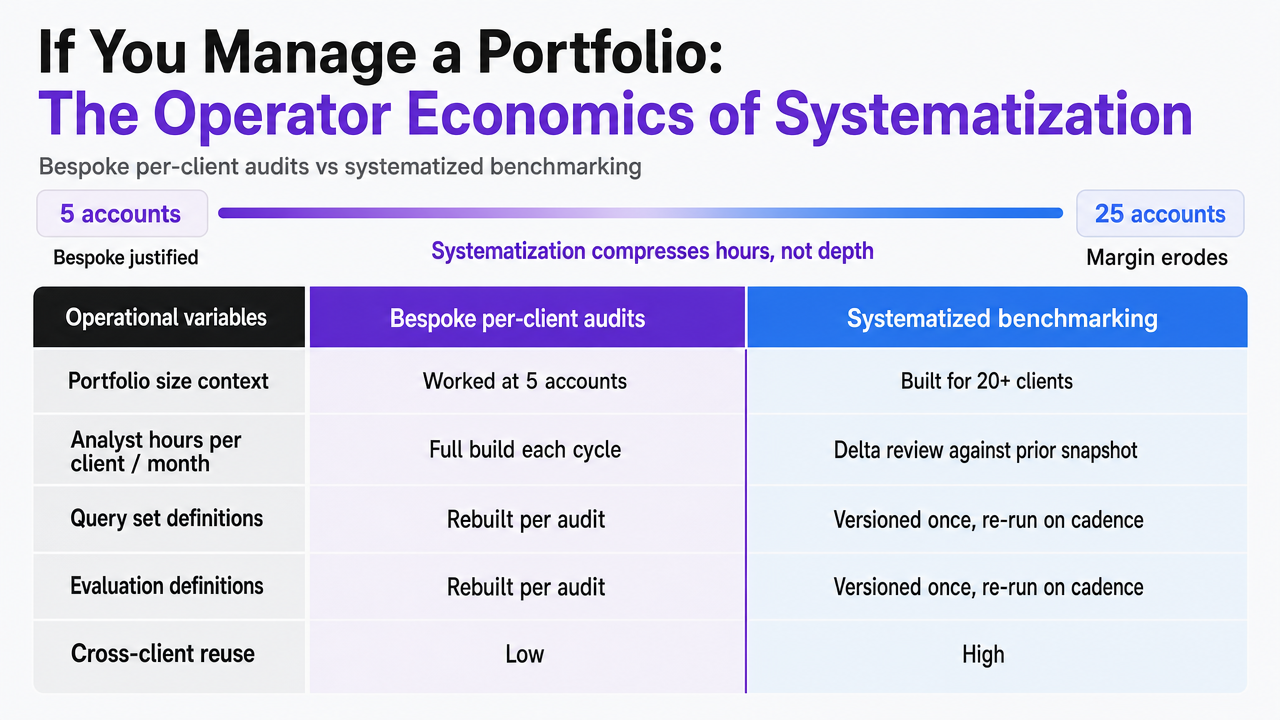 Visualize the comparison table in the section contrasting bespoke per-client audits versus systematized benchmarking across five operational variables
See How Real-Time Competitor Insights Can Accelerate Your SEO Execution
Connect with our team to explore automated systems that extract, analyze, and operationalize competitor intelligence—enabling you to scale SEO strategy across all client accounts without increasing headcount.
Governance: Human Review as the Rate-Limiter on AI-Assisted Analysis
AI accelerates the mechanical parts of competitor work—query-set re-runs, change detection on hundreds of tracked URLs, pattern extraction across content profiles, anomaly flags on SERP features. It does not replace the judgment call about which flagged change matters, which pattern is worth copying structurally, and which recommendation leaves the client exposed. Scaling the analysis without scaling the review layer is how agencies ship bad recommendations fast.
GAO's work on generative-AI deployment identifies the risks that make human review non-negotiable: model integrity, availability, and the gap between fluent output and verified fact 5. The adjacent GAO review of AI in regulated sectors reinforces the same principle from a governance angle—documented controls, accountability for decisions, and auditable review processes before AI-generated findings reach a client 4. Neither report is marketing-specific, and neither should be read as a sector rulebook. The transferable discipline is the pattern: automation handles detection, humans handle approval, and every approval leaves a record.
A workable rate-limiter has three concrete pieces:
- Flagged changes route to a strategist queue, not a client inbox.
- Each recommendation carries the evidence trail that produced it.
- Nothing with legal, accessibility, or review-rule exposure ships without a named reviewer signing off.
The AI buys hours; the review gate decides whether those hours become quality or liability.
From Findings to Prioritized Work Without Expanding Headcount
A six-layer audit that ends in a 40-page deck is a failure mode. The output that matters is a ranked work queue a strategist can hand to production on Monday morning, with evidence attached and a reviewer named. Prioritization is the step that converts analysis into throughput.
Two filters do most of the work:
- Lead-impact weighting drawn from the measurement layer: competitor gaps that touch high-converting query clusters, no-result site searches, or low-CTR terms the client already ranks for move to the top, consistent with the DAP framework's emphasis on connecting search signals to user outcomes 9.
- Effort-to-ship, scored against existing production capacity. A gap that requires one brief and a 1,200-word page clears faster than one requiring a new schema deployment and legal review.
The queue itself stays short. Ten to fifteen ranked items per client per cycle, each tagged with the evidence trail from the audit, the reviewer who signed off, and the KPI it is expected to move. Headcount does not expand because the queue, not the deck, is the deliverable.
Frequently Asked Questions
References
- 1.Results and Challenges in Web Search Evaluation.
- 2.WebMetrics: A Methodology for Producing Usable Web Sites.
- 3.User-Centered Usability Engineering Processes for Websites.
- 4.GAO-25-107197, Artificial Intelligence.
- 5.GAO-25-107651, Artificial Intelligence: Generative AI Training, Development, and Deployment Considerations.
- 6.The Consumer Reviews and Testimonials Rule: Questions and Answers.
- 7.You are how (and where) you search? Comparative analysis of web search behavior using browser logs.
- 8.Search Engines and Generative Artificial Intelligence Integration.
- 9.DAP: Digital Metrics Guidance and Best Practices.
- 10.Statement of Policy Regarding Comparative Advertising.
- 11.Websites and Website Content.
- 12.Guidance on Web Accessibility and the ADA.
- 13.Native Advertising: A Guide for Businesses.
- 14.Federal Trade Commission Announces Updated Advertising Guides to Combat Deceptive Reviews and Endorsements.
- 15.Endorsements, Influencers, and Reviews.