
Key Takeaways
- Content audit tools should build inventory, score pages against defined criteria, and rank fixes; treating crawl output as evaluation leaves the team with data but no direction 6, 8.
- Name the audit objective before booking demos, since consolidation, refresh, migration, accessibility, and brand governance each demand different tool capabilities and depth 7.
- Score vendors against the eight GoodWeb attributes—usability, content, design criteria, functionality, appearance, interactivity, satisfaction, and loyalty—and require them to name where human review fills the gaps 8.
- Expect automated coverage of W3C compliance, WCAG technical checks, readability, performance, and link evaluation, and staff human reviewers for accuracy, audience fit, and cognitive accessibility barriers 9, 1.
- Require vendors to name the WCAG version and conformance level tested, which criteria run in code versus route to manual review, and how that review is tracked 2, 1.
- Join audit findings to behavioral signals such as bounce rate, time on site, and the DAU to MAU ratio so prioritization reflects both content quality and real engagement 3.
- Treat readability and structural checks as policy-backed rules the tool exposes at the page level, with enough context that a writer can fix issues in one pass 4, 5.
- Use a weighted capability matrix tied to the current objective, and press vendors on the exit path from finding to ticket to shipped edit, or the audit will stall 8, 7.
The gap between crawling a site and knowing what to change
Most content audit tools crawl a site well. They pull every URL, flag broken links, extract metadata, and export a tidy spreadsheet. That output is inventory, not evaluation. It tells the content manager what exists. It does not tell the team what to fix first, why, or against which standard.
The distinction matters because published research on website evaluation treats inventory and assessment as separate stages. Yale's audit guidance describes the quantitative inventory as a starting point, then layers in qualitative review for audience fit, brand alignment, and risks such as accessibility errors 6. The scoping review behind the GoodWeb framework, which analyzed 69 website evaluation studies, found that content itself, defined as completeness, accuracy, relevancy, timeliness, and understandability, requires evaluation methods beyond a crawl 8.
A content audit tool earns its place when it does three things: builds the inventory, scores each page against defined criteria, and ranks what to update, consolidate, or retire based on the audit's objective. Selection should start there, not with a feature checklist.
Start with the audit objective, not the feature list
Feature lists rarely predict which tool will produce a shipped edit calendar. The objective does. A tool that excels at keyword cannibalization detection will underperform on an accessibility remediation project, and a crawler tuned for large e-commerce catalogs will bury the signal on a 400-page service site. The AMA's own audit template makes the same point in a different form: it recommends running the toolkit ahead of a defined trigger such as a redesign, CMS migration, or content rewrite initiative, not as a general-purpose scan 7.
Content managers should name the objective before scheduling a single vendor demo. That naming exercise controls three downstream decisions: which criteria the tool must score against, how deep the qualitative review has to go, and how the output will feed the production queue. Yale's audit guidance treats this sequencing as foundational, pairing quantitative inventory with qualitative review of audience fit, brand alignment, and risks including accessibility errors 6.
Five objectives that change which tool wins
Five audit objectives cover most in-house use cases.
- Consolidation targets keyword cannibalization, duplicate topical coverage, and thin pages that dilute a cluster.
- Refresh identifies pages losing rankings or traffic where updated data, examples, or internal links can restore performance.
- Migration builds the pre-move inventory and post-move parity check the AMA template flags as a primary use case 7.
- Accessibility compliance requires scoring against a named WCAG version and mixing automated checks with human review 1.
- Brand governance enforces voice, claims, and CTA consistency across pages authored by rotating writers or contractors.
Each objective privileges different tool capabilities. Consolidation needs strong keyword-overlap analysis and internal-link mapping. Accessibility needs a scanner tied to a specific standard version. Brand governance needs custom rulesets the crawler cannot infer on its own.
Matching capability depth to objective
The capability the tool must go deep on shifts with the objective. A consolidation audit needs cluster-level scoring and URL-to-URL similarity, not accessibility conformance. A migration audit needs redirect mapping and metadata parity, not readability grading. An accessibility audit needs coverage against a specific WCAG version and an intake for the manual checks automation cannot resolve 1.
Buyers who skip this step end up paying for coverage they never use and lacking depth where the audit actually turns into work. Write the objective, then the top three capabilities it demands, and score vendors against that shortlist rather than a generic feature grid.
The eight evaluation attributes a serious tool has to cover
The GoodWeb scoping review, which analyzed 69 website evaluation studies, consolidated the field into eight attribute categories: usability, content, web design criteria, functionality, appearance, interactivity, satisfaction, and loyalty 8. Content itself was evaluated in 41 of those 69 studies, defined as completeness, accuracy, relevancy, timeliness, and understandability of the information 8. That frequency is worth pausing on. It confirms that content quality is the single most-studied attribute in the academic literature, but it also means seven other attributes appear in a majority of serious evaluations. A tool that only scores the content axis leaves most of the review surface uncovered.
The practical translation is a scoring backbone the audit lead can defend in a stakeholder meeting.
- Usability covers navigation depth, task completion, and error recovery.
- Content covers accuracy, freshness, and readability.
- Web design criteria cover layout logic, heading structure, and information hierarchy.
- Functionality covers forms, search, and interactive components that either work or do not.
- Appearance covers visual consistency across templates.
- Interactivity covers response to user input, from filter behavior to CTA states.
- Satisfaction and loyalty cover the behavioral end of the funnel, measured through repeat visits, task completion rates, and self-reported experience 8.
Most commercial audit tools score two or three of the eight well. Crawlers dominate content and design-criteria checks such as heading structure and metadata. SEO platforms extend into content relevance and freshness through keyword and traffic overlays. Almost none score interactivity, satisfaction, or loyalty without pulling from a separate analytics or user-research feed. The AMA template acknowledges this gap by design, pairing crawl-derived SEO metrics with columns for accuracy, freshness, branding, and CTA quality that a human fills in 7.
Buyers should treat the eight attributes as a coverage checklist during vendor demos. Ask the vendor to demonstrate how the tool scores each attribute, and where the tool expects a human reviewer or a data connector to fill the gap. A tool that admits its coverage boundary is more useful than one that claims to cover everything, because the audit lead can plan the manual review pass around the known gaps. The scoping review's own caveat reinforces this: no single method covered all attributes across the 69 studies, and evaluators routinely combined questionnaires, observed browsing, automated testing, card sorting, and web analytics to get a complete read 8.
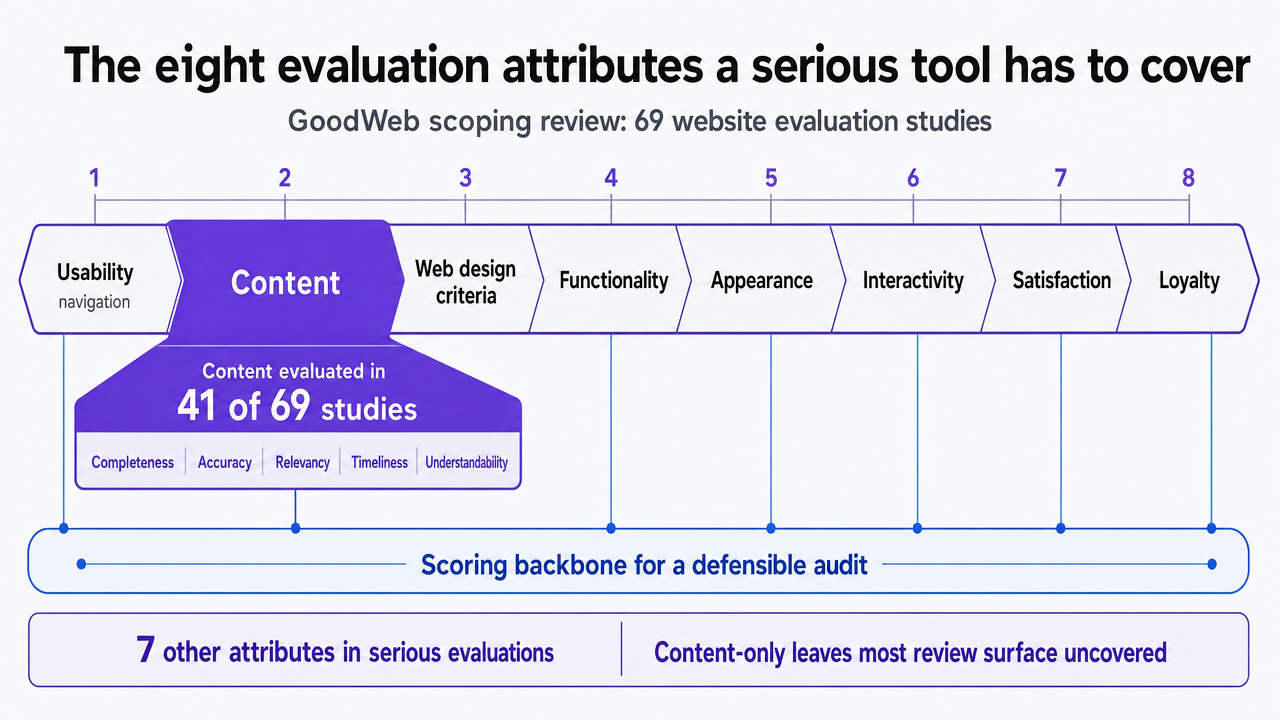 Visualize the eight GoodWeb attribute categories a serious content audit tool should evaluate, directly supporting the section's cited framework
What automated crawling reliably detects and what it misses
An experimental study on automated web page evaluation cataloged what tool-based checks can score with reasonable consistency:
- compliance with W3C HTML standards
- compliance with W3C mobile standards
- WCAG conformance at the technical level
- readability of the text
- page performance
- link evaluation 9
That list defines the reliable floor of any content audit tool. If a vendor cannot demonstrate coverage across those six checks, the tool is not competitive with a mid-tier crawler paired with a free readability grader.
The same study is direct about the ceiling. Automated tools flag syntax errors and specific accessibility violations, but they cannot assess higher-level usability or judge whether the content is appropriate for the intended audience 9. A crawler can confirm that a heading exists. It cannot confirm that the heading describes the section beneath it. A readability score can flag a passage at a college reading level. It cannot decide whether a college reading level is wrong for the page's audience.
Accessibility research draws the boundary even more sharply. The systematic review of web accessibility evaluation catalogs the methods practitioners actually use in the field: checklists, cognitive barrier walkthroughs, automatic checking, user testing, observation, questionnaires, interviews, focus groups, heuristic evaluation, cognitive walkthrough, and data logging 1. Automatic checking is one entry on a list of eleven. Mixed-method evaluation remains the norm because no single method covers the full range of barriers, particularly cognitive barriers that require observing a real user attempting a real task 1.
The practical split for a content audit tool selection looks like this. On the automated side, expect reliable coverage of W3C HTML and CSS compliance, mobile compliance, WCAG technical success criteria that can be tested in code, readability scoring, page performance metrics, broken and redirected links, metadata completeness, and duplicate content detection 9. On the human-review side, expect to staff for content accuracy against source material, brand voice and claims alignment, audience fit for the page's actual reader, cognitive accessibility barriers that require walkthrough or user observation, and the full mixed-method accessibility pass the systematic review documents as standard practice 1.
Buyers should ask vendors two direct questions during the demo. First, which of the six automated checks does the tool actually run, and against which standard version. Second, where does the tool hand off to human review, and how does it track that the human review happened. A vendor that answers the second question with a shrug is selling inventory dressed up as evaluation.
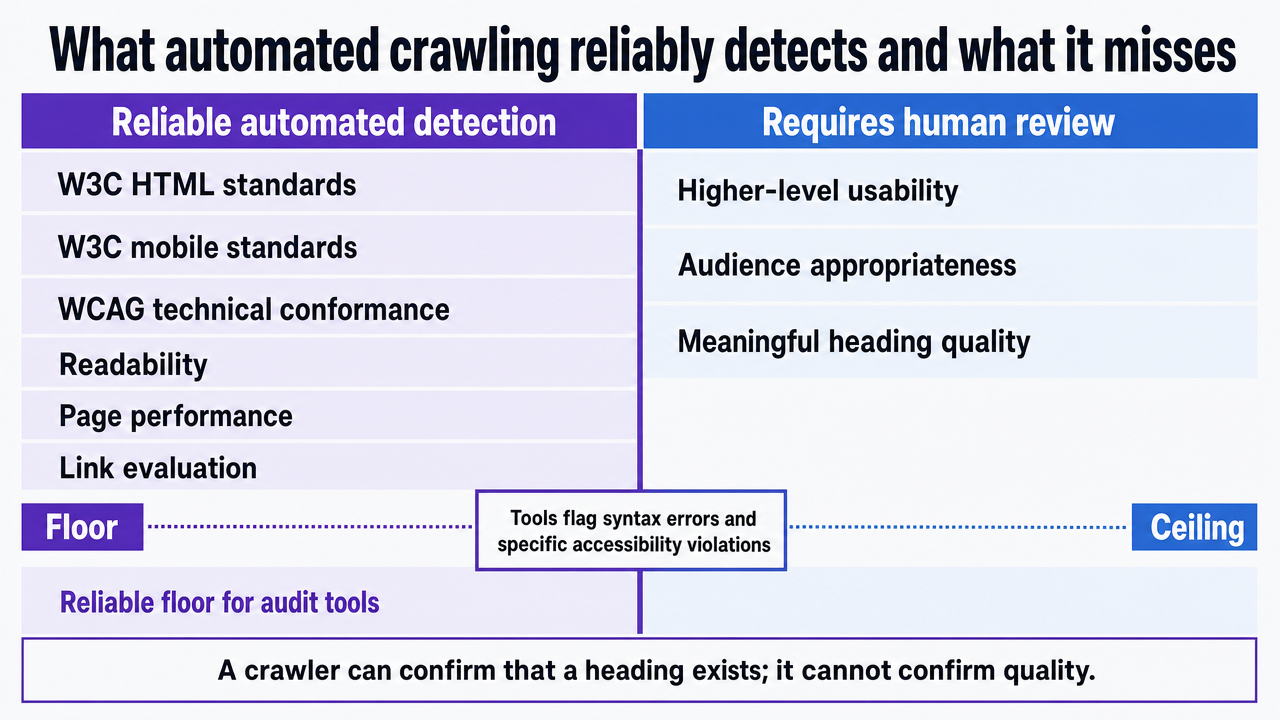 Show the split between what automated audit tools reliably detect versus what requires human review, directly visualizing the section's central comparison from the cited experimental study and accessibility systematic review
Run a Full Content Audit in One Week
Identify and address content gaps before your next reporting cycle—no delays, no placeholder data.
Accessibility: which standard the tool actually checks
Accessibility coverage in an audit tool comes down to a version number and a scope. The current standard is WCAG 2.2, which the W3C published as a Recommendation in 2023 and which adds nine new success criteria addressing barriers for users with visual, mobility, hearing, and cognitive disabilities 2. A vendor that answers "we check WCAG" without naming a version is checking an older ruleset by default, and the audit lead should treat that answer as a red flag.
The version alone does not settle the question. The systematic review of accessibility evaluation practice catalogs eleven methods in active use, including checklists, cognitive barrier walkthroughs, automatic checking, user testing, observation, questionnaires, interviews, focus groups, heuristic evaluation, cognitive walkthrough, and data logging 1. Automated checking is one method among eleven, and the review is explicit that mixed-method evaluation remains the field norm because no single technique surfaces the full range of barriers, particularly the cognitive ones 1.
Buyers should require three answers before accepting a tool's accessibility claim. Which WCAG version and conformance level does the scanner test against. Which success criteria does the scanner test in code versus flag for human review. How does the tool track that the required manual review actually happened. A scanner that reports WCAG 2.2 conformance without a manual-review handoff is reporting on a subset of the standard, not the standard itself.
Connecting audit findings to behavioral signals
A ranked list of thin pages is a hypothesis, not a priority. The audit lead needs behavioral data alongside the content score to know which fixes are worth the writer's time. Web analytics, defined as the measurement, collection, analysis, and reporting of internet data used to gauge direct user interaction, supplies that second axis 3. Common engagement metrics that pair well with audit output include bounce rate, pages viewed, time on site, and the DAU to MAU ratio 3.
A capable content audit tool either ingests those metrics through an analytics connector or exports its inventory in a shape that joins cleanly to the analytics warehouse. Without that join, the audit ranks pages by internal criteria alone. With it, the audit lead can filter for pages that score poorly on content quality and underperform on engagement, then work that intersection first.
One caveat belongs on the record. Behavioral metrics indicate performance. They do not prove content quality or confirm accessibility 3. A page with strong time-on-site can still fail a WCAG check or misstate a service claim. The engagement layer sharpens prioritization; it does not replace the scoring criteria the audit is built on.
Readability and structural checks that policy already requires
Readability is not an editorial preference. It is a policy line in most government and institutional style guides, which means the audit tool should be able to score it against a rule the reader can point to. Digital.gov's plain-language guidance calls for logically structured pages, consistent heading levels, clear headings, and lists that support scanning 4. Georgia's state web standard is more prescriptive: space text with headlines, segments, and bullet lists to increase scan-ability, and spell out acronyms on first reference 5.
Those rules are testable. A crawler can flag heading-level skips, missing H1s, and pages with no lists in dense text blocks. A readability grader can score grade level per page and surface acronyms that never expand. Buyers should ask whether the tool exposes these checks as rules the audit lead can edit, not just as generic scores. A readability column that reports "grade 14" without linking to the paragraphs that raised the score forces the reviewer back into manual reading, which is exactly what the tool was supposed to prevent.
Structural checks belong in the same category. Heading hierarchy, list use, and acronym handling are structural signals the crawler already sees. The question during evaluation is whether the tool reports them at the page level with enough context for a writer to fix the page in one pass.
A capability matrix for scoring vendors
A scoring sheet turns a demo into a decision. The matrix below lists what each category of tool covers against the eight GoodWeb attributes, SEO signals, and WCAG 2.2 accessibility 8, 7, 2. Rows are the criteria the audit lead is buying against. Columns are the tool categories most in-house teams shortlist.
| Criterion | Crawler-based tool | SEO audit platform | Spreadsheet template | AI-assisted audit system ||---|---|---|---|---|| Usability (navigation, task flow) | Partial | Partial | Manual | Partial + human handoff || Content (accuracy, freshness, readability) | Readability only | Freshness + keywords | Full, manual | Scored + flagged for review || Web design criteria (headings, hierarchy) | Strong | Partial | Manual | Strong || Functionality (forms, search) | Partial | Weak | Manual | Partial || Appearance (template consistency) | Weak | Weak | Manual | Partial || Interactivity (CTA states, filters) | Weak | Weak | Manual | Partial || Satisfaction (survey, feedback) | None | None | Manual | Connector-based || Loyalty (repeat visits, retention) | None | Traffic overlay | Manual | Analytics join || SEO signals (rankings, cannibalization) | Partial | Strong | Manual entry | Strong || WCAG 2.2 technical checks | Partial | Weak | Manual | Partial + human handoff |
Three patterns show up quickly. Crawlers cover the structural axis and little else. SEO platforms extend into content freshness and rankings but drop the accessibility and satisfaction rows. Spreadsheet templates, including the AMA's, fill every cell but require a human to do the actual filling, which is exactly why the AMA structures its toolkit around columns for accuracy, freshness, branding, CTAs, and broken links alongside SEO metrics 7. AI-assisted systems score more rows automatically and route the rest for human review, which matches the mixed-method norm the accessibility literature documents 1.
The scoring exercise itself is straightforward. Weight each row against the audit objective set in section two. Multiply the vendor's coverage score by that weight. The tool with the highest weighted score for the current objective wins the shortlist slot, not the tool with the most green cells overall.
Pinpoint Content Gaps and Opportunities with Data-Driven Audits
Connect with our team to see how leading brands automate comprehensive content audits, surface actionable fixes, and accelerate production—without expanding headcount or sacrificing governance.
The failure mode most audits share: findings that never ship
A finished audit spreadsheet is not the goal. Shipped edits are. Most audits stall between the two because the tool that produced the inventory has no connection to the production queue that would act on it. The rows sit in a shared drive. The writers keep working from the editorial calendar. Two quarters later, the audit runs again and surfaces the same pages.
The research literature hints at why. Yale's audit guidance treats inventory as the first step and qualitative review as a distinct second stage, which means someone has to own the handoff from scored rows to assigned work 6. The AMA template solves this on paper by adding columns for accuracy, freshness, branding, CTAs, and broken links next to SEO metrics, so a reviewer can convert a finding into a task in the same document 7. That works when a human sits down and does it. It fails when the audit lead runs the scan, exports the file, and moves on to the next priority without a routing step.
Buyers should press vendors on the exit path. Which findings become tickets, which route to a writer, and which trigger a human review pass. A tool without that answer produces reports, not results.
A note for content managers running audits across multiple locations
A quick audience shift: the next 150 words are for content managers running audits across a portfolio of location pages, whether that portfolio is 12 dental practices, 40 home-service branches, or 200 senior-living communities. The single-site playbook does not scale cleanly, and the tool selection question changes with it.
Multi-location audits need three capabilities most single-site tools handle poorly.
- First, template inheritance: the tool should score each location page against the master template and flag drift in heading structure, CTA placement, and required disclosures, not just missing metadata 4.
- Second, per-location variance reporting: readability, WCAG technical checks, and content freshness need to roll up by location group so a regional manager can act on their pages without wading through a national export 9.
- Third, cluster-aware cannibalization detection, because location pages targeting the same service in adjacent markets will cannibalize each other if the tool treats them as independent URLs.
Running the shortlist: a two-week evaluation the team can actually finish
Two weeks is enough time to stress-test three vendors against a real objective. Longer evaluations stall because the audit lead runs out of internal reviewers before a decision gets made.
Week one belongs to setup and coverage.
- Day one, name the objective from section two and pick a representative sample of 40 to 60 URLs that covers the site's main templates.
- Day two through four, run each vendor against that sample and record which of the six automated checks the tool actually executes: W3C HTML compliance, mobile compliance, WCAG technical criteria, readability, performance, and link evaluation 9.
- Day five, score each vendor's output against the eight-attribute matrix and note where the tool hands off to human review 8.
Week two tests the exit path. Assign one writer to convert findings from each tool into three concrete edits, then measure how long the round trip takes. Confirm the WCAG version the scanner claims and require the vendor to name which success criteria route to manual review 2, 1. The tool that produces the fastest scored-finding-to-shipped-edit cycle wins, not the one with the prettiest dashboard. Teams looking to compress that cycle further, and connect audit output directly to approved production, are the audience Vectoron built its Command Center for.
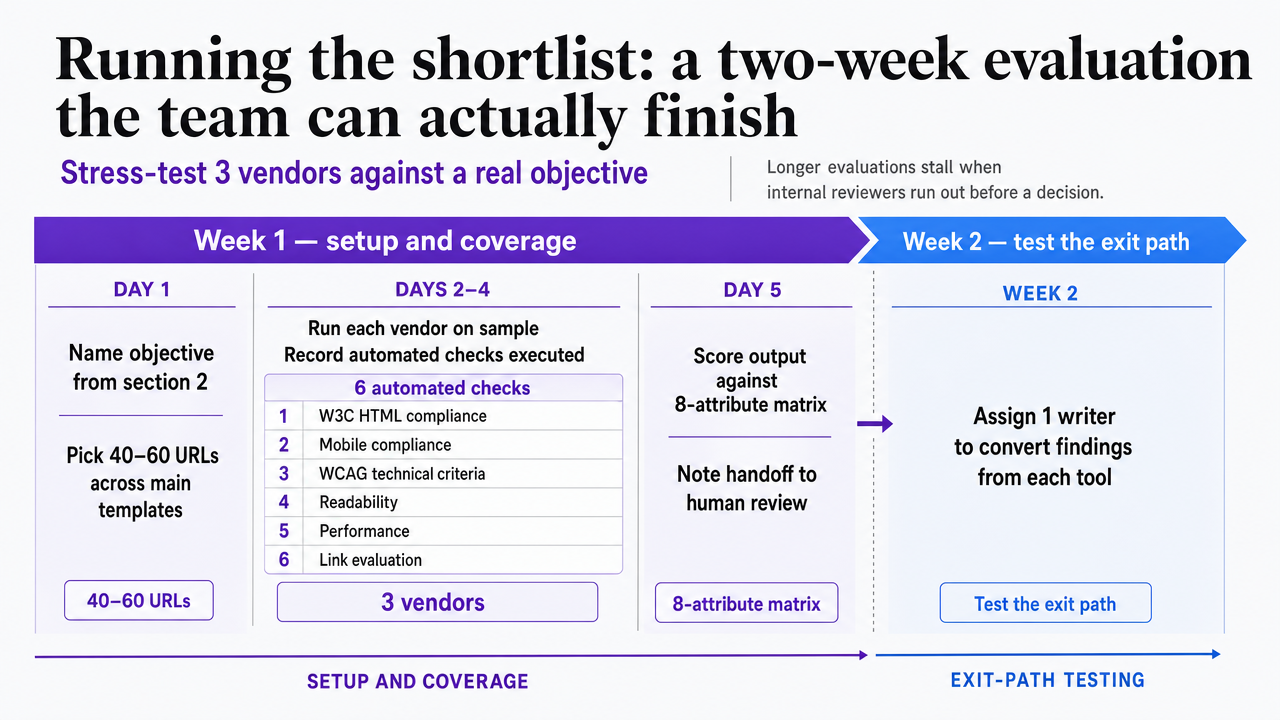 Visualize the section's explicit two-week vendor evaluation workflow as a process timeline, matching the day-by-day plan described in the prose
Frequently Asked Questions
References
- 1.Accessibility engineering in web evaluation process: a systematic review.
- 2.W3C WCAG 2.2 Now Available.
- 3.Methodological Guidelines for Systematic Assessments of Web-based Interventions.
- 4.Design for understanding.
- 5.5.4 Readability.
- 6.How to Conduct a Content Audit | YaleSites.
- 7.AMA Website and SEO Content Audit Template.
- 8.A Comprehensive Framework to Evaluate Websites: Literature Review and Development of GoodWeb.
- 9.An Experimental Study on Web Page Usability and Accessibility Testing.
- 10.A Comprehensive Framework to Evaluate Websites.