
Key Takeaways
- Treat SEO content as a four-layer production system: intent selection tied to opportunity value, an evidence bar matching Google's people-first criteria, structural design for scanners and AI answer engines, and pipeline measurement over pageviews.
- Score topics by expected opportunity value rather than search volume, since a low-volume comparison query attached to a large deal segment outperforms a high-volume definitional query attached to smaller deals.
- Every draft needs at least one non-commodity element—proprietary data, first-hand observation, or a defensible framework—because AI answer surfaces cite sources that add something, not restatements of existing content 4.
- Replace last-click reporting by joining Search Console query data to CRM opportunities monthly and blending market mix modeling with multi-touch attribution to defend sourced and assisted pipeline claims 15.
Why Traffic Stopped Being the Right Scoreboard
Content teams still get asked for traffic charts. Finance leaders ask a different question: which pages produced qualified opportunities last quarter, and how much did each cost? The gap between those two questions is where most SEO content programs quietly lose their budgets.
The Content Marketing Institute's benchmark data makes the gap uncomfortably concrete. In its aggregated B2B research, 56% of B2B marketers name attributing ROI to content as a top measurement challenge, and 56% cite tracking customer journeys as another. 12 Two majorities, same root cause: content activity is easy to count, and content revenue is not.
That measurement gap has consequences. When editorial teams cannot connect a comparison page or a category primer to a specific opportunity in the CRM, sessions and rankings become the default scoreboard by elimination. Traffic goes up, pipeline stays flat, and the next planning cycle brings pressure to publish more of the same. Google's people-first guidance is unambiguous about where that road ends: content produced primarily to attract search traffic, rather than to serve a reader with a real question, is exactly what the helpful content signals were designed to suppress. 2
The reframing is straightforward, even if the operational work is not. SEO content earns its budget when it is treated as a production system with four connected layers: topics chosen against opportunity value, drafts held to Google's evidence bar, structure engineered for scanning readers and AI answer surfaces, and measurement tied to pipeline rather than pageviews. Each layer is testable. Each layer produces evidence a CFO will actually read. The rest of this piece walks through what those layers look like in practice, and where most teams break.
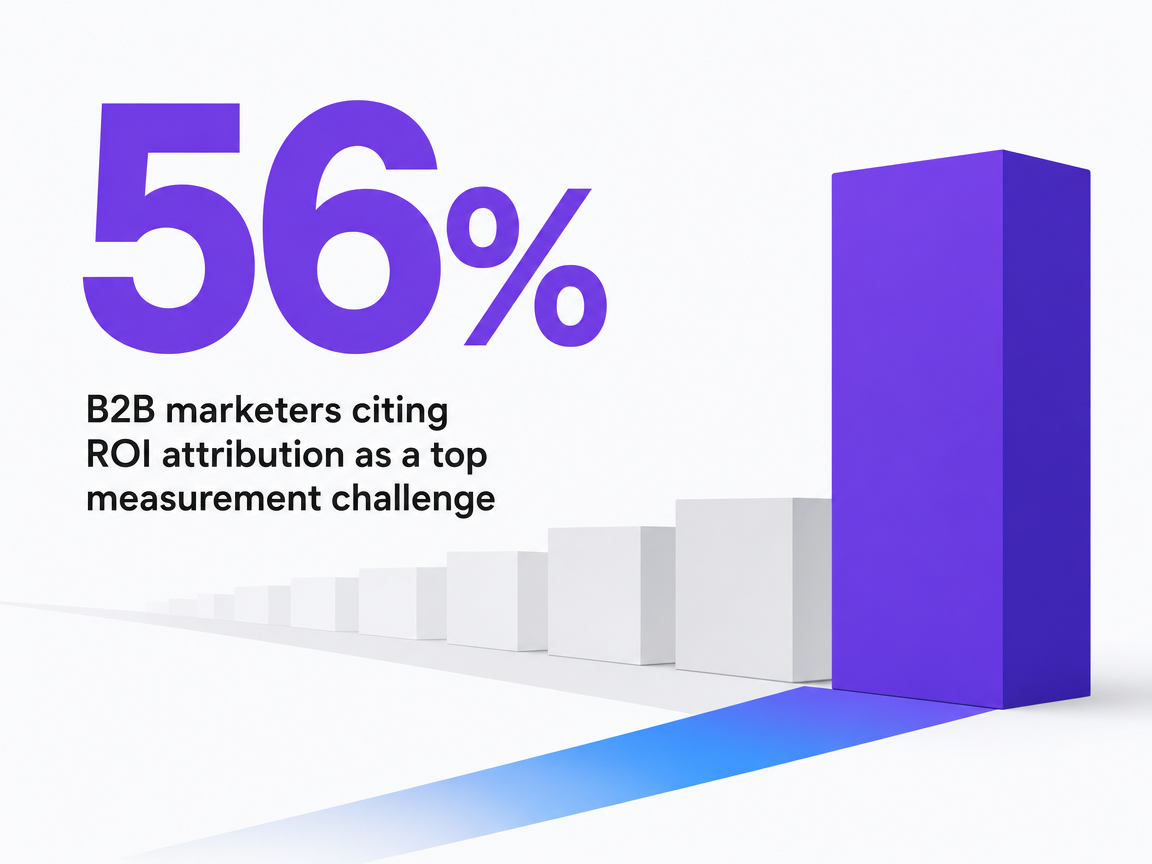 B2B marketers citing ROI attribution as a top measurement challenge
B2B marketers citing ROI attribution as a top measurement challenge
The Four-Layer Production Operating System
Treating SEO content as a production system means giving each stage its own inputs, quality gate, and evidence of outcome. Four layers do the work, and each one fails in a recognizable way when it is skipped.
- Intent selection ranks topics by opportunity stage and revenue potential, not by search volume alone.
- The evidence bar holds every draft against Google's people-first criteria before publication, catching the search-engine-first patterns that the helpful content update was designed to suppress. 2
- Structural design engineers the page for scanning readers and AI answer surfaces, using heading hierarchy, concise prose, and inline sourcing.
- Pipeline measurement closes the loop, connecting query data to CRM opportunities rather than stopping at sessions.
The layers are sequenced deliberately. Skipping intent selection produces well-written pages that rank for the wrong queries. Skipping the evidence bar produces volume that AI search surfaces will not cite. Skipping structural design buries the answer readers came for. Skipping measurement leaves the program undefended at budget time. The sections that follow work through each layer with the operational moves that make it hold.
Layer One: Intent Selection Mapped to Revenue
Scoring Topics by Opportunity Stage, Not Search Volume
Keyword volume tells editorial teams what people search for. It says nothing about which of those searchers can become a paying customer. A topic list ranked by monthly volume will predictably overweight top-of-funnel definitional queries and underweight the narrower comparison, evaluation, and category-fit queries where opportunities actually form.
A pipeline-aware scoring model replaces volume-first ranking with a weighted composite: opportunity stage, average deal size for the segment that queries the term, competitive difficulty, and existing coverage on the site. Editorial teams that map topics to opportunity stages typically end up with three tiers:
- Category primers and definitional queries feed the top of the funnel and earn credit for assisted opportunities.
- Comparison queries, alternative-to queries, and integration-fit queries sit in the middle and produce most of the sourced pipeline.
- Pricing, implementation, and specific use-case queries sit at the bottom and correlate most tightly with closed revenue.
The practical move is to score every candidate topic on a simple sheet before it enters the calendar. A 2,900-volume definitional query with a $12,000 average deal size loses to a 210-volume comparison query with a $60,000 average deal size once expected opportunity value is calculated. Most editorial calendars invert that math because volume is easier to see than deal value.
Google's own guidance points in the same direction. Its people-first questions ask whether a reader leaves having accomplished the goal that brought them to the page, which is a stage-specific question, not a volume-specific one. 1 Topics chosen to serve a specific decision produce pages that satisfy that decision. Topics chosen to serve a traffic target usually do not.
Personalization as an Intent Multiplier
Once topics are scored against opportunity stages, the next lever is how tightly each page speaks to the reader in that stage. McKinsey's research on personalization quantifies what most editorial teams have felt but rarely defended: personalization most often drives a 10–15% revenue lift, with company-specific outcomes spanning a 5–25% range depending on execution quality and data maturity. 19 The band is wide because personalization is not a single tactic. It is a discipline of matching content to the role, industry, and decision stage of the reader who arrived at the page.
For SEO content, the personalization move is not dynamic content injection. It is topic granularity. A single "guide to case management software" page cannot outperform three separate pages built for plaintiff firms, defense firms, and insurance-side operations. Each of those pages ranks for narrower queries, converts at higher rates, and produces measurably different opportunity values in the CRM. McKinsey's follow-on work on B2B growth leaders makes the same point from the buyer side: winning teams tie personalized content experiences to conversion velocity and deal size, not to session counts. 20
The operational implication for editorial calendars is straightforward. Instead of publishing one comprehensive page per topic, publish a base page and two to four segment-specific variants when the CRM shows meaningful deal-value differences between segments. Each variant carries its own primary query, its own examples, and its own conversion path. That structure is what turns the personalization revenue band from a McKinsey statistic into a line item content teams can actually defend at budget review.
Accelerate SEO content output with real results
Test-drive a full production workflow and see measurable SEO impact on live content before you commit.
Layer Two: The Evidence Bar That Google Now Enforces
People-First Questions as an Editorial QA Gate
Google's helpful content guidance reads less like a rulebook and more like a QA checklist. Editorial teams that treat it that way catch problems before publication that would otherwise show up as ranking drops six weeks later.
The core questions map cleanly to an editorial gate:
- Does the page provide a substantial and comprehensive description of the topic?
- Does the reader leave feeling they learned enough to accomplish what brought them to the page?
- Does the content demonstrate first-hand expertise, or is it a summary of what other pages already say? 1
Those are pass-fail questions, not aspirations. A draft that cannot answer them affirmatively is a draft that will underperform regardless of how well it is optimized for the target query.
The 2022 helpful content update named the failure patterns explicitly. Content produced primarily to rank in search rather than to help a specific reader, thin summarization of other sources, and extensive automation without meaningful human judgment are flagged as search-engine-first signals. 2 Each of those patterns is detectable in a draft. A managing editor reading for search-engine-first tells can catch them: sections that pad word count without adding a new claim, headings that exist to hold keywords rather than to answer questions, and closing paragraphs that summarize what was just said instead of giving the reader something to do next.
The operational move is to add a documented QA pass between draft and publish where the reviewer signs off on each people-first question by name. Not a rubric score. A signature.
What Disqualifies Content in AI Search Surfaces
AI answer engines raised the bar again in 2025. Google's guidance for AI search experiences names the disqualifier directly: pages that repeat what other pages already say do not earn citations in generated answers. The instruction is to produce "unique, non-commodity content" that is helpful and satisfying to visitors arriving from both classic Search and AI experiences. 4
Commodity content is easy to identify once teams look for it:
- A definition paragraph that could have been copied from any of the top ten results is commodity content.
- A benefits list assembled from competitor pages is commodity content.
- A pros-and-cons table that reflects no first-hand testing is commodity content.
AI systems trained to synthesize information across sources do not need to cite the fifth restatement of the same explanation. They cite the source that added something the others did not.
The editorial move is to require at least one non-commodity element per page: a proprietary data point, a documented practitioner observation, a specific example with named variables, or a framework the team can defend as its own. CMI's 2026 outlook points in the same direction, noting that winning teams are using AI to add creativity and rigor rather than to increase the volume of restated content. 6 Pages built on that standard get cited in AI answers. Pages built on aggregation get quietly replaced by the answer itself.
Layer Three: Structural Design for Scanners and Answer Engines
Scannability, Heading Hierarchy, and the Usability Payoff
Readers do not read pipeline content the way editors write it. Nielsen Norman Group's usability research is blunt about the behavior gap: users scan pages in F-shaped and layer-cake patterns, extracting meaning from headings, subheads, first sentences, and highlighted terms before deciding whether to slow down. In NN/g's controlled testing, sites written concisely, scannably, and objectively scored 124% higher in measured usability when all three attributes were combined. 7 That number is a study result, not a universal guarantee, but the directional finding has held across two decades of follow-on research.
The structural moves that produce the lift are specific:
- Descriptive H2s and H3s that name what the section actually answers, not clever phrasings that obscure the topic.
- Short opening sentences that state the section's claim before evidence arrives.
- Bulleted lists reserved for parallel items, not used as decoration.
- Inline data placed close to the claim it supports.
- One idea per paragraph, with paragraph breaks used as pacing rather than filler.
Accessibility guidelines reinforce the same structure from a different angle. WCAG requires that relationships conveyed visually be programmatically determined through proper semantic markup, so screen readers and parsers can follow the document's logic. 16 It also specifies that headings and labels describe topic or purpose rather than decorate the page. 17 That specification is functionally identical to what AI answer engines need. A generative system parsing a page for a citable answer relies on the same heading hierarchy and semantic cues a screen reader uses. Pages that ignore heading structure are harder for both audiences to consume, and both audiences respond by leaving.
The practical test is to strip the page down to its H2s and H3s and ask whether the outline alone tells a reader what they will learn. If it does not, the structure is decorative, and the usability lift will not appear.
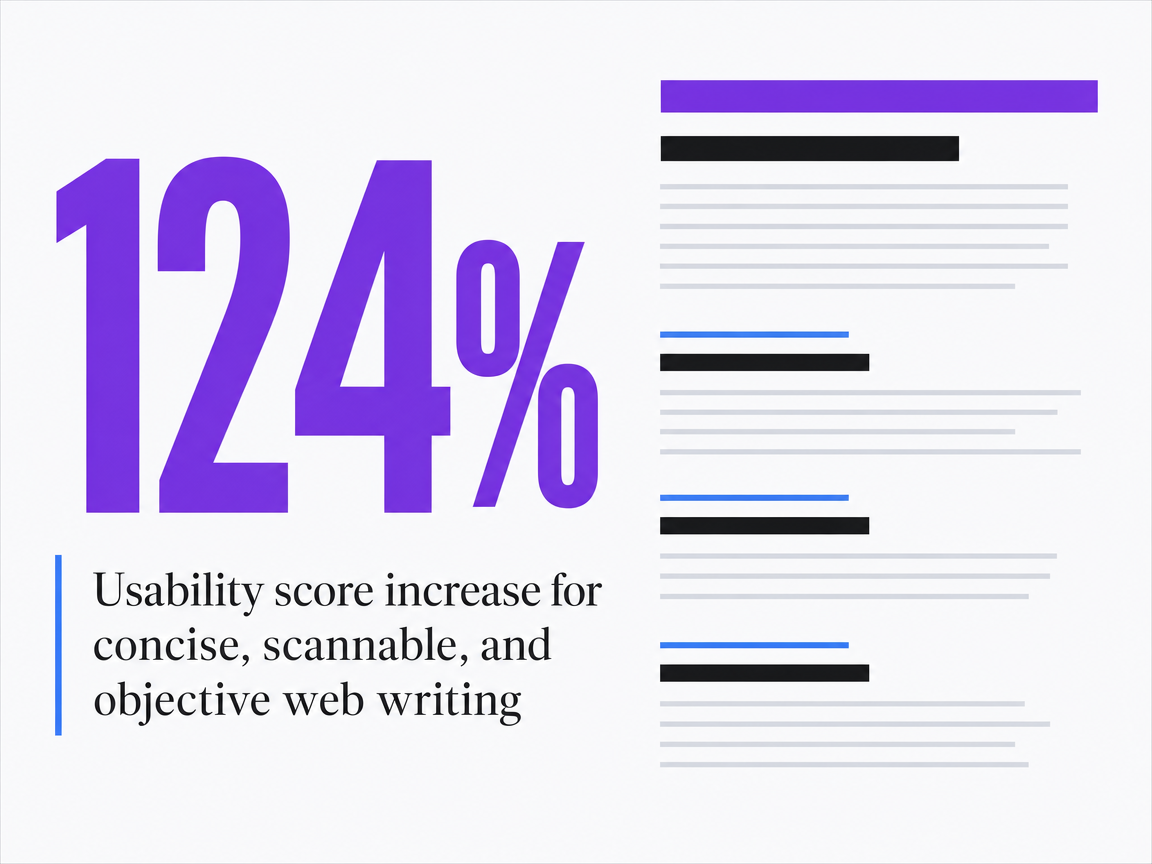 Usability score increase for concise, scannable, and objective web writing
Usability score increase for concise, scannable, and objective web writing
Depth Without Length Inflation
Backlinko's analysis of 11.8 million search results found that the average Google first-page result contains 1,447 words, but the same study reported no direct correlation between word count and ranking position once a page reached page one. 10 The finding is often misread as license to publish longer. The correct reading is narrower: comprehensive coverage tends to correlate with page-one presence, but padding a page past its natural length does not move it up.
The distinction matters because length inflation is the most common failure mode in SEO content programs. Writers add a history section, a benefits list, and a summary of adjacent topics to hit a target word count, and the page ends up burying the answer the reader arrived for. Google's people-first questions catch exactly this pattern by asking whether the content provides substantial coverage of the topic and whether the reader leaves having accomplished their goal. 1 A 2,400-word page that answers the query in the first 600 words and then repeats itself for another 1,800 fails both tests.
Depth is a function of claims per paragraph, not paragraphs per page. A page earns its length when each section adds a new claim, a new example, or a new data point the reader could not get from the previous section. Editors reviewing drafts against that standard cut faster than they add, and the pages that survive the cut are the ones that hold rankings when helpful content signals recalibrate.
Layer Four: Pipeline Measurement Beyond Last Click
Search Console as the Query-to-Page Ground Truth
Analytics platforms disagree about a lot. Search Console is the one source of query-to-page truth Google itself publishes, and content teams that treat it as the spine of their measurement stack argue from firmer ground than teams working from third-party rank trackers alone.
The setup Google recommends is unglamorous but load-bearing: verify ownership, confirm that Google can crawl and render the pages, submit sitemaps where they help, and monitor performance on a cadence that matches the publishing calendar. 8 The payoff is a query-level record of impressions, clicks, and average position for every page that earns visibility, exportable at scale through the Search Console API when reporting outgrows the web interface. 9
The operational move is to export query and page performance monthly, join it against the CRM on landing-page URL, and produce a single table that shows which queries produced which opportunities. That join is where most content programs discover that a handful of narrow comparison queries carry the pipeline while the traffic-heavy definitional pages produce sessions and little else. The table does not need to be sophisticated to change budget conversations. It needs to exist.
Blending MMM and Multi-Touch for Defensible Revenue Claims
Last-click attribution undercounts SEO content by design. A reader who finds a comparison page in March, returns through a branded search in May, and converts through a sales email in July shows up in most reports as a sales-sourced opportunity. The content that seeded the buying journey earns nothing on the scorecard.
The IAB's attribution guidance names the problem directly: different attribution models can assign credit for the same journey in conflicting ways, which is why single-source reporting produces arguments rather than decisions. 14 The 2025 IAB companion guide recommends a blended approach that combines market mix modeling with multi-touch attribution, using MMM for top-down measurement of channel and content contribution and MTA for the tactical, opportunity-level view that content teams need for iteration. 15 Neither model is sufficient alone. Together they produce a revenue claim that survives finance scrutiny.
For a content team without a data science function, the practical version is smaller than the acronyms suggest:
- Tag every SEO landing page as a first-touch source in the CRM.
- Track assisted-opportunity credit alongside sourced credit, and report both.
- Run a quarterly review that compares SEO-touched pipeline against non-SEO-touched pipeline for the same segments, controlling for deal size and sales cycle length.
That comparison is the closest thing to a defensible revenue claim most content programs will produce, and it is enough to shift the conversation from sessions to sourced opportunities at the next budget review.
See How AI-Driven Content Workflows Accelerate SEO Pipeline Impact
Request a walkthrough of coordinated, approval-based AI content production designed to increase publish velocity, streamline SEO execution, and maintain enterprise-grade quality standards—without expanding your internal team.
The Production Model: Approval-First AI, Not Full Automation
The four layers only hold if the production model behind them can sustain the work. Most content teams cannot staff their way there. A writer producing four to eight long-form pieces per month is a realistic ceiling once research, drafting, editing, and stakeholder review are factored in. Multiply that by the number of pipeline-worthy topics on a competitive site and the calendar breaks before the year does.
AI closes part of that gap, but only under a specific operating model. CMI's 2026 outlook is direct about which pattern is working: winning B2B teams are strengthening fundamentals and using AI to add creativity and rigor, not to replace the editorial judgment that produces citable pages. 6 The teams pushing volume through unsupervised generation are the ones producing exactly the search-engine-first, thin-summarization output Google's helpful content update was built to suppress. 2
The 2025 budget data reinforces which direction the money is moving. CMI found that 46% of B2B marketers expected their content marketing budget to increase in 2025, and that spend is not funding writer headcount at the rates it once did. 5 It is funding production systems, measurement infrastructure, and AI tooling wrapped in human review.
The operating pattern that fits the four-layer system is approval-first. AI drafts against a documented intent brief, a human editor runs the people-first QA gate, structural and citation checks happen before publish, and every piece carries a signature before it ships. Nothing goes live without sign-off. That model produces the throughput the calendar demands and holds the evidence bar the rankings now require. Full automation does neither.
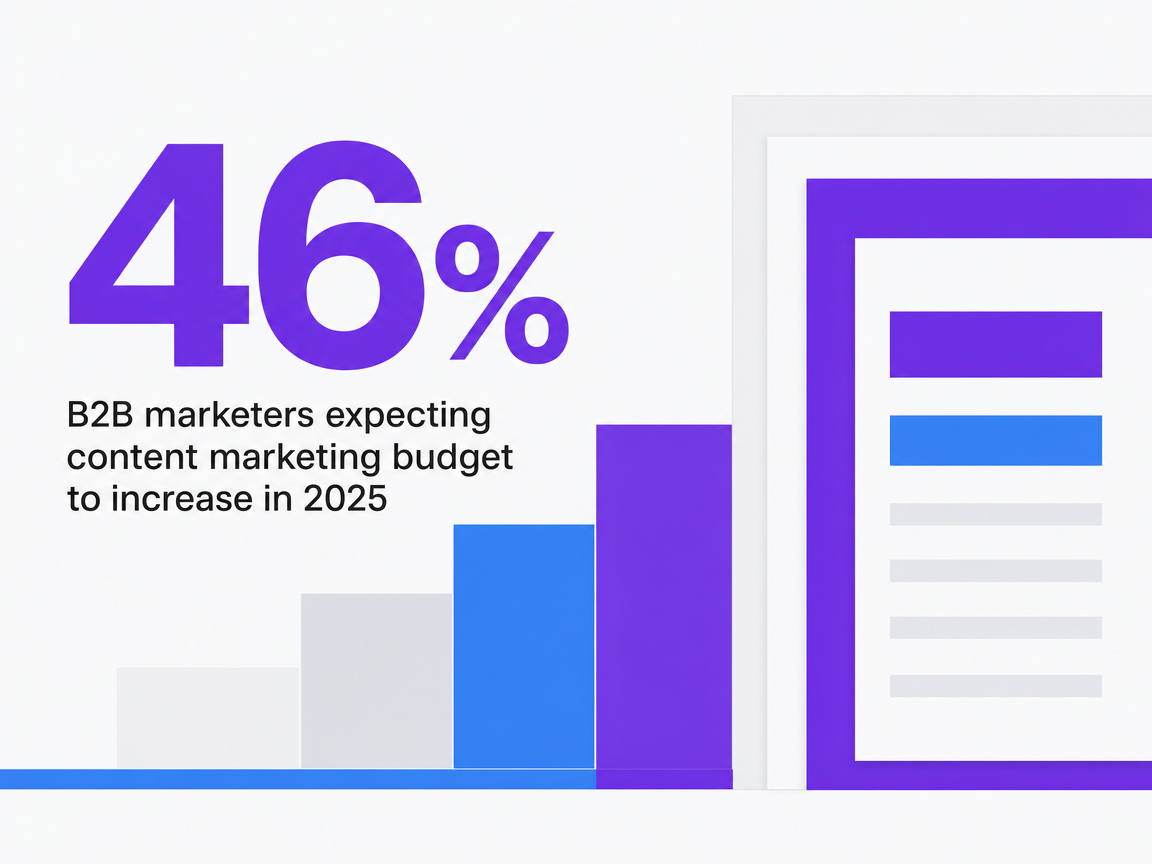 B2B marketers expecting content marketing budget to increase in 2025
B2B marketers expecting content marketing budget to increase in 2025
The Next Operator Move
The four layers are not a strategy deck. They are a weekly checklist.
- Score next quarter's topics against opportunity value before the calendar is locked.
- Run every draft through the people-first questions with a named editor's signature.
- Strip the outline to H2s and H3s to confirm the page tells its story without the paragraphs.
- Join Search Console exports to CRM opportunities monthly, and report sourced and assisted pipeline side by side.
Teams that install this loop stop arguing about traffic. They start arguing about which comparison pages to build next. That is the conversation Vectoron was built to run alongside an in-house team: AI drafting against intent briefs, human editors holding the evidence bar, and every piece signed off before it ships.
Frequently Asked Questions
References
- 1.Creating Helpful, Reliable, People-First Content.
- 2.What creators should know about Google’s August 2022 helpful content update.
- 3.Search Engine Optimization (SEO) Starter Guide.
- 4.Top ways to ensure your content performs well in Google’s AI experiences.
- 5.B2B Content Marketing: 2025 Benchmarks & Trends.
- 6.B2B Content and Marketing Trends: Insights for 2026.
- 7.Concise, SCANNABLE, and Objective: How to Write for the Web.
- 8.How To Use Search Console.
- 9.Getting your performance data | Search Console API.
- 10.We Analyzed 11.8 Million Google Search Results. Here’s What We Learned About SEO.
- 11.Google’s 200 Ranking Factors: The Complete List.
- 12.57+ Content Marketing Statistics To Help You Succeed in 2025.
- 13.Enterprise Content Marketing Benchmarks, Budgets, and Trends: Findings for 2025.
- 14.Measurement & Attribution.
- 15.IAB State of Data 2025\_Companion Guide.
- 16.Info and Relationships.
- 17.Headings and Labels.
- 18.The multiplier effect: How B2B winners grow.
- 19.The value of getting personalization right—or wrong—is multiplying.
- 20.B2B buyers reset the bar.
- 21.Marketing’s Holy Grail: Digital personalization at scale.