
Key Takeaways
- Replace one-off keyword overlap audits with a five-layer diagnostic covering topic coverage, intent match, SERP features, AI Overview visibility, and technical discoverability.
- Prioritize gaps using pipeline proximity, revenue weight, gap severity, and remediation cost rather than search volume, so a low-volume intake query outranks a high-volume awareness term.
- Standardization drives the margin shift: templated diagnostics can cut analyst hours per account and raise the accounts-per-strategist ceiling before AI execution is layered on.
- Install the loop in 90 days by templating one vertical first, keeping universe definition, pipeline weighting, and regulated-language approvals with human strategists.
Why gap analysis broke at portfolio scale
Content gap analysis, traditionally a one-off deliverable, struggles when applied across a large portfolio of clients. A strategist would typically analyze competitor keyword overlap, identify missing terms, and provide a document to a writer. While effective for a single client, this model becomes unsustainable with numerous accounts.
The primary challenge is arithmetic. A senior analyst conducting a bespoke audit for a 12-page legal services site spends eight to twelve hours per audit. Scaling this to thirty to eighty accounts with quarterly refreshes means gap analysis alone consumes analyst capacity intended for strategic work. Heads of SEO report that prioritization, not production, becomes the bottleneck. The CMI 2026 B2B benchmark, surveying over 1,000 marketers, highlights a shift from increasing content production to making better strategic choices8. Enterprise content teams face similar coordination difficulties within a single organization9.
The traditional deliverable itself is also outdated. A keyword-overlap export only identifies terms competitors rank for that a client does not. It fails to address critical factors in today's search environment, such as:
- whether the intent behind topics matches the query,
- changes in SERP feature mix,
- AI Overviews citing pages or routing clicks elsewhere7,
- and technical issues preventing pages from being indexed6.
Agencies still relying on keyword-overlap PDFs are using a 2018 solution for a 2026 search landscape.
The solution is not to hire more analysts but to implement a standardized diagnostic system. This system should operate consistently across all accounts, score gaps based on pipeline impact rather than search volume, and reserve human judgment for truly complex decisions. The remainder of this article details such a system.
The five-layer diagnostic that replaces keyword-overlap audits
Layer one: topic coverage against a defined universe
Topic coverage is a common but often inconsistently applied layer in agency audits. A competitor overlap merely shows what peers rank for, not the client's actual addressable topic universe.
The key is to define the topic universe before comparison. For example, a personal injury firm in three states has a universe defined by practice areas, jurisdictions, injury types, and procedural stages, not just competitor publications. Once this map is established, coverage becomes a binary check: page present, page absent, or page thin. "Thin" content is a frequent audit failure point. Google's guidance emphasizes "substantial, complete, or comprehensive" topic descriptions4, meaning a 400-word page on a topic requiring 1,800 words is a gap, not a win.
Standardization is crucial here. A predefined universe template for each vertical (e.g., legal, behavioral health, dental) allows the same diagnostic to run across all accounts in that vertical without requiring strategists to rebuild taxonomies. This template transforms topic auditing from a bespoke project into a repeatable process.
Layer two: intent gaps hiding inside covered topics
A page can cover a topic but still fail to match user intent, leading to significant unrecovered traffic. This layer is often overlooked by competing frameworks.
Academically, Kraaij's multi-dimensional model highlights that a single information need can generate multiple intents11. Brenes and Gayo-Avello categorize these intents as informational, navigational, transactional, and local12. Applied to client audits, this framework asks: does the page format align with the dominant intent behind the query that surfaces it? This question is not answered by keyword overlap analysis.
For instance, a behavioral health provider ranking a clinical explainer for a transactional query (e.g., "covered provider near ZIP code") has an intent gap despite topic coverage. Similarly, a legal services page with an informational article for a query dominated by local pack results faces the same issue. The solution isn't always new content; often, it's a format change, such as converting an explainer into a service page with intake forms or segmenting a long guide into a hub with intent-specific spokes.
At portfolio scale, the intent layer requires a consistent scoring rubric for strategists. This rubric would classify dominant intent, current page format, and flag matches or mismatches, making intent gaps visible across numerous accounts.
Layer three: SERP feature and format gaps
The SERP itself provides clues about optimal content format. If a query yields a featured snippet, multiple video results, a People Also Ask section, and a local pack above organic links, a format gap is evident even before competitor analysis.
Auditing SERP features at scale demands structured data capture, not just screenshots. For each priority query, an inventory should be created, noting the presence of snippets, video carousels, image packs, PAA, local packs, product grids, and site links. The gap is the difference between available SERP features and those the client's page is eligible to earn. For example, a dental group lacking schema markup on procedure pages cannot compete for rich results prevalent in its category's SERPs.
Format gaps also include depth mismatches. If top organic results average 2,400 words with embedded comparison tables, and the client's page is a 600-word summary, there's a compositional format gap. Google's guidance stresses "unique" and useful content5, but SERP-level evidence indicates which aspect of uniqueness—depth, media type, data, or structure—drives clicks for a specific query.
Layer four: AI Overview and generative surface visibility
AI Overviews have altered click dynamics. A page ranking third organically can lose clicks to a generative answer citing other sources. Misdiagnosing this as a ranking problem overlooks the true gap.
Search Console's generative AI performance reports now provide measurable data on impressions, pages, countries, devices, and dates for AI feature visibility7. This makes AI-surface visibility a quantifiable layer. The critical question becomes: for revenue-tied queries, is the client's domain cited in the generative answer, and if not, which competitors are?
Remediation for AI Overviews differs from traditional organic optimization. AI Overviews favor extractable, attributable statements—defined terms, specific numbers, comparative claims, and structured answers to sub-questions. A page can be comprehensive by Google's helpful-content criteria4 yet be unsuitable for generative systems if its useful information is buried in paragraphs that prevent clean attribution.
At portfolio scale, this layer generates a client-specific list of queries where AI Overview visibility is lacking, ranked by associated revenue. This list is distinct from keyword gap lists and requires different production briefs—shorter answers, clearer definitions, and more structured comparisons—which a standardized workflow can route to appropriate templates.
Layer five: technical discoverability as a hidden gap
While strategic gaps receive more attention, technical gaps can undermine all efforts. A client might have well-mapped topics, matched intent, competitive formats, and AI-friendly content, but still fail if the page is not crawlable or indexable.
Google's developer guidance is clear: every page needs a descriptive title and meta description, and text content must be accessible in the DOM6. Portfolio audits frequently reveal pages failing these checks—e.g., service pages rendered client-side, category pages with duplicate title tags across many URLs, or long-form articles where substantive text loads after the crawler window closes.
Separating this layer provides diagnostic clarity. If a page underperforms despite good topic and intent matches, the framework first checks technical discoverability before recommending new content. Roughly a third of the time, a spot-check reveals the fix is a rendering or indexing correction, not a rewrite. This routing protects analyst capacity from being spent on content that crawlers cannot fully access.
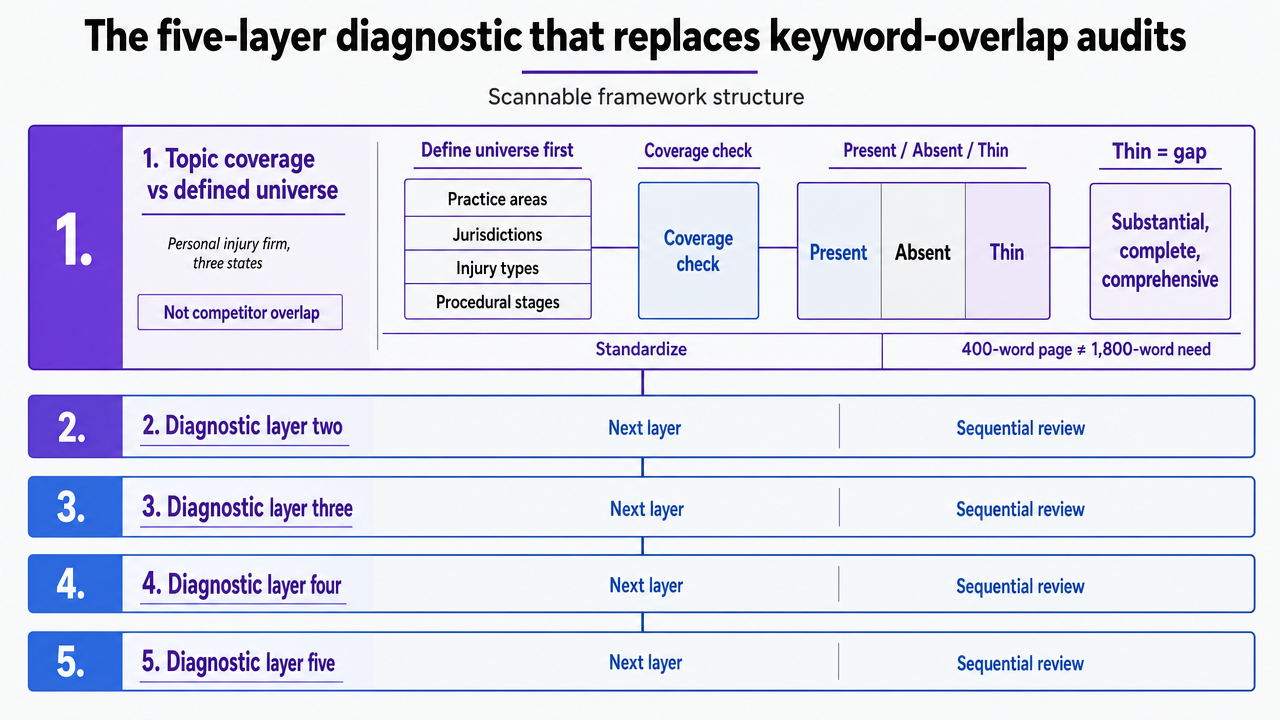 Visualize the five sequential diagnostic layers described in the section, giving readers a scannable reference for the framework's core structure
Prioritization: scoring gaps against client pipeline, not keyword volume
Detecting gaps yields a list; prioritization determines which items warrant immediate attention. At portfolio scale, many agencies lose margin because they default to search volume for prioritization, which often has little correlation with a specific client's revenue.
For example, a legal services client with a $9,000 average matter value prioritizes six queries where AI Overviews cite competitors. A dental group focuses on twenty procedure pages leading to booked appointments. A behavioral health provider prioritizes intake-adjacent queries in specific ZIP codes. These diverse portfolios share no common keywords, and volume-based rankings would incorrectly prioritize all of them.
A portable scoring model requires four inputs applicable to any account:
- Pipeline proximity (how close the query is to a converting action),
- Revenue weight (deal size or lifetime value associated with the query),
- Gap severity (which diagnostic layer is failing and by how much), and
- Remediation cost (new page, format swap, technical fix, or extractability rewrite).
Each input is scored on a fixed scale, and the composite score ranks the queue.
This formalization ensures consistency. A standardized scoring rubric allows one strategist to manage more accounts without compromising quality. BCG's value-centric approach notes that AI excels in data-heavy workflows where topic and intent modeling can be scored and re-scored, rather than debated per client2. The CMI's 2026 B2B benchmark further confirms that prioritization, not production capacity, is the main constraint for marketing teams8.
Effective frameworks for real portfolios exhibit two key scoring habits. First, pipeline proximity always outweighs volume in tie-breaks. A query with 90 monthly searches one click from an intake form is more valuable than a 12,000-volume awareness query without a clear conversion path. Second, remediation cost is quantified in analyst hours, not abstract ratings, allowing the queue to be sequenced against actual quarterly capacity. A gap requiring a schema fix and a 200-word extractability rewrite can ship quickly, while a new twelve-page hub competes for the next quarter's budget.
The output is a ranked queue per client, consistent across the portfolio: query, gap layer, pipeline stage, revenue weight, remediation cost, and composite score. This allows a head of SEO reviewing forty accounts to see forty identical queues, transforming prioritization from a discussion into a clear decision.
Test a Complete Content Gap Workflow Now
Experience a live, end-to-end content gap analysis and publish production-ready content for real clients.
Portfolio delivery economics: what standardization actually buys
Standardization is not merely a preference; it dictates how many accounts a strategist can manage without quality degradation, directly impacting agency margin.
The economics involve three variables: analyst hours per account per quarter, accounts per strategist ceiling, and a relative cost index. Assuming a constant analyst rate, cost differences arise from the degree of templated diagnostics, scored versus debated decisions, and automated execution. BCG's agentic marketing analysis estimates 15% to 20% cost efficiencies and up to a 3x volume increase when AI agents orchestrate repeatable workflow layers3. This range directly reflects the difference between bespoke audits and a standardized loop.
For quarterly gap work across a portfolio, the models compare as follows:
| Delivery model | Analyst hours per account per quarter | Accounts per strategist ceiling | Relative cost index |
|---|---|---|---|
| Bespoke per-client audit | 8–12 | 12–18 | 1.0x (baseline) |
| Standardized framework | 4–6 | 25–35 | 0.80–0.85x |
| Framework plus AI execution | 1.5–2.5 | 40+ | 0.60–0.70x |
The hour ranges are for quarterly refreshes of the five-layer diagnostic, not initial audits. The cost index is benchmarked against the bespoke baseline and aligns with BCG's efficiency range3; the volume ceiling reflects the potential 3x throughput increase from the same analysis.
Two points are critical for a head of SEO. First, the shift from bespoke to a standardized framework offers greater margin recovery than the jump from framework to framework-plus-AI. Templating diagnostics and scoring rubrics captures most efficiency before automation. Second, the accounts-per-strategist ceiling determines hiring needs. Adding fifteen accounts with a bespoke ceiling necessitates a new strategist, whereas the same growth with a standardized ceiling can be absorbed by existing capacity.
These efficiency figures are from a marketing-wide analysis, not SEO-specific, and represent a potential range, not a guarantee. They indicate the upper bound of what the operating model can achieve.
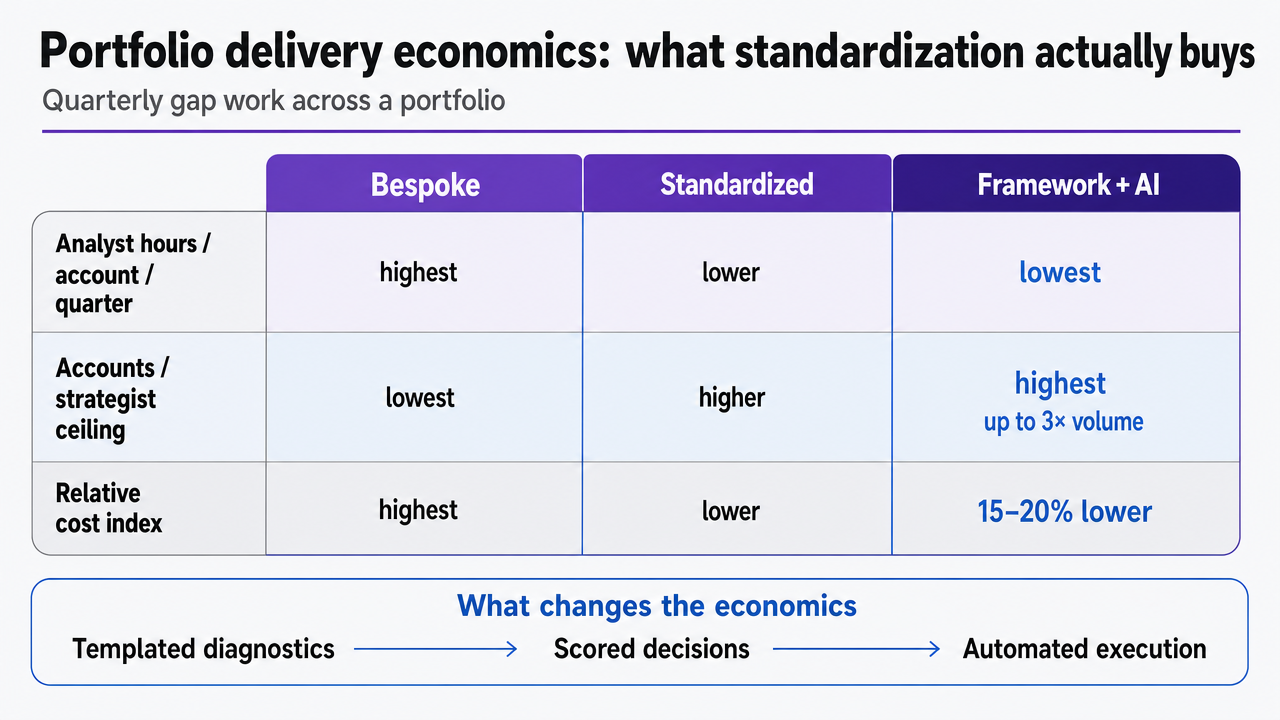 Render the comparison table from the section as a clear visual, showing how bespoke, standardized, and framework-plus-AI models differ across analyst hours, account ceilings, and cost index
If you manage multiple client portfolios: the operating loop
This section focuses on the head of SEO managing delivery across a portfolio, shifting the analysis from individual audits to the continuous loop that produces them.
The five-layer diagnostic and scoring rubric are components that only generate compounded margin when integrated into a closed loop. This loop ingests signals, produces ranked queues, routes work for approval, and feeds outcome data back into the next cycle. A process that ends with a strategist emailing a spreadsheet is still a bespoke workflow, despite appearing structured.
The operating loop consists of six stations.
- Signal ingestion gathers raw inputs: Search Console performance data (including generative AI reports7), SERP feature captures for priority queries, competitor coverage snapshots, and client pipeline data (e.g., qualified leads, booked appointments, matter values).
- Diagnostic execution runs the five layers against these inputs.
- Prioritization scoring applies the rubric to create a ranked queue.
- Human approval gates which items proceed.
- Execution produces the work (new pages, format swaps, rewrites, technical fixes).
- Finally, KPI feedback closes the loop by attributing movement back to the layer and query that initiated the work.
Two design choices determine scalability. First, signal ingestion and diagnostic execution must be templated per vertical, not per client. A legal services template should run identically across all legal accounts; a dental template across all dental groups. Forrester notes that generative AI is most effective when embedded into structured operating models rather than bolted onto bespoke workflows1. Second, the approval gate must be positioned between prioritization and execution, not between diagnostic and prioritization. Strategists approve what ships, while the diagnostic runs automatically.
At portfolio scale, this loop creates a common cadence. Every account progresses through the same six stations on the same schedule. This provides a head of SEO with visibility into forty loops at known stages, rather than forty projects at unknown stages. This visibility is a critical asset, transforming portfolio management from a status-meeting problem into a capacity-allocation decision.
See How Data-Driven Content Gap Analysis Scales Client SEO Without More Headcount
Connect with a strategist to review frameworks for automating content gap detection, prioritization, and execution across multi-client portfolios—backed by live performance benchmarks from leading agencies.
Governance: what a human strategist still owns
The scaling argument relies on treating governance as a deliberate design choice, not a bottleneck. Even with automated diagnostic execution and scoring, clear rules are needed for what humans approve, what runs automatically, and what should never be delegated.
Three categories remain with the strategist:
- Universe definition: deciding if a legal services client's topic map includes premises liability but excludes workers' compensation is a strategic business decision, not something a diagnostic can infer.
- Pipeline weighting in the scoring rubric: assigning higher revenue weight to intake-adjacent queries in specific ZIP codes requires knowledge of client margins, referral patterns, and capacity constraints. Automating this flattens the very judgment the framework needs.
- Go/no-go decisions on remediation involving brand claims, regulated language, or competitive positioning (e.g., behavioral health disclosures, legal disclaimers, medical procedure descriptions). Here, extractability for AI Overviews is less critical than the compliance cost of incorrect phrasing.
The repeatable middle can be automated:
- layer-one topic checks against a defined universe,
- SERP feature capture,
- technical discoverability audits6,
- Search Console generative AI report ingestion7, and
- mechanical application of an approved scoring rubric.
BCG's agentic marketing analysis supports this split, where AI agents handle data-heavy layers while humans manage context-dependent decisions3.
The governance artifact is a documented approval matrix per vertical. This matrix specifies which diagnostic outputs auto-queue, which require strategist sign-off before production, and which need partner-level review before publishing. Written once, applied consistently across the portfolio, and revisited quarterly, this document prevents a forty-account portfolio from developing forty different quality standards.
Installing the framework in the next 90 days
Ninety days is sufficient to transition one vertical of a portfolio to the standardized loop, but not the entire portfolio. Attempting to do too much at once often leads to project stalls.
The first thirty days are dedicated to developing the universe template and scoring rubric for one vertical. Choose the vertical with the most accounts (e.g., legal, dental, behavioral health) to maximize template amortization. Define the addressable topic map, the intent classification rubric (based on informational, navigational, transactional, and local categories12), the SERP feature inventory schema, and the four-input scoring model. The approval matrix should be shipped concurrently; nothing runs automatically until the strategist approves this matrix.
Days thirty-one to sixty involve running the loop with three pilot accounts in that vertical. Three accounts are enough to identify template gaps but few enough to fix them without extensive rework. Signal ingestion connects to Search Console, including generative AI performance reports7. The five-layer diagnostic runs, the scoring rubric ranks the queue, strategists approve, execution proceeds, and KPI feedback attributes movement to the triggering layer. Track template exceptions; each strategist override is an input for rubric refinement, not a workflow failure.
Days sixty-one to ninety extend the vetted template to the remaining accounts in the initial vertical and begin building the template for the second vertical. By day ninety, one vertical operates on the loop, another is in template design, and the accounts-per-strategist ceiling for the standardized layer is a measured reality, not a projection.
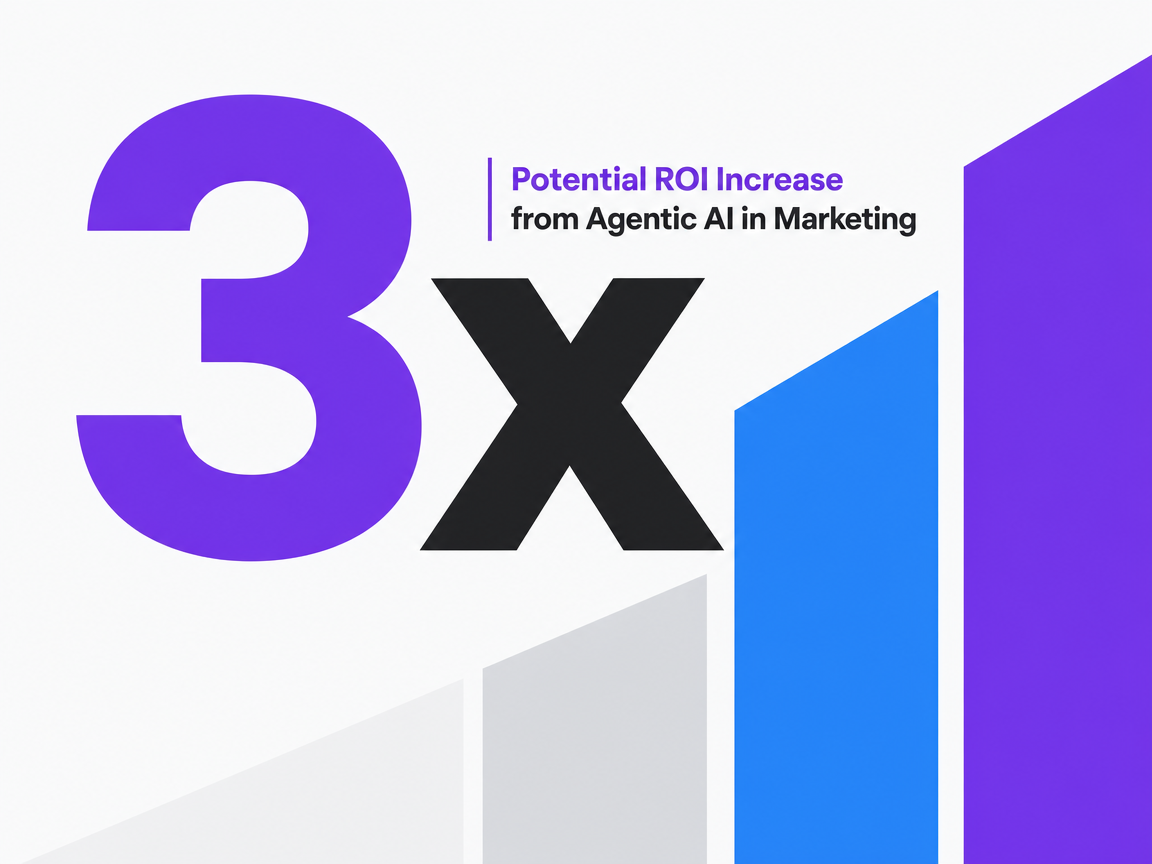 Potential ROI Increase from Agentic AI in Marketing
Potential ROI Increase from Agentic AI in Marketing
Frequently Asked Questions
References
- 1.The State Of Generative AI Inside US Marketing Agencies, 2025.
- 2.From Campaigns to Business Value: AI in Marketing.
- 3.CMOs Who Move First in Agentic Marketing Will Win.
- 4.Creating Helpful, Reliable, People-First Content.
- 5.Search Engine Optimization (SEO) Starter Guide.
- 6.SEO Guide for Web Developers.
- 7.Introducing Search Generative AI performance reports in Search Console.
- 8.B2B Content and Marketing Trends: Insights for 2026.
- 9.Enterprise Content and Marketing Trends: Insights for 2026.
- 10.Technology Content and Marketing Trends: 2026 Insights.
- 11.A multi-dimensional model for search intent.
- 12.Deriving Query Intents from Web Search Engine Queries.