
Key Takeaways
- Keyword overlap reports only surface symptoms; a four-layer taxonomy covering keyword, intent-stage, SERP-format, and conversion-path gaps separates traffic opportunities from actual pipeline contribution.
- Rank gap candidates by expected pipeline contribution using intent-stage weight, realistic capture rate, downstream conversion value, and hours-to-close rather than search volume or difficulty alone.
- Evaluate every closed gap against Google's originality and completeness bar 1, and triage technical-visibility issues 8before commissioning new editorial work on duplicate topics.
- Focus next on instrumenting server-side events through GA4's Measurement Protocol 4so each asset reports assisted conversions and pipeline value, informing the following quarter's queue.
Why keyword overlap reports stopped being enough
Every competitor overlap report highlights keywords a client's site doesn't rank for, which is a common finding for agency SEO leads. However, this output rarely surprises anyone or significantly boosts client revenue.
The issue isn't with tools like Ahrefs or Semrush, which accurately identify keyword deltas. The problem is that a keyword delta is a symptom, not a diagnosis. A page might rank for a missing term but still fail to generate qualified leads or signed engagements. The client's true concern lies further down the sales funnel.
Google's own guidance emphasizes unique, up-to-date, and people-first content over keyword completeness 2. The Helpful Content system assesses whether a page offers original information, reporting, research, or analysis and covers the topic comprehensively 1. Traditional overlap reports do not measure these crucial aspects.
Agencies that prioritize content gap analysis based on expected pipeline contribution create fewer, more effective assets. The following sections detail this shift, beginning with a four-layer gap taxonomy that distinguishes traffic from revenue.
The four-layer gap taxonomy that separates traffic from pipeline
Keyword gaps: the surface layer every tool already finds
Keyword gaps serve as an initial data point, not a complete framework. A typical overlap export identifies terms for which three or more competitor domains rank, but the client's site does not, often filtered by search volume and difficulty. Any agency strategist can quickly generate this list.
While this output offers some diagnostic value, it's limited. It shows which text strings are absent from the client's index but doesn't indicate whether these strings represent potential buyers, researchers, or comparison shoppers. It also doesn't reveal if existing pages cover the topic but lack technical visibility, a failure mode Google's developer guidance highlights when pages are unreachable, semantically unclear, or poorly titled 8.
Keyword gaps should be treated as raw material. Remove branded terms belonging to competitors, informational queries that don't align with the client's monetization strategy, and duplicates. The remaining terms form a candidate pool, not a content plan. The subsequent three layers—intent, format, and conversion path—determine which candidates warrant further investment. Agencies that move beyond just keyword gaps publish less but achieve better rankings.
Intent-stage gaps: where the higher-value queries hide
Intent-stage gaps explain why pages targeting the same keyword yield different revenue outcomes. The keyword might be identical, but the searcher's intent varies.
Jansen and colleagues' foundational intent taxonomy categorized web queries as informational, navigational, and transactional, with over 80% being informational 6. While this study focused on general web search, and modern SERPs often blend intents, the strategic implication remains: agency content calendars often overemphasize informational queries due to their high volume and lower competition. The 20% representing decision-stage behavior, however, receives disproportionately less attention.
This imbalance creates revenue gaps. Queries related to comparisons, pricing, provider selection, and local searches convert at a much higher rate than informational queries. These high-value queries require a different content approach—more concise, specific, and direct. Clustering-based intent detection can streamline classification by grouping queries with similar SERP characteristics, allowing strategists to label large keyword sets more efficiently than manual review 7.
The operational strategy involves scoring every keyword-gap candidate for its intent stage before allocating production resources. An audit revealing a client covers 90% of informational queries but only 15% of decision-stage queries within a topic cluster indicates a portfolio allocation problem, not just a keyword issue. Addressing this can be the most significant factor in increasing booked revenue per published asset.
SERP-format gaps: ranking exists, the format does not
A page can rank highly but still fail to attract clicks if its format doesn't match the SERP's dominant content type. Format gaps occur when a client's text-heavy page competes against video carousels, a listicle against comparison tables, or a long guide against FAQ-style snippets.
Identifying these gaps is straightforward. Analyze the top ten results for each priority keyword and categorize the dominant content type: how-to, comparison, listicle, calculator, video, product page, or local pack. Then, compare this to the client's asset for that query. If there's a significant format mismatch, simply rewriting the copy won't suffice. The page requires structural changes, such as table blocks, structured data, embedded media, or an entirely different template.
Google's guidance views format as an interpretation challenge. Semantic HTML, descriptive titles, and text equivalents for visual content help search systems understand page offerings 8. Structured data further enhances interpretability, especially on SERPs where rich results capture clicks before traditional blue links 9. Format gaps are easy to identify and moderately costly to fix, offering a good effort-to-impact ratio for portfolios with existing rankings that underperform.
Conversion-path gaps: the page ranks and still leaks revenue
The fourth layer, often overlooked in agency reporting, involves pages that rank well and have respectable time-on-page metrics but generate few qualified leads. The problem isn't acquisition but what happens after the click.
Conversion-path gaps typically manifest in several ways: the primary call-to-action is buried, the form requests information visitors aren't ready to provide, or crucial next steps (like pricing or intake instructions) are not linked from the ranking asset. The page answers the query but fails to guide the visitor toward a transaction.
Google's page experience guidance states that no single UX signal dictates rankings and that evaluation is page-specific 3. This implies that a page can satisfy search systems and user queries but still fail commercially because ranking and converting are distinct objectives. Strong content that doesn't facilitate conversion represents a revenue leak, not a ranking failure.
Auditing this layer requires linking session-level behavior data to downstream outcomes like form fills, calls, or booked consultations. Traditional KPIs such as page views, bounce rate, and average time on page don't reliably identify these leaks 5. While instrumentation is feasible, it falls under funnel attribution, which is discussed later in this analysis.
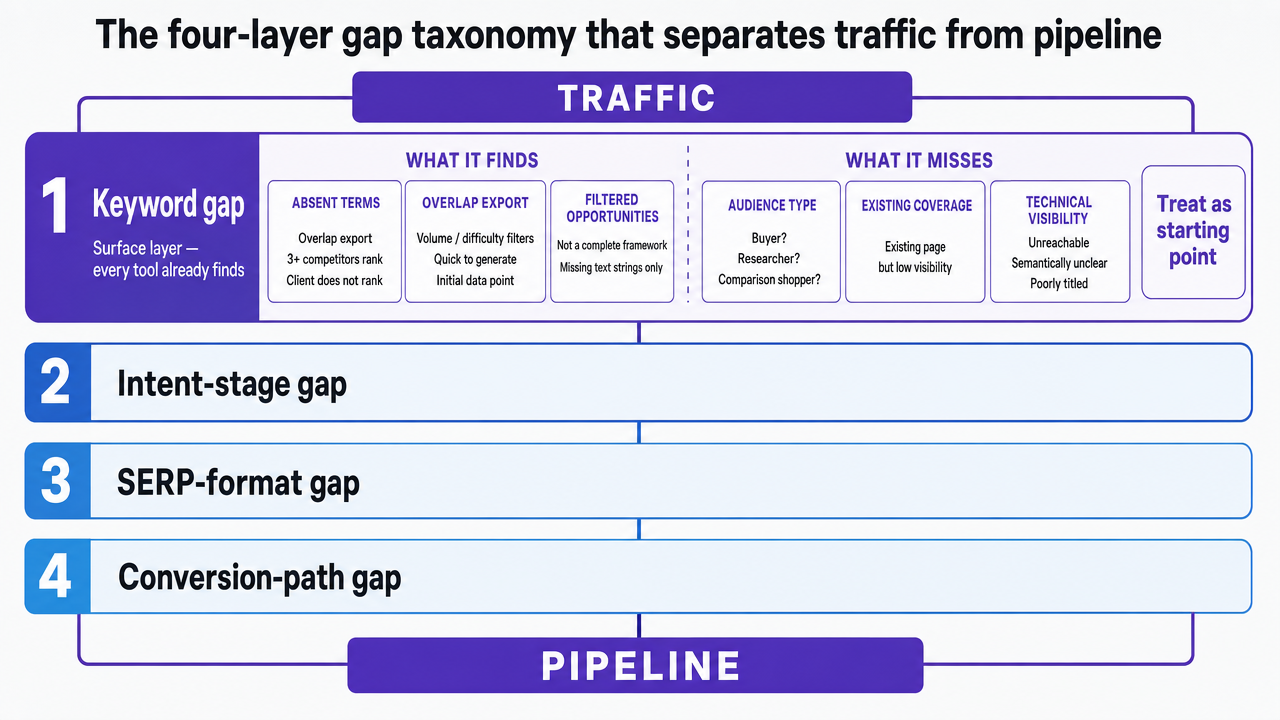 Visualize the four-layer gap taxonomy (keyword, intent-stage, SERP-format, conversion-path) that structures the entire article's framework
Ranking gaps by expected pipeline contribution
Once the four gap layers are identified, prioritization becomes an allocation exercise. Each gap candidate is assessed based on its expected pipeline contribution, considering search demand at the intent stage, current SERP position for related pages, conversion rate of the nearest revenue-generating template, and the strategist hours needed to close it. The result is a ranked queue, not just a list of missing keywords.
The defensibility of this queue depends on the measurement layer. Traditional audit frameworks track metrics like page views, bounce rate, average time on page, page-one keyword rankings, and backlink counts 5. These metrics reflect reach and engagement but not pipeline contribution. A page can excel in all these areas and still generate no booked consultations.
Pipeline-linked audits require different instrumentation. GA4's Measurement Protocol can send server-side events, connecting online sessions to offline behaviors such as booked calls or signed engagements, and attributing them to a session_id. Google notes this supplements, rather than replaces, front-end tagging and may result in partial reporting without it 4. When combined with content-level dimensions, this data allows agency leads to score each URL by assisted conversions, qualified leads, and influenced pipeline value, moving beyond traffic alone.
The ranking formula doesn't need to be complex: Expected pipeline contribution = intent-stage weight × realistic capture rate × downstream conversion value, discounted by hours-to-close. Sorting this queue in descending order tells strategists which gaps to prioritize this quarter and which to defer. It also provides client-facing leads with a clear answer to the common QBR question: "Why this content, why now, and what will it return?"
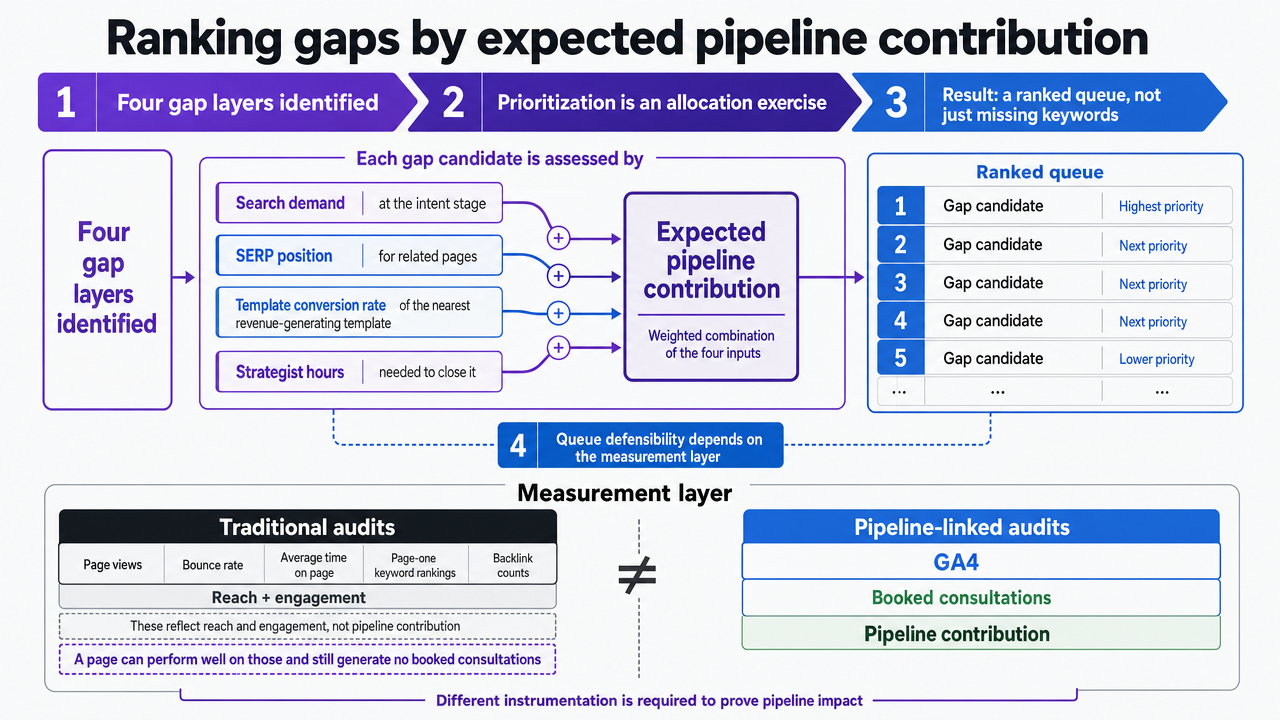 Visualize the pipeline contribution ranking formula and prioritization workflow described in this section
Pinpoint and Close Content Revenue Gaps Fast
Identify missed keyword opportunities and publish targeted content to address revenue-driving gaps immediately.
Closing gaps against Google's helpful content bar
The originality and completeness threshold
Every gap in the ranked queue is ultimately evaluated against Google's helpful content guidelines. These guidelines ask whether a page offers original information, reporting, research, or analysis, and whether it provides a substantial, complete, or comprehensive description of the topic 1. This standard, not word count or keyword density, is the benchmark for competitor content.
Most competitor pages fall short on either originality or completeness. They often merely summarize existing content or address only part of the searcher's decision-making process. Agency strategists can assess competing URLs for a target keyword based on these two criteria. If both are weak across the top ten results, it signals a significant opportunity for a well-scoped content brief.
Originality doesn't always demand primary research. It requires unique insights the client can offer, such as proprietary data, expert perspectives, jurisdictional specifics, or firsthand operational details. Completeness means the page fully resolves the query—covering definitions, tradeoffs, edge cases, and next steps—rather than just serving as an entry point. Pages built to this standard rank on merit and maintain their position.
Page experience as a revenue variable, not a ranking checkbox
Page experience is often seen as a technical hygiene task in agency workflows, which underestimates its financial impact when neglected. Google's guidance clarifies that there isn't a single page-experience signal, and core ranking systems evaluate content on a page-specific basis 3. Additionally, INP replaced FID in Core Web Vitals in March 2024, shifting the focus for field data monitoring.
The revenue implications are distinct from ranking. A page can rank well due to strong content but convert poorly if the interaction is slow, the layout shifts, or a form loads too late. This constitutes a page-experience revenue leak, not a ranking failure.
Agency leads auditing gap-closing content should evaluate each priority URL based on field-data Core Web Vitals alongside its conversion rate for that template. If INP is high on mobile and the primary CTA is below the fold, the solution is engineering, not editorial. Reporting these two metrics together ensures page experience is not merely a post-launch checkbox.
Technical-visibility gaps disguised as writing gaps
Some apparent editorial gaps are actually technical. A client might have already published a relevant page that covers the topic, but it fails to rank because search systems cannot access, parse, or understand its content.
Google's developer guidance explicitly outlines these failure modes: pages must be reachable via links from other discoverable pages, visual content needs text equivalents, and every page requires a descriptive title and meta description 8. Broader technical guidance includes structured data, crawl budget management for large sites, mobile-friendliness, and hreflang for multilingual content as levers that enable proper interpretation of strong content 9.
The audit process should involve cross-referencing the keyword-gap candidate list with the client's existing URL inventory before commissioning new content. If a matching URL exists but is orphaned, poorly titled, or blocked from crawling, the gap can be closed with a quick technical fix. Creating a duplicate page on the same topic wastes strategist time and dilutes the topic cluster. Technical-visibility triage should precede, not follow, the editorial queue.
AI-assisted gap analysis: what accelerates, what still needs judgment
The four-layer taxonomy—keyword, intent-stage, SERP-format, conversion-path—clearly delineates where AI assistance is beneficial and where human judgment remains essential. Each layer presents diagnostic questions and closing tactics, with machines handling roughly half of each.
Clustering models excel at the keyword and intent-stage layers. Research on query intent detection for SEO demonstrates that clustering methods can group queries by shared SERP signatures and features, then label new queries based on proximity to these clusters 7. A strategist manually reviewing 4,000 candidate terms would take days, whereas reviewing pre-clustered groups with draft intent labels takes hours. This significant acceleration compounds across a portfolio.
SERP-format detection is similarly mechanical. Scraping the top ten results for priority queries, classifying dominant content types, and flagging format mismatches against the client's assets is repetitive labeling work that machines perform faster and more consistently than junior strategists.
The judgment layer begins with revenue weighting. Deciding which intent-stage gap to prioritize requires client-specific context: margin per engagement, sales team capacity, seasonal demand, and competing internal priorities. While AI can rank candidates using the pipeline contribution formula, the inputs—capture rate assumptions, conversion value estimates—still rely on human account knowledge.
Originality is another area where judgment is crucial. Google's helpful content criteria ask whether a page offers original information, reporting, research, or analysis and covers the topic substantially 1. Generative models produce fluent summaries of existing content but do not create proprietary intake data, expert perspectives, or firsthand operational details that distinguish a truly gap-closing asset from another summary. This editorial input must come from the client or a knowledgeable strategist.
The most effective workflow combines AI acceleration for classification and clustering with human judgment for weighting, sourcing, and voice. Agencies that fully automate the entire pipeline risk publishing faster but ranking worse.
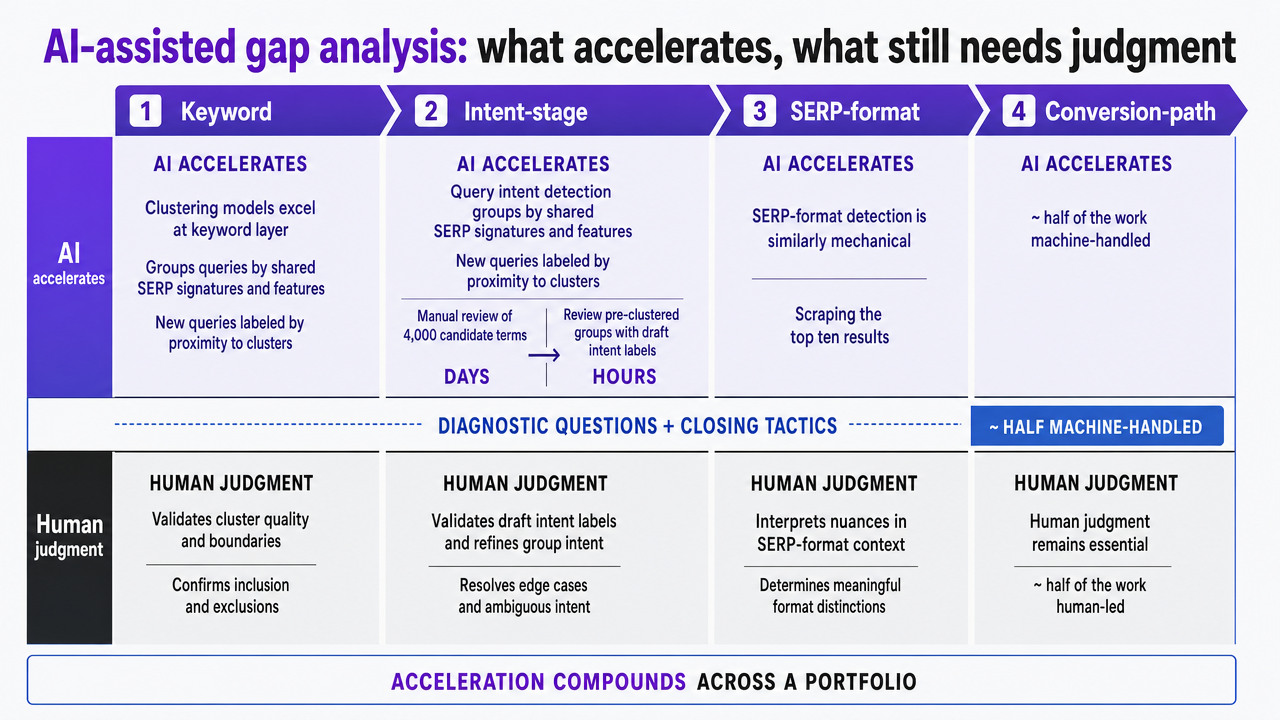 Comparison infographic showing which gap analysis tasks AI accelerates vs which require human judgment, directly supporting this section's split framework
If agencies manage multi-location portfolios: gap analysis at scale
The framework discussed so far assumes a single client, domain, and topic cluster. However, agencies managing multi-location portfolios, such as dental support organizations, law firm networks, or senior living operators, operate at a different scale. A DSO with 120 locations doesn't have one content gap analysis; it has 120, plus a corporate site and service-line hubs feeding into each location page.
The scale changes prioritization. Under a traditional per-page audit, strategist hours increase linearly with location count. A portfolio owner conducting quarterly audits for 80 locations, each with 15 pages, faces 1,200 URLs before any writing begins. Many agencies never complete such audits, leading to location pages that often resemble duplicated templates with only city names swapped.
Two strategies compress this effort. First, treat location pages as instances of a template, so gap analysis is performed once against the template and applied to all instances. Intent-stage and SERP-format gaps at the template level can be closed for the entire portfolio in a single production cycle. Second, prioritize technical-visibility triage before editorial work, as location portfolios accumulate crawl waste faster than content debt. Google's technical guidance highlights structured data, crawl budget management, mobile-friendliness, and hreflang for multilingual coverage as critical factors for interpreting location content 9.
Conversion-path gaps remain location-specific. Local intake numbers, provider bios, jurisdiction-specific disclosures, and near-me calls-to-action do not template cleanly. Agency leads conducting portfolio audits should distinguish template-level gaps from location-level gaps in the ranked queue and staff them differently: template work goes to senior strategists, while location-specific variants are handled by a production team using a checklist. This division optimizes portfolio economics for the agency.
Pinpoint Content Gaps Costing You Organic Revenue—Faster
See how leading agencies apply data-driven content gap analysis to surface missed opportunities, benchmark against competitors, and prioritize initiatives with measurable pipeline impact across multiple clients. Request an expert consultation tailored to your portfolio.
Instrumenting the funnel so each asset reports back
A ranked queue of gaps is only valuable if each closed asset reports its contribution. Without this feedback loop, subsequent prioritization relies on guesswork.
The instrumentation stack has three layers. Front-end tagging captures on-page behavior and initial conversion events. Server-side events via GA4's Measurement Protocol send booked calls, qualified-lead flags, and closed engagements back into the same property, linked to the originating session through a session_id. This ensures asset-level attribution persists from click to CRM 4. Google notes that this protocol supplements, rather than replaces, gtag, Tag Manager, or Firebase, meaning both layers must be robust for accurate revenue reconciliation 4.
Most agencies underinvest in the reporting layer. Content-level dimensions—URL, topic cluster, intent stage, gap layer closed—need to be integrated with downstream outcomes so each asset's report includes assisted conversions, qualified leads, and pipeline value, in addition to traffic. Traditional audit metrics remain useful diagnostics but are no longer the primary scorecard 5. With this system, the next quarterly audit's ranked queue can be rebuilt from live pipeline data, rather than relying on strategist memory.
What agency SEO leads do differently next quarter
The change isn't in tooling; every agency has access to similar overlap exports. The shift is in what gets published and what remains in the backlog.
Agency SEO leads employing revenue-linked gap analysis refine keyword exports to focus on intent-stage candidates. They prioritize technical-visibility fixes before commissioning new content and evaluate completed assets based on originality and completeness, rather than just word count 1. They integrate asset-level dimensions with server-side conversion events to ensure future audits are informed by pipeline data 4. For multi-location portfolios, they differentiate between template-level and location-level gaps, staffing them accordingly.
This approach results in fewer, more comprehensive assets and provides a clear answer to client questions about ROI. Platforms like Vectoron streamline classification and clustering, allowing strategists to focus their time on critical judgment areas—revenue weighting, sourcing, and voice—where human expertise is indispensable.
Frequently Asked Questions
References
- 1.Creating Helpful, Reliable, People-First Content.
- 2.Search Engine Optimization (SEO) Starter Guide.
- 3.The role of page experience in creating helpful content.
- 4.Measurement Protocol | Google Analytics.
- 5.How To Find (and Close) the Hidden Gaps in Your Content Strategy.
- 6.Determining the User Intent of Web Search Engine Queries.
- 7.Query Intent Detection from the SEO Perspective.
- 8.SEO Guide for Web Developers | Google Search Central.
- 9.Technical SEO Techniques and Strategies.
- 10.Get on Discover.