
Key Takeaways
- Treat keyword-overlap exports as one input, not the strategy — real gaps include thin pages, duplicate coverage, and unowned URLs that fail user tasks 3.
- Build the template on ten columns ending in a Disposition decision, extending the USDA schema with Task Served, Quality Score, and Priority 8.
- Scope each audit to one business objective, a defined URL boundary, and named competitors before opening a spreadsheet, so downstream disposition calls have an anchor 2.
- Capture inventory from CMS, crawl, and Search Console, then freeze six baseline metrics per URL — reviewers log facts, not editorial judgment, at this stage 9.
- Score every page on seven fixed axes (usability, readability, findability, accuracy, value, voice, ownership) using a 1–3 band, with a calibration pass to remove reviewer drift 4.
- Map each URL to a specific user task, not a keyword, to surface orphaned, duplicated, and misaligned jobs that drive Create, Consolidate, or Revise decisions 3.
- Route rows through a Keep / Revise / Consolidate / Retire matrix triggered by quality score, ROT flag, and strategic fit — using Task Served as the tiebreaker 10.
- Rank the actionable backlog with a Traffic × Fit × Effort score between 1 and 125, then draw a capacity line so writers pull from a defensible queue 12.
Why Keyword-Overlap Reports Miss the Real Gaps
Most content gap analyses stop at a keyword overlap export: pull three competitor domains into a research tool, filter for terms they rank for and the site does not, and hand the list to writers. That output is a shopping list, not a strategy. It ignores whether the site already has a thin page on the topic, whether the existing page fails a user task, and whether publishing a fourth near-duplicate would shrink or expand overall quality.
The federal digital teams that publish content operations guidance frame the problem differently. Digital.gov defines the goal of a content review as identifying gaps in coverage, redundant or outdated content, and content that does not help users meet goals 3. That reframe matters because it treats missing keywords as one symptom among several — alongside pages that exist but underperform, pages that duplicate each other, and pages nobody owns.
Google's own guidance points the same direction. It asks whether a page provides original information, reporting, research, or analysis, and whether it offers a substantial description of the topic 1. A keyword the site does not rank for is not automatically a gap. A page that ranks but fails those quality tests is. A useful template must catch both, produce a ranked action list, and force a disposition decision on every URL already in the inventory.
The Template Schema: Ten Columns That Force a Decision
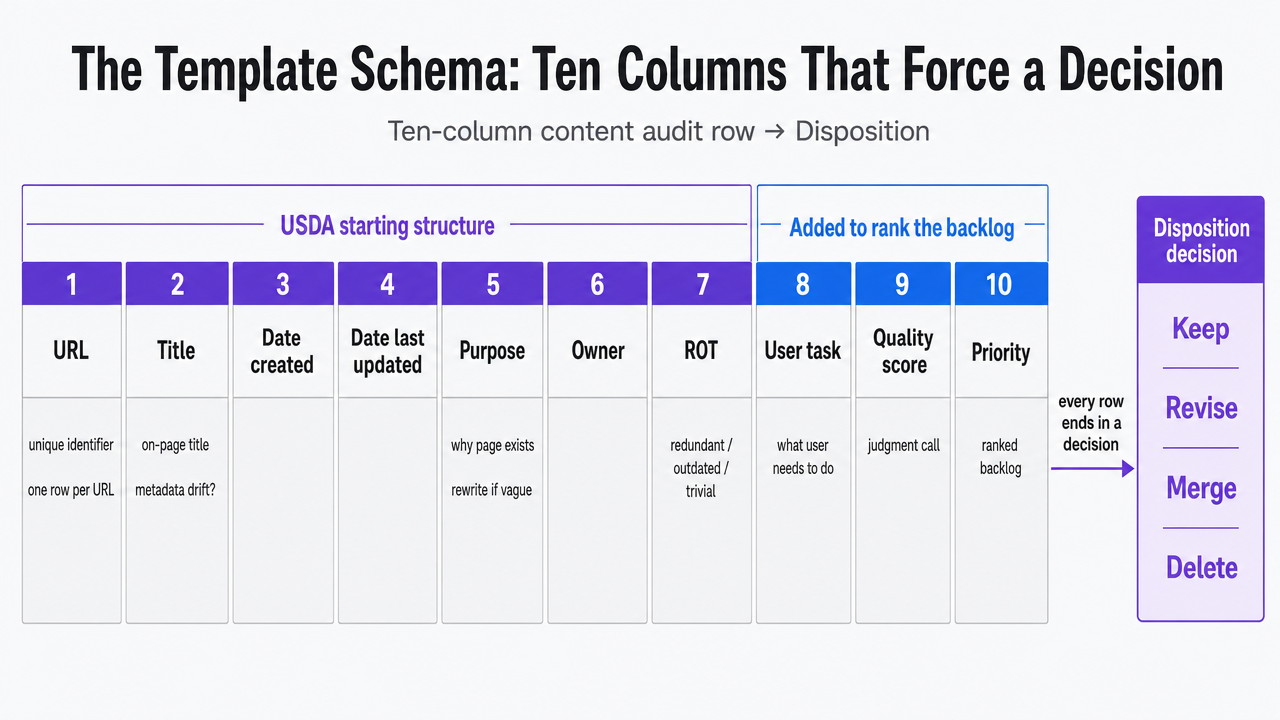
A gap analysis template earns its keep when every row ends in a decision. The USDA Content Audit Template models this discipline directly: its column set includes URL, title, date created, date last updated, purpose, owner, ROT (redundant, outdated, trivial), and action 8. That structure is the starting point. The ten-column schema below extends it to capture user task, quality score, and priority — the fields that turn an inventory into a ranked backlog.
Each column exists because it forces a judgment call the writer or editor would otherwise defer:
- URL — The unique identifier. One row per URL, no exceptions. Duplicate slugs surface here first.2. Title — The current on-page title, not the CMS filename. Discrepancies between the two often signal metadata drift.3. Purpose — One sentence answering why the page exists. If the reviewer cannot write it, the page is a consolidation candidate.4. Owner — A named person, not a team. USDA's guidance treats ownership as a prerequisite for refining and optimizing content, not a nice-to-have 7.5. Last Updated — The last substantive edit date. Age alone does not justify deletion, but it flags freshness review 9.6. Intent — Informational, navigational, transactional, or commercial. Mismatched intent is a common quality failure.7. Task Served — The specific user job the page completes. Digital.gov frames gaps as unanswered user needs, so this column is where the strategic thesis lives 3.8. Quality Score — A composite score against the seven evaluation criteria covered in Step 3 4.9. ROT Flag — Redundant, outdated, or trivial, per the USDA schema 8. A binary yes/no that feeds disposition logic.10. Disposition — Keep, Revise, Consolidate, or Retire. The forcing function of the whole template.
An eleventh field — Priority — is added at the end of the process once traffic potential, strategic fit, and effort have been scored. That column converts the disposition list into a ranked backlog writers can pull from.
Teams that shortcut this schema — dropping Purpose, Owner, or Task Served because they feel qualitative — end up with a spreadsheet nobody trusts. The columns that resist automation are the ones that create accountability.
 Visualize the ten-column template schema as a process infographic so readers can see the structure of the spreadsheet and how each column feeds the Disposition decision
Step 1: Scope the Audit Before Touching a Spreadsheet
Scope is the variable that decides whether a gap analysis ships in three weeks or dies in month four. The USA.gov team, reflecting on a federal-scale audit, stressed defining the focus first and working from a representative sample when the calendar is tight 12. That advice carries directly to a lean in-house team with a live editorial calendar: pick the slice, then commit.
Three scoping decisions belong on paper before anyone opens a spreadsheet.
Business objective. The audit serves one goal per cycle — pipeline growth from a specific service line, recovery of decayed rankings in a topic cluster, or cleanup of a legacy subdomain. Digital.gov's four-step workflow starts with goals for a reason: without one, every column argument becomes a preference debate 2.
URL boundary. Name the directories, templates, or clusters included. A 4,000-URL site does not need a 4,000-URL audit. A representative sample — top-traffic pages, top-converting pages, and a random sample of the long tail — surfaces the same patterns faster 12.
Competitive frame. Competitors are named by service line and segment, not by domain rating. The SBA's competitive analysis structure — identify rivals by product line and market segment — keeps the comparison anchored to buyers a mid-market brand actually loses to 6.
Write these three decisions at the top of the sheet. Every disposition call downstream will point back to them when a stakeholder asks why a page was retired.
Step 2: Build the Inventory and Capture Baseline Metrics
With scope locked, the inventory becomes a data-capture exercise, not a discovery one. USDA guidance frames the purpose plainly: the audit exists to understand what content exists, where the gaps sit, and what needs to be refined or optimized 7. That framing keeps the inventory build from mutating into a rewrite session — a common failure mode when reviewers start editing pages they were supposed to be logging.
Pull the URL list from three sources, in this order. Start with the CMS export, which catches unpublished drafts, orphaned pages, and templates that analytics tools miss. Layer in a crawl (Screaming Frog, Sitebulb, or the equivalent) to catch pages the CMS forgot. Then reconcile against Google Search Console and analytics to surface URLs that receive impressions or sessions but do not appear in either of the first two lists. The 2015 Digital.gov guidance on beginning with repositories and analytics still holds: those two data streams frame the true inventory boundary 9.
Baseline metrics attach to each row at inventory time, not later. Six fields cover the operational minimum:
- Sessions (last 90 days) — traffic reality, not vanity.- Impressions and average position — demand signal for pages that underperform their opportunity.- Conversions or assisted conversions — the pipeline tie-in.- Internal links in — a proxy for site architecture weight.- Backlinks — external authority signal.- Last crawl or index status — indexation problems disguise themselves as content gaps.
Capture these once, freeze the snapshot, and note the date. Metrics will drift during the scoring pass, and a moving baseline makes disposition arguments unwinnable.
One discipline separates inventories that ship from inventories that stall: no editorial judgment in this step. Reviewers log facts. Quality scoring, task mapping, and disposition come next, on a full dataset — not one URL at a time.
Test Your Content Gap Analysis in Action
Run a complete content gap analysis and publish results live during your free trial.
Step 3: Score Quality Against Seven Criteria
Quality scoring is where most gap analyses collapse into subjectivity. Two reviewers open the same URL, one calls it "pretty good," the other calls it "needs work," and the disposition column becomes a coin flip. The fix is a fixed rubric applied identically to every row. The Oregon Design Guide's evaluation model — usability, readability, findability, accuracy, value, voice, and ownership — supplies seven auditable axes that resist reviewer drift 4.
Score each axis on a 1–3 band. One means the page fails the criterion outright. Two means it passes but shows specific weaknesses. Three means it meets the criterion without qualification. The seven scores sum to a composite between 7 and 21, which drops into the Quality Score column defined in the schema.
What each axis is actually testing:
- Usability — Can a visitor complete the intended action without hunting? Broken forms, dead CTAs, and buried next steps score a 1.- Readability — Grade level, scan patterns, and structural clarity. Wall-of-text pages score a 1 regardless of accuracy.- Findability — Internal linking, navigation depth, and search visibility. Orphaned pages score a 1.- Accuracy — Factual correctness and freshness of claims. A single outdated statistic drops the score to 2; a materially wrong claim drops it to 1.- Value — Does the page offer original information, reporting, research, or analysis, per Google's people-first standard 1? Rewritten competitor content scores a 1.- Voice — Tone consistency with brand and audience. Mismatches with peer content in the same cluster score a 2.- Ownership — A named owner accountable for updates. Unowned pages score a 1 by default.
Composite scores map to action bands. Pages scoring 17–21 flow to Keep. Scores of 12–16 flow to Revise. Scores of 7–11 flow to Consolidate or Retire, with the ROT flag and task-mapping step deciding which. Locking those bands before scoring begins removes the argument about where the line sits after reviewers have preferences.
One calibration pass matters. Before the full inventory is scored, two reviewers score the same ten URLs independently, then compare. Any axis with more than a one-point spread gets a written definition refinement before the pass continues. That thirty-minute exercise is what separates a rubric from a mood.
Step 4: Map Gaps to User Tasks, Not Keyword Lists
A keyword the site does not rank for is a symptom. The underlying question is which user task the page would complete — booking a consultation, comparing two service tiers, checking whether a condition qualifies for treatment, or verifying a service area. Digital.gov's content goals guidance is explicit on this point: audits should identify gaps in coverage, redundant or outdated content, and content that does not help users meet goals 3. Meet goals, not match query strings.
Task mapping happens in the Task Served column defined in the schema. Each row gets one sentence naming the specific job the page completes for a specific reader at a specific stage. "Explains pricing for single-location dental practices evaluating monthly SEO retainers" is a task. "Dental SEO" is a keyword. The first drives disposition; the second does not.
Three failure patterns surface once tasks are named:
- Orphaned tasks. Real user jobs — insurance verification, service-area confirmation, cancellation policy — that no page owns. These become Create candidates.- Duplicated tasks. Three pages competing for the same job, cannibalizing each other. These become Consolidate candidates.- Misaligned tasks. A page targeting a commercial task with informational content, or the reverse. These become Revise candidates.
Competitor mapping enters here, not earlier. The SBA frames competitive analysis around identifying rivals by product line and market segment, then finding the ground where a brand can differentiate 6. Applied to content, that means checking which tasks competitors serve well, which they serve poorly, and which they ignore — then scoring the site's coverage against that map. Keyword overlap tools inform the exercise but do not replace it.
Step 5: Apply the Disposition Matrix — Keep, Revise, Consolidate, Retire
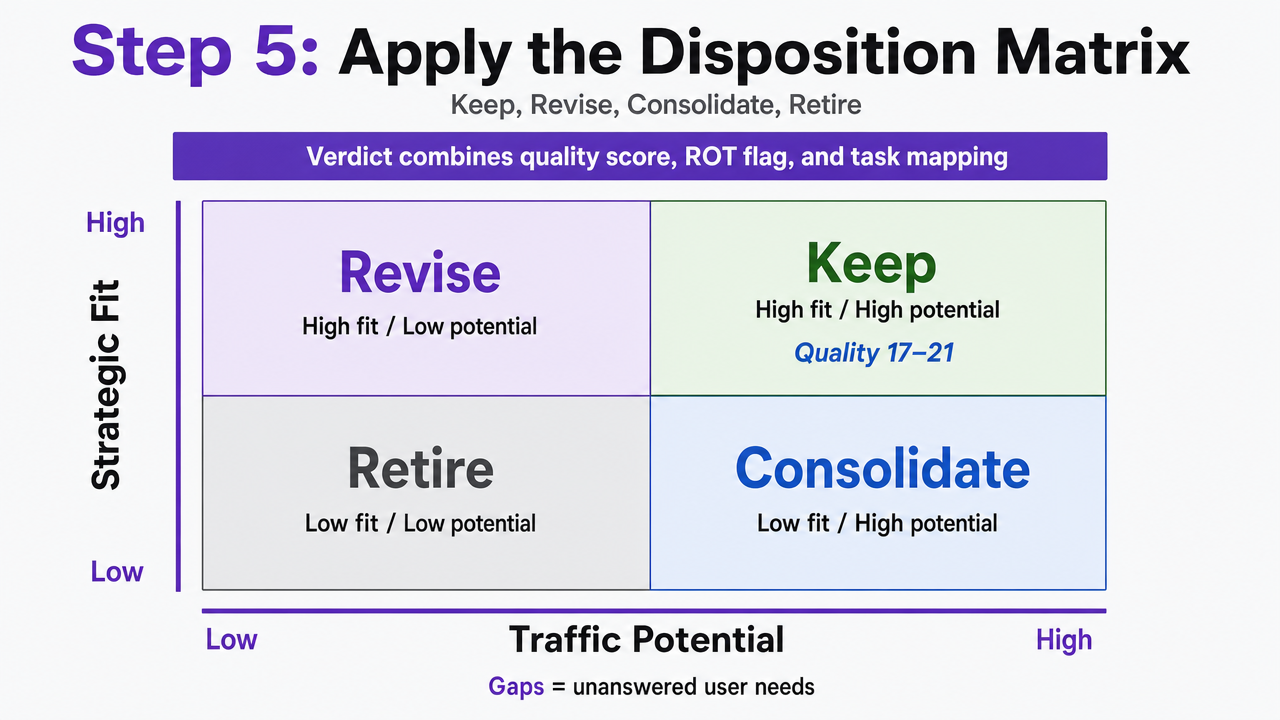
Every scored row lands in one of four buckets. The disposition matrix converts the composite quality score, ROT flag, and task-mapping notes into a single verdict per URL. Two axes drive the call: strategic fit (does the page serve a user task tied to a current business objective?) and traffic potential (does the page have measurable demand, existing rankings, or clear intent match?). The 2x2 that results — high fit / high potential, high fit / low potential, low fit / high potential, low fit / low potential — maps directly to Create or Prioritize, Consolidate, Revise, and Retire, respectively. Digital.gov frames this exact reframe: gaps are unanswered user needs, not missing keywords 3.
Each quadrant has trigger conditions that remove reviewer discretion:
- Keep — Quality score 17–21, task clearly served, no ROT flag. The page holds its slot. Note any minor freshness updates in the backlog, but do not open the file.- Revise — Quality score 12–16, task is correct but execution fails on one or two axes. Iowa's rule applies: content intended for the public that is not up to date with current information gets updated, not deleted 5. Assign an owner and a scope note ("rewrite intro, add pricing table, refresh 2022 stats").- Consolidate — Two or more URLs compete for the same task, or a scored page shares 60%+ topical overlap with a stronger sibling. Maryland's guidance is direct: the goal is to shrink the number of webpages by removing redundant, outdated, or trivial content 10. Pick the canonical URL, merge unique value from the others, 301 the losers.- Retire — Quality score 7–11, no strategic fit, or ROT flag set. The 2015 Digital.gov guidance is the tiebreaker when age argues one way and traffic argues another: deletion is better justified by poor fit with the content strategy than by age alone 9.
Edge cases surface fast. A page with strong backlinks but weak content is a Revise, not a Retire — the equity is worth preserving. A page with high traffic but low strategic fit is a Consolidate candidate, folded into a page that does serve the objective. Binghamton's audit criteria — usefulness, relevance, accuracy, redundancy, freshness — cover the corner cases the matrix leaves ambiguous 11. When two reviewers disagree on a disposition, the tiebreaker is the Task Served column, not the traffic number.
 Render the 2x2 disposition matrix described in the section so readers can see how Strategic Fit and Traffic Potential map to Keep, Revise, Consolidate, and Retire
Step 6: Rank the Backlog With a Traffic × Fit × Effort Score
Disposition alone does not produce a work order. A hundred rows tagged Revise or Create still need a queue, and the queue needs a rule the whole team can defend when a stakeholder asks why the pricing page rewrite is jumping the launch of a new service-area cluster. A three-factor score — Traffic Potential × Strategic Fit × Effort — resolves that argument on paper.
Each factor scores on a 1–5 band, applied only to rows with an active disposition (Revise, Consolidate, or Create). Keep and Retire rows exit the ranking exercise.
- Traffic Potential (1–5) — Anchored to demand signals captured at inventory: monthly search volume for the target task, current impressions on the URL, and average position for pages within striking distance of page one. A 5 means measurable demand plus a realistic path to rank; a 1 means the topic is speculative.- Strategic Fit (1–5) — Direct tie to the business objective named at scoping. A page serving the priority service line scores 5. A page adjacent to a secondary line scores 3. A page that scored well on quality but does not advance the current cycle's objective scores 1, regardless of traffic.- Effort (1–5, inverted) — Hours required to ship, inverted so lower effort scores higher. A five-hour refresh scores 5. A net-new pillar with three subject-matter interviews scores 1. USA.gov's audit team learned this the hard way: comparing content against survey and analytics data produced a long candidate list that had to be sorted by what could actually be tested, improved, moved, or deleted within the calendar 12.
Multiply the three scores. The resulting range of 1–125 becomes the Priority column defined in the schema. Sort descending, draw a line at the team's realistic quarterly capacity, and the backlog is a work order.
One guardrail keeps the model honest: no row publishes without a named owner and a Task Served entry that survives a peer read. Google's people-first standard rewards originality, expertise, and completeness 1— none of which survive a queue built on volume alone.
Access a Proven Content Gap Analysis Template for Scalable SEO Impact
Connect with our team to receive a data-driven content gap analysis template designed for multi-location brands—enabling faster content planning, measurable SEO improvements, and streamlined stakeholder collaboration.
If You Manage Multiple Locations: Scaling the Template Across a Portfolio
This section shifts scope from single-brand teams to multi-location operators — dental groups, home services franchises, senior living portfolios, and law firm networks running location pages, service pages, and geo-modified landing pages at scale.
Portfolio audits multiply on three axes: pages_per_location × locations × review_hours. A dental group with 40 offices, 12 location pages per market, and 20 minutes per URL is looking at 160 review hours before scoring even begins. USA.gov's audit team hit the same wall and defaulted to representative sampling — auditing one anchor market fully, then spot-checking the rest 12.
Consolidation carries more weight than net-new creation at portfolio scale. Maryland's guidance to shrink the surface area by removing redundant or trivial content applies squarely to boilerplate location pages that differ only by city name 10. Two operational rules keep the disposition matrix from collapsing under portfolio volume:
- Score one location's page set fully, then apply the same disposition template to sibling markets unless local task data disagrees.- Flag any location page where Purpose and Task Served read identically to another market's row. Those are Consolidate or Revise candidates, not Keep.
Running It Quarterly Without Stalling Production
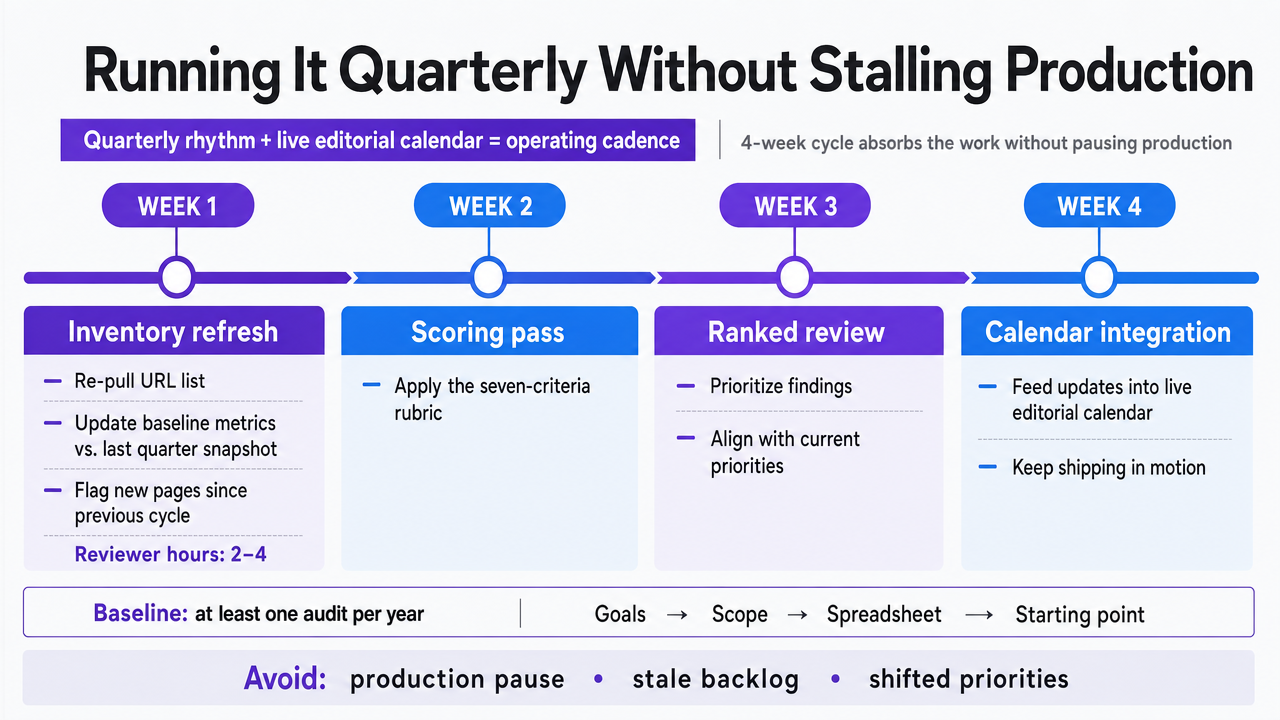
A gap analysis that consumes the calendar defeats its own purpose. The editorial team stops shipping while the audit runs, the backlog goes stale, and by the time the ranked list arrives, the priorities that shaped it have shifted. Digital.gov's baseline recommendation is at least one audit per year, structured around four steps: goals, scope, spreadsheet, starting point 2. Compressed into a quarterly rhythm and paired with a live editorial calendar, that workflow becomes an operating cadence, not a project.
A four-week cycle absorbs the work without pausing production:
- Week 1 — Inventory refresh. Re-pull the URL list, update baseline metrics against the frozen snapshot from last quarter, and flag any new pages published since the previous cycle. Reviewer hours: two to four.- Week 2 — Scoring pass. Apply the seven-criteria rubric to net-new pages and any URL whose traffic, conversions, or rankings moved more than one standard deviation. Full re-scoring is not required every quarter — only when the underlying signal shifts.- Week 3 — Disposition and task mapping. Update the disposition column for changed rows. Resolve any Consolidate candidates surfaced by the refreshed data.- Week 4 — Backlog re-ranking. Recalculate Traffic × Fit × Effort scores. Redraw the capacity line. Hand the top of the queue to writers on Monday of the following quarter.
One role assignment protects the cadence: a single editor owns the sheet, and writers pull from the ranked backlog rather than lobbying for pet topics. The USA.gov team learned the same lesson at federal scale — a candidate list only produces movement when it is filtered against what can actually be tested, improved, moved, or deleted within the available window 12. Quarterly review keeps the filter honest without turning content operations into a permanent audit.
 Show the four-week quarterly operating cadence described in the section as a horizontal timeline so readers can visualize the workflow without pausing production
From Ranked Backlog to Published Output
A ranked backlog is not a shipped page. The bottleneck moves the moment the spreadsheet is sorted: writers need briefs, editors need review windows, and approvers need visibility into what is going live and why. USDA's framing applies here too — the audit exists to understand what needs to be refined and optimized, which only matters if that refinement actually publishes 7. Teams that stall at this handoff produce a well-scored inventory and a flat traffic curve.
Three operational moves close the gap between rank and release. Convert each backlog row into a brief that carries forward the Task Served, Quality Score deficits, and Disposition rationale — writers should not reverse-engineer the reasoning. Assign a weekly publish quota tied to the capacity line drawn in Step 6, not to whichever topic feels urgent. And route every draft through a single approval step so the disposition logic that governed the audit also governs what ships. Platforms like Vectoron exist to compress that loop — turning a ranked backlog into approved, published output without adding editorial headcount.
Frequently Asked Questions
References
- 1.Creating Helpful, Reliable, People-First Content.
- 2.An introduction to content.
- 3.Content goals.
- 4.Oregon Design Guide : Perform a Content Audit : Planning.
- 5.Content Audit Templates and Guidance.
- 6.Market research and competitive analysis.
- 7.Content Plays.
- 8.Content Audit Template.
- 9.The Content Corner: Performing a Content Audit.
- 10.How to Do a Content Evaluation.
- 11.Website Content Audit/Review.
- 12.Five Lessons Learned During a Content Audit.