
Key Takeaways
- A signal analysis platform ranks topics against traffic potential and intent, compressing topic selection under volume pressure and improving qualified organic sessions per published asset.
- Competitive SERP intelligence parses ranking pages for structural patterns and entity coverage, keeping editors from drafting the wrong asset type for format-specific search results.
- A ranked recommendation engine turns signals into scored briefs with entities and link candidates attached, lifting first-draft acceptance rates and cutting hidden rewrite hours.
- An editorial calendar and topic-cluster planner ties briefs to pillar pages and tracks internal link debt so scaled output does not produce orphaned assets.
- A long-form AI writing assistant tuned to a team's style guide and knowledge base reduces editor hours per asset compared with generic chat interfaces.
- Multimodal generation extends one approved brief into images, video, and audio variants, compounding a single editorial input into channel-specific output.
- An SEO and readability QA layer scores drafts against entities, structure, schema, and reading level, normalizing review criteria as drafting volume rises.
- Brand voice and factuality checkers flag tone drift and unsupported claims, protecting brand equity as AI-assisted output grows past manual review capacity.
- Content credentials and durable watermarking bind signed provenance to assets and survive re-encoding, giving chain-of-custody records for AI-assisted work 2.
- Vectoron's approval-first orchestration routes signals through briefs, drafts, QA, and provenance with named editor sign-off at each handoff, cutting cycle time while preserving audit trails.
Why content intelligence became its own stack layer
Content intelligence used to live inside SEO suites as a keyword recommendation tab. That framing no longer fits how work gets done. Editorial teams now coordinate signal analysis, brief generation, AI drafting, quality review, and provenance labeling across separate systems, and the coordination itself has become the bottleneck.
The economic case for treating this as its own stack layer sits on a specific number. McKinsey estimates that generative AI could increase marketing productivity by 5% to 15% of total marketing spending, a range large enough to fund the tooling that captures it and small enough to disappear if workflows are not rebuilt around the tools 4. That estimate reflects modeled potential across marketing functions, not a guaranteed team-level outcome, and McKinsey ties realization to workflow redesign rather than tool adoption alone.
Demand pressure is the second force. Deloitte reports a 54% year-over-year increase in the volume of content marketing teams need to produce, alongside average time savings of 11.4 hours per week for generative AI users 12. The gap between rising output requirements and flat headcount is what pushes managers to look past single-purpose writing assistants toward a layered stack.
Analyst coverage confirms the category shift. The Forrester Wave for Content Platforms, Q1 2025, evaluated 12 providers across 24 criteria, treating integrated analytics, AI, and governance as platform-level expectations rather than optional add-ons 7, 8. Content intelligence is now what sits between the CMS and the editor.
How the ten tools map to six functional layers
The ten tools in this shortlist fall into six functional layers:
- Signal intelligence
- Brief generation
- AI drafting
- Editorial QA
- Provenance and governance
- Orchestration
Grouping them this way exposes stack gaps that a flat feature comparison hides. A team with three AI writers and no brief engine is overspending on drafting and underspending on decisioning. A team with strong SEO signal tools but no provenance layer is exposed on the risk side.
That risk side is not abstract. Deloitte's research on marketing content operations reports a 54% year-over-year increase in the volume of content teams need to produce, average time savings of 11.4 hours per week among generative AI users, and 65% of companies reporting they are very or extremely concerned about intellectual property or legal risks tied to generative AI 12. Those three numbers describe the same operating environment: demand rising faster than headcount, AI-assisted output closing part of the gap, and legal exposure climbing in parallel.
Each layer of the stack addresses one leg of that triangle. Signal, brief, and draft tools compress cycle time and absorb the volume increase. QA tools protect quality as output scales. Provenance and orchestration close the risk and control gap. The next sections cover each tool by layer, in that order.
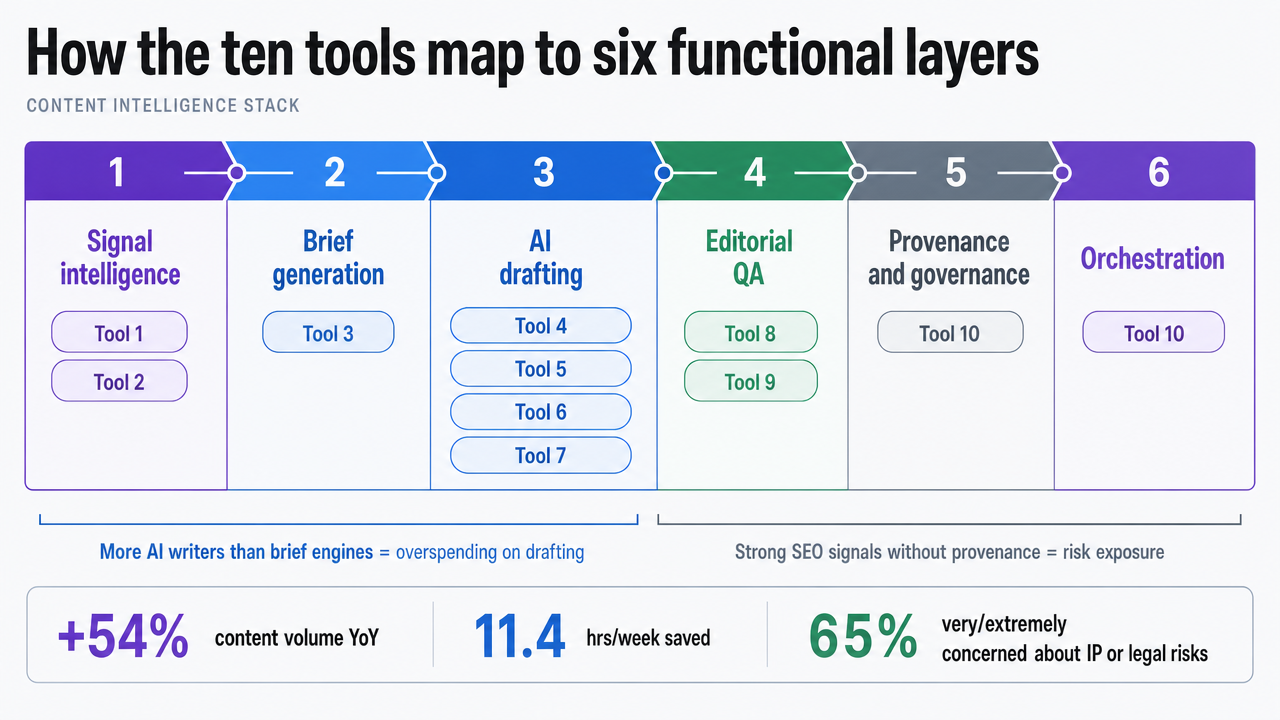 Visualize the six functional layers of a content intelligence stack described in this section, mapping each of the ten tools to its layer
Signal intelligence: reading demand before writing starts
Tool 1 — Signal analysis platform for search and audience demand
A signal analysis platform sits at the top of the stack because every downstream cost, drafting hours, editor review time, distribution effort, is wasted if the topic itself misses demand. Tools in this category ingest search query data, SERP features, first-party analytics, and social signals to surface which topics carry rising intent and which have peaked.
The operational problem this layer solves is topic selection under volume pressure. Deloitte's marketing research reports a 54% year-over-year increase in the volume of content teams need to produce, which forces topic decisions to happen faster and with less deliberation 12. A signal platform compresses that decisioning window by ranking opportunities against traffic potential, difficulty, and existing coverage on the site.
The KPI it moves is qualified organic sessions per published asset. Managers evaluating this layer should look for API access to search console and analytics data, refresh cadence on SERP snapshots, and the ability to tag topics against a content taxonomy the team already uses. Platforms that only surface keyword lists without intent classification push the sorting work back onto editors and defeat the point of the layer.
Tool 2 — Competitive content and SERP intelligence
Where a demand-signal platform answers what to write, a competitive SERP intelligence tool answers what has to be true for a page to rank against the current top ten. This layer parses the pages already winning a query, extracts structural patterns, entity coverage, schema usage, freshness signals, and turns them into inputs for briefs.
The distinction matters because search results have become format-specific. A query that returns a video carousel, a How-To rich result, and three listicles is not the same target as one dominated by product pages, even when the keyword is identical. Editors who skip this read spend drafting cycles producing the wrong asset type.
The KPI this tool moves is ranking position gained per hour of editorial input. Useful capabilities include entity extraction against a reference knowledge graph, SERP feature tracking over time, and side-by-side comparison of internal drafts against ranking competitors. Forrester's Q1 2025 evaluation of content platforms across 24 criteria treats integrated analytics and AI-driven recommendations as baseline expectations, which is where this category is heading 7, 8.
Test Advanced Content Intelligence On Live Workflows
Experience faster content delivery and measurable SEO outcomes using your own campaigns—no commitment required.
Brief generation and editorial planning
Tool 3 — Ranked recommendation engine for briefs and outlines
A ranked recommendation engine converts signal data into a prioritized list of briefs an editor can act on the same day. It reads inputs from the demand and SERP layers, scores each opportunity against site authority, existing coverage, and business value, then produces an outline with target entities, question clusters, and internal link candidates already attached.
The operational problem this layer solves is the gap between knowing what to write and briefing it well enough that a drafter, human or AI, produces something usable on the first pass. Weak briefs generate rewrites, and rewrites are where editorial hours quietly disappear. McKinsey's translation of the broader productivity thesis into marketing use cases identifies ideation and drafting as high-value applications precisely because workflow redesign, not tool novelty, is what unlocks the gains 5.
The KPI this tool moves is first-draft acceptance rate. Managers should look for scoring transparency, so editors can see why a topic ranked where it did, and outline templates that can be tuned to the site's voice guide rather than a generic H2/H3 skeleton.
Tool 4 — Editorial calendar and topic-cluster planner
An editorial calendar and topic-cluster planner is the layer that keeps ranked briefs from piling up as isolated assets. It maps each brief to a pillar page, tracks internal link debt, and enforces cadence across authors, freelancers, and AI-assisted drafts. Without it, a team producing more content produces more orphaned pages.
Cluster planning also shifts reporting from vanity output counts to structural coverage. Managers can see which pillars are underdeveloped, which supporting pages are missing schema, and which topics have decayed enough to warrant a refresh cycle. Forrester's Q1 2025 evaluation of content platforms across 24 criteria treats integrated planning and analytics as baseline platform expectations, not premium features 7.
The KPI this layer moves is share of published assets tied to an active cluster, versus one-off posts. Useful capabilities include automated internal link suggestions between siblings and pillars, cluster health scoring against organic performance, and dependency views that flag when a supporting page ships before its pillar is ready.
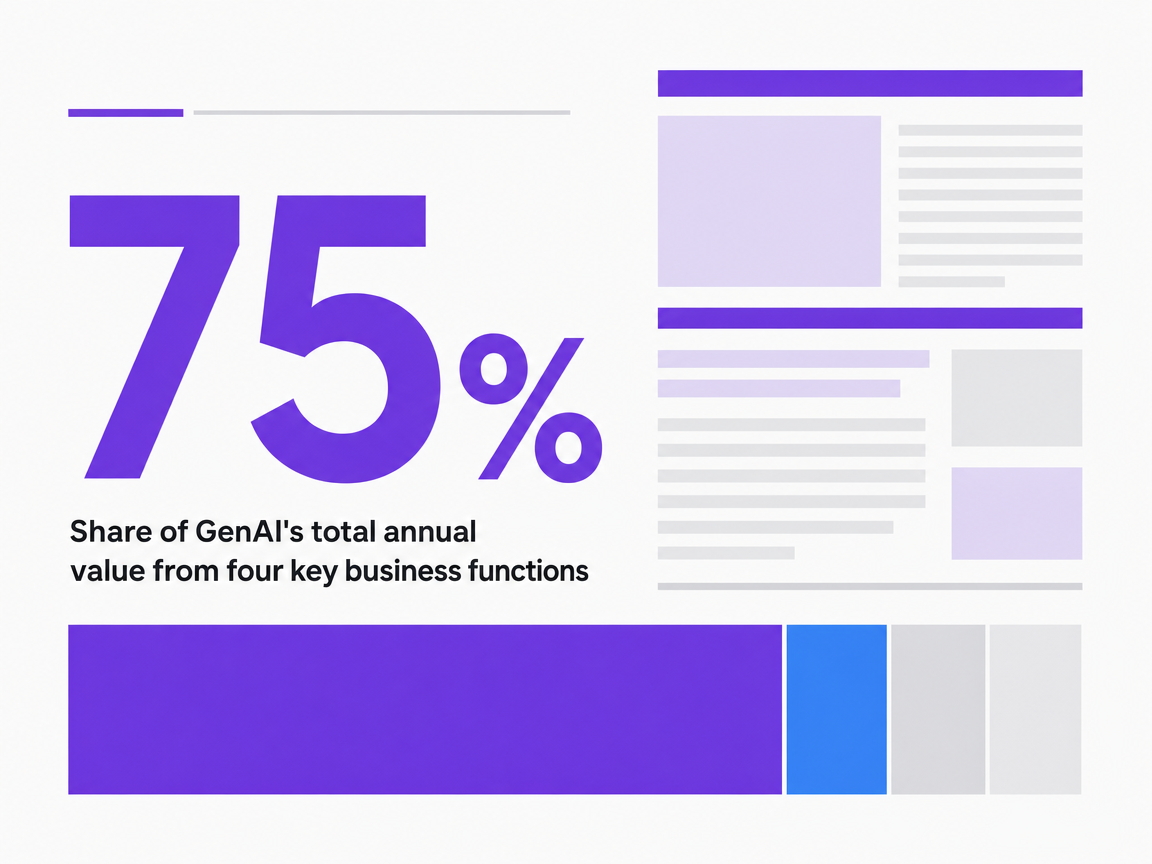 Share of GenAI's total annual value from four key business functions
Share of GenAI's total annual value from four key business functions
AI drafting and content generation
Tool 5 — Long-form AI writing assistant tuned for editorial output
A long-form AI writing assistant tuned for editorial output is the layer that most managers already have in some form. The distinction that matters is whether the assistant is a general chat interface or a system trained on the team's style guide, prior published assets, and brief structure. General interfaces produce drafts that read like everyone else's drafts. Tuned assistants produce copy that clears editorial review with fewer rewrites.
McKinsey's estimate that generative AI could increase marketing productivity by 5% to 15% of total marketing spending is modeled on workflow redesign, not on writers using a chatbot in a browser tab 4. The productivity delta shows up when the assistant reads the brief, respects the outline, and pulls source material from a team library rather than the open web.
The KPI this tool moves is editor hours per published asset. Capabilities worth requiring include retrieval against a team-owned knowledge base, controllable tone parameters mapped to a voice guide, and structured output that respects the brief's H2/H3 skeleton. Assistants that free-write past the outline push cleanup work back to editors.
Tool 6 — Multimodal generation for asset variants
Multimodal generation extends the drafting layer beyond text into images, short video, and audio variants derived from the same source brief. A single approved long-form asset can produce a hero image, a set of social cards, a script for a 45-second explainer, and a podcast summary without a separate creative cycle for each format.
Investment in this layer is easier to justify once the value concentration is visible. McKinsey estimates that roughly 75% of generative AI's total annual value falls into four business functions, with marketing and sales among them 5. Multimodal output is where a single editorial input compounds into channel-specific assets, which is what turns a drafting tool into a production layer.
The KPI this tool moves is asset variants shipped per approved brief. Capabilities to require include shared prompt libraries across modalities, brand asset locking on colors and typography, and export formats that match the destination channel's specs. Multimodal systems that produce generic stock-style images defeat the point.
Editorial QA and quality intelligence
Tool 7 — SEO and readability QA layer
An SEO and readability QA layer is the checkpoint between an AI-assisted draft and a page that ships. It scores drafts against target entity coverage, heading structure, internal link density, schema validity, and reading level, then returns a punch list an editor can clear in a single pass. Without it, quality control happens by tribal knowledge, and standards drift as output scales.
The operational problem this layer solves is variance. Once drafting volume rises, editors face drafts from human writers, tuned AI assistants, and freelancers in the same queue, each with different failure modes. A QA layer normalizes the review criteria so the fifth draft of the week gets the same scrutiny as the first.
The KPI this tool moves is publish-ready rate on first editor review. Managers should require configurable thresholds per content type, since a product page and a thought-leadership post do not share the same readability target, and API hooks that let QA run inside the CMS rather than as a separate browser tab.
Tool 8 — Brand voice and factuality checker
Brand voice and factuality checkers sit next to the SEO QA layer but solve a different failure mode. Voice checkers compare a draft against a codified style guide, flagging tone drift, banned phrases, and structural tics that read as off-brand. Factuality checkers cross-reference claims against a team-approved source library and surface unsupported statements before they reach an editor.
Both capabilities matter more as AI-assisted output grows. Forrester's Q1 2025 evaluation of 12 content platform providers across 24 criteria treats governed AI output as a platform-level expectation, not a niche feature 7, 8. The evaluation reflects where the category is heading: drafting speed without voice and factuality guardrails produces content that erodes brand equity faster than it earns traffic.
The KPI this tool moves is editorial rework rate tied to voice or accuracy defects. Useful capabilities include a voice guide that ingests real published examples rather than adjective lists, claim-level source linking, and audit trails that show which checks ran on which draft.
See How Leading Teams Use Content Intelligence to Double Output—Without Extra Headcount
Request a live walkthrough of unified content intelligence and workflow automation designed for agencies and enterprise brands scaling production while maintaining quality and compliance.
Provenance and governance: the layer most stacks miss
Tool 9 — Content credentials and synthetic-content transparency
Provenance tooling is the layer most editorial stacks skip, and it is the layer regulators, platforms, and enterprise buyers are starting to require. Content credentials bind signed metadata to a media file so that downstream systems, whether a social platform, a CMS, or a third-party audit, can verify what a piece of content is, who produced it, and whether AI was involved in its creation or editing. Durable content credentials add a watermark plus fingerprint matching for retrieval, which keeps the provenance signal attached even after a file is cropped, re-encoded, or reposted 2.
NIST's guidance on synthetic content transparency treats authentication, provenance tracking, synthetic-content labeling, and detection as four complementary technical approaches rather than substitutes 1, 6. Brookings reaches a similar conclusion, identifying watermarking, content provenance, retrieval-based detectors, and post-hoc detectors as the four most prominent authenticity approaches, and warns that no single signal is reliable once content is modified in distribution 3.
Practical implication for a content operations manager: a provenance layer needs to combine at least two of these approaches, typically signed credentials plus a watermark, to hold up.
The operational problem this layer solves is chain-of-custody for AI-assisted assets. When 65% of companies report they are very or extremely concerned about intellectual property or legal risks tied to generative AI 12, the missing artifact in most workflows is a record of which tools touched which asset and when. The KPI this tool moves is percentage of published assets with verifiable credentials attached. Capabilities to require include C2PA-aligned metadata signing, watermark embedding at export, and audit logs that survive re-encoding.
Governing the workflow with NIST AI RMF
Provenance tooling records what happened to an asset. A governance framework decides what is allowed to happen in the first place. The NIST AI Risk Management Framework is the reference structure most content operations teams should map their workflow against, because it aligns trustworthy AI properties with organizational processes across the AI lifecycle rather than at a single checkpoint 10.
For an editorial workflow, that means four concrete controls:
- A documented inventory of which AI tools are permitted for which content types.
- A risk classification per asset class, so a regulated-industry landing page carries stricter review than an internal newsletter.
- Human approval gates tied to the classification, with sign-off recorded against a named editor.
- Monitoring hooks that surface drift, whether a tool starts producing unsupported claims or a voice model shifts off-brand.
The framework is principle-based, not prescriptive, so the operational work is translating each function into a policy line and a system control. Teams that skip this step end up with provenance tooling that logs activity no one reviews, which is worse than no logging at all.
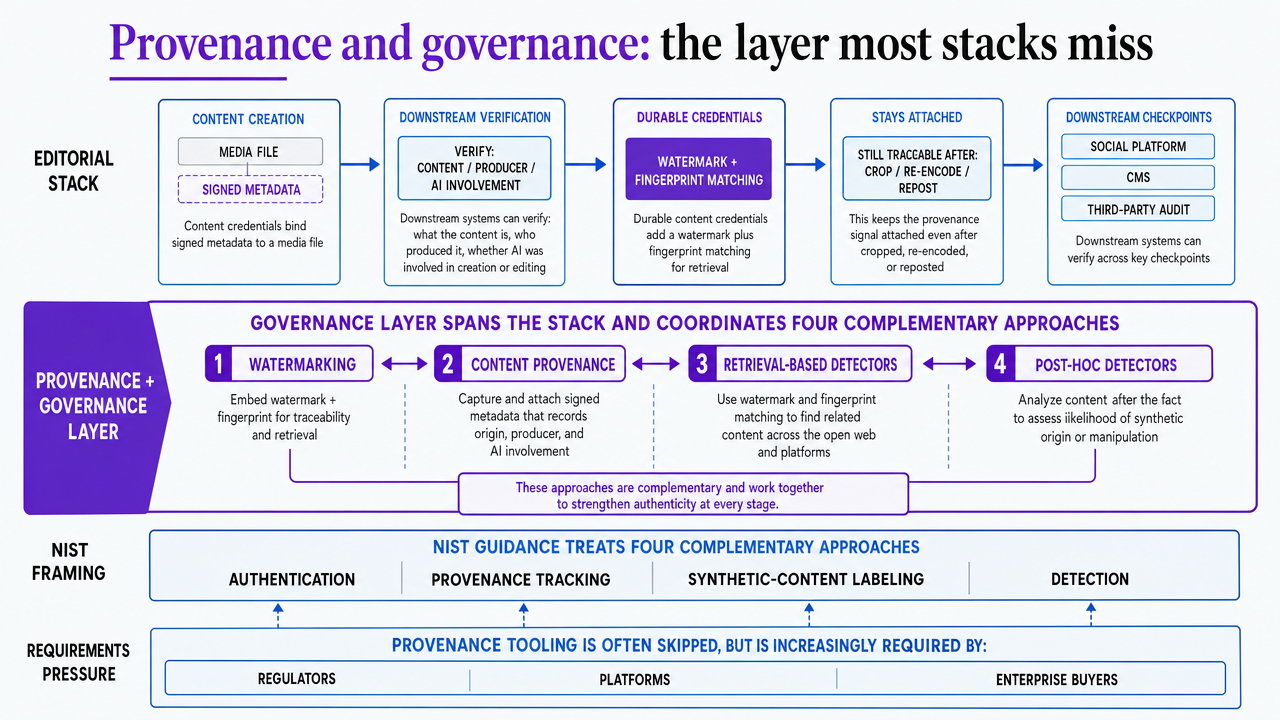 Illustrate the four complementary authenticity approaches (watermarking, content provenance, retrieval-based detectors, post-hoc detectors) cited from NIST and Brookings in this section
Orchestration and approval workflow
Tool 10 — Vectoron and the approval-first orchestration layer
Orchestration is the layer that decides whether the other nine tools function as a stack or as a pile of tabs. It routes signals into briefs, briefs into drafts, drafts into QA and provenance checks, and finished assets into publishing, with a human approval gate recorded at each handoff. Without it, editors spend their week copying outputs between systems rather than editing.
Vectoron sits in this layer as an approval-first orchestration platform. Specialist strategists for content, SEO, and adjacent channels read live signals, rank recommendations against business KPIs, and stage the work, but nothing ships until a named editor signs off. Each recommendation carries the reasoning behind it, so approval is a review decision rather than a blind acceptance. That structure matches the workflow-redesign condition McKinsey attaches to its 5% to 15% marketing productivity estimate, where the gain depends on rebuilding the process around the tools rather than adding tools to the existing process 4.
The KPI this layer moves is cycle time from signal to published asset, held against a fixed approval rate. Capabilities to require include a unified command surface across channels, per-asset audit trails that survive vendor changes, and role-based sign-off tied to the risk classification set at the governance layer.
If you manage multiple locations: consolidation economics of a governed stack
This section shifts scope from a single content team to multi-location service brands, where the same editorial calendar has to produce location-specific pages, reviews responses, and local landing assets at volume. The economics change because tool licenses, brief costs, and editor hours all scale by location rather than by topic.
The typical unmanaged stack in this segment carries four line items per market: an SEO tool license, a separate brief generator, an AI writing assistant, and an outsourced editorial reviewer. A governed orchestration layer collapses those into a single per-seat license, a per-brief cost that already includes signal and QA, and internal editor hours that shrink because rewrites drop.
| Cost driver | Unmanaged stack | Governed orchestration layer ||---|---|---|| Software licenses | Multiple per-seat licenses across SEO, brief, draft, QA tools | One per-seat license covering the workflow || Per-brief production cost | Sum of tool outputs plus manual assembly | Single per-brief cost with signal and QA included || Editor hours per asset | High, driven by cross-tool handoffs and rework | Lower, tied to approval review only || Governance overhead | Location-by-location, often informal | Centralized policy with per-asset audit trail |
Operators managing five or more locations should model the consolidation against actual editor hours per market, not against advertised license savings.
A decision framework by team size and content volume
Stack composition should follow output volume and review capacity, not tool novelty. Three team profiles cover most in-house content operations.
- A solo manager or two-person team publishing under 20 assets per month should invest first in signal intelligence, a tuned AI writing assistant, and a QA layer. Brief generation can run inside the assistant with a locked prompt. Orchestration is manual, and provenance can be handled through export-time metadata rather than a dedicated tool.
- A four-to-eight-person team publishing 40 to 100 assets per month needs the full brief and cluster planning layer, a factuality checker, and a lightweight orchestration surface. At this volume, cycle time from signal to publish is the dominant cost, and unreviewed AI output is where quality drift starts. Forrester's Q1 2025 evaluation of 12 content platforms across 24 criteria reflects this stage, where integrated analytics and governed AI shift from optional to expected 7.
- Teams publishing more than 100 assets per month, or coordinating output across multiple locations, should treat orchestration and provenance as required, not optional. That is where approval-first platforms like Vectoron consolidate the workflow into a single audited loop.
Frequently Asked Questions
References
- 1.Reducing Risks Posed by Synthetic Content An Overview of Technical Approaches to Digital Content Transparency.
- 2.Strengthening Multimedia Integrity in the Generative AI Era.
- 3.Detecting AI fingerprints: A guide to watermarking and beyond.
- 4.Economic potential of generative AI.
- 5.How generative AI can boost consumer marketing.
- 6.Reducing Risks Posed by Synthetic Content.
- 7.The Forrester Wave™: Content Platforms, Q1 2025.
- 8.Highlights From The Forrester Wave™: Content Platforms, Q1 2025.
- 9.The economic potential of generative AI: The next productivity frontier.
- 10.AI Risk Management Framework.
- 11.Detecting AI fingerprints: A guide to watermarking and beyond.
- 12.Deloitte Digital's latest research forecasts generative AI's impact on marketing content production.