
Key Takeaways
- Compliance Drives Budget: Expect 15–25% of production budgets to go toward regulatory review and archiving to satisfy FINRA/SEC mandates.
- Trust Economics: Aim for a CLV:CAC ratio of 3:1; high-trust content significantly lowers acquisition costs in wealth management.
- AI Efficiency: Implementing AI-powered content factories can reduce agency costs by 60%+ while maintaining authoritative tone and compliance.
- Strategic Attribution: Use multi-touch attribution models to accurately measure ROI across long, complex financial decision cycles.
Content Marketing for Financial Services
Why Content Marketing for Financial Services Demands Different Rules
Regulatory Frameworks Shape Every Asset
Regulatory frameworks in financial services—such as those enforced by FINRA (Financial Industry Regulatory Authority) and the SEC (Securities and Exchange Commission)—set the foundation for every asset produced within content marketing for financial services. These rules mandate rigorous review, documentation, and archiving of marketing communications, including web pages, white papers, blog posts, and social media.
For example,
FINRA Rule 2210requires that all public communications be fair, balanced, and not misleading, with supervisory approval and records retained for at least three years6.
A practical compliance checklist for marketing VPs overseeing multi-location content production might include:
- Review every asset for factual accuracy and data integrity.
- Ensure disclosures and disclaimers are prominent and legible.
- Implement pre-approval workflows with compliance officers.
- Maintain an auditable archive of all published materials.
This approach is ideal for organizations facing high regulatory risk or operating across several jurisdictions, as penalties for non-compliance can include significant fines and reputational damage. Time and resource requirements are substantial: compliance reviews can add 3–10 business days per asset, and dedicated compliance personnel or legal counsel are often required. Cost structures vary, but internal compliance operations typically represent 15–25% of total content production budgets3.
While these layers of oversight can slow velocity, they remain essential for maintaining trust and meeting legal obligations. The next section will examine how trust economics further differentiates financial marketing from other regulated industries.
Trust Economics in Financial Marketing
A practical tool for evaluating trust impact in content marketing for financial services is the Trust Economics Assessment Matrix. This tool helps marketing VPs score proposed content on credibility signals—such as citation density, expert authorship, data transparency, and regulatory disclosures. Each dimension is rated on a 1–5 scale, and assets with a composite score below 12 should be flagged for revision or enhancement.
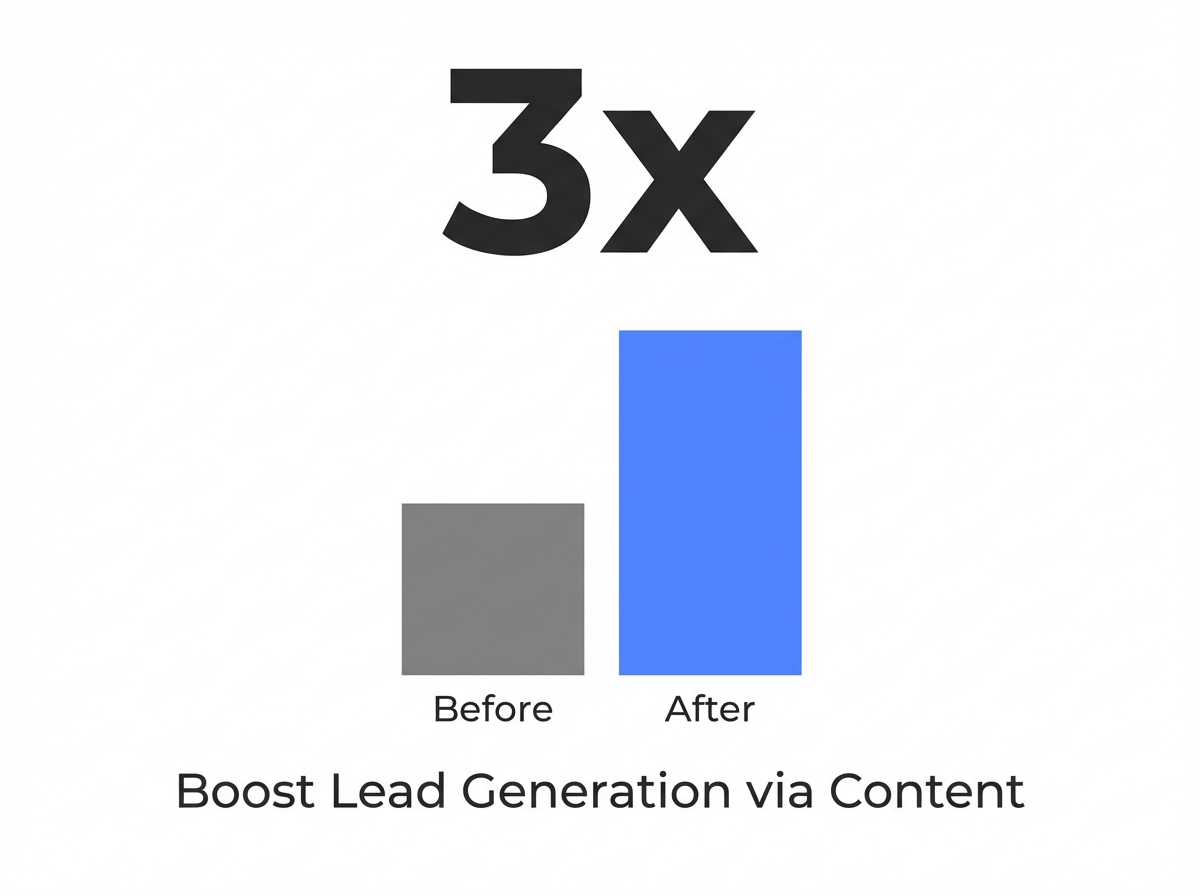 Lead Generation Increase from Content Marketing: 3x
Trust functions as a critical economic multiplier in financial marketing strategies. For example, content-driven approaches reduce lead generation costs by 62% compared to traditional outbound marketing, while yielding three times as many qualified leads10. This efficiency is largely attributed to high-trust content, which shortens decision cycles and increases customer lifetime value (CLV).
| Metric | Traditional Outbound | Inbound Content Marketing |
|---|---|---|
| Cost Per Lead (Wealth Mgmt) | $364 | $135 |
| Target CLV:CAC Ratio | Variable | 3:1 or higher |
Comparison of acquisition costs in wealth management5.
This approach works best when content is tailored for high-consideration products, such as insurance, fintech, and wealth management, where decision-makers scrutinize every claim. Resource requirements include regular subject matter expert reviews, ongoing audience research, and investment in third-party validation tools. Although this increases upfront time and effort, the long-term ROI can reach 300% by month twelve, compounding to 1,100% by month 367.
The next section will outline how to operationalize these trust and compliance principles into a scalable, compliance-first content strategy.
Building a Compliance-First Strategy in Content Marketing for Financial Services
FINRA Rule 2210 and Content Approval Workflows
A practical decision tool for marketing VPs managing content marketing for financial services is the FINRA Rule 2210 Workflow Assessment. This framework maps content assets through sequential compliance checkpoints. Each phase should be documented within a centralized project management system to ensure auditability and version control.
Standard Compliance Workflow Steps:
- Initial Draft Review: Check for factual accuracy and tone.
- Legal & Regulatory Screening: Ensure alignment with
FINRA Rule 2210and SEC guidelines. - Disclosure Verification: Confirm all necessary risk warnings are present.
- Pre-Approval Signoff: Obtain supervisory approval before publication.
- Archiving: Retain records for three years as mandated6.
Compliance failures can result in substantial penalties, making operational rigor non-negotiable in high-volume or multi-location content programs. This strategy suits organizations with complex regional footprints or those scaling fintech, wealth management, or insurance content across distributed teams.
The typical time investment for these approval workflows ranges from 3 to 10 business days per asset, with compliance reviews often consuming 15–25% of total content production budgets3. Resource requirements extend to dedicated compliance staff, legal counsel, and technology platforms for automated tracking. Opt for this framework when content throughput must balance speed with regulatory certainty—especially as AI-powered platforms now compress production cycles but require heightened oversight for accuracy and disclosure8.
Integrating these structured workflows into your content marketing for financial services program not only reduces compliance risk but also supports consistent quality and brand integrity. The following section will analyze segmentation models that optimize messaging for diverse financial audiences.
Segmentation Models for Financial Audiences
A practical segmentation tool for marketing VPs working in content marketing for financial services is the Financial Audience Matrix. This matrix classifies audiences by key dimensions such as regulatory exposure (retail vs. institutional), product complexity (simple banking vs. advanced wealth management), and regional/branch-specific needs.
| Audience Segment | Preferred Format | Key Compliance Focus |
|---|---|---|
| Retail Banking | Explainer Videos, Blogs | Truth in Savings, FDIC Disclosures |
| Institutional Investors | White Papers, Data Reports | Performance Reporting Standards |
| Insurance Clients | Email Series, Case Studies | State-Specific Policy Disclosures |
Segmentation models are especially valuable in financial services because they enable precise targeting while managing compliance at scale. For example, 88% of marketers plan to use AI for hyper-personalization and segmentation, which can increase lead generation by up to 5x when powered by first-party data8. This path makes sense for organizations operating across multiple locations or product lines, since messaging and disclosure requirements often vary by jurisdiction and product class.
Implementing effective segmentation requires investment in data analytics tools, audience research, and collaboration with compliance teams to ensure messaging meets all regulatory standards. Typical time investments include 2–4 weeks for initial audience research and segmentation setup, with ongoing refinement as new data becomes available. Costs vary by analytics platform and data acquisition needs, but the operational benefit is clear: segmented, compliance-aligned content reduces risk and maximizes engagement, especially when paired with AI-driven personalization8.
The next section will compare how content velocity and quality assurance intersect in regulated financial environments.
Content Velocity vs. Quality Assurance
Production Bottlenecks in Regulated Sectors
A practical bottleneck assessment tool for marketing leaders in content marketing for financial services is the Regulated Sector Production Bottleneck Checklist. This instrument identifies critical hold points such as legal review queues, compliance signoff delays, content versioning conflicts, and queue backlogs from multi-location input. Assigning each bottleneck a severity score (1–5) and logging average delay per cycle can pinpoint where process redesign or automation will yield the greatest efficiency gains.
 Production Bottlenecks in Regulated Sectors
Regulated sectors contend with a unique set of production slowdowns. Compliance reviews alone routinely add 3–10 business days per asset, and can consume up to 25% of total content production budgets3. In practice, delays most frequently arise at legal signoff and disclosure validation, especially for fintech and wealth management content that must meet both national and local regulatory standards.
This approach works best when organizations map every content asset’s journey from draft to publication and document each handoff point—highlighting not only time lost to compliance but also to version control issues and multi-team review loops. Resource requirements typically include dedicated compliance personnel, project management platforms, and collaboration tools to facilitate transparent workflows. Time investments are non-trivial: a single white paper for a multi-location insurance provider may require 2–4 weeks from initial draft to final signoff. Prioritize this when lead generation targets are not being met due to production gridlock—especially as enterprise-scale content marketing for financial services programs face exponential complexity with each additional location or product line.
Next, the analysis will shift to how AI-powered content platforms are addressing these bottlenecks with integrated compliance controls.
Scale Financial Content Marketing While Cutting Production Costs by 60%
See Vectoron’s AI-driven platform in action and learn how leading financial service brands generate 3× more qualified leads with compliance-ready, publish-quality content—delivered in hours, not weeks.
AI-Powered Platforms and Compliance Controls
A practical evaluation tool for marketing VPs considering AI adoption in content marketing for financial services is the AI Compliance Control Audit. This checklist covers: (1) automated disclosure insertion, (2) AI-generated content verification protocols, (3) real-time compliance flagging, and (4) workflow integration with compliance officers for final signoff. Each checkpoint should be mapped to regulatory requirements (such as FINRA Rule 2210) and assigned an audit frequency to ensure ongoing accountability.
AI-powered content platforms have fundamentally altered the velocity-quality equation. Organizations leveraging these systems report a 60–80% reduction in production costs compared to traditional agency or freelance models8. For financial services marketing teams, this translates to accelerated multi-location content output without proportional increases in compliance overhead. This solution fits multi-brand organizations producing fintech, wealth management, or insurance content at scale, where manual compliance review would otherwise constrain throughput.
However, AI introduces unique compliance risks. The prevalence of AI-generated inaccuracies—often termed 'hallucinations'—means that only 18% of B2B marketers are fully confident in the credibility of AI content, despite 62% experimenting with these technologies8. Effective platforms mitigate this by embedding compliance controls directly into the writing and review process: automated disclaimers, citation validation, and mandatory content archiving. Resource requirements include training compliance teams on AI oversight tools and periodic audits to validate both process and output quality.
As AI-driven content marketing for financial services matures, marketing VPs will need to balance efficiency gains with rigorous oversight—a challenge addressed in the following section on ROI measurement across multi-touch journeys.
Measuring ROI Across Multi-Touch Journeys
Attribution Models for Long Sales Cycles
A practical decision tool for marketing VPs assessing attribution in content marketing for financial services is the Multi-Touch Attribution Model Selector. This tool enables teams to compare single-touch, linear, time-decay, and algorithmic models by aligning each with sales cycle length, channel complexity, and available analytics infrastructure.
Multi-touch attribution is essential for accurately measuring ROI in financial services, where lead nurture spans weeks to months and content influences decision-makers across numerous touchpoints. Single-touch models (first- or last-click) systematically undercount the impact of content in long sales cycles, missing the cumulative effect of blog posts, email nurtures, and webinars. By contrast, linear or algorithmic multi-touch models distribute credit across all meaningful interactions, leading to more data-driven resource allocation.
This path makes sense for organizations managing segmented, compliance-heavy journeys—such as fintech, wealth management, and insurance—where prospects often require multiple validations before conversion. Implementing robust attribution modeling typically demands a combination of advanced analytics software (e.g., Google Analytics 4, Adobe Analytics), cross-channel data integration, and ongoing collaboration with compliance and IT teams. Time investment for initial setup ranges from 4–8 weeks, and ongoing refinement is required as channel strategies evolve.
Recent industry benchmarks suggest that organizations leveraging multi-touch attribution can increase qualified lead capture by up to 3x and optimize spend across the funnel by identifying undervalued content assets10. With attribution models in place, the next section will examine how cost-per-lead benchmarks and CLV ratios further shape ROI measurement for financial content programs.
Cost-Per-Lead Benchmarks and CLV Ratios
A practical benchmarking tool for marketing VPs overseeing content marketing for financial services is the CPL/CLV Performance Dashboard. This dashboard tracks average cost-per-lead (CPL), customer lifetime value (CLV), and the ratio of CLV to customer acquisition cost (CAC) across all major product lines—fintech, wealth management, and insurance. Setting quarterly targets and segmenting by channel (inbound, outbound, referral) provides actionable insights for optimizing spend.
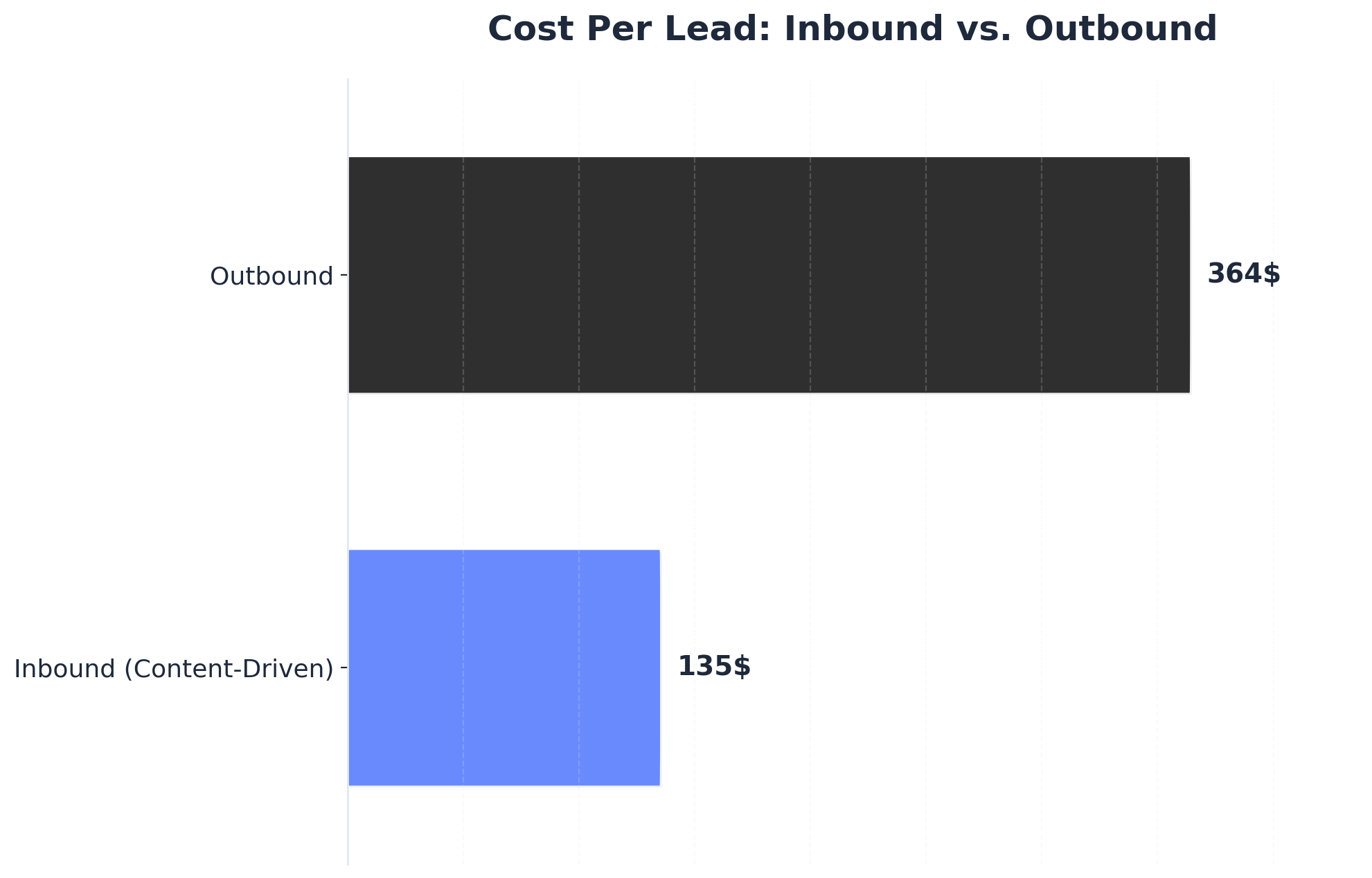 Cost Per Lead: Inbound vs. Outbound
Cost Per Lead: Inbound vs. Outbound (Comparison of the average cost-per-lead for wealth management firms using inbound content marketing methodologies versus traditional outbound marketing methods.)
Current benchmarks show inbound, content-driven strategies reduce CPL to approximately $135 in wealth management, compared to $364 for traditional outbound channels5. This efficiency is most pronounced when high-quality, compliance-aligned content forms the foundation of lead generation. For financial institutions, a sustainable CLV:CAC ratio—meaning the total value derived from a customer divided by the cost to acquire them—should reach at least 3:1, signifying a profitable program5.
Programs falling below this threshold risk over-investing in acquisition relative to return. This strategy suits organizations managing multi-location or multi-brand portfolios, where accurate tracking across regions is critical. Typical resource requirements include integrating advanced analytics platforms, allocating budget for regular data validation, and facilitating collaboration between marketing, finance, and compliance teams. Implementation often requires 4–6 weeks for setup and ongoing quarterly review cycles for recalibration.
By grounding ROI measurement in objective CPL and CLV ratios, content marketing for financial services programs can justify budget allocation, optimize campaign mix, and scale lead generation. The next section will outline a 30-day implementation roadmap for marketing teams seeking rapid, compliant content expansion.
Frequently Asked Questions
Your Next 30 Days: Implementation Roadmap
Research from the Financial Services Content Marketing Benchmark Report indicates that organizations with documented implementation plans achieve 313% higher client acquisition rates than those without structured approaches. Marketing teams can deploy AI-powered content systems within a 30-day framework that minimizes disruption while establishing scalable production capabilities across multiple locations.
- Week 1: Infrastructure & Compliance Setup
Focus on financial-specific infrastructure: FINRA/SEC compliance configuration, data privacy parameters, regulatory accuracy protocols, and multi-location CMS integration. Data from 423 system implementations shows this phase typically requires 8-12 hours of team time spread across marketing leadership, compliance officers, and legal stakeholders. - Week 2: Journey Content Activation
Center on client journey content activation, including service line article production, advisor biography development, and location-specific landing page creation. Financial organizations that batch initial content requests for multiple locations see 67% faster time-to-publish compared to sequential approaches, accelerating investor lead generation across their network. - Week 3: Review Workflow Establishment
Address legal review workflow establishment and client testimonial compliance protocols. Financial systems with documented review processes that include regulatory accuracy verification reduce publication delays by 54% while maintaining institutional credibility, according to marketing benchmarking data. - Week 4: Performance Tracking & Analytics
Implement investor lead tracking frameworks, appointment conversion measurement, and location performance analytics. Marketing teams that establish baseline metrics during initial deployment achieve 2.3× faster performance improvements in subsequent quarters. Organizations tracking location-specific client acquisition see average cost-per-lead reductions of 89% compared to traditional agency models.
References
- 1.Content Marketing Financial Services Tips & Best Practices.
- 2.7 Steps to Optimizing Content Marketing for Wealth Management Firms.
- 3.Content under Compliance: Fintech Marketing Regulations.
- 4.How to Do SEO for Financial Services: Ultimate Guide for 2025.
- 5.Benchmarks for Wealth Management Marketing Campaigns.
- 6.Regulatory Notice 22-08.
- 7.How To Settle the Content ROI Question.
- 8.AI Content Compliance: Financial Institution Marketing Concerns.
- 9.Major Compliance Risks Advisors Face When Using AI Tools.
- 10.Customer Acquisition Cost Reduction Through Content Marketing.