Key Takeaways
- Documenting the strategy as a living artifact separates high-performing programs from drifting ones, with 61% of top marketers maintaining written strategies versus roughly 40% overall 3.
- Hybrid AI-human production parallelizes drafting, review, and optimization, cutting per-piece costs 40-60% and compressing cycle times 60-75% against retainer baselines 2.
- Workflow automation removes the calendar invite, not the editor, reclaiming the five-plus hours per week each team member loses to approvals and routing 5.
- A modular team keeps a small strategic core—lead, editor, analyst—holding voice and measurement, while specialists and AI flex in by project rather than monthly retainer.
- Multi-touch attribution, particularly the U-shaped 40/20/40 model, finally credits the awareness and consideration content that last-click reporting systematically zeroes out 7.
- Unifying analytics, CRM, and ad data into a single persistent customer profile turns attribution from a modeling exercise into a query against actual behavior 8.
- Coordinating five or more channels from one editorial calendar drives 412% higher purchase rates than single-channel programs, provided derivative assets stay synchronized 9.
- Real-time dashboards paired with preset decision rules turn performance data into active production inputs, killing weak topics early and scaling traction within the same sprint 10.
- Sales calls, support tickets, and onboarding notes produce topic intelligence that keyword tools cannot replicate, mapping content to real buying behavior rather than assumed journeys 3.
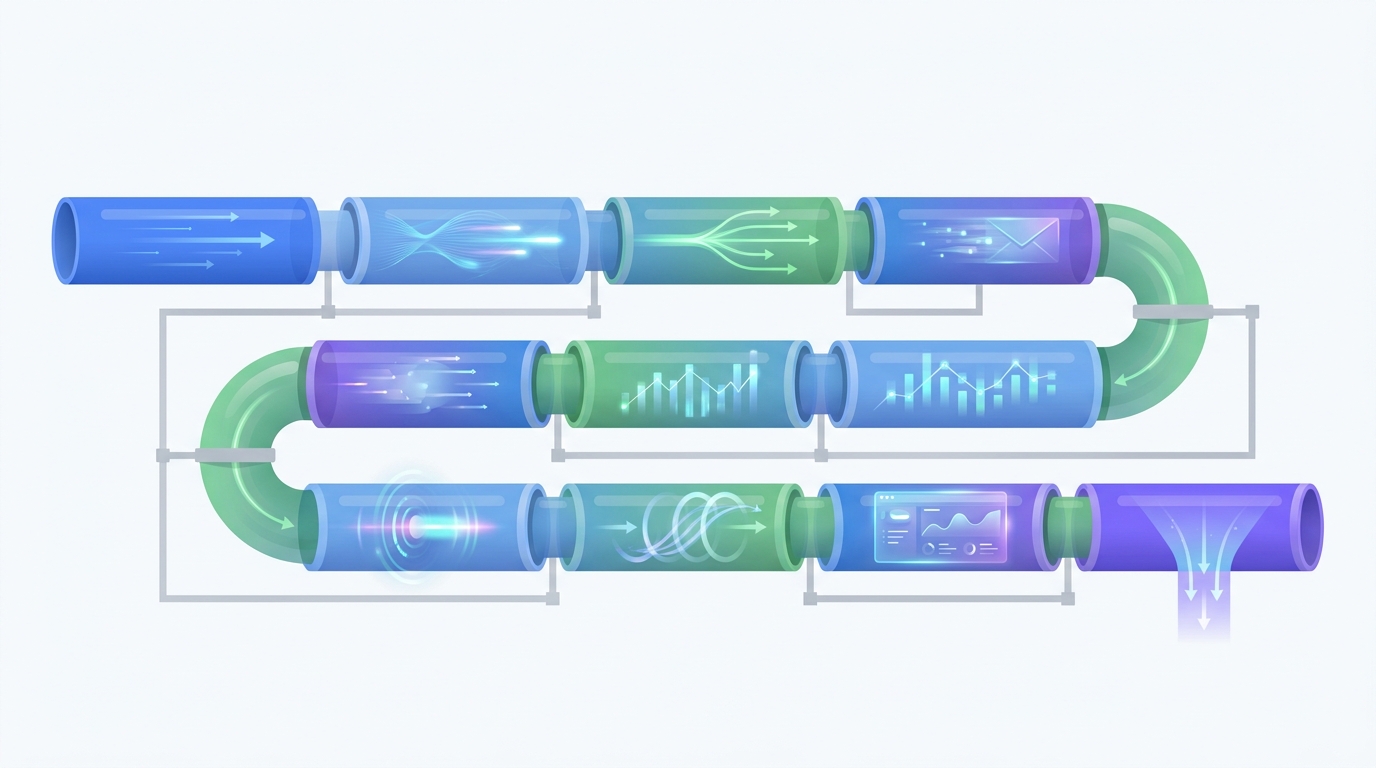
- The nine practices only deliver compounding gains when an integration layer connects strategy, production, distribution, and measurement under a single source of truth 810.
Why In-House Content Operations Now Beat the Retainer Model
Content marketing produces 54% more leads at 13% lower cost than traditional outbound channels, a margin that should have settled the category-level economics years ago 1. The unresolved question for growth teams is structural: which production model captures that margin, and which leaks it back through coordination overhead?
Retainer agencies were built for a world where content was scarce, expensive to produce, and best handled by external specialists with proprietary process. That world is gone. Production cost curves have collapsed, distribution complexity has multiplied, and the bottleneck has shifted from craft to orchestration. Sequential handoffs between strategist, writer, editor, and publisher—the core loop inside most retainers—now sit upstream of the actual cost driver.
Systematized in-house operations win on the variables that matter to a growth director: cycle time, attribution clarity, and output per dollar. Hybrid AI-human production, instrumented workflows, and unified data have compressed timelines by 60-75% and reduced per-piece costs by 40-60% against the retainer baseline 2. None of this requires a larger team. It requires a different operating design.
The nine practices below describe that design, each tied to a specific failure mode the retainer model cannot resolve from the outside.
Retainer Agency vs Systematized In-House Operation: The Economics
The cost gap between the two models is no longer marginal. Research comparing AI-assisted production against traditional agency engagements documents 50-70% reductions in time spent on repetitive tasks and 40-60% lower per-piece costs once workflow automation is in place 2. Cycle times compress by 60-75% when production stages run in parallel rather than through sequential agency handoffs 2.
The table below frames the operating variables a growth director controls. Agency-side figures sit as directional ranges drawn from the same comparative analysis; in-house figures reflect what becomes available once the nine practices are systematized.
| Operating Variable | Retainer Agency Baseline | Systematized In-House Operation |
|---|---|---|
| Per-piece production cost | Baseline | 40-60% lower 2 |
| Average production cycle time | Baseline | 60-75% shorter 2 |
| Monthly output ceiling | Baseline | 3-5x higher at flat headcount 2 |
| Internal coordination hours per week | Elevated by manual approvals and status meetings | Reduced as automation absorbs routing and review 5 |
| Content marketing ROI ratio | Typical 3:1 range | 5:1 or higher within six months 2 |
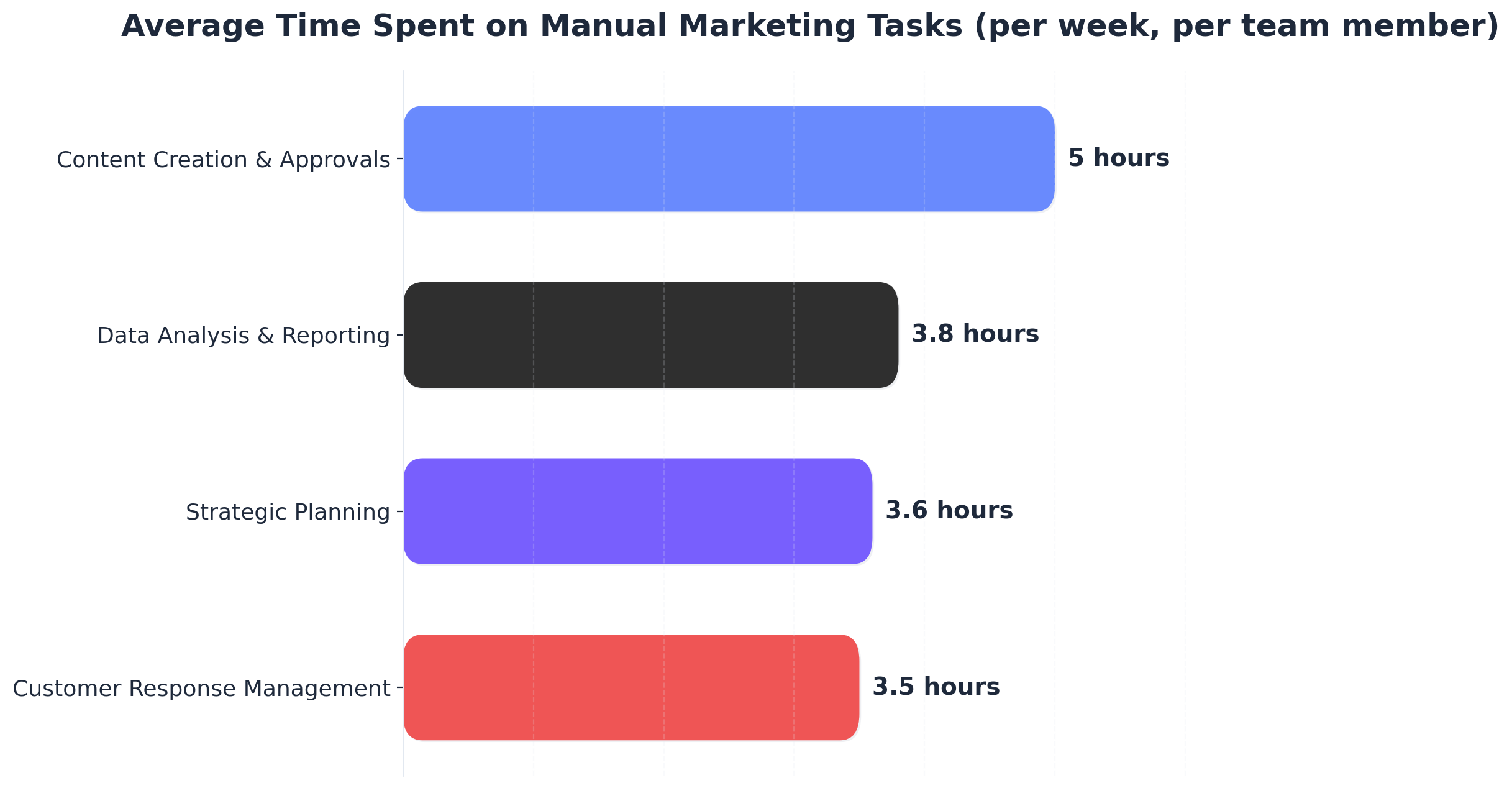 Average Time Spent on Manual Marketing Tasks (per week, per team member)
Average Time Spent on Manual Marketing Tasks (per week, per team member): Content Creation & Approvals: 5hours, Data Analysis & Reporting: 3.8hours, Strategic Planning: 3.6hours, Customer Response Management: 3.5hours.
Two variables drive the spread: where production hours land, and how quickly published work converts into measurable pipeline. The remaining sections unpack each lever in operational detail.
Document the Strategy Before Scaling Production
The single variable that separates high-performing content programs from middling ones is whether the strategy lives as a written artifact or in the heads of the people running it. Among the most successful content marketers, 61% maintain a documented content strategy, while the broader population sits closer to 40% 3. The gap is not incidental. Documentation is what allows a program to scale production without scaling confusion.
Retainer agencies often produce strategy decks at kickoff and rarely update them mid-engagement. The result is a static brief that drifts out of alignment within a quarter, then becomes a polite fiction during quarterly business reviews. Systematized in-house operations treat strategy as a living document tied to sales, customer success, and analytics inputs—revised when ICP signals shift, not when the contract renews 3.
A working strategy artifact specifies four things: the audience segments worth pursuing, the funnel stage each piece serves, the sales and customer success insights informing topic selection, and the metrics that define success at each stage 3. Each element constrains downstream production decisions. Without that constraint, briefs balloon, scope creeps, and approval cycles stretch.
The compounding effect matters most. A documented strategy turns every published piece into training data for the next one, instead of a one-off deliverable judged on its own merits.
Run Hybrid AI-Human Production as the Default Workflow
Hybrid production is the operating choice that most directly explains the cost and cycle gap between systematized in-house teams and retainer agencies. When AI handles first-draft generation, brief expansion, outline structuring, metadata, and optimization passes, human operators redirect their hours to angle selection, source interviews, narrative judgment, and final editorial review. The math falls out cleanly: comparative analysis documents 50-70% reductions in time spent on repetitive production tasks and 40-60% lower per-piece costs once hybrid workflows replace fully manual ones 2.
The structural advantage is parallelization. A retainer engagement runs strategist, writer, editor, and account manager in sequence, with each handoff introducing queue time that often exceeds the actual work time. Hybrid production collapses several of those stages into concurrent passes—AI drafts while a subject matter expert is still being scheduled, optimization runs while editorial review is in flight. The same comparative research attributes 60-75% cycle time compression to this shift, alongside a 3-5x lift in monthly output at flat headcount 2.
Output ceiling matters more than per-piece savings for growth-stage SaaS. A program that previously shipped eight pieces a month against a retainer can run twenty-four to forty against the same internal coordination load, which changes what topic clusters, funnel coverage, and experimentation cadence become reachable inside a quarter.
Quality control is where hybrid workflows earn or lose credibility. The non-negotiable inputs are a documented voice specification, a fact-check pass against primary sources, and an editor with authority to reject AI output that drifts from the brief. Programs that skip those inputs produce volume without lift; programs that enforce them produce the cost curve the research describes.
Automate the Workflow Layer to Reclaim Strategic Hours
Manual coordination is the silent tax on every content program. Roughly 63% of marketing teams report that repetitive tasks consume hours that would otherwise fund strategic work, and the breakdown is specific: about five hours per week per team member on content creation and approvals, 3.8 hours on data and reporting, 3.6 hours on planning, and 3.5 hours on customer response management 5. Across a four-person content team, that is more than sixty hours a week of reclaimable capacity sitting inside Slack threads, spreadsheets, and email approvals.
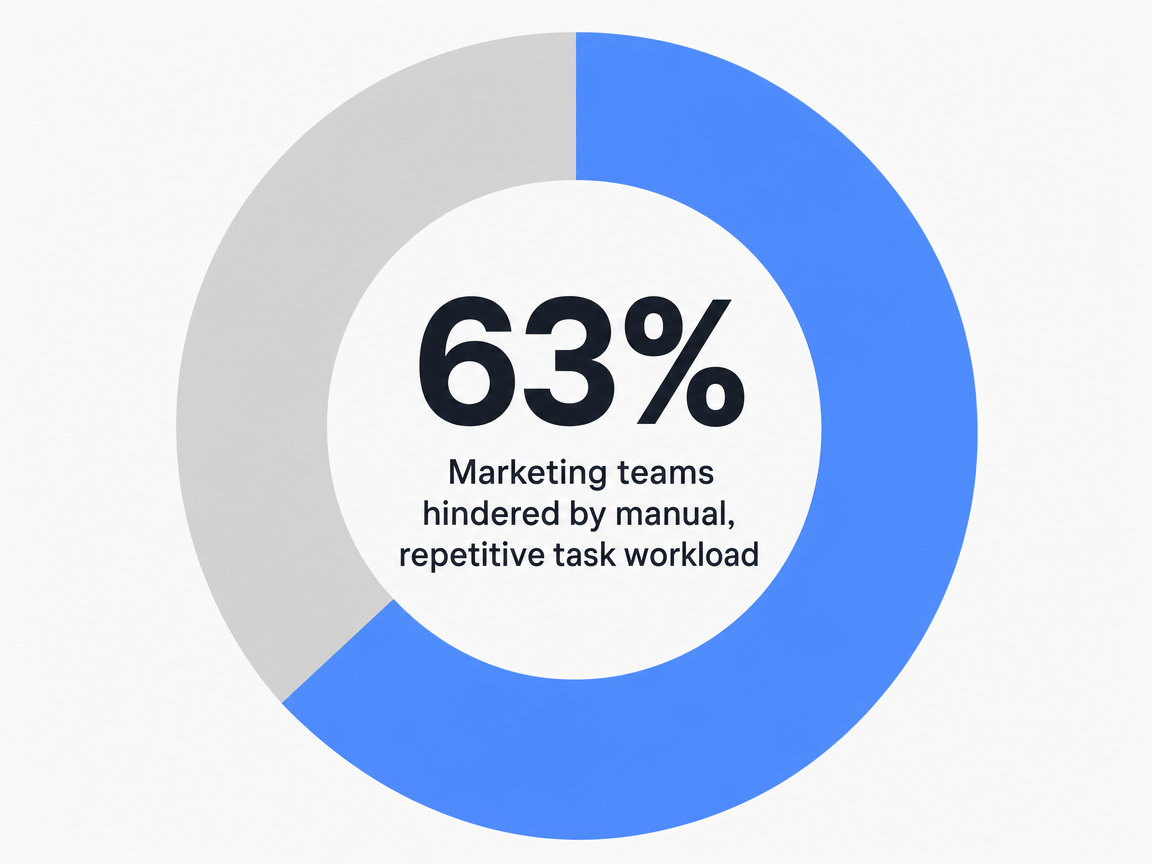 Marketing teams hindered by manual, repetitive task workload: 63%
Workflow automation targets the routing layer, not the creative layer. The decomposition pattern documented in operational research is to break each content project into discrete phases—brief, draft, review, optimization, publish, distribute—and assign automated triggers between them so handoffs occur the moment upstream work clears its checklist 4. Status meetings become unnecessary when the system itself reports state.
The reclaimed hours land in three places that compound: deeper topic research, sharper editorial judgment on which pieces to greenlight, and post-publish optimization that most retainer engagements never fund because the contract ends at delivery. A content lead who recovers ten hours a week from approval routing can run two additional optimization cycles per month against existing top-performing pieces, which historically produces more pipeline lift than net-new production.
Programs that resist automation usually do so on quality grounds, arguing that human review at every gate protects the brand. The counter-evidence is straightforward: automation does not remove the editor, it removes the calendar invite. Editorial authority stays where it belongs while the routing, notifications, version control, and metadata population run on rules 4.
Discover How Top SaaS Teams Automate Content Marketing for 2x Greater ROI
Connect with Vectoron to see real performance benchmarks and workflow automations that help agencies and enterprises scale content and PPC without the drag or cost of traditional agency models.
Design a Modular Team Around a Small Strategic Core
Modular team design separates the work that requires institutional judgment from the work that can be sourced, automated, or rotated. A small strategic core—typically a content lead, an editor with veto authority, and an analyst who owns the measurement stack—holds the variables that compound over time: voice, taxonomy, funnel logic, and performance interpretation. Everything else flexes.
The flexible layer is where retainer agencies traditionally inserted themselves: drafting, design, motion, technical SEO passes, distribution. Systematized in-house operations now treat that layer as a curated specialist network combined with hybrid AI production, called in by project rather than billed by month. The economic shift is that fixed agency retainers convert into variable specialist spend tied to actual output, while the strategic core stays small enough to move quickly on documented inputs from sales and customer success 3.
Three operating rules keep the model coherent. The core never outsources final editorial authority. Every specialist engagement runs against the documented brief, not a verbal kickoff. Performance review of specialist output happens against the same dashboards the core uses to manage the program, so quality drift surfaces in metrics rather than in retrospectives.
A four-person core can run the output ceiling that previously required a ten-person agency team plus internal coordinators.
Replace Last-Click Reporting with Multi-Touch Attribution
Last-click reporting is the reason most content programs look underfunded on paper. When the final paid search ad or branded direct visit absorbs full credit for a conversion, the blog post that introduced the prospect, the comparison guide that shaped the shortlist, and the case study that closed the consideration gap all register as zero. Budget conversations then follow the data, and content gets cut against its own contribution.
Multi-touch attribution distributes conversion credit across every touchpoint in the customer journey rather than collapsing it onto the last interaction 7. The U-shaped model offers a defensible starting point for content programs: 40% of credit to the first touch, 40% to the last touch, and 20% distributed across the middle interactions 7. The weighting reflects what growth directors already know intuitively—the introduction and the closing moment carry disproportionate influence, while nurturing touches compound in aggregate.
The reporting shift exposes a category of content that last-click reporting systematically undervalues: top-of-funnel educational pieces that rarely close deals but consistently open them. Once first-touch credit becomes visible, the ROI case for sustained investment in awareness-stage content stops being a faith argument.
The discipline that separates real attribution from theater is matching reporting against measurement. Reporting describes what happened; measurement explains why, and ties content performance to revenue outcomes the finance team will accept 6. A U-shaped dashboard without a documented methodology behind it is still a vanity exercise. The methodology—touchpoint definitions, lookback windows, conversion events, exclusion rules—is what makes the model auditable across quarters.
Unify the Data Stack Around a Single Customer Profile
Fragmented data is the structural reason most content programs cannot prove their contribution. Page-level analytics live in GA4, intent signals live in the marketing automation platform, deal outcomes live in the CRM, and ad engagement lives in each channel's native console. When those systems never reconcile against a single identity, the same prospect appears as four anonymous sessions, one form fill, and a closed-won deal that no content asset gets credit for influencing.
A customer data platform resolves the identity problem by unifying records from every source into a single persistent profile per individual, then exposing that profile to downstream tools for segmentation and personalization 8. The strategic effect for content operations is twofold. Reporting becomes coherent because every touchpoint maps to one person rather than four cookies, and personalization becomes operationally feasible because audience segments built on unified profiles update in real time as behavior accumulates 8.
Three integrations carry most of the weight: the analytics layer for behavioral signal, the CRM for revenue outcome, and the ad platforms for paid touchpoint reconciliation. Once those three feeds resolve to the same profile, multi-touch attribution stops being a modeling exercise and becomes a query against actual data.
The operating discipline is to treat the unified profile as the source of truth that every dashboard, brief, and segmentation rule references—not as one report among many.
Orchestrate Five or More Channels in Coordinated Sequences
Channel count correlates with conversion in a way that single-channel programs cannot replicate through volume alone. Coordinated campaigns running across five or more channels produce 412% higher purchase rates than single-channel equivalents, and 91% of top-performing marketing teams identify multi-channel orchestration as their most impactful strategic priority 9. The figure is large enough to reframe how content programs allocate effort.
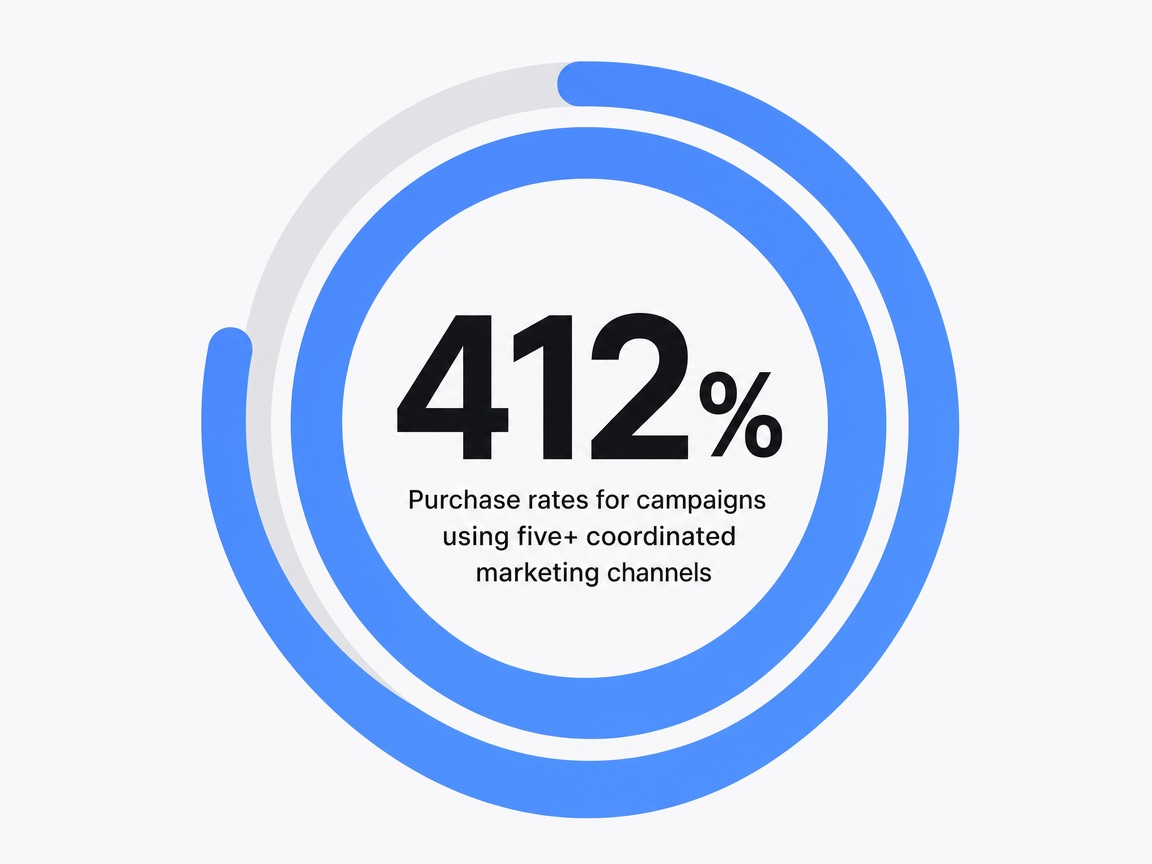 Purchase rates for campaigns using five+ coordinated marketing channels: 412%
The operative word is coordinated. Five disconnected channels running independent calendars produce noise, not lift. Orchestration means a single piece of cornerstone content fans out into channel-specific sequences—an analyst-style blog post becomes a LinkedIn carousel, a sales enablement one-pager, a paid social ad set, an email nurture, and a retargeting display sequence—each timed against the others so a prospect encountering the brand on Tuesday meets a reinforcing message by Friday rather than a contradictory one.
Retainer engagements typically struggle here because each channel often sits with a different specialist or vendor, and the coordination cost of synchronizing five calendars exceeds the cost of running them in isolation. Systematized in-house operations resolve the problem at the planning layer: one editorial calendar drives every channel, with derivative assets generated in parallel from the source piece rather than briefed separately.
The practical threshold is five channels because below that count, the compounding effect on frequency and recall stays modest. Above it, the same prospect encounters the brand often enough across contexts that purchase intent accelerates measurably 9.
Build a Continuous Feedback Loop with Real-Time Dashboards
Static reporting cycles—monthly recaps, quarterly business reviews, end-of-engagement decks—optimize for accountability theater rather than performance lift. By the time a retainer status report flags an underperforming pillar, the team has already published three more pieces against the same flawed assumptions. Continuous feedback loops close that latency gap by routing live performance data into the production calendar 10.
The mechanism is a real-time dashboard tied to the metrics that actually move the program: organic sessions by intent cluster, assisted conversions by funnel stage, scroll depth and dwell on cornerstone assets, and pipeline influence sourced from the CRM. Operators monitoring those signals weekly can pull a misfiring topic before it consumes a quarter of production capacity, and double down on a cluster showing early traction within the same sprint 10.
The discipline that makes the loop work is decision rules written in advance. A piece that fails to clear a defined engagement threshold inside thirty days triggers an optimization pass, not a debate. A cluster that overperforms triggers a derivative production queue automatically. Without preset rules, dashboards become passive scoreboards rather than active inputs.
This is also where the 5:1 ROI ceiling becomes reachable—programs that optimize continuously against live data outperform programs that ship and forget 2.
Source Topic Intelligence from Sales and Customer Success
The most underused topic intelligence inside any growth-stage SaaS company sits in the call recordings, support tickets, and onboarding notes that sales and customer success generate every week. These conversations contain the exact phrasing prospects use to describe problems, the objections that stall deals, and the misconceptions that surface during implementation—every one of them a brief waiting to be written.
Data-driven content programs treat sales and customer success as primary research inputs, not stakeholders to consult quarterly 3. The operating mechanism is a standing intake: a shared document or tagged field in the CRM where account executives log the questions buyers ask in discovery calls, and customer success managers log the friction points that surface in the first ninety days of an account. Each entry becomes a candidate topic with built-in audience validation.
Retainer agencies cannot replicate this input from the outside. Their topic ideation runs on keyword tools and competitor analysis, which produce the same content the rest of the category is already publishing. Internal intake produces the content prospects actually search for after a sales conversation surfaces a question the website never answered.
The downstream effect is funnel coverage that maps to real buying behavior rather than assumed journeys 3.
Connect the Nine Practices Through an Integration Layer
The nine practices reinforce each other only when they share infrastructure. A documented strategy without a unified data stack produces briefs that cannot measure their own outcomes. Multi-touch attribution without continuous feedback loops produces dashboards no one acts on. Hybrid production without modular team design produces volume the editor cannot govern. Run the practices in isolation and the gains dilute against the same coordination overhead the retainer model imposed.
The integration layer is what closes the loop. It pulls sales and customer success intake into the topic queue, routes documented strategy into the production workflow, executes hybrid drafts against the brief, distributes derivative assets across five or more channels, and reconciles every touchpoint against a unified profile so the feedback dashboard reflects reality rather than fragments 810. One operating system, one source of truth, one decision rhythm.
This is the structural argument against the retainer model in a single sentence: the agency owns pieces of the workflow, never the integration. Platforms such as Vectoron exist to provide that integration layer as a single AI marketing operating system, which is what makes the 5:1 ROI ceiling and the 60-75% cycle compression reachable in practice rather than in theory.
Test Data-Driven Content Execution Risk-Free
Experience live content marketing results on your channels before making any commitment.
Frequently Asked Questions
References
- 1.Is Content Marketing Surpassing Traditional Marketing Strategies?.
- 2.AI Marketing Agency vs Traditional Agency: Complete ROI Analysis.
- 3.10 Essential Tips for Data-Driven Content Marketing.
- 4.How to Optimize Your Content Workflow with Automation.
- 5.4 Strategies to Increase Marketing Team Productivity.
- 6.How to Measure Content Marketing ROI (and Why Marketers Struggle with It).
- 7.Multi-Touch Attribution — What It Is, and How to Do It Well.
- 8.What Is a Customer Data Platform (CDP)?.
- 9.Multi-Channel Marketing Strategy: High-Performance Guide 2026.
- 10.Building a Continuous Feedback Loop to Accelerate Ongoing Optimization.