
Key Takeaways
- Optimization now hinges on continuously matching search intent, proving firsthand experience, and structuring pages for people first, with mechanical on-page fixes serving as support rather than the primary driver 2.
- Intent alignment and content quality deliver the largest conversion gains, with intent-matched pages converting 2.5x higher and each unit of landing page quality lifting conversion rates up to 22.5% 10, 6.
- Triage refresh queues by combining traffic decay with conversion value, prioritizing pages that slipped from positions 1-5 to 6-15 on commercial queries where recoverable pipeline is highest.
- Defend the program to leadership by reporting cycles completed, conversion deltas on refreshed cohorts, and organic pipeline contribution rather than rankings alone, using throughput as the forward-looking constraint 10.
Why Optimization Stopped Being a Checklist
Content optimization used to be a simple checklist: target keyword in the title, one H1, meta description under 160 characters, internal links to related posts. This approach, still common in many CMS templates, often fails to explain why two technically similar pages yield vastly different pipeline outcomes.
The 2022 helpful content update shifted the focus. Google now advises creators to prioritize satisfying content, using SEO practices to enhance value rather than as the primary driver 2. A page can pass every on-page audit and still be devalued if it appears to be search-first instead of people-first 1. This change transformed optimization from a static publishing task into an ongoing evaluation process.
Recent evidence supports this shift. A meta-analysis of ten studies from 2022 to 2024 found a significant effect size (d = 1.049) for structured SEO work on rankings and traffic, identifying content quality, keyword optimization, and backlinks as key drivers 9. Such substantial effects stem from teams continuously diagnosing, refreshing, and measuring existing pages, not from minor title-tag adjustments.
For in-house content managers, the challenge is no longer what to optimize, but how many optimization cycles their team can complete quarterly without compromising quality.
What Content Optimization Actually Means in 2024-2026
Content optimization is the continuous effort to align a page with a specific search intent, demonstrate firsthand experience, and structure the asset for both readers and ranking systems to quickly extract its value. This definition has become more stringent since 2022.
Intent alignment has superseded keyword density as the primary input. A page ranks and converts when it addresses the user's underlying need, not by repeating a phrase at a specific frequency. Google's helpful content guidance emphasizes that content should satisfy the searcher, with SEO practices adding value 2. Pages that reverse this order underperform, even if they pass technical audits 1.
Experience and expertise are now essential production requirements. The 2022 addition of "Experience" to E-A-T formalized what raters seek: evidence that the author has practical knowledge of the topic 3. This includes bylines with credentials, original screenshots, proprietary data, and specific details that cannot be replicated by merely summarizing competitors.
Structure and technical hygiene remain foundational. Clear headings, scannable formatting, internal linking, schema, and page speed are still important, but they no longer provide a competitive edge. In 2024-2026, optimization is a disciplined cycle of matching intent, proving experience, measuring conversion impact, and refreshing the page when performance declines.
The Levers That Move Conversion, Not Just Rankings
Intent Alignment as the Highest-Leverage Input
Not all optimization efforts yield the same return. When in-house teams prioritize inputs by measured conversion lift, intent alignment consistently ranks highest, with a significant gap between it and mechanical on-page fixes.
Aggregated 2026 benchmarks indicate that content optimized for user intent achieves a 2.5x higher conversion rate than content that misses intent, and SEO-optimized landing pages show a 45% higher conversion rate than non-optimized ones 10. Paid search research offers a similar insight: a one-unit increase in landing page quality score correlates with a 22.5% lift in conversion rate 6. These studies, despite their different scopes, consistently show that aligning a page with the searcher's actual goal drives disproportionate gains.
Intent alignment goes beyond simply choosing the right keyword. It involves classifying the query by the underlying job—comparing options, completing a task, verifying a fact, making a decision—and then structuring the page to fulfill that job within the first scroll. For example, a commercial-investigation query answered with a definitional introduction fails the alignment test, even if the target phrase is in the H1.
For content managers, this implies a reordering of priorities. Rewriting the opening 200 words and the primary section structure to serve the dominant intent will improve conversion metrics faster than adjusting meta descriptions, adding FAQ schema, or tightening internal anchor text. While these latter elements are still important, they build upon intent-fit rather than replacing it.
Quality as a Conversion Driver, Borrowed from Paid Search Evidence
The strongest quantitative evidence linking page quality to conversion comes from paid search, offering valuable insights for organic teams. An empirical analysis of search engine advertising revealed that increasing landing page quality score by a single unit correlated with conversion rate gains of up to 22.5% 6. Although this study focused on advertiser landing pages in a paid auction, the underlying mechanism—clearer relevance, faster comprehension, and more credible presentation—is directly applicable to organic content.
The paid-search literature highlights that quality impacts the post-click phase of the funnel. A visitor landing on a page that appears thin, off-topic, or generic will bounce, regardless of how they arrived. For organic content, this means pages ranking for high-intent queries will still lose potential conversions if the content itself fails to deliver on the promise of the click.
Content managers can operationalize this without adopting Google's opaque quality score. Concrete proxies for quality perception include:
- a clear headline-to-intent match,
- an above-the-fold answer to the primary question,
- credible bylines with relevant credentials,
- original screenshots or data instead of stock imagery,
- and citations for any claim a reader might question.
Each of these elements is part of the editorial workflow, making this lever accessible during every refresh cycle, not just during technical migrations.
Where Organic Optimization Outperforms Paid at the Keyword Level
Organic and paid channels respond differently to optimization inputs. An academic comparison of performance metrics across both channels found that many keyword-level characteristics have a stronger and statistically significant impact on organic search performance than on paid search 7. Factors like word count, keyword specificity, and query framing influence organic click and conversion outcomes more significantly than their paid equivalents.
For in-house teams, this means that the return on investing in keyword-level content decisions—which phrases to target, how specifically to frame the topic, and how the page is structured around the query—is more fully realized by organic campaigns than by paid campaigns targeting the same terms. Paid advertising can secure position, but the content asset itself determines conversion. Organic rewards these decisions over a longer horizon.
For teams managing mixed budgets, this redefines the choice. Optimization cycle time spent on organic pages compounds through both the ranking system and the on-page conversion mechanism. The same effort applied to a paid landing page only influences the latter. Content managers advocating for cycle capacity in a mixed-channel plan can directly point to this asymmetry.
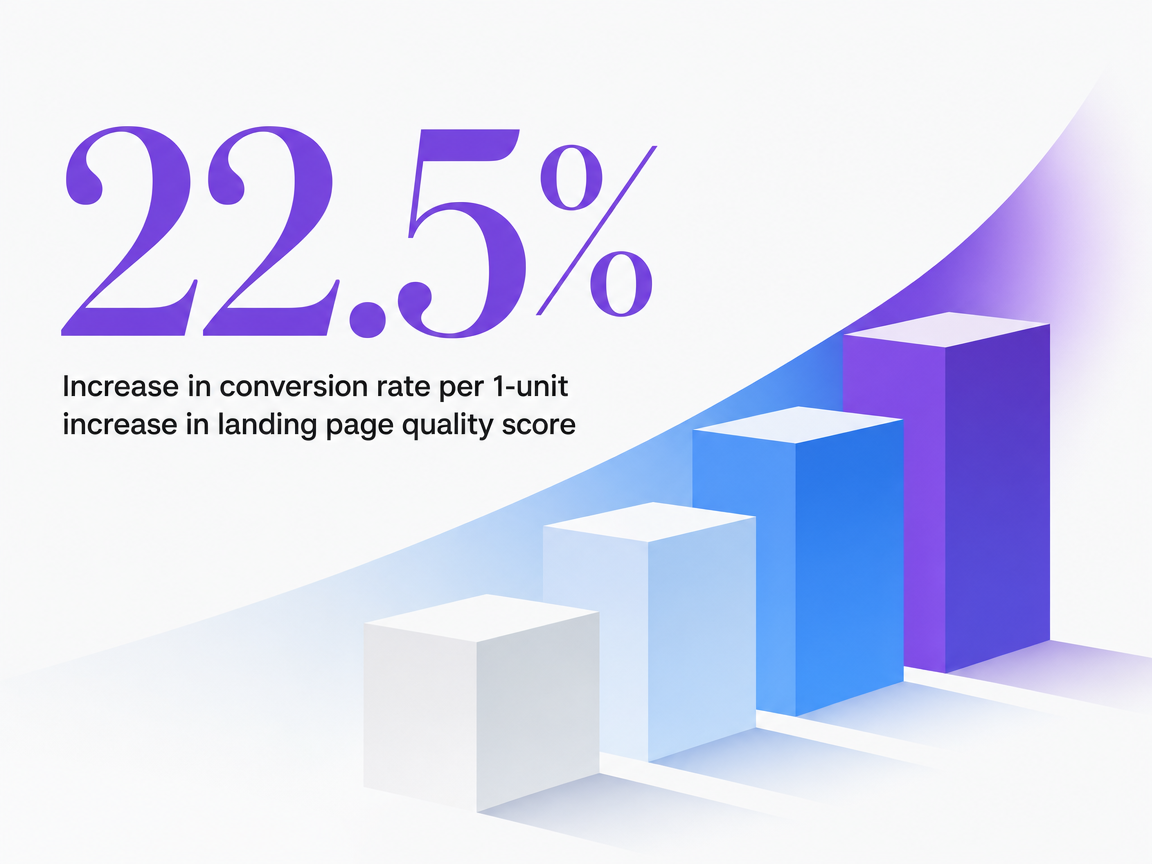 Increase in conversion rate per 1-unit increase in landing page quality score
Increase in conversion rate per 1-unit increase in landing page quality score
E-E-A-T as a Production Spec, Not a Mystery Signal
The Search Quality Rater Guidelines do not directly rank pages 3, 4. This fact is often misinterpreted as permission to ignore E-E-A-T. The correct interpretation is the opposite: the guidelines describe what Google's ranking systems are designed to reward, making them the clearest available specification for what a high-quality page should contain before publication.
Translating this specification into editorial workflow means identifying the specific elements that must be present on the page.
Experience : demonstrated through original screenshots of actual use, proprietary data from the team's operations, and specific details that cannot be produced by merely paraphrasing top-ranking competitors 3.
Expertise : shown through bylines with verifiable credentials linked to author pages that document the writer's background.
Authoritativeness : conveyed through citations to primary sources rather than summaries from other blog posts.
Trust : built with clear publication and update dates, transparent methodology for any numerical claims, and correction notes when figures are revised.
A 2025 empirical study on structured optimization found a correlation of r = 0.74 between an E-E-A-T composite score and conversion rate on the sampled site 8. While this coefficient is directional evidence from a single study, it supports the rater guidelines' premise: credible-looking pages convert at rates that traffic volume alone cannot predict.
Operationally, E-E-A-T becomes a pre-publish checklist that content managers can enforce without subjective quality debates. Either the byline links to a credentialed author page, or it doesn't. Either the page contains at least one original artifact—screenshot, chart, dataset, direct quote from a named practitioner—or it doesn't. Either every quantitative claim has a source link, or it's removed. Building E-E-A-T becomes a production step with clear pass/fail states, rather than a hoped-for signal.
Accelerate SEO Content Impact This Week
Test-drive real-time content optimization and measure ranking improvements before making a commitment.
The Compounding Case for Continuous Refresh Cycles
A single optimization pass on a page creates a one-time improvement. However, applying that pass to the same page quarterly, informed by previous data, generates a continuous growth curve. The difference between these two outcomes represents pipeline most in-house programs fail to capture.
Evidence comes from a 2025 single-site empirical study that implemented structured optimization over six months. The site saw a 638% increase in organic traffic, an average keyword position improvement of 39.6 places, and a 209% lift in conversion rate during this period 8. While these figures are specific to one site and market, they directionally demonstrate the power of a disciplined refresh cadence. The key takeaway is the pattern of results: traffic and conversion improved together because the same cycle drove both—intent alignment on republish, experience artifacts added on refresh, and structural cleanup applied against measured decay.
The compounding effect lies within the cycle itself. Each refresh informs the next diagnosis: which sections maintained rank, which lost impressions, which converted traffic, and which leaked it. Pages that are optimized once and then left untouched stop learning. Pages within a governed loop accumulate signals—more experience artifacts, tighter intent match, cleaner internal linking—and this accumulation distinguishes a program that produces a temporary spike from one that generates sustained growth.
Throughput is the limiting factor. A team completing eight refresh cycles per quarter learns eight times more than a team completing one, and this compounding effect becomes visible in the pipeline report two quarters later.
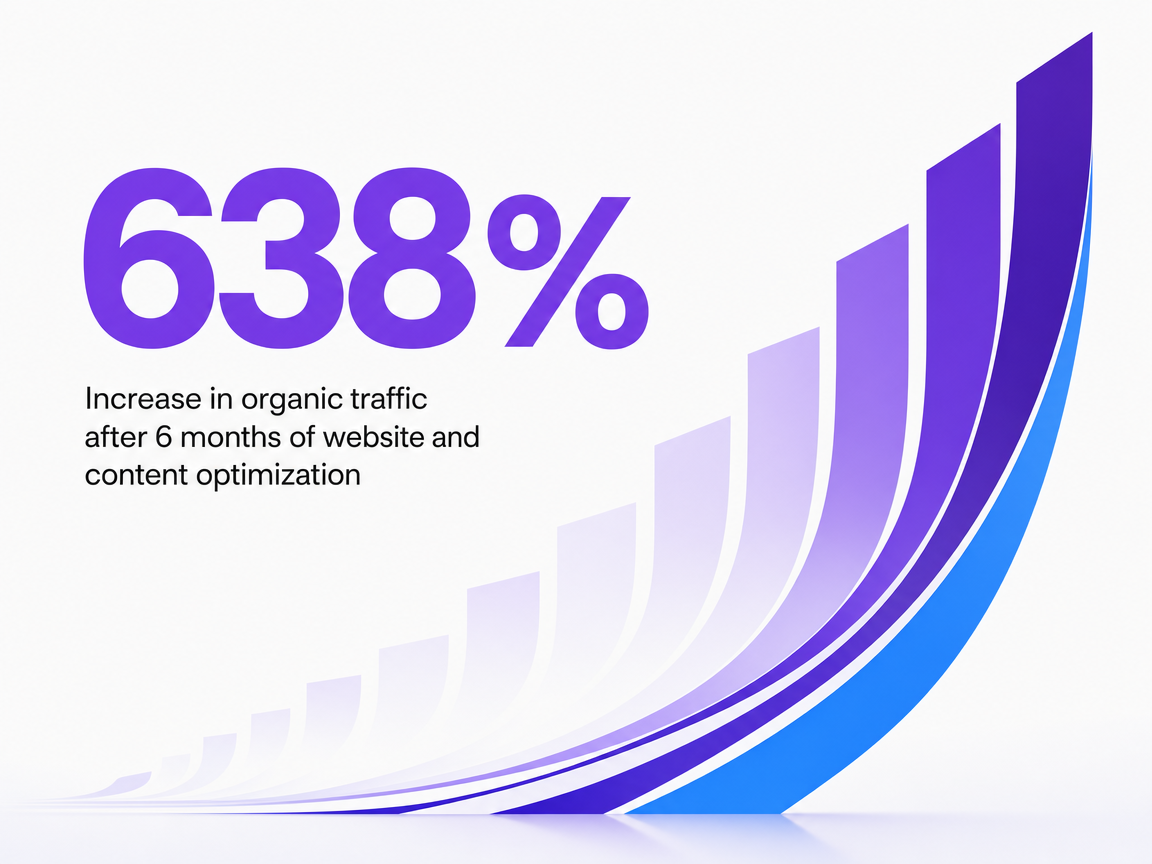 Increase in organic traffic after 6 months of website and content optimization
Increase in organic traffic after 6 months of website and content optimization
A Triage Framework for Deciding Which Pages to Refresh First
Most in-house teams cannot refresh every page every quarter. The challenge is prioritizing which pages receive the next cycle, and "update old content" is an insufficient answer for a quarterly business review. A robust triage model scores existing pages based on two criteria: traffic decay and conversion value.
Traffic decay is the more straightforward signal. Any page that has lost impressions or clicks quarter-over-quarter for two consecutive quarters is a candidate. Pages that once ranked in positions 1-5 for a commercial query and have since dropped to positions 6-15 represent the most recoverable pipeline. This is because the ranking system has already validated their topical fit, and the decline typically indicates issues with freshness, intent drift, or a competitor publishing a more comprehensive answer. Pages that never ranked well should be considered for rewriting or retirement, not refreshing.
Conversion value is often overlooked. Ranking pages solely by session volume rewards top-of-funnel traffic that may not convert. A more effective score multiplies assisted conversions or pipeline-influenced revenue by the recovery probability implied by the current rank. For instance, a page at position 8 for a bottom-funnel query with a 3% historical conversion rate should be prioritized over a position-3 informational page with a 0.2% conversion rate.
This triage matrix creates four quadrants:
- Pages with high decay and high conversion value belong in the refresh queue and receive immediate attention.
- Pages with high decay and low conversion value are placed in the audit queue, where decisions are made to consolidate, redirect, or retire them.
- Pages with low decay and high conversion value are in the protect queue, monitored for competitor activity and updated preemptively.
- Pages with low decay and low conversion value are not prioritized until the other three quadrants are addressed.
Applied weekly, this framework transforms a vague backlog into a ranked queue that a manager can justify. It also reveals throughput limitations: if the refresh queue contains forty pages and the team completes eight cycles per quarter, the issue is one of staffing or tooling, not strategy.
Isolating the Highest-Leverage Optimization Inputs
Not every optimization input warrants equal time. A meta-analysis of ten studies conducted between 2022 and 2024 found a significant overall effect size (d = 1.049) for structured SEO implementation on rankings and traffic 9. Crucially, the meta-analysis identified three statistically significant variables: content quality, keyword optimization, and backlinks 9.
Two of these three variables are within the editorial workflow. Content quality and keyword optimization are decisions a content manager makes during every refresh cycle. This means the leverage attributed to them by the meta-analysis is achievable without a technical migration or a dedicated link-building budget. While backlinks are important, they operate on a slower timeline and typically fall under a different function.
The practical ranking of priorities follows:
- Cycle time spent on content quality—including intent match, experience artifacts, and structural clarity—yields the fastest compounding returns because it is an input the team fully controls and is flagged as significant by pooled evidence.
- Keyword optimization is second, encompassing query framing, entity coverage, and internal anchor structure on pages already being refreshed.
- Backlink acquisition runs in parallel, not as a replacement for the first two.
Content managers can directly reference this meta-analysis in planning meetings to advocate for cycle capacity. The effect size is high, the drivers are clearly identified, and two of the three drivers are within the team's direct control.
See How Leading Teams Accelerate SEO Results with Data-Driven Content Optimization
Request a walkthrough of workflow automation that enables scalable, measurable content improvements—without adding headcount or sacrificing brand control. Tailored for agencies and enterprise marketing leads managing high-volume SEO operations.
Governing AI-Assisted Optimization Without Getting Devalued
Google's public stance on AI-generated content is method-agnostic. Search prioritizes the quality of the output, not its production method. Ranking systems aim to reward original work that demonstrates experience, expertise, authoritativeness, and trustworthiness, regardless of AI involvement 5. This guidance does not endorse unsupervised generation; instead, it clarifies that AI-assisted content meeting the same quality standards as human-only work will perform well, while AI-assisted content lacking experience and originality will be considered thin, regardless of volume.
The risk of devaluation stems from a specific failure: content produced primarily to attract search traffic at scale, without adding original value. Google's helpful content guidance identifies this as a problem signal, and the system operates site-wide, meaning a large volume of thin AI output can negatively impact the performance of otherwise strong pages 2. Volume without proper governance is a compounding liability, not a growth strategy.
An effective governance model treats AI as a drafting layer within an approval workflow, not a publishing endpoint. Human editors define the intent brief and the required experience artifacts (original screenshots, proprietary data, credentialed byline, primary-source citations) before AI begins drafting. AI accelerates the middle of the cycle: outline generation, first-draft prose, structural formatting, and internal link suggestions. Every draft is then routed to a named reviewer with the authority to reject, revise, or publish. Nothing ships without this human sign-off.
For in-house content managers, the operational takeaway is increased throughput while maintaining a high quality bar. Approval-first workflows enable a team to complete more optimization cycles per quarter without lowering the standard measured by the helpful content system. This is because AI expands drafting capacity, while human judgment ensures the page is perceived as people-first, not search-first.
If You Manage Multiple Locations: A Cost Model for Optimization at Scale
This section is for content managers overseeing organic programs across numerous locations—such as DSOs, law firm networks, senior living portfolios, home services franchises, or multi-region healthcare groups. The optimization calculus changes when each location requires its own intent-aligned pages, experience artifacts, and refresh cadence tailored to local competitors.
Three operating models cover most scenarios:
- An agency retainer per location outsources the work, typically with a monthly fee per market.
- An in-house team with location-specific writers centralizes strategy but distributes production headcount.
- A centralized team using AI-assisted drafting within an approval workflow maintains a consistent editorial standard while expanding drafting capacity per reviewer.
The cost structure, not the deliverable, differentiates these models. The table below outlines the key cost categories; dollar values should be supplied by the operator based on their specific market, as this article cannot provide universal benchmarks.
| Cost category | Agency per location | In-house per location | Centralized + AI-assisted |
|---|---|---|---|
| Monthly recurring fee | Retainer × locations | Fully-loaded writer salary allocation | Platform fee (Vectoron trial converts at $599/mo) + reviewer time |
| Editorial oversight | Included, variable quality | In-house editor headcount | Named reviewer per approval queue |
| Refresh cycles per location per quarter | Contract-defined, usually 1–2 | Capped by writer throughput | Capped by reviewer approval capacity |
| Marginal cost of location #51 | Full retainer added | Full writer allocation added | Reviewer minutes added |
The marginal cost per additional location is the deciding factor. Agency and headcount models incur linear cost increases. A centralized approval-first workflow primarily adds reviewer minutes, which is why the meta-analysis effect size for structured optimization 9becomes economically viable at a portfolio scale, not just for flagship sites.
Defending the Program: Reporting Optimization to a CMO
Optimization programs are often cut when reporting focuses solely on rankings. CMOs prioritize pipeline, cost per qualified lead, and organic contribution to revenue. Content managers who translate their work into these metrics retain budget; those who report only position changes and impression counts risk losing their argument in the next planning cycle.
A defensible quarterly report should demonstrate three key areas:
- Cycles completed against the triage queue, detailing the intent alignment and experience artifacts added to each page.
- Conversion rate movement on the refreshed cohort, isolated from unrefreshed pages to attribute the delta.
- Organic contribution to pipeline, tracked as assisted and last-touch conversions against the sales system, rather than generic analytics goals.
The framing should be based on verifiable evidence for a CMO. Aggregated benchmarks show organic search accounts for 53% of website traffic and 33% of conversions in pooled data 10, establishing the channel's importance before program-specific numbers are presented. The report then shifts to the team's own cohort deltas—metrics that withstand scrutiny because they measure the same site the CMO already observes.
The forward-looking conclusion should address throughput: the next quarter's queue length, available reviewer capacity, and tooling decisions—including platforms like Vectoron—that will determine how many cycles the program can deliver for the next report.
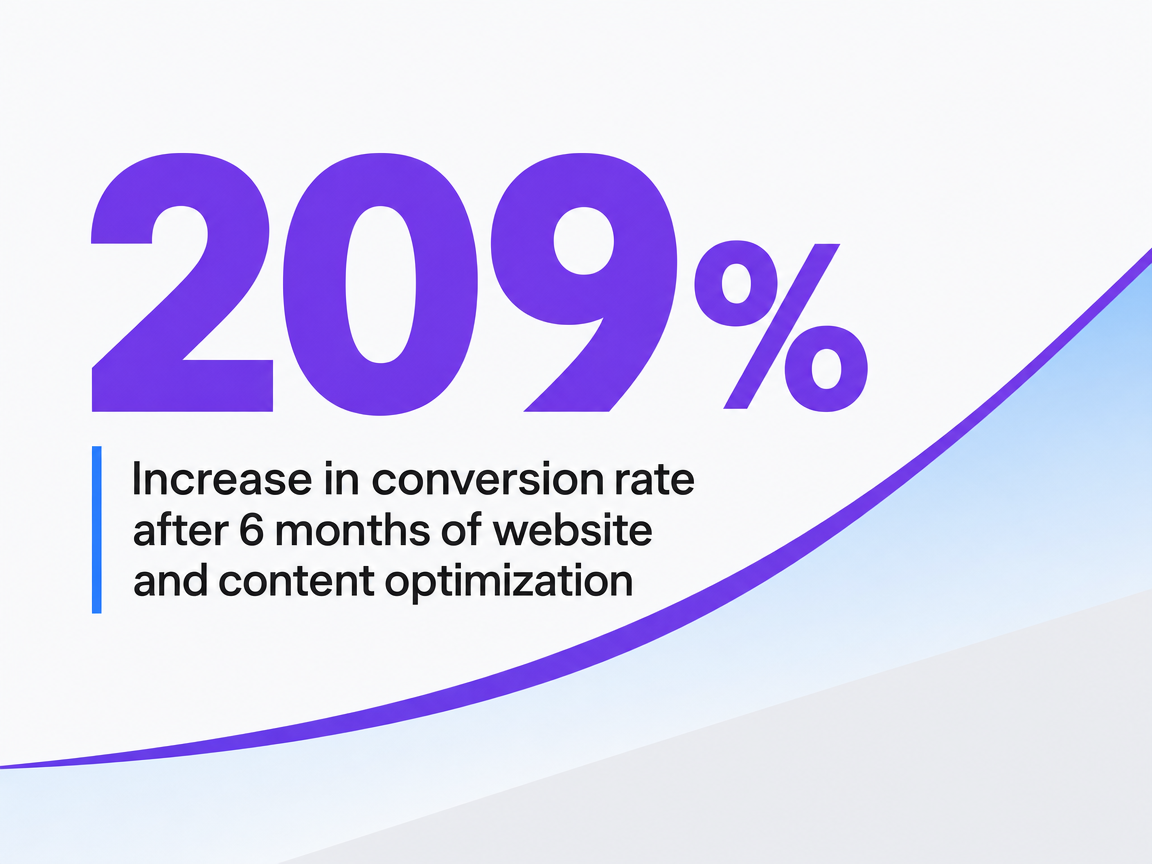 Increase in conversion rate after 6 months of website and content optimization
Increase in conversion rate after 6 months of website and content optimization
Frequently Asked Questions
References
- 1.Creating Helpful, Reliable, People-First Content.
- 2.What creators should know about Google's August 2022 helpful content update.
- 3.Our latest update to the quality rater guidelines: E-A-T gets an extra E for Experience.
- 4.Search Quality Raters Guidelines update.
- 5.Google Search's guidance about AI-generated content.
- 6.An Empirical Analysis of Search Engine Advertising.
- 7.Comparing Performance Metrics in Organic Search with Sponsored Search Advertising.
- 8.Optimasi Struktur Website dan Kualitas Konten Berbasis SEO terhadap Trafik Organik dan Konversi.
- 9.The Effectiveness Of Search Engine Optimization (SEO) In Increasing Website Traffic and Sales: A Meta-Analysis.
- 10.Does Optimizing Content For SEO Work Statistics 2026.