
Key Takeaways
- Platform One is the SERP-scoring standard for editorial teams, solving brief drift with deep SERP intelligence but requiring separate tools for rank tracking, project management, and CMS integration.
- Platform Two compresses brief-to-draft cycles from days to hours for high-velocity blogs, though its outputs often lack original perspective and demand a strong human editing layer.
- Platform Three audits large libraries of 3,000-plus URLs to fight portfolio decay through clustering, cannibalization detection, and refresh prioritization, but does not handle drafting or briefing.
- Platform Four coordinates social, email, and paid variants through a single approval queue, addressing channel sprawl as generative AI use in social content climbs toward 48% by 2026 11.
- Platform Five uses a trained voice model and real-time checks to prevent voice drift across freelance pools, freeing editors to focus on argument and evidence rather than tone enforcement.
- Platform Six, where Vectoron fits, consolidates research, briefing, drafting, optimization, publishing, and measurement into an approval-first loop that eliminates the coordination tax of stacked point tools 8.
The Category Split That Changes 2026 Shortlists
Content optimization software has evolved beyond simple editor interfaces and SERP-scoring. The market is projected to grow significantly, from $2.8 billion in 2025 to $7.2 billion by 2033, a 12.5% compound annual growth rate1. This growth is driven by a demand for integrated solutions that connect research, briefing, drafting, optimization, and publishing within a single, governed workflow.
This shift has created two distinct product tiers: "optimization scorers" and "execution platforms." Scorers are single-purpose tools that grade a draft against top-ranking pages, providing a checklist for improvement. Execution platforms, conversely, view scoring as one stage within a broader production system, incorporating approval workflows, brand-voice controls, and measurable channel impact.
Content managers must recognize this distinction. Selecting a scorer when a platform is needed can lead to hidden coordination costs across teams. Conversely, using a platform solely as a scorer underutilizes its capabilities. The six vendors ranked in this article are categorized by this tier split and then evaluated based on the specific operational problems they solve for content teams in 2026.
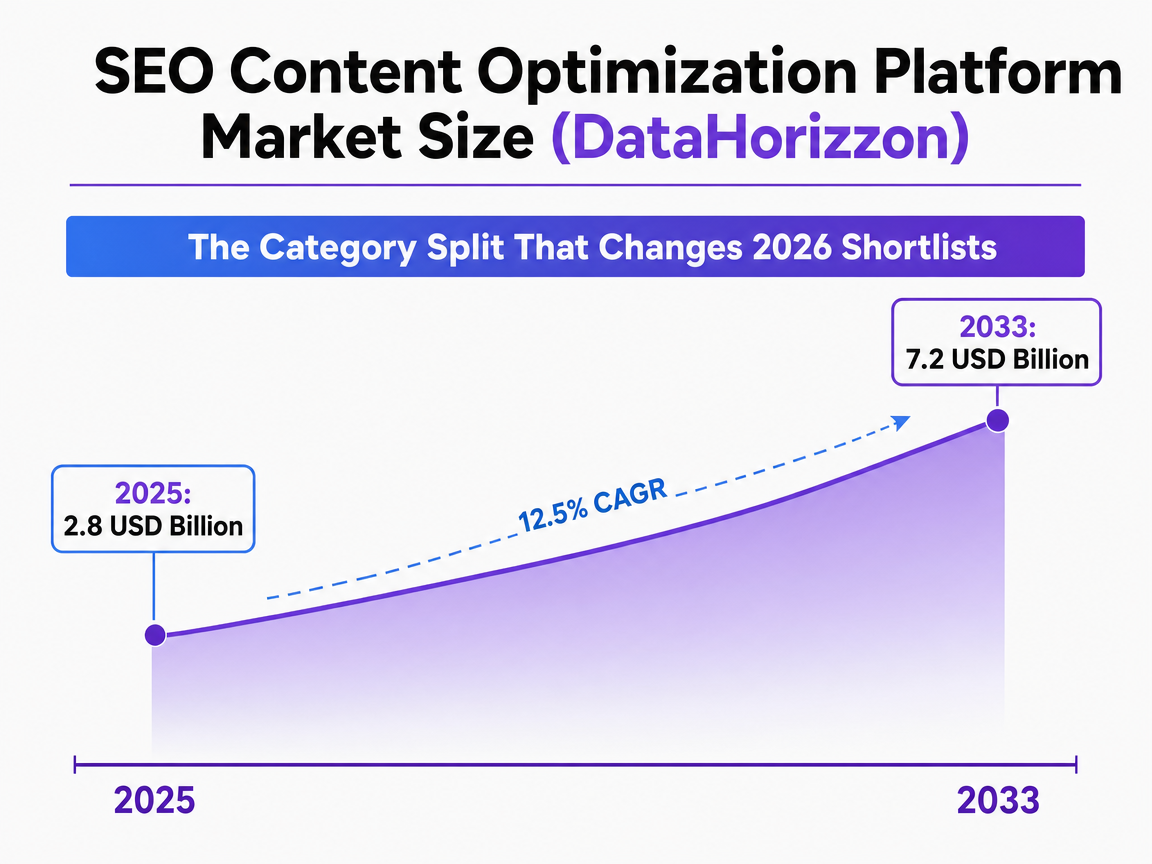 SEO Content Optimization Platform Market Size (DataHorizzon)
Shows the projected growth of the SEO content optimization platform market from $2.8 billion in 2025 to $7.2 billion by 2033, representing a 12.5% CAGR.
How the Six Platforms Were Evaluated
The evaluation framework for these platforms is based on four weighted criteria:
- production velocity
- SEO impact
- workflow integration
- governed AI execution
These criteria directly address the operational challenges content managers face in 2026. Feature parity was not a primary consideration, as most serious vendors now offer similar basic functionalities like SERP analysis, brief generation, and AI drafting. The goal was to assess how tools perform within a real-world content operation.
Inclusion in this evaluation required meeting current industry adoption benchmarks. According to Global Growth Insights' 2025 analysis, 58% of SEO tools now include AI integration, 54% offer automation, and 61% run on cloud infrastructure3. Platforms falling below these thresholds were excluded. The key question then became which qualifying tools effectively integrate their AI and automation capabilities into the broader content workflow, rather than merely stopping at draft generation.
Workflow integration received the heaviest weighting. A platform that scores drafts but necessitates manual file transfers between project managers, CMS, and rank trackers introduces coordination costs that can negate optimization benefits. Adobe's 2025 content supply chain report highlights this issue, noting that siloed tools create governance and sprawl problems, undermining AI's efficiency gains9. BCG further advises CMOs to identify end-to-end workflow steps for AI integration rather than deploying isolated pilots8.
Governed AI execution was the second-heaviest criterion. The evaluation favored platforms with explicit approval controls, audit trails, and brand-voice guardrails over those that generate output without human sign-off. SEO impact was assessed by the depth of SERP intelligence and the platform's ability to track ranking changes. Production velocity was measured by the time-to-publish for a standard 1,500-word article, based on vendor-documented workflows. Each platform was ranked by the specific operator problem it most credibly solves, rather than a generic feature scorecard.
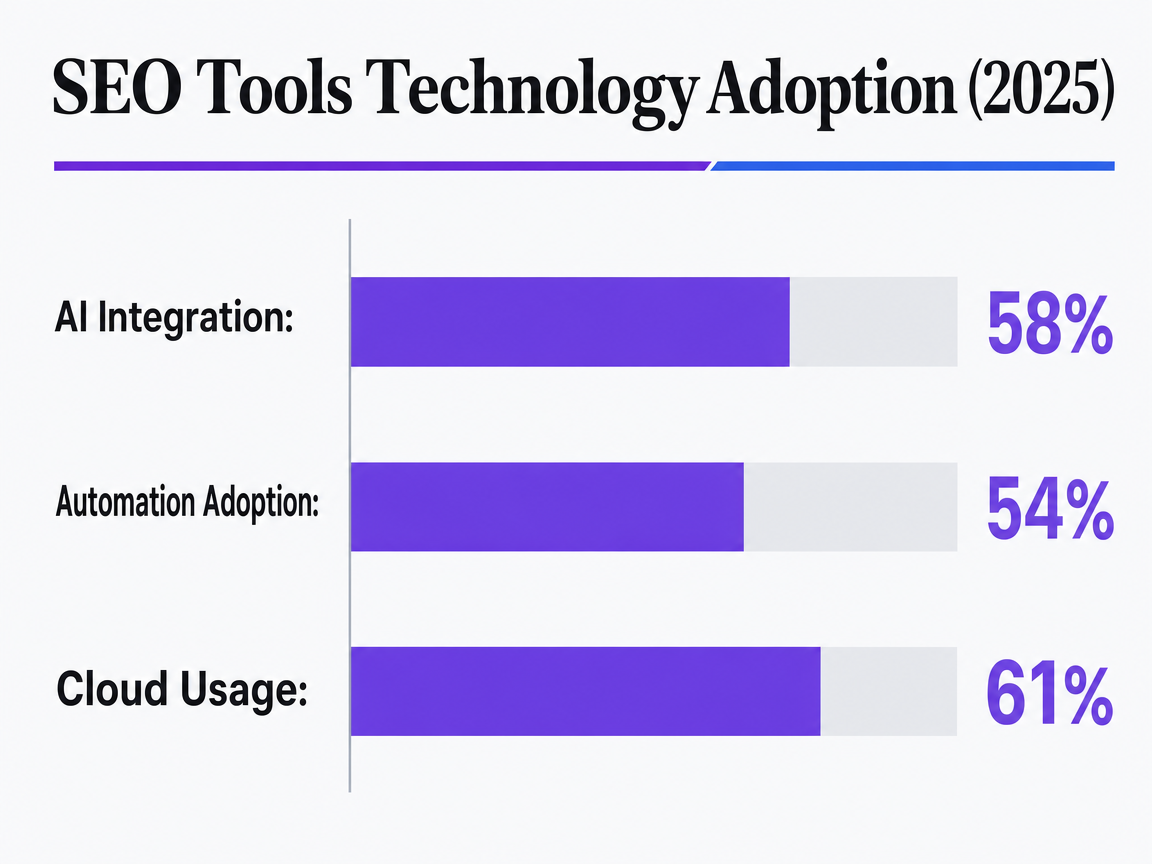 SEO Tools Technology Adoption (2025)
Shows the percentage of SEO tools that have adopted key technologies: AI integration (58%), automation (54%), and cloud deployment (61%).
Accelerate Content Velocity With Full-Access Trial
Produce and publish live content to assess measurable impact before making a commitment.
The Two-Tier Taxonomy: Scorers vs. Execution Platforms
The content optimization market is now characterized by two distinct product philosophies. Optimization scorers focus on the draft as the primary unit of work. They analyze top-ranking pages for a target keyword and provide a grade with recommendations for terms, headings, and structural adjustments. The writer implements these changes, and the tool's function concludes at publication, requiring manual transfer to subsequent stages.
In contrast, execution platforms treat the entire campaign as the unit of work. Scoring is just one element within a comprehensive workflow that includes research, brief generation, drafting, approval routing, publishing, and post-publish performance tracking. This difference significantly impacts headcount. Teams using scorers need personnel to manage transfers between various tools (optimizer, CMS, rank tracker, analytics, project management). Execution platforms, however, automate these handoffs through their integrated systems, with approval gates ensuring human oversight at critical decision points. Adobe's 2025 content supply chain analysis underscores this, differentiating between organizations managing siloed tools and those consolidating planning, creation, management, and optimization into connected systems9.
Among the six platforms reviewed, three fall into the scorer tier and three into the execution tier. The scorer tier includes tools focused on SERP-scoring editorial, brief-to-draft speed, and enterprise content intelligence. The execution tier comprises platforms for multi-channel social optimization, freelancer voice-consistency, and approval-first execution, where Vectoron is positioned. This categorization, rather than a feature grid, underpins the subsequent ranking.
The Six Platforms, Ranked by Operator Problem Solved
Platform One — The SERP-Scoring Standard for Editorial Teams
This incumbent platform, widely recognized by content managers, excels at its core function: analyzing top-ranking URLs for a target query and providing a content grade with recommendations for terms, entities, heading structures, and word-count ranges. Editorial teams value its deep SERP intelligence, stable scoring model, and transparent feedback on how recommendations impact the grade.
It primarily solves the problem of "brief drift." By exposing gaps in search intent before a draft reaches editing, it can eliminate one revision cycle for many articles. For teams publishing 20 to 60 pieces monthly, this efficiency alone can justify the investment.
However, its limitations appear beyond the draft stage. It lacks briefing, approval routing, and post-optimization ranking tracking. A content manager still requires separate tools for rank tracking, project management, and CMS integration to complete the workflow. Adobe's 2025 content supply chain analysis highlights how siloed tools create governance and sprawl issues, undermining AI's efficiency gains9. This scorer is best suited for teams that already have a robust surrounding tech stack and need a best-in-class draft grader, not a comprehensive system of record.
Platform Two — Brief-to-Draft Speed for High-Velocity Blogs
This scorer prioritizes accelerating the time-to-first-draft. Its value proposition is compression: input a keyword, generate a brief, approve an outline, produce an AI draft, and then have a human editor polish it. Teams managing content calendars of 80 or more pieces per month find it valuable because it reduces the brief-to-draft cycle from days to hours.
It addresses the operational challenge of "production lag" for informational content. When SEO briefs accumulate faster than writers can handle them, this platform can defer the need for additional hires by enabling one editor to oversee the output that previously required multiple writers. Statista's 2024 survey indicates that 42% of marketing and media leaders now use AI tools for content generation multiple times a week or daily, reflecting the growing adoption of such workflows10.
The platform's qualitative limitations are notable. While adequate for top-of-funnel explainers and comparison pages, its drafts often lack original perspective, primary research, and distinct voice. Research on generative AI in creative practice warns that automating routine tasks can challenge traditional notions of authorship and originality, emphasizing the need for critical human oversight to preserve unique expression6. Therefore, a content manager using this platform must ensure a strong human editing layer is in place to inject unique perspectives, or risk producing homogenized content that may rank initially but quickly loses relevance.
Platform Three — Enterprise Content Intelligence for Large Libraries
This scorer is designed for content managers overseeing extensive content libraries, typically 3,000 or more URLs, who need to identify which pages require updates, consolidation, or retirement. Instead of optimizing individual drafts, this platform audits the entire corpus, clusters pages by topic and intent, detects cannibalization issues, and prioritizes refresh candidates based on traffic and conversion potential.
It solves the operational problem of "portfolio decay." Large content libraries can quietly lose organic traffic due to shifting intent, newer competitor content, and fragmented internal linking. Manually managing this decay often requires a full-time analyst. This platform automates much of that analysis, providing diagnostics and prioritized action lists.
Its enterprise-grade integration features include SSO, role-based permissions, and API hooks into major CMS platforms. This is crucial, as Global Growth Insights' 2025 analysis shows that 61% of SEO tools now run on cloud infrastructure and 54% offer automation, setting a high bar for integration with existing governance structures3. However, this platform does not handle drafting, freelance workflow routing, or briefing. Teams adopting it still need a separate writing pipeline. It is ideal for managers focused on mitigating library decay, but may be over-specified for growth-stage teams primarily publishing new content.
Platform Four — Social and Multi-Channel Optimization at Scale
This execution-tier platform extends optimization beyond traditional blog and SEO content to include social media, email, and paid channels. It takes a source asset, generates channel-specific variants, applies native formatting, and routes each variant through an approval workflow before publishing. Content managers handling multi-channel calendars find it invaluable, as it streamlines a process that would otherwise require coordinating multiple specialists to manually produce content.
It addresses the operational challenge of "channel sprawl." Modern campaigns often require a blog post, multiple social variants, an email version, and paid ad copy. Manual production of these assets can quickly consume a content calendar. Capterra's 2024 survey of social media marketers indicates that businesses plan to use generative AI for an average of 48% of their social media content by 2026, up from 39% in 202411. This trajectory suggests that teams not extending optimization to social channels by 2026 will operate at roughly half the velocity of their peers.
The platform's limitation lies in its depth for any single channel. While competent for social and email, it may not offer the same SERP-scoring depth as dedicated blog optimizers, nor does it manage paid media buys. Managers may still need specialist tools for competitive SEO analysis on high-value pages. Its primary strength is coordination: collapsing multiple production streams into a single approval queue, which is a critical differentiator for teams managing content across diverse channels.
Platform Five — Freelancer-Heavy Workflows and Voice Consistency
This execution-tier platform is designed for content operations heavily reliant on freelance labor. Its core feature is a voice model, trained on approved brand samples, which provides real-time checks during drafting and acts as a gate before publication. Freelancers write within the platform, the voice model scores adherence to brand guidelines for each paragraph, and editors can review flagged sections before they enter the approval queue.
It solves the operational problem of "voice drift" across a rotating pool of writers. Historically, content managers working with numerous freelancers spent significant editing time enforcing tone, terminology, and structural conventions. This platform automates much of that enforcement, allowing editors to focus on argument and evidence.
Academic research on generative AI in creative practice supports this design, noting that automating routine consistency tasks can preserve human judgment for higher-order creative decisions and reduce the risk of homogenized output when guardrails are properly configured6. Additionally, the platform integrates freelance payments, assignment routing, and revision tracking, eliminating the need for separate project management tools. Its limitations include less depth in pure SEO and multi-channel coverage. Managers may still require a dedicated SERP scorer for competitive keywords and a separate solution for social media. This platform is ideal when the primary operational cost is coordinating freelance production, rather than optimizing individual pages.
Platform Six — Approval-First Execution Platforms (Where Vectoron Fits)
This final entry in the execution tier views content optimization as an integral part of a broader marketing operation. Approval-first execution platforms coordinate research, briefing, drafting, optimization, publishing, and post-publish measurement within a single, governed loop. Human sign-off is required at every decision point before automated execution proceeds. Vectoron exemplifies this category, utilizing specialist AI strategists for content, SEO, and other channels to provide ranked recommendations through a Command Center approval workflow.
This tier addresses the "coordination tax" that accumulates when teams manage multiple point tools and freelance production. Every handoff between systems creates a manual decision point, leading to velocity leaks. BCG's guidance to CMOs directly advises identifying end-to-end workflow steps where AI can consolidate execution, rather than proliferating isolated pilots8.
A key differentiator from fully autonomous AI tools is approval-first automation. Nothing is published without human sign-off, every recommendation includes strategic reasoning, and audit trails ensure accountability. This structure is crucial because research on AI content marketing indicates that algorithmic optimization enhances targeting and performance when human oversight governs outputs, but introduces authenticity and brand risk when it does not7. Content managers aiming to scale without increasing headcount gain the velocity of automated execution combined with the control of a governed editorial process. This tier is ranked last not due to lesser capability, but because its operational model is the most distinct from the traditional scorer approach.
See How Leading Teams Automate Content Optimization at Scale in 2026
Connect with our experts to benchmark your content workflow, discover real-world optimization metrics, and explore AI-driven solutions proven to accelerate production without sacrificing brand quality.
If You Manage Multiple Locations or an Agency Book: The Consolidation Math
This section is tailored for content managers overseeing production across numerous locations, a franchise network, or an agency with 15 to 50 active clients. At this scale, the economics of tool selection differ significantly from a single growth-stage brand, as the coordination costs of running multiple point tools multiply with each added location or account.
A typical stacked configuration often includes an optimization scorer, an AI drafting tool, a rank tracker, a project management system, and freelance editing capacity. Each tool incurs its own seat license, administrative overhead, and integration challenges. For instance, a manager with ten locations might require twelve seats for the scorer, six for the drafter, three for the rank tracker, and a per-user project management tool. Often, the tools themselves are a smaller expense compared to the compounding costs of freelance production hours and internal coordination time. BCG's guidance to CMOs directly addresses this, advocating for identifying end-to-end workflow steps where AI can consolidate execution rather than leading to a proliferation of isolated pilots8.
The following table illustrates the cost comparison using ranges for operator-supplied licenses and fixed values from research where available:
| Line item | Stacked point tools (per month) | Integrated execution platform (per month) |
|---|---|---|
| Optimization scorer (10+ seats) | Operator-supplied license range | Included |
| AI drafting tool | Operator-supplied license range | Included |
| Rank tracker | Operator-supplied license range | Included |
| Project management | Operator-supplied per-seat cost | Included in approval workflow |
| Freelance editing | Operator hours × operator rate | Reduced by governed AI drafts |
| Vectoron integrated platform | — | $599/mo post-trial |
The purpose of this comparison is not to declare one column universally superior, but to highlight that consolidation transforms a variable, coordination-heavy cost structure into a fixed, governed one. For managers dealing with multi-location content sprawl, this predictability often outweighs the raw license cost difference.
A Decision Framework for the 2026 Shortlist
To narrow down credible platforms to one or two finalists, a framework anchored in operational reality, rather than just feature lists, is most effective. Three key questions can guide this process.
- Identify the primary bottleneck. Teams struggling with draft quality against SERP competitors should prioritize the scorer tier, focusing on deep SERP intelligence. Conversely, teams facing coordination challenges across writers, channels, and publishing steps should lean towards the execution tier, where workflow integration and governed AI are more critical than any single scoring feature.
- Assess the organization's tolerance for ungoverned AI output. Research on AI content marketing indicates that algorithmic optimization improves targeting and performance when human oversight is present, but introduces authenticity and brand risk without it7. Platforms with explicit approval gates and audit trails are essential for regulated industries and multi-location brands. Those without such controls are better suited for scenarios where velocity is prioritized over strict accountability.
- Consider the future state of the tech stack in twelve months. A scorer purchased today might become one of several tools a manager needs to coordinate by the next planning cycle. An execution platform, however, is designed to absorb these adjacent functions. The ideal choice is one whose capabilities align with the team's projected trajectory, not just its current headcount. Managers evaluating this trajectory can initiate a Vectoron trial to assess how an approval-first execution platform integrates with their specific workflow.
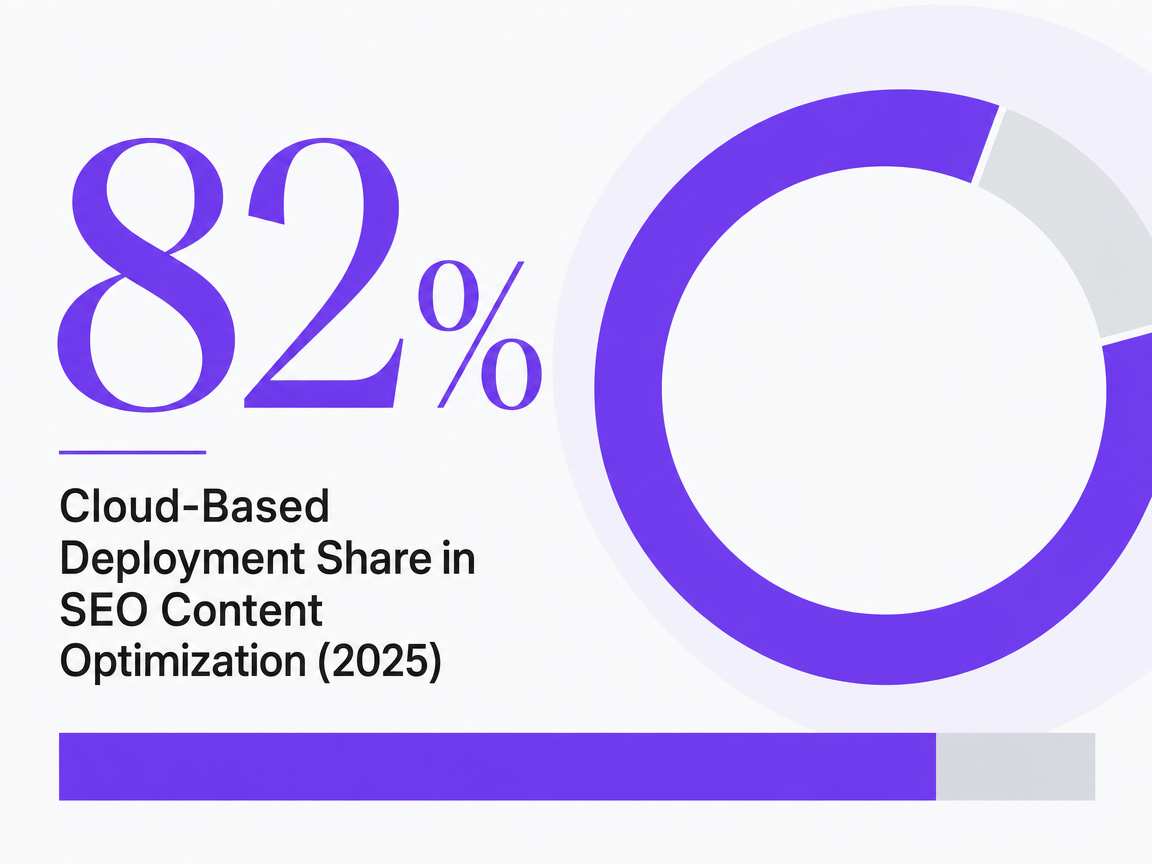 Cloud-Based Deployment Share in SEO Content Optimization (2025)
Cloud-Based Deployment Share in SEO Content Optimization (2025)
Frequently Asked Questions
References
- 1.SEO Content Optimization Platform Market.
- 2.SEO Content Optimization Platform Market Size, Share, Growth ....
- 3.Search Engine Optimization (SEO) Tools Market Growth Driven by ....
- 4.SEO Content Optimization Platform Market's Evolution.
- 5.Global Content Optimization Tool Market Research Report 2025.
- 6.From concept to creation: The role of generative artificial intelligence in contemporary design practice.
- 7.AI-Powered Content Marketing: Leveraging Algorithms for Enhanced Engagement and Personalization.
- 8.The Blueprint for AI-Powered Marketing.
- 9.2025 AI and Digital Trends: Content Creation and Management.
- 10.AI tools' use in global content marketing 2024.
- 11.Nearly Half of All Social Media Content Created by Businesses Will Be AI-Generated by 2026.