
Key Takeaways
- Lowering the reading grade on top-traffic pages before touching keywords produces faster ranking movement, since sentence structure and vocabulary shifts cannot be replicated by keyword swaps 1.
- Placing the primary keyword in five slots—URL, H1, meta description, body copy, and image alt attributes—covers the topical signal without chasing density percentages 2.
- Priority-first structure with answer-first openings, short paragraphs, descriptive subheads, and lists makes depth visible to readers and to generative search extractors 5.
- Accessibility edits like descriptive alt text, semantic heading order, and clear link anchors double as engagement signals that search engines reward 4.
- Titles and meta descriptions win clicks when they match query shape—definitional, how-to, comparison, or list—and front-load the primary term before truncation.
- Internal links function as a topic scaffold when descriptive anchors point supporting pages to a pillar, telling crawlers which page owns which query 2.
- Visual formats such as comparison tables, process diagrams, callouts, and annotated screenshots absorb cognitive load in dense sections where prose alone stalls readers 9.
- Dropping keyword density targets, monthly meta rewrites, exact-match anchors, and off-topic FAQ schema frees hours for edits that actually compound.
- A fixed refresh cadence tied to traffic tier—90, 180, or 365 days—prevents decay on the pages that once drove the most organic sessions.
- Portfolio sites gain more from template-level edits that propagate across N pages than from one-off rewrites, so separate template-driven and bespoke layers before auditing 4.
- An audit-prioritize-execute-measure loop turns the tactics into an operating system, retiring any edit that shows no ranking or session movement after 90 days.
Why optimization now decides which pages compound
Content marketing managers publishing into 2025 are working against a search environment that rewards fewer, better pages instead of steady volume. Two shifts have made optimization the highest-leverage lever a small team can pull. First, generative search surfaces pull answers from pages that read cleanly and structure information in scannable blocks. Second, ranking pages increasingly cluster around content that meets plain-language and accessibility expectations that regulators have codified for public-sector writing 5.
The evidence from health information research points the same direction. A 2024 analysis of diabetic retinopathy patient education pages found that greater readability, measured by lower Flesch-Kincaid grade levels, was associated with higher SEO metrics and earlier positions in search results 1. The scope is narrow, one clinical topic and one content type, but the signal is consistent with what content managers see across verticals: pages written for comprehension outperform pages written for keyword coverage.
The ten tips that follow are ordered by leverage, not by novelty. Each one names the signal it fixes and the workflow move that lets a lean team apply it across an existing library without adding writers.
Rewrite for a lower reading grade before touching keywords
Most optimization projects start with keyword research. That order costs a small team weeks of gains. A cleaner sequence is to drop the reading grade of the top 20 traffic pages first, then revisit target terms. Grade-level edits change sentence length, vocabulary, and structure in ways that keyword swaps cannot replicate, and the evidence links those edits directly to search performance.
A 2024 analysis of diabetic retinopathy patient education sites found that 97% of studied pages exceeded the median US health literacy level, yet pages with lower Flesch-Kincaid grade levels were correlated with improved SEO metrics and appeared earlier in search results 7. The scope is one clinical topic, so the effect size does not transfer wholesale to B2B SaaS or home services content. What does transfer is the mechanism: shorter sentences, common words, and cleaner clause structure make a page easier for both readers and language models to parse.
Content managers can operationalize this without a rewrite army. Three moves cover most of the lift:
- Set a target grade level per content type. Product education pages target grade 8 to 9. Thought leadership can sit at grade 10 to 11. Anything above 13 flags for revision.
- Run the current library through a batch readability check and sort by traffic. Rewrite the top-traffic pages that score above the target grade first.
- Cut compound sentences into two. Replace latinate verbs with common English equivalents. Move the main claim to the first clause.
Only after those edits ship should the team revisit primary and secondary keywords. Cleaner prose creates room for the target term to appear in natural context rather than forced insertion.
Place the primary keyword in five locations, not fifty
Keyword density as a target metric has been dead for a decade, yet audit templates still flag pages for hitting a percentage. The higher-leverage move is placement discipline. Ohio State's on-page content optimization guidance names five slots where the primary keyword should appear: the URL, the H1, the meta description, the body copy, and image alt attributes, with internal link anchors reinforcing the same term 2. That covers what search engines index as topical signals without pushing prose into the awkward phrasing that keyword-count tools reward.
The five-slot pattern gives editors a checklist that runs in under a minute per page:
- URL: the primary term appears in the slug, not the folder hierarchy alone. Short slugs beat category-nested ones for click legibility.
- H1: one H1 per page, containing the primary term in a natural phrase, not a keyword stub.
- Meta description: the term appears once, positioned in the first 120 characters so it survives truncation on mobile SERPs.
- Body copy: the term and its close variants appear where the page defines or answers the query, usually within the first 100 words and again in a subhead.
- Image alt attributes: descriptive alt text for at least one relevant image includes the primary term or a direct variant, doing double duty for accessibility.
Internal link anchors from other pages on the site should reinforce that same term when the target page is genuinely the best answer. What content managers can drop from the checklist: exact-match repetition counts, keyword-in-first-sentence rules that fight prose flow, and meta keyword tags, which no major engine has used for ranking in years. Placement discipline replaces volume as the on-page signal.
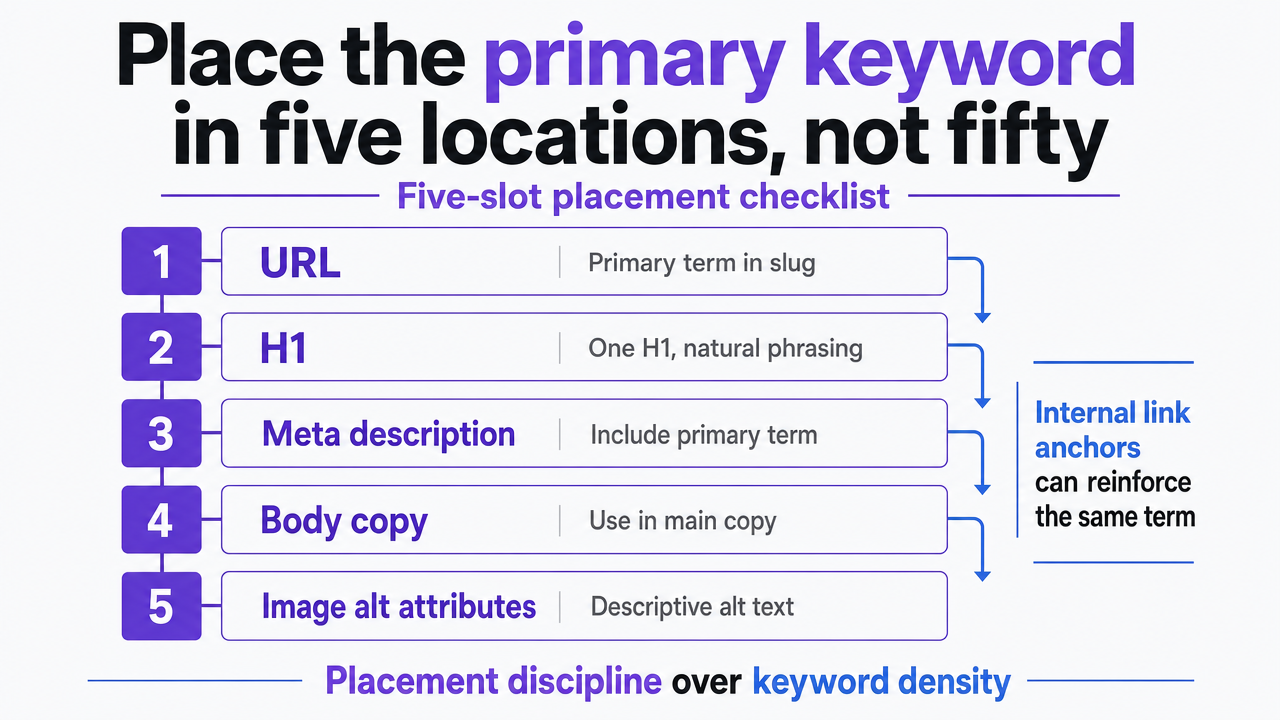 Visualize the five specific on-page slots where the primary keyword should appear, directly supporting the section's core framework cited from Ohio State guidance
Structure prose for priority-first scanning
Readers do not consume optimized pages linearly. Eye-tracking behavior on informational content skews toward F-shaped scanning, which means the pages that rank and get cited are the ones that answer the query in the first block and use visible structure to signal where each subclaim lives. Digital.gov's plain language guidance codifies this pattern for federal writing, advising authors to organize information so the most important points come first and to use headings, lists, and tables to make content easy to scan 5.
Content managers can apply the same structural rules to commercial pages without diluting depth. Five moves cover the pattern:
- Answer first, context second. The opening paragraph states the direct answer to the query in one or two sentences. Background, caveats, and methodology follow.
- One idea per paragraph. Paragraphs run three to five sentences. Longer blocks split at the natural claim break.
- Descriptive subheads every 200 to 300 words. Subheads carry the subclaim, not a clever phrase. A reader skimming the H2 and H3 stack should still get the argument.
- Lists for parallel items, tables for comparisons. Prose fights when three or more items share the same shape. Convert to a list. Two-axis comparisons move to a table.
- Active voice by default. Passive constructions bury the actor and inflate word count. Editors flag any sentence where the subject is not doing the verb.
The compounding benefit shows up in AI search surfaces. Generative engines extract answer blocks from pages where the priority-first structure makes the extractable unit obvious. A buried thesis that arrives in paragraph six does not get pulled into an AI Overview citation, even when the underlying content is stronger than a competitor's. Structural discipline is what makes depth visible.
Accelerate Content Production and Validate SEO Impact
Test-drive rapid content workflows and measure organic performance improvements in your live environment risk-free.
Treat accessibility as an engagement signal, not a compliance chore
Accessibility work gets slotted into the legal review lane, which is why most content teams under-invest in it. The framing costs them ranking upside. NIST's methodology work on WCAG scoring makes the case that accessibility is multi-dimensional and that systematic scoring helps organizations prioritize the specific fixes that improve usability for the widest range of users 4. Usability improvements register as engagement improvements, and engagement is what search engines and generative surfaces reward.
The tactical overlap between accessibility and SEO is tighter than the compliance framing suggests. Descriptive alt text feeds image search and gives assistive technology a real caption. Semantic heading order lets screen readers and crawlers walk the same outline. Sufficient color contrast keeps mobile readers on the page in bright light, which shows up as lower bounce. Descriptive link text replaces "click here" anchors that carry no topical signal and no context for a screen reader user.
Content managers can build a four-item accessibility pass into the standard editorial checklist:
- Every image has alt text that describes the content, not the filename.
- Headings step from H1 to H2 to H3 in order, with no skipped levels for styling.
- Link anchors describe the destination in three to five words.
- Body text contrasts at 4.5:1 or higher against its background.
None of these edits require a rewrite. They ship inside the normal publishing loop and compound across every page the checklist touches.
Write titles and meta descriptions that match query shape
Titles and meta descriptions get treated as final polish when they should be treated as query-matching decisions. The pages that win clicks answer the shape of the query in the title tag itself, not just the topic. A query phrased as a question deserves a title that answers it. A comparison query deserves a title that names both sides. A how-to query deserves a title that leads with the verb.
Ohio State's on-page guidance names the meta description and title tag as required slots for the primary keyword, alongside the URL, H1, and image alt attributes 2. Placement is the floor. Query-shape matching is the ceiling.
Four patterns cover most commercial content:
- Definitional queries ("what is X"): title leads with the term and a one-clause definition. Meta description states the answer in the first sentence.
- How-to queries: title opens with "How to" plus the action verb and the outcome. Meta description names the number of steps or the time required.
- Comparison queries ("X vs Y"): title includes both entities and the axis of comparison. Meta description states which reader profile each option fits.
- List queries ("best X", "top X"): title includes the number and the qualifier. Meta description names the selection criteria.
Truncation discipline matters as much as pattern matching. Titles that run past 60 characters lose their tail on mobile SERPs. Meta descriptions that push the primary term past character 120 lose it in the same way. Front-load both.
Build internal links as a topic scaffold, not a footer dump
Internal linking gets treated as a hygiene task, which is why most sites end up with a related-posts widget in the footer and nothing else. That pattern gives search engines a weak signal about topic hierarchy and gives readers no reason to click deeper. A stronger model treats internal links as the scaffold that names which page is the authoritative answer for each subtopic and which pages support it.
Ohio State's on-page guidance lists internal links alongside titles, headers, body copy, and alt attributes as a placement where the primary term carries topical weight 2. The mechanism is straightforward: descriptive anchor text tells crawlers what the destination page is about, and the pattern of links across a site tells them which page owns which query.
Content managers can build the scaffold with three moves:
- Name a pillar for each topic cluster. One page per commercial query owns the primary term. Supporting pages link up to it using anchor text that matches the pillar's target phrase.
- Write anchors that describe the destination. Replace "learn more" and "this guide" with three to five words that name what the linked page answers. The anchor doubles as a topical signal and as accessible link text.
- Link from high-traffic pages down, not just from new pages up. A new post buried in the archive gets no equity. Adding two contextual links from the top ten trafficked pages sends both crawlers and readers to it within a publishing cycle.
The footer widget can stay. It should not be doing the work.
Add visual clarity that supports comprehension of dense sections
Prose-heavy pages lose readers at the exact moment the argument gets technical. A study of NHS miscarriage information pages found that visual appearance, including font size, spacing, and use of headings, plays a key role in how users process sensitive information 9. The finding sits in health content, but the mechanism generalizes: when a section carries three or more dense concepts, a supporting visual absorbs cognitive load that prose alone forces the reader to hold.
Content managers can insert visual clarity without commissioning custom illustration for every post. Four low-effort formats cover most dense sections:
- Comparison tables for two or more options evaluated across the same axes. Prose fights when the reader needs to hold four attributes across three vendors.
- Numbered process diagrams for sequences with dependencies, where step three cannot start until step two completes.
- Callout blocks that isolate a definition, formula, or warning from surrounding prose, giving the eye an anchor on a long page.
- Annotated screenshots for interface or interpretation content, where the visual carries the noun and the annotation carries the claim.
Every visual needs descriptive alt text and a caption that states the takeaway, not the file type. A chart labeled "Figure 2" adds nothing; a caption that names the comparison and the conclusion doubles the section's scannable value.
See How High-Velocity Content Optimization Powers SEO at Scale
Connect with our team to explore data-backed content optimization workflows designed for enterprise teams seeking measurable SEO gains—without expanding headcount or compromising approval controls.
Stop over-tweaking: what to drop from the checklist
Half of most optimization backlogs is work that no longer moves rankings. The checklist keeps growing because tools flag issues, not because the issues change search performance. Content managers who cut the low-yield items free up hours for the edits that actually compound.
Four common tasks belong in the drop pile:
- Hitting a keyword density percentage. No major engine has published a target density in over a decade. Placement discipline in the five on-page slots already covers the topical signal 2. Repeating the term to hit 1.5% degrades prose and reads worse to language models parsing the page.
- Rewriting meta descriptions monthly. Search engines rewrite descriptions on the fly for most queries. A well-matched description that survives truncation is enough. Rotating copy every 30 days generates busywork without measurable click-through change.
- Chasing exact-match anchor text on every internal link. Descriptive anchors that name the destination outperform stuffed anchors. Overusing the exact target phrase looks manipulative to crawlers and reads worse to users.
- Adding FAQ schema to pages that do not answer questions. Schema markup on thin or off-topic Q&A blocks invites manual actions and adds no visibility. Reserve it for pages that genuinely resolve a question in the body.
Dropping these frees the review loop to focus on readability, structure, and internal linking, where the evidence points.
Refresh existing pages on a fixed cadence
Published pages decay without a refresh schedule. Statistics age, product screenshots drift, and competing pages update while the original sits untouched. Content managers who treat refresh work as an ad-hoc project lose ground on the exact pages that once drove the most traffic.
A fixed cadence solves the prioritization problem before it starts. Sort the library by trailing 90-day organic sessions, then assign refresh slots by tier: top decile pages get reviewed every 90 days, the next quartile every 180 days, and the long tail every 12 months or on a triggered basis when rankings drop more than five positions.
Each refresh follows a short review pass, not a full rewrite. Check the reading grade against the content-type target 5. Verify the five on-page keyword slots still match current query language 2. Update any statistic older than 18 months, replace broken internal links, and confirm the answer to the query still appears in the first block. Log the refresh date in the CMS so the next cycle knows what shipped and what did not.
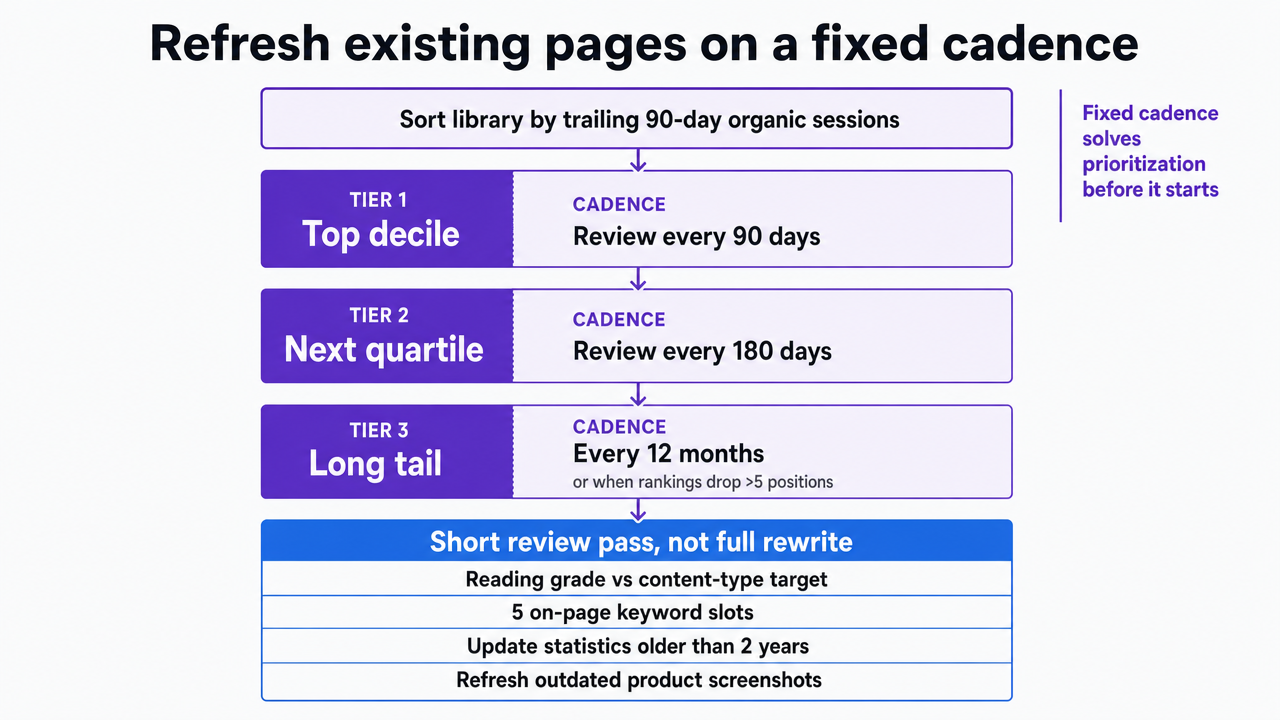 Visualize the three-tier refresh cadence model described in the section, a clear operating framework tied directly to the surrounding prose
If you manage multiple locations or a content portfolio
Content managers running a single blog and content managers running a portfolio site face different math. For law firms with 30 practice-area pages across five offices, DSOs with 200 location pages, home services brands with a service-by-city matrix, or senior living operators with a community page per property, the ten tactics above do not get applied one page at a time. They get applied once at the template level and propagate.
The compounding math is what makes template-level fixes worth prioritizing over one-off edits. A single readability pass on a location-page template written at grade 13 that ships across N pages produces N times the lift of the same rewrite applied to one asset. The same logic holds for a schema block, a title pattern, an internal link module, or an accessibility fix such as heading order and alt text conventions 4.
| Optimization | One-off edit | Template-level edit across N pages | Review cadence |
|---|---|---|---|
| Readability rewrite of shared intro block | H hours per page × 1 page | H hours × 1, applied to N pages | Quarterly |
| Title tag pattern update | 5 min × 1 page | 5 min × 1, propagated to N pages | Semi-annual |
| Internal link module (cluster anchors) | 15 min × 1 page | 15 min × 1, propagated to N pages | Quarterly |
| Accessibility fix (heading order, alt text rule) | 10 min × 1 page | 10 min × 1, propagated to N pages | Semi-annual |
The operational move is to separate the library into template-driven pages and bespoke pages, then run the audit against each layer. Template edits ship through the CMS once and get validated on a sample of live pages. Bespoke pages, usually the pillar and thought leadership set, stay on the page-by-page cadence from the refresh tip. Portfolio managers who mix the two layers together end up rewriting introductions on 200 location pages by hand.
Turn the ten tips into an audit-prioritize-execute-measure loop
The ten tactics fail without a repeatable cycle behind them. Content managers who apply them page by page as inspiration strikes end up with uneven libraries and no way to prove which edits moved the needle. A four-stage loop, run on a fixed cadence, turns optimization from a project into an operating system.
- Audit. Pull the full URL list, then score each page on four dimensions: reading grade against its content-type target, presence of the primary keyword in the five on-page slots 2, structural signals such as heading order and answer-first opening 5, and accessibility basics such as alt text and link anchors 4. A monthly audit of the top 50 traffic pages catches decay before rankings slip.
- Prioritize. Rank the audit findings by two variables: current traffic and gap size. A pillar page with grade 14 prose and 8,000 monthly sessions outranks a long-tail post with a missing meta description on every dimension that matters. Template-level fixes on portfolio pages jump the queue when they propagate across dozens of URLs.
- Execute. Ship edits in batches by fix type, not by page. A single editor running a readability pass across ten pages in one sitting moves faster than ten editors each doing full-scope rewrites. Log every change in the CMS with the date and the tactic applied.
- Measure. Track ranking position, organic sessions, and time on page for edited URLs against a 30- and 90-day baseline. Edits that produce no movement in 90 days get retired from the checklist. The loop tightens itself.
Small teams that need the audit and execution layers running without new headcount can plug in AI-assisted platforms such as Vectoron to handle the repetitive scoring and batch execution while editorial judgment stays with the manager.
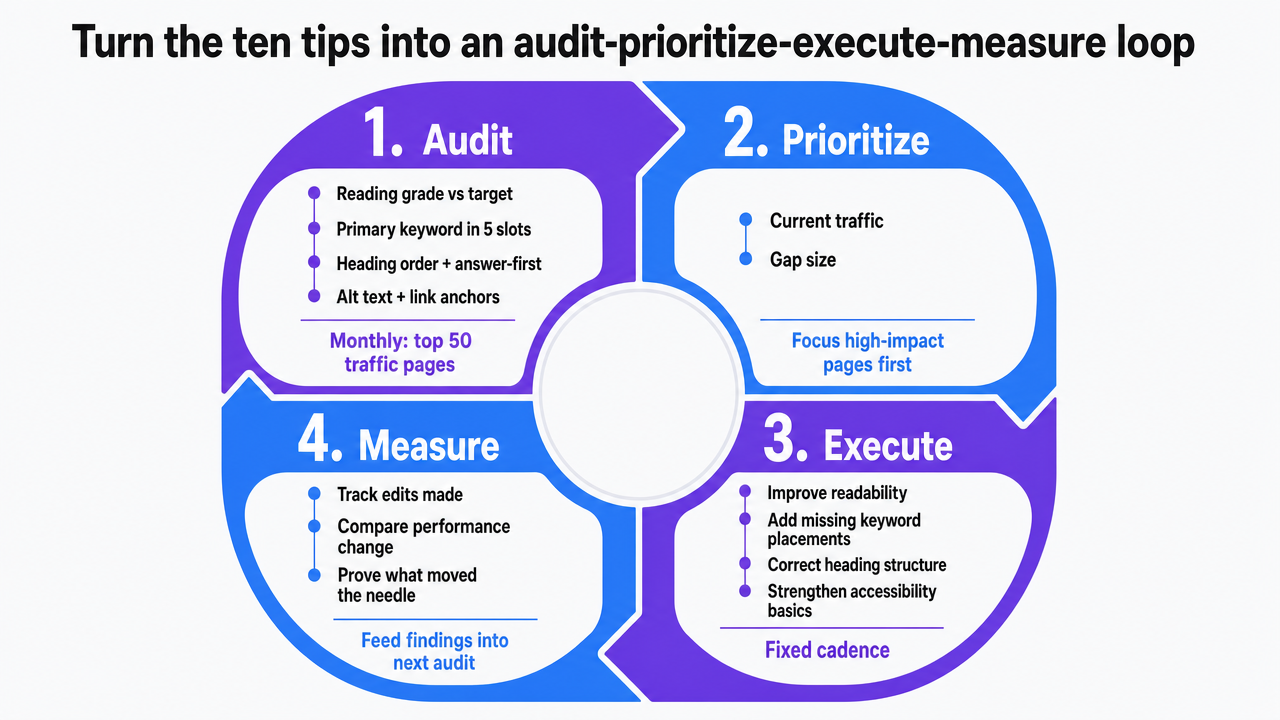 Visualize the four-stage operating loop that structures the closing section, turning the article's ten tactics into a repeatable workflow
Frequently Asked Questions
References
- 1.Search Engine Optimization and Its Association With Readability in Online Patient Education Materials for Diabetic Retinopathy.
- 2.Content Optimization.
- 3.The readability of general practice websites: a cross-sectional analysis.
- 4.Challenges and Benefits of a Methodology for Scoring Web Content Accessibility Guidelines (WCAG).
- 5.Principles of Plain Language.
- 6.Plain Language: Getting Started.
- 7.Search engine optimization and its association with readability and accessibility of diabetic retinopathy websites.
- 8.Evaluating the Readability, Accessibility, and Quality of Online Opioid Use Disorder Information.
- 9.An evaluation of the readability and visual appearance of NHS websites regarding miscarriage.
- 10.Search Engine Optimization and Its Association With Readability in Online Patient Education Materials for Diabetic Retinopathy.
- 11.Challenges and Benefits of a Methodology for Scoring Web Content Accessibility Guidelines.