
Key Takeaways
- Treat pillar pages as information architecture nodes, not long documents — hierarchy, labeling, coverage, and validated navigation are the four inputs that produce durable topical authority 2.
- Scope card sorting and tree testing between outline approval and content production; a five-participant tree test catches labeling and nesting problems while remediation is still cheap 1.
- Vertical IA research shows structure drives specific outcomes: interpretation in legal 7, credibility in behavioral health 8, comprehension in dental 9, and trust in senior living 10.
- For multi-location portfolios, codify hierarchy, labels, coverage maps, and schema templates once per vertical, then replicate — so cost per hub falls as location count grows.
Why Pillar Programs Stall at Agency Scale
Most agency SEO leads have shipped a pillar page. Far fewer have shipped a pillar program that holds together across 15, 40, or 80 client sites. The first hub goes live with executive attention, a proper outline, and a strategist watching the internal links. The second and third get built to a lower standard. By the tenth account, the model has drifted into whatever the assigned writer remembered from the kickoff deck.
The failure pattern is consistent. Hubs are treated as long documents rather than governed structures. Labeling varies between accounts because no one codified it. Supporting clusters are commissioned by keyword volume instead of by user need, then linked back inconsistently. Validation steps that would catch these problems, like card sorting and tree testing, get skipped because they were never scoped into the production workflow in the first place 1.
The evidence base for what actually drives topical authority is more specific than the tactic decks suggest. Information architecture research in healthcare, legal, dental, and senior care settings has measured how hierarchy, grouping, and navigation change user behavior and trust 3, 7. Agencies that translate those findings into a repeatable operating model, rather than a bespoke build per client, ship consistent authority without expanding the strategy bench.
Pillar Pages Are Information Architecture, Not Long Documents
The industry's most common mistake is conflating a pillar page with a 5,000-word guide. Word count is an output. The input that actually produces topical authority is information architecture: the way pages are grouped, labeled, nested, and connected across a site. Texas A&M's institutional IA guidance identifies four operating inputs that separate structured sites from content piles — clear labels, logical nesting, alignment to user needs, and documented relationships between pages 2. A pillar page is the surface expression of those four inputs on a single topic. Treat it as a document and the structure drifts. Treat it as an IA node and the structure holds.
The effect size is worth calibrating. A randomized experiment on a patient education website compared different information architectures and concluded that IA has "small but notable effects on users' experiences with web-based health education interventions" 3. That framing matters for agency leads deciding where to invest production hours. IA is not a silver bullet, and content quality still carries most of the weight. What IA changes is the ceiling: without it, comprehensive content underperforms because users and crawlers cannot resolve how pieces relate. With it, the same content compounds because every supporting page reinforces the hub's scope.
This reframing changes what gets scoped into a pillar brief. Instead of a word target and a keyword list, the brief specifies the hub's position in the hierarchy, the labels used at every entry point, the subtopics it must cover to match user need, and the exact set of supporting pages that link into and out of it. That specification is portable across accounts, which is where agency scale becomes possible.
The Four Inputs of a Governed Hub System
Hierarchy: Nesting Pages Around User Need
Hierarchy is the first input because it decides what the hub is about before a single word gets written. Texas A&M's IA guidance frames it plainly: pages should nest logically, and that nesting should match how users actually navigate the site 2. In pillar terms, that means the hub sits at the parent level of a service line or condition category, and every supporting page occupies a defined child position beneath it.
The failure mode agencies see most often is nesting by keyword volume rather than user need. A personal injury hub that lives under a generic "practice areas" branch and links out to cluster pages organized by search demand loses its structural signal. A hub nested under the exact service the firm delivers, with supporting pages arranged around the questions clients ask in intake, holds together across audits.
The practical test is whether a strategist can draw the parent-child relationships on one page and defend each placement against a user need. If the nesting requires footnotes to explain, the hierarchy is not doing its job.
Labeling: Descriptive Anchors Over Clever Titles
Labels are the surface layer users and crawlers read first. Texas A&M's guidance calls for "clear, logical labels" that match the site's navigation 2. That standard rules out most of what agencies inherit from creative teams: metaphor-driven H1s, category names that require insider knowledge, and navigation labels that describe the brand's internal org chart rather than the user's task.
A governed hub uses the same label in three places: the primary navigation entry, the page title, and the anchor text of every internal link pointing to it. Variation across those surfaces fragments the entity signal and confuses users who scan before they click. "Estate Planning" as a nav item, "Wills and Trusts Overview" as an H1, and "our estate services" as anchor text describe three slightly different things to a retrieval system.
Codifying labels at the account level, not the page level, is what makes this input scale. One label per hub, applied everywhere, checked in QA before publish.
Coverage: Comprehensive Without Redundant
Coverage is where most pillar programs either underbuild or overbuild. Underbuilt hubs leave obvious subtopics uncovered, so users bounce to competitors that answer the follow-up question. Overbuilt hubs stack ten near-duplicate cluster pages that cannibalize each other and dilute the hub's signal.
The dental IA study offers a useful calibration point: sites with structured topic hierarchies and comprehensive coverage of dental conditions produced higher comprehension scores among users 9. Comprehension, not word count, is the outcome that coverage should target. That reframes the scoping question from "how many supporting pages" to "which subtopics must exist for a user to leave with a complete mental model of this service."
A working coverage map lists every subtopic a user might need, assigns each to exactly one page, and flags any two pages whose scopes overlap by more than a paragraph. Overlap gets consolidated before the brief goes to production. That single discipline prevents the cluster bloat that quietly degrades hub performance across accounts.
Validated Navigation: Card Sorting and Tree Testing Before Publish
The fourth input is the one most agencies skip. Card sorting asks users to group topics the way they naturally think about them. Tree testing asks users to find a specific piece of content inside a proposed navigation structure. Digital.gov positions both as low-cost validation methods that improve navigation and information architecture without requiring specialized research budgets 1. Open-source tools and small participant panels can run either method in a week.
The payoff is measurable. The consumer health IA study found that more intuitive information architectures reduced search time and improved perceived ease of use in health information seeking 4. That is the specific outcome card sorting and tree testing are built to produce: a structure users can navigate without cognitive effort. Publishing a hub without either test means the structure was validated by internal opinion, which correlates poorly with how prospects actually search.
Scoping validation into the workflow is a governance choice, not a research budget question. A five-participant tree test on the proposed hub structure, run between outline approval and content production, catches labeling and nesting problems while they are still cheap to fix. Skipping it means those problems surface as bounce rate and low time-on-page three months after launch, when remediation costs multiples of the original scope.
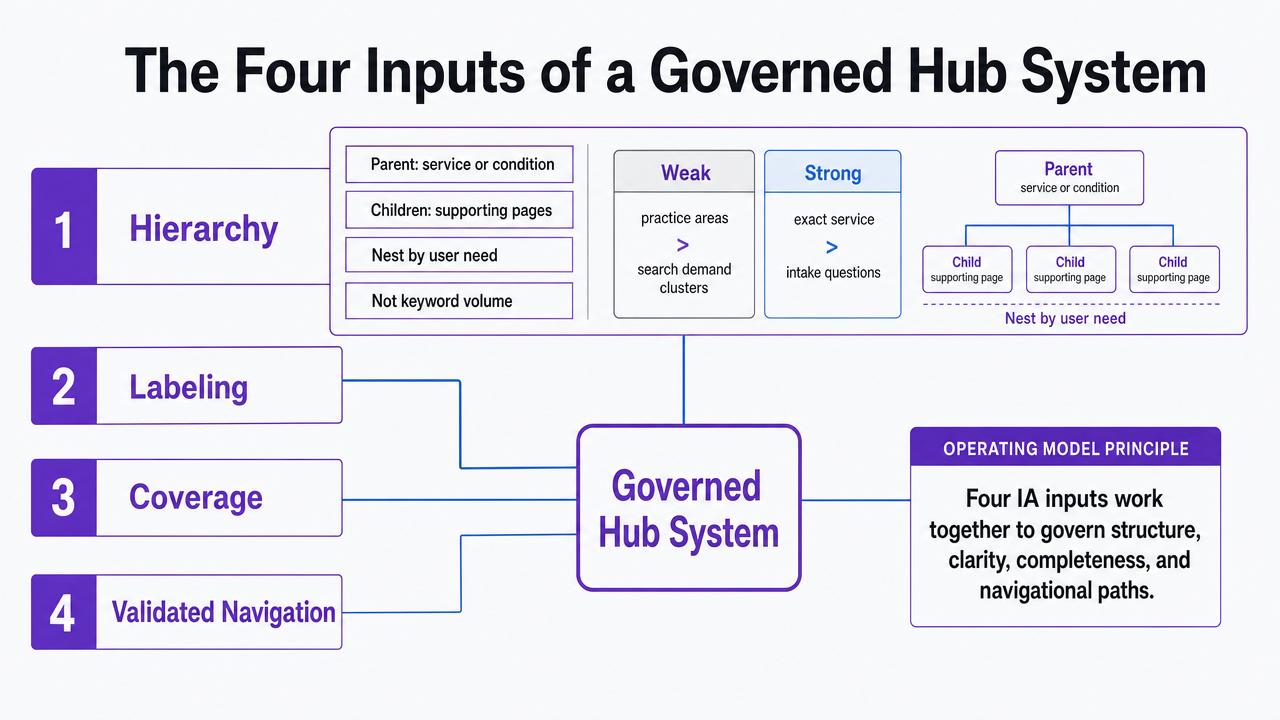 Visualize the four IA inputs described in this section as a governance framework, since the section explicitly enumerates hierarchy, labeling, coverage, and validated navigation as the operating model
Test pillar-driven SEO workflows on live sites now
Experience full-scale content pillar deployment and measure actual impact before committing.
What Vertical IA Research Says About Hub Design
Legal Hubs: Hierarchy That Improves Interpretation
Legal content punishes weak structure faster than most verticals. A prospect researching a wrongful termination claim needs to move from a general concept to jurisdiction-specific rules to procedural steps without losing the thread. Research on online legal information systems designed for public use found that hierarchical structuring of legal topics and clear explanatory content significantly improved users' ability to interpret legal information 7. Interpretation, not just retrieval, is the outcome legal hubs should be built around.
The practical implication for law-firm accounts is that practice-area hubs should be organized around how a claim actually progresses, not around keyword clusters. A personal injury hub with supporting pages on liability standards, damages categories, statute of limitations, and settlement versus trial pathways gives users a scaffolding for interpretation. A hub that stacks ten location-modified variants of the same query does not. Agencies auditing legal accounts should measure hub design against interpretive completeness before measuring it against ranking coverage.
Behavioral Health Hubs: Grouping Services for Credibility
Behavioral health prospects arrive with a different problem: they are often uncertain which service category applies to their situation. A study of mental health service portals found that clearer grouping of related mental health services and topics increased perceived credibility and usability of the portals 8. Grouping, in this context, is a credibility signal — a site that organizes anxiety, depression, trauma, and substance use into coherent service families reads as competent before a single treatment page loads.
Hub design for behavioral health clients should map service groupings to how clinicians actually classify care, not how the marketing team labels programs. A hub on outpatient services that groups individual therapy, group therapy, medication management, and intensive outpatient programming as siblings under one parent reflects the clinical reality prospects will encounter. Fragmenting those into unrelated top-level pages breaks the grouping signal the research identifies as the credibility driver.
Dental Hubs: Structure That Raises Comprehension
Dental content sits between medical complexity and consumer decision-making. Prospects need to understand what a procedure is, why it is recommended, what alternatives exist, and what recovery involves — before they will book. The dental IA study found that sites with more structured topic hierarchies and comprehensive coverage of dental conditions produced higher comprehension scores among users 9. Comprehension is the metric that predicts booking, not word count on the treatment page.
A working dental hub organizes each service line — implants, orthodontics, endodontics, cosmetic — with supporting pages that answer the sequence of questions a prospect works through: candidacy, procedure, alternatives, timeline, cost factors, aftercare. That sequence is portable across DSO accounts because the underlying clinical logic does not change between locations. Agencies that codify the comprehension sequence once and replicate it across dental clients ship consistent hubs without redesigning the IA per account.
Senior Living Hubs: Organized Content and Visible Attribution
Senior living decisions carry higher stakes and more decision-makers than most service categories. Adult children, aging parents, and often financial advisors evaluate the same content, each looking for different signals. Research on senior care websites found that high-quality, clearly organized information and visible contact details were significant predictors of trust in senior care websites 10. Trust factors combine at the hub level: organization signals competence, and visible attribution signals accountability.
The parallel evidence from the broader health portal trust study is worth pairing here. That research reported that perceived expertise and transparent attribution were significant predictors of user trust in health information portals 5. Across both studies, four trust predictors emerge as consistent inputs to E-E-A-T at the hub level — perceived expertise, transparent attribution, organized information, and visible contact details. A senior living hub that pairs a clear taxonomy of care levels (independent living, assisted living, memory care, skilled nursing) with author credentials, licensing details, and prominent contact points operationalizes all four inputs. Hubs that treat any one of them as optional leave measurable trust on the table.
Entities and Relationships: Why Hub Structure Now Matters for Retrieval
Classical SEO treated the web as a graph of pages connected by links. Modern retrieval systems, including the ones powering LLM-based search, treat it as a graph of entities connected by relationships. Etzioni and colleagues framed this shift years before it became operational: "Facts are naturally organized in terms of entities, classes, and their relationships as in an entity-relationship diagram or a semantic network," and the extraction graph sits as an intermediate representation between raw pages and structured knowledge 11. That framing is what makes pillar structure a retrieval concern, not just a UX concern.
A hub built as an IA node exposes the entities a retrieval system needs to resolve: the service or condition as a class, the supporting pages as instances or attributes of that class, and the internal links as typed relationships between them. A hub built as a long document flattens all of that into prose, forcing the extractor to reconstruct relationships that the site could have declared outright. The first structure survives translation into a knowledge graph. The second degrades on the way in.
For agency SEO leads, the practical consequence is that hub architecture now serves two consumers — human users and machine extractors — with overlapping but not identical requirements. Clear labeling, logical nesting, and documented relationships between pages satisfy both 2. Hubs that were built to those standards already are positioned for entity-based retrieval without a separate migration project.
Metadata and Schema as the Interoperability Layer
Structure at the page level only carries so far. The signal a hub sends to retrieval systems depends on whether the relationships between pages are declared in machine-readable form. NIST's reference architecture for big data interoperability makes the general case: standardized metadata and reference architectures improve the "discoverability, accessibility, and reusability" of information assets 6. The finding is not SEO-specific, but the mechanism transfers directly. A hub with typed schema for the service, the organization, the author, and the relationships between supporting pages is discoverable in ways that prose alone cannot replicate.
Agencies that codify metadata at the template level, rather than the page level, capture this cheaply. Each vertical gets a schema pattern — MedicalCondition and Physician markup for behavioral health hubs, Dentist and MedicalProcedure for dental service lines, LegalService and Attorney for law-firm practice areas — applied automatically at publish. Author credentials, licensing details, and organizational attribution are populated from a governed source of truth, not rewritten per page. This is the same operating discipline as labeling: define once, apply everywhere, verify in QA. Hubs that carry consistent schema across an account portfolio give crawlers and extractors the typed relationships they need without adding production overhead per client.
See How Enterprise Teams Operationalize Content Pillar Strategies at Scale
Get a data-driven walkthrough of AI-powered workflows for building and managing content pillar pages—enabling consistent topical authority across large site portfolios without expanding your team.
If You Manage Multiple Locations: Pillar Economics Across a Portfolio
The audience for this section narrows to agency leads managing multi-location clients: DSO groups, senior living operators, regional law firms with branch offices, home services franchises, and behavioral health networks. The economics of pillar production change once a client has 8 or 80 locations attached to the same service catalog.
The default pattern most agencies inherit is bespoke content per location. Each site gets its own service pages, its own supporting cluster, and its own quiet drift away from any shared IA. Cost scales with location count. Quality varies with whoever wrote that batch. Topical authority stays trapped at the individual site level because nothing structural connects the locations to a shared knowledge base.
The alternative is service-line hubs replicated as an IA template, with location-specific supporting pages that inherit the hub's structure. The dental IA study supports this design directly: structured topic hierarchies and comprehensive coverage of dental conditions produced higher comprehension scores among users 9. Comprehension is portable — the clinical logic of an implant procedure does not change between Phoenix and Cleveland. The senior care research reinforces the same point from the trust side: organized information and visible contact details predicted trust 10, and both variables can be templated once and populated per location.
The economics resolve as variables rather than fixed figures:
- Locations × service-line hubs × supporting cluster pages per hub under the templated model
- Locations × full bespoke content builds per site under the default model
In the templated model, hub IA is authored once per service line and replicated across locations. Cost per hub falls with each additional location because the label system, coverage map, and schema template are already governed. In the bespoke model, cost per location stays flat and quality variance compounds. Agencies scaling portfolio work should price the templated approach and route location-specific content — provider bios, licensing, addresses, local case studies — into the supporting layer where variation actually earns its keep.
Codifying Pillar Production as an Agency Operating Model
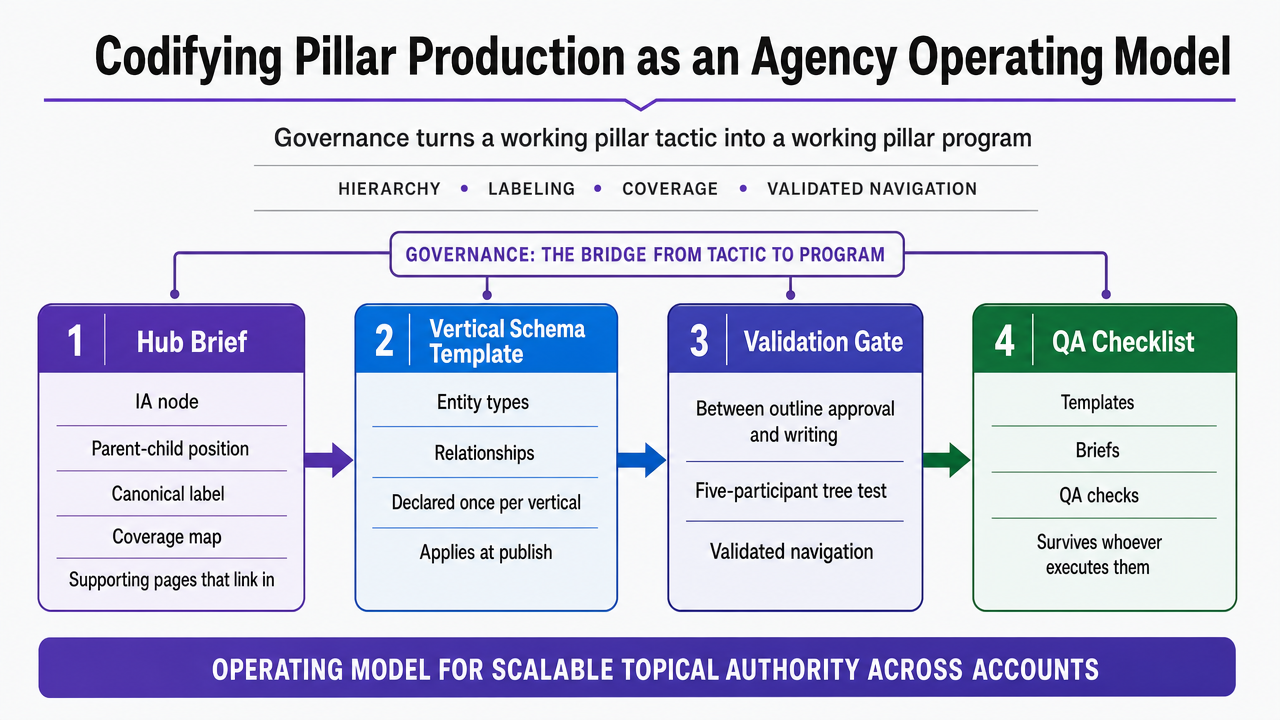
The gap between a working pillar tactic and a working pillar program is governance. Agencies that scale topical authority across 40 or 80 accounts do not ship better hubs because their strategists are more talented. They ship better hubs because the four IA inputs — hierarchy, labeling, coverage, and validated navigation — are encoded in templates, briefs, and QA checklists that survive whoever executes them 2.
The operating model breaks into four artifacts:
- A hub brief specifies the IA node before content production begins: parent-child position, canonical label, coverage map, and the exact supporting pages that will link in.
- A vertical schema template declares the entity types and relationships once per vertical, then applies at publish.
- A validation gate runs a five-participant tree test between outline approval and writing, catching structural problems while remediation is cheap 1.
- A QA checklist verifies label consistency, schema completeness, and internal link patterns before anything ships.
These four artifacts define the pillar as a governed structure, not a document assignment.
The strategic payoff extends past classical SEO. Hubs authored to this standard expose the entity-relationship structure retrieval systems now consume 11, carry consistent metadata across accounts 6, and hold their shape across audits. Platforms like Vectoron support this discipline by keeping specialist strategy, approval, and execution in one governed loop — so pillar production scales as a system rather than a series of one-off builds.
 Visualize the four production artifacts explicitly named in this section — hub brief, vertical schema template, validation gate, QA checklist — as a linear operating workflow that closes the article's operating-model argument
Frequently Asked Questions
References
- 1.Using the Tools You Have To Conduct Card Sorting and Tree Testing.
- 2.Information Architecture - Websites at Texas A&M.
- 3.Effects of Information Architecture on the Effectiveness and Use of a Patient Education Website.
- 4.Website Information Architecture and Consumer Health Information Seeking.
- 5.User Experience and Trust in Online Health Information Portals.
- 6.NISTIR 8288: The NIST Big Data Interoperability Framework – Volume 8: Reference Architecture.
- 7.Designing Online Legal Information Systems for Public Use.
- 8.Information Architecture and Mental Health Service Portals.
- 9.Online Dental Health Information: Structure, Quality and Consumer Comprehension.
- 10.Information Quality and Trust in Senior Care Websites.
- 11.Relational Web Search.