
Key Takeaways
- Content strategy works as a four-part operating system—signal, production, approval, and measurement—because credibility collapses when any layer reports activity instead of connection to opportunity outcomes.
- Buying groups form shortlists before sales conversations begin, with more than 90% arriving at active evaluation already decided, so content must serve specific roles and decisions rather than keyword volume 3.
- AI-assisted production earns its place in drafting and variants, but human approval between draft and publication is what protects claims under FTC standards and NIST oversight guidance 8.
- Replace traffic dashboards with opportunity influence, stage progression, deal velocity, and expansion contribution, then let those signals direct next quarter's briefs instead of a topic calendar 5.
Why Measurement Credibility Decides Which Strategies Survive
Content strategy debates usually start with the wrong question. Teams argue about publishing cadence, topic clusters, and channel mix before confirming whether their measurement system can tell them what worked. Forrester's 2024 analysis of B2B marketing leaders found that 64% did not trust their organization's marketing measurement for decision-making, while 73% of B2B revenue in the same research came from existing customers through renewal, cross-sell, and upsell 4. Those two numbers, read together, explain why most content programs feel busy without feeling accountable.
If the measurement layer is distrusted, every strategy built on top of it inherits the doubt. A content calendar producing weekly posts can show rising sessions, downloads, and MQLs, yet the CFO still asks where the pipeline is. The dashboard is not wrong so much as pointed at the wrong outcomes. When a majority of revenue comes from accounts the company already serves, content that only measures net-new form fills is reporting on a slice of the business while the rest of growth happens off-screen.
The practical consequence for a VP of Marketing is narrower than it sounds. Strategies that survive the next budget cycle are the ones whose outputs connect to opportunity creation, deal progression, retention, and expansion rather than to activity counts. That reframe decides what gets written, who reviews it, where it is distributed, and which signals get reported upward.
The rest of this piece treats content strategy as an operating system with four coordinated parts: signal, production, approval, and measurement. Each part is examined against what current B2B buying behavior and AI-era research actually require, not what a legacy editorial calendar assumes.
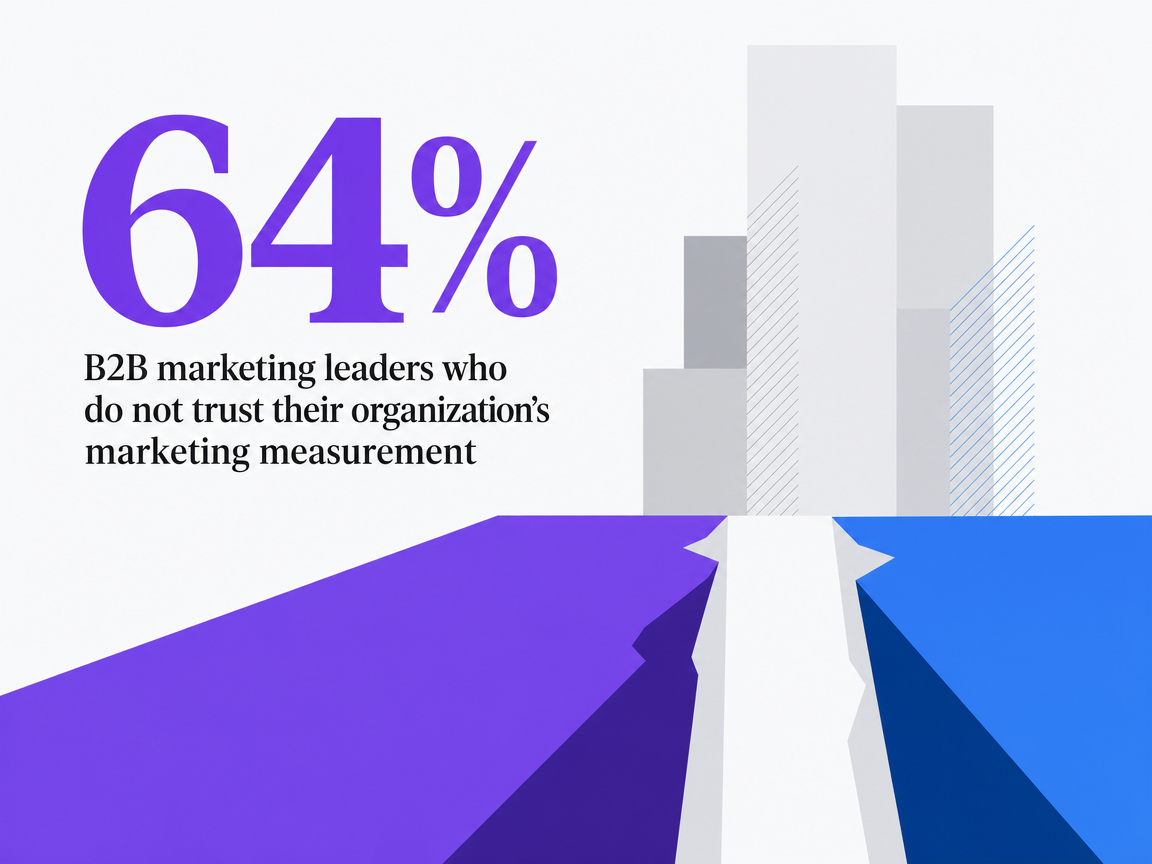 B2B marketing leaders who do not trust their organization's marketing measurement
B2B marketing leaders who do not trust their organization's marketing measurement
How Buying Groups Actually Decide Before You Enter the Room
By the time a buying group talks to sales, most of the decision architecture is already in place. Forrester found that 41% of B2B buyers begin their process with one preferred vendor already in mind, and more than 90% arrive at the active evaluation stage with a shortlist already formed 3. The content a company publishes is not competing for a first impression at the demo stage. It is competing for a seat on that shortlist weeks or months earlier, often without a form fill to prove it happened.
That reshapes what content has to accomplish. A buying group for a mid-market service purchase typically includes:
- an economic buyer who needs business-case language,
- a technical evaluator who needs specification depth,
- an end user who needs workflow realism, and
- an internal champion who needs ammunition to defend the choice in a conference room.
One piece of content rarely serves all four. A product overview page may satisfy the champion while giving the technical evaluator nothing to verify. A thought leadership essay may land with the economic buyer and leave the end user wondering what the actual workflow looks like on a Tuesday morning.
The practical implication is that content strategy has to be mapped against the decisions each role is trying to make, not against keyword volume alone. The question stops being "what are people searching?" and becomes "what does the technical evaluator need to see before she will tell the champion this vendor is credible?" McKinsey's analysis of AI-enabled sales and marketing reaches a similar conclusion: content increasingly has to adapt to persona and stage rather than broadcast a single message across the committee 2.
Shortlist formation also happens in places marketing teams rarely instrument. Peer conversations, Slack communities, analyst briefings, podcast appearances, and conversational search sessions all shape the shortlist before any tracked visit occurs. A content program that only measures what happens on owned properties is reporting on the last mile of a journey that was mostly decided elsewhere.
The Four-Part Operating Model for Pipeline-Producing Content
Signal: Mapping Buying-Group Decisions, Not Keyword Clusters
Signal is the input layer of a content operation. It answers one question: what does the next useful piece of content need to do for a specific person inside a specific account at a specific point in their decision? Keyword clusters answer a shallower version of that question. They describe what strangers type into a search bar, not what a technical evaluator at a target account needs to see before she will sign off on a shortlist.
A signal-driven content program pulls from four streams simultaneously:
- CRM and opportunity data expose which deals stalled at which stage and what objection the sales team heard most often.
- Call transcripts and conversation intelligence surface the exact phrasing buyers use when they describe their problem, which rarely matches the phrasing marketing uses when it describes the solution.
- Intent and account-engagement data flag which accounts are researching the category now, even if no form has been filled.
- Customer-success notes reveal which existing accounts are asking expansion questions, which matter because 73% of B2B revenue typically comes from the installed base 4.
Those streams get synthesized into content briefs organized by buying-group role and decision point, not by topic cluster. The brief for a technical evaluator comparing two shortlisted vendors looks nothing like the brief for an economic buyer trying to defend a line item. McKinsey's work on AI-enabled commercial operations describes the same pattern: content increasingly has to adapt to persona and sales stage rather than broadcast one message across the committee 2.
The output of the signal layer is a short, ranked list of what to produce next and why. Everything downstream inherits that priority order.
Production: Where AI Assistance Earns Its Place
Production is the layer most content debates fixate on, and the one most reshaped by generative AI in the past 24 months. McKinsey's B2B Pulse 2024 found that 19% of surveyed B2B organizations were already implementing generative-AI use cases for buying and selling, while another 23% were developing or experimenting with them 1. Read together, roughly four in ten respondents had moved past the pilot stage or were actively building toward it. AI-assisted production is no longer the differentiator; the quality of what gets shipped under it is.
The useful question for a VP is where AI earns its place in the production chain and where it does not. It earns its place in:
- first-draft generation against a tightly scoped brief,
- variant production for different buying-group roles,
- summarization of research or call transcripts into usable source material, and
- translation of long-form arguments into formats sized for different channels.
It does not earn its place in originating the strategic point of view, in making a claim no human has verified, or in producing proof assets like case studies where the evidence itself is the content.
The practical constraint is throughput without drift. A production system that generates five variants of a technical-evaluator brief in an hour is only useful if a specialist can review all five against the signal brief and reject the ones that wander. The teams getting measurable output from AI-assisted production tend to shorten the brief-to-draft cycle while lengthening the time spent on strategic input and specialist review. McKinsey's analysis of AI in commercial workflows describes the same pattern: generative tools create materials at scale and adapt them to persona and stage, but the stage-fit judgment remains a human call 2.
Production is where volume problems look solved and quality problems get introduced. The next layer exists to catch what production misses.
Approval: The Governance Gate Between Draft and Publication
Approval is the layer most AI-assisted content operations underbuild. A draft produced in minutes still has to pass through a review that answers four questions:
- is the claim substantiated,
- is the source correctly attributed,
- is the audience framing accurate, and
- does the piece advance the opportunity it was briefed to influence.
None of those are editorial preferences. Each has a direct connection to whether the content compounds trust or quietly erodes it.
NIST's Generative AI Profile, published in July 2024 as a companion to the broader AI Risk Management Framework, identifies human oversight, content provenance, source validation, and testing as recommended controls for generative AI systems 8. The framework is voluntary and cross-sector, which means marketing leaders have to translate it into field-specific gates rather than adopt it wholesale. For a content operation, that translation usually produces three checkpoints:
- a specialist review for factual and claim accuracy,
- a legal or compliance review for anything touching regulated categories, and
- a final publication approval that confirms the piece matches the brief the signal layer produced.
The sequence matters. Approval has to sit between draft and publication, not between publication and the next quarterly review. The FTC's 2025 enforcement action against an AI vendor that misrepresented its product's compliance capabilities and presented connected third-party material as independent opinion resulted in a $1 million payment and ongoing restrictions on unsupported claims 10. The underlying principle applies to any content operation: AI-generated or AI-assisted claims are evaluated under the same truth-in-advertising standards as any other claim.
Operationally, a working approval gate records who reviewed what, which source each claim relied on, and which version was authorized for publication. That record is what allows a lean team to move quickly without accumulating risk. The teams that treat approval as a bottleneck tend to be the ones that have not scoped reviewer time against production volume. When the ratio is right, approval compresses to minutes per piece for standard content and expands only for the small subset of pieces that make substantive claims. The next layer measures what all of this actually produced.
Measurement: Pipeline-Quality Signals Worth Defending to a CFO
Measurement is where most content programs lose credibility with finance. The dashboard reports sessions, downloads, MQLs, and engagement rates, and the CFO asks a different question: which of those correlate with opportunities that closed. Forrester's analysis of the engagement-versus-accountability gap argues that activity metrics are relevant but insufficient on their own, and that much of a program's influence happens before a buyer fills out a form, attends an event, or enters a formal buying cycle 5. A measurement system that only counts the form fills is reporting on the visible tail of a longer process.
The signals worth defending to a CFO are narrower than most content dashboards suggest:
- Opportunity influence, measured as the share of created pipeline where a buying-group member engaged with content before the opportunity opened, connects content to pipeline without claiming sole credit.
- Stage progression, measured as the content touches that correlate with movement from one opportunity stage to the next, exposes which assets actually advance deals versus which only generate activity.
- Deal velocity, measured as time from first qualified touch to closed-won within accounts exposed to a defined content track versus matched accounts that were not, isolates whether the content shortened the cycle.
- Retention and expansion content performance, measured against the installed base rather than net-new accounts, closes the loop on the revenue stream most B2B programs under-serve.
None of these signals require perfect attribution. They require consistent account-level definitions, comparison groups, and a willingness to report fewer numbers more credibly. A short scorecard built on opportunity influence, stage progression, velocity, and expansion contribution survives CFO scrutiny better than a long dashboard built on activity. The operating model only compounds when the measurement layer tells the signal layer which decisions to prioritize next quarter.
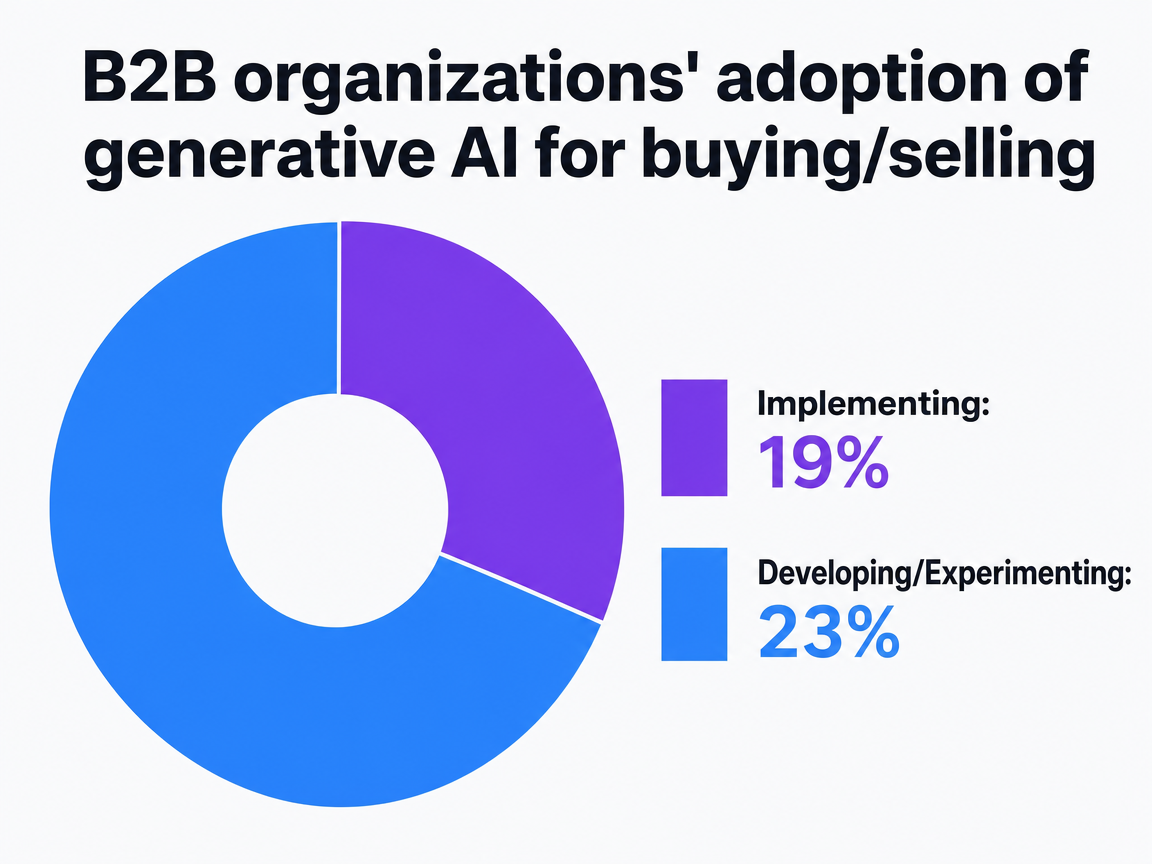 B2B organizations' adoption of generative AI for buying/selling
McKinsey B2B Pulse 2024 data showing stages of generative AI adoption. A stacked bar or pie chart could show the breakdown of adoption stages.
Run a live pipeline content experiment now
Test data-driven content strategies on your own channels and measure impact before committing further.
Proof-First Content: Building an Inventory Buyers and Answer Engines Trust
The content a buying group trusts is rarely the content a marketing team publishes about itself. Forrester's analysis of B2B content behavior finds that decision-makers lean heavily on third-party validation from peers, partners, influencers, review sites, and successful customers when forming shortlists and defending choices internally 14. First-party claims set the frame; proof assets decide whether the frame holds under scrutiny.
A proof-first inventory starts by naming the asset types that carry evidentiary weight and matching them to the buying-group roles identified in the signal layer:
- Case studies with named outcomes serve the economic buyer who needs a business case.
- Independent reviews and analyst mentions serve the technical evaluator who needs confirmation the vendor is not grading its own homework.
- Expert contributions from clinicians, attorneys, or operators serve the end user who needs to see the work described in their own vocabulary.
- Peer references and community mentions serve the champion who has to defend the pick in a room where others will push back.
The distribution assumption underneath this inventory has shifted. Forrester's 2026 research reports that 94% of surveyed B2B buyers used AI during their research, and that twice as many named generative AI or conversational search as a more meaningful information source than any other channel 11. The scope matters: this is a Forrester survey of B2B buyers, not a universal behavioral claim, and conversational-search usage varies by category and buying complexity. The practical implication is still direct. Proof assets have to be structured so answer engines can quote them accurately, which means specific claims, named sources, dated evidence, and clean attribution rather than brand prose that reads like a brochure.
Short-form video and other engaging formats have a role here, but a bounded one. A peer-reviewed study on short-form video found that usefulness, ease of use, and entertainment affect purchase intention through consumer trust as the mediating variable 15. The study examined consumer behavior rather than B2B buying committees, so the finding should not be stretched into a general B2B conversion claim. What it does reinforce is that trust is the mechanism, and trust in a complex purchase is built faster by verifiable proof than by production value.
The operational test for a proof-first inventory is simple. For every claim a sales deck makes, there should be at least one published asset that substantiates it with a source a stranger can verify. If that asset does not exist, the signal layer owes the production layer a brief, and the measurement layer should track whether the resulting piece appears in opportunity histories for the accounts it was built to influence.
Substantiation and Governance as Pipeline Levers
Substantiation is often filed under compliance, which obscures what it actually does for pipeline. A claim that can be sourced survives the buying group's internal challenge. A claim that cannot gets quietly removed from the shortlist defense, and the opportunity cools without anyone sending an email to explain why. The governance work that produces defensible claims is the same work that makes content worth citing in a conversational search answer or an analyst briefing.
The FTC's position on advertising is direct: claims must be truthful, non-deceptive, and evidence-based, with specific requirements covering reviews, testimonials, and endorsements 13. For regulated verticals, that general standard tightens. Health-related claims require competent and reliable scientific evidence before dissemination, not after a challenge arrives 6. Endorsements have to reflect experiences the endorser actually had, and material connections between the endorser and the advertiser must be disclosed 7. The Consumer Reviews and Testimonials Rule, in effect since October 21, 2024, bars fake reviews, insider endorsements presented as independent, and buried disclosures; the rule does not categorically ban AI-generated avatars, but it does not exempt them from the underlying truthfulness and disclosure obligations 9.
The 2025 enforcement action against an AI marketer that paid $1 million over unsupported product claims and disguised third-party material clarifies the stakes 10. AI-assisted production does not relax the evidentiary standard; it raises it, because volume increases exposure. A content system that cannot show which source backed which claim cannot defend the claim when a regulator, a prospect's legal team, or an answer engine asks.
Privacy sits inside the same governance layer when content systems ingest call transcripts or CRM records. The FTC has warned that privacy commitments extend to data reused for advertising and model development, and that quiet repurposing without affirmative consent creates legal exposure 12. The operational translation is a documented chain from source material to published claim: who said it, where it was recorded, what consent covers its reuse, and which reviewer approved its appearance in a public asset.
Treated this way, governance is not a drag on throughput. It is the record that lets a lean team move faster next quarter because last quarter's claims are still standing.
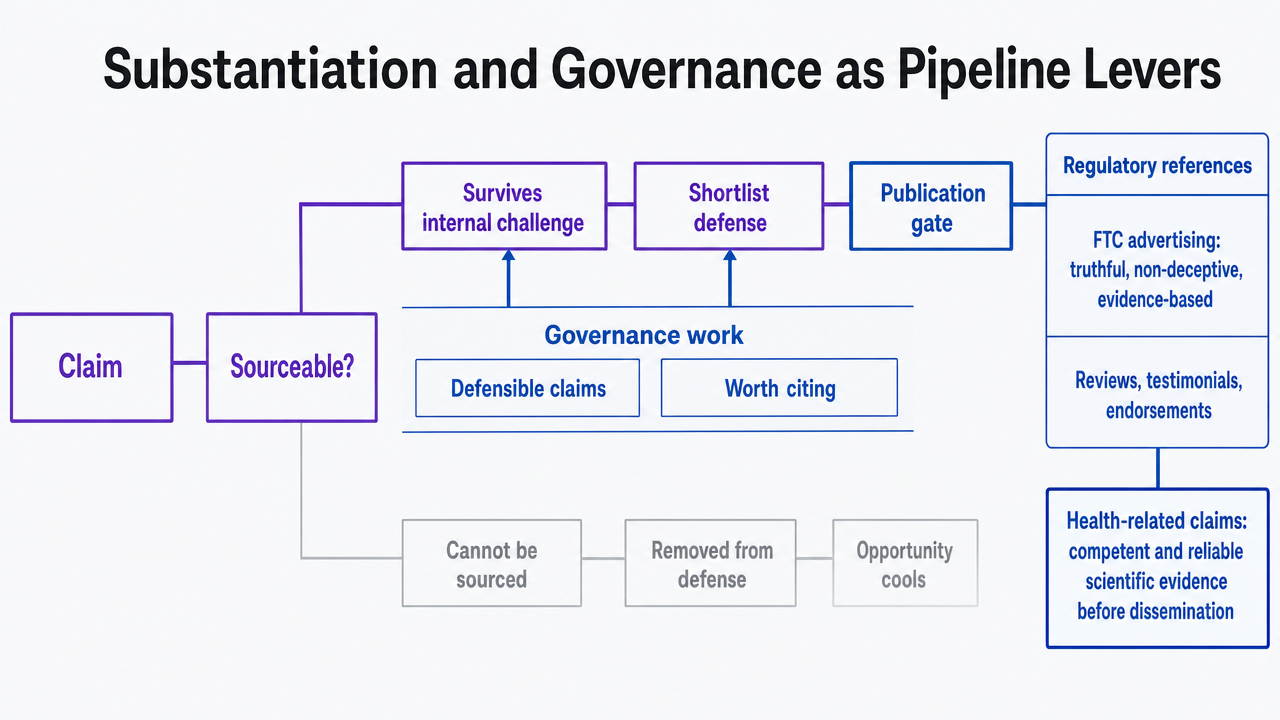 Summarize the governance checkpoints and regulatory references cited in this section as a reviewable publication gate
See How Leading Teams Build Predictable Pipeline with Data-Driven Content Execution
Request a walkthrough of unified AI-powered workflows that align content, SEO, and channel strategy—enabling marketing leaders to accelerate pipeline without increasing headcount or vendor management complexity.
If You Manage Multiple Locations: Reducing Briefing and Review Cycles
A note for a different reader: this section is written for marketing leaders at multi-location operators—DSOs, home-services franchises, behavioral-health groups, senior-living portfolios, and multi-site legal practices. In-house VPs running a single-brand program can skip ahead.
Multi-location content programs fail at the coordination layer long before they fail at the writing layer. Each location wants pages that reflect its own services, clinicians, pricing structure, and local proof. Each one also inherits the same substantiation obligations as the parent brand, since FTC advertising rules apply to claims regardless of which location published them 13. The result is a review queue that scales linearly with footprint while the marketing team does not.
Three operational moves reduce the drag:
- The signal layer should produce one master brief per decision point and a short variant spec per location, rather than a separate brief per location.
- Approval should be split: brand and legal review the claim and the proof once at the master level, and location leads approve only the local variables—name, address, provider roster, service availability.
- The measurement layer should report opportunity influence by location cohort, so the next quarter's briefs go to the locations where content is actually moving pipeline rather than to the loudest regional manager.
Putting the Operating Model to Work in the Next Quarter
The four-part model earns its keep only when it changes what the team does on Monday. A workable 90-day sequence starts with the measurement layer, not the publishing calendar. Define opportunity influence, stage progression, deal velocity, and expansion contribution at the account level, agree on the comparison groups, and get finance to sign off on the definitions before the first new piece ships. That alignment is what makes later tradeoffs defensible.
Weeks two through four belong to the signal layer. Pull the last two quarters of closed-won and closed-lost opportunities, read the call transcripts, and rank the top ten decision points where content was absent or weak. That ranked list becomes the brief queue. By week six, production and approval run against those briefs with reviewer time scoped to volume, so the gate between draft and publication compresses to minutes for standard pieces and expands only for claims that need substantiation 8.
By day 90, the scorecard should report fewer numbers more credibly, and the next quarter's briefs should come from what the measurement layer learned, not from a topic calendar. Teams building this operating loop with Vectoron keep approval in human hands while the specialist strategists handle signal synthesis, production, and tracking inside one workflow.
Frequently Asked Questions
References
- 1.McKinsey B2B Pulse 2024.
- 2.Five ways B2B sales leaders can win with tech and AI.
- 3.B2B Brand Measurement Is Broken, But There’s A Way To Fix It.
- 4.B2B Marketing Leaders Don't Trust Their Measurement.
- 5.Why B2B Marketers Need To Stop Confusing Engagement With Accountability.
- 6.Health Products Compliance Guidance.
- 7.Advertisement Endorsements.
- 8.Artificial Intelligence Risk Management Framework: Generative Artificial Intelligence Profile.
- 9.The Consumer Reviews and Testimonials Rule: Questions and Answers.
- 10.FTC Order Requires Online Marketer to Pay $1 Million for Deceptive Claims Its AI Product Could Make Websites Compliant.
- 11.B2B Buyers Make Zero-Click Number One.
- 12.AI Companies: Uphold Your Privacy and Confidentiality Commitments.
- 13.Advertising and Marketing.
- 14.B2B Companies Lean Heavily On Validation From Third-Party Content.
- 15.Influence of short video content on consumers purchase intention: The mediating role of consumer trust.