
Key Takeaways
- Treat content tooling as a five-stage production line rather than a shopping list, so each stage owns one metric and hands off cleanly to the next.
- Brief generators like Frase, MarketMuse, and Clearscope cut revision cycles by scaffolding entities, intent, and internal links before the writer starts drafting.
- Drafting layers earn their seat only when they inherit a structured brief and return a draft the optimizer can score without a rewrite.
- SERP optimizers such as Surfer, Clearscope, and NeuronWriter close the gap between readable prose and rankable prose by scoring entity and heading coverage against live results.
- Editorial governance is the checkpoint most stacks skip, and skipping it explains the ranking decay AI-heavy content shows by month three 3.
- QA on YMYL client work requires verifying every numeric claim, quote, and reference against source, since fabrication is a documented LLM failure mode 1.
- Measurement only works when ranking, engagement, and conversion data reach the strategist writing the next brief within days, not weeks.
- Portfolio agencies can capture McKinsey's 5–15% productivity range only when consolidation preserves the approval trail across brief, draft, optimize, govern, and measure 9.
- Intent, voice and factual accuracy, and performance interpretation are the three decisions that stay human no matter how capable the drafting model becomes.
The stack question every content-heavy agency now faces
Heads of SEO running multi-client delivery are not debating whether to use AI writing tools. They are deciding which categories belong in the production line, which stay human, and how many separate subscriptions the P&L can absorb before margin evaporates. The Databox survey of 140+ companies puts a number on how far this shift has already traveled: 62.18% now use AI for content generation or enhancement, and 47.90% use it for keyword research and SEO optimization 6. Adoption is not the question. Architecture is.
The pain shows up in the delivery meeting. Writers are drafting faster but the QA queue is longer. Optimization scores climb while 90-day organic performance drifts. A senior editor spends half the week rewriting AI first drafts that hit the word count and miss the brief. Meanwhile the tool bill grows: a research suite, a brief builder, a drafting assistant, a SERP optimizer, a plagiarism checker, a workflow board.
What agencies actually need is a stack view. Not a top-15 list ranked by star rating, but a map of five workflow stages, the tool category that owns each stage, the metric each category is supposed to move, and the checkpoint where human editorial judgment stays in the loop. The rest of this piece walks that map: research and briefing, drafting, optimization, editorial governance, and measurement. Named tools sit inside each stage, including where an approval-first orchestration layer replaces three or four point solutions at once.
Reading the workflow as a production line, not a tool list
The category label "content writing tools for SEO" hides a design choice. Treat the tools as a shopping list and the agency ends up with five subscriptions, four logins, and no single owner of the asset moving through them. Treat them as stations on a production line and the questions change: what handoff happens between stages, what does each stage measure, and where does a human sign off before the work moves forward.
Five stages carry a piece of content from keyword to client report:
- Research and briefing turns a target query into a structured outline the writer cannot misinterpret.
- Drafting produces the first full pass, usually AI-assisted, against that brief.
- Optimization pushes the draft toward the SERP's actual demands, checking entities, headings, and internal link targets.
- Editorial governance is where a human reads for accuracy, voice, and client-specific claims before anything publishes.
- Measurement closes the loop by feeding ranking, engagement, and conversion data back into the next brief.
Each stage owns one metric:
- Briefs are judged on revision cycles per asset.
- Drafting is judged on time-to-first-draft and writer hours per 1,500 words.
- Optimization is judged on on-page score deltas and internal linking coverage.
- Governance is judged on 90-day ranking retention and factual error rate.
- Measurement is judged on how quickly performance data reaches the strategist writing the next brief.
Reading the stack this way makes the tool question tractable. A vendor either owns a stage, spans two, or duplicates something already in place.
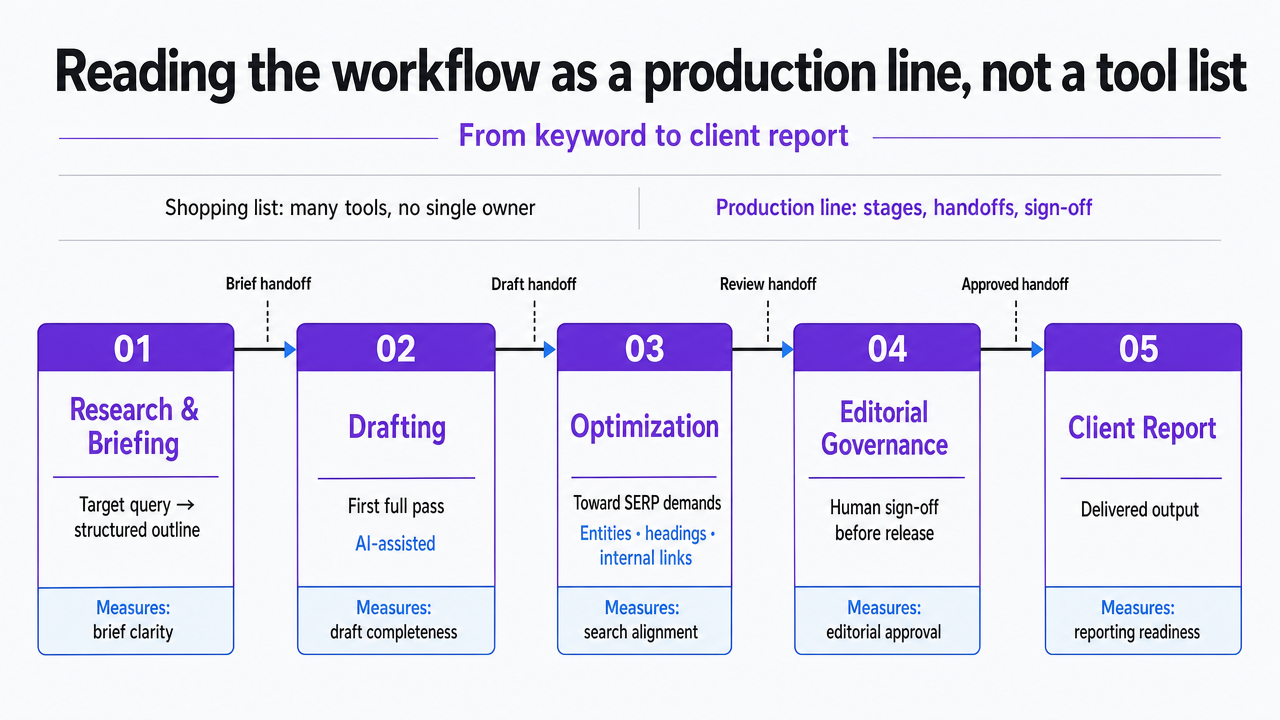 Visualize the five-stage content production line described in the section, showing each stage, its owned metric, and the handoff between stages
Stage one: brief generators that make the writer's job smaller
The brief is where quality is won or lost. A writer working from a keyword and a target word count will produce a document that reads like it was written from a keyword and a target word count. A writer working from a structured brief that already names the entities to cover, the SERP intent, the internal link targets, and the client's voice constraints will produce something closer to finished on the first pass.
Brief generators sit at the top of the production line for a reason. They translate SERP data, keyword clusters, and competitor gap analysis into an outline the writer cannot misinterpret. Named tools in this category include Frase, MarketMuse, and Clearscope on the research-heavy end, and Content Harmony and Letterdrop on the workflow-integrated end. Each pulls the top-ranking URLs for a target query, extracts recurring headings and entities, and produces a scaffolded outline with topic coverage requirements attached.
The metric this stage moves is revision cycles per asset. Agencies running unstructured briefs typically see three to five revision rounds before a piece is client-ready. Structured briefs, when the writer follows them, cut that to one or two. That difference compounds fast across a portfolio: a senior editor freed from rewriting first drafts can review twice the volume in the same week.
What a brief generator should not do is write the brief without a strategist reading it. SERP scraping produces recurring patterns, not always correct ones. A brief for a behavioral health client that inherits three competitor headings about medication protocols needs a human to flag which claims require citation and which cannot appear at all. McKinsey's genAI marketing analysis flags the same principle in a different context: personalization and optimization at scale still require the strategist to set the constraints 5. The brief tool drafts the scaffold. The strategist approves what belongs in it.
Stage two: drafting layers where AI earns its seat
Drafting is where the tool bill gets loudest and the debate gets stalest. The useful question is not whether AI should draft, but what a drafting layer should be graded on inside a production line the strategist already owns.
Two metrics decide it: time to first draft and writer hours per 1,500 words. A drafting layer that pulls a structured brief from stage one and returns a coherent long-form pass in minutes moves both numbers. A drafting layer that ignores the brief and improvises returns a document the editor has to reconstruct, which erases the gain.
Named tools in this category split into three groups:
- General-purpose assistants, meaning ChatGPT, Claude, and Gemini used through their own interfaces or an API, produce flexible output but require a strategist to hand-carry the brief in and the draft out.
- Marketing-specific drafters like Jasper and Copy.ai wrap those models in templates tuned for blog posts, landing pages, and product copy.
- SEO-native drafters like Surfer AI and Frase generate the draft against a live SERP model so the output already carries entity coverage and heading structure the optimizer will check later.
McKinsey's marketing analysis frames the upside in operational terms: generative AI can produce personalized outreach content at scale and support A/B testing across page layouts, ad copy, and SEO variants 5. That is a drafting layer earning its seat by feeding downstream stages, not by replacing the writer.
The rule that keeps this stage honest: the drafting layer inherits the brief and hands off to the optimizer. It does not publish, does not fact-check itself, and does not decide voice. When a Head of SEO evaluates a drafting tool, the test is whether it accepts a structured brief as input and returns a draft the optimizer can score without a rewrite. Anything that fails that handoff is a demo, not a production tool.
Test advanced SEO content workflows risk-free now
Experience measurable content output improvement with real publishing during your seven-day trial—no commitments required.
Stage three: SERP optimizers and on-page tuning
A draft that reads well is not the same as a draft that ranks. SERP optimizers exist to close that gap. They score a draft against the entities, headings, and semantic coverage the top-ranking pages already carry, then flag what is missing before the piece leaves the writer's queue.
Named tools in this category include Surfer, Clearscope, MarketMuse, Frase, and NeuronWriter. Each pulls the current top ten to twenty results for a target query, extracts term frequencies and topical clusters, and returns a content score with specific additions the draft needs. Some go further into on-page signals: title and meta suggestions, heading depth, image alt coverage, internal link opportunities based on the client's existing sitemap. McKinsey's marketing analysis identifies this exact use case, calling out on-page optimization of titles, tags, and URLs alongside A/B testing of layouts and copy as areas where generative AI tools produce measurable lift 5.
The metric this stage owns is the on-page score delta between first draft and publish-ready, paired with internal linking coverage. A drafting layer that hands off to the optimizer with a coverage score in the 60s should exit the stage in the 80s or better. Anything below that suggests the brief was thin or the drafter ignored it.
Two failure modes recur:
- First, writers chase the score by stuffing recommended terms into paragraphs where they do not belong, producing prose the editor has to unwind.
- Second, agencies treat the optimizer's suggestions as instructions rather than inputs, letting the tool dictate structure a strategist should be setting.
The optimizer flags gaps. The strategist decides which gaps matter for the client's intent and which reflect SERP noise from competitors who happen to outrank on domain authority alone.
Stage four: editorial governance and the approval checkpoint
Governance is the stage where most agency stacks quietly break. The brief tool works, the drafter ships copy, the optimizer scores it green, and someone hits publish because the queue is full. Three months later the ranking report tells a different story. An academic study comparing AI and human articles found that AI-generated content produced an initial ranking boost of 35% within the first two weeks, then 48% of those articles saw ranking decline by month three, while 72% of human-written articles held or improved position over the same window 3. The scope matters: this was a controlled comparison of AI-only versus human-only content, not a claim about hybrid workflows or the entire SERP. The operational lesson still travels. Speed without a governance gate buys short-term wins the agency has to rewrite later.
The Hastewire case study reaches the same conclusion from a different angle, noting that AI excels in speed and volume while human writing consistently outperforms in engagement metrics and long-term ranking stability 8. That is the rationale for the approval checkpoint, stated plainly: the drafter and optimizer produce a candidate. A human editor decides whether it publishes.
What that checkpoint actually checks is narrower than a full rewrite. A senior editor working from a governance template runs four passes:
- Factual claims against source
- Voice against the client's style guide
- Internal claims against legal or compliance constraints
- Structural judgment on whether the piece answers the query a real reader typed
Named tools in this stage include Grammarly Business and Writer for style enforcement, Originality.ai and Copyleaks for AI-detection and plagiarism flags, and workflow platforms like Airtable, Notion, or purpose-built orchestrators that route drafts through approval before publish.
The metric governance owns is 90-day ranking retention paired with factual error rate. Agencies that instrument both numbers see the decay curve early and adjust the brief upstream, not the draft downstream.
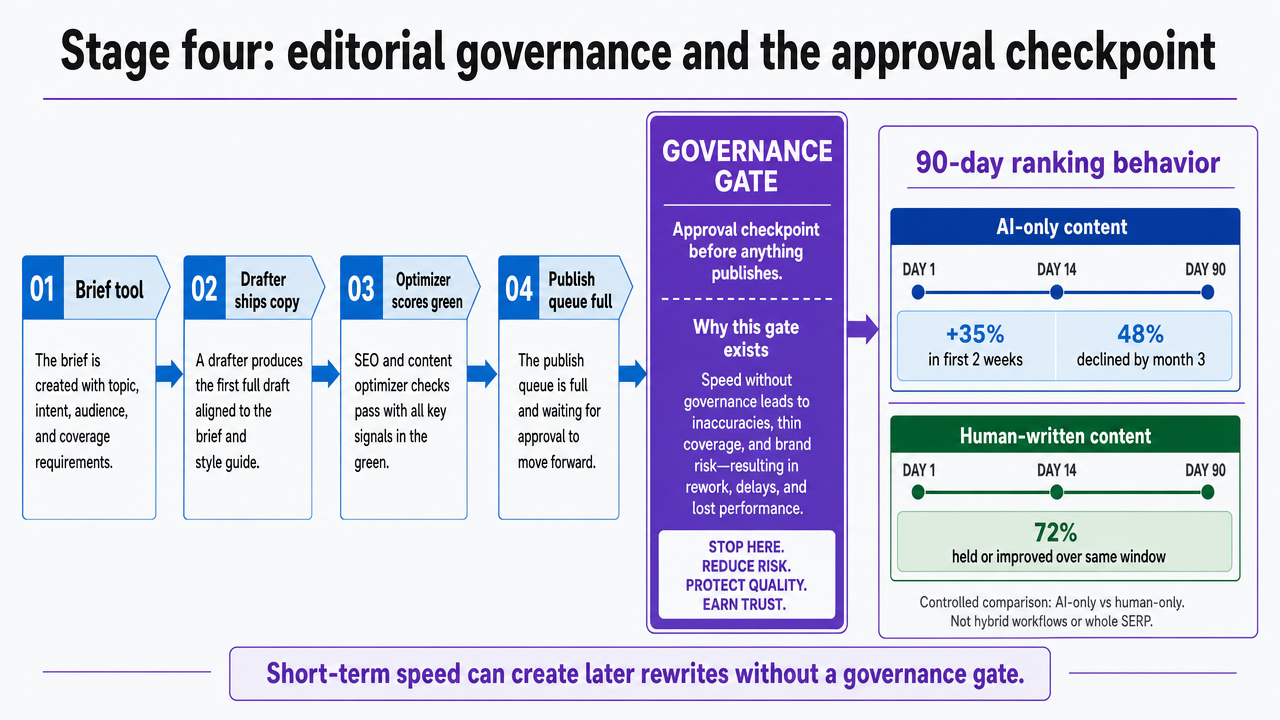 Support the cited statistic contrasting AI-generated versus human-written content ranking behavior over 90 days
QA, fact-checking, and the risks nobody wants on a client site
The failure modes that scare a Head of SEO are not stylistic. They are the ones that survive optimization, pass the editor's first read, and only surface when a client's compliance team calls. The NIH review of AI-assisted writing tools catalogues three that recur across LLM-generated output:
- Plagiarism
- Fabricated or false information
- Inaccurate or fabricated references 1
The review's context is academic writing, but the mechanics travel intact to any workflow that lets a model produce claims without a source check.
For agencies serving YMYL verticals—law firms, behavioral health, dental groups, senior living, healthcare—these are not abstract risks. A fabricated statute citation on a personal injury landing page, a hallucinated dosage detail on a treatment center blog, or an invented study reference on a senior care resource page is a legal exposure the client did not agree to. The QA layer exists to catch those before publish.
Three checks belong in every AI-assisted workflow:
- Every numeric claim and every named source gets verified against the actual source, not the model's paraphrase of it.
- Direct quotes get traced to a real speaker in a real document.
- A plagiarism scan runs on the final draft, because AI drafters occasionally reproduce training data verbatim.
Named tools include Originality.ai, Copyleaks, and Grammarly's plagiarism module. The check is the point, not the tool.
See How Leading Agencies Scale Content Production Without Increasing Headcount
Request a walkthrough of unified, AI-powered workflows that coordinate content, SEO, and approvals—purpose-built for agencies managing high-volume, multi-client delivery.
Stage five: measurement that ties tools to client reporting
Measurement is where the stack proves it earned the budget. A drafting tool that halves time-to-first-draft is a line item until the client report ties that speed to ranking, engagement, and conversion movement on the properties the agency is paid to grow. The last stage of the production line pulls performance data back into the brief so the next asset starts smarter than the last.
Three data streams belong in a client-ready measurement layer:
- Organic ranking and impression trends come from Search Console and the agency's rank tracker of choice.
- On-page engagement and CTR come from GA4 paired with SERP click data.
- Content marketing benchmarks come from the sector data agencies use to calibrate what "good" looks like for a given vertical.
The Content Marketing Institute's tech-sector benchmark work documents which KPIs mature programs actually report against, and flags measurement complexity as one of the recurring obstacles even well-resourced teams face when tying content investment to outcomes 4.
Numeric targets keep the report honest. Databox's benchmark aggregation puts the September 2024 median engagement rate across industries at 56.21% and the median content marketing CTR at 1.56% 10. Sprout Social's 2024 benchmark work adds format-level engagement baselines agencies can use to defend content-mix decisions to clients whose instincts still favor volume over fit 2. The CMI statistics roundup rounds out the picture with ROI and frequency data that translates AI-assisted throughput into program-level results 7.
The measurement stage owns one operational metric of its own: how fast performance data reaches the strategist writing the next brief. If that loop takes weeks, the stack is producing content faster than it is learning.
If you run a portfolio: the consolidation math on a five-tool stack
This section speaks to agency leads running content delivery across a client portfolio, not solo operators publishing on one site. The economics change when the same stack decision hits ten or fifty accounts at once.
The standalone model is familiar. A research and briefing tool at one seat cost, a drafting layer at another, a SERP optimizer per writer, a QA and plagiarism checker per editor, and a workflow board holding it together. Each vendor charges per seat, per project, or per word. Each renews on its own cycle. Each requires an admin to provision and deprovision as staff turns over. The tool bill is one line. The coordination tax, meaning the hours writers and editors spend moving assets between logins, is the line nobody reports.
McKinsey estimates that generative AI could increase marketing productivity by 5–15% of total marketing spending when deployed in structured workflows, with content creation and SEO optimization of titles, tags, and URLs among the specific use cases driving that range 9. Structured is the operative word. Fragmented tools produce fragmented gains.
The table below frames the comparison. Dollar figures stay as variables because seat prices for named tools shift by tier, contract, and negotiation, and inventing them would misrepresent the math.
| Workflow stage | Standalone tool category | Seat/subscription cost | Human hours per 1,500-word asset | Consolidated workflow equivalent |
|---|---|---|---|---|
| Brief | Brief generator (Frase, MarketMuse, Clearscope) | $A/seat/mo | H1 hours | Single orchestration layer with brief module |
| Draft | AI drafter (Jasper, Surfer AI, Copy.ai) | $B/seat/mo | H2 hours | Same layer, drafting stage |
| Optimize | SERP optimizer (Surfer, Clearscope, NeuronWriter) | $C/seat/mo | H3 hours | Same layer, optimization stage |
| Govern | QA and workflow (Grammarly Business, Originality.ai, Airtable) | $D/seat/mo | H4 hours | Same layer, approval checkpoint |
| Measure | Reporting stack (GA4, Search Console, rank tracker) | $E/mo | H5 hours | Same layer, performance feedback loop |
The consolidated column is where orchestration platforms compete. Named entrants that pitch approval-first workflow across these stages include Letterdrop, Narrato, and Vectoron. The claim to test is not "AI writes faster." It is whether one governed loop across brief, draft, optimize, govern, and measure captures the 5–15% McKinsey range without adding editorial risk the standalone stack was catching by accident. If a demo cannot show the handoff from brief to measurement inside a single approval trail, the consolidation is cosmetic.
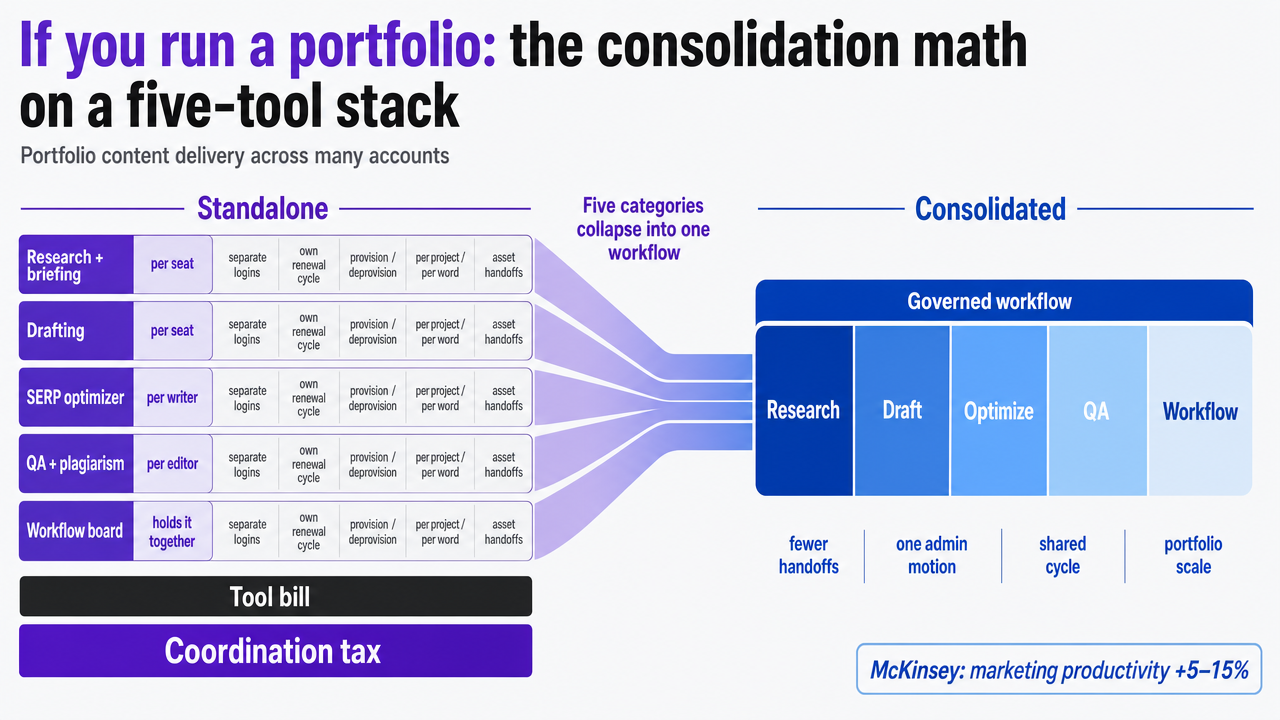 Visualize the standalone versus consolidated stack comparison presented in the section's table, showing how five separate tool categories collapse into one governed workflow
Wiring the stack: where human judgment stays non-negotiable
Five stages, five tool categories, one governed loop. The wiring question is which decisions inside that loop cannot be delegated to a model, no matter how good the drafter gets.
Three checkpoints stay human:
- Intent belongs to the strategist: what query the client actually needs to win, which competitor patterns to ignore, and what claims the brand cannot make.
- Voice and factual accuracy belong to the editor at the approval gate, where a senior read against source documents catches the errors optimizers miss.
- Performance interpretation belongs to the analyst who reads the 90-day curve and decides whether the brief upstream needs to change, not the draft downstream.
Every other stage compresses. Brief scaffolds, first drafts, on-page scoring, plagiarism scans, and reporting rollups all belong to tooling that reports into the approval trail. Orchestration platforms that pitch this consolidation, including Letterdrop, Narrato, and Vectoron, compete on whether the handoff between stages preserves the human checkpoint or bypasses it. Approval-first is the test. If a draft can reach a live client site without a named editor signing the record, the stack is not governed. It is just faster.
Frequently Asked Questions
References
- 1.Artificial Intelligence-Assisted Academic Writing.
- 2.2024 Content Benchmarks Report.
- 3.AI-Based Automated Content Generation and its SEO.
- 4.Technology Content Marketing: Benchmarks, Budgets & Trends.
- 5.Marketing and sales soar with generative AI.
- 6.The State of Content Marketing and SEO [Data from 140+ companies].
- 7.57+ Content Marketing Statistics To Help You Succeed in 2024.
- 8.Case Study: AI Content Ranking vs Human Writing Insights.
- 9.The economic potential of generative AI: The next productivity frontier.
- 10.Content Performance Benchmarks for 2026: Engagement Rates and CTR.