
Key Takeaways
- Traditional click and ranking reports miss how AI Overviews, Copilot, and ChatGPT resolve queries upstream, forcing agencies to rebuild reporting around a two-layer framework.
- Keep the foundation layer intact since crawlability, structured data, and helpful content still govern eligibility for AI-generated answers 1, 3.
- Add a generative layer covering selection rate, citation breadth, absorption, support quality, and coverage equity to reflect how AI systems actually use content 11.
- Source AI citation data transparently from Search Console's Generative AI performance report and Bing Webmaster Tools AI Performance, labeling any prompt-panel data as sampled 2, 6, 7.
- Pair raw citation counts with a sampled support-quality score, since only 51.5% of AI-generated sentences were fully supported by their cited sources in peer-reviewed testing 8.
- Frame the generative layer honestly: it can show selection and citation patterns but cannot guarantee AI placement, share of voice, or direct revenue attribution 9.
- Structure the client deck into executive summary, foundation metrics, generative metrics, and a governance block that documents human review to address scaled content policy risk 4, 5.
- Standardize the two-layer template across the client book to hold analyst load in a 3 to 7 hour monthly band per account and preserve reporting margin at scale.
Why agency reporting broke when AI answers arrived
The traditional client report, focused on rankings, clicks, and impressions, was designed for a search landscape where users primarily clicked on blue links. This model is now insufficient as a significant portion of query resolution occurs within AI Overviews, AI Mode, Copilot, and ChatGPT answer panels. Users often read synthesized responses and do not click through to the source. Google's documentation indicates that traffic from AI Overviews and AI Mode is included in the Search Console Performance report under the Web search type, meaning traditional metrics no longer fully capture the customer journey 1.
This shift presents two main challenges:
- First, click and CTR trends can decline even when a client's content is performing well, because the content is consumed within an AI answer rather than on the website.
- Second, agencies face new client inquiries like "are we showing up in ChatGPT?" which cannot be answered solely with Google Search Console data.
While Microsoft has started providing citation-level data for Copilot and Bing AI summaries 6, the overall reporting landscape for AI visibility remains fragmented and incomplete.
To address these issues, agencies must rebuild their reporting framework, acknowledging that a single dashboard view no longer aligns with diverse search behaviors.
The two-layer report: foundation plus generative
Foundation layer: what has not changed
Google's guidance confirms that no additional requirements exist for content to appear in AI Overviews or AI Mode. The same foundational SEO principles—crawlability, indexability, internal linking, page experience, structured data, and helpful content—that drive organic rankings also determine eligibility for inclusion in synthesized AI answers 1. A May 2026 resource on generative AI features reiterates that valuable, distinctive content is the core requirement, not a separate optimization strategy 3.
Consequently, the foundation layer of the report retains most traditional SEO metrics. This includes:
- Indexation coverage
- Core Web Vitals
- Internal link depth to key pages
- Structured data validity
- Organic clicks and impressions by query cluster
- Brand versus non-brand share
- Assisted conversions from organic sessions
The key change lies in interpretation. A flat or declining click trend for informational queries no longer automatically signifies a content failure; it may indicate that AI answers are resolving the query upstream, while the underlying content continues to serve its purpose effectively.
This foundation block should be presented as the critical base of the report. Without strong crawl, index, and content quality, no generative-layer metric will be meaningful.
Generative layer: selection, absorption, and influence
The generative layer addresses a different set of questions than the foundation layer. Instead of focusing on whether a page ranked and received clicks, it examines if the page was selected as a source by an AI system and how significantly its content shaped the generated answer. Recent research models this as a two-stage process: source selection followed by source absorption. It suggests a dashboard built around five distinct dimensions: selection rate, citation breadth, absorption score, support quality, and coverage equity 11.
Each dimension provides specific insights for the report:
Selection rate : Indicates how often a site is chosen as a source for a defined set of prompts.
Citation breadth : Measures the number of unique URLs on the domain that are cited, revealing whether visibility is concentrated or distributed across the content library.
Absorption score : Estimates how much of the generated answer's content originates from the site, reflecting "answer influence" more accurately than a simple citation count.
Support quality : Assesses whether the cited passage genuinely backs the claim it is associated with.
Coverage equity : Evaluates if citations are spread across the client's target intent set or clustered within a narrow topic.
The 2026 GEO literature survey highlights that "visibility" encompasses at least nine distinct quantities in published research, underscoring why a single AI visibility number is insufficient for reporting 10. Presenting these five dimensions individually offers a transparent and defensible framework for QBR discussions.
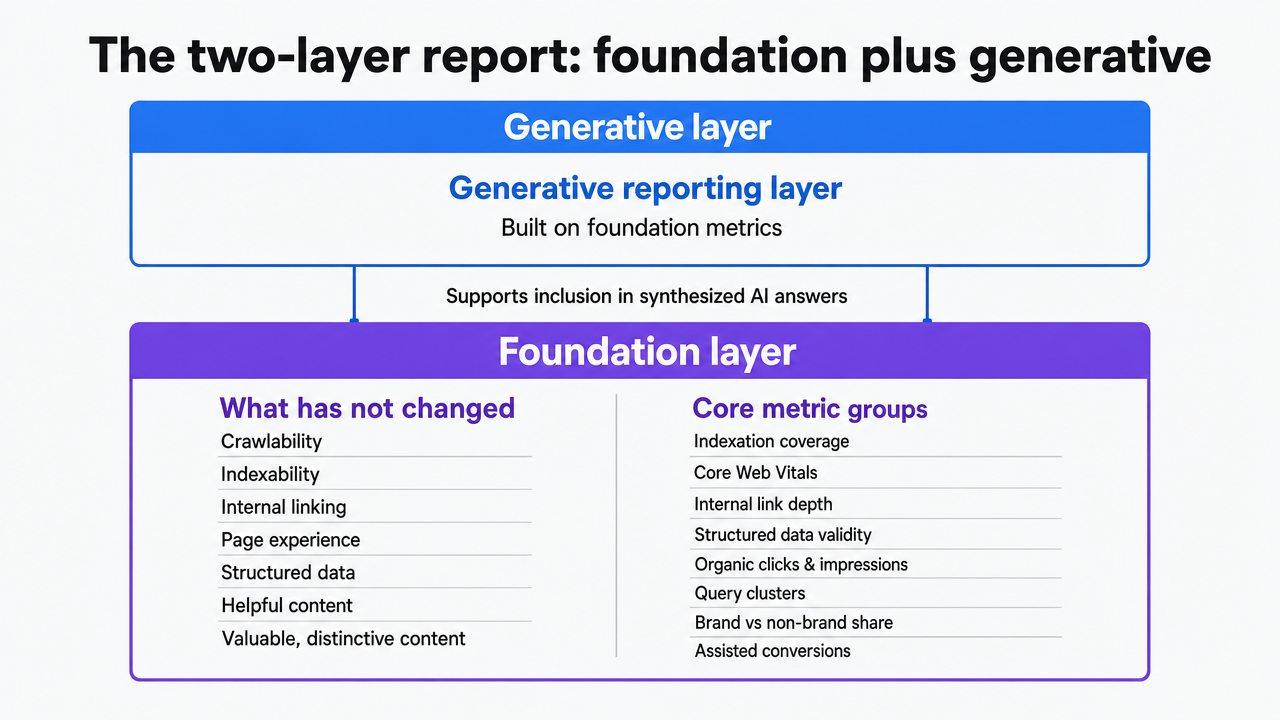 Visualize the two-layer reporting framework introduced in this section, showing how the foundation layer supports the generative layer with their respective metric groups
Where the AI citation data actually comes from
Google: Search Console and the Generative AI performance report
Google's reporting for AI features is more integrated than some vendors suggest. Traffic from AI Overviews and AI Mode is included in the standard Search Console Performance report under the Web search type. This means clicks and impressions from AI features are counted but are not separated from conventional blue-link results by default 1. There is no direct option to isolate "AI Overview clicks" as a distinct metric in the basic report.
Google's optimization guide directs users to the Generative AI performance report in Search Console for insights into how content is discovered through generative AI features on Search and Discover 2. This report serves as the primary Google-side input for the generative layer of client decks. Combined with Google's foundational guidance that no special markup or AI-specific optimization is needed beyond helpful, distinctive content 3, the Google section of the report should cover aggregate performance from Search Console, generative-feature performance from the Generative AI report, and a note clarifying that AI feature clicks are counted but not always cleanly isolable.
Microsoft: Bing Webmaster Tools AI Performance, Intents, Topics, Citation Share, Compare
Microsoft's reporting provides more explicit data on AI citation activity. The AI Performance report in Bing Webmaster Tools, launched in public preview in February 2026, offers total citations, average cited pages, citation activity over time, cited URLs, and the retrieval phrases that triggered these citations across Microsoft Copilot, Bing AI-generated summaries, and selected partner integrations 6. This is currently the most comprehensive engine-side AI visibility feed available to agencies.
A June 2026 update introduced four additional dimensions: Intents, Topics, Citation Share, and Compare 7.
- Intents categorize grounding queries into informational, commercial, navigational, local, and research, allowing for AI visibility segmentation by prompt type.
- Topics group cited queries into subject clusters.
- Citation Share shows the site's share of citations against competitors.
- Compare allows for side-by-side analysis of two properties across the same prompt space.
For SEOs developing a robust reporting template, this Microsoft data adds significant depth to the generative block. It can provide cited URLs, retrieval phrases, intent mix, and competitive share—data points that directly map to selection rate, citation breadth, and coverage equity. It's crucial to note, as Microsoft stated, that citation totals measure reference frequency and do not indicate placement, prominence, or business value within the AI answer itself 6. The report should explicitly state this limitation alongside the Google-side note about the Generative AI performance report being the recommended Search Console surface for generative features 2.
Outside Google and Microsoft: what the report should and should not claim
Platforms like ChatGPT, Perplexity, Claude, and Gemini do not offer publisher-facing citation feeds comparable to Google Search Console or Bing Webmaster Tools. Third-party tracking tools attempt to fill this gap by running prompt panels and scraping cited domains. However, this data is sampled, dependent on the prompt set used, and not officially endorsed by the underlying AI engines. This distinction must be clearly stated in the report itself, not hidden in a methodology footnote.
A transparent approach requires naming each data source, its cadence, and its scope. Google-side generative visibility comes from the Generative AI performance report in Search Console 2. Microsoft-side data is sourced from Bing Webmaster Tools AI Performance, including its Intents, Topics, Citation Share, and Compare views 6, 7. Any other data, whether from agency-run prompt sampling or vendor estimates, should be clearly labeled as such. When clients ask about ChatGPT visibility, the honest answer is that observable signals come from prompt panels run at a defined cadence, not engine-published metrics. Including this scope note in the template prevents misunderstandings during QBRs.
Experience data-driven SEO reporting in action
Test real-time, AI-powered SEO reporting on your live client campaigns—risk-free for seven days.
Citation quality: why raw counts overstate value
A raw citation count, while seemingly impressive, can be a misleading metric. The Bing AI Performance report might show a client domain was cited 1,247 times in a month across Copilot and Bing AI summaries 6. However, this number doesn't indicate if the cited passage actually supported the AI's claim, whether the citation was prominent or a mere footnote, or if the source was accurately paraphrased.
Rigorous public data on this issue comes from a 2023 Findings of EMNLP study that evaluated four generative search engines. Key findings from this paper, which should be highlighted in any citation-quality discussion, include:
- Only 51.5% of generated sentences were fully supported by their cited sources.
- 74.5% of provided citations actually supported the sentence they were linked to 8.
While the study's scope (four systems, 2023 vintage) is important context, the fundamental measurement gap persists, and this paper remains a strong peer-reviewed reference for a support-quality metric.
Operationally, this means the generative block should include a sampled support-quality score alongside total citation counts from Bing Webmaster Tools. An analyst would review a fixed number of cited answers each reporting period, verifying if the cited passage on the client's page substantively supports the AI's claim, and express this as a percentage. Even a small sample (25 to 50 cited answers per client per month) can provide a defensible support-quality trend line without requiring excessive analyst time. Reporting both the count and the support rate prevents QBRs from focusing solely on increased citation numbers when actual answer influence might be declining.
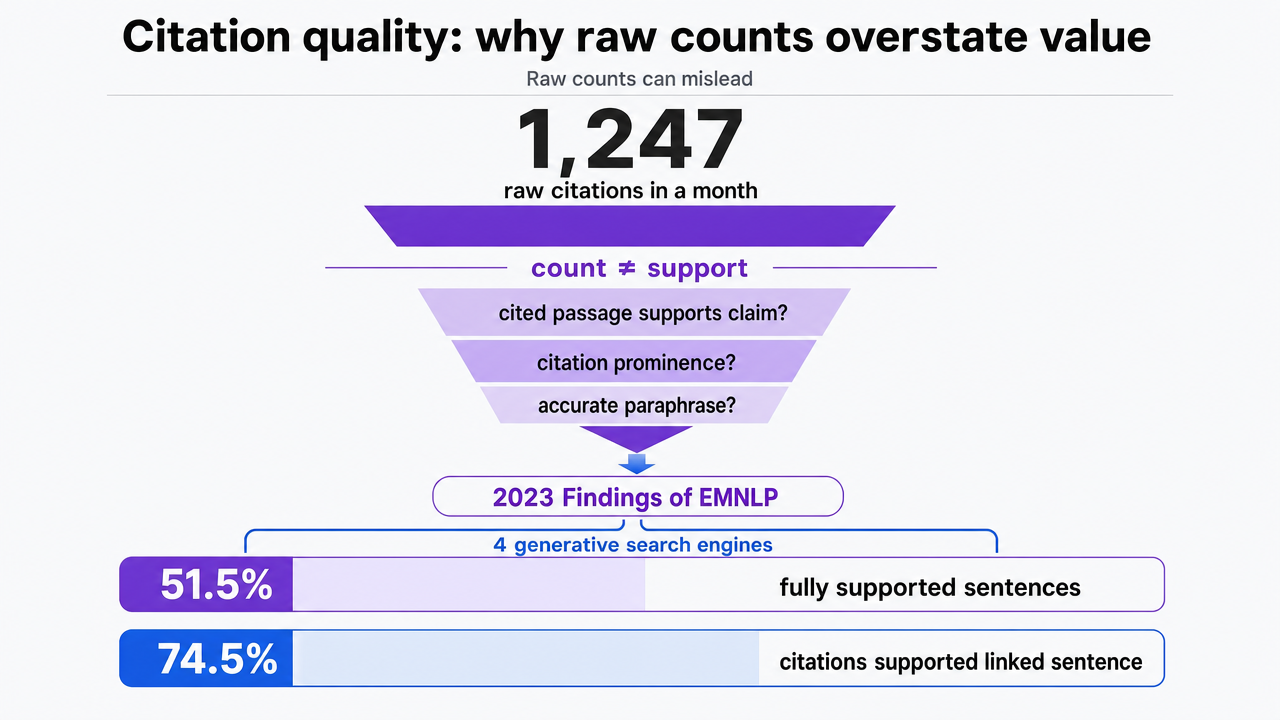 Support the section's central claim that raw citation counts overstate value by charting the two peer-reviewed support-quality figures cited in the prose
What the generative layer can and cannot promise
The most frequently cited experimental result in GEO literature is a visibility improvement of up to 40% from tested optimization methods, as reported in the 2023 paper that introduced the discipline 9. This figure should only be presented to clients with its full context: the gain was observed in controlled experiments against specific generative systems, with more pronounced effects on lower-ranked sites. It does not establish a repeatable ranking factor across Google's AI Overviews, Bing Copilot, ChatGPT, or Perplexity. Presenting this number without proper context risks turning a research finding into an unrealistic sales promise.
A more realistic framing for a QBR is narrower. The generative layer can demonstrate whether a client's content is being selected as a source, how widely citations are distributed across the domain, which retrieval phrases trigger these citations, and if the cited passages genuinely support the AI's claims. However, it cannot guarantee placement in any specific AI answer, forecast a stable share of voice across different AI assistants, or directly attribute revenue to a citation event. Reports that make such promises risk losing credibility when a competitor's URL replaces the client's in a high-value answer for reasons beyond dashboard explanations.
Section-by-section template for the client report
Executive summary and pipeline outcomes
The executive summary should prioritize pipeline outcomes over traffic metrics. Qualified inquiries, booked consultations, cost per lead, and revenue attributed to organic sessions are the most critical figures, as they directly justify retainer spend. A concise summary of two to three sentences should explain key movements and link them to specific campaigns or content investments during the reporting period.
Following this, a brief scorecard should present pipeline outcomes, foundation performance, and generative performance, each with a directional indicator compared to the previous period. Call-derived signals—such as qualified call volume, missed-call rate, and intake conversion—should be included alongside form conversions, recognizing that AI-driven journeys increasingly lead to phone contacts. The summary should avoid composite scores and clearly state the reporting window, data sources, and any changes in data collection that might affect period-over-period comparability.
Foundation metrics block: crawl, index, rankings, clicks, conversions
This block reports essential, foundational signals: indexation coverage, Core Web Vitals status, structured data validity, internal link depth to revenue-generating pages, non-brand impressions and clicks by query cluster, brand versus non-brand share, and assisted conversions from organic sessions. Google's guidance confirms that AI Overviews and AI Mode traffic is included in the Search Console Performance report under the Web search type, meaning aggregate clicks and impressions already reflect AI-feature exposure 1.
Interpretation notes are more crucial than ever. A decline in informational-query clicks with stable impressions is not necessarily a content failure; it can indicate query resolution within AI features, where the content still meets Google's foundational quality standards 3. The report should explicitly highlight this interpretation, rather than automatically recommending corrective action for every downward trend.
Generative metrics block: selection rate, citation breadth, support quality
The generative block should report each dimension separately. Selection rate and citation breadth are derived from Bing Webmaster Tools AI Performance, which provides total citations, average cited pages, cited URLs, and retrieval phrases for Copilot and Bing AI-generated summaries 6. Intent mix and competitive citation share come from the June 2026 additions—Intents, Topics, Citation Share, and Compare—allowing for segmentation by informational, commercial, navigational, local, and research prompts 7. Google-side generative performance data is sourced from the Generative AI performance report in Search Console 2.
Support quality is presented as a sampled metric below the counts: an analyst reviews 25 to 50 cited answers per client per period, assessing whether the cited passage substantively supports the AI's claim, expressed as a percentage. The block header should clarify that citation totals measure reference frequency, not placement or business value 6.
Governance block: scaled content, human review, policy risk
For clients with increased content velocity, a governance block is essential. Google's spam policy defines scaled content abuse as producing many pages primarily to manipulate rankings, regardless of whether they were human-written or AI-generated 4. Google's guidance on generative AI content emphasizes that AI assistance is permitted, but high volume without added user value increases policy exposure 5.
This block should include four key metrics:
- Pages published during the period
- The percentage that received documented human editorial review
- The percentage with subject-matter fact-check sign-off
- Any URLs flagged for originality or thin-content risk
Presenting production volume alongside review coverage allows for discussions about velocity while addressing policy concerns. This also provides the Head of SEO with a defensible artifact if a client inquires about the governance of AI-assisted output within the delivery workflow.
See How Leading Agencies Streamline SEO Reporting for AI-Driven Search
Request a walkthrough of workflow automation that enables scalable, data-rich SEO reporting across all clients—optimized for AI search environments and tailored for enterprise agency demands.
If you manage a book of 20 to 200 clients: consolidating reporting economics
This section is aimed at agency principals and Heads of SEO managing multiple client accounts. Reporting economics change significantly with 20, 60, or 200 clients, and the two-layer template becomes most effective when standardized across the entire portfolio.
The primary cost driver is analyst hours per client per month. A custom report—with unique slide layouts, manual GSC pulls, ad hoc Bing Webmaster Tools exports, and bespoke narratives—typically consumes a variable number of hours (H) per client, which increases with report complexity. A standardized two-layer template reduces this by fixing the block structure, data sources, and QBR narrative pattern in advance. Key variables are:
H : Hours per client per period
N : Number of clients
C : Reporting cadence per year
The table below outlines each report component, its source, and the estimated analyst time required at a standardized cadence. Hours are presented as ranges due to varying client complexity.
| Report component | Source of truth | Cadence | Analyst hours per client per period | |---|---|---|---| | Executive summary and pipeline | Call intelligence, CRM, GA4 conversions | Monthly | 0.5 to 1.5 | | Foundation metrics | Search Console Performance report 1 | Monthly | 0.5 to 1.0 | | Generative metrics (Google) | Generative AI performance report in Search Console 2 | Monthly | 0.25 to 0.75 | | Generative metrics (Microsoft) | Bing Webmaster Tools AI Performance, Intents, Topics, Citation Share, Compare 6, 7 | Monthly | 0.5 to 1.0 | | Support-quality sample (25 to 50 cited answers) | Analyst review against 8 method | Monthly | 1.0 to 2.0 | | Governance block | Editorial workflow logs, publishing system | Monthly | 0.25 to 0.75 |
Once the template is stable, the total analyst load per client per month typically falls within a 3 to 7 hour range. For N clients at a monthly cadence, this translates to N × H × 12 hours of reporting labor annually. The two main levers for efficiency are compressing H through standardization and leveraging AI-assisted analysis for tasks like support-quality sampling and citation data aggregation, which reduces manual effort without replacing analyst judgment on the narrative.
Delivering the QBR narrative without an AI visibility score
There's a common temptation in QBRs to provide clients with a single, overarching number that summarizes AI performance, similar to how domain rating summarizes backlinks. However, such a number does not exist. The 2026 GEO literature survey indicates that "visibility" is used to describe at least nine distinct quantities in published work 10. Any composite score would oversimplify critical information needed for budget decisions.
A more effective narrative structure guides the QBR audience through three sequential questions:
- Did pipeline outcomes improve, and which content or campaigns contributed to this movement?
- Did the foundational SEO elements—crawl, index, structured data, and non-brand organic performance—remain strong?
- Did the generative layer show the site being selected, cited across a broad range of URLs, and cited in passages that substantively support the AI's answers?
Each question directly corresponds to a section within the established template, and each answer relies on specific, named metrics rather than a consolidated index.
The closing slide should clearly state what the report can and cannot claim for the upcoming period. This transparency protects the retainer relationship from promises that no dashboard can reliably deliver.
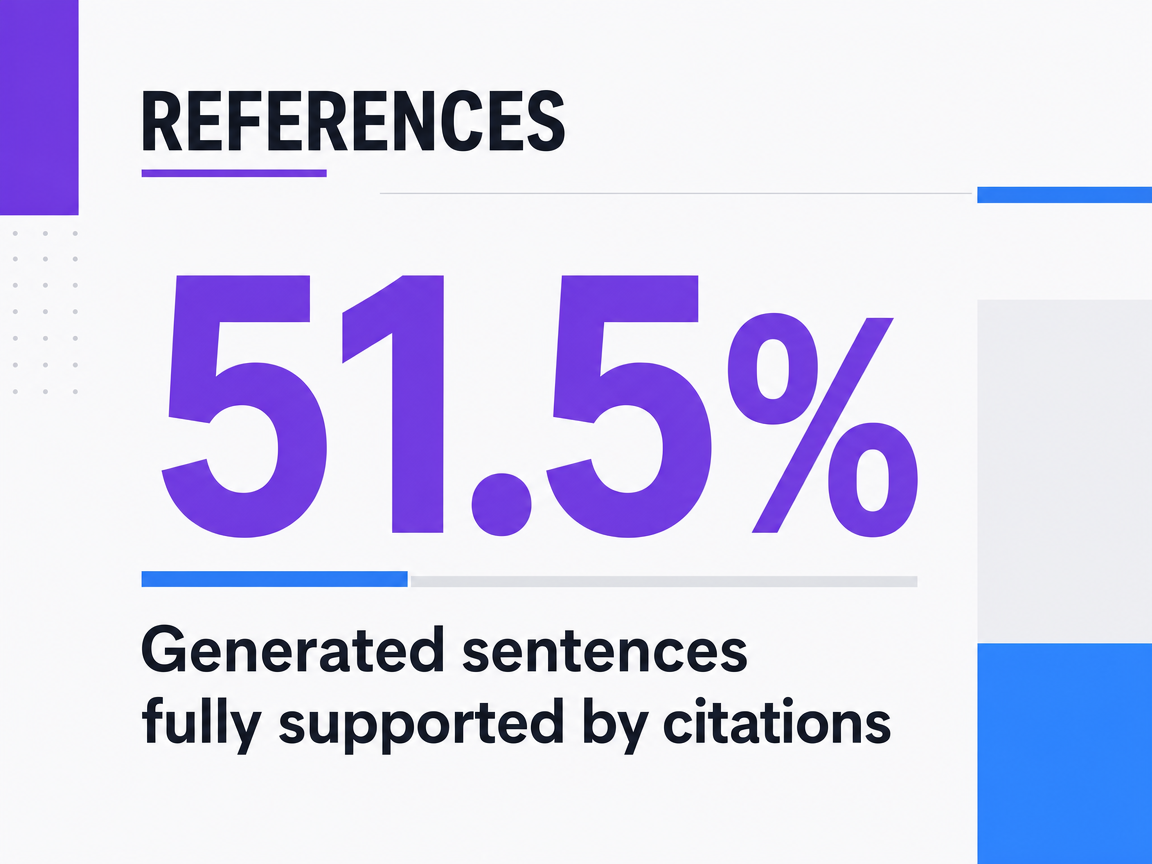 Generated sentences fully supported by citations
Generated sentences fully supported by citations
Frequently Asked Questions
References
- 1.AI Features and Your Website | Google Search Central.
- 2.Google's Guide to Optimizing for Generative AI Features on Google Search | Google Search Central | Documentation | Google for Developers.
- 3.A new resource for optimizing for generative AI in Google Search.
- 4.Spam Policies for Google Web Search | Documentation.
- 5.Google Search's guidance on using generative AI content.
- 6.Introducing AI Performance in Bing Webmaster Tools Public Preview.
- 7.New AI Visibility Insights in Bing Webmaster Tools: Intents, Topics, Citation Share, Compare.
- 8.Evaluating Verifiability in Generative Search Engines.
- 9.GEO: Generative Engine Optimization.
- 10.Optimizing Visibility in Generative Engines: A Critical Survey of Generative Engine Optimization (2023-2026).
- 11.A Measurement Framework for Generative Engine Optimization.