
Key Takeaways
- Organic CTR is not a Google ranking factor but a diagnostic signal that exposes title weakness, SERP-composition shifts, and pages whose impressions fail to convert into sessions 15, 7.
- Universal CTR benchmarks fail on modern SERPs; defensible reads condition on position, device, and SERP composition, using floors like 9.28% at position one as directional, not absolute 17.
- A one-slot rank drop can cut clicks by roughly 42%, so CTR deltas paired with position movement rarely justify a content refresh and should be filtered out before strategist review 6.
- At portfolio scale, route URLs through a tiered triage—impression floor, position stability, SERP composition, then residual CTR delta—so analysts only touch pages where content edits address the actual cause 16.
The Wrong Debate: Ranking Factor vs. Diagnostic Signal
Senior SEO leads have spent a decade litigating whether organic click-through rate feeds Google's ranking systems. It is the wrong argument to keep having. Google's own ranking-systems documentation describes Search as a collection of systems assessing relevance, quality, and usability, and it does not list organic CTR as a standalone factor 15. Independent Google Research explains why raw clicks cannot be treated as a clean relevance label: click data is sparse, biased by selection effects, and shaped by which results a user was actually shown and noticed 7.
Position bias compounds the problem. Users click higher-ranked results in part because those results appear earlier and carry implicit trust, which means CTR reflects examination probability before it reflects preference 8. A metric distorted by placement, layout, and visibility is not a metric a ranking system can consume without correction—and Google has not claimed it does.
The more useful question for an agency SEO lead is different: what does organic CTR actually diagnose, and where does it belong in a portfolio workflow? Read conditionally, CTR is one of the highest-signal metrics an SEO team owns. It exposes title and snippet weakness, flags SERP-composition changes before rank tracking catches them, and identifies pages whose impression growth is not converting into sessions. Read unconditionally—compared to a universal benchmark, ignored for device split, disconnected from SERP-feature context—it produces false alarms and misallocated refresh cycles.
The rest of this piece treats CTR as a diagnostic instrument, not a ranking input, and lays out how to operationalize it across many client accounts without drowning strategists in noise.
Why Aggregate CTR Benchmarks Fail on Modern SERPs
The industry ritual of citing a single organic CTR curve—position one at 30%, position two at 15%, and so on—assumes a search results page that no longer exists at scale. A 2024 clickstream analysis by SparkToro and Datos found that 58.5% of Google searches in the United States and 59.7% in the European Union ended without a click to the open web, with only about 374 U.S. and 360 EU clicks per 1,000 searches reaching a third-party site 5. That baseline reshapes what any position-one CTR figure means: the denominator in Search Console's impressions column often includes a large share of sessions where no organic click was ever available to win.
Aggregate benchmarks also collapse variables that behave independently. A large-scale study of SERP composition found that features such as direct answers and featured snippets exert a negative influence on organic CTR on average, though the specific feature, the organic result's position, and whether the site is included inside the feature can flip the outcome 16. A separate academic analysis of Google components reported that direct answers and featured snippets both reduce organic CTR and increase time spent on the results page, while local results and images redistribute clicks between Google-owned and third-party destinations in different directions 18. A benchmark that averages across all of these SERP shapes produces a number that describes no actual query.
Query intent adds another layer. Google's own visual elements documentation catalogs text results, rich results, and other components that vary by query, making a single click curve across a portfolio a category error rather than a measurement 14. Brand queries, navigational queries, and long-tail informational queries sit inside entirely different SERP templates, and their CTR distributions reflect that.
The practical consequence for agency reporting is direct: comparing a client's page-level CTR to a generic industry table generates false positives whenever the SERP contains features that suppress open-web clicks, and false negatives whenever branded or navigational impressions inflate the expected rate. The defensible read requires conditioning CTR on position, device, SERP composition, and query type before any comparison is made—a framework the next section builds out.
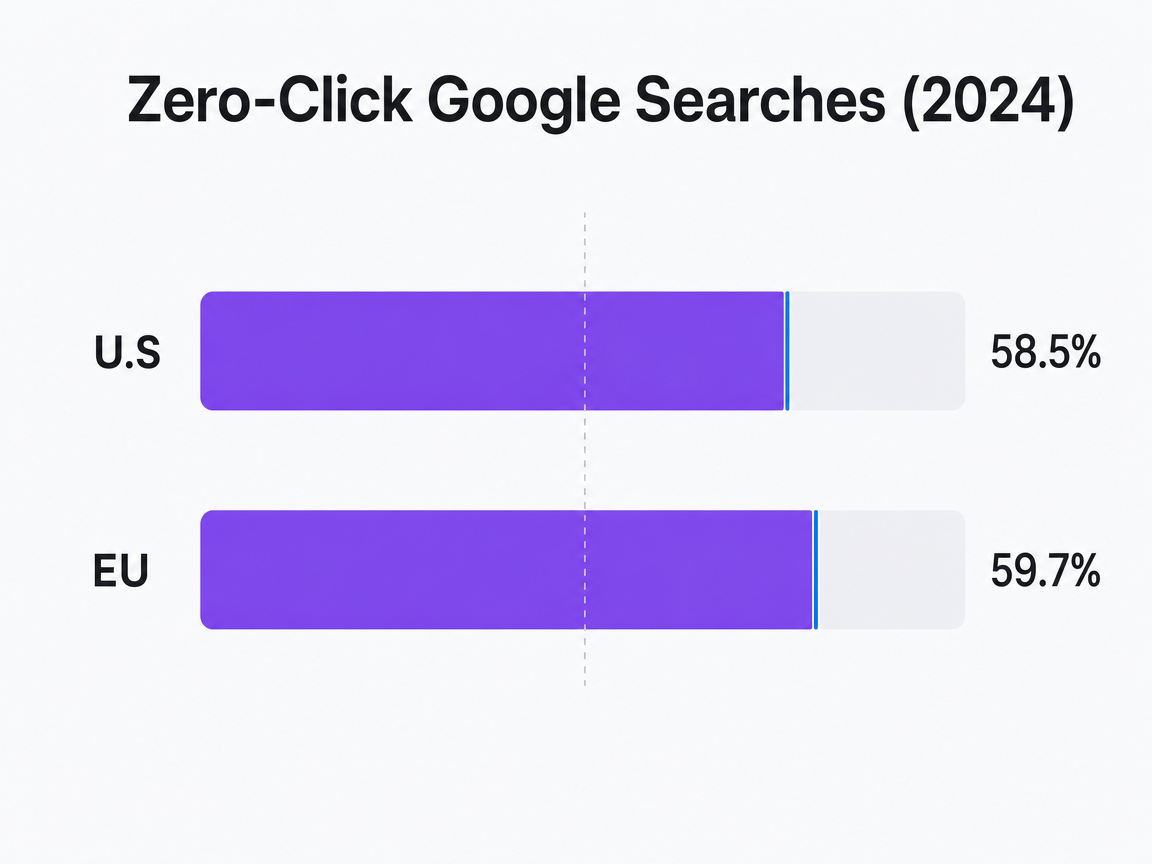 Zero-Click Google Searches (2024)
Percentage of Google searches in the U.S. and EU that ended without a click to the open web, based on a 2024 clickstream analysis.
What a Defensible CTR Read Actually Requires
Reading organic CTR defensibly means abandoning the universal benchmark and building comparisons that hold position, device, and SERP composition constant. The three subsections below establish the empirical baseline, the sensitivity trap that catches strategists who skip position conditioning, and the layered model that explains why any single CTR number compresses at least three independent variables into one figure.
Position-Conditioned Comparison and the Real Curve
The most defensible reference point for organic CTR in 2024 came from Strzelecki and Miklosik, who estimated position-conditioned rates using a large clicks-and-impressions dataset. Their figures: 9.28% at position one, 5.82% at position two, and 3.11% at position three 17. Those numbers sit far below the folklore curves still circulating in agency decks, and the gap matters. A page ranking at position one and pulling a 12% CTR is outperforming the study's baseline; a page at the same rank pulling 6% is not obviously underperforming until the SERP context and device split are inspected.
The device layer is where most portfolio reads fall apart. The same study found that desktop CTR declines steadily by position while smartphone CTR falls more rapidly, meaning a page whose impressions are 70% mobile behaves differently from a page whose impressions are 70% desktop, even at identical average positions 17. Aggregating both into a single CTR figure smooths over a real behavioral difference and can hide underperformance on the dominant device.
The operational implication is narrow and enforceable: comparisons should be built inside matched position bands—#1, #2–3, #4–6, #7–10—and then split by device before any variance is called meaningful. Search Console's performance report exposes both dimensions natively, and Google's own troubleshooting guidance recommends reviewing average position and device alongside clicks and impressions rather than in isolation 4. A strategist evaluating a client's underperforming page against the 9.28% figure without first confirming position one and confirming the device mix is comparing two different distributions.
Position-conditioned reads also carry a caveat worth stating once: the Strzelecki and Miklosik curve is dataset-specific and does not generalize across every vertical, geography, or query type 17. It functions as a directional floor, not a ceiling to defend.
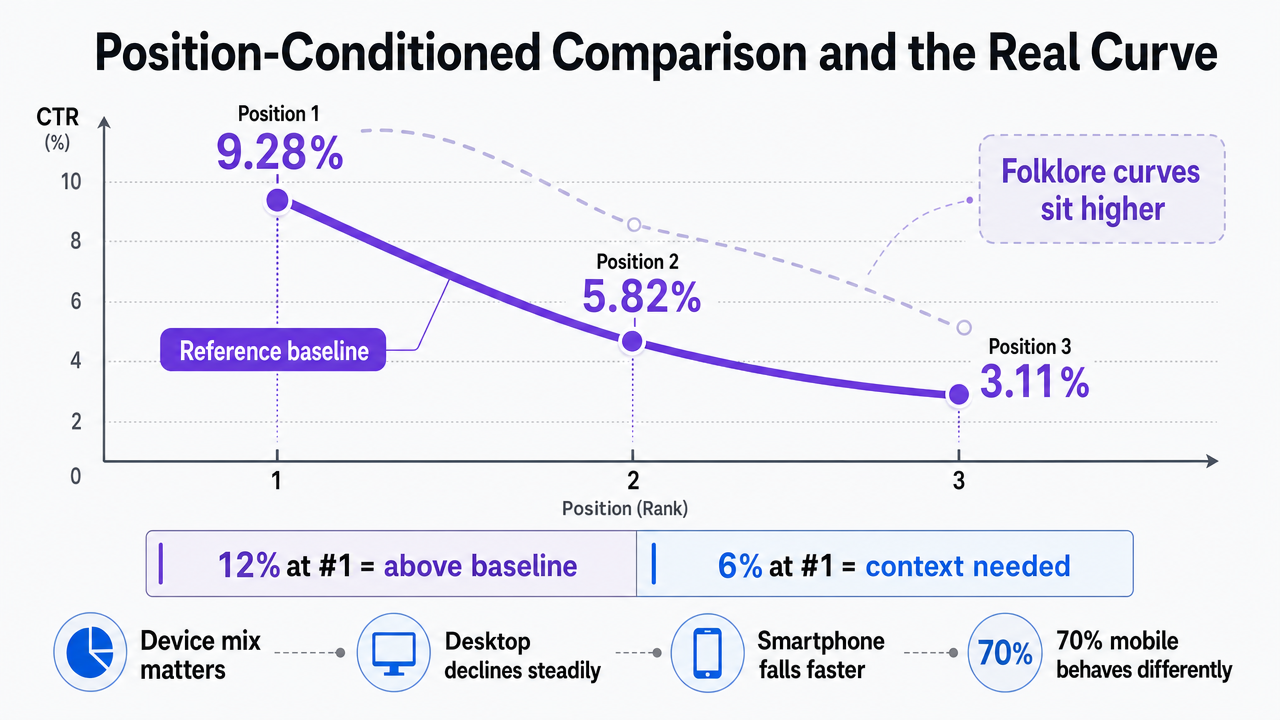 Show the position-conditioned CTR baseline cited in the section (9.28% / 5.82% / 3.11%), giving readers a defensible reference curve against folklore benchmarks
The Rank-Movement Sensitivity Trap
The most common analytical error in portfolio CTR reporting is treating a week-over-week CTR delta as a content or snippet signal when the underlying cause is a small rank shift. Experimental work on Google's SERP found that moving a result down one position reduced its clicks by an average of 42%, and moving it down two positions reduced clicks by more than 50% 6. The study manipulated result placement directly, isolating position from relevance, which is what makes the effect size credible rather than merely correlational.
Peer-reviewed research reached a compatible conclusion using a different method. A rank move from #1 to #2 reduced the odds of a click by between one-third and two-thirds, with the range depending on the specific query 9. The bounds are wide because query type, brand familiarity, and SERP composition all interact with rank—which is precisely the point. A universal CTR curve applied across a client portfolio cannot recover any of this variance.
What this means for a reporting workflow: any CTR delta below roughly 50% on a page whose average position also moved by one slot has a plausible position-only explanation and should not trigger a content refresh. The refresh queue fills with false positives when strategists react to CTR movement without a matched-position control. The defensible read isolates pages whose CTR moved while average position held stable, and it flags pages whose CTR held steady while position improved—both of which are more diagnostic than raw CTR change alone.
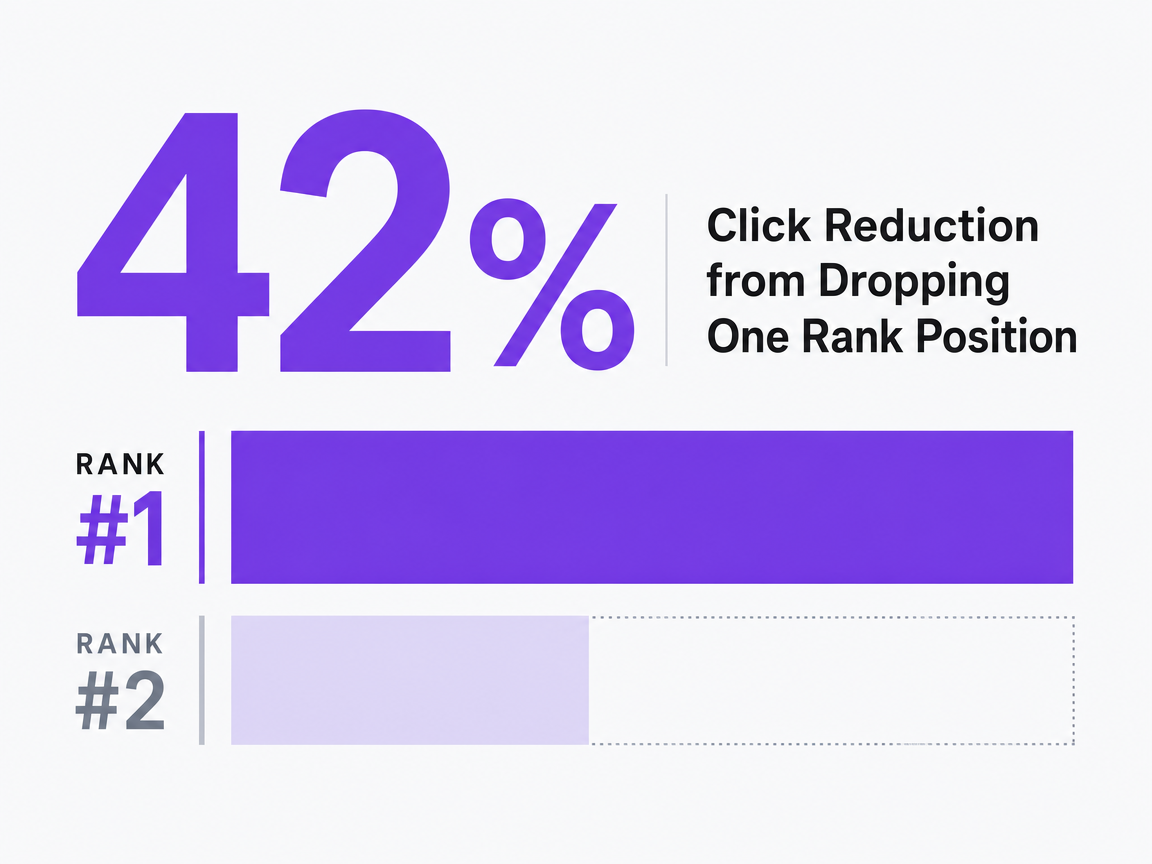 Click Reduction from Dropping One Rank Position
Click Reduction from Dropping One Rank Position
Examination × Attractiveness × Relevance: The Layers Behind One Number
Google Research formalized the structure a CTR figure actually represents: CTR is the product of the probability that a user examines a result and the probability of a click given examination 20. A single number therefore compresses at least two independent stages of user behavior, and each stage can move for different reasons. A page whose CTR drops may have lost examination probability—pushed below the fold by a new AI Overview, buried under a shopping module, or shifted to a device layout that hides it—without any change to its underlying appeal.
Attractiveness sits inside the second stage and is not a synonym for relevance. Google Research experiments on Web Search found substantial evidence that users are more likely to click results with more attractive titles, and that this attractiveness effect operates alongside the well-documented bias toward higher-ranked results 19. A page that gains CTR after a title rewrite is not necessarily more relevant to the query; it may simply be winning more of the examinations it already received.
The three-layer read—examination, attractiveness, relevance—turns CTR from a summary metric into a diagnostic one. A rising CTR at stable position and unchanged snippet points toward improved relevance or shifted query mix. A rising CTR after a title rewrite points to attractiveness. A falling CTR alongside a new SERP feature points to lost examination. Collapsing all three into one benchmark comparison forfeits the diagnostic value the metric actually offers.
Test AI-driven CTR optimization on live sites
Experience measurable CTR improvements on actual client pages before making a long-term commitment.
CTR After AI Overviews: What Changed, What Didn't
AI Overviews sit above organic results on a growing share of queries, which changes the arithmetic of any CTR read without changing the underlying measurement. Search Console still logs an impression when an organic result appears on a page that includes an AI Overview, and Google confirms that AI-feature traffic is folded into the standard Web performance report 1. The impression counter has not moved; what has moved is the visual weight of the organic list relative to everything above it, and that shift shows up in CTR before it shows up anywhere else.
Two questions actually matter for agency reporting. First, whether the clicks that still reach the site behave differently than they did before AI Overviews existed. Second, whether the mechanics of feature-driven click suppression are new or simply a continuation of what direct answers and featured snippets have already been doing for years. The subsections below address each in turn, with the evidence weighted toward independent research where Google's own claims are directional rather than verified.
Google's Position on 'Higher Quality Clicks' — and Its Limits
Google has stated, in both its AI features documentation and the AI Overviews and AI Mode PDF, that clicks originating from search results containing AI Overviews are higher quality, with users more likely to spend more time on the destination site 1, 12. The company has also said that testing of more prominent link placements inside AI Overviews drove increased traffic to supporting websites compared with earlier designs 11. Taken at face value, the framing suggests fewer but better clicks—a compositional shift rather than a pure loss.
The framing deserves to be recorded and then bracketed. Google's statements are primary-source guidance, not independent causal studies. The AI Overviews PDF is a Google document describing Google's interpretation of its own product 12. The traffic-increase claim in the October 2024 expansion post refers to internal testing without a disclosed sample, query distribution, or third-party verification 11. Neither source establishes a benchmark an agency can defend to a client whose organic sessions are down quarter over quarter.
The operational read Google itself recommends is more useful than the quality claim: supplement clicks with conversions and time-on-site analysis rather than judging AI-feature exposure by CTR alone 1. That aligns with the standard Search Console plus Analytics workflow, where Search Console captures pre-visit behavior and Analytics captures what happens after arrival 10. If clicks from AI Overview–present SERPs are in fact higher quality for a given page, the evidence will surface as a rising conversion rate or session duration on the URLs receiving those clicks—not in the CTR column. Agencies treating Google's directional statement as an empirical benchmark risk defending a claim they cannot independently verify.
SERP Features, Direct Answers, and Redistributed Clicks
AI Overviews did not invent on-SERP answer suppression; they extended a pattern that direct answers, featured snippets, and knowledge panels established years earlier. An academic study of Google components found that direct answers and featured snippets both decrease organic CTR and increase time spent on the results page, while local results and images redistribute clicks—sometimes lifting first-party Google destinations while suppressing third-party ones 18. The mechanism is compositional: the more real estate an answer or module occupies, the less examination probability remains for organic results below it.
Large-scale SERP-feature research reaches a compatible conclusion with an important qualifier. Position remains the strongest predictor of organic CTR, and while SERP features exert a negative influence on average, the specific feature, the organic result's position, and whether the site itself is included inside the feature can flip the outcome 16. A page cited inside an AI Overview or occupying the featured snippet is playing a different game than a page ranked #4 beneath both.
For portfolio interpretation, this reframes what a CTR decline actually means when a new feature appears on a query. The decline may reflect lost examination rather than lost appeal, and the correct response is to check whether the client's URL is included in the feature, whether average position held steady, and whether impressions rose as the feature drew in adjacent query variants. Google's traffic-drop debugging guide explicitly recommends reviewing clicks, impressions, average position, queries, and devices together rather than diagnosing from CTR alone 4. A CTR read that ignores which modules now sit above the organic list will attribute compositional loss to content weakness and route the page to a refresh queue that cannot fix the underlying cause.
The Levers Agencies Actually Control
Organic CTR sits downstream of ranking, device mix, and SERP composition—variables an agency can influence indirectly at best. The levers that move CTR directly are narrower and better documented. Google's title link documentation identifies the specific page elements that feed the SERP title: the title element, the visible on-page title, headings, prominent text, anchor text, and WebSite structured data 13. Each is under the agency's control, and each can be edited without touching the underlying content strategy. The snippet field draws from page copy and meta descriptions when Google chooses to use them, which makes above-the-fold body text a second production surface rather than an afterthought.
Structured data expands the surface further. Google's visual elements gallery catalogs the components a text result can display—attribution, title link, snippet, and rich result additions such as review stars, FAQ expansions, and site links—and the composition of that presentation changes clickability independently of rank 14. A page eligible for rich result enhancements competes for examination differently than a plain text result at the same position.
The caution worth stating once: title and snippet edits that improve CTR can also increase expectation mismatch, and Google Research has documented that users click more attractive titles even when relevance is held constant 19. A rewrite that lifts CTR while depressing conversion rate or dwell time is a presentation win and a business loss. Any title or snippet test run at portfolio scale should be paired with a downstream engagement or conversion read in Analytics before the change is judged successful 10.
If You Manage Multiple Client Portfolios: A Tiered CTR Triage Model
This section narrows from general SEO teams to agency operators running many client accounts in parallel. The math changes at portfolio scale. A shop with 40 clients averaging 800 tracked URLs each is monitoring roughly 32,000 URLs, and Search Console's 16-month reporting window recommended by Google's traffic-debugging guide means each of those URLs carries a rolling comparison surface 4. Even at an optimistic five minutes per URL for a proper position-conditioned, device-split, feature-aware read, exhaustive manual CTR review across a portfolio of that size would consume more analyst hours per month than exist in the calendar. Triage is not a preference; it is the only workable posture.
A defensible triage model routes URLs through four filters in order, and stops as soon as a URL is disqualified from human review.
| Tier | Filter | Threshold | Routing |
|---|---|---|---|
| 1 | Impression volume | Below a per-client floor (e.g., 30-day impressions in the bottom quartile) | Ignore; sample size too low for signal |
| 2 | Position stability | Average position moved >1 slot in the comparison window | Attribute CTR delta to position; no refresh |
| 3 | SERP composition change | New feature or AI Overview appeared on head queries | Investigate inclusion status, not content quality |
| 4 | CTR delta vs. matched-position expectation | CTR moved while position, device mix, and SERP composition held stable | Route to strategist for title, snippet, or content review |
The tiering matters because each earlier filter absorbs the majority of URLs before a strategist ever looks. Impression floors eliminate the long tail where random variance dominates. Position stability checks catch the pages whose CTR moved for reasons Search Console's own dimensions already explain 3. SERP composition checks catch the pages losing examination probability rather than appeal, consistent with the finding that features exert a negative influence on CTR on average but flip direction when the site is included in them 16. Only the residual—URLs whose CTR moved while every other variable held—warrants the analyst time a refresh review actually costs.
The workflow implication for agency leads is direct: the triage rules belong in the reporting layer, not in the strategist's head. Portfolio-scale SEO now depends on command-center-style approval workflows—platforms such as Vectoron are built around this pattern—where automated filters surface only the URLs that survived all four tiers, and a human decides whether to ship the refresh.
A Diagnostic Workflow for Reading CTR Movement
A defensible CTR read is a sequence, not a glance at a column. The workflow below assumes an analyst has already isolated a set of URLs whose CTR moved beyond normal variance and needs to decide, for each one, whether the movement is signal worth acting on or noise worth ignoring.
- Step one is to confirm the impression base is large enough to trust. Search Console's performance report exposes impressions alongside clicks and average position 3, and any URL sitting in the low-impression tail should be shelved before interpretation begins—small denominators generate CTR swings that describe nothing.
- Step two is to check average position across the comparison window. If position moved by even a single slot, the CTR delta has a plausible position-only explanation and the URL exits the queue 9. Google's own traffic-drop debugging guide recommends reviewing position and device alongside clicks and impressions rather than reading CTR in isolation 4.
- Step three is SERP composition. A new AI Overview, featured snippet, or local pack changes examination probability independently of appeal, and the finding that SERP features exert a negative influence on CTR on average—reversed when the site is included in the feature—means the correct diagnostic question is inclusion status, not content quality 16. Device mix belongs in the same check; a shift toward mobile impressions on a URL with steeper mobile decay produces a CTR drop no content edit can recover.
- Step four is the residual. URLs whose CTR moved while impressions, position, device mix, and SERP composition all held stable are the ones that warrant a title, snippet, or content review. Before shipping a rewrite, the workflow closes with a downstream check in Analytics: Search Console captures pre-visit behavior, Analytics captures what happens after arrival, and a CTR win that depresses conversion rate or session duration is not a win 10.
Frequently Asked Questions
References
- 1.AI Features and Your Website | Google Search Central.
- 2.Google's Guide to Optimizing for Generative AI Features on Google Search.
- 3.How To Use Search Console | Documentation.
- 4.Debugging drops in Google Search traffic.
- 5.2024 Zero-Click Search Study: For every 1,000 US Google searches, only 374 clicks go to the open web. In the EU, it’s 360..
- 6.An engine not a camera: Measuring performative power of online search.
- 7.Learning to Rank with Selection Bias in Personal Search.
- 8.Position Bias Estimation for Unbiased Learning to Rank in Personal Search.
- 9.How Does Ranking Affect User Choice in Online Search?.
- 10.Using Search Console and Google Analytics Data for SEO.
- 11.AI Overviews in Search are coming to more places around the world.
- 12.AI Overviews and AI Mode in Search.
- 13.Influencing Title Links in Google Search.
- 14.Visual Elements Gallery of Google Search.
- 15.A Guide to Google Search Ranking Systems.
- 16.Beyond Rankings: Exploring the Impact of SERP Features on Organic Click-through Rates.
- 17.Device-dependent click-through rate estimation in Google organic search results based on clicks and impressions data.
- 18.Google the Gatekeeper: How Search Components Affect Clicks and Attention.
- 19.Beyond Position Bias: Examining Result Attractiveness as a Source of Presentation Bias in Clickthrough Data.
- 20.User browsing models: relevance versus examination.