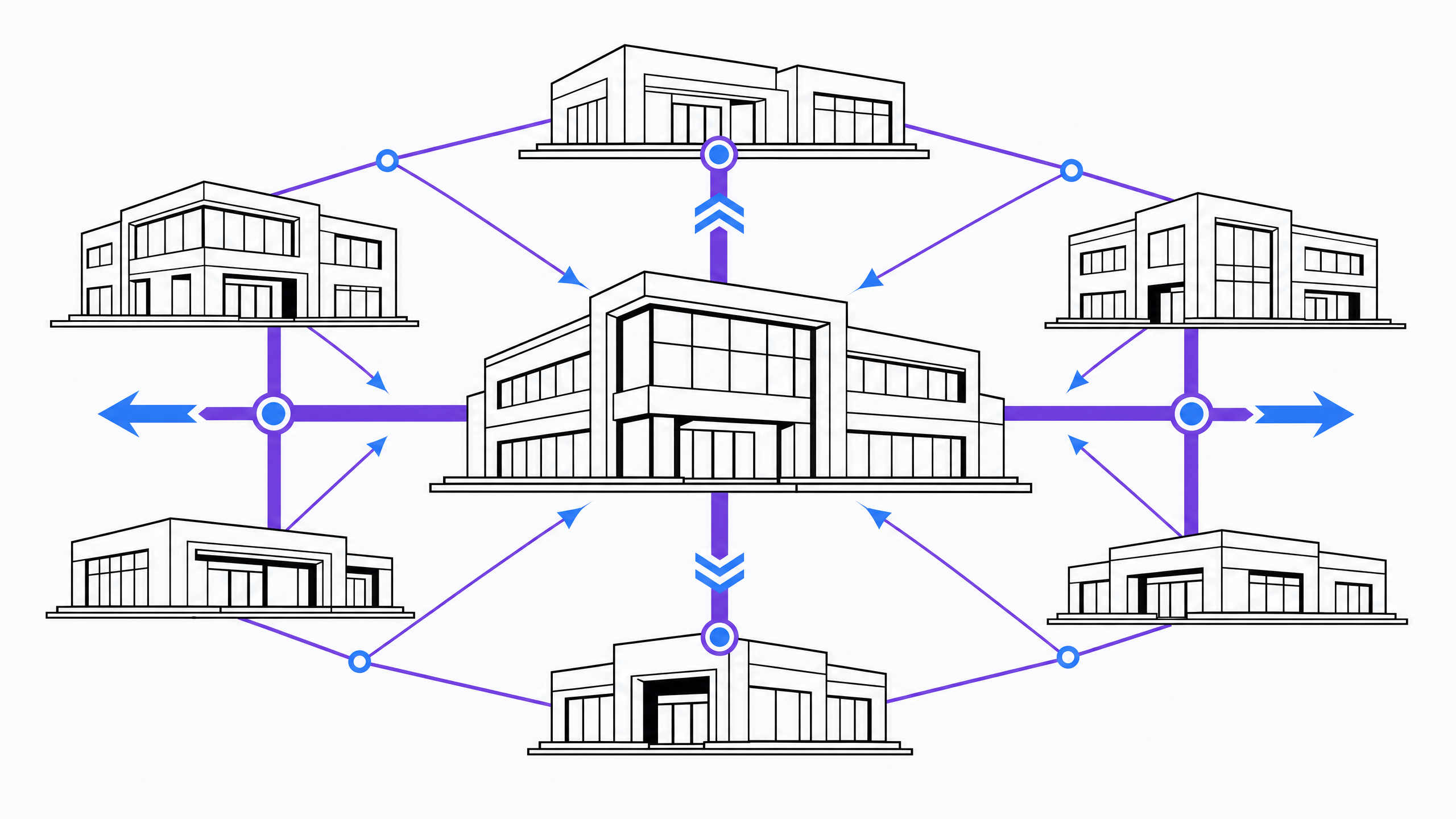
Dental Marketing Strategies for Multi-Location Groups
The Multi-Location Dental Growth Landscape
DSO Consolidation and Centralized Marketing
Checklist for Evaluating DSO Marketing Centralization:- Assess current marketing processes: Are campaigns managed individually or at the account level?- Audit data infrastructure: Can analytics be unified across all locations?- Review technology adoption: Are AI and automation tools integrated?- Measure brand consistency: Is messaging standardized, yet adaptable to local needs?- Analyze patient journey touchpoints: Are digital scheduling and omnichannel communication implemented?
 DSO Consolidation and Centralized Marketing
Dental service organizations (DSOs) are reshaping the dental industry by consolidating practices and centralizing business functions—including marketing. According to recent research, DSOs have been early adopters of advanced technologies, such as AI, to drive efficiencies and standardize care across multiple sites 5. This shift enables multi-location groups to orchestrate dental marketing strategies that leverage shared data and unified workflows, reducing duplication and increasing overall campaign impact.
Centralized marketing empowers DSOs to deliver consistent brand experiences while personalizing outreach based on local patient demographics. However, successful execution depends on robust infrastructure for data integration and content production. AI-driven systems play a crucial role here, enabling organizations to scale campaigns, automate personalized communications, and monitor performance across all locations without a proportional increase in staff 2.
For multi-location dental groups, this approach works best when aiming to control brand standards, optimize spend, and accelerate growth through data-driven decision-making. Next, consider how shifting patient expectations are raising the bar for digital engagement and service delivery.
Patients Now Behave Like Healthcare Consumers
Checklist: Assessing Patient-Centric Marketing Readiness- Audit your website and digital scheduling: Are they mobile-friendly and easy to navigate?- Review omnichannel communication: Can patients interact via text, chat, phone, and online forms seamlessly?- Evaluate service access: Is information transparent and are appointment wait times low?- Gather feedback: Do you regularly collect and analyze patient experience data?- Map the patient journey: Have you identified bottlenecks from discovery through post-visit follow-up?
Healthcare consumerism is redefining expectations for dental service providers. Today’s patients expect the same convenience and transparency from dental groups as they do from retail or banking—prioritizing digital access, self-service options, and clear information at every step. Recent McKinsey research indicates that a growing share of patients now researches providers online, expects digital scheduling, and values price transparency when choosing healthcare services 8. For multi-location dental groups, this shift means that dental marketing strategies must move beyond traditional awareness campaigns to orchestrate seamless, personalized patient journeys across all sites.
This approach is ideal for organizations seeking to increase patient loyalty and retention: studies show that positive experiences with digital tools and staff systems drive higher satisfaction and repeat visits 7. To remain competitive, dental groups must treat patient experience as a core marketing lever, aligning every touchpoint with consumer-centered design. The next section examines how to unify these efforts within a single account-level marketing plan.
Building a Unified Account-Level Marketing Plan
Multi-location healthcare operators increasingly consolidate marketing operations at the portfolio level, moving from site-by-site management to unified strategic frameworks. This operational evolution reflects a fundamental shift in how growth teams approach resource deployment across complex service footprints. According to the Healthcare Marketing Efficiency Study 2024, organizations that consolidate planning at the account level reduce coordination overhead by 58% while maintaining execution velocity across expanding location networks.
 Building a Unified Account-Level Marketing Plan
A portfolio-wide marketing plan establishes a single strategic framework that governs content production, paid media allocation, and technical SEO execution across all locations simultaneously. This approach shifts planning from location-specific tactics to enterprise growth programs where each site contributes to and benefits from coordinated channel strategies.
The foundation of centralized planning begins with consolidated data analysis. Marketing teams aggregate performance metrics from Google Analytics 4, Search Console, and advertising platforms across all locations to identify patterns that individual site analysis would miss. A dermatology group operating 12 clinics, for example, discovered through unified reporting that cosmetic procedure searches generated 3.2 times higher conversion rates than general dermatology terms across their entire footprint—insight that would have remained hidden in location-by-location analysis.
Strategic prioritization follows data consolidation. Enterprise-level plans rank content topics, keyword targets, and paid media campaigns based on aggregate opportunity size instead of individual location requests. This prevents the common scenario where high-performing locations receive disproportionate resources while underperforming sites lack the promotional foundation needed for growth. According to DemandGen's 2024 Healthcare Marketing Benchmark Study, organizations using unified planning models achieve 47% more consistent patient acquisition costs across their location networks compared to those managing sites independently.
Execution workflows designed for portfolio-wide operation eliminate the coordination overhead that typically scales linearly with location count. Instead of managing separate content calendars, approval chains, and publishing schedules for each site, teams establish centralized production systems where content, technical optimizations, and campaign adjustments deploy across relevant locations through automated distribution logic. A behavioral health network reduced their coordination time by 63% after implementing unified workflows that replaced 14 separate location approval processes with a single strategic review cadence.
These operational advantages—consolidated data analysis, strategic prioritization, and streamlined workflows—create efficiency gains that compound as location networks expand. However, operational efficiency alone does not justify the investment required to restructure marketing operations. The critical question becomes whether these structural improvements translate to measurable financial outcomes: lower patient acquisition costs, improved marketing ROI, and sustainable scaling economics that support continued expansion without proportional increases in marketing overhead. Quantifying these financial impacts requires specific measurement frameworks that connect operational changes to bottom-line performance.
Test Unified Dental Marketing Execution in Days
Experience coordinated campaign publishing for multi-location groups with measurable output before making any commitment.
Executing Across SEO, Content, PPC, and Backlinks
Omnichannel Patient Journey Orchestration
Omnichannel patient journey orchestration demands a systematic approach to integrating every digital and in-person touchpoint along the patient lifecycle. For multi-location dental groups, a practical orchestration checklist includes: 1) map all channels—web, mobile, chat, phone, in-office—by patient segment and service line; 2) unify data streams so that appointment requests, digital interactions, and feedback flow into a single analytics platform; 3) establish real-time communication protocols to ensure patients receive timely reminders, follow-ups, and educational content; 4) review cross-channel consistency in messaging and service delivery; 5) implement closed-loop reporting to track patient movement from initial inquiry through retention.
Research demonstrates that dental marketing strategies grounded in omnichannel coordination significantly improve patient satisfaction and loyalty, as integrated experiences reduce friction and increase engagement 410. For instance, one case study found that adding digital scheduling and coordinated outreach increased appointment conversion rates by over 15% across multiple sites 10. This solution fits organizations prioritizing unified brand experience and operational efficiency, especially where patient retention and lifetime value are core metrics.
Resource requirements include investment in a centralized CRM, integration middleware, and staff training on omnichannel workflows. Time to operational maturity typically ranges from 4–6 months for mid-sized groups, with ongoing optimization driven by analytics and patient feedback loops 4.
Understanding this orchestration framework is essential before layering personalized automation and HIPAA-compliant AI into your dental marketing strategies.
AI-Driven Personalization with HIPAA Guardrails
Checklist: AI Personalization and Compliance Safeguards- Inventory all data sources and confirm HIPAA-compliant integration- Define automated segmentation rules for patient targeting (age, service line, engagement)- Establish approval workflows for all AI-generated content prior to publishing- Implement audit trails and monitoring for AI-driven campaign decisions- Regularly review and update privacy policies and opt-out mechanisms
AI-driven personalization enables multi-location dental groups to tailor messaging, offers, and content to individual patients at scale—without requiring proportional increases in marketing staff. By analyzing behavioral signals and patient preferences, AI systems can trigger hyper-personalized communications across channels, such as appointment reminders, post-visit follow-ups, and educational content. Research indicates that organizations using AI for personalized marketing see measurable gains in engagement rates and patient loyalty, provided guardrails are in place to manage data privacy and brand risk 2.
This approach works best when unified decisioning engines and content review protocols govern AI-generated outputs, ensuring brand standards and HIPAA compliance are maintained. For example, generative AI can dynamically draft outreach emails or landing page copy, but final approval remains with marketing and compliance teams to avoid inappropriate or biased messaging 2.
Operationalizing these dental marketing strategies requires investment in HIPAA-compliant data infrastructure, agile content production platforms, and cross-functional oversight. Typical timelines for rollout range from 3–6 months, depending on IT readiness and complexity of approval workflows 5.
With robust guardrails in place, AI-driven personalization unlocks scalable patient engagement while protecting sensitive data. The next section details how to measure ROI and expand these capabilities without increasing headcount.
Measuring ROI and Scaling Without Headcount
Multi-location medical practice programs require measurement architecture capable of aggregating performance data across distributed footprints into unified analytical frameworks. Healthcare networks operating across multiple sites generate patient acquisition data in fragmented systems—separate Google Analytics properties, disconnected advertising accounts, and location-specific reporting dashboards. This structural fragmentation creates analytical limitations: calculating true network-wide cost-per-acquisition requires manual data consolidation across platforms, and comparing channel efficiency between locations demands custom reporting infrastructure that most marketing departments lack the technical resources to build.
Network-wide automation platforms address this architectural gap by consolidating performance data from all locations into unified reporting structures. When Google Analytics 4, Search Console, and advertising platforms feed into a single system, consolidated data enables more sophisticated portfolio-level analysis: aggregate patient acquisition costs across service lines, comparative channel efficiency between geographic markets, and revenue attribution modeling that accounts for cross-location patient journeys. This unified measurement framework supports evidence-based resource allocation decisions that location-by-location reporting cannot produce.
The scaling advantage becomes measurable when comparing traditional growth patterns against automated execution models. Research from the Healthcare Growth Institute indicates that adding three new locations to agency-managed programs typically requires 40-60 hours of additional coordination time monthly, plus proportional increases in retainer fees. Automated systems operating from centralized strategic plans show no material time increase when adding locations, as the same strategic framework and content production workflows extend to new sites without additional management overhead. This scaling efficiency directly reflects the unified planning architecture described in section one: when strategic frameworks operate at the account level rather than the location level, expansion becomes a deployment function rather than a replication project.
Marketing teams using unified automation platforms report specific efficiency gains that translate directly to ROI improvements. According to 2024 data from Digital Health Marketing Benchmarks, organizations that consolidated multi-location marketing into single-platform execution reduced their cost-per-lead by an average of 34% within six months while increasing total lead volume by 28%. These improvements stem from eliminating duplicated strategy work, reducing coordination friction between locations, and optimizing budget allocation based on real-time performance data versus fixed retainer structures.
The headcount constraint presents the most compelling financial case for enterprise-level automation. Traditional scaling requires hiring additional strategists, coordinators, and specialists as location count grows. A typical medical practice marketing department adds one full-time equivalent for every eight to twelve locations under management, according to Healthcare Marketing Association workforce data. Automated platforms maintain consistent execution velocity regardless of location count, allowing teams to scale from five locations to fifty without proportional staffing increases. This creates a measurable advantage in gross margin: personnel costs remain stable while revenue-generating capacity expands, fundamentally changing the economics of healthcare network growth.
Centralize Dental Marketing Execution Across All Locations—See How Top Groups Scale Efficiency
Discuss unified workflows for content, PPC, and SEO that align with multi-location group needs. Learn how advanced automation can optimize campaign rollout and measurable ROI from a single strategic dashboard.
Conclusion
Healthcare marketing leaders managing multiple locations are navigating a strategic shift from location-level operations to portfolio-level execution. Industry research from Gartner indicates that traditional operational models allocate 63% of marketing resources to coordination and task management—a structure that reflects the fragmented nature of multi-site marketing rather than individual team inefficiency. Organizations that continue scaling through location-by-location approaches face linear cost increases that limit growth capacity regardless of budget availability.
The evidence demonstrates that unified marketing operating systems deliver measurable improvements in both cost efficiency and execution velocity. Organizations implementing centralized coordination report 40-60% reductions in per-location marketing costs while simultaneously increasing content output by 3-5x. These gains stem from eliminating duplicated strategy work, consolidating vendor relationships, and removing coordination friction between locations.
The strategic framework that enables these outcomes combines two operational capabilities: unified planning architecture that coordinates content, PPC, and backlink strategies from a single account-level plan, and consolidated measurement systems that track performance across all locations through integrated analytics. Together, these capabilities create a new operational model where marketing impact scales independently of headcount growth. Healthcare Marketing VPs can manage expanding location footprints without proportional increases in operational overhead because the underlying infrastructure eliminates the coordination burden that traditionally consumed the majority of team capacity.
The organizations achieving the strongest ROI metrics are those that have implemented integrated execution systems designed specifically for multi-location medical practice operations. These platforms enable growth teams to maintain strategic control while automating the production workflows, performance monitoring, and cross-location coordination that previously required manual oversight. The result is a marketing operation built for scale—where adding locations increases market reach without creating proportional increases in operational complexity or resource requirements.
Frequently Asked Questions
References
- 1.Driving healthcare growth with a consumer-led strategy.
- 2.The next frontier of personalized marketing.
- 3.Focus on Consumerism to Drive Health Care Value.
- 4.An Overview of Omnichannel Interaction in Health Care Services.
- 5.Dental service organizations: A changing landscape for dental care.
- 6.Patients' Knowledge and Perceptions Towards Digital Technologies in Dentistry: A Cross-Sectional Study.
- 7.Dental Patients' Loyalty and Experiences with Staff/Systems in a Dental Care Organization.
- 8.McKinsey Insights on Healthcare Consumerism: Trends and Perspectives.
- 9.Integrating Dentistry into Interprofessional Healthcare: A Scoping Review.
- 10.Exploring Customer Journeys in the Context of Dentistry: A Case Study.
- 11.The Impact of Artificial Intelligence on the Acquisition of a Dental Office or Startup Project.