
Key Takeaways
- The orchestration gap sits between channels, not within them—buyers now touch around ten channels per journey 1, while internal teams still run separate workstreams that produce disconnected experiences.
- Campaigns coordinated across four or more channels can outperform single- or dual-channel efforts by 300% 6, but only when one offer, message hierarchy, and measurement frame govern execution.
- The operating model that compounds pipeline pairs a shared signal layer with one ranked recommendation queue, one approval surface, and journey-level KPIs like qualified calls and booked consults.
- Focus next on collapsing briefing cycles, consolidating approvals under a single owner of the martech ecosystem and modular content 3, and reporting pipeline outcomes the CFO already books.
The Orchestration Gap Most Marketing Teams Are Missing
Digital marketing campaigns rarely fail at the tactic layer anymore. SEO teams hit publishing quotas. Paid search teams hold CPCs in line. Social calendars ship. The gap shows up between those workstreams—in the handoffs, the timing, and the data that never quite arrives in the same shape at the same time.
The shift in buyer behavior explains why that gap now costs pipeline. McKinsey's 2024 B2B Pulse, a survey of B2B buyers across industries, reports that customers use an average of ten interaction channels in a single buying journey, up from five in 2016 1. Roughly one-third prefer in-person at any given stage, one-third remote, and one-third digital self-service 1. Channel count doubled. Most marketing teams still organize the work as four to six separate lanes with separate owners, separate dashboards, and separate review cycles.
That mismatch is the orchestration gap. A buyer touching ten channels expects one continuous experience; an internal team running six workstreams produces six disconnected ones. Pipeline outcomes—qualified calls, booked consults, cost per booked lead—depend on whether those channels reinforce each other or compete for the same budget without anyone reconciling them. The rest of this article treats orchestration, not channel performance, as the operating problem to solve.
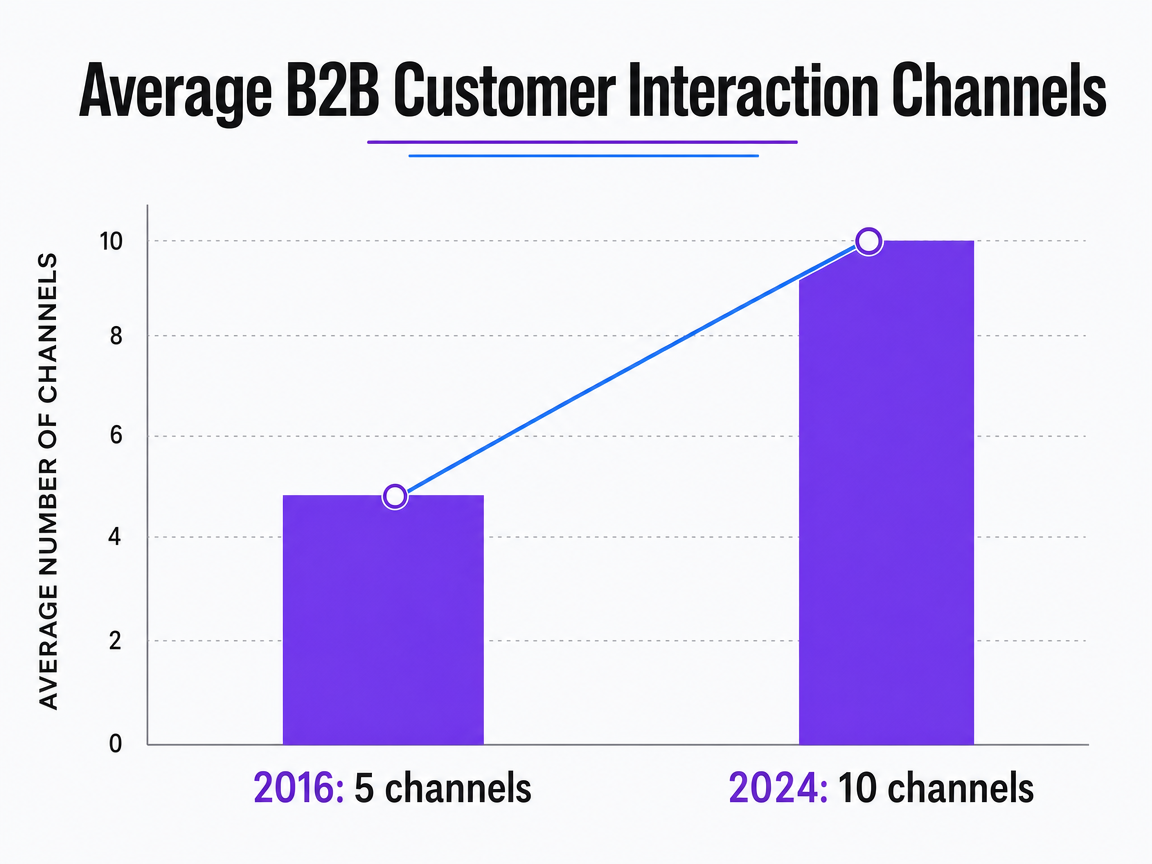 Average B2B Customer Interaction Channels
Shows the growth in the average number of channels a B2B customer uses in their buying journey, comparing 2016 to 2024.
Why Channel Parallelism Stops Producing Pipeline
The Hidden Tax of Running Channels as Separate Workstreams
Channel parallelism looks efficient on an org chart. SEO reports to one lead, paid to another, social to a third, lifecycle to a fourth. Each owner has clear KPIs and a defensible scope. The tax is invisible until pipeline goes flat.
The tax shows up in three places:
- Briefing cycles: a single campaign concept gets re-explained four to six times, once per channel owner, with edits flowing back through each lane on its own clock.
- Coordination meetings: status syncs multiply with every added channel, and decisions get re-litigated when one team's data contradicts another's.
- Attribution: when a buyer touches paid search, then a comparison post, then a retargeting ad, then a sales call, no single owner can credibly claim or disclaim the conversion.
Forrester's prescription points directly at this overhead, recommending that a single team own the integrated martech ecosystem and that content be modularized so the same asset can scale across web pages, SEO, advertising, and lifecycle programs 3. Fragmented ownership produces fragmented content, which produces fragmented measurement. The result is a marketing organization that spends most of its capacity coordinating itself rather than reaching the buyer.
Integrated Campaigns Outperform Channel Stacks
Adding more channels is not the same as integrating them. The performance differential between the two postures is large enough to redirect a marketing budget.
Gartner data cited in an integrated campaign guide reports that campaigns running across four or more coordinated channels outperform single- or dual-channel campaigns by 300% 6. The number is a benchmark drawn from integrated-campaign practitioners, not a universal law, and it measures coordinated execution rather than raw channel count. A team running six channels as six campaigns will not see that uplift. A team running one campaign across six channels can.
That distinction matters because most marketing organizations confuse channel addition with channel integration. Adding paid social to an existing SEO and email program produces three workstreams with three calendars. Integrating them means one offer, one message hierarchy, one measurement frame, and shared decisioning about which channel carries which weight at which stage of the buyer journey. McKinsey's omnichannel work reaches the same conclusion from a buyer-side view: B2B customers expect to move between channels without friction, and revenue accrues to companies that present one journey rather than several parallel ones 7.
The Operating Model Behind Orchestrated Campaigns
Signal Capture: What Counts as a Decision Input
Orchestration starts with what the team agrees to listen to. A channel-parallel organization listens to channel metrics: impressions, CTR, organic sessions, CPL by source. An orchestrated program listens to buyer-side signals that cross channels—qualified calls, booked consults, opportunity stage progression, revenue attributed to a journey rather than a last-touch source.
McKinsey's digital sales and analytics work finds that the teams pulling above-market growth are the ones using analytics to inform interactions rather than just report on them, balancing human and digital touch with speed, transparency, and expertise 5. The practical implication for a VP of marketing is narrow: the signal layer has to include downstream conversion data, not just media performance. A qualified call from a behavioral health intake line, a booked consult on a dental site, a service request from a multi-location home services brand—those are the inputs that should be ranking the next campaign decision, not last week's keyword movement in isolation.
Ranked Recommendations and the Approval Loop
Signal capture without ranking produces a dashboard nobody acts on. The second layer of the operating model is a recommendation engine—human, software, or both—that converts signals into a short list of moves ordered by expected pipeline impact.
Forrester's guidance points the same direction: assign a single team to own the integrated martech ecosystem and modularize content so the same asset can flex across web pages, SEO, advertising, and lifecycle programs without re-briefing 3. Single ownership of the ranking layer is what makes the recommendations defensible across channels. When the SEO lead, the paid lead, and the lifecycle lead each rank their own work, every priority is a one. When one owner ranks across all of them, the team gets a real queue.
The approval loop sits on top of that queue. Each recommendation carries the reasoning—what signal triggered it, what outcome it targets, what budget or asset it consumes—so the VP can approve, modify, or reject without re-litigating the analysis. Approval-first governance is the answer to the most common objection orchestration raises: that consolidating decisioning means losing creative control. It does the opposite when the queue is explicit.
Execution, Measurement, and the Feedback Cycle
Once a recommendation clears approval, execution should happen in the same system that captured the signal and produced the ranking. Every handoff between systems, vendors, or teams reintroduces the briefing-cycle tax described earlier. A campaign that took three minutes to approve should not take three weeks to ship because the creative brief has to traverse four agencies.
Measurement closes the loop. The KPI the recommendation targeted—cost per booked consult, qualified call volume by location, opportunity-stage velocity—gets attributed back to the move, not to the channel. McKinsey's reframing work documents how cross-channel meetings rebalance budgets and allocate customers across channels so the channels reinforce rather than compete, and points to one organization that routed roughly $1 billion of revenue through more deliberately orchestrated processes 9. The number is a single case, not a benchmark, but the mechanism it describes is the one that compounds: measure at the journey level, feed the result back into the signal layer, and let the next ranked recommendation reflect what just happened. Channels remain the execution surface. The journey becomes the unit of analysis.
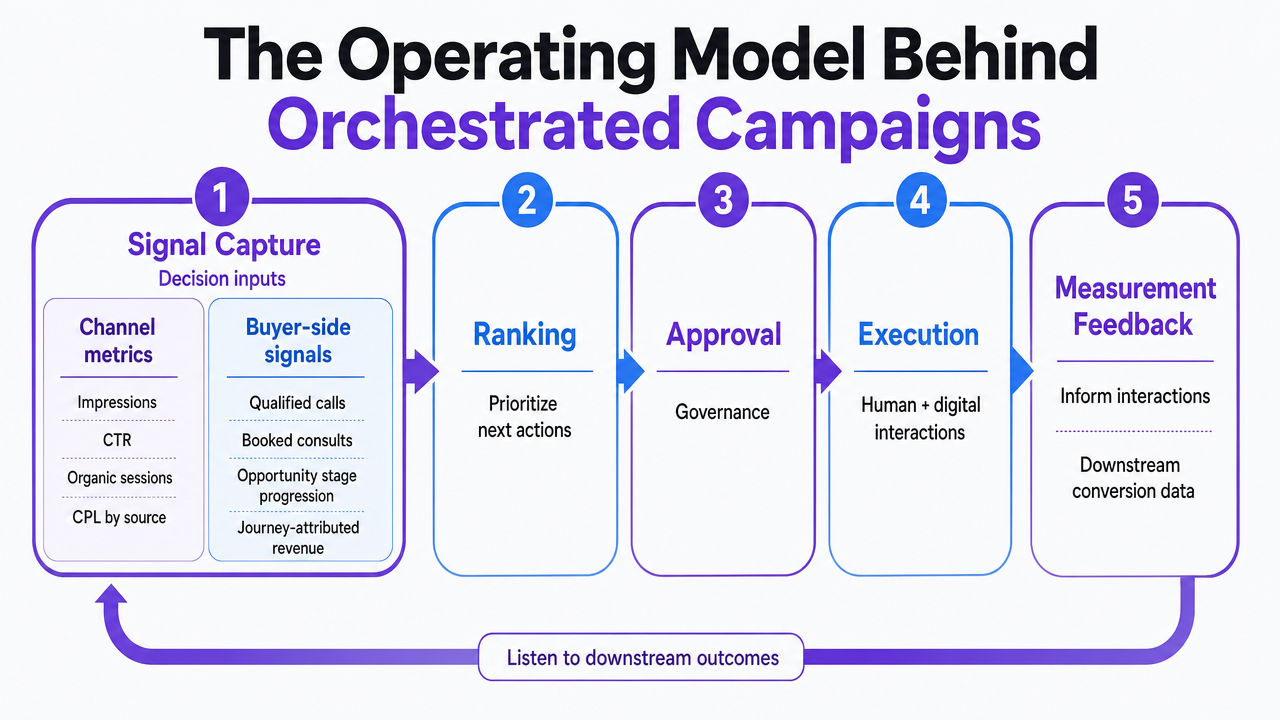 Visualize the five-stage operating loop described across the three subsections: signal capture, ranking, approval, execution, and measurement feedback
Test Data-Driven Campaign Execution in Real Time
Experience full-scale campaign orchestration and measure live impact on your marketing pipeline within one week.
The CFO Pressure That Made Orchestration Non-Optional
Budgets are growing, and so is the scrutiny that comes with them. Forrester projects marketing investment will rise at a 6% compound annual growth rate between 2021 and 2025, up from 5% between 2015 and 2019 4. A one-point CAGR shift sounds modest until it lands on a marketing line item that doubled in the same window. CFOs see the spend curve before they see the pipeline curve, and they ask the obvious question: what is the incremental dollar buying that the prior dollar did not?
That question is where channel parallelism breaks down under board review. A VP can defend SEO traffic, paid search CPL, and social engagement as individual outputs. None of those numbers, presented in isolation, answer the CFO's question about marginal return. The team that runs six channels as six budgets ends up defending six lines instead of one program. The team that orchestrates can point to a single pipeline number—qualified calls, booked consults, opportunity-stage velocity—and trace each incremental dollar to a ranked decision and an observed outcome.
Forrester's framing makes the consequence explicit: CMOs are being asked to prove revenue impact through integrated, tech-enabled programs, and the bar for that proof is rising in step with the budget 4. Orchestration is the answer to that bar because it produces a measurement surface a CFO recognizes. The alternative—defending channel-by-channel spend against a 6% growth trajectory—is the conversation that gets marketing budgets cut, not the one that gets them renewed.
Consolidation Economics: Three Ways to Run a Six-Channel Program
Coordination Overhead Is the Line Item Nobody Budgets
Marketing budgets list media, tools, salaries, and agency retainers. They almost never list coordination. That omission hides the real cost of running a six-channel program the traditional way.
Coordination overhead has three components a VP can actually measure:
- Briefing hours: the time spent translating one campaign concept into separate inputs for an SEO agency, a paid search team, a social vendor, a content shop, and a link-acquisition contractor.
- Meeting load: the recurring status syncs, QBRs, and reconciliation calls that scale linearly with vendor count.
- Rework: the asset revisions that happen when two channels interpret the same brief differently and the team has to choose which version survives.
Forrester's case for a single team owning the integrated martech ecosystem, with modular content scaling across web, SEO, advertising, and lifecycle programs, is in part an argument against this overhead 3. The point is not that meetings are wasteful in principle. It is that a program organized around channel handoffs spends a defensible share of its capacity on the handoffs themselves, and that share rarely appears as a line item the CFO can see.
Multi-Vendor Stack vs. In-House Build vs. Integrated Execution
The decision facing most VPs of marketing reduces to three operating models for the same six-channel program: a multi-vendor agency stack, an in-house FTE build, or an integrated execution model that consolidates strategy, production, and publishing under one approval loop. The economics differ on three axes: direct cost, coordination overhead, and decisioning speed.
The table below compares the three models for a representative program covering SEO content, technical SEO, paid search, paid social, organic social, and link acquisition. Dollar figures are expressed as variables because retainer ranges and fully-loaded salaries vary by market and seniority. The coordination column is the one most budgets miss.
| Model | Direct Cost | Coordination Overhead | Decisioning Speed |
|---|---|---|---|
| Multi-vendor agency stack | ~6 × $X/month retainer (one per channel) | High: separate briefs, separate calls, separate reporting cadences | Slowest: every cross-channel decision routes through multiple vendors |
| In-house FTE build | ~4–6 × fully-loaded salary + tools | Moderate: shared employer, still channel-siloed roles | Moderate: faster than vendors, bounded by headcount |
| Integrated AI-coordinated execution | Platform fee + reduced vendor/FTE footprint | Low: one approval queue, modular assets, shared signal layer | Fastest: ranked recommendations move from signal to execution in one system |
McKinsey's reframing work describes cross-channel meetings where managers rebalance budgets and allocate customers so channels reinforce rather than compete, including one organization that routed roughly $1 billion of revenue through more deliberately orchestrated processes 9. The mechanism applies at any scale: the model that produces the fastest, best-informed rebalancing decisions wins on pipeline efficiency, not on retainer price.
If You Operate Multiple Locations: DSO, MSO, and Multi-Site Service Math
The math shifts when the reader runs marketing for a dental support organization, a behavioral health MSO, a multi-site home services brand, or a senior living portfolio. The unit of analysis is no longer one program. It is one program replicated, with local variation, across ten, fifty, or two hundred locations.
Channel parallelism scales badly here. A six-channel program at one location becomes a sixty-channel-instance program at ten locations: the same briefing cycles and status meetings, multiplied. Vendor stacks that quote per-location pricing compound the direct cost while leaving coordination overhead untouched. In-house builds run into the headcount ceiling well before they hit the location count.
Forrester's modular-content recommendation matters most in this context 3. A single offer, message hierarchy, and asset library that flexes by location keeps the briefing cost roughly fixed while the location count grows. Integrated execution magnifies the effect because the same signal layer—qualified calls by location, booked consults by site, cost per booked lead by market—feeds one ranking system rather than fifty parallel ones. The VP running a multi-location program does not need more agencies. They need fewer briefing cycles per location and one queue the regional teams can act on.
AI as Connective Tissue, Not the Headline
The interesting question about AI in marketing is not what it generates. It is what it connects. A model that drafts ad copy in seconds still produces a briefing-cycle tax if the copy has to traverse four vendors before it ships. The orchestration argument treats AI as the layer that binds signal capture, ranking, approval, execution, and measurement into one loop—not as a content faucet pointed at the same fragmented org chart.
The economic case for that framing is large enough to matter. McKinsey estimates generative AI could open up an incremental $0.8 trillion to $1.2 trillion in productivity across sales and marketing functions 2. The range is scoped to those two functions specifically, not to the broader economy, and it represents potential value contingent on operating-model change rather than tool adoption. A team that bolts a generative model onto a six-vendor stack captures a slice of that productivity at the asset layer and loses most of it back to coordination overhead. A team that uses AI to read live signals—qualified calls, booked consults, cost per booked lead—rank the next moves, route them through one approval queue, and ship the approved work in the same system captures it at the program layer.
That distinction is why AI-coordinated execution is the mechanism behind orchestration rather than the headline above it. The headline is still pipeline. The connective tissue is what makes the pipeline number move when the team cannot add headcount.
Coordinate Multi-Channel Campaigns With Data-Driven Precision
Connect with our team to see how unified workflow automation streamlines campaign orchestration, reduces manual overhead, and drives measurable pipeline growth across every digital channel.
Governance: One Approval Queue, One KPI Line
Orchestration without governance produces a different failure mode than channel parallelism, but the pipeline result looks similar. A team that consolidates signals and ranking without consolidating approval ends up with faster fragmentation: more recommendations, still routed through the same scattered review process.
Two governance moves separate orchestrated programs that compound from those that stall. The first is collapsing approvals into one queue. Every ranked recommendation—paid budget shift, content brief, link target, social asset, lifecycle send—routes to the same review surface with the same reasoning attached. The VP is not approving a paid bid in one tool, a blog outline in another, and a retargeting audience in a third. The work, the signal that triggered it, and the KPI it targets sit together. McKinsey's reframing work describes cross-channel meetings where managers rebalance budgets and reallocate customers so channels reinforce rather than compete 9. The approval queue is the persistent version of that meeting—what used to require a calendar invite becomes a continuous review surface.
The second move is collapsing reporting into one KPI line tied to the buyer journey, not the channel. Qualified calls, booked consults, opportunity-stage velocity, cost per booked lead—the program is graded on the outcome the CFO recognizes, and channel metrics live one layer below as diagnostics. One queue feeding one line is the governance shape that keeps orchestration from devolving back into six workstreams in a faster wrapper.
Measurement That Survives Board Review
A measurement framework holds up in a board meeting when it answers three questions in one slide: what did the program produce, what did it cost to produce it, and what changed since the last review. Channel dashboards rarely answer any of them cleanly. Orchestrated programs can, because the measurement surface matches the way the buyer actually moved.
The reporting hierarchy that survives scrutiny has two layers:
- Top layer — pipeline outcome expressed in the units the business already books: qualified calls, booked consults, opportunity-stage velocity, cost per booked lead.
- Bottom layer — channel diagnostics: organic sessions, CPC, CTR, send-to-open ratios—used to explain movement in the top layer, not to substitute for it.
McKinsey's digital sales and analytics work finds that above-market growers use analytics to inform interactions rather than report on them, striking a deliberate human-digital balance in speed, transparency, and expertise 5. The same logic governs board reporting: the numbers the CFO sees should be the numbers driving the next ranked decision, not a separate slide deck built after the fact.
One discipline keeps the framework honest. Every reported KPI ties back to a specific approved recommendation and the signal that triggered it. When pipeline moves, the team can name the move that produced it; when it stalls, the diagnostic layer shows where. That traceability is what converts marketing reporting from a defense exercise into a renewal conversation.
A 90-Day Path From Channel Stack to Orchestrated Program
Orchestration is a structural change, not a tooling swap. A reasonable timeline assumes three thirty-day blocks, sequenced so the operating model is in place before the team consolidates execution.
- Days 1–30 — the signal layer. The team agrees on the two or three pipeline KPIs the program will be graded on—qualified calls, booked consults, cost per booked lead—and stitches the data sources that produce them into one view. Channel dashboards stay live, but they move one layer down. McKinsey's analytics work finds that above-market growers use data to inform the next interaction, not just to report on the last one 5, which is the standard the signal layer has to meet.
- Days 31–60 — collapse ranking and approval. One owner takes the integrated martech ecosystem and the modular content library, per Forrester's recommendation 3. Every cross-channel recommendation routes through a single queue with its triggering signal and target KPI attached.
- Days 61–90 — consolidate execution. Briefing cycles compress, vendor scope narrows to what the orchestrated model genuinely needs, and the feedback loop—signal, rank, approve, ship, measure—runs end to end on the same surface.
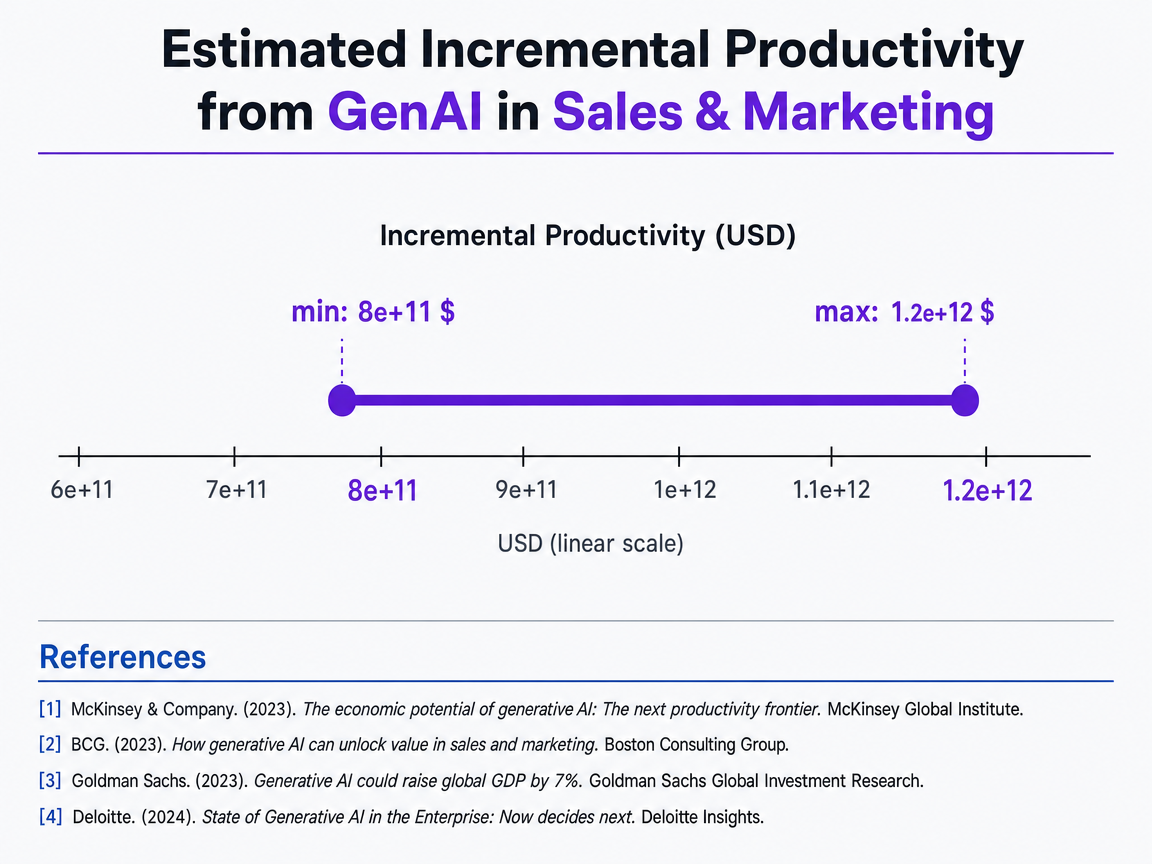 Estimated Incremental Productivity from GenAI in Sales & Marketing
Represents the potential economic value unlocked by generative AI across sales and marketing functions, as estimated by McKinsey.
Frequently Asked Questions
References
- 1.McKinsey B2B Pulse 2024: Five fundamental truths about how B2B winners keep growing.
- 2.An unconstrained future: How generative AI could reshape B2B sales.
- 3.Advance Digital Marketing Capabilities And Competencies To Achieve New Outcomes.
- 4.Marketing Growth Will Accelerate In The Post-Pandemic Era.
- 5.Digital Sales & Analytics: Driving above-market growth in B2B.
- 6.Build, Execute, and Measure An Integrated Marketing Campaign.
- 7.The new B2B growth equation.
- 8.Omnichannel in B2B sales: The new normal in a year that has been anything but.
- 9.The future of B2B sales: The big reframe.