
Key Takeaways
- Blogs deliver 55% more visitors and 67% more leads for maintained programs, yet 96.55% of published pages get zero Google traffic — the operating model decides which side a program lands on 3, 5.
- Refreshing existing posts produces a median 106% traffic lift and re-ranks in about 14 days, while new posts take 2 to 4 months, making refresh the highest-leverage editorial investment 12, 13.
- A Publish, Refresh, Retire portfolio discipline — with roughly half of capacity on refresh of the top quartile — outperforms volume targets and turns the library into a compounding asset rather than a treadmill 13.
- Under helpful content guidance and AI Overviews, only posts carrying proprietary data, first-hand experience, or coverage depth the SERP lacks earn citations; commodity how-tos are the wrong queries to chase 11, 15.
The paradox every marketing VP has to resolve
Two data points sit uncomfortably next to each other on any honest slide about blogging. Companies that publish blogs pull in roughly 55% more website visitors than peers that don't 3, generate 67% more monthly leads, and carry 434% more indexed pages 1. Yet across the broader web, 96.55% of published pages receive zero traffic from Google 5. Both numbers are drawn from the same 2026 content marketing datasets. Both are directionally accurate. Neither can be dismissed.
The tension isn't a statistical accident. It reflects the gap between blogs run as a maintained content system and blogs run as a publishing calendar. The 55% and 67% figures describe brands that treat blog output as an asset class — topics mapped to demand, posts refreshed on cadence, internal links routed toward revenue pages. The 96.55% describes what happens when publishing is the goal and everything after publishing is optional.
For a marketing VP defending a blog budget to a CRO, the question isn't whether blogs help SEO. The evidence on that closed years ago. The question is which side of the paradox a given program lands on, and what operating model separates the two. That framing changes the conversation from "should we blog" to "what cadence, quality bar, and refresh discipline convert blog output into predictable pipeline."
The rest of this analysis works through that question in sequence: what the ranking and pipeline evidence actually shows, why the majority of pages die on the vine, how a portfolio-management approach reverses the outcome, and what the unit economics look like for operators running content across multiple locations or service lines.
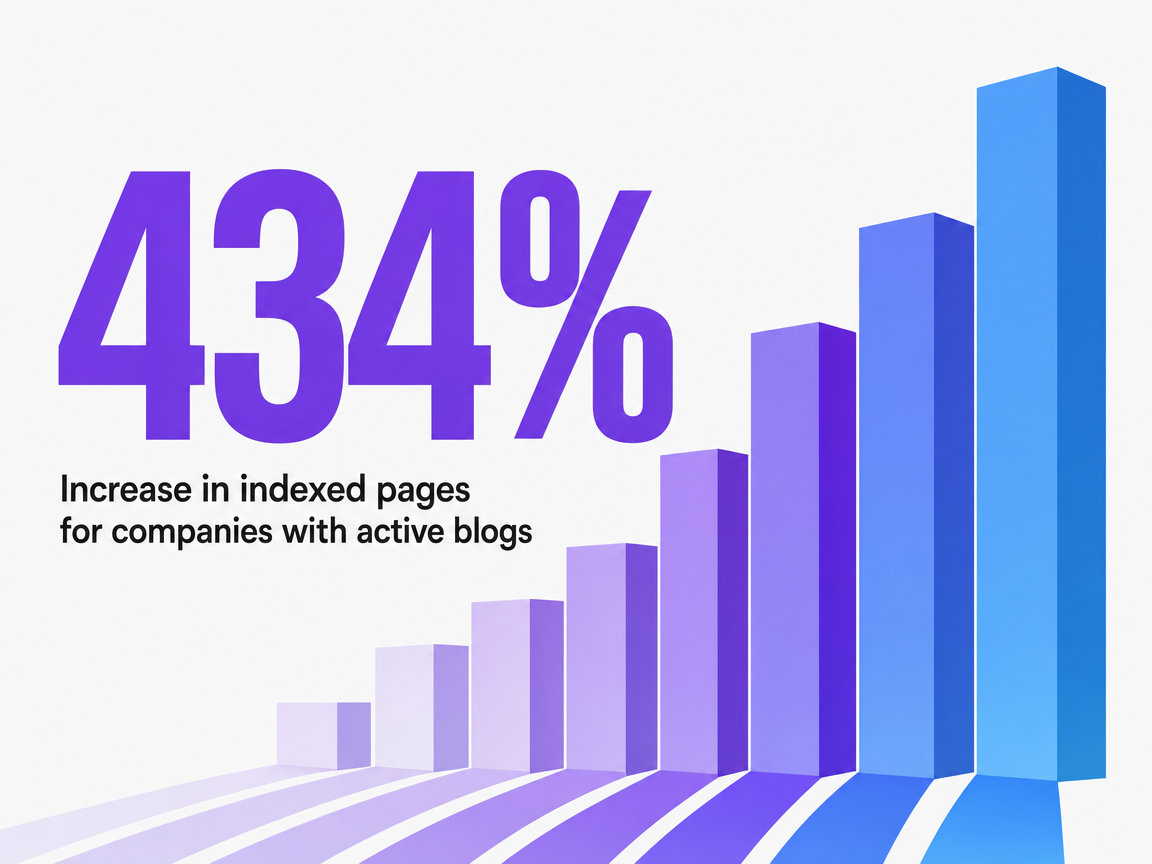 Increase in indexed pages for companies with active blogs
Increase in indexed pages for companies with active blogs
What the evidence actually says about blogs and rankings
The ranking case for blogs rests on three mechanisms that show up repeatedly in 2026 datasets: indexed surface area, query coverage, and compounding authority. Companies with active blogs carry 434% more indexed pages than non-blogging peers, a figure drawn from aggregated benchmarks across content marketing programs rather than a single controlled study 1. More indexed URLs mean more chances to intercept long-tail queries, most of which never touch the homepage or a service page directly.
That indexing advantage translates into measurable traffic. Businesses publishing blog posts average 55% more website visitors than those that don't, a benchmark HubSpot and DemandSage data both support when measuring blogging versus non-blogging brands at comparable domain sizes 3. The lift isn't uniform — B2B websites publishing nine or more posts per month grew Google traffic 35.8% year-over-year, while original research content specifically lifted organic traffic by nearly 30% for B2B SaaS 3. Cadence and content type matter as much as the decision to publish at all.
The Content Marketing Institute's 2024 and 2025 B2B benchmarks add operator context to the raw numbers. Blogs and short articles remain among the most commonly used B2B formats, and a majority of marketers rate them effective for awareness and lead nurture 7. The 2025 update shows more teams tying blog metrics to pipeline rather than traffic alone, alongside a running debate about volume versus depth — some teams are cutting cadence to invest in fewer, higher-quality pieces 8. That debate matters because it directly shapes which of the two paradox outcomes a program lands in.
Two caveats belong in the same paragraph as these numbers. First, the 55% and 434% figures describe averages across brands that actively blog, not guarantees for any single program. Second, ranking gains scale with both topical relevance and maintenance discipline — the traffic curve for a maintained blog looks nothing like the curve for one that publishes and moves on. The next section works through what happens after the click.
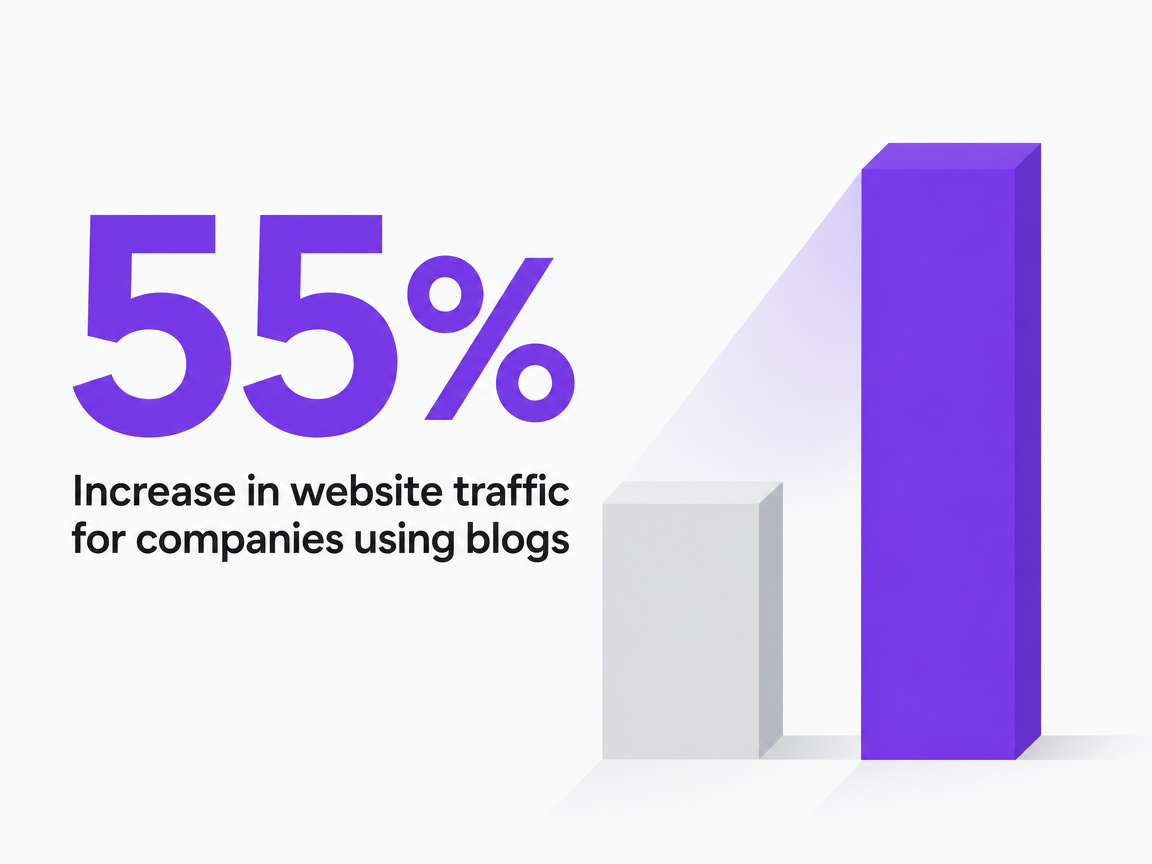 Increase in website traffic for companies using blogs
Increase in website traffic for companies using blogs
From traffic to pipeline: the blog-to-revenue chain
Traffic is a leading indicator, not the outcome a CRO signs off on. The pipeline case for blogs runs through a specific chain: informational queries land on blog content, internal links route qualified readers toward service pages and comparison assets, and organic sessions convert at rates competitive with paid channels while costing meaningfully less to acquire. Content marketing generates roughly 3x as many leads as traditional outbound at about 62% lower cost per lead, a Gitnux aggregation drawn from B2B benchmarks measuring paid-versus-organic acquisition efficiency rather than a single vendor's funnel 4.
The revenue attribution numbers close the loop. Organic search drives 44.6% of all B2B revenue in the datasets compiled across HubSpot and DemandSage inputs, a figure that reflects last-touch and multi-touch attribution across mixed B2B portfolios rather than a specific vertical 5. Roughly 36% of B2B revenue is directly attributed to content marketing efforts on average, with blogs sitting inside that mix alongside case studies, research, and gated assets 4. The 748% search-driven content ROI figure that circulates in B2B roundups comes from a narrower slice of top-performing programs and should be read as a ceiling, not a median 6.
Two operating patterns separate blogs that clear this chain from those that don't. First, the highest-performing programs treat blog posts as entry points to a linked network — pillar and service pages receive the qualified traffic, blogs feed it. Second, they measure at the assist and pipeline level, not just sessions. CMI's 2025 benchmark shows more B2B teams tying blog metrics to pipeline than in prior years, though attribution across long sales cycles remains the most-cited measurement challenge 8. Blogs help SEO in the sense a VP can defend to finance only when the chain is instrumented end to end.
Test Data-Backed Blogging Impact on SEO Performance
Measure how blog-driven content influences organic traffic and qualified pipeline in your actual environment.
Why most published pages produce nothing
The 96.55% zero-traffic figure isn't a story about Google being stingy — it's a story about what gets published in the first place 5. Most posts that die on the vine share a recognizable profile:
- topics chosen from keyword tools without demand validation,
- formats that duplicate what already ranks in the top ten,
- thin coverage that satisfies neither an informational query nor a commercial one,
- and no internal link path from the post to anything a buyer would convert on.
The traffic never arrives because the post was never competitive for the query it was aimed at.
Volume, on its own, doesn't fix this. The cadence data is often quoted as a growth lever — companies publishing 16 or more posts per month see 3.5x more traffic and 4.5x more leads than lower-frequency peers 5. That benchmark is real, but it describes brands whose 16 posts are demand-aligned and maintained, not brands that hit a monthly quota. The same dataset that surfaces the 3.5x figure also surfaces the 96.55% zero-traffic figure. Both describe the population of published pages. Only one describes the population of pages built to earn a click.
The compounding math tells the same story from the asset side. Programs with 400 or more indexed blog posts generate 4.2x more leads than programs with fewer than 100 1. That advantage is not linear with post count — it's linear with useful post count. A library of 400 posts stuffed with commodity how-tos and outdated listicles will not produce 4.2x anything, because most of those URLs contribute nothing to the crawl budget, the internal link graph, or the queries that route toward revenue pages.
Three publishing patterns account for most of the dead inventory:
- Topic selection driven by search volume rather than buyer intent, which fills the library with high-volume queries the brand has no authority to rank for.
- Cadence targets set before editorial capacity, which forces teams to ship posts that hit word counts but not standards.
- No post-publication workflow — no refresh cycle, no internal linking pass, no measurement of which posts actually feed pipeline.
Under those conditions, the 96.55% number stops looking surprising. It looks like the expected outcome of treating publishing as the finish line.
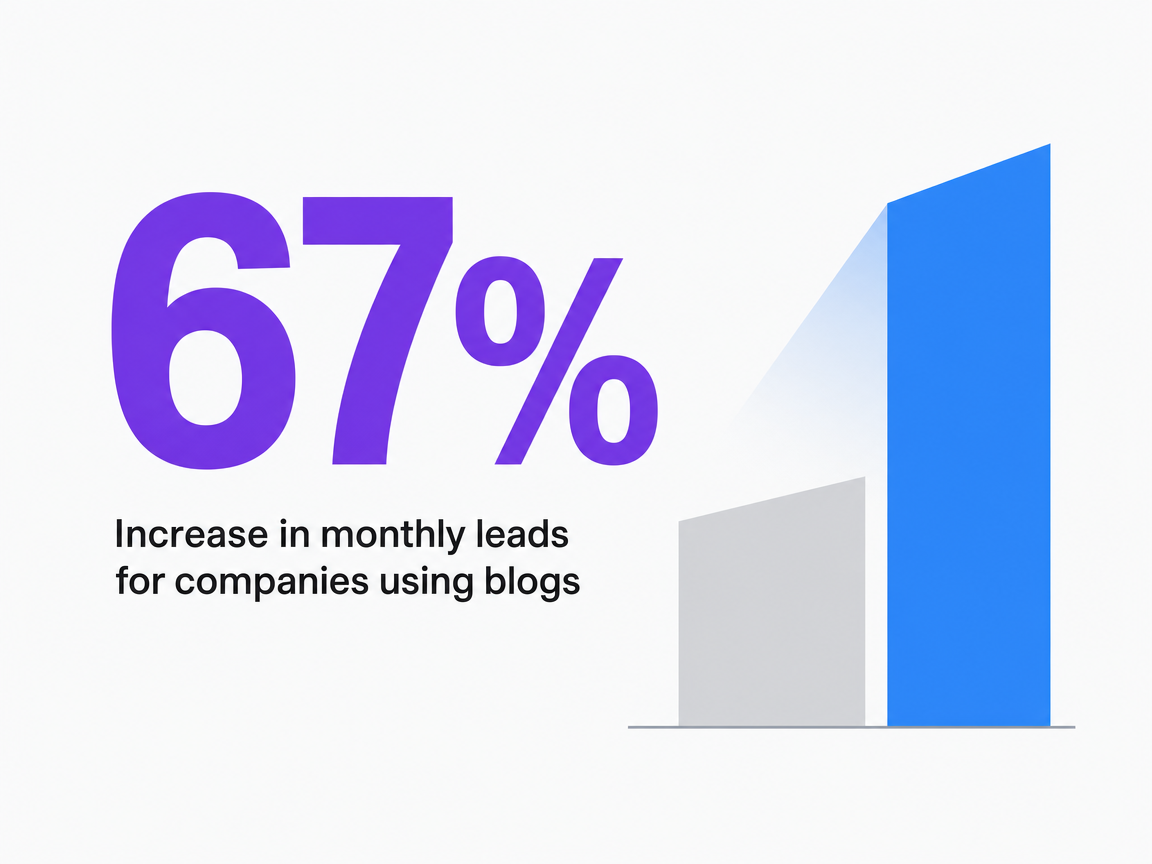 Increase in monthly leads for companies using blogs
Increase in monthly leads for companies using blogs
The maintenance curve: why publish-and-forget is the real failure mode
Blog posts have a half-life. Most high-ranking posts start losing traffic within 12 to 24 months of publication as competing pages update, SERP features shift, and the underlying query intent drifts 13. A library built without a refresh cycle isn't a stable asset — it's a depreciating one, with the decay curve running quietly beneath the traffic dashboard until the quarterly report surfaces it.
The counter-move is unglamorous and well-documented. A 2026 synthesis of 15 studies and 500+ data points found that updating existing posts produces a median 106% increase in organic traffic, an average jump of 4.6 SERP positions, and 25.7% more AI citations 12. HubSpot's own audit of its blog reached the same headline: republishing old posts drove a 106% average lift in monthly organic search views, and teams refreshing content quarterly saw 42% better results than those refreshing annually 13. The lift isn't a rounding error. It's frequently larger than what the same editorial hours would produce as new content.
The timing gap is what makes the case operationally decisive. Updated posts respond in roughly 14 days — Google recrawls, re-evaluates, and re-ranks against the refreshed signal. New posts typically take 2 to 4 months to reach a stable ranking position, assuming they rank at all 12. For a VP forecasting pipeline against a quarterly board target, that gap changes which editorial investment produces measurable revenue inside the reporting window.
The refresh mechanism works because it aligns with how ranking systems actually score content. Freshness signals, updated citations, tightened internal links, expanded coverage of subtopics that have emerged since publication, and evidence that a page reflects current information all move the same underlying quality assessment. Refreshed content also earns disproportionate AI citations under generative search, where recency and completeness carry weight in whether a passage gets pulled into an overview 12.
None of this argues against new publication. It argues against treating new publication as the only lever. A blog program running at 12 new posts per month with no refresh cycle is producing an asset base that will lose roughly half its traffic within two years of each post's publication date, then require net-new posts just to hold flat. The same team reallocating a portion of that capacity to a structured refresh cycle — quarterly on high-value posts, annually on the tail — compounds the existing library instead of racing decay. That reallocation is what separates a blog that produces a growing traffic curve from one that produces a treadmill.
Portfolio triage: Publish, Refresh, Retire
The maintenance math only pays out if a team knows which posts to feed, which to fix, and which to kill. Most blog programs stall because every URL is treated as equally worth defending, which spreads editorial capacity thin across an inventory where a small fraction is actually doing the work. A portfolio triage discipline reverses that pattern by sorting the library into three buckets — Publish, Refresh, Retire — and matching each to a specific signal set.
Refresh is the highest-leverage bucket and should absorb roughly half of editorial capacity in most maintained programs. Candidates are posts ranking in positions 4 through 20 for queries with real demand, posts that once drove traffic but have decayed inside the 12-to-24-month window most high-ranking pages start losing traffic in 13, and posts adjacent to service pages where a stronger internal link would route qualified sessions toward revenue. The expected return justifies the priority: a median 106% traffic lift, a 4.6-position SERP gain, and a re-ranking response in roughly 14 days versus 2 to 4 months for net-new content 12. Quarterly cadence on this bucket outperforms annual by 42% 13.
Publish covers net-new posts, and the bar is narrower than most calendars assume. New content earns a slot when it targets a query the existing library cannot reach through refresh, when the brand has enough topical authority to compete, and when the post connects to a defined pipeline path — a pillar, a comparison page, or a service page it can feed. Original research and category-defining formats belong here; commodity how-tos rarely do.
Retire is the bucket most teams skip. Posts that have not earned traffic in 18 months, that duplicate stronger URLs in the library, or that cover queries the brand no longer serves should be consolidated into a canonical page or removed. Retirement improves crawl efficiency, tightens the internal link graph, and stops diluting the topical signal the maintained posts are trying to build. The triage runs continuously, not annually — the library is the product, and the product needs a roadmap.
See How Leading Brands Turn Blog Content Into Measurable SEO Results
Request a data-backed consultation on scaling organic pipeline with AI-powered blog strategies—no added headcount, no agency overhead. Get actionable insights tailored to multi-location and enterprise marketing teams.
The quality bar under helpful content and AI Overviews
The rules that govern which blog posts earn traffic have moved twice in the past four years, and both moves point in the same direction. Google's helpful content guidance, first introduced in August 2022, tells creators to focus on satisfying content for people rather than posts produced primarily to rank 10. The follow-on E-E-A-T framework — experience, expertise, authoritativeness, trustworthiness — instructs publishers to consider who created content, how it was produced, and why, with originality and demonstrated value treated as ranking-relevant signals rather than editorial preferences 9.
The 2026 generative-AI guidance narrows the target further. Google's resource on optimizing for AI in Search stresses the importance of "providing valuable, unique, non-commodity content" to earn visibility in AI-generated answers 11. The operational read is direct: posts that restate what every other top-ten result already says have a shrinking place in the SERP, because an AI Overview can synthesize that consensus without citing any single source. What earns a citation is content that adds something the aggregation cannot reproduce — proprietary data, first-hand operator experience, a defensible point of view, or coverage depth the competing pages skipped.
AI-assisted production is not the disqualifier some teams assumed it would be. Google's guidance is explicit that AI-generated content is not automatically spam when it is helpful, original, and not produced primarily to manipulate rankings 15. What crosses the line is scaled low-value output — high volumes of keyword-spun posts with no differentiation, which the 2026 spam policy classifies as scaled content abuse regardless of whether a human or a model produced them 15. Origin matters less than whether the post gives a reader something the rest of the results do not.
Two operating consequences follow. Editorial standards have to be codified before production scales, not after — user need analysis, established E-E-A-T signals on the author and publisher, and a regular update cadence are the operational translation of Google's guidance into a repeatable process 16. And the topic filter has to tighten. Commodity queries where the brand has no unique data, experience, or authority are the wrong queries to chase, because the ceiling on that content is already an AI Overview summary the reader never scrolls past. The blog library that compounds under these conditions is one where every post either brings evidence the SERP doesn't already have or serves a query the brand is uniquely positioned to answer.
Blog program unit economics for multi-location service operators
The math changes when a single blog engine has to feed dozens of location or service pages rather than one national funnel. Multi-location operators in legal, dental, behavioral health, home services, and senior living face a modeling problem their single-site peers don't: pillar and blog content has to route qualified sessions into the right geographic or service-line service page, and cadence has to be planned at the portfolio level rather than per market.
The table below expresses cadence, refresh discipline, and expected outcomes as sourced multiples and variables, not invented dollars. Operators plug in their own baseline traffic, lead volume, and paid CPL to model the delta.
| Program tier | New posts / month | Refresh cadence | Traffic multiple vs baseline | Lead multiple vs baseline | Time to payback |
|---|---|---|---|---|---|
| Minimal | 2–4 | Annual | ~1.55x 3 | ~1.67x 1 | 12–14 months 1 |
| Maintained | 8–12 | Quarterly on top quartile | ~2x with 106% refresh lift on updated posts 12 | ~2x with quarterly-vs-annual 42% delta 13 | 10–12 months 1 |
| Compounding | 16+ | Quarterly on top quartile, annual on tail | 3.5x 5 | 4.5x 5 | 8–10 months 1 |
Two variables translate the multiples into dollars an operator can defend. Cost per lead moves from paid CPL toward roughly CPL_paid × 0.38 as organic share grows, using the 62% lower cost per lead content marketing carries versus outbound as the anchor 4. Attributed revenue tracks the 44.6% of B2B revenue organic search delivers in aggregated benchmarks, with content-attributed revenue averaging 36% of the B2B total 5, 4.
Portfolio math matters more than throughput. A 30-location operator running the Compounding tier at the national level, without per-market service-page linking, will leave most of the lift on the table. The operational rule is to size cadence to the number of service-line and geographic service pages the library has to feed, then allocate roughly half of editorial capacity to refresh on the posts already routing sessions toward revenue 13.
An operating model that turns blog output into predictable pipeline
The programs that clear the paradox share a common shape. They run editorial as a portfolio function, not a production line. A quarterly planning cycle assigns capacity across three buckets before any post is briefed: refresh on the top quartile of URLs already routing sessions toward revenue, net-new on queries the library cannot reach through updates, and retirement on posts that have not earned traffic in 18 months. Roughly half of editorial hours land in refresh, where the 14-day ranking response makes pipeline forecastable inside a reporting window 12.
Measurement runs at the assist and pipeline level, not the session level. Each post carries a defined role — awareness, consideration, decision — and a linked path to a service or comparison page. The dashboard the CRO sees ties blog-attributed sessions to pipeline stages and CPL, not to pageviews. That instrumentation is what turns organic search's 44.6% share of B2B revenue from a benchmark into a defensible line item 5.
Governance is the piece most in-house teams underbuild. Topic selection needs a demand and authority filter before a brief is written. Every post needs an owner for the refresh cycle, not just the launch. The quality bar has to be codified — E-E-A-T signals, original evidence, and a differentiation test against the current SERP — so scaled AI-assisted production stays on the helpful side of Google's policy line 15. Platforms like Vectoron are built to run that governed loop end to end, with approval gates on every recommendation so cadence scales without the oversight breaking.
Frequently Asked Questions
References
- 1.Content Marketing Statistics 2026: 180+ Data Points.
- 2.Content Marketing Statistics 2026: ROI, AI Trends & Tactics.
- 3.Content ROI Statistics for 2026: Channel Benchmarks, Blog ....
- 4.Content Marketing Roi Statistics: Market Data Report 2026 - Gitnux.
- 5.100+ Content Marketing ROI Statistics for 2026.
- 6.30 Content Marketing ROI Statistics for B2B Companies.
- 7.2024 B2B Content Marketing: Benchmarks, Budgets, and Trends.
- 8.2025 B2B Content Marketing: Benchmarks, Budgets, and Trends.
- 9.Creating helpful, reliable, people-first content.
- 10.What creators should know about Google's August 2022 helpful content update.
- 11.A new resource for optimizing for generative AI in Search.
- 12.Content Updates vs. Rankings: What the Data Shows (2026).
- 13.Content Updates vs Rankings: Study.
- 14.Blog Marketing: 2026 Verified Stats.
- 15.Google AI Content Guidelines 2026: AI Mode, SEO & Spam Policy.
- 16.How to Follow Google’s SEO Content Best Practices.