
Key Takeaways
- Scalable DIY SEO runs on five interlocking systems—intent mapping, a quality rubric, an approval-based production line, a compliance layer, and a retrieval-grade measurement loop—rather than individual heroics.
- An intent taxonomy that binds each query to a job-to-be-done, template, and destination is what lets briefs, writers, and AI drafters produce consistent output without the manager mediating every decision.
- Grading drafts against a four-dimension rubric—accuracy, completeness, readability, usefulness 8—shifts editors from rewriting to approving, and holds the review gate whether humans or AI produced the first pass.
- Managers should track precision at k, refresh coverage against the intent map, and cost per graded article 5, directing refresh capacity to pages within reach of the top three and retiring persistent mid-page holders.
Why solo SEO stalls at the second hire
Solo SEO breaks at a predictable point: when the content manager stops being the only person touching the pipeline. One operator can hold intent maps, briefs, edits, internal linking, and Search Console reviews in their head. Add a second writer, a freelancer, or a subject-matter reviewer, and the tacit system becomes the bottleneck. Briefs get inconsistent. Quality drifts. Review cycles stretch. Publishing velocity flattens exactly when leadership expects it to climb.
The deeper issue is that individual heroics do not compound. Peer-reviewed work on SEO persistency finds that sustained, systematic activity — not intensity — drives brand positioning outcomes, with all five tested hypotheses showing Pearson correlations above 0.70 between persistency of SEO strategy and online brand positioning success 9. A solo operator can sprint. A system persists across staff turnover, seasonal load, and executive attention.
What scales is not more writing capacity. It is a governed operating model: shared rubrics, retrieval-grade measurement, a compliance layer that survives volume, and an AI-assisted production line where humans approve rather than draft from zero. The manager's job shifts from producing content to running the pipeline that produces it. The rest of this piece breaks that pipeline into five systems a content lead can actually operate.
The five operating systems that replace individual heroics
A scalable DIY SEO program is not a longer checklist. It is five interlocking systems that a content lead runs the way an operations manager runs a production floor.
- The first is intent mapping — a shared taxonomy that classifies every target query by job-to-be-done and routes it to the right template and on-site experience.
- The second is a quality rubric grounded in measurable dimensions like accuracy, completeness, readability, and usefulness, so editors grade against the same criteria rather than personal taste 8.
- The third is a production line where AI drafts and humans approve, replacing the writer-editor bottleneck with governed review gates.
- The fourth is a compliance layer that handles FTC disclosure standards, YMYL expectations, and ADA/WCAG accessibility as reusable defaults rather than per-article firefighting.
- The fifth is a measurement loop tuned to retrieval-grade signals — precision at the top of the SERP — rather than aggregate impressions 5.
Each system removes a specific failure mode. Together, they let a small team publish at agency volume without agency overhead. The next sections work through each one in the order a manager would actually build them.
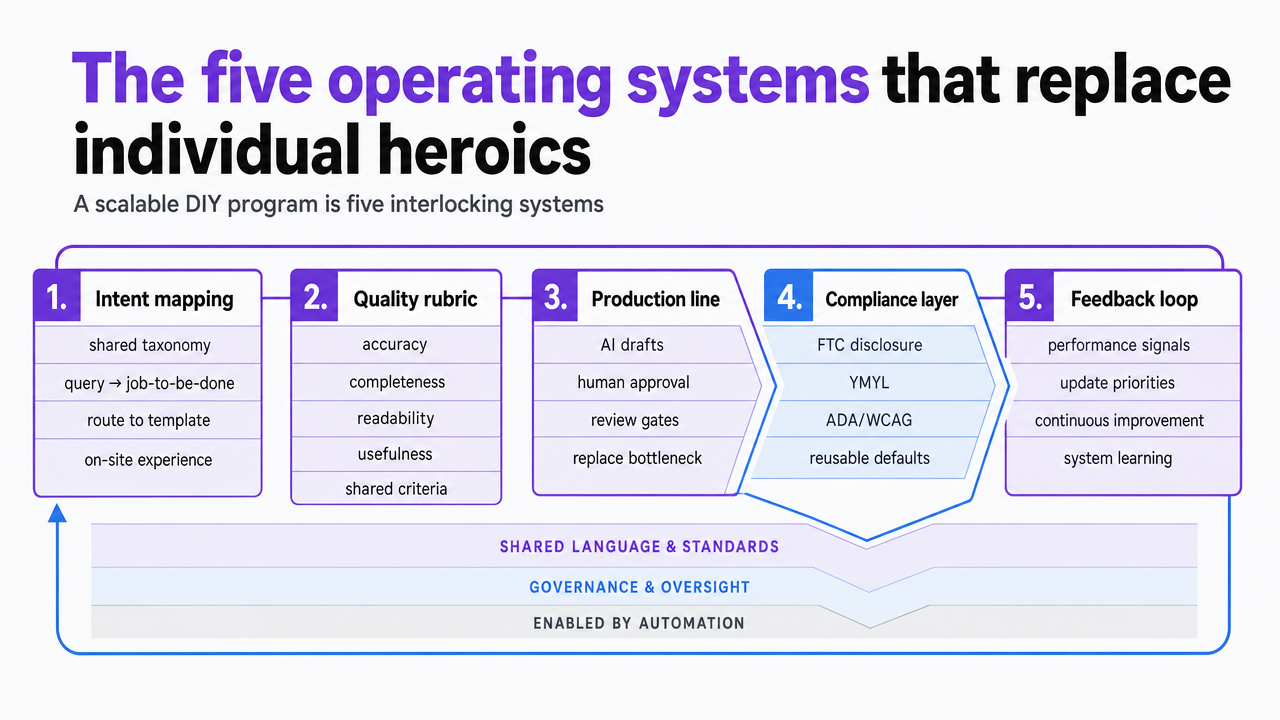 Visualize the five interlocking operating systems that structure the entire article, giving readers a mental map before diving into each system's section
System one: intent mapping that survives volume
Intent mapping as the first system
Intent mapping is where most DIY programs quietly break. A keyword list is not an intent map. It becomes one only when every target query is tagged with the job the searcher is trying to finish, the template that answers that job, and the on-site destination that converts it. Without that taxonomy, briefs drift, writers reinvent structures, and editors negotiate the same decisions on every draft.
A workable taxonomy has four columns: query, job-to-be-done, content template, and downstream destination. A query like "do it yourself SEO" belongs to a strategic-planning job, maps to a foundational pillar template, and routes to a mid-funnel resource hub. A query like "how to fix a 404 in Search Console" belongs to a task-completion job, maps to a short procedural template, and routes to a documentation index. Same domain, entirely different production requirements.
The payoff is retrieval-grade. Information-retrieval research shows that evaluation should measure "how effectively a system retrieves relevant documents while avoiding nonrelevant ones" 5. A taxonomy that binds each query to a specific job forces the same discipline at the production end: the page is built to be the relevant answer for a defined intent, not a generic essay hoping to catch traffic. When the taxonomy is written down and versioned, a second writer, a freelancer, or an AI drafter can produce a brief that matches the standard without the manager mediating every decision. That is the point at which the system starts absorbing volume instead of leaking it.
Routing organic entries to segmented on-site experiences
An intent map only earns its keep if the destinations it points to are actually differentiated. Organic entries that dump every visitor onto a single generic landing page waste the segmentation work done upstream. McKinsey's analysis of personalization finds that companies executing tailored experiences well can generate meaningful revenue lift, with some seeing 10–15% uplift when data and content adapt to who is arriving and why 11.
For a content lead, that translates into a routing layer, not a personalization engine. Each template in the taxonomy ships with a designated next step: a pillar page routes to a segmented resource hub, a comparison page routes to a decision guide, a procedural page routes to a documentation index or a scoped demo request. The routing is declared in the brief, not decided in production.
Two operational constraints keep this scalable. First, the number of destinations stays small—five to eight for most mid-size operations—so editors can hold the routing rules in working memory. Second, each destination is instrumented with its own conversion event, so the measurement loop later in the system can attribute outcomes to the intent tier, not just the URL. That instrumentation is what lets the manager defend the taxonomy to leadership when a broad-impression page ranks well but converts nothing.
Test DIY SEO Workflows With Real Content
Run a live SEO campaign and evaluate workflow impact before committing long term.
System two: a quality rubric that scales past one editor
A four-dimension quality rubric editors can actually apply
Editors cannot scale personal taste. A rubric can. Research on multidimensional information-quality assessment identifies four dimensions that map cleanly to Google's helpful-content criteria and to what a second reviewer can consistently grade: accuracy, completeness, readability, and usefulness 8. Those four columns are enough to run an editorial floor. Adding more dimensions makes the rubric harder to apply without measurably improving output.
Accuracy : Translates into concrete checks: every factual claim carries a citation, every statistic names what was measured and its scope, every expert quote is attributable.
Completeness : Asks whether the page answers the full job-to-be-done declared in the intent map — not whether it hits a word count.
Readability : Graded against the target reading level and paragraph rhythm, not a single Flesch score.
Usefulness : The hardest and most valuable: does the page let the reader finish the task or make the decision they came for?
Each dimension gets a three-point scale — meets, needs revision, blocks publish — and each score maps to a defined action. An accuracy "needs revision" routes back to the drafter with the specific claim flagged. A usefulness "blocks publish" escalates to the content lead because the brief itself is probably wrong. That routing is what turns a rubric into a system: the editor is not negotiating standards on every draft, and the drafter knows what a passing document looks like before writing it.
Applied consistently, the rubric also becomes the training signal for AI-assisted drafting later in the pipeline. The same four dimensions that grade a human draft grade a machine draft, which keeps the review gate identical regardless of who — or what — produced the first version.
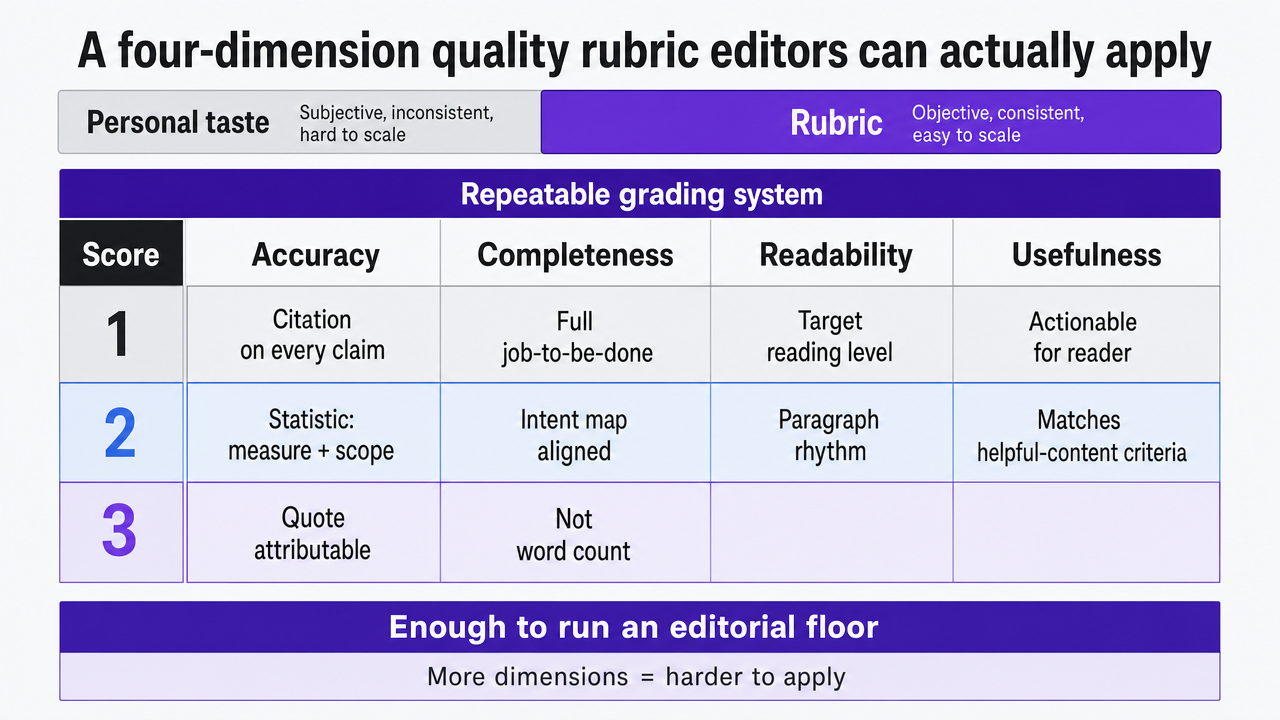 Illustrate the four-dimension rubric and its three-point scoring scale so editors and readers can visualize how the rubric turns taste into a repeatable grading system
Why thin, template-driven output degrades retrieval
The temptation, once a template library exists, is to run it hot. Spin the template, swap the keyword, ship the page. Document-quality research from the University of Massachusetts information-retrieval group shows why that shortcut fails at the ranking layer: document quality significantly affects retrieval performance, and the effect is measurable across standard evaluation metrics including precision, MAP, and MRR on TREC web collections 13. Low-quality documents do not just underperform on their own — they drag the retrieval system's judgment of the site that hosts them.
For a content lead, that finding has a direct operational consequence. Volume produced without the rubric applied is not neutral output; it is a liability that competes for the same crawl budget and internal-linking equity as the pages the team actually wants ranked. In regulated verticals, where medical-SEO research already shows that credibility and adherence to standards determine user trust more than raw visibility 7, the ceiling on thin output is even lower.
The practical rule: no template ships without the four-dimension rubric attached, and no page publishes with a blocking score in any dimension. Throughput is measured in graded pages, not drafts.
System three: a production line built around approval, not drafting
The human-approval production line
The writer-editor loop is the tightest constraint in a solo program. A drafter takes six to ten hours to produce a first pass; the editor spends two to four hours rebuilding it. Doubling output means doubling both roles. That math is what pushes managers toward agencies or new hires, and it is the wrong math to solve.
A production line built around approval inverts the sequence. AI drafts against the intent-map brief and the four-dimension rubric. A human reviewer grades the draft using the same rubric, marks blocking scores, and either approves, routes back with specific flags, or escalates a brief-level problem to the content lead. The reviewer is not rewriting from scratch. The reviewer is deciding whether the draft meets the standard the rubric already defined.
That inversion is only defensible if the review gate holds. Automated quality assessment can support reviewers but does not replace them — the multidimensional quality research is explicit that these systems help identify high-quality information, not certify it 8. The human sign-off is where accuracy claims get verified, usefulness gets pressure-tested, and the page earns its place in the crawl-budget queue.
Throughput on this line is measured in approved, rubric-graded pages per reviewer-hour. That single metric is what a content lead defends to leadership and tunes against.
When to disclose AI involvement and when to hold back
AI disclosure is not a binary policy. A 2026 study on AI-generated marketing content found that disclosure enhanced the effectiveness of functional content — the informational, task-completion pages that make up most SEO libraries — while diminishing the impact of hedonic content built on emotional resonance 12. The operational read is that disclosure practice should follow content type, not a single corporate default.
For procedural pages, comparison guides, technical documentation, and most pillar content, a visible AI-assisted note pairs with named human reviewers and expert validators. That combination signals process rigor and increases trust in the functional claim the page is making. For brand storytelling, founder narratives, and case-study interviews where authenticity carries the message, the same disclosure erodes what the content is trying to do. Those pages should either be human-authored end to end or use AI only for structural scaffolding that a named human then rewrites.
The practical rule for a content lead: declare the disclosure posture at the template level in the intent map. The brief specifies AI-drafted with disclosure, AI-scaffolded with human authorship, or human-authored only. The decision happens once per template, not per article, and the review gate confirms compliance before publish.
If you manage multiple locations: staffing math for a 20-article-per-month operation
The economics shift once a content lead is publishing across a portfolio — ten dental practices, twenty senior-living communities, a multi-market law firm. Volume requirements compound, but so does the payoff on a governed system, because the same intent map, rubric, and review gate serve every location.
The comparison below assumes a 20-article-per-month target for a mid-size operation. Writer salary, agency retainer, and reviewer-hour cost are left as reader variables — plug in local numbers. The one fixed figure is the platform subscription referenced in the closing note.
| Model | Fixed monthly cost | Variable per article | Approval-hours per article | Cost per graded article ||---|---|---|---|---|| In-house team expansion (2 writers + 1 editor) | 3 × loaded salary (variable) | 0 | 6–10 (drafting + editing) | Salary ÷ 20 || Traditional agency retainer | Retainer (variable) | Overage per article (variable) | 2–4 (brief + review) | Retainer ÷ 20 + overage || AI-assisted approval line | $599/mo platform post-trial | Reviewer-hour cost (variable) | 1–2 (rubric-graded review) | $599 ÷ 20 + reviewer time |
The defensible KPI for a CFO is cost per published, rubric-graded article — not cost per word or cost per hour. The approval line compresses the reviewer-hour count because the drafter is no longer the bottleneck, and the rubric makes the reviewer's decision consistent across locations. That consistency is what lets one content lead run twenty markets without the quality drift that typically forces a new hire at the tenth location.
System four: the compliance layer that survives volume
Compliance is where scaled programs quietly accumulate risk. One article with an undisclosed testimonial is a footnote. Two hundred articles across a portfolio, each carrying incentivized reviews, employee quotes, or repurposed social endorsements without disclosure, is an enforcement exposure that a content lead cannot fix after the fact. The compliance layer has to be built into templates, not bolted onto individual drafts.
Three standards do most of the work. The FTC endorsement guides require that material connections affecting endorsement credibility be clearly and conspicuously disclosed, a rule that applies to testimonials, expert quotes, and employee-authored reviews inside SEO content 2. The 2023 revisions tightened treatment of incentivized reviews, fake negative reviews, employee reviews, and the meaning of "clear and conspicuous" itself 3. When the same content is repurposed for social amplification, disclosure rules travel with it: the FTC's guidance for social promotions requires disclosures that are hard to miss, written in simple language, and placed with the endorsement message rather than buried in a bio 4.
Accessibility is the second standard and increasingly overlaps with page experience. ADA guidance affirms that websites must be accessible to people with disabilities 1, and WCAG 2.2 adds success criteria targeting usability for users with disabilities that also affect how search engines interpret navigation and structure 10. In regulated verticals, the third standard is YMYL: medical-SEO research finds that content credibility and adherence to domain standards remain the main determinants of user trust, regardless of ranking gains 7.
The operational move is to encode all three as template defaults. Each template in the intent map ships with a disclosure block, an accessibility checklist for headings, alt text, contrast, and focus order, and a YMYL flag that triggers named-expert review when the topic warrants it. The review gate confirms the defaults fired. Compliance stops being per-article firefighting and becomes a property of the pipeline.
See How Leading Teams Scale DIY SEO—Without Expanding Headcount
Request a walkthrough of workflow automation that enables in-house teams to deploy, track, and optimize high-volume SEO initiatives—while maintaining brand oversight and measurable impact across all channels.
System five: a measurement loop tied to retrieval-grade metrics
Precision at k as the KPI that outranks impressions
Impressions grow when a page ranks anywhere on the first ten pages. Revenue grows when it ranks in the top three. A measurement loop that treats those two outcomes as equivalent misallocates every downstream decision — which pages to refresh, which templates to retire, which briefs to reinvest in. The Stanford information-retrieval evaluation chapter is direct about which signal actually matters:
"the single most commonly used measure in information retrieval is precision at k," a metric that asks how many of the top results are relevant to the query 5.
The same chapter frames the overall goal of retrieval evaluation as assessing "how effectively a system retrieves relevant documents while avoiding nonrelevant ones" 5.
Translated into a content lead's dashboard, precision at k becomes a defensible primary KPI: for each tracked query, how many of the top three or top five results the site occupies, and how those positions convert against the destination declared in the intent map. Impressions and total clicks stay on the dashboard as diagnostic signals, not targets. A page that gains 40,000 impressions while sliding from position 4 to position 8 is losing, not winning, and the KPI should say so.
The operational discipline that follows is a monthly review that ranks pages by movement in top-three occupancy for their assigned query cluster, not by aggregate traffic. Refresh capacity flows to pages within reach of the top three. Retirement candidates are pages that have held mid-page positions for two review cycles without conversion — the exact profile the document-quality research flags as a drag on the retrieval system's judgment of the domain.
Continuous operations beat campaign bursts
Campaign thinking treats SEO as a project with a launch date. Operating-system thinking treats it as a standing function with a monthly cadence. The 2024 peer-reviewed study on SEO persistency tested five hypotheses linking sustained SEO activity to online brand positioning outcomes for entrepreneurs:
- niche differentiation
- valuable content
- targeted keywords
- scalable link building
- consistent execution
All five hypotheses returned Pearson correlations above 0.70 at p < 0.05, a uniformly strong association across every dimension measured 9. The scope is important: the study measured persistency, not intensity, and the outcome measured was brand positioning as perceived by the surveyed operators.
For a content lead, the practical read is that a steady output of rubric-graded pages, reviewed against precision at k every month, compounds in a way that quarterly campaign pushes do not. The measurement loop should be built to survive a slow month without triggering a strategy reset. The dashboard shows twelve-week rolling movement in top-three occupancy, refresh coverage against the intent map, and cost per graded article. Those three numbers, reviewed on a fixed cadence, are what a content lead defends when leadership asks whether the program is working — and what a platform like Vectoron is built to keep running without adding headcount.
Running the system: what the manager actually does on Monday
The operator's week has a shape. Monday morning is not for writing. It is for reading the three numbers the measurement loop produces: twelve-week rolling movement in top-three occupancy, refresh coverage against the intent map, and cost per graded article. Pages within reach of the top three get refresh briefs cued for the production line. Pages holding mid-page positions for two review cycles without conversion get retirement flags, because thin output drags the retrieval system's judgment of the whole domain 13.
By midweek, the content lead is grading, not drafting. Approvals move through the rubric, blocking scores route back with specific flags, and brief-level problems escalate before they consume reviewer hours. Compliance defaults — disclosure blocks, accessibility checks, YMYL flags — are confirmed at the gate rather than debated per article.
That is what DIY SEO looks like when it stops depending on individual heroics. The manager owns the system. A platform like Vectoron runs the pipeline underneath it.
Frequently Asked Questions
References
- 1.Guidance on Web Accessibility and the ADA.
- 2.Guides Concerning the Use of Endorsements and Testimonials in Advertising.
- 3.Revised FTC Endorsement Guides.
- 4.Disclosures 101 for Social Media Influencers.
- 5.Evaluation in Information Retrieval.
- 6.Search Engine Optimization (SEO) and Content Strategy in Health Information Websites.
- 7.Search Engine Optimization and Evaluation of Web Content in Medical Contexts.
- 8.Online Health Search Via Multidimensional Information Quality Assessment Based on Deep Language Models: Algorithm Development and Validation.
- 9.Search engine optimisation (SEO) strategy as determinants to enhance online brand positioning.
- 10.W3C WCAG 2.2 Now Available.
- 11.The future of personalization—and how to get ready for it.
- 12.Value-dependent and empathy-mediated: how artificial intelligence–generated marketing content affects customer engagement behaviors.
- 13.untitled.