
Key Takeaways
- Operating SEO for pipeline means running four connected layers: demand sensing tied to CRM intent, content built for ranking and citation, conversion architecture that preserves query context, and attribution beyond clicks.
- Awareness queries reward accumulated topical authority while decision queries reward tight relevance, so content queues and production standards should be separated rather than optimized against search volume alone 1.
- In healthcare, behavioral health, dental, and legal, claims substantiation, endorsement rules, and HIPAA-scoped tracking belong inside the SEO brief so approvals move faster and exposure stays contained 4, 5, 6.
- Replace the sessions chart with branded query volume, decision-stage direct entries, assisted-conversion paths, and win rate on inbound organic opportunities segmented by prior content engagement.
Search Became a Revenue System, Not a Traffic Channel
The question "what does it mean to do SEO" has a different answer in 2026 than it did five years ago. For a VP of marketing being asked by a CFO whether organic search still earns its budget, the honest answer is that SEO stopped being a traffic channel the moment buyers stopped needing to click to get answers. Forrester's 2025 Buyers' Journey Survey found that 94% of business buyers used AI in their buying process, and twice as many identified generative AI or conversational search as a meaningful source as identified any other source 2. Clicks are no longer the primary unit of exposure.
That shift reframes the discipline. Doing SEO for pipeline growth means operating organic search as a revenue system with four connected layers:
- Demand sensing that reads buying intent inside queries
- Authoritative content built to be both ranked and cited inside AI answers
- Conversion architecture that routes qualified intent into the CRM as identifiable opportunities
- Attribution that measures branded demand, assisted conversions, and sales-cycle influence rather than sessions alone
Teams that still report SEO as traffic will keep watching that number soften while the underlying buying activity grows invisible to them. Teams that rebuild SEO as a pipeline system gain a compounding advantage, because vendor preference now forms before a buyer ever submits a form. The rest of this piece lays out how that operating model works, where it changes in regulated verticals, and what to count when the old scorecard stops telling the truth.
The Zero-Click Shift That Forces a New Operating Model
Two Forrester data points, one year apart, describe the behavioral change that every in-house SEO program now has to answer for. In its 2024 Buyers' Journey Survey, Forrester found that 89% of B2B buyers used generative AI tools at every stage of the purchase process 3. In its 2025 Buyers' Journey Survey, 94% of business buyers used AI during their buying process, and twice as many buyers identified generative AI or conversational search as a meaningful source as identified any other source 2. Both are self-reported survey figures, scoped to business buyers Forrester panels, and both describe the same trajectory: AI-assisted research is now the default, not the exception.
The operational consequence is specific. A query that once produced a session on the vendor's site now often produces an answer inside an AI interface, with the vendor's content either cited, paraphrased, or omitted entirely. The buyer may still convert, but the first ten touches that shaped their shortlist are invisible to Google Analytics. Teams that score SEO by sessions are watching the wrong instrument.
This changes what the SEO function is responsible for producing. Rankings still matter, because citations inside AI answers draw disproportionately from top-ranked, well-structured, authoritative pages. But the deliverable expands from "traffic to the site" to "presence inside the research surface the buyer actually uses." That includes being quoted in AI summaries, being named in third-party comparison content, appearing in review sites and vendor directories, and being retrievable by name once the buyer does arrive on the site.
It also changes the measurement contract with the executive team. If the CFO is still being handed a sessions chart, the SEO conversation will keep looking like a losing one even when branded search, direct traffic, assisted conversions, and win rates for inbound opportunities are rising. The operating model has to be rebuilt around what buyers now do, not around what the analytics platform happens to count.
The Four Layers of a Pipeline-Grade SEO Operation
Demand Sensing: Reading Intent Before It Reaches a Form
Demand sensing is the discipline of reading what a query reveals about where a buyer sits in their decision and how much weight that query deserves in the content plan. Most keyword lists collapse this into a single axis—search volume—and then wonder why high-volume pages produce traffic but not opportunities. The empirical work on keyword selection says that is the wrong axis to optimize against.
A peer-reviewed Journal of Retailing study on keyword selection in SEO analyzed query popularity, competition, specificity, intent, content relevance, and online authority against organic-click data. It found that online authority is the key driver of organic clicks during awareness-stage searches, while content relevance becomes the dominant driver when consumers move closer to purchase 1. The two stages respond to different signals, and treating them as a single optimization problem under-serves both.
For an in-house team, that asymmetry has a direct operational consequence. Awareness-stage queries—broad category terms, early problem framing, educational questions—reward sites that have accumulated topical authority across the category. Decision-stage queries—feature comparisons, pricing frameworks, vendor evaluations, implementation questions, vertical-specific use cases—reward pages whose relevance to the specific question is tight and unambiguous.
A defensible demand-sensing layer therefore does three things:
- It tags every tracked query by stage, not just by volume.
- It separates the authority-building queue (where the goal is category coverage and link acquisition over time) from the relevance-building queue (where the goal is precision pages that match a narrow intent).
- It reconciles those queues against the CRM, so that queries which precede booked opportunities—personal injury consultation requests, behavioral health intake calls, dental new-patient bookings, home services dispatches—are weighted above queries that merely produce sessions.
Demand sensing is where the pipeline model starts, because everything downstream inherits the quality of this prioritization.
Authoritative Content Built for Ranking and Citation
The content layer has two jobs now. It still has to rank, because ranking remains the entry criterion for being pulled into AI summaries, featured snippets, and third-party research. It also has to be structured so that an AI system can extract a defensible answer and attribute it. Pages that rank but cannot be cleanly quoted lose the second battle even when they win the first.
That changes how briefs are built. Claims need to be stated as discrete, verifiable sentences rather than buried in narrative. Definitions, comparisons, numbers, and procedures benefit from being placed near the heading that frames them, so an extraction model can resolve the question without context-hopping. Sources should be named inline. Author expertise should be stated plainly, with credentials that match the subject.
The authority dimension is cumulative and cannot be shortcut. For a dental services organization expanding into a new metro, a personal injury firm opening a satellite office, or a behavioral health group launching an adolescent program, the site has to demonstrate category depth before any single page in that cluster will carry weight. That means publishing the supporting pieces—the sub-topic explainers, the clinical or procedural detail, the local context—before expecting the hero page to perform. Google and generative models alike reward sites whose coverage of a topic looks complete rather than opportunistic.
Two practical standards hold up this layer. First, every page should answer one question completely rather than three questions partially. Second, every claim that would survive scrutiny from a legal reviewer, a clinical reviewer, or a competing vendor should be written to that bar from the first draft, not retrofitted later. Content built for citation is also content that holds up under evaluation.
Conversion Architecture: Routing Qualified Intent Into the CRM
Conversion architecture is the layer most teams under-invest in, because it sits between content and sales and tends to be owned by neither. It covers the paths a qualified visitor can take once they arrive, the data captured along those paths, and the handoff that makes the resulting opportunity visible to revenue systems.
The design question is not "what CTA should this page have." It is "what identifiable action proves intent for this query, and how does that action land in the CRM with enough context for sales to act on it."
- For a personal injury firm, that might be a call with intake qualification fields logged against the originating landing page.
- For a behavioral health intake team, it is a verified request routed to the correct level of care.
- For a DSO, it is a new-patient booking with the specific service and location captured.
- For a home services operator, it is a dispatch request with job type, address, and source attribution attached.
Three elements decide whether this layer produces pipeline or vanity leads:
- Form and call capture need to carry the originating query, page, and campaign through to the CRM record, not strip them at the gateway.
- Routing logic needs to send qualified intent to the right human quickly—minutes, not hours—because the preference formed during research decays once a competitor responds first.
- Disqualified traffic needs its own path, so that intake teams are not evaluating the same leads sales already rejected.
Conversion architecture is where SEO stops being a marketing report and starts being a revenue input.
Attribution Beyond Clicks: Branded Demand, Assists, and Sales-Cycle Influence
Attribution is the layer where the old scorecard breaks hardest. If a team measures SEO by sessions and keyword rankings alone, the picture will keep darkening even as the underlying buying activity grows. The replacement is not more sophisticated last-click modeling. It is a wider set of indicators that match how buyers actually decide.
Forrester's 2025 Buyers' Journey Survey found that 68% of B2B buyers had a front-runner at the beginning of the journey, and the preferred vendor won 80% of the time 9. That is the empirical case for measuring early visibility as a leading indicator of pipeline, not a soft brand metric. If organic content, review presence, comparison coverage, and expert visibility shape the shortlist weeks or months before a form is submitted, the attribution system has to be able to see that influence.
Four indicators carry the load:
- Branded search volume—queries that include the firm, practice, or location name—measures whether earlier touches drove recognition.
- Direct and dark-social traffic to decision-stage pages measures whether buyers who already know the brand are returning to validate it.
- Assisted-conversion paths in the CRM measure which organic pages appeared in the touch sequence before a closed opportunity, even when they were not the last click.
- Win rate on inbound organic opportunities, segmented by whether the account showed prior content engagement, measures whether SEO is producing better opportunities or just more of them.
These four, reported together, let an in-house team defend SEO as a pipeline system even in quarters when session counts fall. They also give the CFO something more honest than a traffic chart: a view of whether the research surface the buyer actually uses is still showing the firm's work.
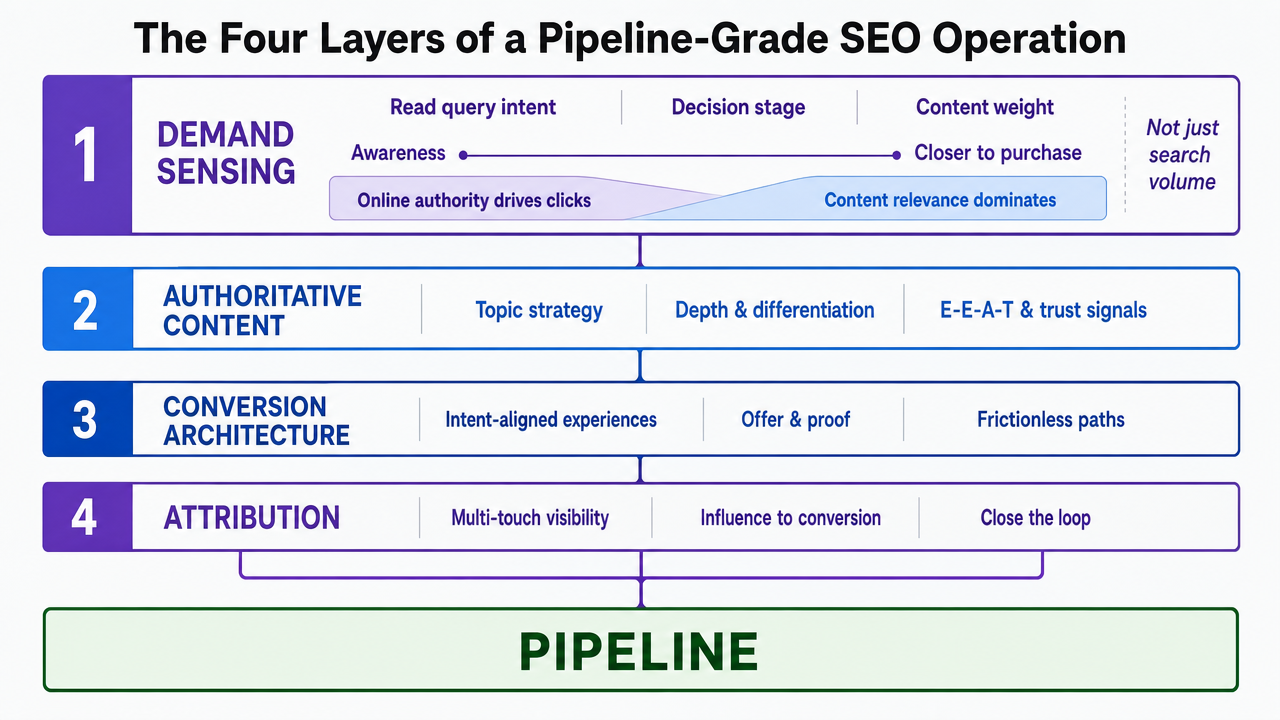 Visualize the four connected operating layers introduced in this section so readers can see how demand sensing, authoritative content, conversion architecture, and attribution flow into pipeline
Test AI-driven SEO execution on live campaigns
Experience measurable SEO improvements and content impact on your actual pipeline risk-free for seven days.
Writing for a Buying Committee, Not a Persona
Persona documents assume one reader. B2B buying does not. Forrester's commentary on its 2025 Buyers' Journey Survey reports that 73% of purchases involve three or more departments, with an average of 13 internal and nine external participants in the decision 10. SEO content that speaks to a single "ideal customer" leaves the other 21 people to assemble their own understanding from competitors, review sites, and AI summaries.
The planning consequence is that a buying-stage topic is rarely one page. A behavioral health group evaluating an EHR needs clinical leadership to see workflow fit, finance to see total cost and billing integration, compliance to see HIPAA posture, and the clinicians who will use it daily to see interface detail. A personal injury firm's intake platform decision pulls in managing partners, intake supervisors, IT, and often outside counsel on data handling. One hero page cannot carry all four reads.
Mapping content against this reality means producing stakeholder-specific companion pieces around each decision-stage topic: a procurement-oriented summary, a technical or clinical deep-dive, a compliance brief, and an operator view. Each one targets different queries, each one gets cited inside a different AI research path, and each one gives the internal champion something to forward. The goal is not more content. It is coverage that matches how the decision actually travels through the organization.
High-Stakes Verticals: Where Doing SEO Is Operationally Different
In healthcare, behavioral health, dental, and legal, the SEO operating model carries constraints that generic B2B playbooks ignore. Content is advertising. Analytics touch regulated data. Reviews and testimonials are governed. Each of these reshapes how an in-house team builds, publishes, measures, and routes organic work.
Start with claims. The FTC treats health-related statements as advertising subject to competent and reliable scientific evidence, and advertisers remain responsible for the testimonials and expert endorsements they publish online 4. For a behavioral health group describing outcomes for an adolescent program, a DSO page explaining a restorative procedure, or a wellness brand making a benefit claim, the content brief has to carry substantiation requirements from the first draft. Retrofitting evidence after publication is slower, more expensive, and leaves a window of exposure.
Endorsements and reviews sit under the same regime. The FTC's Endorsement Guides require that endorsements reflect the endorser's honest opinion, that unsupported claims cannot be made through a testimonial that could not be made directly, and that material connections be disclosed clearly 6. Patient stories, attorney case summaries, influencer mentions, and employee-authored expert bios all fall inside that frame. Review generation programs run across multiple locations need a central governance owner, not an at-will local practice.
Analytics and conversion tracking carry a separate obligation. HHS has stated that regulated entities must configure tracking technologies on authenticated pages so that any use or disclosure of protected health information complies with the HIPAA Privacy Rule, and that electronic protected health information must be secured under the Security Rule 5. For an SEO program, that means pixel deployments, call tracking, chat tools, form captures, and remarketing audiences need to be scoped against what data they touch, where that data flows, and whether a business associate agreement governs it. The decision is not whether to measure; it is which measurement surface is lawful on which page.
Credibility sits next to compliance. A 2025 peer-reviewed comparison of Google, Bing, ChatGPT, and Gemini on consumer health questions, using DISCERN and JAMA Benchmark Criteria, found that Google achieved the highest mean credibility scores while ChatGPT scored lowest, and all platforms produced content above recommended reading levels for public health information 7. For a behavioral health intake page or a dental procedure explainer, that argues for named clinical reviewers, transparent sourcing, readable prose, and visible update dates. These are ranking factors and trust factors at the same time.
The operational takeaway is a single governed workflow. Claims substantiation, endorsement review, tracking configuration, and clinical or legal sign-off belong inside the SEO production path, not downstream of it. Teams that treat compliance as a late-stage gate ship slower and publish weaker pages. Teams that build it into the brief publish faster because approvals have fewer surprises.
See How AI-Led SEO Drives Predictable Pipeline—Without Team Expansion
Request a walkthrough of coordinated, data-driven SEO execution that aligns with enterprise pipeline targets—eliminating manual bottlenecks and vendor complexity while maintaining full oversight.
If You Operate Multiple Locations: Shared Authority, Local Conversion
The Economics of Centralized SEO Versus Per-Location Programs
For multi-location operators—DSO networks, law firm groups with satellite offices, behavioral health systems running regional programs, home services franchises, senior living portfolios—the SEO cost structure is different from the single-site case, and the per-location model is almost always the more expensive one.
Authority is the shared asset. A page that establishes the brand as a credible source on a procedure, a legal practice area, or a care model earns ranking and citation weight that every location inherits. Running separate SEO programs per location fragments that asset. Each location's agency or in-house effort rebuilds the same category explainers, the same clinical overviews, the same procedure pages, with no compounding across the portfolio.
The variables that decide the economics are concrete:
- Cost per qualified lead per location
- Number of locations
- Content units reused across markets
- Review-and-approval cycle time per published asset
A centralized program amortizes one authoritative asset across every market; a per-location program multiplies production cost by location count and still produces weaker individual pages because none of them inherits portfolio-level authority.
What stays local is conversion. Service menus, intake hours, insurance acceptance, provider rosters, booking paths, and call routing belong to the location, not the hub. The economic model that works is shared category content at the top, local relevance and conversion architecture at the bottom.
Governance: Reviews, Claims, and Tracking Across the Portfolio
Governance is where portfolio SEO breaks when it is left to each location. Three obligations have to sit with a central owner.
Review and testimonial programs need one policy across every market. The FTC's Endorsement Guides require honest opinions, disclosed material connections, and no claims through a testimonial that the brand could not substantiate directly 6. Twenty locations running twenty review programs produce twenty exposure surfaces.
Claims substantiation belongs in one briefing library. When a procedure page, outcome statement, or service description is approved once with evidence attached, every location publishes from the same vetted source rather than drafting local variants that drift from the substantiation on file 4.
Tracking configuration is the third. Pixel deployment, call tracking, and form capture scoped against HIPAA obligations cannot vary by location without creating risk the portfolio owner inherits anyway 5. One governed configuration, applied uniformly, is the only workable posture.
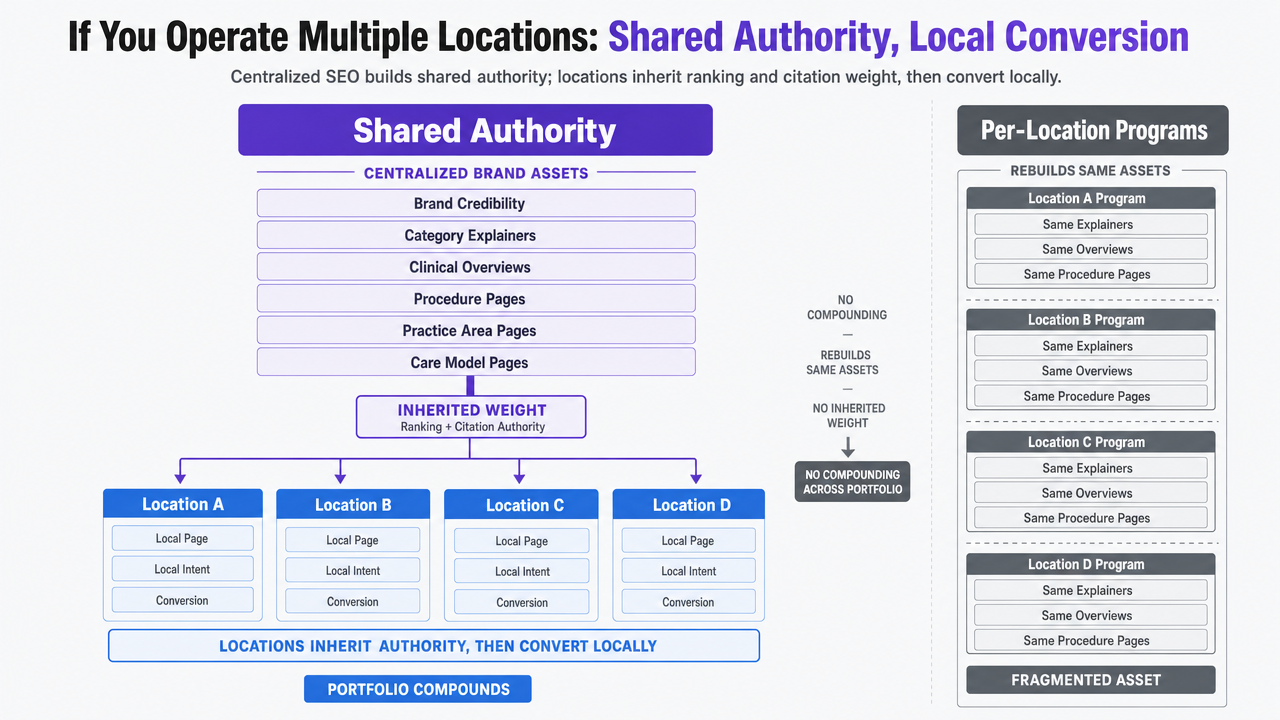 Illustrate the centralized-authority vs. localized-conversion operating model described in this section as a governance framework
What to Count When Clicks Decline but Influence Rises
A scorecard that measures only what the analytics platform happens to count will under-report pipeline every quarter that buyer behavior keeps shifting toward AI-assisted research. The replacement is not more dashboards. It is a smaller set of indicators the executive team can read in one page and the SEO team can act on in one week.
Four counts carry the weight:
- Branded query volume, segmented by location or practice area, shows whether upstream content and visibility are producing recognition that returns later as direct demand.
- Decision-stage page entries from direct and referral sources show whether buyers who already know the brand are coming back to validate it before contacting sales.
- Assisted-conversion paths in the CRM show which organic pages touched a closed opportunity, even when a form submission came through a different channel.
- Win rate on inbound organic opportunities, split by whether the account had prior content engagement, shows whether SEO is producing better-qualified pipeline, not just more of it.
Two context lines belong next to those counts. Share of voice inside AI answers for the queries that matter most, tracked by sampling the same prompts on a schedule. And citation presence in third-party comparison content, review surfaces, and vertical directories, where buyers increasingly form their shortlist before any vendor site is visited.
The reporting discipline is to show these together, every month, with the same definitions. When clicks decline but branded search, decision-page returns, assisted conversions, and win rate hold or rise, the pipeline system is working as designed. That is the honest answer to the CFO's question, and it is the one the old scorecard cannot produce.
Frequently Asked Questions
References
- 1.Keyword Selection Strategies in Search Engine Optimization.
- 2.B2B Buyers Make Zero-Click Number One.
- 3.Shifting Search Behaviors Demand Smarter Content Strategies.
- 4.Health Products Compliance Guidance.
- 5.Use of Online Tracking Technologies by HIPAA Covered Entities and Business Associates.
- 6.FTC’s Endorsement Guides: What People Are Asking.
- 7.The Reliability Gap: How Traditional Search Engines and Generative AI Platforms Compare in Consumer Health Information.
- 8.Health Products Compliance Guidance.
- 9.B2B Buyer Vendor Preferences Are Durable Across All Purchase Types.
- 10.Three Realities About B2B Buying Networks.