
Key Takeaways
- Modern SEO organizes around four load-bearing elements—Accessibility, Helpfulness, Eligibility, and Surface Control—each with a named owner, a measurable artifact, and a Search Console reporting surface.
- Core Web Vitals thresholds (LCP under 2.5s, INP under 200ms, CLS under 0.1) gate downstream performance, and structured data changes result eligibility rather than raising rankings 2, 4.
- AEO/GEO tactics like llms.txt files, content chunking, and unsupported schema variants are called out as unnecessary; foundational SEO with original, practitioner-sourced content is what earns AI-surface visibility 7.
- Multi-location programs should consolidate vendors into one workflow, enforce editorial briefs that require original inputs per page, and assign the AI-visibility policy directly to the VP of Marketing 3, 8.
Why the Old Elements List No Longer Describes the Work
Ask ten marketing leaders to list the elements of SEO and most will recite the same inventory: keywords, backlinks, meta tags, page speed, mobile-friendliness, internal links. That list is not wrong. It is incomplete in a way that quietly costs pipeline.
Google's own documentation has moved on. The Search Engine Optimization Starter Guide still frames SEO as helping search engines understand content and helping users find sites, but it now sits alongside a distinct guide for generative AI features that treats AI visibility as an extension of foundational SEO rather than a separate discipline 1, 6. A second 2026 document tells site owners exactly how to appear in, or opt out of, AI Overviews and generative UI in Search 8. Answer formats are being generated on the fly 11. Meanwhile, spam policy explicitly covers attempts to manipulate generative AI responses and the scaled content patterns common in multi-location publishing 3.
None of that fits a checklist. It fits a system.
This article reorganizes the elements of SEO around four load-bearing components that map to how Google actually evaluates and surfaces content in 2026: Accessibility, Helpfulness, Eligibility, and Surface Control. Each has an owner, a measurable artifact, and a reporting surface. Treated as separate workstreams, they produce coordination drag. Operated as one workflow, they produce predictable organic pipeline.
The Four Load-Bearing Elements of Modern SEO
Accessibility: What Google Can Reach, Render, and Rank
Accessibility is the physical layer of SEO: whether Googlebot can crawl a URL, whether the browser can render it fast enough for a human to use, and whether the markup gives the crawler an unambiguous read of what the page is about. Google's Starter Guide still leads with this: descriptive titles, clean site structure, useful internal links, and images and videos that machines can parse 1. None of it is glamorous. All of it gates everything downstream.
The measurable half of accessibility now lives in Core Web Vitals. Google publishes three numeric thresholds for a page to fall in the "good" band: Largest Contentful Paint under 2.5 seconds, Interaction to Next Paint under 200 milliseconds, and Cumulative Layout Shift under 0.1 2. Pages that miss any of the three drop into "needs improvement" or "poor," which correlates with weaker Search performance and, more importantly for a VP, weaker on-page conversion.
Treating CWV as a ranking mystery misses the point.
LCP : describes how quickly the main content shows up.
INP : describes how quickly the page reacts when a user taps a button or fills a form field.
CLS : describes whether elements jump around under the cursor.
Each maps directly to whether a lead completes an intake form or bounces to a competitor result.
The operating implication is unglamorous. The engineering team, not the content team, owns the accessibility element. The artifact is the Core Web Vitals report in Search Console. The review cadence is monthly at minimum, and any release that regresses LCP, INP, or CLS on a money template, such as a location page, service page, or intake form, gets flagged before the next content push. Content quality cannot compensate for a page the browser cannot paint.
Helpfulness: The Quality Bar That Replaces Keyword Density
Helpfulness is the element most often mistranslated inside marketing organizations. Google's Creating Helpful, Reliable, People-First Content guidance asks a specific question of every page: does it provide original information, substantial coverage, and value beyond copying or rewriting other sources 5. That is a content-operations standard, not a keyword instruction.
Two clarifications matter for a VP-level operating model. First, E-E-A-T (experience, expertise, authoritativeness, trust) is a quality concept Google uses to describe what helpful content looks like, not a slider inside the ranking system that a team can tune directly 5. Author bios, credentials, and citations matter because they make content demonstrably trustworthy to a reader, not because a schema field for "expertise" moves a URL up the results page. Second, the helpfulness bar has replaced keyword density as the decisive input. Coverage, originality, and clear sourcing outweigh term frequency on any page competing for informational or commercial-investigation queries.
The pipeline consequence is concrete. A 900-word service page that says the same thing every competitor says will underperform a 900-word page that includes original information the reader cannot get elsewhere: pricing ranges the business actually charges, a decision framework from a named practitioner, an intake process explained step by step, or outcome data from the business's own book. Google's helpful-content guidance explicitly frames "value beyond copying or rewriting" as the bar 5.
Ownership sits with the content team, and the artifact is the editorial brief. A defensible brief specifies the original inputs required, names the practitioner or subject-matter expert providing them, and blocks publication until those inputs are in the draft. The measurement surface is Search Console performance by query and page, filtered to pages carrying original inputs versus pages that do not. The delta tends to be visible within one to two review cycles and is more predictive of pipeline than any keyword-difficulty score.
Eligibility: Structured Data as a Visibility Contract, Not a Ranking Trick
Structured data is where marketing teams most often confuse cause and effect. Google's supported markup gallery is explicit: structured data helps Google understand a page and can qualify it for richer appearances in results, such as review stars, FAQs, event details, product data, or business information 4. It does not raise rankings. It changes eligibility for how a result presents when it does rank.
The eligibility chain has four links, and each is a gate.
- The markup must be present on the page and use a supported type from Google's gallery 4.
- The markup must accurately reflect what the page actually contains; Google's completeness policy warns against marking up irrelevant or misleading content and requires that structured data represent the page truthfully 10.
- The page and its markup must comply with the broader structured data policies, including freshness and completeness requirements 10.
- Even when all three conditions are met, a rich result is never guaranteed—Google decides, at query time, whether to render one 4.
That framing changes how a VP funds this work. Structured data is not a ranking lever a technical vendor can pull for lift. It is a visibility contract that keeps a page eligible for the richest available appearance. Broken or misleading markup can disqualify a page from rich results entirely, and in cases of misrepresentation, invite manual action.
The operational answer is to standardize a small set of schemas per template—Organization and LocalBusiness for brand and location pages, Service and FAQPage where the page actually contains those elements, Article or BlogPosting for editorial—and validate them on every deploy. The owner is engineering with editorial review. The artifact is a schema map per template. The measurement surface is the Search Console rich results and enhancement reports, reviewed alongside the performance report so that eligibility gains are tied to actual click and impression changes.
Surface Control: Managing Visibility in AI Overviews and Generative UI
Surface control is the newest element and the one most VPs are still learning to own. Google now provides site owners with explicit controls that determine whether a site appears in, and helps ground, generative AI features on Search, and Google reports on that visibility separately from traditional web results 8. This is no longer a philosophical debate about AI Overviews; it is a settings decision with measurable consequences.
The tradeoff is binary and worth stating plainly. Appearing in generative AI Search features preserves impressions and traffic from those surfaces, at the cost of less control over how content is summarized alongside competitors. Opting out means zero traffic and zero impressions from those AI features, in exchange for keeping content out of AI-generated summaries entirely 8. There is no middle setting that captures the impressions without accepting the summarization.
For most service businesses that depend on organic pipeline, opting out is the more expensive decision. It removes the site from a surface where the query volume is already flowing and where competitors will continue to appear. For a small number of publishers—those whose value is in the raw content itself rather than in converting a click into a booking—the calculation may reverse. The point is that a VP has to make the call deliberately, document it, and revisit it as reporting matures.
Google's own AI optimization guidance reinforces that the way to earn visibility inside those surfaces is not a new tactic stack. It is the same foundational SEO already described in this article: original, helpful content, technical clarity, and Search Console monitoring, extended to include the AI features report 7. Tactics being sold as AI-specific requirements, such as llms.txt files or content chunking rewrites, are called out in that guide as unnecessary 7.
Ownership of the surface-control element sits with the VP of Marketing directly, not delegated to a vendor. The artifact is a written visibility policy specifying which properties appear in AI features and why. The measurement surface is the AI features section of Search Console, reviewed on the same cadence as the performance report so that any shift in AI-mediated impressions is visible before it shows up in booked pipeline.
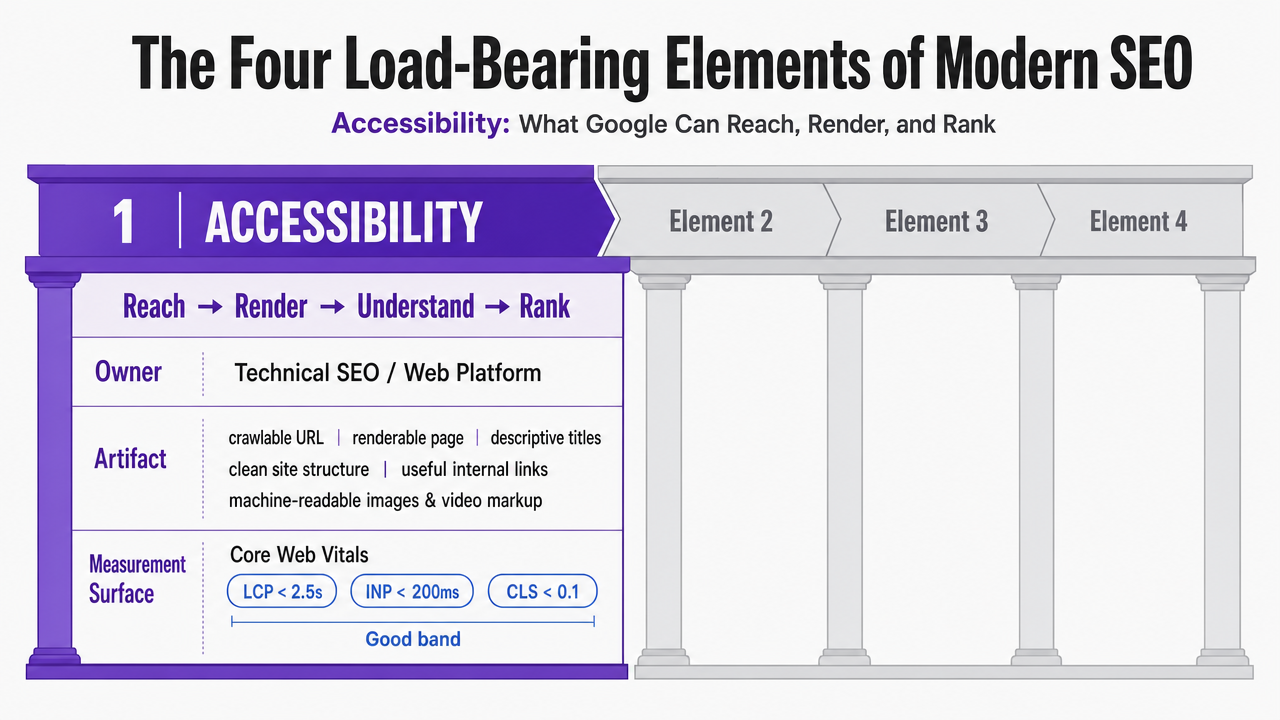 Visualize the four load-bearing elements framework introduced in this section, showing each element's owner, artifact, and measurement surface as described in the article prose
Experience AI-driven SEO execution firsthand now
See measurable SEO impact by publishing real campaigns during your free trial—no delays, no restrictions.
What Google Endorses vs. What the AEO/GEO Market Sells
A cottage industry has grown up around "answer engine optimization" and "generative engine optimization," and much of what it sells contradicts what Google actually documents. The gap is worth walking through because a VP funding an SEO program in 2026 will be pitched both stories, often by the same vendor, and the invoices are not small.
Google's AI optimization guide is direct: continue prioritizing foundational SEO best practices, and skip tactics such as chunking content into AI-friendly blocks or publishing llms.txt files as a route to visibility inside generative AI features 7. The companion blog post reinforces the same position, describing valuable, unique, non-commodity content as the input that earns visibility in AI surfaces, and framing SEO best practices as foundational to generative AI features rather than superseded by them 6.
Set that against a typical AEO/GEO deliverables list:
- Rewrite pages into short answer blocks.
- Publish an llms.txt manifest.
- Restructure headings for extractability.
- Add "AI-ready" schema variants Google does not support.
The first three items are explicitly called unnecessary in the AI optimization guide 7. The fourth conflicts with structured data policy, which requires markup to reflect a supported type and represent the page accurately or risk disqualification 10.
Two claims from vendor decks deserve specific scrutiny. Any promise to "guarantee" citation inside AI Overviews is unsupportable; Google decides at query time whether to generate an AI response and which sources ground it 11. And any tactic framed as manipulating what a generative AI response says about a brand runs directly into spam policy, which now covers attempts to manipulate generative AI responses in Search 3.
The endorsed work is the same work already described in this article. The unendorsed work is the extra invoice.
Operating the Four Elements as One Workflow
Owners, Artifacts, and the Search Console Measurement Plane
The four elements fail as separate workstreams because their measurement surfaces overlap in one place: Search Console. Engineering owns Accessibility, but its Core Web Vitals report reads the same URLs the content team is publishing against the helpful-content bar 2, 5. Structured data eligibility shows up in enhancement reports on those same URLs 4. AI features visibility now reports on them too 8. When four vendors each pull their own slice of that data on their own schedule, the delay between a signal appearing and a decision getting made is where pipeline goes missing.
A workable operating model assigns one artifact per element and forces them onto a shared review:
- Accessibility owns a CWV dashboard filtered to money templates: location pages, service pages, and intake forms.
- Helpfulness owns an editorial brief that names the original inputs and the practitioner supplying them 5.
- Eligibility owns a schema map per template validated on deploy 4, 10.
- Surface Control owns a written AI-visibility policy stating which properties appear in generative AI features and why 8.
The review cadence is monthly, and it happens against one export from Search Console rather than four vendor decks. A regression in INP on a service page, a drop in impressions on a page that lost its FAQ rich result, and a shift in AI features impressions on the same URL are three symptoms of the same operating problem. Reviewing them together compresses the decision cycle from weeks of vendor coordination to a single approval loop the VP already runs.
AI-Assisted Content Without Tripping Spam Policy
Google's position on AI-assisted content is conditional, not permissive. Appropriate use is not against guidelines, but automation used primarily to generate content at scale for the purpose of manipulating rankings is a spam violation 9. The spam policies extend that principle to scaled content abuse and site reputation abuse, both of which are especially exposed for multi-location publishing programs that spin up hundreds of near-duplicate location pages 3.
The line a VP has to defend is the one between assistance and manufacturing. AI drafting a section a practitioner then edits, fact-checks, and signs off on meets the helpful-content bar if the final page carries original information the reader cannot get elsewhere 5. AI generating template pages at volume with no practitioner input, no original data, and no editorial gate does not. The difference is not the tool. It is the presence of a named human owner and an approval step before publication.
The operational safeguard is a governed workflow: every AI-assisted draft routes through the same editorial brief that names the original inputs, and nothing publishes without sign-off. Platforms built around approval-first automation, including Vectoron, exist because that gate is easier to enforce inside a single workflow than across a stack of disconnected tools.
See How AI-Driven SEO Elements Deliver Pipeline Consistency
Request a walkthrough of unified, approval-first SEO execution that eliminates manual bottlenecks and produces measurable, channel-spanning impact for agencies and enterprise teams.
If You Manage Multiple Locations, Practices, or Brands
The four-element model tightens when a single property is in play. It strains when the same VP owns 40 location pages across a DSO, 12 practice sites under a behavioral health group, or a franchise map of home-services brands. The strain is not editorial. It is coordination.
Two Google policies deserve specific attention at this scale. Scaled content abuse and site reputation abuse are named in the spam policies, and both target patterns common in multi-location publishing: near-duplicate pages generated at volume with no original input, and third-party or partner-produced content published under a stronger domain's authority 3. A location-page factory that outputs 200 service pages with swapped city names and stock language sits inside the pattern the policy describes. So does a group site that hosts partner-written content trading on the parent brand's reputation.
The helpful-content bar applies to every one of those pages individually. Original information, substantial coverage, and value beyond copying or rewriting other sources is the standard for a single URL, and it does not soften because a page is one of 300 5. The operational answer is not fewer pages. It is a brief that forces original inputs per location: the named practitioner, the intake process at that office, the pricing range that office actually charges, and the outcome data from that book.
Coordination is where multi-location programs bleed margin. A typical stack runs a technical SEO vendor, a content agency, a structured-data contractor, and an analytics partner, each with its own review cycle and its own slice of Search Console. The variables that determine whether that stack is sustainable are countable:
| Operating variable | Separate vendor stack | Unified element workflow |
|---|---|---|
| Vendor count | 3–4 | 1 |
| Approval touchpoints per page | Multiple, per vendor | One, per brief |
| Review cycle length | Weeks across decks | Monthly, one export |
| Owner of AI-visibility policy | Often unassigned | VP of Marketing 8 |
The stack does not fail because any single vendor is weak. It fails because a regression in INP on a service template, a lost FAQ rich result on a location page, and a shift in AI features impressions on the same URL surface in three different meetings, run by three different owners, on three different schedules 2, 4, 8. By the time the pattern is visible, the pipeline delta already landed.
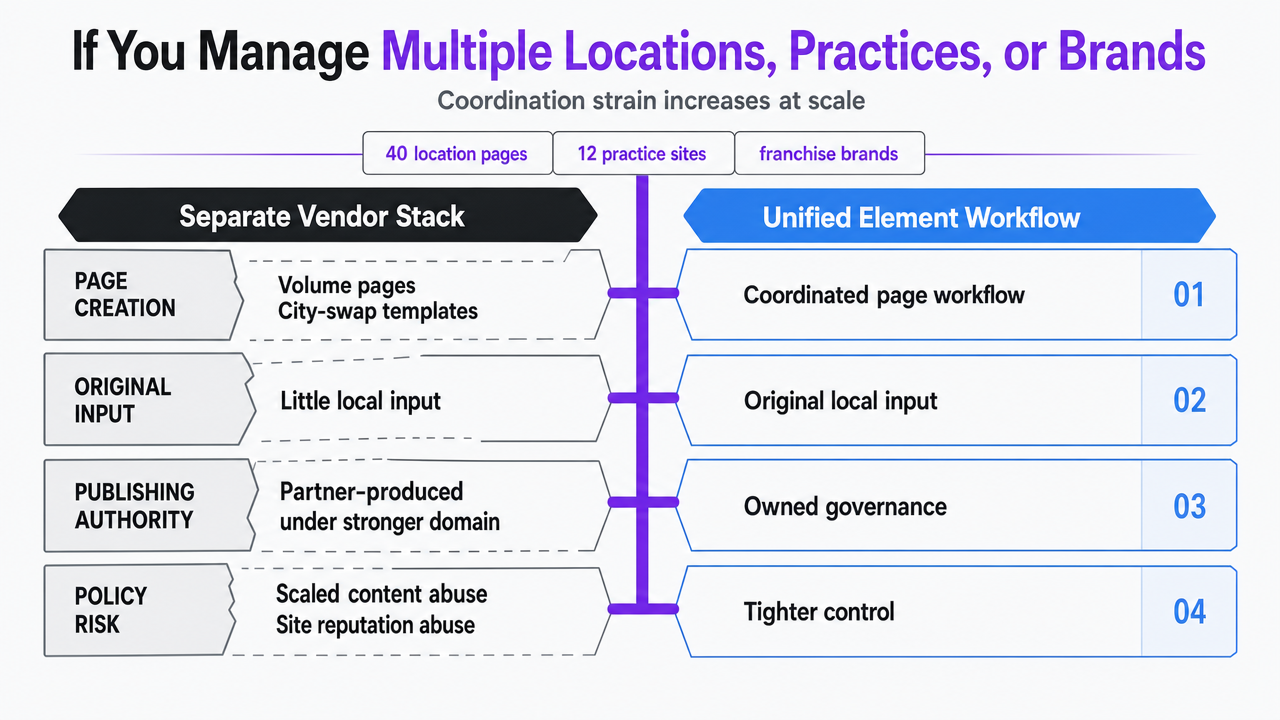 Visualize the comparison table already present in this section contrasting separate vendor stack versus unified element workflow across four operating variables
Where Search Is Heading and What to Brief Writers On Now
Google has described Search building the ideal response in the right format for the question, on the fly, which means the unit of optimization is drifting from a ranked link to an answer a generative UI assembles at query time 11. That does not change the input. It changes what the input has to contain.
Two brief-level updates follow:
- Every draft has to carry original information that a generative response can ground itself in—pricing ranges the business actually charges, a decision framework from a named practitioner, outcome data from the book—because commodity content is exactly what Google's AI optimization guide describes as the wrong input for AI-surface visibility 7.
- Writers need to compose in answer-ready units: a direct answer near the top of a section, the reasoning below it, and the practitioner attribution attached. That is not chunking rewritten for machines. It is editorial structure that serves a reader whether the surface is a blue link or a generated summary.
The brief itself is the artifact that carries this forward, and it is the same brief the helpful-content bar already required 5.
Frequently Asked Questions
References
- 1.Search Engine Optimization (SEO) Starter Guide.
- 2.Understanding Core Web Vitals and Google search results.
- 3.Spam Policies for Google Web Search.
- 4.Structured Data Markup that Google Search Supports.
- 5.Creating Helpful, Reliable, People-First Content.
- 6.A new resource for optimizing for generative AI in Search.
- 7.Google's Guide to Optimizing for Generative AI Features on Google Search.
- 8.New opportunities, control and insights for website owners.
- 9.Google Search's guidance about AI-generated content.
- 10.Completeness.
- 11.A new era for AI Search.