
Key Takeaways
- Agency SEO now runs on two surfaces at once—ranked SERPs and answer engines—and the techniques that compound are the ones engineered to earn visibility on both from a single production system.
- A shared foundation of entity models, versioned schema templates, and crawl hygiene must sit upstream as a service, not get rebuilt inside every brief, or specialist hours quietly disappear 2, 4.
- Governance works as coded review gates—evidence, schema, and citation-share checks with pass/fail artifacts—rather than policy PDFs, which is what makes a ten-to-one strategist ratio defensible 13.
- Replace rank-only dashboards with citation share, answer saturation, entity coverage, and specialist utilization, keeping rank scoped to transactional and locality-modified queries where clicks still convert 3, 9.
The dual-surface problem facing agency SEO leaders
Agency SEO leaders now optimize for two audiences that behave nothing alike. One is the classic ranked SERP, where crawlers reward depth, internal linking, and relevance signals refined over two decades. The other is the answer engine—Google's AI Overviews, Perplexity, ChatGPT search, Copilot—which reads pages differently, quotes selectively, and often resolves the query before the user ever clicks. Forrester now frames this second surface as answer engine optimization, a discipline with its own citation share, saturation, and technical constraints 3, 5.
The operational problem is not conceptual. It is throughput. A head of SEO running 15 to 80 client accounts cannot simply add a second content workflow beside the first. Specialist hours are already committed, review queues are already deep, and client reports still lead with rankings that AI Overviews are quietly eroding for question-based informational queries 9.
Producing more articles does not resolve this. The agencies that scale in 2025 are consolidating a smaller set of high-signal techniques into a single production system that feeds both surfaces from one entity model, one schema layer, and one review gate. Forrester's recent guidance treats SEO platforms as the substrate for exactly this consolidation—content, technical, and measurement workflows coordinated at scale rather than distributed across point tools 2.
The sections that follow examine which techniques still compound under that dual-surface pressure, what each one costs an analyst hour, and how one strategist can govern the output of a team ten times their size without loosening quality.
Why the old technique list stopped compounding
For most of the last decade, the technique list was stable enough to industrialize. Keyword research fed a brief, the brief fed a draft, the draft got a title tag and internal links, and the whole thing compounded because Google rewarded depth, freshness, and topical coverage on a single ranked surface. Agency pods scaled by adding writers behind that assembly line. The list worked because the target did not move.
Two things broke the compounding curve. First, AI Overviews and generative answer engines began resolving question-based informational queries directly in the result, cutting click-through on the exact asset types agencies had industrialized—definitional posts, how-to guides, comparison pages 9. Second, Forrester's guidance on answer engine optimization made clear that AI crawlers read pages against a different rubric: persona-modeled questions, concise quotable answers rich in unique statistics, schema markup for accurate contextualization, and minimized JavaScript rendering so the content is actually parseable 4. A page tuned only for ranked retrieval can meet none of those criteria and still rank respectably—while returning zero citation share in the answer surface that is absorbing the query.
The infographic below summarizes the divergence: shared foundation on entity coverage and technical hygiene, then two distinct output tracks with different signal weights 4.
The result is that classic technique lists no longer describe the whole job. They describe half of it. Producing more of the old asset does not close the gap on the new surface, and producing a parallel AEO workflow beside the old one doubles specialist load without doubling either revenue or citation share. Forrester's framing of SEO's return to the center of the marketing mix is really a framing of consolidation: content, technical, and measurement workflows have to run through one system, or the math stops working 2.
The techniques themselves have not disappeared. Depth still matters. Internal linking still matters. Schema still matters. What changed is that each one now has to earn its keep on two surfaces at once, which forces a harder question about which techniques an agency should keep industrializing—and which ones to retire.
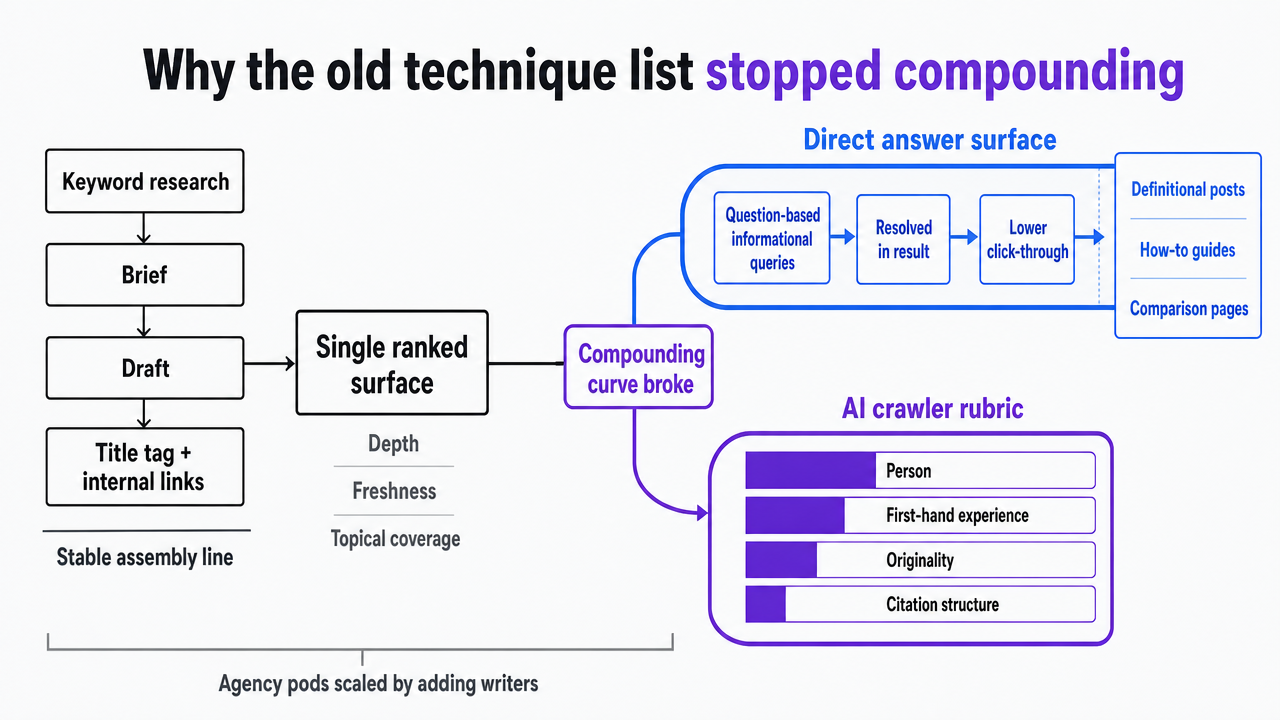 Visualize the dual-surface divergence described in this section: a shared foundation feeding two distinct output tracks with different signal weights
The dual-surface optimization stack
Shared foundation: entity coverage, schema, and crawl hygiene
Before either surface pays out, the same three layers have to be in place. Entity coverage—the degree to which a site's pages collectively describe the people, products, procedures, and concepts a client actually deals in—is the substrate both ranked retrieval and answer engines read against. Schema markup makes those entities machine-legible. Crawl hygiene ensures they get read at all. Forrester's AEO guidance is explicit that structured data
"remains necessary to help crawlers accurately interpret, contextualize, and index content,"
and that minimizing JavaScript rendering is now a visibility issue across engines, not just a performance nit 4.
For an agency scaling across 15 to 80 accounts, the operational move is to treat the foundation as a shared service rather than a per-article task. That means one entity model per client—maintained as a living document that maps services, locations, practitioners, procedures, and their relationships—rather than entity coverage assembled ad hoc inside each brief. It means schema templates (Organization, LocalBusiness, Service, FAQPage, HowTo, Article) versioned centrally and applied through the CMS, not hand-coded per page. And it means a crawl-hygiene audit cadence—rendering path, robots directives, sitemap accuracy, canonical logic, response-code drift—run as a recurring platform check rather than a quarterly project.
The payoff at scale is that a single foundation feeds both output tracks below. The same entity-rich page that ranks for a service query also gets quoted in an answer engine because the schema tells the crawler what the entity is and the clean render lets it read the passage. Agencies that skip this layer end up rebuilding it inside every content brief, which is where specialist hours quietly disappear 2.
Ranked retrieval track: depth, internal linking, and topical authority
The ranked track still rewards what it has rewarded for a decade, with tighter tolerances. Depth means the page actually resolves the query rather than orbiting it—covering the sub-questions a competent reader would ask next, in the order they would ask them. Internal linking means the page sits inside a topic cluster that signals coverage breadth, not a stranded asset linked only from a blog index. Topical authority means the domain has enough surrounding coverage that a crawler can place the page in a recognizable neighborhood of entities and intents.
None of that is new. What changed is the margin for error. AI Overviews now absorb question-based informational clicks that used to reward thin definitional posts, so ranked traffic increasingly concentrates on pages that solve harder, more specific, or more transactional intents 9. The technique still compounds; the asset type that compounds has narrowed.
At agency scale, this argues for fewer, denser assets per client and a stricter internal-link discipline. A useful working rule: every new asset must connect to at least two existing cluster pages by descriptive anchor, and every cluster hub must be reviewed quarterly for coverage gaps against the client's entity model. The measurement side stays familiar—rank position, indexed URL count, share of voice on target clusters—but is now paired with the answer-surface metrics below rather than reported in isolation 3. Agencies that keep reporting ranked position alone are describing a shrinking half of the visibility their clients actually receive.
Answer engine track: quotable blocks, persona questions, and citation-worthy stats
The answer track reads pages against a different rubric, and the techniques that feed it are structural before they are stylistic. Forrester's operational guidance is direct:
"To develop highly visible content, model the questions various personas ask answer engines at different phases of buyers' journeys,"
and structure the content as concise answers rich in unique quotes and statistics 4. The unit of optimization is no longer the page; it is the passage.
Three techniques do most of the work.
- Quotable answer blocks—40 to 90 word passages that resolve a specific persona question in the opening sentence and support it with a specific figure or named source in the next. These are what generative engines lift into citations.
- Persona-modeled FAQ patterns that map to buyer-journey stages rather than to keyword clusters, so the same client site addresses awareness, evaluation, and decision questions with distinct answer blocks rather than one omnibus post.
- Citation-worthy statistics or original data points inside the passage, because generative systems disproportionately quote assertions that carry a number and a source 3, 4.
Operationally, this changes the brief. An answer-track brief specifies the exact persona questions the page must resolve, the target passage locations for each answer, the schema type (FAQPage, HowTo, Article) that will wrap them, and the sourced statistics or client-owned data points each block must contain. Writers stop composing essays around a keyword and start composing indexed answer blocks around modeled questions.
The measurement stack shifts with it. Rank position becomes one input among several; the leading indicators are citation share on target queries and answer saturation across the client's topic set 3. Agencies that industrialize the answer track are not producing more content—they are producing the same or fewer assets, engineered so each page contributes multiple citable passages instead of one rankable body.
Test scalable content workflows with real publishing
Validate engine optimization techniques by executing and measuring live content across channels during your trial.
Governance as a review-gate design, not a policy document
Most agency governance for AI-assisted content still lives in a PDF: a style guide, a legal review checklist, a note about disclosure. That format solved the wrong problem. The risk in scaled AI production is not that a writer forgets a rule; it is that unsupported assertions and mis-cited statistics enter the pipeline faster than any human reader can catch them at the end. Stanford HAI's audit of generative search engines found that roughly 50% of generated statements had no supportive citations at all, and only about 75% of the citations that were present actually supported the statement they were attached to 13. The study looked at generative search outputs rather than agency workflows, but the failure mode transfers directly: fluent prose, plausible citations, weak provenance.
Treating that as a review-gate design problem changes what gets built. A gate is a point in the production loop where a specific artifact must be verified against a specific rule before the draft advances. Three gates carry most of the load.
- An evidence gate checks that every statistic, quoted source, and named study in the draft resolves to a real, retrievable source that says what the passage claims it says.
- A schema and entity gate confirms that the structured data matches the visible content and that the entities referenced exist in the client's entity model.
- A citation-share gate, run post-publish, verifies that the quotable answer blocks are actually being picked up by answer engines on the target queries 3, 4.
The operational point is that these gates are code and workflow, not memos. Each gate has an owner, a pass/fail artifact, and a queue position, so the strategist reviewing the draft sees what failed and why rather than reading the whole document for vibes. Forrester's guidance on modeling persona questions and structuring content as concise, source-rich answers becomes enforceable at the gate rather than aspirational in a brief 4. The reviewer's job compresses to adjudicating edge cases, which is what makes the ten-to-one strategist ratio in the next section defensible.
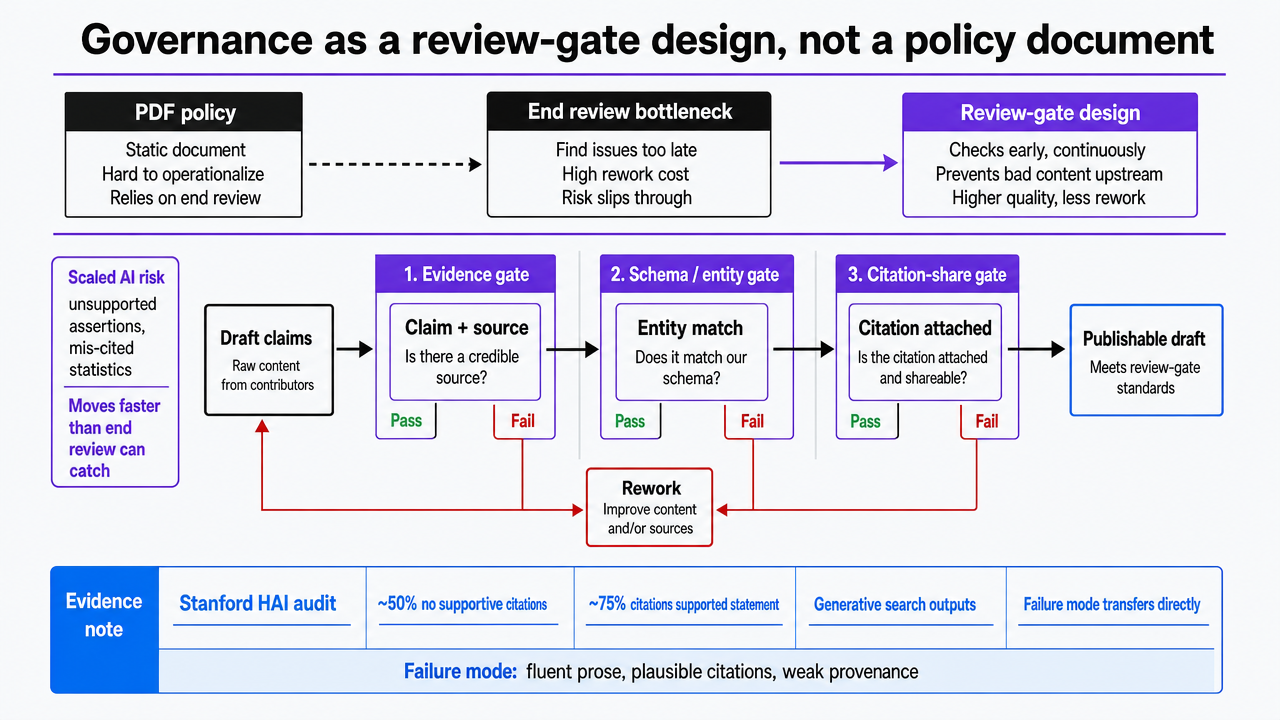 Illustrate the three review gates described in prose (evidence, schema/entity, citation-share) as a workflow with pass/fail artifacts
Scaling economics: what each technique costs an analyst hour
Specialist-hours per asset across three operating models
The unit economics of scalable SEO come down to two variables: specialist-hours per published asset, and assets per month per strategist. Everything else—margin per account, review queue depth, citation share growth—derives from those two. Yet most agency P&Ls track neither directly, which is why the shift from a ranked-only workflow to dual-surface production tends to arrive as a margin surprise rather than a planned investment.
Three operating models dominate the field.
- A traditional agency pod bundles a strategist, writer, editor, and technical SEO around a book of accounts; specialist-hours per asset are high because entity modeling, brief development, schema application, and evidence checking all happen manually inside each ticket.
- An in-house team with point tools centralizes some of that work in a research or ops role but still runs the brief-to-publish loop through human handoffs.
- A platform-governed AI production model with human approval consolidates the shared foundation—entity model, schema templates, crawl audits, evidence checks—into automated gates, so the strategist's hours concentrate on adjudication rather than assembly.
McKinsey's estimate that generative AI could increase the productivity of the marketing function by 5 to 15 percent of total marketing spending sets a defensible ceiling for the third model's economic impact, though the scope matters: the figure covers the marketing function overall, not SEO production in isolation, and it is a productivity band rather than a per-asset benchmark 6, 10. Applied as a low/mid/high multiplier against an agency's current blended hourly cost, it frames the range of savings a head of SEO can defend to a managing director without overreaching the source.
| Operating model | Specialist-hours per asset | Assets/month/strategist | Review-gate depth | Citation-share tracking |
|---|---|---|---|---|
| Traditional agency pod | Your current baseline | Your current baseline | End-of-draft, manual | Rarely instrumented |
| In-house team + point tools | Baseline × ~0.85–0.95 | Baseline × ~1.05–1.15 | Checklist in doc | Ad hoc, per query |
| Platform-governed AI production | Baseline × (1 − 0.05 to 0.15) applied to marketing-function scope 6 | Baseline × 1.05–1.15 within same scope 10 | Evidence + schema + citation gates in workflow | Continuous, per cluster 3 |
The qualitative deltas are where the third model earns its keep. Review-gate depth shifts from a single end-of-line pass to three checkpoints that fail fast, and citation-share tracking moves from a query-by-query lookup to a standing measurement of answer saturation across each client's topic set 3, 4.
If you manage multiple locations, branches, or a franchise portfolio
The economics change shape when the reader is not a single-site enterprise SEO lead but an operator running content across a portfolio of locations—a DSO with 40 practices, a home-services franchisor with 120 territories, a behavioral health network with 25 clinics, a senior living group with 60 communities. The specialist-hours math still applies, but the multiplier is the number of location pages, service pages, and locality-modified answer blocks each strategist has to govern, not the number of articles.
Two constraints define the portfolio case. First, entity coverage has to be maintained per location—practitioners, service lines, insurance acceptance, intake hours, geographic modifiers—and each of those entities feeds both the ranked local pack and the answer surface that resolves "near me" and locality-specific questions. Forrester's guidance on schema and persona-modeled questions applies at every location, which is why treating the entity model and schema layer as a shared service is not optional at portfolio scale 4. Second, review-gate depth has to hold across every location, because unsupported claims about a specific practice, provider, or service radius carry regulatory exposure that a generic blog post does not.
The consolidation move for portfolio operators is to run one central strategist against the same three gates described above, applied to templated location assets rather than one-off articles. Specialist-hours per location page fall because the entity model, schema, and evidence checks are inherited from the parent template; the strategist's time concentrates on the location-specific facts that vary. Assets per month per strategist rise not because more essays get written, but because more locations are kept current, more answer blocks are kept accurate, and more citation share is captured on locality-modified queries that pure ranked reporting would miss 3, 12.
Scale Engine Optimization Without Expanding Your Team
Connect with our specialists to see how leading agencies automate content and SEO workflows for multi-client portfolios, maintaining full oversight and measurable results—no additional headcount required.
The measurement stack that replaces rank-only dashboards
Rank-only dashboards describe a shrinking portion of the visibility a client actually receives. When AI Overviews resolve a question-based query inside the result, the ranked position of the underlying page is not the outcome that matters; whether the passage was cited is. Forrester's guidance on answer engine optimization treats AI citation share and answer saturation as the leading indicators of visibility on that surface, and neither shows up in a rank tracker 3.
Four metrics belong in the replacement stack.
- Citation share measures the percentage of AI answers on a target query set that quote or link the client's site, and it is tracked per cluster rather than per keyword because generative engines cross-reference passages across a topic.
- Answer saturation measures how much of a client's mapped question set is being resolved with a citation to the client at all, which is the AEO equivalent of index coverage 3.
- Ranked position and share of voice still belong in the stack for transactional and locality-modified queries where clicks continue to convert 9.
- Entity coverage—how completely the site's entity model is represented in schema and prose—functions as the leading input for both surfaces 4.
Two operational metrics sit alongside the visibility metrics. Review queue depth tracks how many drafts are waiting behind which gate, which is where throughput problems announce themselves before margin does. Specialist utilization tracks assets governed per strategist rather than hours logged, aligning the dashboard to the scaling constraint that actually matters.
The reporting shift for clients is smaller than it sounds. Ranked position stays on the report; it stops being the headline. Citation share and answer saturation lead, because they describe the surface where the informational query was resolved 3, 1. Rank follows, scoped to the queries where a click is still the outcome. Head of SEO teams that make this swap in Q1 tend to make it once—the client conversation about "why rankings held but traffic fell" stops recurring, because the dashboard now shows both halves of the visibility a page earned.
How one strategist governs the output of ten
The ten-to-one ratio is not a headcount trick. It is what happens when the shared foundation, the review gates, and the measurement stack described above run as a single system rather than as three parallel projects. The strategist stops assembling assets and starts adjudicating them.
Three operational moves make the ratio hold.
- The entity model and schema layer sit upstream as a versioned artifact, so no brief starts from a blank entity map and no writer negotiates schema per page 4.
- Evidence, schema, and citation-share checks run as gated queues with pass/fail artifacts, so the strategist opens a draft already flagged for what needs judgment rather than reading each document end to end 13.
- The measurement dashboard reports citation share, answer saturation, and specialist utilization on a standing cadence, so priority is set by where the visibility gap is widest rather than by whichever account emailed last 3.
Forrester's argument for a centralized SEO platform predates the answer-engine era but describes the same substrate: coordinated auditing, ranking support, measurement, and project management running through one system rather than distributed across point tools 11, 12. The current version of that substrate is an approval-gated production loop where AI handles assembly and humans hold the judgment calls. Platforms built around that pattern—Vectoron among them—are how a head of SEO defends the delivery quality of a 60-account book without adding a specialist for every ten new clients.
Frequently Asked Questions
References
- 1.GenAI Reshapes Shopping And Revives SEO.
- 2.SEO’s Hype-Fueled Move To The Center Of The Marketing Mix.
- 3.Win Visibility In AI Search With Answer Engine Optimization.
- 4.How To Master Answer Engine Optimization.
- 5.Answer Engine Optimization (AEO) Best Practices.
- 6.The Economic Potential of Generative AI: The Next Productivity Frontier.
- 7.Search Evaluation.
- 8.Topic4Evaluation.
- 9.State of SEO in the AI Era.
- 10.The Economic Potential of Generative AI: The Next Productivity Frontier.
- 11.The Forrester Wave™: SEO Platforms, Q4 2012.
- 12.Every Company Needs An SEO Platform.
- 13.Generative Search Engines: Beware the Facade of Trustworthiness.