
Key Takeaways
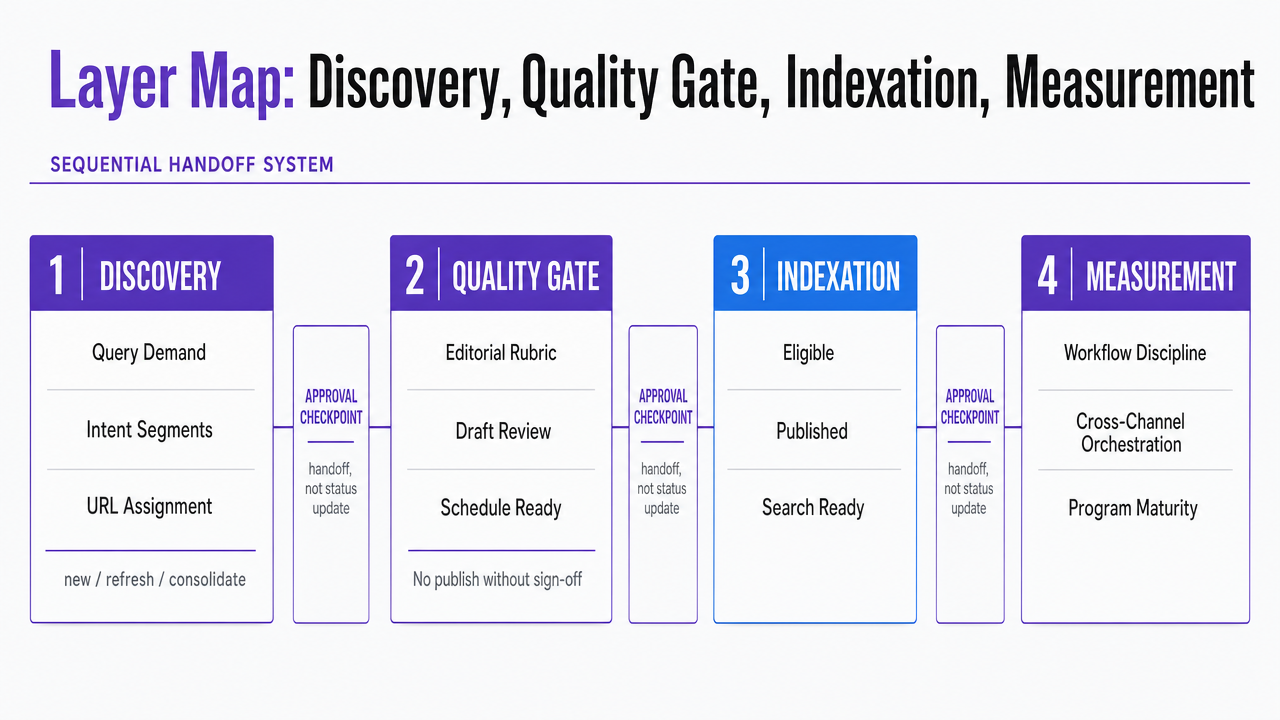
- Enterprise keyword ranking runs as a four-layer system — Discovery, Quality Gate, Indexation, and Measurement — with named-reviewer approvals between each layer rather than status handoffs.
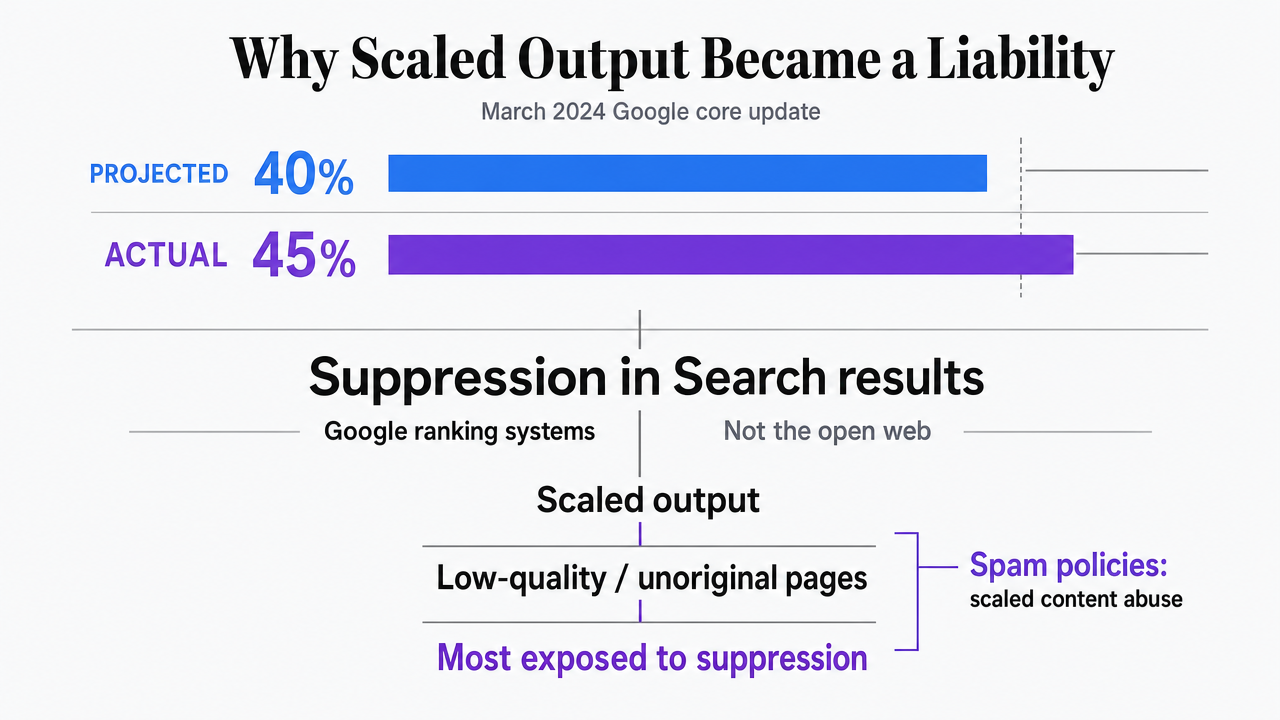
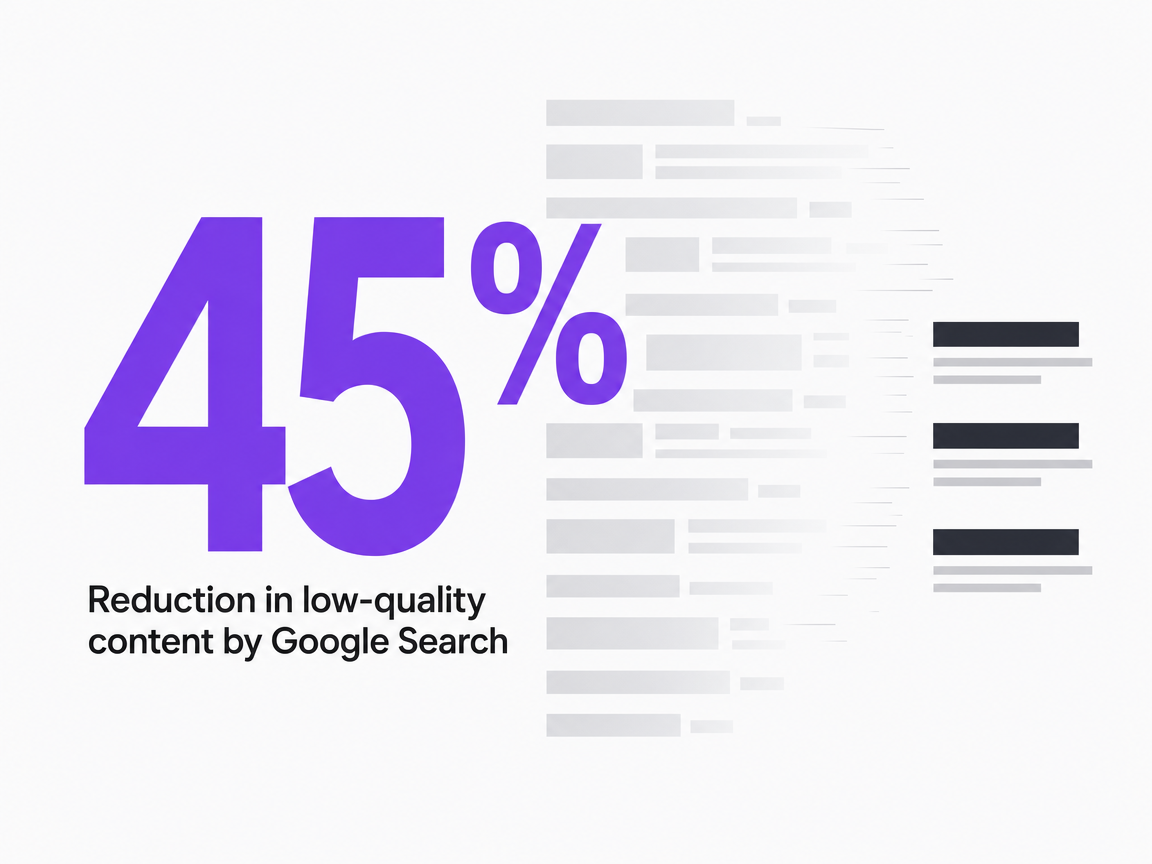
- Google's March 2024 core update cut low-quality, unoriginal content in results by 45%, making scaled output a liability unless a fixed editorial rubric gates every publish 5.
- Reviewer capacity, not drafting capacity, sets portfolio throughput; AI-assisted drafts stay compliant only when routed through the same rubric with prompts stored and a human signing publish 2.
- Rank position is diagnostic, not a scorecard — track graded query satisfaction, top-ten retention, and engaged-outcome rate by intent cluster, and re-audit segment maps, rubrics, and weights quarterly 11.
Why Scaled Output Became a Liability
For most of the last decade, an agency Head of SEO could defend a scaled-content strategy by pointing to the math: more indexed URLs, more query surface, more sessions. That equation broke in March 2024. Google reported that the combination of its March 2024 core update and prior efforts cut low-quality, unoriginal content in search results by 45%, higher than the 40% reduction the company had initially projected 5. The scope matters: Google is describing what its own ranking systems now suppress across Search, not a third-party audit of the open web. For a delivery organization publishing across dozens of client sites, the read-through is direct — the pages most likely to be caught in that suppression are exactly the ones scaled content operations produce most cheaply.
Google's spam policies name the pattern explicitly. Scaled content abuse is defined as generating many pages primarily to manipulate rankings rather than help users, and the same policy set covers doorway pages, site reputation abuse, and expired domain abuse 2. None of those categories exempt human-written work; the test is purpose and value, not production method.
The operational consequence for agency leadership is unpleasant. Volume no longer compounds — it decays. A portfolio that ships 400 templated pages a month without a defensible quality gate is now underwriting risk on every client site it touches. The rest of this article treats that gate, and the routing around it, as the actual product.
The Four-Layer Production System
Layer Map: Discovery, Quality Gate, Indexation, Measurement
Mature enterprise SEO programs no longer resemble the tactical keyword-and-tickets model that defined the discipline through the 2010s. Forrester's read on the market is that the function has shifted from tactical execution to governed, cross-channel orchestration, with measurement and workflow discipline separating mature programs from the rest 16. That framing is the scaffolding underneath the four-layer system a Head of SEO can actually run.
The layers are sequential, and each hands off through an approval checkpoint rather than a status update.
- Discovery and Mapping converts query demand into intent segments and assigns each segment to a specific URL — new, refreshed, or consolidated.
- Quality Gate holds every draft against a fixed editorial rubric before it can be scheduled; nothing publishes without a sign-off tied to a named reviewer.
- Indexation and Crawl Health confirms the page is reachable, canonical, internally linked, and eligible to rank once it exists.
- Measurement Loop closes the system by feeding graded relevance, engagement, and conversion data back into Discovery, retiring underperforming URLs and reweighting segment priorities.
What makes this a system rather than a checklist is the approval gate between layers. Google's own guidance is that helpful, people-first content and crawlable architecture are the two practices with the largest ranking impact 1 — the layers exist to make both non-negotiable at portfolio scale.
Where Agency Incentives Collide with Spam Policy
Every layer in that system exists partly to protect against the delivery org's own incentives. Agencies get paid per page, per campaign, per retainer tier — structures that reward throughput. Google's spam policies are written against precisely the patterns those incentives produce.
Four categories deserve explicit naming on any agency risk register:
- Scaled content abuse covers pages produced primarily to manipulate rankings rather than help users, regardless of whether a human or a model wrote them 2.
- Doorway pages target the near-duplicate location and service permutations common in multi-location home services and legal work.
- Site reputation abuse — sometimes called parasite SEO — covers third-party content published on a client's domain to trade on its authority, a pattern that appears in guest-post programs and syndication deals.
- Expired domain abuse addresses the revival of purchased domains stuffed with unrelated content 2.
The approval gate between Discovery and Quality is where these risks are caught. A reviewer asking whether a proposed URL exists to serve a distinct user need, or only to occupy a keyword slot, is doing spam-policy compliance whether the SOP calls it that or not. The framework's job is to make that question mandatory before production spend, not after publication.
Discovery and Keyword-to-URL Mapping
From Keyword Lists to Intent Segments
A keyword list is an inventory. An intent segment is an instruction. The distinction matters at portfolio scale because a Head of SEO cannot personally reconcile 40,000 head-and-tail queries against the URLs of 30 client sites — that reconciliation has to be reproducible by an analyst pool without producing a different answer every quarter.
Segmentation solves the reproducibility problem. Group queries by the job the searcher is trying to complete — comparing two providers, confirming eligibility, booking, troubleshooting after purchase — and each cluster resolves to one canonical URL, whether that URL already exists, needs a rewrite, or should be created. Machine-learning approaches to SEO classification have shown this scales: one thesis dataset of 46,000 queries built from city and business-term combinations demonstrated that segmentation and modeling outperform manual keyword management once query volume crosses low thousands 15. The point is not to replace analyst judgment but to compress it into rules that survive staff turnover.
Long-term keyword work reinforces the same discipline. Persistent, cumulative investment in a defined query set outperforms one-off optimization sprints 12, which means the mapping artifact — segment to URL to owner — is the durable output of Discovery, not the keyword list itself.
Prioritization Weights That Survive Audit
Once segments are mapped, the Head of SEO has to decide which URLs get produced or refreshed first. That decision needs a defensible weighting, because a shared analyst pool working across 30 accounts will otherwise default to whichever client shouted loudest in the last status call.
Empirical ranking-factor research gives the weights a floor. A study of 24 website characteristics affecting Google rankings found that backlinks, keyword-in-URL, text length, and domain age emerged as the strongest factors in its dataset 13. Those four are not the whole story — Google's own guidance is that helpful, people-first content and crawlable architecture carry the largest impact 1 — but they translate into scoring inputs an analyst can apply without interpretation: does the target URL already have referring domains, does the slug contain the head term, is the existing draft substantive enough to satisfy the query, and is the domain established enough to compete for it.
A workable priority score combines four inputs:
- Segment business value (revenue or qualified-lead proximity)
- Current visibility gap (position 4-20 is cheaper to move than 30+)
- Authority readiness (existing backlink profile at the URL or subfolder)
- Production cost (net-new vs. refresh vs. consolidation)
Weights should be documented once at the portfolio level and reviewed quarterly, not renegotiated per ticket. Survey work with practitioners rating ranking-factor influence on a 1-to-10 scale confirms the field has never fully agreed on the numbers 14 — which is exactly why the weighting has to be written down and defended, not carried in an analyst's head.
Run a Live Enterprise Keyword Ranking Pilot
Test enterprise-scale keyword strategies and publish real campaign content before making a commitment.
The Quality Gate: Turning Rater Criteria into an SOP
Editorial Rubric Built From Helpful Content Questions
Google's helpful content guidance is written as a self-assessment, not a checklist, which is why most agencies fail to operationalize it. The document asks whether a page provides original information, substantial coverage, insightful analysis, and clear sourcing, and whether a reader would want to bookmark or recommend it 3. Those are evaluative questions. A shared analyst pool cannot answer them consistently unless they are converted into binary rubric items with named owners.
A workable rubric collapses the guidance into six pass/fail checks applied before a draft can move to publication:
- Does the page contain original information, analysis, or reporting not available in the top ten results for the target query?
- Is the primary claim of the page supported by a cited source or first-party data?
- Does the author or reviewer have demonstrable standing on the topic, visible on the page?
- Does the draft answer the specific query the URL is mapped to, not an adjacent one?
- Is the length driven by what the query needs rather than a template minimum?
- Would a subject-matter reviewer share this page unprompted?
Each check produces a reviewer initial and a timestamp. Drafts missing any check route back to production with the failing item named — not with a general revision request.
The rubric is the artifact that survives staff turnover. The questions are Google's; the enforcement is the agency's.
YMYL Verticals and the Experience Signal
Law firms, behavioral health practices, DSOs, and senior living operators — the verticals where an agency Head of SEO typically earns the largest retainers — are also where Google's rater guidelines apply the most scrutiny. The Search Quality Rater Guidelines instruct raters to give the Lowest rating to pages that are harmful, untrustworthy, or spammy on topics that affect health, finances, safety, or well-being 6. The full guidelines make clear that E-E-A-T — experience, expertise, authoritativeness, trust — is the framework raters apply when a topic sits inside that YMYL surface 7.
Experience is the signal most often missing from agency production. A staff writer researching bariatric coverage from a keyword brief cannot demonstrate experience; a bariatric surgeon quoted, credited, and shown as a reviewer can. The rubric in the prior section needs one additional YMYL-specific gate: for any page in a health, legal, or financial vertical, a named practitioner or licensed reviewer must approve the substantive claims, and their credential must appear on the page. This is where most agency SOPs quietly fail — the review happens, but it is not attributable, and the byline shows the marketing team.
Google's own framing is that page purpose matters more than page type 7. A short YMYL page written by the practitioner will outperform a 2,500-word page written around the practitioner.
AI-Assisted Drafting Under Approval-First Routing
The spam policies are explicit that scaled content abuse covers pages generated primarily to manipulate rankings, regardless of whether a human or a model wrote them 2. Google's helpful content guidance now also asks reviewers to consider how content was produced, including whether automation was used 3. Neither document bans AI-assisted drafting. Both make production method irrelevant to the quality test.
What changes at portfolio scale is where the approval sits. In a governed workflow, model-generated drafts enter the same rubric-and-reviewer routing as analyst-written drafts, with two additions: the prompt or brief that produced the draft is stored with the draft, and a named human reviewer signs the publish decision. That signature is what converts a machine-generated page from scaled abuse risk into a supervised input. The rubric does not soften for AI-assisted work; if anything, checks (a) and (b) — original information and cited support — carry more weight because language models default to consensus paraphrase.
Approval-first routing is the only defensible way to scale drafting velocity in the current quality regime. Volume without the gate is the exposure Google's March 2024 update was built to catch. Volume with the gate is production leverage.
Indexation and Crawl Health as a Portfolio Signal
A page that isn't indexed cannot rank, and a page that is indexed but never re-crawled cannot recover. At single-site scale that truism is trivial; across a 30-account portfolio it becomes the earliest warning signal a Head of SEO gets that quality problems are compounding. Google's guidance on core updates is direct: broad ranking shifts should trigger a sitewide self-assessment against helpful-content principles, not page-level patches 4. Crawl and index behavior is where that assessment starts, because Google's own systems reveal their judgment through what they choose to fetch and keep.
The portfolio metrics worth watching are ratios, not counts:
- Indexed URLs as a share of submitted URLs
- Crawl requests per indexed URL over a 30-day window
- The discovered-not-indexed segment in Search Console
Together they tell a Head of SEO which client sites are drifting toward suppression before rank drops confirm it. A behavioral health site whose discovered-not-indexed count climbs from 4% to 18% over a quarter is signaling that Google's systems are triaging its pages out, regardless of what the rank tracker still shows. Google Search Essentials names crawlable architecture and helpful content as the two practices with the largest impact 1 — crawl health is how the first practice is measured, and index retention is how the second one is judged.
The operational move is to route crawl-ratio deterioration into the Quality Gate as a retroactive trigger. When indexation drops below a threshold on a subfolder, the URLs in that subfolder re-enter the rubric — the same six checks a new draft would face — before any new production is scheduled against them. That closes the loop between what Google's crawlers are telling the portfolio and what the analyst pool does next week.
Measurement: Graded Relevance Over Rank Position
Rank tracking survived the last decade because it was cheap and legible in a QBR slide. It is no longer a sufficient measurement layer for portfolio work, because a URL sitting at position 6 can be satisfying the query, cannibalizing an adjacent page, or ranking on a term the searcher never intended — and the rank number alone cannot tell a Head of SEO which. Information-retrieval evaluation has answered this problem for decades by using graded relevance judgments rather than binary hits, with labels such as Very Useful, Useful, and Not Useful applied against ranked cutoffs 10. TREC's broader methodology treats ranked retrieval as measurable only when graded judgments and specific cutoffs, like top-ten retrieval, are defined in advance 11. That discipline is what the measurement loop borrows.
The operational translation is three metrics running in parallel to rank:
- Query-satisfaction sampling: a rotating audit where an analyst rates whether the ranking URL actually resolves the query intent on a graded scale, applied to a fixed sample of high-value segments each month.
- Top-ten retention: how many mapped segments hold a position within the first ten results across the portfolio, tracked as a share rather than an average.
- Engaged-outcome rate: the proportion of ranked sessions that produce a defined downstream event — a form fill, a call, a booking — segmented by intent cluster so that navigational and transactional queries are not measured against the same conversion baseline.
Rank position remains a diagnostic, not a scorecard. A page that climbs from position 14 to 7 without moving engaged-outcome rate is a warning about intent-URL mismatch, and the segment goes back to Discovery for re-mapping rather than to Content for a rewrite. The loop is what makes the framework self-correcting; without it, the other three layers optimize toward a metric that stopped predicting revenue several updates ago.
See How Leading Agencies Systematize Keyword Ranking Across 10,000+ Pages
Request a walkthrough of enterprise-scale frameworks, approval workflows, and AI automation used by top digital teams to coordinate and accelerate multi-site SEO programs—without increasing headcount.
If You Manage a Multi-Client or Multi-Brand Portfolio
Analyst-Hours Under Three Delivery Models
The framework the earlier sections describe is legible at single-site scope. It behaves differently once a Head of SEO is allocating a shared analyst pool across 20 to 200 accounts, because the constraint stops being editorial judgment and becomes hours per hundred pages. Forrester's read on mature enterprise programs is that governance and shared workflow platforms — not analyst headcount — are what separates delivery orgs that scale from ones that stall 16. The comparison below uses variables rather than dollar figures, because the useful question is not what an hour costs but how many the model consumes.
| Delivery model | Analyst hours per 100 pages | Review cycles per draft | Sustainable pages/month per analyst |
|---|---|---|---|
| Fully manual agency pod | High (research + draft + revision owned by one analyst) | 2–3 | Low |
| Hybrid: analyst + templated production | Moderate (templates absorb structure; analyst owns claim and QA) | 2 | Moderate |
| Governed AI-assisted with human approval | Low on drafting, unchanged on Quality Gate review | 1–2, with rubric enforced pre-publish | High, capped by reviewer capacity |
The variable that changes least across models is Quality Gate review time. The rubric in section 4 takes the same minutes to apply whether the draft was written by an analyst, assembled from a template, or generated from a brief. That is the constraint a Head of SEO should plan around: reviewer capacity, not drafting capacity, sets the ceiling on portfolio throughput. Segmentation and modeling research at 46,000-query scale supports the same conclusion — scale comes from compressing analyst judgment into reproducible rules, not from adding analysts 15.
Triage Routing When Core Updates Hit Several Accounts
Core updates rarely affect one account in isolation. When Google's ranking systems reweight sitewide quality signals, a portfolio-scale delivery org typically sees drops land across four or five clients in the same week. Google's core-update guidance is explicit that broad ranking shifts warrant sitewide self-assessment rather than page-level patches 4, which means the triage cannot be run as five parallel client fire-drills without duplicating work.
The routing that holds up under load has three tiers:
- Portfolio-wide diagnosis: pull the crawl-ratio and top-ten retention metrics from section 5 and 6 across every affected account and cluster the losses by pattern — thin YMYL pages, doorway-adjacent location permutations, subfolders with weak experience signals.
- Account-level assignment: each pattern gets one owner who applies the same remediation SOP across every client that shows it.
- Client communication, which lags the work by a week so the QBR update reflects action taken, not action promised.
The pattern-first routing is what keeps a shared analyst pool from doing the same diagnostic work five times against five slightly different logos.
Operating the Loop: What Changes Quarter to Quarter
A framework that reads well in a QBR is not the same as one that survives four quarters of drift. The Discovery-to-Measurement loop only compounds if the artifacts it produces — the segment map, the rubric, the priority weights, the crawl thresholds — are re-audited on a fixed cadence rather than treated as one-time deliverables. Long-term keyword work rewards cumulative, deliberate investment against a defined query set rather than seasonal reshuffling 12, and the same discipline applies to the operating documents behind that investment.
A quarterly cadence that holds up in practice sets three review points:
- In month one, the segment map is reconciled against actual query data — new intent clusters added, dead segments retired, URL assignments corrected where cannibalization surfaced.
- In month two, the rubric is stress-tested against pages that ranked but failed to convert, and against pages that were rejected at Quality Gate to check for reviewer drift.
- In month three, priority weights and crawl-ratio thresholds are recalibrated using the prior quarter's outcome data.
Google's core-update guidance frames recovery as sitewide reassessment against helpful-content principles 4 — the quarterly loop is what makes that reassessment routine rather than reactive. The next Head of SEO to inherit the portfolio should be able to run it from the documents alone.
 Reduction in low-quality content by Google Search
Reduction in low-quality content by Google Search
Frequently Asked Questions
References
- 1.Google Search Essentials (formerly Webmaster Guidelines).
- 2.Spam Policies for Google Web Search.
- 3.Creating Helpful, Reliable, People-First Content | Google Search Central.
- 4.Google Search's Core Updates.
- 5.New ways we’re tackling spammy, low-quality content on Search.
- 6.Search Quality Rater Guidelines: An Overview.
- 7.General Guidelines.
- 8.Search Quality Raters Guidelines update.
- 9.Academic Search Engine Optimization (ASEO).
- 10.Overview of the TREC 2024 Lateral Reading Track.
- 11.Overview of TREC 2023.
- 12.Search engine optimization: The long-term strategy of keyword choice.
- 13.Important Factors for Improving Google Search Rank.
- 14.search engine ranking factors analysis.
- 15.Pushing the Boundaries of Digital Marketing with SEO-Modeling.
- 16.The State Of SEO 2023.