
Key Takeaways
- Rank data earns executive trust only when it predicts pipeline, so evaluate trackers as a visibility layer within a revenue measurement system rather than a standalone dashboard.
- Insist on query-level reporting that unifies position with impressions, clicks, and CTR 3, because position alone describes potential, not actual demand capture.
- Separate performance metrics from health metrics so executives see revenue-relevant rankings while SEO managers monitor indexation and crawl signals that precede position decline 4.
- Treat intent tier, page cohort, and funnel stage as first-class fields, and join rank data with organic-filtered analytics so conversion outcomes anchor every position movement 2.
- Score vendors on data quality, automation, reporting, and integration 13; crawl frequency and keyword caps are secondary to defensible numbers and clean joins with the analytics stack.
- Document a baseline of query-level metrics, cohort conversion rates, and health indicators before demos 10, turning procurement into an accountable scoring exercise rather than a wishlist.
- For multi-location or multi-brand portfolios, consolidate onto a single schema; fragmented tools inflate analyst reconciliation hours and erode every Forrester evaluation dimension 13.
- Close the loop from signal to approved execution, where the tracker triggers ranked recommendations that route to a human approver, preserving brand judgment and prioritization authority.
Why Rank Data Only Matters When It Predicts Pipeline
Ranking reports have become less trusted in marketing. Executives have observed position graphs rise without a corresponding increase in pipeline, leading to the conclusion that a keyword moving from position 8 to position 4 is not, by itself, a significant business event. A VP of Marketing should assess whether an enterprise rank tracker provides signals that predict qualified demand or merely presents a superficial display of green arrows.
The distinction is measurable. Query-level organic reporting converts position data into visibility and click behavior, utilizing impressions, clicks, click-through rate, and average position as key metrics 3. Rankings without these accompanying metrics describe potential, not actual performance. Organic-filtered analytics then translate this click behavior into landing-page engagement and conversion outcomes, which is where rank data proves its value in executive discussions 2.
This evaluation framework considers an enterprise rank tracker as a visibility layer within a revenue measurement system, rather than a standalone dashboard. Selection criteria prioritize commercial segmentation, integration with conversion data, and workflow governance over factors like crawl frequency and keyword limits. Rank data that cannot be linked to a page cohort, an intent tier, and a downstream conversion event is merely decorative. Conversely, rank data that can be linked serves as a valuable forecasting input, justifying enterprise-level investment.
The Query-Level Unit of Analysis Every Enterprise Tracker Must Support
Rank position, in isolation, is a coordinate. It transforms into a business signal only when combined with three critical metrics: impressions, clicks, and click-through rate. Query-level organic reporting treats these four values as a unified unit of analysis, enabling analysts to evaluate both a page's visibility in search results and the appeal of its listing to users 3. An enterprise rank tracker that fails to expose all four at the query level, segmented by market, device, and landing URL, lacks a fundamental component for effective analysis.
Each metric addresses a distinct commercial question:
- Impressions quantify reach, indicating how often the portfolio appears within a demand pool.
- Clicks measure capture, showing how much of that reach translates into site visits.
- CTR assesses listing quality relative to competitors at similar positions, reflecting the effectiveness of SERP feature optimizations and title-tag strategies.
- Average position indicates structural exposure, and only when combined with the other three metrics does a position gain correlate with incremental sessions.
The evaluation is straightforward: a tracker that reports position for thousands of keywords but cannot integrate this data with impression and click behavior at the same query granularity provides a superficial overview, not a robust data model. VPs should request vendors to demonstrate query-level joins with Search Console data at the cohort level, not just the account level, and to segment these joins by intent tier and page type without requiring manual data manipulation. Research on SEO performance determinants directly links measurable outcomes to strategic execution, a connection that relies on a consistent query granularity underlying the reporting layer 8.
Performance Metrics vs. Health Metrics: What a Tracker Should Separate
Rank trackers that consolidate all data on a single screen often blur the lines between two distinct metric families, each serving different audiences and decision-making processes. Performance metrics quantify outcomes, such as rankings linked to organic sessions, conversions, and pipeline progression. Health metrics describe underlying conditions, including indexation status, crawl health, canonical integrity, and Core Web Vitals. Both are essential in an enterprise system, but presenting them with the same frequency to the same audience contributes to the "wallpaper effect" that executives have come to distrust.
This distinction is well-established in higher-education marketing analysis, where success metrics evaluate strategy performance, while health metrics guide optimization efforts 4. This separation applies directly to enterprise SEO. A CRO reviewing a quarterly board deck requires performance metrics filtered to commercial-intent cohorts and conversion outcomes. An SEO manager preparing for a Monday standup needs health metrics that highlight URLs dropped from the index, templates with lost structured data, or crawl anomalies preceding a position decline.
An enterprise rank tracker should expose both types of metrics, categorize them by family, and facilitate reporting workflows that route them to different destinations without manual reformatting. This implies separate default views, distinct alert thresholds, and independent export paths into business intelligence tools or analytics stacks already filtered by organic source 2. When a tracker forces a VP to navigate through crawl-error counts to access revenue-relevant rankings, the tool is dictating the narrative rather than supporting it.
The evaluation question is precise: ask vendors how the platform handles a scenario where organic conversions decrease by 12% in a week while the average position across the tracked portfolio remains stable. A system that differentiates performance from health will identify the indexation or template-level health event that disrupted the conversion path before position data reflects the change. A system that only reports rank movement will offer no useful insights until the next crawl cycle, by which time the pipeline gap will already be impacting forecasts.
Test Enterprise-Grade Rank Tracking in Practice
Experience live ranking insights and measure SEO impact using actual content and data during your trial.
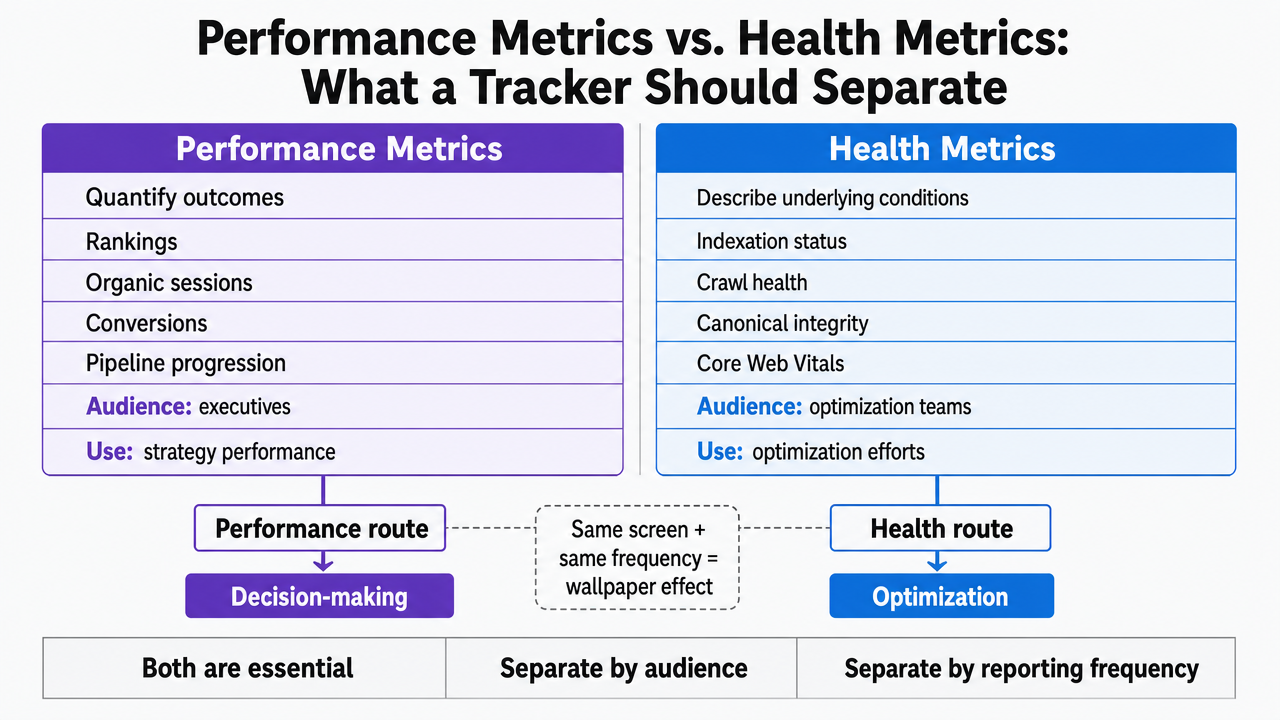 Visualize the article's core distinction between two metric families, their audiences, and their routing paths — a comparison framework explicitly described in this section
Segmenting the Keyword Portfolio by Commercial Intent
Intent Tiers, Page Cohorts, and Funnel Stage as First-Class Dimensions
A 40,000-keyword portfolio without segmentation is merely a spreadsheet, not a strategic asset. The dimensions that make rank data commercially valuable are intent tier, page cohort, and funnel stage. An enterprise rank tracker justifies its cost when these dimensions are integrated as first-class fields within its data model, rather than being applied retrospectively in a BI layer.
Intent tiers differentiate informational, comparison, and transactional queries, each converting at varying rates and belonging in distinct reports. Page cohorts group URLs by template—pillar guides, comparison pages, solution pages, location pages, and product pages—as they respond differently to position changes; averaging them obscures critical signals. Funnel stage assigns each query to a demand phase, enabling a VP to determine if a position gain occurred where pipeline genuinely forms or on top-of-funnel terms that won't impact the forecast.
Academic research on SEO performance determinants links measurable outcomes to strategic execution, not just raw ranking volume 8. This link is only valid when the portfolio is segmented prior to reporting. A tracker that includes intent classification, template tagging, and funnel-stage assignment as native fields, and allows analysts to modify these taxonomies without engineering support, is essential for connecting visibility to meaningful business impact. The evaluation test is whether a VP can filter the dashboard to commercial-intent queries on solution-page templates in the consideration stage and view position, impressions, clicks, and CTR joined at that specific granularity 3.
Filtering Rank Data Through Organic-Only Analytics
Segmentation extends beyond the SERP. Once a click leads to the website, the crucial question becomes whether the traffic associated with a ranked query converted. The answer lies in analytics filtered exclusively for organic sources. This organic-only filtering ensures accurate SEO data by removing direct, paid, referral, and social sessions that would otherwise skew conversion attribution for a query cluster 2.
An enterprise rank tracker should either perform this join natively or export cohorts cleanly into an analytics environment that already applies the organic filter. Baseline conversion rates for each intent tier and page cohort become the benchmarks against which position movement is evaluated 10. A rank improvement on a solution-page cohort that historically converts at 3.4% indicates a different pipeline impact than the same gain on an informational cohort converting at 0.2%; the tracker should display both figures in the same view.
The evaluation question for vendors is whether the platform can report position, click behavior, and organic-filtered conversion outcomes for the same query cohort in a single query, or if it necessitates three separate exports and an analyst's afternoon to compile. The latter disqualifies the tool for enterprise use.
Evaluation Criteria That Survive Executive Scrutiny
The evaluation criteria that withstand CFO scrutiny differ from those found in typical vendor comparison spreadsheets. While crawl frequency, keyword capacity, and SERP feature coverage are relevant, they are secondary to four foundational dimensions: data quality, automation, reporting, and integration. These are the axes Forrester uses to categorize enterprise SEO solutions, and they should be directly incorporated into a VP of Marketing's selection scorecard 13.
Data quality : Determines the defensibility of the numbers. Position accuracy across geographies and devices, index freshness, and the fidelity of the query-to-URL join dictate whether the tracker produces actionable evidence or mere noise. Request the methodology behind position sampling, not just marketing claims, and demand documentation on how the platform reconciles its rank data with Search Console at the query level 3.
Automation : Dictates whether the tool can scale without increasing analyst headcount. Features like alerts for position drops filtered by intent tier, automatic cohort refreshes for new URLs, and template-level tagging without manual assignment are crucial for a system to manage thousands of keywords effectively.
Reporting : Determines whether executives actually see and understand the output. Native views that distinguish performance from health metrics, exports that maintain segmentation for BI tools, and stakeholder-specific dashboards prevent rank data from becoming mere background noise 4.
Integration : Decides if the tracker becomes a core part of the measurement stack or an isolated tool. Direct joins with organic-filtered analytics, warehouse connectors, and API access at the cohort level are essential for enterprise applications 2. A tracker that excels in the first three dimensions but lacks robust integration will likely be abandoned within a fiscal year, regardless of its standing on any analyst grid.
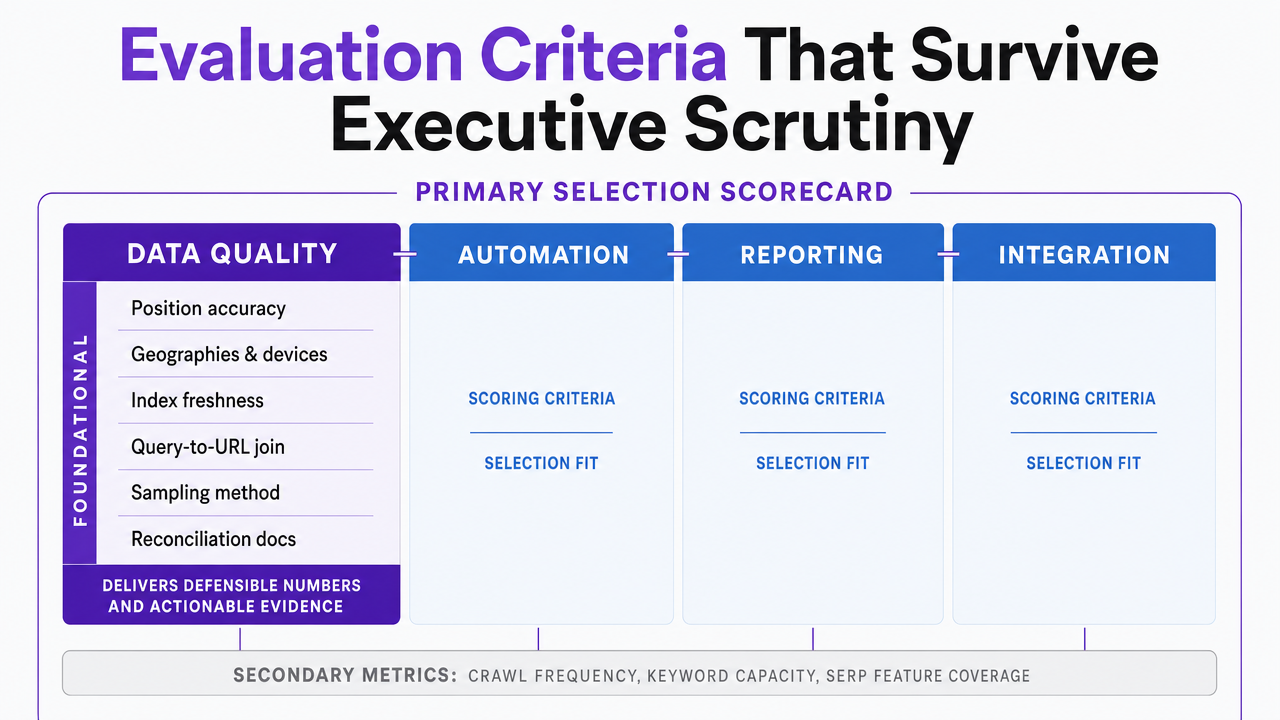 Visualize the four Forrester evaluation dimensions cited in the section (data quality, automation, reporting, integration) as a scoring framework buyers can apply
Benchmarking Before Procurement: Setting the Baseline Contract
Procurement discussions are more productive when a documented baseline is established before product demonstrations. Enterprise rank trackers are easier to compare and hold accountable when the buyer presents documented starting values for traffic, keyword rankings, and conversion rates across the segments to be tracked 10. Vendors unable to replicate these baselines within their own data model during a trial period signal potential integration issues.
The baseline contract comprises three components:
- A documented snapshot of query-level metrics for the portfolio at the cohort granularity the tracker must support: impressions, clicks, CTR, and average position for each intent tier and page template 3.
- The conversion rate associated with each cohort, derived from organic-filtered analytics to ensure defensible reference points 2.
- A target set of health indicators, including indexation coverage, template-level structured data status, and crawl anomaly counts, which the tracker will monitor alongside performance 4.
Framed this way, the baseline transforms into a procurement artifact rather than a mere wishlist. It provides the vendor with a scoring rubric during the trial and equips the VP with a defensible metric to justify the tracker's renewal based on pipeline outcomes.
See How Leading Enterprises Monitor SEO Performance at Scale
Request a walkthrough of enterprise-grade rank tracking, data consolidation, and automated reporting workflows designed to support high-volume SEO teams managing complex multi-domain portfolios.
If You Manage Multiple Locations or Brands: The Consolidation Economics
Where Fragmented Rank Tools Inflate Cost Per Insight
While the preceding sections assume a single-brand portfolio, this section addresses VPs managing multi-location operations, franchise networks, or multi-brand portfolios, where the economics of rank tracking shift significantly.
Fragmentation often arises from acquisitions or gradual expansion. For instance, a regional group acquires three practices, each with existing rank tracker contracts. A DSO integrates a new brand already using a mid-market tracker. Within a few years, the parent organization finds itself managing multiple platforms, taxonomies, and billing cycles, lacking a consistent method to compare visibility across markets. The primary cost isn't the visible and negotiable license fees, but the analyst hours spent reconciling disparate exports before any executive can discern portfolio-level trends.
This reconciliation burden undermines the benchmarking discipline crucial for effective evaluation. Establishing baseline traffic, keyword rankings, and conversion rates across markets necessitates a consistent query granularity, intent taxonomy, and organic-filtered conversion definitions across all locations 10. Multiple tools inevitably produce inconsistent data grains. Analysts then spend reporting cycles rebuilding a common schema instead of interpreting data, causing the cost per defensible insight to escalate with each added location. Forrester's evaluation dimensions—data quality, automation, reporting, and integration—all degrade when the tracker layer is fragmented across multiple vendors 13.
A Variable-Based Model for Locations, Keywords, and Analyst Hours
The argument for consolidation is more compelling when presented as a variable model rather than a mere sales pitch. The inputs a VP already possesses are sufficient to quantify the operational load without inventing financial figures.
Let L represent the number of locations or brands managed, K the average keyword universe tracked per location, H the analyst hours required for one report cycle at that location, and R the number of report cycles per quarter. The total quarterly analyst load under fragmented tooling is approximately L × H × R, where H is inflated by the reconciliation work eliminated by a single-schema tracker. The keyword universe K influences license cost and also drives taxonomy work: intent tier, page cohort, and funnel stage assignments must be maintained for each location under fragmentation, but only once under consolidation 3.
| Variable | Fragmented Tooling | Consolidated Tracker |
|---|---|---|
| Locations tracked (L) | Per-tool licenses | Single instance, all L |
| Keyword universe (K) | K maintained per tool | K maintained once |
| Analyst hours per cycle (H) | H + reconciliation overhead | H, no reconciliation |
| Report cycles per quarter (R) | L × H × R | H × R at portfolio grain |
The crucial outcome is not the license cost difference, but whether a CRO can access a single view displaying position, click behavior, and organic-filtered conversion outcomes at portfolio, brand, and location levels without requiring an analyst to compile it 2. Benchmarking against a shared baseline makes rank movement defensible across markets 10, and shared baselines necessitate a single schema, not multiple.
From Ranking Signal to Approved Execution
A rank tracker that generates alerts without subsequent action is merely a subscription, not a functional system. The measurement stack must complete the loop: a position change within a segmented cohort should trigger a prioritized recommendation, route to a human approver, and, once approved, initiate the necessary content, technical, or on-page work. Rank data thus becomes an input for execution, not the final deliverable.
An effective workflow involves the tracker detecting a movement, such as a solution-page cohort losing two positions on commercial-intent queries. Query-level metrics confirm the signal's validity: impressions remained stable, clicks decreased, and CTR compressed 3. The organic-filtered conversion view reveals that the affected URLs are above a cohort with a historically significant conversion rate 2. This combination generates a ranked recommendation, not just a raw alert, providing the strategic rationale a VP needs for quick approval or decline.
An approval-first workflow is vital because it safeguards two non-delegable responsibilities of a marketing VP: brand judgment and prioritization authority. Automation handles signal detection, response ranking, and execution of approved tasks. Humans retain the final sign-off. Platforms built around this loop, including Vectoron, treat rank data as the catalyst for a governed decision cycle, rather than just a report to be observed. This is the operational model enterprise rank tracking should adopt when a VP must justify renewals based on pipeline outcomes, not merely a feature checklist 13.
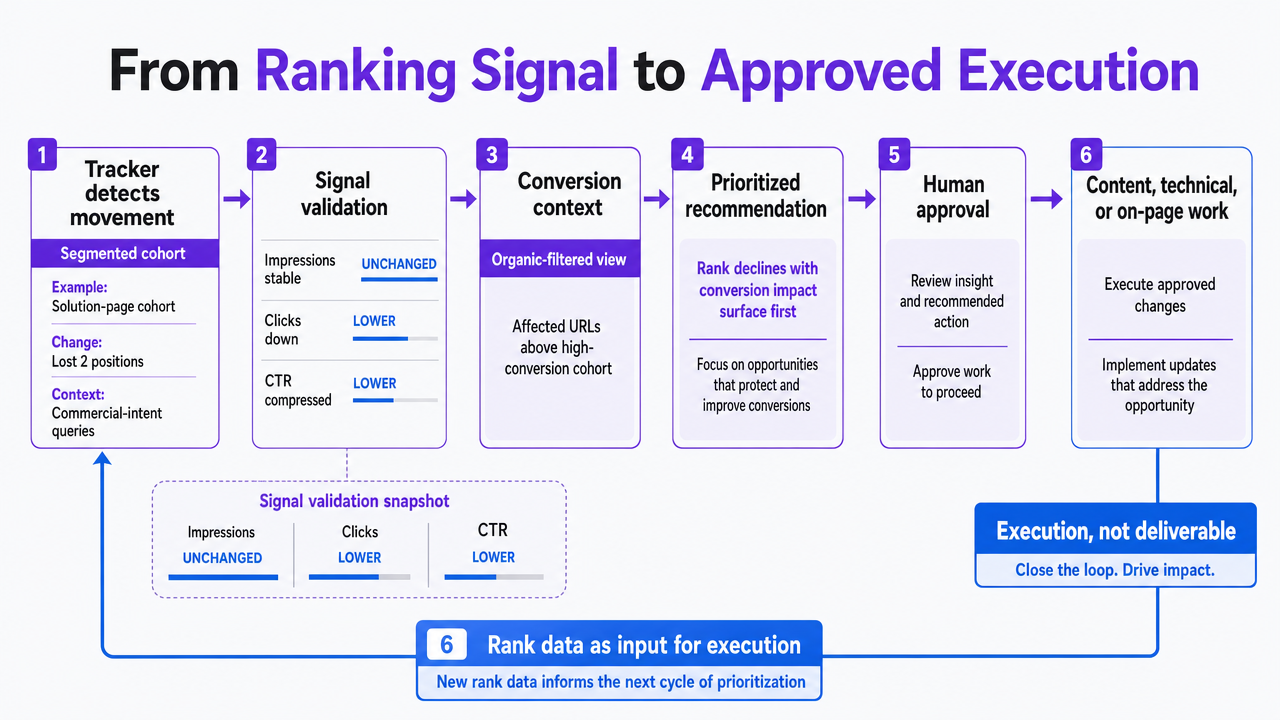 Illustrate the section's described closed-loop workflow from rank signal detection through human approval to execution — a process flow directly narrated in prose
Defending or Killing Rank Reporting in the Boardroom
Rank reporting earns its place in a board deck only when it functions as a leading indicator for pipeline. Before the next quarterly review, a VP should ask whether a hypothetical 15% gain in average position across the commercial-intent cohort would impact the qualified-lead forecast, and by how much. If the answer is indifferent, the report should be either eliminated or reframed.
Defensible rank reporting possesses three key attributes:
- It is filtered to cohorts that convert, using organic-source analytics as the definitive measure 2.
- It combines position with query-level metrics that describe demand capture, rather than presenting position alone 3.
- It is benchmarked against a documented baseline for traffic, rankings, and conversion rates, ensuring that any movement is evaluated against a reference already familiar to the CFO 10.
When these attributes are absent, discontinuing the report is the appropriate action. Replace it with a visibility-to-pipeline view that illustrates position changes, click behavior, and organic-filtered conversion outcomes for the cohorts that drive the business. Such a view withstands executive scrutiny. A raw ranking table does not, and its continued presentation undermines the credibility of all other SEO metrics presented by the marketing organization.
Frequently Asked Questions
References
- 1.Search engine optimization | Digital.gov.
- 2.SEO Process | Ohio State Marketing and Communications.
- 3.How to Use the Google Organic Search Report | Ohio University.
- 4.Tracking the Right Higher Education SEO Metrics for Marketing Success.
- 5.Understanding Digital Marketing - International Trade Administration.
- 6.Frequently Asked Questions - USDA.
- 7.SEO-Best-Practices - CT.gov.
- 8.Search engine optimisation (SEO) strategy as determinants to ... - PMC.
- 9.Blogging for Manufacturers: 5 Reasons You Need a Company Blog.
- 10.Six Ways to Improve Your Site's Ranking (SEO).
- 11.Content and SEO - UMSL.
- 12.[PDF] VIRTUAL INTERNATIONAL MARKETING Handbook.
- 13.The Forrester Wave™: Search Engine Optimization Solutions, Q3 2025.