
Key Takeaways
- Treat Google Search Console as a reconciliation dataset rather than a rank tracker, since its blended average positions and export ceilings distort competitive views for multi-location portfolios 1, 15.
- Score vendors on measurement fidelity using distinct properties—accuracy, precision, recall, freshness, and AI citation share—so procurement moves past dashboard aesthetics into defensible terms 2, 8.
- Require volatility-aware crawl cadence and per-query SERP feature timelines, because static weekly snapshots misread categories the DataForSEO index scores at 6 or higher 12.
- Insist on native AI visibility tracking with disclosed prompt-run frequency and shared query keys, since AI answers are non-deterministic distributions rather than single observations 8, 9.
- Vet inbound GSC reconciliation, outbound BI feeds, and analytics join keys before the second demo, or rank data becomes a second source of truth that stakeholders stop trusting 10, 14, 15.
- Tie rank movement to CAC, LTV, and pipeline segments finance already reports, because CFOs fund measurement systems that defend organic revenue attribution, not share-of-voice charts 7, 11, 16.
- Portfolio operators should test the data model for consistent join keys and segmented rollups across clients, since each property carries its own GSC cap and dimension multipliers 10, 15.
- Run a six-step evaluation covering reconciliation, precision, ingestion, volatility, AI visibility, and reporting fit before signing, separating measurement systems from decorative dashboards 1, 2, 14.
The measurement problem behind vendor demos
Most enterprise rank tracking demos open the same way: a polished dashboard, a color-coded position chart, and a keyword count that runs into the hundreds of thousands. What the demo rarely shows is how the vendor's numbers reconcile against Google Search Console, how they hold up when a SERP is redrawn twice in a week, or whether the same query returns a consistent position across two crawls run an hour apart.
For agency SEO leads running delivery across dozens of clients or hundreds of locations, that gap matters. An empirical comparison of Search Console reported positions against observed positions found GSC accuracy degrades sharply for sites whose rankings vary by city, which is exactly the profile of multi-location portfolios 1. Meanwhile, industry practice has moved past position-as-outcome. The current synthesis is to score rankings alongside traffic, revenue, and conversions, not in isolation 16.
The evaluation question is not "which tool tracks the most keywords." It is which platform functions as a defensible measurement system: one that reconciles against an authoritative dataset, exposes its methodology, captures SERP volatility and features, extends into AI answer surfaces, and pushes clean data into the reporting stakeholders already read. The rest of this piece walks through that framework, in the order procurement will need it.
Why Google Search Console is a reference dataset, not a rank tracker
Where GSC's accuracy breaks down at enterprise scale
Search Console is the authoritative view of what Google recorded for a property, and that is precisely why it should anchor an evaluation. It is not, however, a rank tracker. The empirical work comparing GSC's reported positions against observed SERP positions found that the tool was often not terribly accurate on ranking, particularly for sites whose positions shifted meaningfully across cities 1. For an agency running a portfolio of multi-location brands, that failure mode is the norm, not an edge case.
The mechanics behind the drift are worth naming when vendors are in the room. GSC reports average position across every impression a URL received for a query, blended across devices, locales, personalization, and SERP features 15. A query that ranked 3 in Denver and 14 in Miami on the same day does not surface as two separate signals in the default view; it surfaces as an average that describes neither market. The 24-hour performance view narrowed the freshness gap, offering clicks, impressions, CTR, and average position at hourly granularity 13, but averaging behavior is a modeling choice, not a latency problem, so faster data does not fix it.
The takeaway for procurement: GSC is the reference against which independent crawls should be reconciled, not the source of truth for competitive position at the ZIP or device level. Any vendor claiming parity with GSC should be able to explain where its numbers diverge and why.
The export ceilings vendors have to engineer around
Even when GSC is used only as a reconciliation dataset, its export limits shape what an enterprise stack can actually do with the data. Google documents three ceilings that matter for a portfolio of any size:
- The performance report UI caps exports at 1,000 rows 15.
- The Search Analytics API accepts a rowLimit parameter valid from 1 to 25,000 per request 14.
- Beyond the per-call limit, the API and Looker Studio connector cap extraction at 50,000 rows per day per site per search type 15.
Those numbers sound abstract until they meet a real portfolio. A single client property indexing tens of thousands of unique queries per month will exhaust the daily API cap within a handful of dimension combinations. Add device, country, and page-level breakdowns across a book of clients and the ceilings compress further: every extra dimension multiplies row count while the 50,000-per-day cap stays fixed 15.
Google Search Console data ceilings: 1,000-row UI export, 25,000 API rowLimit per request, 50,000 rows/day API and Looker Studio cap per site per search type 14, 15.
This is the point where an evaluation gets specific. A defensible rank tracking platform should show, in writing, how its ingestion layer handles paging, dimension splits, and daily cap exhaustion. Ask how the vendor stitches partial daily pulls into a continuous history, how it flags days when the cap truncated results, and whether its independent SERP crawls fill the gaps GSC will not export. Vendors that hand-wave the answer are shipping dashboards on top of incomplete pulls, and the reporting downstream will inherit the same holes.
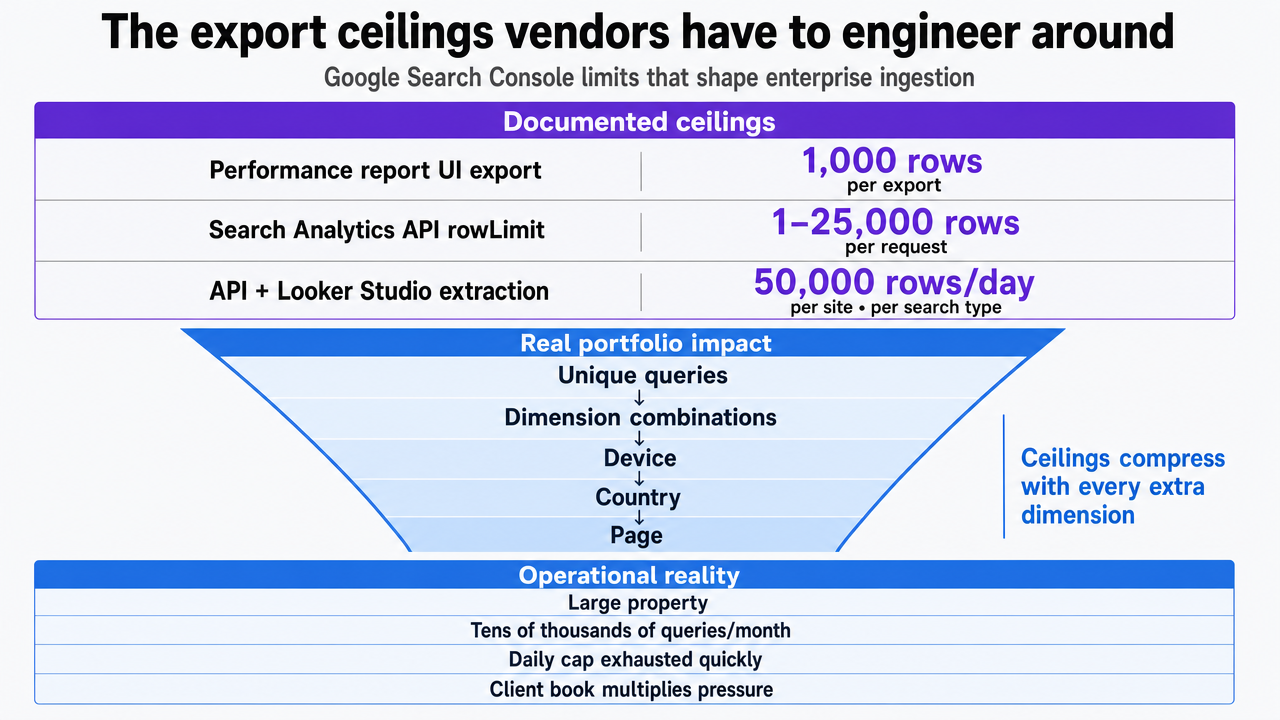 Visualize the three Google Search Console export ceilings cited in the prose so buyers can reference the actual limits when auditing vendor ingestion
Scoring vendors on measurement fidelity
Accuracy, precision, recall, freshness: a working vocabulary
Vendor conversations tend to collapse into a single word: accuracy. That is not enough language to run a procurement process. Search evaluation literature separates the concept into distinct properties, and borrowing that vocabulary lets an agency lead score platforms on defensible terms rather than dashboard aesthetics. The clearest framing comes from the search metrics tradition: accuracy is how close a measurement sits to the true or accepted value, while precision is how close repeat measurements of the same item sit to each other 2. A tracker that returns position 4, 7, and 12 for the same keyword across three back-to-back crawls has a precision problem, regardless of what its average looks like next to Search Console.
Four properties belong on the scorecard:
Accuracy : Asks whether the reported position matches an observed SERP pulled at the same moment from the same locale and device.
Precision : Asks whether the tracker returns consistent numbers on repeat pulls when nothing about the SERP has moved.
Recall : Borrowed from the same evaluation tradition 2, asks what share of the queries that should be tracked are actually being captured, including long-tail terms that never surface in a UI export.
Freshness : Asks how quickly a ranking change reaches the dashboard; Google's 24-hour Search Console view sets a practical floor for what enterprise teams now expect, with hourly granularity on clicks, impressions, CTR, and average position 13.
A five-pillar measurement fidelity scorecard: accuracy against observed SERPs 2, precision across repeat crawls 2, freshness benchmarked to the 24-hour Search Console view 13, coverage/recall across the full query set 2, and AI citation share across AI Overviews, ChatGPT, Perplexity, and Gemini 8.
A fifth pillar now sits alongside the classical four: AI citation share, or the rate at which a brand appears or is cited in AI-generated answers across surfaces like AI Overviews, ChatGPT, Perplexity, and Gemini 8. Enterprises that skip this dimension are scoring vendors on a 2022 problem.
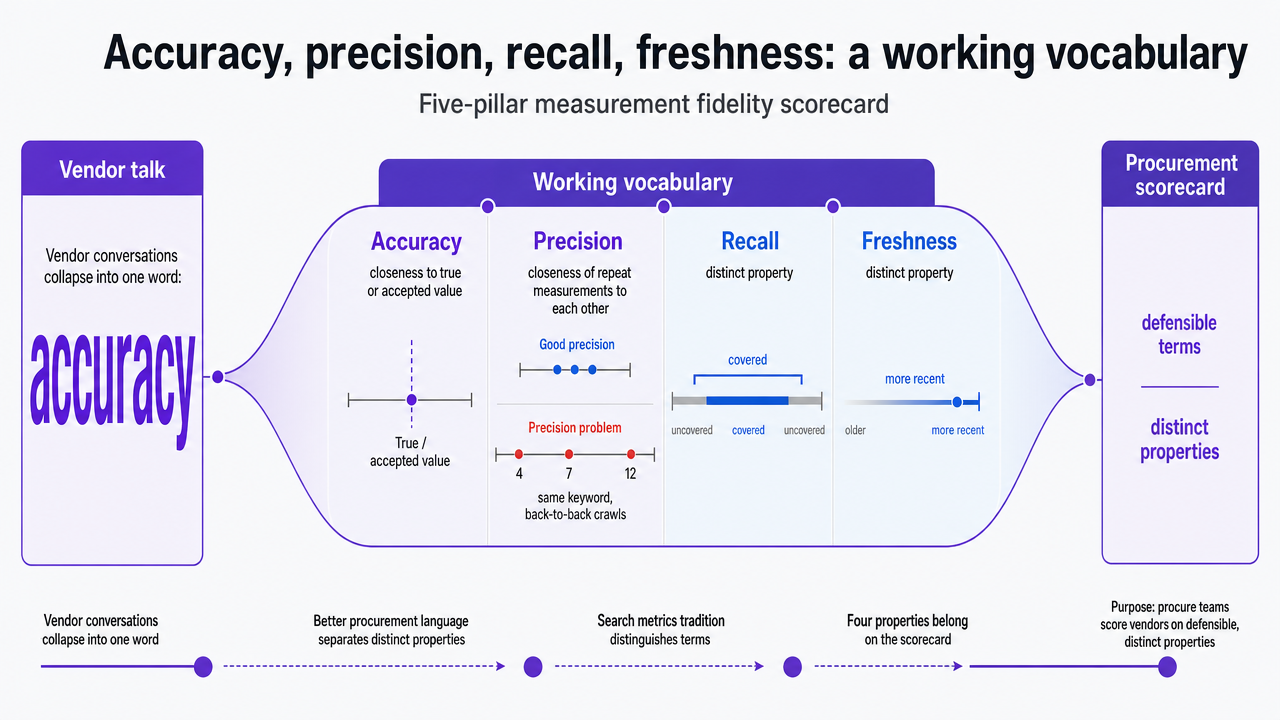 Codify the five-pillar measurement fidelity scorecard introduced in the section so procurement teams can score vendors on defensible, distinct properties
The reconciliation question every vendor should answer
Score the scorecard by asking one question in writing: when your reported position disagrees with Google Search Console for a given query, URL, and date, how do you decide which number is correct, and what do you show the customer? A serious platform has a documented answer. A weak one changes the subject to crawl frequency or keyword volume.
The answer should cover three mechanics:
- Sampling: how the vendor draws locale, device, and personalization state for each crawl, and how those choices explain divergence from GSC's blended average position across every impression a URL received 15.
- Cadence: how often positions are refreshed for tracked terms versus incidental terms, and how that cadence compares against the hourly signal now available in Search Console's 24-hour view 13.
- Disclosure: whether the interface flags days when its own crawl failed, when GSC data was truncated by daily row caps, or when the two datasets simply disagree beyond a defined threshold.
Vendors that surface reconciliation openly are betting their reputation on measurement fidelity. Vendors that hide it are betting the buyer will not check. The distinction matters most when a client's revenue team asks why the tracker shows position 3 and their own manual check shows position 9, which happens on any multi-location account with enough surface area to be worth tracking 1.
Test enterprise rank tracking at real project scale
Experience live keyword monitoring and reporting across multiple domains before making a commitment.
SERP volatility and feature presence as first-class criteria
A weekly rank pull is a photograph of a moving object. DataForSEO's SERP Volatility Index quantifies exactly how much motion is present: daily changes in Google and Bing rankings scored on a 1–10 scale, where 1 signals minimal shift and 10 signals dramatic algorithm updates, calculated by continuously analyzing SERPs for a fixed set of categorized keywords across industry, product, and service segments 12. When the index reads 6 on a Tuesday for a client's category, a Monday snapshot and a Friday snapshot describe two different SERPs, and the delta reported to stakeholders is measurement noise dressed as strategy.
The SERP Volatility Index scores daily ranking movement from 1 (minimal change) to 10 (dramatic algorithm shift), segmented by industry and product category, exposing why static weekly rank pulls misrepresent performance in volatile categories 12.
Two capabilities separate serious platforms from decorative ones:
- Crawl cadence tied to volatility, not calendar. A tracker that can raise crawl frequency when a category's index climbs, and lower it when the SERP is quiet, produces cleaner trend lines and lower infrastructure cost than a fixed weekly job.
- Segmented volatility reporting: the ability to show a client that finance queries moved at a 7 last week while their tracked brand terms sat at a 2, which is the difference between an algorithm story and a content story.
Feature presence belongs on the same evaluation line. A number-three position beneath an AI Overview, a local pack, a video carousel, and a People Also Ask block is not the same asset as a number-three position on a clean ten-blue-links SERP. Vendors should track which SERP features appear for each query, how often, and how their presence correlates with click-through on the tracked URL. Without that layer, position data cannot be tied back to traffic or pipeline, which is where every reporting conversation eventually lands 16. Ask each vendor for a per-query feature timeline and a volatility-adjusted trend view. Platforms that cannot produce either are selling snapshots.
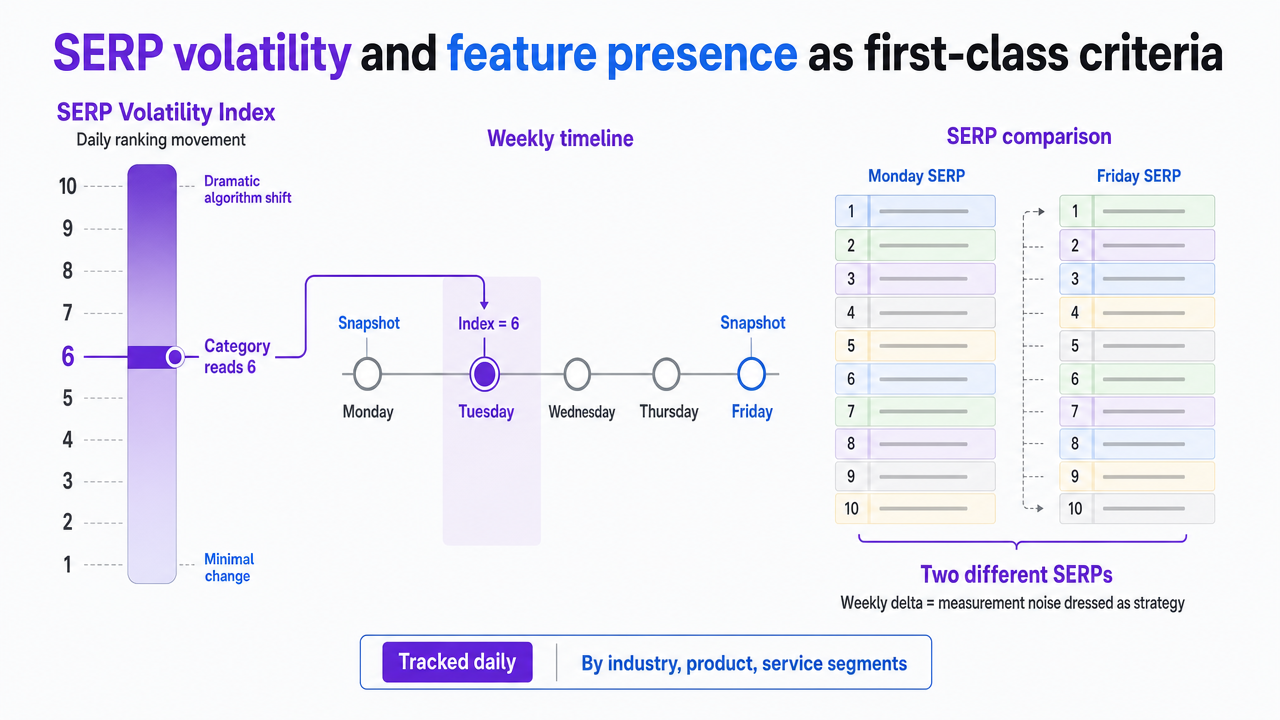 Show the 1 to 10 SERP Volatility Index scale cited from DataForSEO so readers can see why weekly snapshots misrepresent high-volatility categories
The AI visibility layer procurement can no longer skip
The measurement problem has widened. Enterprise SEO programs in 2026 are being scored on how a brand appears in AI-generated answers across Google AI Overviews, Google AI Mode, ChatGPT search, Perplexity, Gemini, Claude, and Grok, not only on where a URL ranks in ten blue links 9. A rank tracker that reports only classical positions is answering last cycle's question.
Three metrics are hardening into procurement requirements:
AI citation share : Captures how often a brand is cited in AI-generated answers relative to the competitive set 8.
Answer presence rate : Measures whether the brand appears at all for a tracked prompt, cited or not 8.
Brand mention share : Extends the same logic across AI surfaces to give portfolio-level share of voice 8.
Current practitioner guidance for enterprise programs now recommends tracking AI citation frequency and share of voice across AI platforms alongside organic revenue attribution and pipeline contribution, not as a parallel dashboard 7.
The methodological catch is that AI answers are non-deterministic. The same prompt returns different citations across sessions, models, and days, which means a single observation is not a measurement; it is a sample. Serious platforms treat AI visibility as a distribution over time rather than a snapshot 9. Ask each vendor how many prompt runs per tracked query per day feed its citation share number, how it handles model version changes, and whether it separates cited mentions from uncited references in the answer body.
Two evaluation questions cut through the marketing:
- Does the platform track AI surfaces natively, or does it stitch in a third-party feed that will change contract terms independently of the primary tool?
- Can AI citation data be joined to the same query and URL keys as classical rank data, so a single report shows position, feature presence, and citation share side by side?
Platforms that keep AI visibility in a separate tab are shipping two products under one login, and reporting downstream will show the seam.
Integrations, reporting, and the CFO conversation
Where rank data has to land in the existing stack
A rank tracker that lives in its own tab is a rank tracker that gets cut in the next budget review. Enterprise SEO programs already run on a crowded stack — Search Console, Bing Webmaster Tools, GA4, and specialized platforms like BrightEdge, Conductor, seoClarity, Ahrefs, SEMrush, Searchmetrics, and Siteimprove sit alongside internal BI 3. Adding a rank tracker that does not read from and write into that ecosystem creates a second source of truth, which is the fastest way to lose stakeholder trust when two dashboards report different numbers.
Three integration surfaces carry the weight:
- Inbound reconciliation: a live GSC connection that respects the 25,000-row per-request API limit and the 50,000-rows-per-day-per-site cap, with logic that pages through query and page dimensions without silently truncating 14, 15.
- Outbound feeds to BI. Enterprise dashboards routinely combine rank, traffic, and technical health across domains through automated data pipelines 10; a tracker that only exports CSVs forces analysts to rebuild that pipeline manually every reporting cycle.
- Analytics join keys. Rank data needs to reach GA4 or the warehouse on the same query, URL, device, and locale keys the traffic data uses, or attribution breaks at the join.
Ask each vendor for a data dictionary and a sample warehouse schema before the second demo. Vendors that cannot produce either are not built for enterprise reporting.
Reporting on CAC, LTV, and pipeline, not positions
The CFO does not care about position 3. The CFO cares whether organic search is lowering customer acquisition cost, extending lifetime value, and contributing pipeline that would otherwise come from paid channels. Enterprise reporting practice has already moved there: stakeholder-grade SEO reports now include ROI, LTV, and CAC alongside ranking and traffic data 11, and current enterprise guidance treats organic revenue attribution and pipeline contribution from organic traffic as primary metrics, with keyword visibility and AI citation frequency feeding those top-line numbers rather than replacing them 7.
A rank tracker earns its line item by making that chain of custody defensible. Position feeds impressions, impressions feed clicks, clicks feed sessions, sessions feed conversions, conversions feed pipeline and revenue. Practitioner synthesis is explicit on this point: rankings should be tracked with traffic, revenue, and conversions, not treated as the end goal, and volume-of-keywords does not matter if those terms do not move business metrics 16. A platform that surfaces a share-of-voice number without a plausible path to CAC or pipeline is a decorative dashboard.
Two capabilities separate the contenders:
- Segmented rollups that map to how finance already reports revenue — by product line, market, or client — so rank movement can be tied to the same P&L slices.
- Exportable trend data at a cadence that matches the CFO's reporting rhythm, monthly or quarterly, without the analyst hand-editing rows.
See How Enterprise SEOs Streamline Rank Tracking at Scale
Request a walkthrough of advanced rank tracking workflows designed for agencies managing multi-location and multi-domain portfolios. Get data-backed insights on workflow efficiency, reporting, and integration capabilities for complex SEO operations.
If you manage a portfolio: segmentation and consolidation at scale
The framework so far assumes a single enterprise brand. The math changes when the reader is an agency SEO lead running delivery across a book of clients, or an in-house team managing hundreds of locations under one parent. At that scale, the evaluation shifts from measurement fidelity per property to segmentation and consolidation across a portfolio, and most mid-market rank trackers were not architected for either.
Start with the dimensions that multiply. A single multi-location client tracked across five markets, two devices, three locales, four AI surfaces, and a competitor set of six brands produces thousands of dimension combinations before any long-tail terms enter the picture. Every combination hits the same Google Search Console ceilings: 25,000 rows per API request and 50,000 rows per day per site per search type 14, 15. A portfolio of twenty such clients does not get twenty times the API budget; each property gets its own cap, but the ingestion layer, warehouse joins, and reporting pipelines are shared.
| Tracking dimension | Data volume implication | GSC ingestion impact | Reporting rollup need |
|---|---|---|---|
| Keywords per market | Linear growth per location | Consumes daily 50,000-row cap per property 15 | Per-market and parent-brand views 10 |
| Devices and locales | 2–3x dimension multiplier | Requires paged API pulls under 25,000 rowLimit 14 | Device-split trend lines 10 |
| AI answer surfaces | Non-deterministic, multi-sample | Outside GSC; separate ingestion 8 | Citation share by surface 9 |
| Competitor sets | Independent SERP crawls only | Not exportable from GSC | Share of voice by segment 11 |
Two capabilities decide whether a platform holds up:
- Portfolio-level rollups need consistent join keys across clients so a parent view reports on the same query, URL, device, and locale schema every property uses 10.
- Segmented consolidation needs client, market, and product-line groupings that map to how each client's finance team already reports revenue, so rank movement lands next to CAC and LTV without an analyst rebuilding the pipeline every month 11.
Vendors that treat multi-tenant reporting as a workspace-switching feature, rather than a data-model feature, will force the delivery team to maintain the consolidation logic in spreadsheets. That is the tax that shows up as a rebuilt stack every eighteen months.
A short evaluation sequence before you sign
Procurement runs cleaner when the framework collapses into a sequence a delivery team can execute in a two-week window. Six checks, in order.
- Reconciliation test. Pick fifty queries across three properties. Pull the vendor's reported position, the observed SERP from the same locale and device at the same moment, and the Search Console average position for the same date range. Ask the vendor to explain divergences in writing before the next call 1, 15.
- Precision test. Run the same tracked query set on the vendor's platform three times in a two-hour window. Measure how far repeat positions drift when the underlying SERP has not moved 2.
- Ingestion audit. Ask the vendor to document how it pages the Search Analytics API against the 25,000-row per-request limit and the 50,000-rows-per-day-per-site cap, and how the interface flags truncated days 14, 15.
- Volatility and feature check. Request a segmented volatility view for the client's category and a per-query SERP feature timeline for a sample set 12.
- AI visibility check. Confirm citation share and answer presence rate are joined to the same query and URL keys as classical rank data, with disclosed prompt-run frequency 8, 9.
- Reporting fit. Ask for a warehouse schema and a sample rollup that maps rank movement to CAC, LTV, and pipeline segments the CFO already reads 7, 11.
Vendors that clear all six ship measurement systems. The rest ship dashboards. Platforms like Vectoron sit adjacent to this decision by routing the approved measurement work, and the execution downstream from it, through a single approval loop rather than a second stack.
Frequently Asked Questions
References
- 1.How accurate is Google Search Console ranking data? A study..
- 2.Metrics to evaluate Search Results | Niklas Heidloff.
- 3.Enterprise SEO Tools - Overdrive Interactive.
- 4.Best Enterprise SEO Tools for 2024: Choosing the Right One.
- 5.The Best Enterprise SEO Tools and Software 2026 - Prosperity Media.
- 6.Best Enterprise SEO Reporting Software 2026 - Worldmetrics.
- 7.Enterprise SEO: The Complete Strategy Guide for 2026 - Rankmax.
- 8.AI Search Optimization for Enterprise Brands in 2026 | AEO & GEO.
- 9.Brand Visibility in AI Search Engines: 9 Strategies - Percepture.
- 10.Enterprise SEO Dashboard Examples & Reporting Templates.
- 11.Creating Enterprise SEO Reports for Stakeholders - StudioHawk.
- 12.SERP Volatility Index - DataForSEO.
- 13.An improved way to view your recent performance data in Search Console.
- 14.Search Analytics: query | Search Console API - Google for Developers.
- 15.A deep dive into Search Console performance data filtering and limits.
- 16.Rank Tracking: How To Do It The Right Way.