
Key Takeaways
- Evaluate enterprise SEO platforms by hours removed per account, not feature parity, since workflow absorption now decides ROI more than crawl depth or keyword database size 1.
- Treat platforms as capacity infrastructure because application-layer AI spending concentrates budget on software that performs work rather than software that describes it 5.
- Score each tool category honestly: crawl platforms remove detection hours, keyword tools compress research, optimization suites route recommendations, and only execution platforms close the production gap 3, 4.
- Judge platforms against six criteria — scale, workflow automation, AI execution depth, approval governance, integration surface, and AI Overviews alignment — that each map to hours removed 2, 18.
- Build the delivery-hours worksheet before any demo, listing recurring deliverables and current hours per account so vendors must answer which rows they collapse and by how much.
- Adjust weightings for multi-location portfolios, where per-location editing, GBP write-back, and rolled-up reporting matter more than total URL crawl coverage.
- Watch for four failure modes — buying on crawl depth, ignoring approval governance, skipping reporting automation, and missing the integration audit — that quietly add headcount by month six 4.
- Run vendor reviews on a weighted scorecard with sandbox task-completion tests against live accounts, cross-referenced with independent scoring, to identify the platform that removes the most hours under defensible governance 19.
The buying question has changed: labor substitution, not feature parity
For most of the past decade, the head of SEO at a multi-account agency evaluated enterprise platforms the way a systems buyer evaluates any large SaaS purchase: crawl depth, keyword database size, rank tracking accuracy, log file support, API limits, dashboard flexibility. Forrester's own framing of the category treats the platform as the data, workflow, and reporting spine for organic performance across large digital properties 1. That framing is still correct. It is no longer sufficient.
The variable that now decides platform ROI is not feature parity. It is how many hours of specialist labor the platform actually removes from each client account per month. An agency running 40 accounts with a senior-to-junior ratio of 1:4 does not need a richer keyword database. It needs auditing, prioritization, briefing, on-page execution, and reporting to consume fewer analyst hours per account without degrading output quality.
The Forrester Wave Q3 2025 evaluation of SEO providers scored vendors on the enterprise-grade capabilities that separate contenders from point tools 19. Read that scorecard through a delivery-capacity lens rather than a feature lens, and the shortlist shifts. Platforms that only inform an analyst score lower. Platforms that execute governed work under human approval score higher. The rest of this article treats capacity per FTE as the primary evaluation axis.
Why enterprise SEO platforms are now evaluated as capacity infrastructure
Capital flows explain the reclassification. Enterprise AI spending grew from $1.7 billion in 2023 to $37 billion in 2025, with $19 billion of that total concentrated in the application layer — the same layer where marketing and SEO platforms sit alongside sales, support, and knowledge tools 5. That is not a story about smarter dashboards. It is a story about buyers routing budget toward software that performs work, not software that describes it.
The consequence for SEO tool selection is direct. When the category was defined by data quality and reporting depth, the head of SEO could rank vendors on crawl fidelity and keyword coverage and be done. Forrester's own category description still names data, workflow, and reporting as the platform's job 1. The weight inside that triad has shifted. Workflow — the part that removes hours from analysts — is now the axis buyers pay for.
Sure Oak's enterprise selection guide already frames the question this way, telling buyers to ask whether a platform can track pages and searches in the millions and coordinate tasks across channels, not just report on them 2. That question is a capacity question. It assumes the platform will absorb coordination work that used to live inside a project manager's inbox.
Read against the Forrester Wave Q3 2025 scorecard, the vendors clustering at the top are the ones treating SEO as an operating system for delivery rather than a diagnostic surface 19. Agency leaders evaluating platforms in this window are not buying analytics. They are buying capacity, and the P&L math only works if the platform is measured that way.
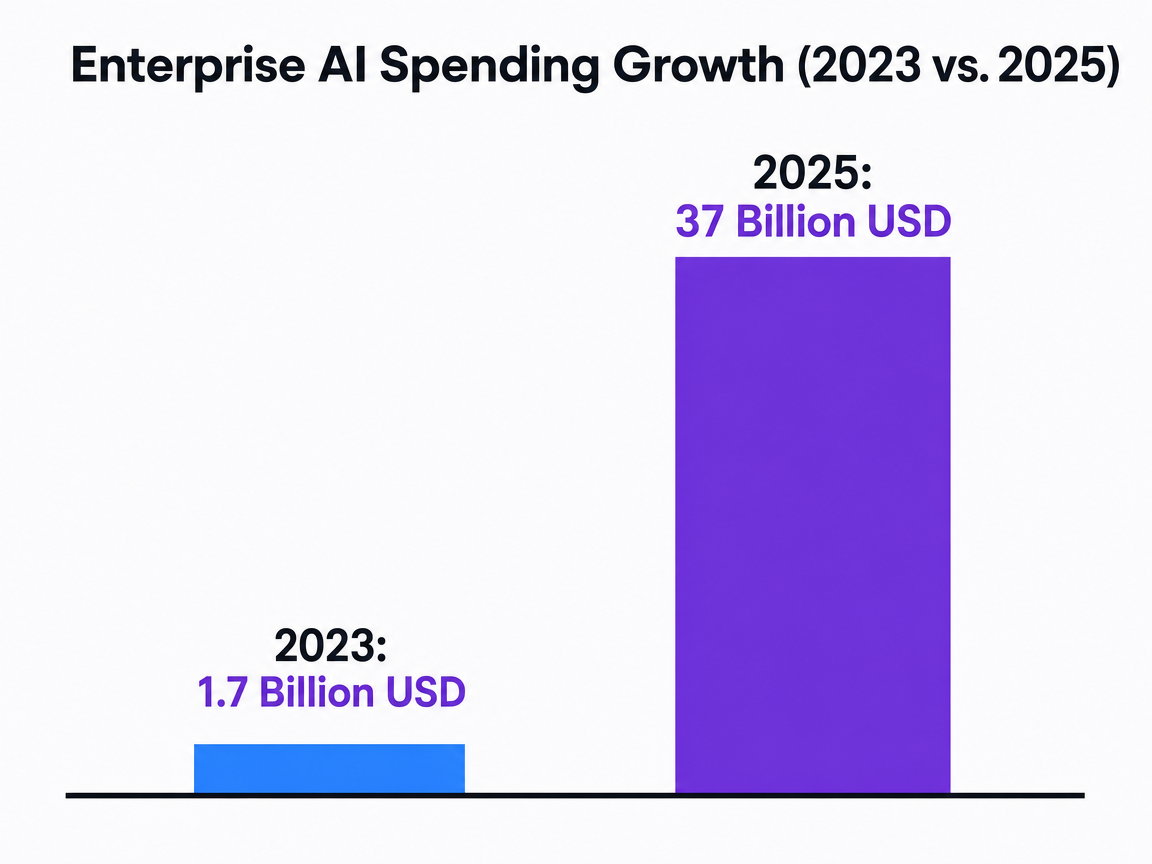 Enterprise AI Spending Growth (2023 vs. 2025)
Comparison of total enterprise AI spending in 2023 versus the estimated spending in 2025, showing significant growth from $1.7B to $37B.
The labor-substitution rubric: what each tool category actually removes from delivery
Crawl and monitoring platforms (Botify, Lumar): what they take off the analyst's desk
Crawl-and-monitoring platforms earn their line item by absorbing the work that used to sit inside a senior technical analyst's week: full-site crawls at scale, log file ingestion, index bloat detection, JavaScript rendering audits, and regression alerting on template changes. For a portfolio of enterprise properties in the millions of URLs, that is meaningful hours reclaimed — Sure Oak's enterprise criteria specifically name the ability to track pages and searches in the millions as a baseline requirement 2.
What this category does not remove is the interpretive layer. Botify or Lumar can flag that 40,000 URLs have shifted to noindex after a deploy, but a human still writes the ticket, prioritizes the fix against release calendars, and coordinates with the client's dev team. The delivery-hours reduction is real on detection and monitoring. It is minimal on remediation and stakeholder communication, which is where account hours actually accumulate.
Keyword and market intelligence platforms (Semrush Enterprise, seoClarity): informing vs. executing
Keyword and market intelligence platforms compress research time. Semrush Enterprise and seoClarity give a strategist SERP composition, share-of-voice movement, competitor gap analysis, and topic clustering in minutes instead of days. For agencies running 40-plus accounts, that compression is the difference between a monthly refresh and a quarterly one.
The category ceiling is structural. These platforms inform decisions; they do not execute them. A ranked list of 300 opportunity keywords still requires an analyst to filter by client intent, map to existing URLs, write briefs, and hand production to a writer. Ovrdrv's category overview describes keyword platforms as delivering insight and coordination benefits, not production output 3. Agency leaders modeling capacity should credit this tier for research hours removed and stop there — not for briefing, drafting, or on-page implementation, which is where the account P&L actually bleeds.
Content optimization platforms (Conductor, BrightEdge): where recommendations stop short of production
Conductor and BrightEdge sit one step closer to execution. They score existing pages against target queries, suggest heading changes, surface internal linking opportunities, and route recommendations into workflow queues that a content team can action. For enterprise programs with hundreds of live pages under continuous optimization, that is genuine coordination lift.
The recommendation-to-production gap is the boundary. The platform will tell an editor that a service page should add three subtopics and revise the H2 hierarchy. It will not draft the new copy, publish the revision to the CMS, refresh internal links across the site, or verify the change in the next crawl. SEO Power Plays lists exactly this oversight — buyers focusing on features while ignoring workflow and collaboration depth — as a common selection mistake that quietly raises manual effort after signing 4. Credit this tier for recommendation quality and prioritization. Do not credit it for production hours it cannot absorb.
Execution platforms (including Vectoron): governed AI that closes the last mile
Execution platforms are the newest category and the one the Forrester Wave Q3 2025 evaluation increasingly rewards on enterprise-grade capability scoring 19. The distinguishing behavior is production output: the platform doesn't just recommend a brief, it drafts the content, proposes the on-page changes, updates internal links across affected templates, and stages the work for human approval before publishing. McKinsey frames this shift as purpose-built AI workflows replacing generic tooling for enterprise marketing operations 20, and Google Cloud's agentic AI trends report identifies the same pattern moving into 2026 21.
Vendors in this tier vary. Some enterprise content-ops platforms bolt AI drafting onto existing optimization suites. Purpose-built execution platforms — Vectoron among them — coordinate specialist AI strategists across content, on-page, and reporting under an approval-first workflow. For the delivery-hours model, this is the only category that removes production and coordination hours simultaneously. Agency leaders should score it against governance depth, not drafting speed.
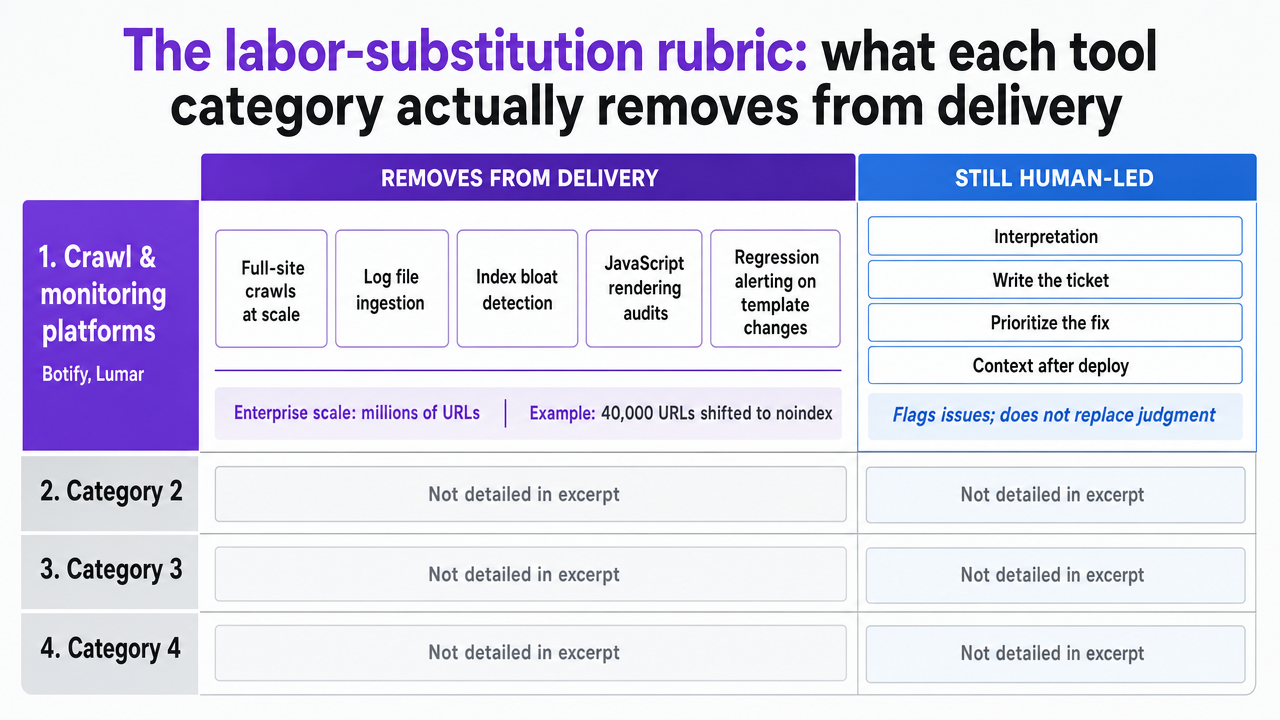 Visualize the four-tier comparison of SEO tool categories and what specialist hours each category absorbs, directly supporting the section's framework
Test Enterprise SEO Execution Without Hiring Up
Experience full-scale SEO content production and workflow automation risk-free for seven days.
Six selection criteria that map to hours removed per account
Scale: crawl depth, entity coverage, and multi-property data unification
Scale is the entry ticket, not the differentiator. Sure Oak's enterprise criteria set the floor at tracking pages, searches, and visits with volume in the millions, plus international coverage where the client footprint requires it 2. A platform that chokes on a 4-million-URL crawl or forces a separate instance per property is subtracting analyst hours in one place and adding them back in coordination.
The variable that actually maps to hours removed is data unification across properties. An agency running a DSO with 380 locations, a national law firm with 26 practice-area subdomains, and a home services franchisor with regional microsites needs one query surface across all of it — not 40 login screens. Score scale on three concrete questions:
- Can the crawler complete a full pass inside the client's release cadence?
- Does entity coverage extend to the vertical taxonomy the accounts actually use?
- Does the reporting layer join first-party analytics without a data engineer in the middle?
Workflow automation: prioritization, briefing, and internal linking as executable steps
Workflow automation is the criterion where the delivery-hours model either works or collapses. The question is not whether a platform surfaces a prioritized task list — most do — but whether that list becomes executable steps without an analyst rewriting it into a brief, a ticket, and a CMS change request.
OpenAI's 2025 enterprise report found that workers using AI save 40–60 minutes per day and 75% report gains in speed or quality, based on surveyed enterprise organizations across ChatGPT and API usage 6. That measurement covers general knowledge work, not SEO specifically, so agency leaders should read it as a directional ceiling on what workflow-embedded AI can compress. Applied to SEO delivery, the compression shows up in briefing (topic clusters converted to structured briefs), prioritization (ranked opportunity queues that respect release capacity), and internal linking (link suggestions rendered as diffs against live templates).
Score this criterion by counting the manual handoffs between recommendation and shipped change. Three or fewer handoffs — recommend, approve, execute — is a workflow platform. Seven or more, and the tool is a report generator wearing a workflow label.
AI execution depth: what the platform produces without an analyst in the loop
AI execution depth measures how much finished work leaves the platform. Not recommendations. Not scored drafts. Shippable output: a completed brief, a revised page body, an updated internal link block, a schema patch, a client-ready monthly report. McKinsey's framing of purpose-built AI workflows for enterprise marketing operations treats production output — not chat interfaces — as the axis where AI compresses delivery cost 20. Google Cloud's agentic AI trends report tracks the same pattern into 2026 as agents move from advisory to operational roles 21.
Agency leaders should test execution depth against a task list, not a demo. For each of the six recurring deliverables in a typical account month — audit, prioritization, brief, on-page revision, internal linking pass, report — ask whether the platform produces the artifact or produces a recommendation about the artifact. The difference is a junior analyst's week.
Approval governance: the checkpoint layer that separates viable platforms from risky ones
Execution depth without governance is a liability. Deloitte's 2026 State of AI in the Enterprise reports that worker access to AI rose 50% in 2025, while only 20% of companies report a mature model for governance of autonomous AI agents 7. That asymmetry is the exact gap enterprise SEO tool selection has to close before scaling execution across client accounts.
For an agency, ungoverned AI publishing is not a productivity story — it is a client-trust story. The head of SEO should require, at minimum, four checkpoint behaviors:
- Every generated artifact routes to a named approver before publish.
- Approvers see the reasoning and source data behind each recommendation.
- Rollback is one-click at the artifact level.
- Audit logs record which human approved which change on which URL.
Gartner's use-case evaluation for B2B marketing weighs execution difficulty alongside business value for exactly this reason — high-value automation without oversight rails scores badly on risk-adjusted outcomes 22.
Approval-first workflow is not a feature toggle. It is the architectural decision that determines whether the platform can be deployed across 40 client accounts without a compliance incident inside the first year.
Integration surface: CMS, analytics, GBP, and ticketing without a middleware team
Integration surface is where hidden headcount lives. SEO Power Plays specifically flags underestimating integration and workflow needs as one of the most common selection mistakes 4. A platform that recommends a page revision but cannot push it into WordPress, Contentful, Sitecore, or the client's custom CMS forces every change through a developer ticket. That ticket is a person.
The minimum integration surface for an agency portfolio:
- Two or three enterprise CMSes the accounts actually run on
- GA4 and the client's data warehouse
- Google Business Profile for multi-location accounts
- Search Console at scale
- The ticketing system the delivery team already uses — Jira, Asana, or Linear
Bonus surface: direct schema deployment, sitemap regeneration, and rank-tracking APIs the client's BI team can query. Score integrations by whether they eliminate a handoff, not by whether they appear on a logo wall.
AI Overviews and quality-signal alignment as a selection input
Traditional ranking coverage is no longer the complete visibility picture. Google's own documentation on AI Overviews describes how the feature synthesizes answers directly inside the results page, with quality and safety filtering applied to which sources surface 18. The Search Quality Rater Guidelines govern the human evaluation layer that shapes what Google considers helpful, and both the overview document and the 2023 simplification update reinforce that quality signals evolve continuously 15, 17.
For tool selection, the practical question is whether the platform's content scoring and recommendations reflect current rater-guideline expectations — experience, expertise, source clarity, topical depth — or whether it still optimizes to a 2019 checklist of keyword density and heading counts. Ask vendors to show how their AI Overview visibility tracking works, how their content recommendations map to helpfulness signals, and how quickly their guidance updates after a rater guideline revision. A platform that treats AI surfaces as a separate report tab, rather than as an input to the same optimization workflow, is one release cycle behind the client's actual visibility problem.
The delivery-hours worksheet: modeling capacity per FTE before the contract is signed
Before any vendor demo, the head of SEO should build the delivery-hours worksheet against the current account model. The exercise is simple: list the six recurring deliverables that consume the majority of specialist time in a typical client month, record the current hours per account for each, and then model what a platform would need to absorb for the account P&L to support 15–20 more accounts without a new analyst hire. The worksheet is what turns vendor scoring from a feature comparison into a capacity decision.
Variables only — the numbers below are placeholders for the agency's own utilization data, not benchmarks.
| Delivery Task | Traditional Model (FTE hrs/account/month) | Platform-Assisted Model (FTE hrs/account/month) | Governance Checkpoint |
|---|---|---|---|
| Technical audit & regression monitoring | Analyst reviews flagged issues before ticketing | ||
| Keyword & topic prioritization | Strategist approves ranked opportunity queue | ||
| Content briefing | Editor signs off on brief structure | ||
| On-page optimization & revisions | Editor approves diffs before CMS push | ||
| Internal linking passes | SEO lead approves link block updates | ||
| Local/multi-location page updates | Account lead approves per-location changes | ||
| Monthly client reporting | Account lead approves narrative & data |
Filled out honestly, the worksheet forces a specific question at each vendor conversation: which of these rows does the platform actually collapse, and by how much. Sure Oak's enterprise criteria already frame tool selection as a task-management and workflow coordination decision 2, and Forrester's platform framing treats workflow as a core capability alongside data and reporting 1. The worksheet operationalizes both. Vendors that cannot answer the row-by-row question are not enterprise platforms for this delivery model — regardless of their crawl depth or keyword coverage.
If the agency serves multi-location clients: where the economics diverge
For agencies whose portfolios lean toward multi-location verticals — dental service organizations, home services franchisors, senior living operators, regional law firms with practice-area subdomains — the delivery-hours model breaks in a specific place. The account is not one site. It is 40, 200, or 800 near-identical location pages, each with unique NAP data, service menus, review signals, and Google Business Profile entries that drift out of sync every quarter.
Traditional platform scoring understates this. A crawl-and-monitor tool that reports beautifully on a 4-million-URL corporate site can still leave a DSO's location-page maintenance to a junior analyst working through a spreadsheet. The hours-per-account math inverts: the account with the smaller total URL count consumes more specialist time because the work is repetitive per-location editing, not portfolio-level strategy.
Score platforms in this segment against three additional questions:
- Can the system generate and update location-specific page content at scale under approval, not just flag inconsistencies?
- Does it write back to Google Business Profile and the client's location data source, or only report drift?
- Does the reporting layer roll up 300 locations into a single client narrative without an analyst rebuilding the deck each month?
Platforms that answer yes to all three are the ones where multi-location economics actually work.
Evaluate AI-Driven SEO Platforms for Scalable Enterprise Execution
Get a data-backed assessment of how unified AI workflows can deliver enterprise-grade SEO across multiple clients—without increasing your internal headcount or losing control over strategy and approvals.
Selection mistakes that quietly raise headcount six months later
The mistakes that cost an agency an extra analyst rarely show up in the demo. They surface in month four, when the platform is live across a dozen accounts and the delivery team is quietly rebuilding workflows the tool was supposed to own. SEO Power Plays names the pattern directly: buyers over-index on price and feature counts while underestimating integration depth, workflow fit, and collaboration surface — the exact areas that determine manual effort after signing 4.
Four failure modes recur:
- Buying on crawl depth alone and discovering the platform cannot push a recommended change into the client's CMS, so every on-page fix becomes a developer ticket.
- Treating AI drafting as the differentiator without checking approval governance, then throttling the platform after the first client escalation.
- Ignoring reporting automation and letting analysts rebuild monthly decks by hand.
- Skipping the integration audit against the account portfolio's actual CMS mix, GBP footprint, and ticketing system — Forrester's platform framing lists workflow and integration alongside data and reporting for exactly this reason 1.
Each mistake reads as a minor gap at signing and as a full-time hire by Q3.
Running the vendor review: a scorecard the head of SEO can bring into the room
The vendor review works when it forces every demo into the same six-column grid. The head of SEO scores each platform on Scale, Data Unification, Workflow Automation, AI Execution Depth, Approval Governance, and Integration Surface — the criteria the earlier sections built out — and weights them against the delivery-hours worksheet. Forrester's platform framing treats data, workflow, and reporting as co-equal capabilities, which is the baseline the scorecard operationalizes 1.
Weight the criteria before the first demo, not after. A reasonable default for a multi-account agency: Workflow Automation 25%, AI Execution Depth 20%, Approval Governance 20%, Integration Surface 15%, Scale 10%, Data Unification 10%. Agencies with heavy multi-location portfolios shift weight toward Integration Surface and Execution Depth. Enterprise programs with single large properties tilt toward Scale and Data Unification.
Score each vendor 1–5 per criterion using evidence from the demo, a sandbox trial against two live accounts, and reference calls with agencies of comparable size. Do not accept feature claims without a task-completion test — the ability to produce a shipped artifact, not a slide. Cross-reference the shortlist against the Forrester Wave Q3 2025 scoring to check for blind spots the internal review missed 19. The platform that wins the scorecard is the one that removes the most hours per account under governance the agency can defend to clients.
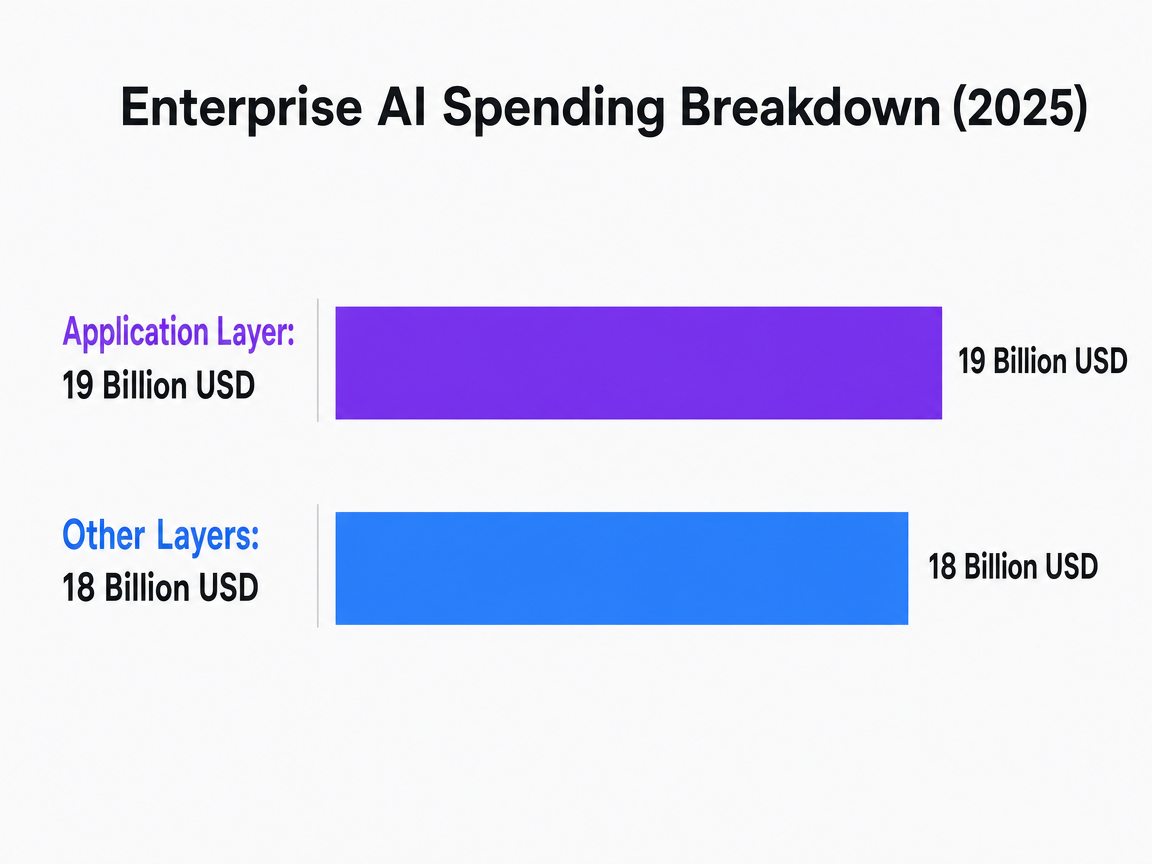 Enterprise AI Spending Breakdown (2025)
Of the $37 billion spent on enterprise AI in 2025, $19 billion is at the application layer, which includes marketing and SEO tools.
Frequently Asked Questions
References
- 1.Every Company Needs An SEO Platform.
- 2.The Enterprise SEO Guide on Tools, Software, and Platforms.
- 3.Enterprise SEO Tools.
- 4.How To Choose the Right Enterprise SEO Platform.
- 5.2025: The State of Generative AI in the Enterprise.
- 6.The state of enterprise AI.
- 7.The State of AI in the Enterprise - 2026 AI report.
- 8.State of Enterprise AI Adoption Report 2025.
- 9.100 AI SEO Statistics (June 2026): Search Trends & AI Visibility.
- 10.How to Scale Recruitment Operations Without Adding Headcount.
- 11.Scaling Revenue Without Adding Headcount.
- 12.Scaling growth and marketing is no longer about adding headcount..
- 13.Unleashing the Power of Digital Marketing: The Digital Maturity Framework.
- 14.AI Risk Management Framework | NIST.
- 15.Search Quality Rater Guidelines: An Overview.
- 16.General Guidelines - RaterHub.com.
- 17.Search Quality Raters Guidelines update - Google for Developers.
- 18.How AI Overviews in Search work.
- 19.Search Engine Optimization Solutions, Q3 2025.
- 20.Transforming the enterprise through AI-powered workflows.
- 21.AI agent trends 2026 report.
- 22.Gartner AI Use Cases for B2B Marketing 2026.