
Key Takeaways
- The Comprehensive Guide, exemplified by Moz's Beginner's Guide to SEO, becomes the category's default reference and compounds backlinks over years, but demands an editorial owner to prevent decay 3.
- The Resource Hub, like HubSpot's marketing statistics library, ranks by consolidating citable artifacts for retrieval-intent queries and requires recurring audit cycles to keep data fresh 3.
- The Interactive Report, seen in Typeform's chaptered data story, treats proprietary research as a designed publication, but only pays off when body copy renders server-side for crawlers 3.
- The Product-Adjacent Educational Hub, exemplified by Cloud Elements' API integration guide, captures category-level buyer research without drifting into product positioning that would sink its ranking 6.
- The Ungated Top-Level Guide is defined by placement at a root URL with no gates, trading demand-gen capture points for the crawlability that makes pillars rank 5.
- The Consolidation Pillar collapses cannibalizing posts into one hub — a B2B fintech case saw 31% more organic sign-ups and impressions climb from 11,000 to 18,000 in 60 days 7.
- The Chaptered Longform, patterned on The Atlantic, wins authority through narrative and prestige but requires senior writing talent and deliberate cluster linking topology 3.
- The SaaS Use-Case Hub, documented by Campfire Labs, organizes chapters around buyer jobs rather than product features, ranking on jobs-to-be-done queries feature pages miss 6.
- The AI-Orchestrated Pillar System is an operating model, not a page, making cluster density reachable for teams whose production capacity previously capped their pillar strategy 13.
Why Pillar Architecture Is Quietly Replacing the Long Blog Post
Content output has decoupled from content budgets. Industry benchmarks show 91% of B2B marketers increasing content volume this year while 67% now use AI for creation and design, largely without proportional budget increases 14. That gap is the operating condition every in-house content manager is working inside — more assets required, the same or smaller team producing them, and stakeholders still counting published posts as the primary proxy for productivity.
Pillar architecture is the quiet response. Instead of adding another standalone post to a queue, lean editorial teams are building hub pages that anchor a topic cluster and route authority through deliberate internal linking. The pillar is not just a longer article. It is production infrastructure: one canonical URL that consolidates intent for a head term, absorbs internal links from a network of cluster posts, and gives the crawler a clean map of what the site claims to know 8.
The shift matters because the alternative — dozens of overlapping posts competing for the same query — burns editorial capacity twice. First on production, then on maintenance, cannibalization audits, and internal ranking cleanup 7. The nine archetypes that follow are not stylistic variants. Each one is a different structural bet on how authority, capture, and enablement should be balanced, and the choice belongs upstream of the first draft.
The Structural Anatomy Behind a Working Pillar Page
The measurable case for pillar structure sits in one number: organizations adopting the topic cluster model see an average 43% lift in organic traffic, according to HubSpot research cited in a B2B SEO strategy guide analyzing pillar-and-cluster deployments across enterprise content teams 4. That figure describes what happens when a site stops publishing parallel posts on overlapping queries and starts routing intent through a single hub. It is not a promise for any one page. It is a structural average tied to a specific architectural change.
A working pillar carries five load-bearing elements:
- The URL sits at the top level of the site, mirroring the head term rather than nested beneath a dated blog path 5.
- The H1 states the head term directly, and a clickable table of contents exposes the chaptered H2s so both readers and crawlers can jump to specific subtopics 2.
- Body sections cover each subtopic with enough depth to stand alone, then link outward to cluster posts that go deeper on narrower queries 1.
- A dedicated internal linking zone routes authority back from every cluster piece — Google's own guidance is that every page a team cares about should have a link from at least one other page on the site 8.
- Schema markup and a submitted sitemap keep the structure legible to search infrastructure over time.
What separates a pillar from a long post is the linking topology, not the word count. The page earns its ranking by consolidating cluster equity, not by exhausting a subject in isolation. Information architecture should mirror how readers think about the topic, not how the marketing team is organized internally 15. When those two diverge, the pillar drifts into a table of internal projects, and the crawler follows.
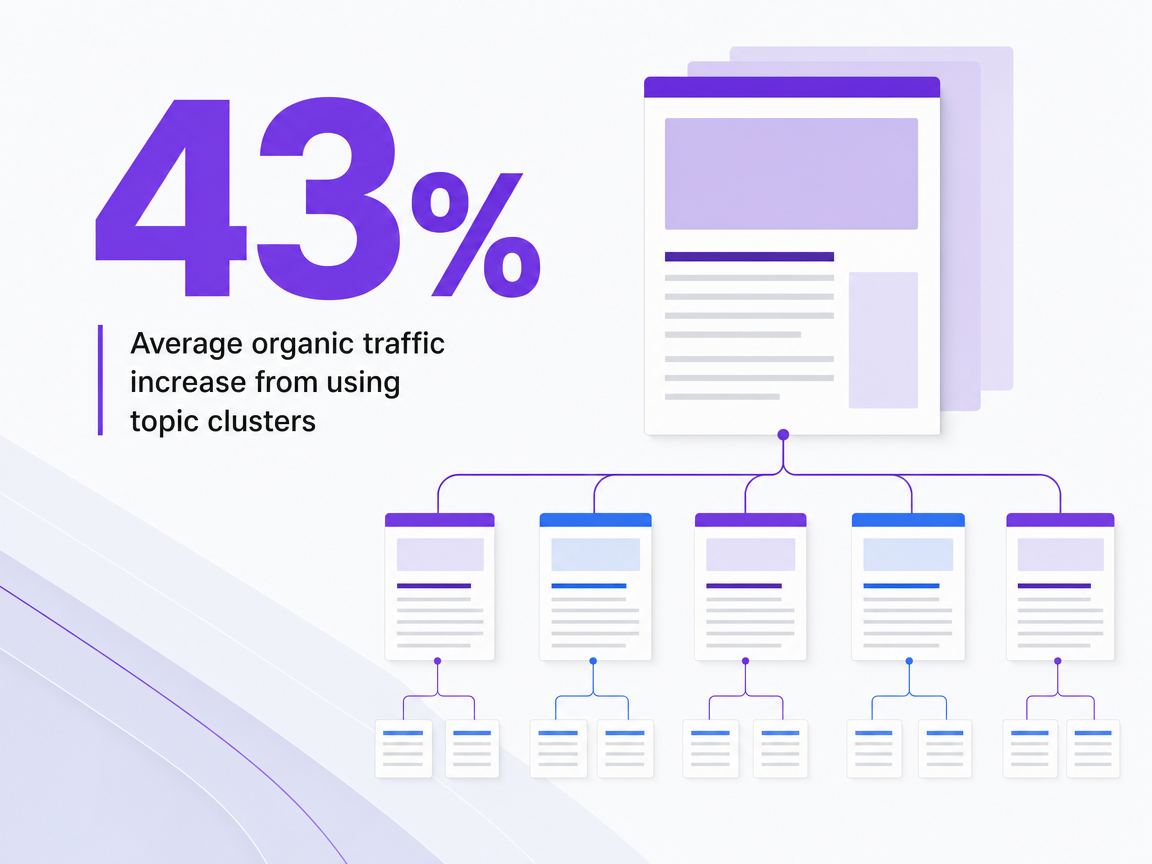 Average organic traffic increase from using topic clusters
Average organic traffic increase from using topic clusters
Test Pillar Page Workflows With Real Publishing Access
Publish live pillar content and measure SEO impact before committing to a paid plan.
Nine Pillar Page Archetypes Content Managers Can Pattern-Match Against
The Comprehensive Guide: Moz's Beginner's Guide to SEO
The comprehensive guide archetype treats a pillar as the category's default reference. Moz's Beginner's Guide to SEO is the canonical example — a chaptered, long-standing resource that competing publishers have repeatedly cited as the standing definition for the head term 3. The structural bet is durability: build a single asset deep enough that follow-up posts orbit around it rather than replace it.
Fit criterion: the head term is stable, high-volume, and educational in intent. Payoff compounds because the page collects backlinks and cluster equity over years rather than campaigns. Tradeoff: production cost is front-loaded, and the page requires a real editorial owner who can shepherd updates against algorithm shifts, subtopic drift, and new best practices. A comprehensive guide that goes unmaintained decays faster than a shorter post because its authority is proportional to its currency.
Content managers pitching this archetype internally should frame it as an infrastructure investment, not a campaign deliverable. The KPI is topical coverage and cluster attach rate over multiple quarters, not first-90-day traffic.
The Resource Hub: HubSpot's Marketing Statistics Library
Where the comprehensive guide teaches a subject end to end, the resource hub aggregates. HubSpot's marketing statistics library is the reference pattern: a single top-level page that indexes hundreds of citable data points, organized by subtopic, with jump links and a persistent table of contents 3. The page ranks not because it explains a concept but because it consolidates the artifacts other writers need.
Fit criterion: the head term implies retrieval, not comprehension. Queries around statistics, benchmarks, templates, checklists, and directories map cleanly to this archetype. The hub earns backlinks by being the shortest path to a specific fact.
Tradeoff: maintenance is continuous. Stale numbers erode the hub's credibility faster than any other pillar format, and cluster posts have to be updated in lockstep or the internal linking begins to contradict itself. Teams that pick this archetype should budget a recurring audit cycle at the outset — quarterly at minimum for statistics libraries, semi-annually for evergreen resource lists — and assign it before the pillar ships.
The Interactive Report: Typeform's Chaptered Data Story
Typeform's chaptered data report treats the pillar as an interactive publication. Scroll-driven navigation, embedded charts, and progressive disclosure convert a research document into something closer to a microsite while keeping the entire experience under one URL 3. The structural bet is engagement depth: time on page, scroll completion, and social sharing become the primary signals, and the page functions as much as a brand asset as an SEO play.
Fit criterion: the underlying content is a proprietary dataset, survey, or original analysis worth defending with design investment. If the source material is a set of blog-adjacent observations, the interactive report is overbuilt.
Tradeoff: development and design cost multiply, and crawlability can suffer if the interactive layer relies on client-side rendering. Content managers pursuing this archetype should confirm that all body copy renders in server-side HTML and that chaptered sections carry real H2s — not just visual dividers — before design freezes. The page still has to read as a document to the crawler.
The Product-Adjacent Educational Hub: Cloud Elements' API Integration Guide
Cloud Elements' API integration guide sits deliberately between educational content and product documentation. The pillar covers a technical category at head-term depth, then routes readers into use-case pages and, downstream, into product surfaces 3. The archetype exists because buyers in technical categories research the category before they research vendors, and the pillar has to earn the category query without turning into a datasheet.
Fit criterion: the buyer's first search is educational, but the eventual conversion is product-shaped. B2B SaaS teams see this pattern often — Campfire Labs documents it as a repeatable format for product-adjacent guides that support demand generation and organic pipeline simultaneously 6.
Tradeoff: editorial discipline. The pillar has to resist feature injection from product marketing without losing its role as a top-of-funnel asset. Ranking on a category term requires the page to read as a category authority; the moment it drifts into product positioning, competing educational hubs outrank it. The internal fight over that boundary is a recurring cost of the archetype.
The Ungated Top-Level Guide: Placement as a Ranking Decision
Some archetypes are defined by content shape. This one is defined by placement. The ungated top-level guide lives at a root-level URL — /topic-name/ rather than /blog/2024/topic-name/ — and remains fully crawlable, with no gates, forms, or interstitials between the crawler and the copy 5. That decision alone changes how the page accrues authority.
Fit criterion: the head term is strategically important enough that URL placement, navigation slotting, and long-term maintenance justify treating the page as a primary site asset rather than an editorial one. The pillar sits alongside product and solution pages in the information architecture, not underneath the blog.
Tradeoff: cross-functional coordination. Top-level URLs typically require sign-off from web, product marketing, and sometimes legal — a slower path than publishing to /blog/. Demand-gen teams also lose a gating point they might have used for MQL capture. The counterargument is straightforward: gated pillar content forfeits the crawlability that makes the pillar rank in the first place. A gated PDF and a ranking pillar are not the same asset, and treating them as interchangeable dilutes both.
The Consolidation Pillar: When 23 Scattered Posts Become One Hub
The consolidation pillar is the archetype content managers reach for when the archive is already the problem. Instead of adding another post, the team audits existing coverage, identifies internal cannibalization, and collapses overlapping posts into a single hub with proper 301 redirects and reworked internal links. The pillar replaces the network. The clusters that survive point back to it.
The strongest documented case sits in a B2B fintech engagement analyzed in a B2B SEO resource: 23 scattered posts on payment fraud prevention were consolidated into a single "Ultimate Guide to Payment Fraud Prevention" pillar. Within 60 days, organic sign-ups rose 31%, and non-brand impressions moved from roughly 11,000 to 18,000 — a lift driven by two distinct mechanisms moving together, not one 7. The impressions delta reflects consolidated ranking on the head term; the sign-up lift reflects a cleaner path from category query to conversion.
Fit criterion: the site already has topical coverage but is losing internal ranking races between its own posts. The signal is a set of URLs trading positions on the same query, or a head term where the site ranks in scattered positions 12–25 across multiple pages instead of a single position 5.
Tradeoff: the audit is unglamorous work, and the political cost is real. Posts get deprecated. Contributors lose bylines. Stakeholders who count published-post totals as productivity have to be shown the impressions and conversion math instead. This is the archetype that requires the most internal advocacy — and returns the most defensible number when it works.
The Chaptered Longform: The Atlantic's Editorial-Style Pillar
The Atlantic's chaptered longform pattern reads more like a magazine feature than a marketing asset. Numbered chapters, editorial voice, narrative pacing, and a persistent sidebar table of contents structure a page that can run past 5,000 words without losing the reader 3. The archetype borrows from publishing because its authority signal is prestige, not comprehensiveness.
Fit criterion: the topic benefits from argument and narrative, not just coverage. Category-defining perspectives, industry analyses, and thesis pieces map to this archetype. The pillar earns its ranking partly through engagement metrics that scale with editorial quality — scroll depth, time on page, and the caliber of the domains that eventually link to it.
Tradeoff: the archetype requires senior writing talent that lean teams often cannot allocate at pillar length. Chaptered longform also complicates the cluster attach: narrative pillars link outward less naturally than reference pillars, and content managers have to design the linking topology deliberately rather than letting it emerge from the subtopic structure. The prose has to carry the page while the internal linking still routes cluster equity back.
The SaaS Use-Case Hub: Campfire Labs' B2B Guide Format
Campfire Labs documents a repeatable B2B SaaS pattern: a comprehensive guide pillar that functions simultaneously as an educational resource and a steady source of organic pipeline, with chapters organized around use cases rather than features 6. The archetype resembles the product-adjacent hub but shifts the organizing principle. Use cases index by the buyer's job, not the vendor's capability, which lets the pillar rank on jobs-to-be-done queries that feature-oriented pages miss.
Fit criterion: the buyer describes their problem in verbs before they describe it in product categories. Queries like "how to reduce churn in a subscription business" or "how to route inbound leads by intent" cluster around use-case pillars more naturally than product-category ones.
Tradeoff: the pillar has to be honest about when a use case is not a fit for the sponsoring product's category. If every chapter routes to the same solution, the page loses credibility with technical buyers and stops attracting the backlinks that keep it ranking. Editorial teams that own this archetype need explicit permission to leave chapters unmonetized — a conversation worth having before the outline is approved, not after the draft is written.
The AI-Orchestrated Pillar System
The ninth archetype is not a page. It is an operating model. AI-orchestrated pillar systems treat the pillar-plus-cluster network as a coordinated production pipeline: the head term is scoped, the cluster map is generated from query and gap analysis, drafts are produced against approved briefs, and internal linking is applied programmatically once the network reaches a threshold of cluster density. Human editors approve each asset before it ships; the automation handles scoping, drafting, and linking coordination between approvals.
The operating-model case rests on velocity. B2B marketing teams surveyed in a 2024 benchmark reported that AI-augmented workflows produced 4.2x more published assets per writer per quarter than the pre-AI baseline 13. The benchmark's scope matters: it measures published output across B2B marketing teams, not organic performance of any specific archetype. What it establishes is that cluster density — the variable that determines whether a pillar routes enough internal authority to rank — becomes reachable for teams that previously could not produce enough supporting content to make the architecture work.
Fit criterion: the team has a defensible pillar strategy but insufficient production capacity to build out clusters at the pace competitors publish. Tradeoff: governance. Approval workflows, brand-voice guardrails, and editorial review have to be designed into the system before scale amplifies mistakes. Platforms in this category include Vectoron among others; the archetype is the operating model, not any single vendor.
Consolidation Economics: Scattered Posts vs. a Single Pillar
The clearest way to defend pillar architecture internally is to put the two production models side by side. Scattered coverage and consolidated hubs generate different costs across four dimensions that content managers can measure without inventing new metrics:
- Internal ranking competition
- Crawl budget allocation
- Editorial maintenance load
- Internal linking clarity
| Dimension | Scattered Posts | Consolidated Pillar |
|---|---|---|
| Internal ranking competition | Multiple URLs trade positions on the same query, splitting click share across the archive 7 | One canonical URL absorbs intent for the head term; cluster posts rank narrower queries |
| Crawl budget allocation | Duplicated coverage forces the crawler to reach every findable page individually 11 | Hub-and-spoke routing concentrates crawl priority on the pillar and its immediate cluster |
| Editorial maintenance | Overlapping posts require parallel updates and recurring cannibalization audits | Updates land in one place; cluster posts inherit currency through the hub's revisions |
| Internal linking clarity | Anchor text splinters across variants of the same term, diluting topical signal | Every cluster piece points back to the pillar with one canonical anchor structure 8 |
The math changes the internal conversation. Post-count productivity becomes indefensible once the maintenance column is priced honestly, and the impressions and conversion deltas from consolidation become the number stakeholders actually track.
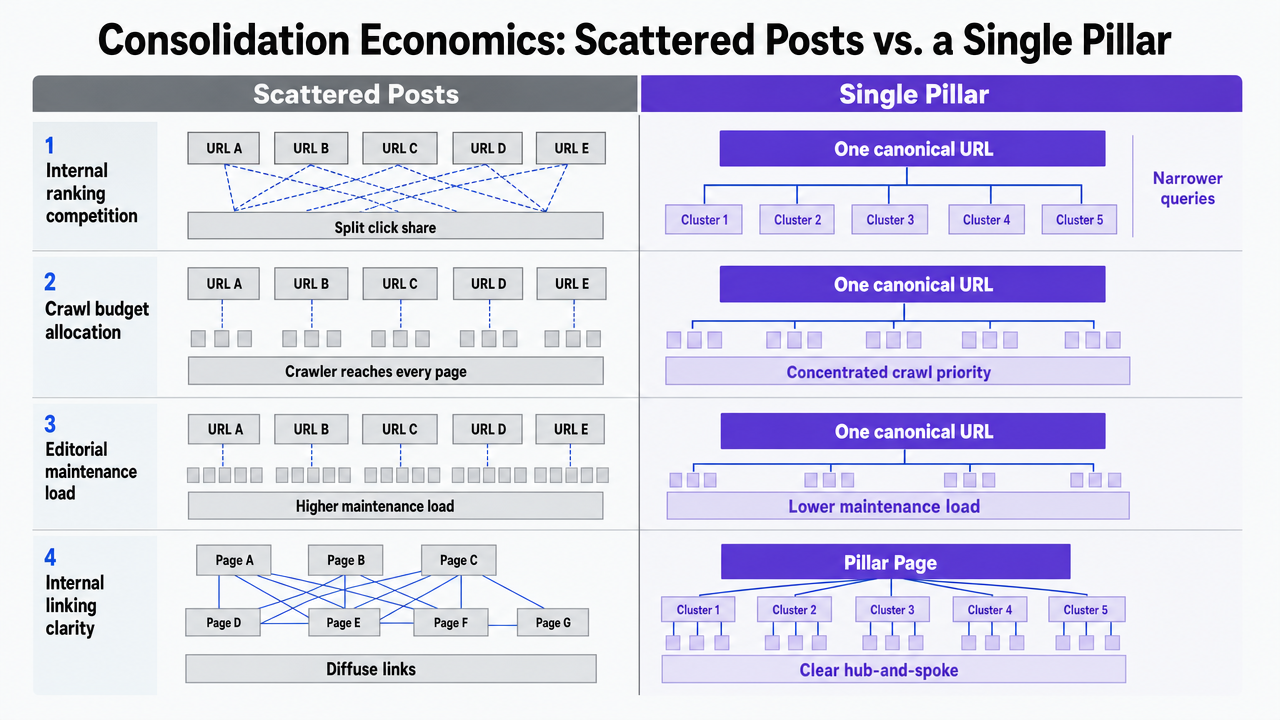 Visualize the side-by-side comparison between scattered posts and a consolidated pillar architecture across the four dimensions the section already lays out in prose and table form, reinforcing the consolidation case with a spatial diagram
See How Leading Brands Build SEO Scale with Pillar Pages
Request a walkthrough of real-world pillar page frameworks and learn how advanced teams coordinate multi-channel content for measurable ranking and traffic impact.
Matching Archetype to Business Goal
Archetype selection belongs upstream of the outline. Content managers who pick a format before naming the business goal end up with pillars that read well and rank poorly, because the structural bet mismatches the query it was meant to capture. The nine archetypes covered above map to five distinct goals, and the mapping is not interchangeable.
| Primary business goal | Best-fit archetype | Signal that confirms the match |
|---|---|---|
| Own the category's default reference | Comprehensive guide | Head term is stable, educational, and cited by competing publishers 3 |
| Capture retrieval-intent queries | Resource hub | Query implies fact-finding, not comprehension 3 |
| Convert original research into authority | Interactive report or chaptered longform | Proprietary dataset or thesis worth defending with design 3 |
| Move category searchers toward product | Product-adjacent hub or SaaS use-case hub | Buyer researches category before vendor 6 |
| Recover from internal cannibalization | Consolidation pillar | Multiple URLs trading positions on the same query 7 |
| Scale cluster density past team capacity | AI-orchestrated pillar system | Pillar strategy defensible; production throughput is the constraint 13 |
The ungated top-level guide is a placement decision that overlays any of these archetypes rather than a competing option 5. Content managers should confirm the goal, pick the archetype, then decide URL placement last.
Frequently Asked Questions
References
- 1.What Are Content Pillars and Why They Matter for B2B SEO.
- 2.What Is a Content Pillar? Guide August 2026.
- 3.Pillar Page Examples: 10 We Studied (2026).
- 4.How Pillar Pages Work: B2B SEO Strategy Guide.
- 5.Blog Posts, Pillar Pages & Landing Pages.
- 6.4 Pillar Page Examples for B2B SaaS Content Marketing.
- 7.Building Successful Pillar Pages For B2B SEO.
- 8.SEO Link Best Practices for Google.
- 9.Search Engine Optimization (SEO) Starter Guide.
- 10.Learn About What Sitelinks Are.
- 11.SEO Guide for Web Developers.
- 12.Organization Schema Markup.
- 13.AI Content Production Benchmarks B2B 2024.
- 14.While B2B Content Volume Grows, Budgets Barely Budge as AI Adoption Rises.
- 15.Site Mapping and Information Architecture.