
Key Takeaways
- Google retired FAQ rich result dropdowns across all domains on May 7, 2026, ending the SERP click lift that once justified aggressive FAQPage deployment 3, 4.
- FAQPage markup itself remains valid Schema.org and still feeds AI Overviews, voice answers, and entity understanding when marked-up Q&A matches visible page text 6, 13.
- Agencies managing multi-site portfolios should triage each page — keep FAQPage where AI citation is plausible, restructure thin blocks into Article schema, and strip auto-generated FAQ content with no query demand.
- Retire pitch decks quoting the old 87% FAQ CTR figure, drop FAQ rich result metrics from client reporting, and shift freed capacity to Product, Review, LocalBusiness, and Article schema 8, 13.
The Ruling: FAQPage Markup Outlived Its Rich Result
Here is the verdict agency SEO leads came for: FAQPage markup is still worth deploying in 2026, but not for the reason it was worth deploying in 2022. The visual dropdown is gone. The machine-readable Q&A feed it produces is not.
Google confirmed the change in its own developer changelog, removing FAQ rich result documentation and posting a deprecation notice stating the feature no longer appears in Search 1. Practitioner analyses of the May 7, 2026 cutoff have been direct about the scope: FAQ dropdowns stopped rendering for every site, including the government and health domains that had been the last exception 3, 4. FAQPage schema itself remains valid Schema.org markup and can stay on pages without penalty 13.
That distinction is the entire strategic question. The rich result was a SERP feature; the schema is a data structure. One died. The other now feeds AI Overviews, voice answers, and entity understanding, provided the marked-up text matches what a user actually sees on the page 6.
For agencies running structured data standards across a book of client sites, the operational question shifts from should we implement FAQ schema to which pages earn it, which questions get marked up, and how does that decision scale across 25 or 100 accounts without draining specialist hours. The rest of this analysis answers those three questions in order.
What Agencies Actually Lost on May 7, 2026
The loss is specific: the visual dropdown accordion that expanded FAQ answers directly beneath a search listing, doubling on-page real estate for pages ranking in the top handful of results. That feature ended for every domain class on May 7, 2026, closing out a phased sunset that started in August 2023 when Google first restricted the rich result to authoritative government and health sites 2, 4. Search Console filters and reporting for FAQ search appearance were retired through June 2026, with API data following in August 2026 4.
Historical CTR lift by rich result type at the same rank. FAQ dropdowns delivered an estimated +20–30% lift before being discontinued in May 2026, while Product, Review, Video, and Event results continue to render 9.
What that meant for click economics is quantifiable. FAQ dropdowns delivered an estimated 20–30% CTR lift at the same rank position, capped at two dropdowns per SERP, according to schema CTR breakdowns published before the removal 9. That lift is now zero. The Product, Review, Video, and Event rich results referenced in the same analysis still render and still expand SERP footprint 9. FAQ is the outlier on the discontinued list.
The second, quieter loss is reporting infrastructure. Agencies that built client dashboards around FAQ impression and CTR data pulled from Search Console lost that data feed in the mid-2026 tooling sunset 1, 4. Any recurring report that still references FAQ rich result performance is either pulling stale data or reporting on a metric that no longer exists.
What did not change is the markup itself. FAQPage JSON-LD remains valid Schema.org, parses cleanly, and stays on pages without penalty 13. Google's own guidance on AI Overviews confirms that structured data continues to function as a supporting signal for understanding, provided it matches visible page text 6. The click-lift feature disappeared; the data structure did not.
The reallocation question is therefore narrow. Agencies did not lose FAQ schema as a technique. They lost a single SERP enhancement that used to justify marking up every question on every page. Which means the operational rules that governed FAQ deployment in 2022—mark up aggressively, more is better, every service page gets a FAQ block—need replacement, not defense.
Why the Markup Still Earns Its Place in the Codebase
Stripping FAQPage markup from client sites in response to the SERP change would be the wrong move. The rich result is gone, but the structured Q&A payload it produced now feeds a different set of surfaces — and those surfaces are where zero-click competition is actually happening. Google's own AI Features guidance is explicit that structured data continues to function as a supporting signal for understanding when it matches visible page text, and that standard SEO fundamentals apply equally to AI Overviews and AI Mode 6. The retrieval channel changed. The parseability of a well-formed FAQPage block did not 12.
The two use cases below are where FAQPage markup still pulls its weight in a 2026 codebase.
AI Overviews Read Structured Q&A as Understanding Signal
Google is careful about what it will and will not say here, and the article should be too. There is no separate AI index, no dedicated ranking factor for AI Overviews, and no promise that FAQPage markup guarantees citation 6. What Google does confirm is that AI Overviews and AI Mode draw from the same index and the same quality signals as organic Search, and that structured data helps those systems understand page content when it matches what a user sees 6.
That is the operative claim. A page with a clean FAQPage block, where each Question and acceptedAnswer pair mirrors the visible on-page Q&A, hands AI systems a pre-parsed, disambiguated data structure 12. The alternative — asking a language model to infer question-answer relationships from prose — is a heavier lift with a wider margin of error. Practitioner analyses published after the May 2026 cutoff have been direct about this: FAQPage schema remains valid, will not be penalized if kept, and continues to serve AI retrieval use cases even without a rich result 3, 13. Agencies should present this to clients as a probability improvement on citation likelihood, not a guarantee.
Voice Answers, Entity Graphs, and On-Site UX Still Draw From It
Voice assistants and answer engines have always favored short, self-contained Q&A pairs because they map cleanly to spoken responses. FAQPage markup packages content in exactly that format, which is why it remains a reasonable input for voice retrieval even after the SERP dropdown disappeared. The Schema.org type also contributes to entity understanding — the mainEntity, Question, and acceptedAnswer properties give search systems explicit relational structure rather than paragraph text they have to segment 12.
The third use case is the one agencies undersell. FAQPage markup enforces a content discipline: every marked question has to correspond to visible text, has to have an answer, and has to be maintained in sync with the page 6. That constraint improves on-site UX by keeping FAQ blocks honest. Pages with drifted, hidden, or auto-generated FAQ content — the kind that used to sneak in for rich result gaming — get flagged by that same visible-text requirement. The markup does not just feed AI. It also acts as a quality gate for the FAQ content itself.
Test FAQ schema strategies with real content output
Validate schema-driven SEO workflows and publish live results before making any commitment.
The CTR-Data Trap Agencies Are Still Selling
Walk into any agency's structured data pitch deck from 2023 and one number does the heavy lifting: FAQ rich results averaged an 87% click-through rate 8. That figure — pulled from Milestone Research and repeated across pitch decks, blog posts, and client QBRs for three years — sold a lot of schema retainers. It is now selling a feature that does not exist.
The math problem is straightforward. That 87% CTR described a specific SERP element: the expanded FAQ dropdown beneath a listing. After May 2026, no site renders that element in standard Google Search, including the government and health domains that had been the last exception 3, 4. Any deck, proposal, or QBR still using the figure to justify FAQ schema work is quoting historical performance on a discontinued feature. Same for the 20–30% CTR lift benchmark from the pre-cutoff schema CTR breakdowns 9. Both numbers were accurate. Neither describes what a client's FAQ markup does today.
The reframe agencies owe their clients is a metric switch, not a metric downgrade. Structured data as a category still correlates with click performance — pages with schema markup have shown roughly 40% higher CTR than pages without, across all rich result types combined 8. That case for schema investment holds. The case for FAQ schema specifically as a CTR play does not. The right performance conversation for FAQPage in 2026 is AI Overviews citation share, voice answer capture, and query coverage on informational intent — not SERP click lift. Agencies that keep the old pitch language are setting up a credibility problem the next time a client audits what they are actually paying for.
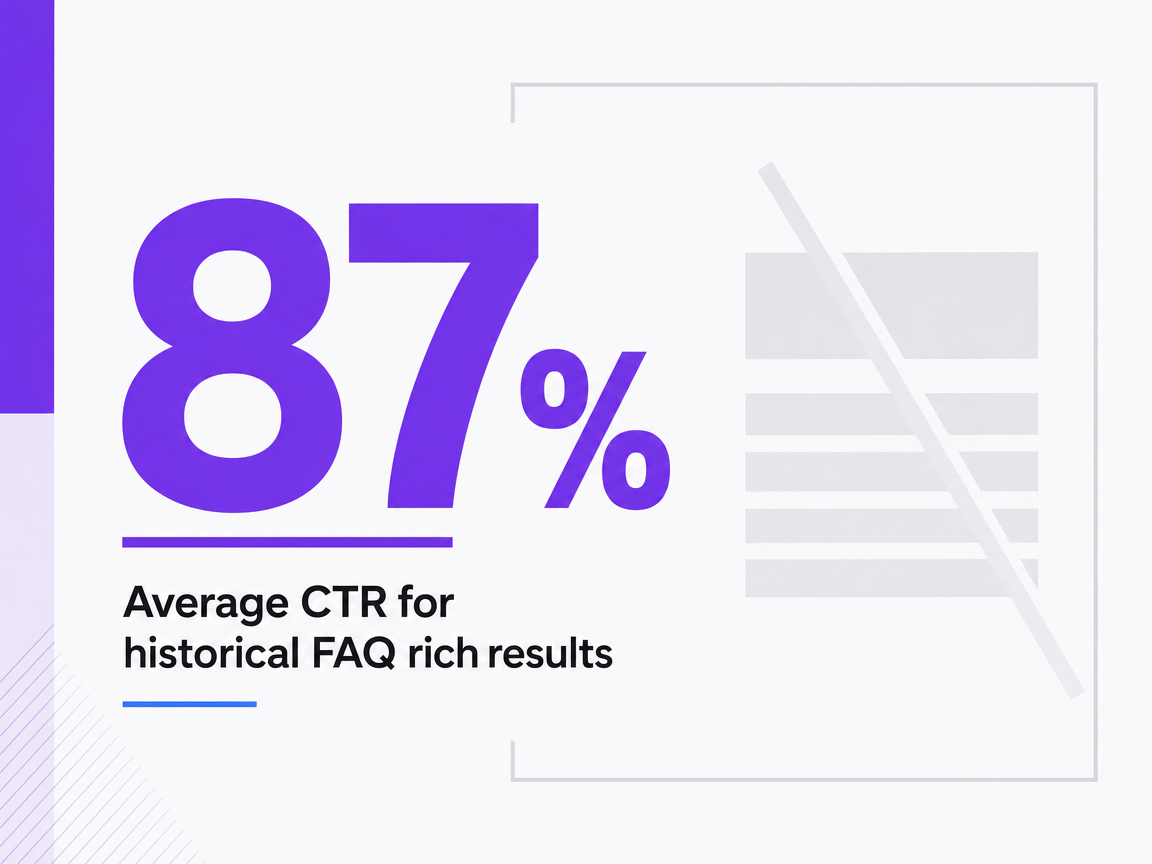 Average CTR for historical FAQ rich results
Average CTR for historical FAQ rich results
A Portfolio Triage Model: Keep, Restructure, Strip
A single rule for FAQPage markup — apply everywhere or strip everywhere — is the wrong instrument for a client book. The right instrument is a three-way sort applied page by page:
- Keep the markup where it feeds AI retrieval,
- Restructure the content where the FAQ format itself is the problem, and
- Strip the schema where it was only ever there to chase the dropdown.
Practitioner guidance published after the May 2026 cutoff has been consistent that FAQPage markup will not be penalized if it stays on a page, but it also produces no visual rich result benefit 13. That is the frame this triage runs on: keep only where there is a downstream use, and stop paying maintenance tax on the rest.
Keep FAQPage on Pages Competing for AI Citations
The pages that earn FAQPage markup are the ones already showing up — or plausibly showing up — as citations in AI Overviews and voice answers for informational queries. Service pages that rank in the top handful of results for question-shaped searches, help center articles that map to high-intent queries, and pillar pages with genuine Q&A depth are the priority tier.
The qualifier Google itself puts on this is important. Structured data acts as a supporting signal for understanding, provided the marked-up Q&A pairs match the visible text on the page 6. Keep the markup where that condition is easy to enforce and where a citation win has business value. A law firm's page on statute-of-limitations questions qualifies. A boilerplate FAQ block copied across every location page does not.
Restructure Thin Q&A Blocks Into Article-Style Content
The middle tier is where the real work sits. Pages with three or four shallow FAQ entries — often written to game the old rich result — usually fail the citation test because the answers are too thin to be extracted and the questions do not match real query demand. Marking them up harder will not fix them. The recommended move in post-deprecation guidance is to restructure that content into Article-style Q&A: full headings, complete answers, and inline context, with Article schema on the page instead of FAQPage 4, 13.
Portfolio triage decision framework. Keep FAQPage on AI-cited and high-intent service pages, restructure thin Q&A blocks into Article-style content with Article schema, and strip auto-generated FAQ blocks with no query demand. FAQPage markup that stays on a page is not penalized but produces no visual rich result 13.
This is a content decision, not a schema decision. The schema swap follows the rewrite, not the other way around.
Strip Auto-Generated FAQ Blocks With No Query Demand
The bottom tier is the cleanup pile. Auto-generated FAQ blocks appended by a CMS plugin, template-driven Q&A appearing on every location or service variant, and questions no one is actually searching for — these get stripped. Not because the schema is harmful, but because there is nothing on the other end of the pipe to justify keeping it in the codebase.
Stripping means removing both the FAQPage markup and the underlying FAQ block from the visible page. Leaving the schema on a page whose FAQ content is boilerplate creates a mismatch risk against Google's visible-text requirement and adds maintenance surface for no return 6. Practitioner guidance is consistent that keeping unused FAQPage markup carries no penalty 13, but the maintenance tax — QA, validation, drift checks — is not free at portfolio scale. That is the cost triage removes.
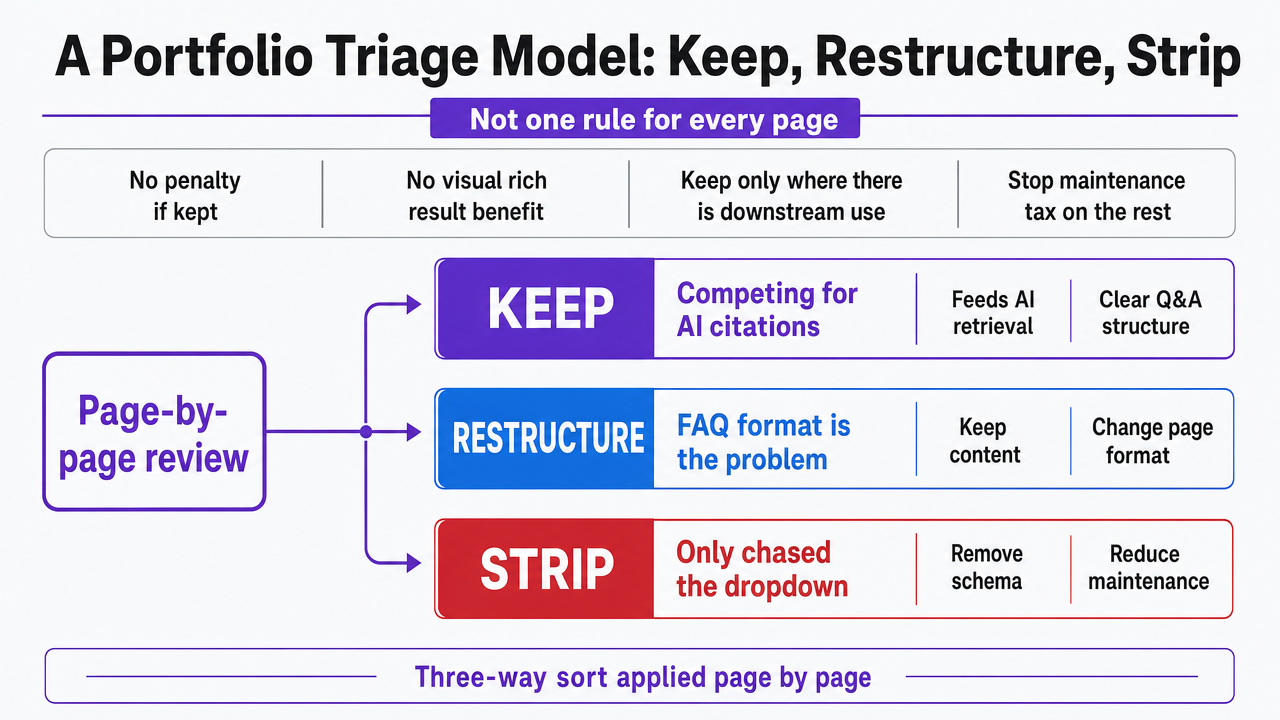 Visualize the three-way page-by-page triage decision framework explained in this section, giving agency readers a scannable operating model
Partial Markup as the Efficiency Lever
Google has been on record for years that FAQPage markup does not need to cover every question on a page. John Mueller's guidance is direct: mark up five of twenty questions if that is what the page warrants, as long as every marked Q&A pair is visible to users 11. Most agency standards documents ignored this because the old rich result rewarded aggressive markup — more questions in the schema meant more potential dropdown surface. That incentive is gone.
The efficiency move is to invert the default. Instead of marking up every question a client's CMS spits into a FAQ block, mark up the two to five questions per page that map to real query demand, have substantive answers, and align with the informational queries a page is trying to win in AI Overviews. Everything else stays as visible on-page content without schema wrapping.
Two operational gains follow:
- Validation and QA surface shrinks — fewer Question and acceptedAnswer nodes to keep in sync with visible text, which is the specific condition Google names for structured data to function as an understanding signal 6.
- The questions that do get marked receive editorial attention rather than template treatment, which raises the odds that the answer is extractable in the first place 12.
Selective markup is not a compromise. It is the correct default now that the SERP incentive for volume no longer exists.
Master FAQ Schema for AI Search: Streamline Agency Implementation at Scale
Connect with specialists on deploying FAQ schema that aligns with evolving AI search standards—reduce manual QA, improve SERP impact, and maintain oversight across high-volume client portfolios.
If You Manage 25+ Client Sites: The Maintenance Math
For agency heads running structured data standards across a book rather than a single site, the FAQ schema question stops being technical and starts being an operations problem. The single-site logic — mark up the pages that matter, skip the ones that don't — is correct but insufficient. The real cost is what it takes to make that decision 25, 50, or 100 times without a specialist team burning a week per audit cycle.
The default most agencies inherited from the pre-2026 era is maintain FAQPage everywhere. Every service page, every location page, every help center article got wrapped in FAQPage markup because the rich result rewarded volume and the maintenance was assumed sunk. That default is now the expensive path. It carries no upside — the dropdown is gone 3— and every marked question still has to satisfy the visible-text match Google names as the condition for structured data to function as an understanding signal 6. Which means QA, drift checks, and CMS-plugin reviews continue across the entire portfolio for a feature that pays nothing.
Portfolio maintenance math across a 25-site client book. Variables: A = audit hours per site, D = decision hours per site, X = deployment hours per site, R = specialist hourly rate. The default of maintaining FAQPage on every page compounds A + ongoing QA hours across all 25 sites; a triage pass invests A + D + X once, then concentrates recurring QA on the reduced surface where markup earns AI citation upside 11.
The triage alternative is a one-time investment against a recurring drain. Applied across a 25-site book, the math looks like this:
| Scenario | Upfront hours | Recurring QA surface | AI citation surface preserved |
|---|---|---|---|
| Maintain FAQPage everywhere (default) | 0 | All FAQ blocks × 25 sites | Diluted across low-intent pages |
| Portfolio triage pass | (A + D + X) × 25 sites | Kept pages only, ~2–5 marked questions each | Concentrated on AI-cited and high-intent pages |
| --- | --- | --- | --- |
| A = audit hours per site, D = keep/restructure/strip decision hours per site, X = deployment hours per site. Recurring QA cost = (marked Q&A pairs) × R per cycle. |
The lever that makes the triage pass affordable is Mueller's partial-markup guidance: mark up five of twenty questions if that is what the page warrants, as long as every marked pair is visible 11. Applied at portfolio scale, that guidance cuts the QA surface by roughly the same ratio. A book that used to maintain 400+ marked Q&A pairs across 25 sites can compress to 50–125 pairs on the pages where a citation win has business value, with the rest either restructured or stripped.
Two operational rules keep this from becoming its own drain:
- The triage decision gets logged once per page and revisited only on content changes, not every reporting cycle.
- The reduced markup surface should be validated in batch — schema validators run against the kept set, not the full portfolio — because there is no longer any reason to audit stripped pages for FAQ compliance.
The agencies that will show margin improvement on structured data delivery in 2027 are the ones that stopped billing hours against a discontinued feature and moved that capacity to schema types that still produce rich results or measurable AI citation lift.
Where Structured Data Spend Should Go Instead
Freed capacity from the FAQ triage pass should not go back into the same pool. It should move to schema types that still produce rich results or measurable AI citation lift. Even as FAQ rich results were curtailed, Google introduced an unprecedented number of new structured data types across products, courses, rentals, and other verticals — the category is expanding, not contracting 7.
Three reallocation targets earn the hours. Product, Review, LocalBusiness, and Article schema continue to generate rich results in standard Search, and post-deprecation guidance flags them as the highest-return replacements for FAQ investment 13. For service-vertical clients — law firms, dental groups, home services, senior living — LocalBusiness and Review markup on location and service pages compounds visibility across map packs and organic listings, surfaces Google explicitly still enhances. Article schema on restructured Q&A content picks up where thin FAQPage blocks left off, giving AI systems the same question-answer signal without the discontinued rich result overhead 4.
The second target is validation infrastructure. Structured data functions as an understanding signal only when the marked-up content matches visible page text 6. Agencies that shifted schema work from volume to precision — fewer types, tighter QA, cleaner visible-text alignment — get more citation surface per specialist hour than agencies still spreading effort across every schema type a CMS plugin will emit. The broader evidence base still supports the underlying case: pages with schema markup have shown roughly 40% higher CTR than pages without across rich result types combined 8. That lift is category-wide, not FAQ-specific, and it moves with wherever the effort is concentrated.
The third target is measurement. Rich results are a visibility lever, not a direct ranking factor, and results vary by query type and SERP layout 10. Reporting should track citation share and rich result render rate by schema type, per client, per cycle — the metrics that survive the next deprecation.
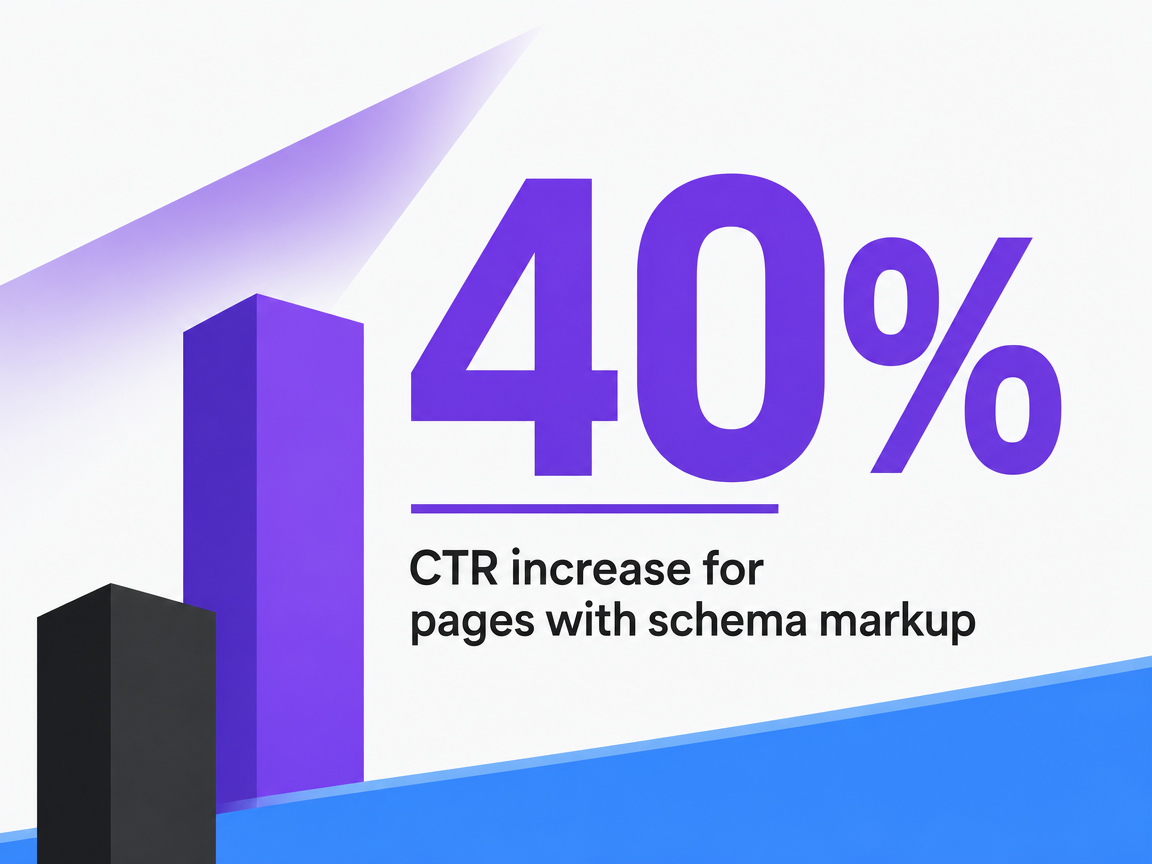 CTR increase for pages with schema markup
CTR increase for pages with schema markup
The Governance Standard to Push to Production Teams
The triage decision only holds if production teams have a written standard to apply without escalating every page. Four rules cover the operational surface without micromanaging implementation.
- Rule one: no FAQPage markup ships without matching visible on-page text. Google's AI Features guidance names this as the condition for structured data to function as an understanding signal, and it is the fastest way to catch CMS-plugin drift in QA 6.
- Rule two: partial markup is the default. Two to five marked questions per page, selected for query demand and answer substance, not every Q&A block the template emits 11.
- Rule three: keep, restructure, or strip decisions get logged per URL and only revisited on content change. No quarterly re-audit of the full portfolio.
- Rule four: reporting drops FAQ rich result metrics entirely. The Search Console filters are gone 1, 4, and any client dashboard still referencing them is measuring a discontinued feature.
Push these four to the production standards doc, retire the pre-2026 FAQ playbook, and the recovered capacity moves to schema types that still earn their maintenance cost.
Frequently Asked Questions
References
- 1.Latest Google Search Documentation Updates.
- 2.Changes to HowTo and FAQ rich results.
- 3.Google Killed the FAQ Rich Result, Don't Panic | JSONLD.COM.
- 4.FAQ Rich Results Discontinued: What Now for FAQ Schema?.
- 5.Why Google Removed FAQ Rich Results (And What SEOs ....
- 6.AI Features and Your Website | Google Search Central.
- 7.Structured Data In 2024: Key Patterns Reveal The Future Of AI ....
- 8.Schema Markup: Statistics, Facts, & Things to Know.
- 9.Schema & CTR: Which Rich Results Lift Clicks Most? (2026 ....
- 10.Schema Markup Statistics & Rich Result.
- 11.Google: FAQ Schema Can Be Used On Select Questions.
- 12.FAQ Structured Data (FAQPage): Complete JSON-LD ....
- 13.Structured Data SEO 2026: What Works After FAQ Removal.