
Key Takeaways
- Google retired the expandable FAQ rich result on May 7, 2026, with Search Console reporting ending in June and API support in August 1, 10.
- Agency SEO leads managing template-driven client portfolios are most exposed, since FAQPage adoption tripled between 2022 and 2024 largely after eligibility was already restricted 8, 12.
- Valid FAQPage markup does not need to be stripped, but claims that it boosts AI Overview citations are not supported by Google's guidance 5, 7.
- Retire the FAQ enhancement KPI before reallocating hours, then redirect capacity to supported schema types, entity coverage, and deeper service-page content rather than scaled Q&A production 3, 13, 14.
The May 2026 Retirement, in Dates and Consequences
On May 7, 2026, the expandable FAQ rich result stopped appearing in Google Search, ending a feature that had been restricted to a small set of eligible domains three years earlier 1. Google's changelog confirmed the feature's removal, and supporting documentation was subsequently removed 1. Independent reporting detailed the full timeline: Search Console performance data and Rich Results Test support were retired in June 2026, with Search Console API support following in August 2026 10.
This retirement was not sudden. In September 2023, Google limited FAQ rich results to "well-known, authoritative government and health websites," effectively eliminating eligibility for commercial sites 12. This pre-emptive restriction set the stage for the formal removal in 2026.
For agency SEO leads, the retirement has three key implications. First, client-facing impression and click data related to FAQ appearances became unreportable in June 2026, rendering any dashboard still tracking this KPI obsolete 10. Second, strategies that positioned FAQPage schema as a SERP real-estate play must be revised to reflect its current influence, which no longer includes a dedicated rich result. Finally, this change is part of a broader pattern, highlighted by Google's 2025 announcement of phasing out several structured-data features to simplify Search results, suggesting caution against over-reliance on any single presentation format 6.
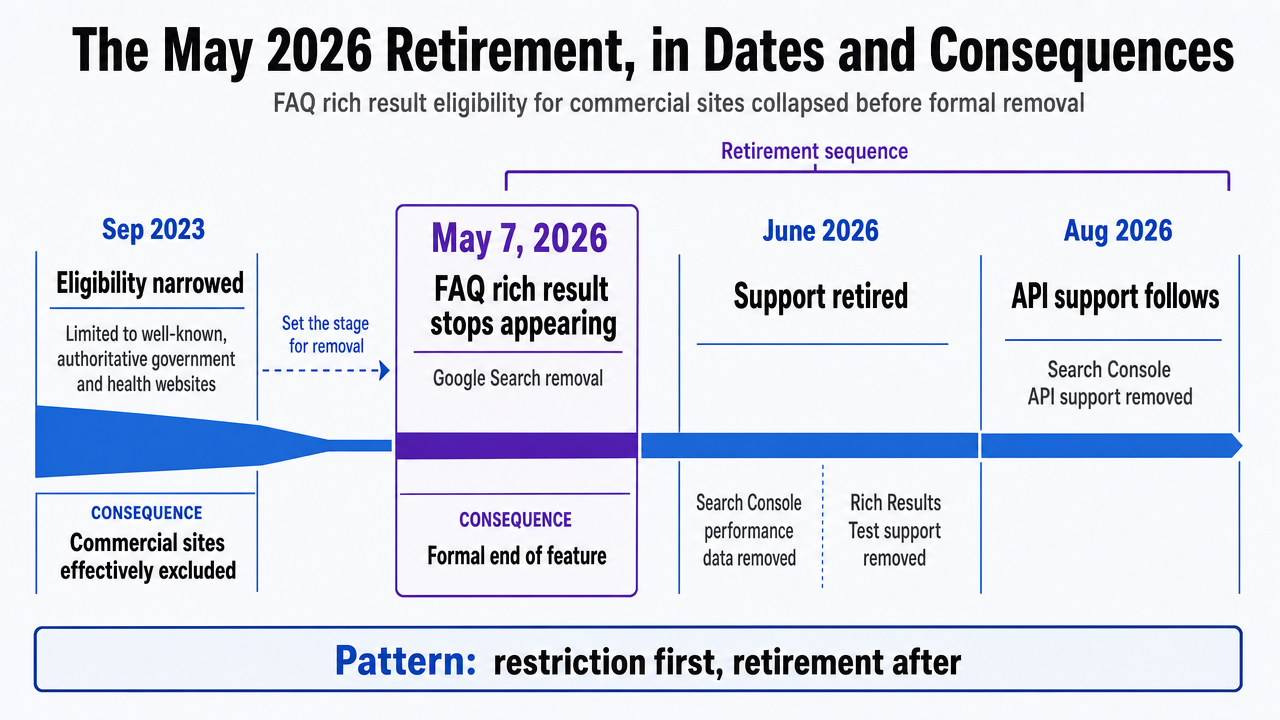 Visualize the collapse of FAQ rich result eligibility for commercial sites, directly supporting the section's timeline narrative
Clarifying FAQ Components: Content, Schema, and Rich Results
Distinguishing FAQ Content, FAQPage Schema, and the FAQ Rich Result
Much of the post-removal discussion conflates "FAQ SEO" into a single concept. However, it comprises three distinct elements, each with a different status after 2026.
FAQ content : Refers to the visible question-and-answer text on a page. This content addresses user queries, enhances page depth, and can be extracted by standard snippet generation, regardless of markup presence. Google's structured data guidance indicates that markup can improve snippet quality even without a specific rich result 2. This utility remains unchanged.
FAQPage schema : The JSON-LD markup that labels questions and answers for machine parsing. It remains a valid schema.org type. However, it is no longer listed among structured-data features that grant eligibility for a supported Search appearance, as its corresponding rich result has been retired 3. The markup is valid, but it no longer confers rich-result eligibility.
The FAQ rich result : Was the expandable accordion that appeared beneath qualifying blue links in search results. This specific SERP treatment is now gone 1. No agency action on a client's markup can restore it.
Differentiating these three components simplifies client discussions. The content still provides value. The markup remains valid. The SERP treatment is retired. Confusion between these elements often leads to either overreaction or inaction.
Enduring Value of Structured Data Post-FAQ Retirement
Structured data as a format continues to be relevant, even as Google discontinues specific features. HTTP Archive's 2024 crawl of approximately 17 million websites revealed that JSON-LD adoption on desktop pages increased to 37% from 34% in 2021 and 2022, while microdata remained stable at 25% over the same period 8. This trend indicates a move towards Google's recommended format, not a decline in structured data usage overall.
The value of structured data post-FAQ retirement falls into two categories. First, it enables eligibility for other supported rich-result types listed in Google's gallery 3. Second, it provides machine-readable context. Google's AI-search guidance notes that structured data can convey information to its systems in a machine-readable format, provided the markup aligns with visible page content and adheres to guidelines 7. This is a semantic contribution, not a guarantee of a specific SERP feature.
It's important to note that correctly implemented markup does not guarantee any rich result 5. Furthermore, the presence of structured data on a page does not automatically correlate with improved rankings or conversions; HTTP Archive cautions that adoption metrics do not prove outcomes 8. Agency SEO leads should continue to use structured data for entity clarity and supported features, but avoid assuming feature permanence or selling schema implementation as a traffic predictor.
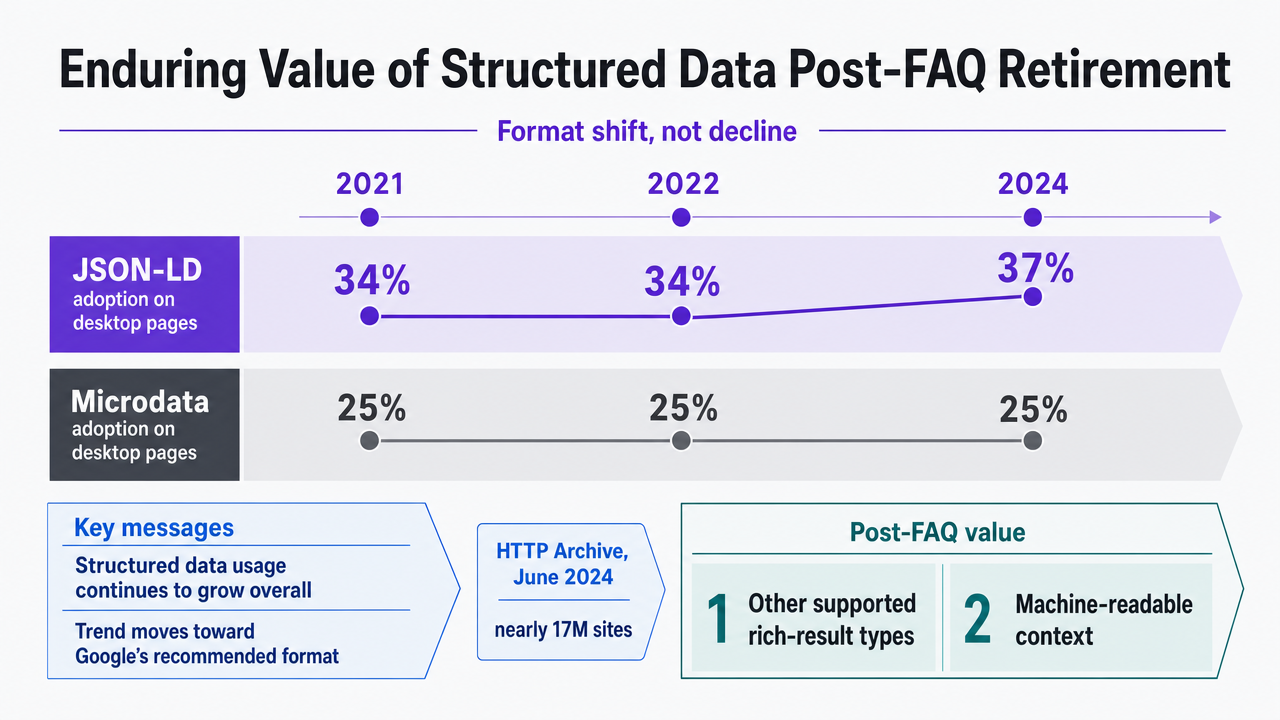 Compare JSON-LD versus microdata adoption trends, supporting the section's claim that structured data usage continues to grow
Client Communication: Framing Risk, Not Panic
Communicating About Existing FAQPage Markup
The appropriate message to clients is concise: the SERP feature that made FAQ markup visible is gone, but the markup itself is not inherently broken. The decision to keep, prune, or remove it should be a strategic portfolio-level judgment, not an urgent reaction 1, 10. Google's 2023 guidance already indicated that publishers could remove FAQ markup without proactive action, a stance not contradicted by the May 2026 changelog 12.
Three key points address most client inquiries. First, valid FAQPage markup does not harm a site; it simply no longer produces the expandable accordion 1. Second, Search Console's impression and click data for the FAQ enhancement report ceased being reportable in June 2026, meaning any month-over-month comparisons against pre-June baselines will inaccurately suggest a loss 10. Third, Google's general structured-data policy still applies: markup must describe visible, accurate content and adhere to spam guidelines 5.
Agency SEO leads should proactively communicate this information to clients. By acknowledging the removed KPI, proposing an alternative measurement plan, and scheduling a review, agencies can facilitate a deliberate decision-making process for managing existing FAQPage implementations.
Why FAQ Schema Is Not an AI Overview Shortcut
A common narrative since the removal is that FAQPage markup, even without a rich result, guarantees inclusion in AI Overviews or AI Mode. Google's own guidance does not support this. The AI-search documentation states that structured data can share information in a machine-readable way if it follows guidelines and matches visible page content, but it does not specify FAQPage as a requirement, preference, or citation lever for generative surfaces 7.
The companion generative-AI optimization guide emphasizes that visibility stems from producing non-commodity, helpful, and people-first content, treating existing SEO fundamentals as the framework for AI features 15. There is no special markup trick. Presenting one to clients creates two problems: it promises an outcome the agency cannot control and is as susceptible to future feature retirements as the FAQ rich result was.
The honest client message is that structured data remains valuable for entity clarity and eligibility for features still supported in Google's gallery 3. It is not a shortcut to AI answers. Agencies that avoid this "shortcut" framing now will prevent repeating the overpromise that the FAQ rich result ultimately failed to deliver.
Test FAQ SEO strategies with live campaigns
Validate new FAQ SEO workflows and measure real impact before committing long term.
Triage Matrix for Existing FAQPage Implementations
Every FAQPage implementation on a client site now falls into one of four dispositions. The decision for each is based on Google's current support, the markup's actual function, and spam policy constraints.
- Keep as-is. This applies when the FAQ block answers genuine user questions, the questions and answers are visible on the page, and the markup accurately reflects that content. Google's general structured-data policy is satisfied: the markup describes accurate, current content and complies with spam guidelines 5. While there's no rich-result benefit, there's no cost to retaining valid markup, and the semantic signal remains available to parsing systems.
- Keep the markup, retire the reporting. This disposition is for pages where the FAQ content provides on-page value, but the client dashboard still references the retired FAQ enhancement report. The markup stays, but the KPI is removed. Any comparison against pre-June 2026 impression baselines will inaccurately inflate perceived losses for a feature that no longer exists to measure.
- Migrate to QAPage only where the page actually qualifies. QAPage markup is specifically for pages centered on a single question with user-submitted answers, and users must be able to submit those answers 2. Most agency-built FAQ pages, which feature multiple business-authored questions, do not meet these criteria and cannot be reclassified without violating eligibility rules. Migration is a limited option, not a general workaround.
- Remove. This applies to pages where the FAQ block was primarily created to earn the retired rich result, where questions are superficial or duplicated across templates, or where the Q&A pattern was scaled extensively to manipulate rankings. Google's spam policies define scaled content abuse as generating many pages primarily for ranking manipulation rather than user benefit, making these pages easier to identify and prune after the SERP incentive's removal 13. Deletion in this context is a quality improvement, not solely a schema decision.
Agency SEO leads should apply this matrix once, documenting the disposition by template rather than individual URL where possible, and revisiting only when page content changes. The decision is not urgent, but it should be deliberate.
Managing FAQ Markup Across a Client Portfolio
Assessing Portfolio Exposure
For SEO leads managing multiple client properties or location templates, the arithmetic differs from that of a single in-house team. HTTP Archive's June 2024 crawl of approximately 17 million websites provides an independent baseline: FAQPage adoption on desktop pages increased from 0.2% in 2022 to 0.6% in 2024, a threefold rise 8.
This growth curve has two implications for agencies with template-driven client rollouts. First, much of the deployed FAQPage markup is recent, often implemented during or after the 2023 restriction that effectively eliminated eligibility for non-government, non-health sites 12. This means a significant portion of an agency's portfolio exposure was created for a rich result that pages were unlikely to earn. Second, template-based deployment through content management systems often means a single JSON-LD block propagates across numerous location or service pages 9. Therefore, portfolio triage should focus on template review rather than URL-by-URL audits, as the chosen disposition for one location typically applies across the set.
Consolidation Table for Reallocating FAQ Production Hours
The reallocation of production hours is a capacity calculation, not a strategic debate. Agency SEO leads should quantify this using variables familiar to finance teams, incorporating existing production system metrics.
H : The average hours per site previously dedicated to FAQ schema build and quality assurance per reporting cycle.
N : The number of client sites or location templates using this markup.
R : The fully loaded hourly production cost.
The exposed capacity for the cycle is H × N, and the exposed spend is H × N × R. Both figures were previously justified by an FAQ enhancement KPI that ceased being reportable in June 2026 and lost API support in August 2026 10.
| Reallocation target | Cycle capacity | Cycle spend | Anchoring evidence |
|---|---|---|---|
| Ongoing FAQ schema build and QA (retired KPI) | H × N | H × N × R | Reporting surface removed 1, 10 |
| One-time portfolio triage against the four dispositions | Fraction of H × N, one cycle only | Fraction of H × N × R | Template-level review, not URL-by-URL 9 |
| Reallocated to helpful, people-first content on existing pages | Residual H × N after triage | Residual H × N × R | Google's people-first guidance 14 |
| Reallocated to supported structured-data types on the same templates | Portion of residual | Portion of residual | Current supported feature gallery 3 |
Two important considerations accompany this table. First, reallocating hours to produce more Q&A pages is not a valid target, as scaling pages primarily to influence rankings constitutes Google's definition of scaled content abuse 13. Second, any remaining capacity allocated to structured data should be measured against a before-and-after window for currently supported features, not against the retired FAQ report 4.
Navigate the FAQ Rich Result Update with Data-Driven Clarity
Get expert guidance on adapting FAQ SEO strategy post-rich result update. See how leading agencies are maintaining SERP impact and workflow efficiency at scale, without increasing team size.
Where Freed Hours Produce Measurable Outcomes
Retiring the KPI Before Reallocating Budget
Reallocation efforts fail if the retired metric remains on the dashboard. If FAQ enhancement impressions are still included in monthly client reports, any new work funded by freed hours will be evaluated against a benchmark that Google stopped publishing when Search Console reporting was retired in June 2026 and API support followed in August 10. This mismatch results in new production appearing to decline against a non-existent baseline.
The correct approach is to remove the KPI from client reporting before the next cycle, replace it with a measurement window linked to a supported feature or on-page outcomes, and document this change in writing. Google's structured-data testing guidance recommends comparing several months of performance before and after any change, necessitating a defined post-change window rather than continuous comparison against a discontinued feature 4.
Once the retired KPI is removed from reports, the reallocation discussion becomes a straightforward capacity question, rather than a defense of budget against a non-existent metric.
Effective Targets for Reallocated FAQ Hours
Three areas can effectively absorb reallocated FAQ hours without encountering the limitations that led to the rich result's demise. Each aligns with Google's current guidance and yields measurable outcomes on surfaces not slated for retirement.
Entity coverage is the first. Structured data remains valuable for machine-readable context when markup matches visible page content and adheres to guidelines 7. The supported feature gallery still lists types that can confer eligibility for current appearances 3. Hours previously spent on FAQ schema can be redirected to implementing Organization, LocalBusiness, Service, Person, and Product markup on the same templates, anchoring the semantic contribution to a supported, rather than retired, feature.
Comparison depth is the second. Pages that compare a client's service, product, or approach with alternatives, highlighting substantiated differences, align with Google's people-first guidance for content created by demonstrated experts for a defined audience 14. The production effort is similar to FAQ work, reviewer requirements are comparable, and measurement relies on ordinary organic performance rather than a feature-specific report.
Local service-page substance is the third, particularly relevant for multi-location and DSO-style portfolios managed by agency SEO leads. Enhancing the depth of service, procedure, and location pages with content tailored for actual searchers fits within the helpful-content framework and does not depend on the availability of any single SERP feature 14.
Why Scaling Q&A Pages Is Not a Viable Replacement
The intuitive response to a lost visual treatment might be to produce more of the content that previously earned it. However, this approach directly conflicts with Google's spam policy on scaled content abuse, which defines the violation as generating many pages primarily to manipulate search rankings rather than help users, explicitly including generative-AI-assisted production 13. The policy focuses on the "why" behind page creation, not the "how."
Two operational patterns fall afoul of this policy. Creating individual landing pages for each question across a location template to regain lost FAQ impressions constitutes scaled production aimed at ranking manipulation. Similarly, duplicating a Q&A block across numerous service pages with only minor entity changes meets this definition if the answers are superficial or repetitive.
The appropriate use of freed hours is to create fewer, deeper pages featuring visible expertise and substantiated answers, measured against standard organic performance rather than a retired enhancement report 14. Volume is not the solution for a discontinued feature; quality that can withstand future feature retirements is.
A Defensible 90-Day Plan and Where Vectoron Fits
A defensible 90-day plan for agency SEO leads involves three phases, avoiding the need for emergency client decisions.
- Days 1-30 focus on client communication and KPI retirement: send a risk-framed notification, remove the FAQ enhancement metric from active reporting before the next cycle, and establish a new measurement window based on currently supported surfaces in Google's gallery 3, 10.
- Days 31-60 involve template-level triage across the client portfolio, applying the four dispositions once per template rather than per URL, reserving removal for pages primarily built for the retired feature or duplicated without added substance 13.
- Days 61-90 redirect residual capacity towards enhancing entity coverage on existing templates and deepening service-page substance, measured against ordinary organic performance 14.
Executing this plan across a portfolio is primarily a coordination challenge, which is where an AI marketing platform like Vectoron excels. Specialist strategists can identify the triage list, route each disposition for human approval, and implement approved changes efficiently without requiring additional headcount.
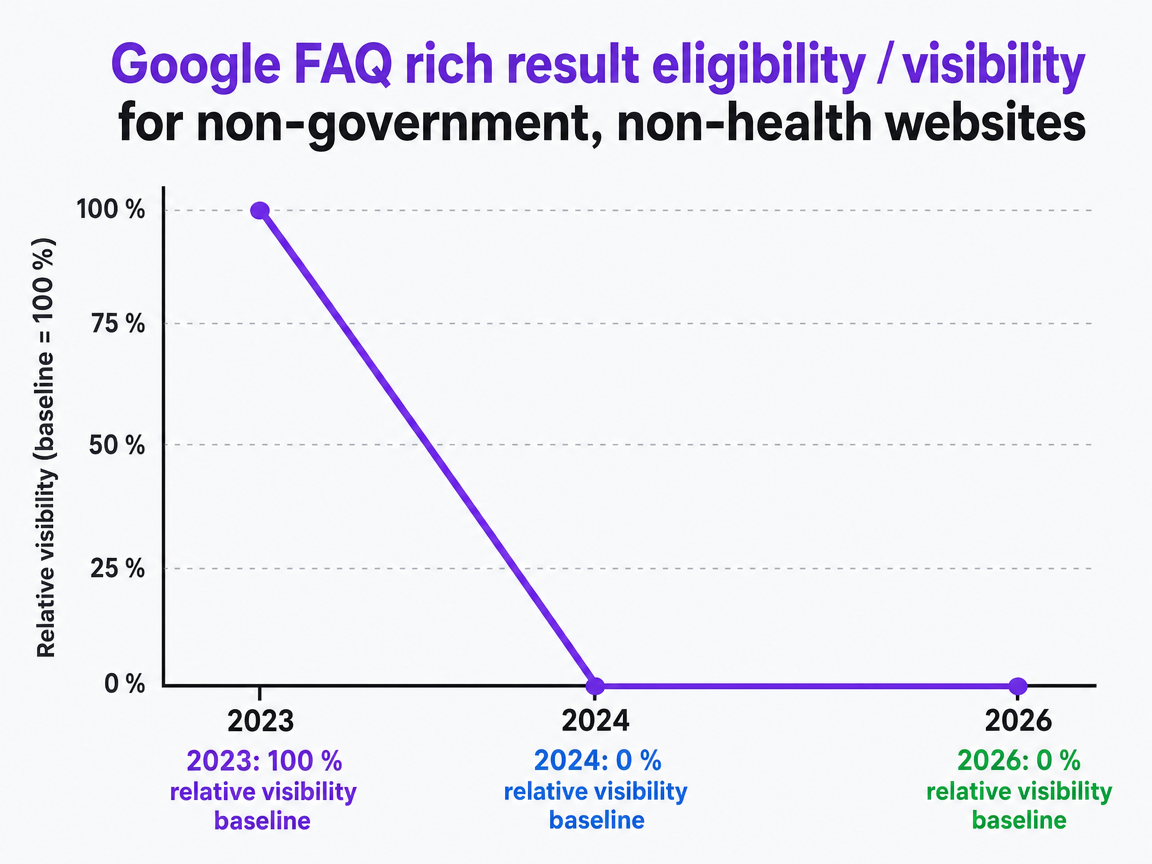 Google FAQ rich result eligibility / visibility for non-government, non-health websites
Source: Changes to HowTo and FAQ rich results
Frequently Asked Questions
References
- 1.Latest Google Search Documentation Updates.
- 2.Schema for Q&A Pages (QAPage) | Google Search Central.
- 3.Structured Data Markup that Google Search Supports.
- 4.Intro to How Structured Data Markup Works | Google Search Central.
- 5.General Structured Data Guidelines.
- 6.Simplifying the search results page.
- 7.Top ways to ensure your content performs well in Google's AI experiences on Search.
- 8.Structured Data | 2024 | The Web Almanac by HTTP Archive.
- 9.CMS | 2025 | The Web Almanac by HTTP Archive.
- 10.Google Drops FAQ Rich Results From Search.
- 11.Google kills FAQ rich results: what SEOs saw coming since 2019.
- 12.Changes to HowTo and FAQ rich results.
- 13.Spam Policies for Google Web Search.
- 14.Creating Helpful, Reliable, People-First Content.
- 15.Google’s Guide to Optimizing for Generative AI Features on Google Search.