
Key Takeaways
- Ranking movement is the default state of Google's search systems, driven by core rollouts, spam enforcement, system interactions, query drift, and location variance rather than site-level failures 3, 13.
- Classifying each fluctuation before investigating it is the highest-leverage move, since the ranking update dashboard and Search Console debugging sequence resolve most tickets without deep analyst work 7, 1.
- During an active rollout, hold the ticket and wait at least one full week after the rollout finishes before evaluating changes, or interventions will be credited to movement the system produced on its own 2.
- Standardization is the main implementation risk: without a shared classification sheet, per-client spam exposure profile, and enforced ticket template, triage collapses into individual judgment and portfolio economics break down 4, 7.
Ranking Volatility Is a Classification Problem, Not a Fix-It Problem
Every Monday, an agency head of SEO faces client escalations about dropped rankings. The immediate reaction is to deploy an analyst for investigation. However, this often leads to the same conclusion: normal variance, wasting valuable time that could be spent on tasks with actual revenue impact.
A more scalable approach is to treat ranking movement as a classification task before it becomes a remediation task. Google itself describes its ranking systems as a set of interacting technologies, not a single dial, meaning shifts can occur without any site-level changes on the client side 3. Historical academic work on Google's top results characterizes this pattern as constant minor changes punctuated by occasional major ones 13. Both descriptions highlight a key operational reality: movement is the default state, not an anomaly.
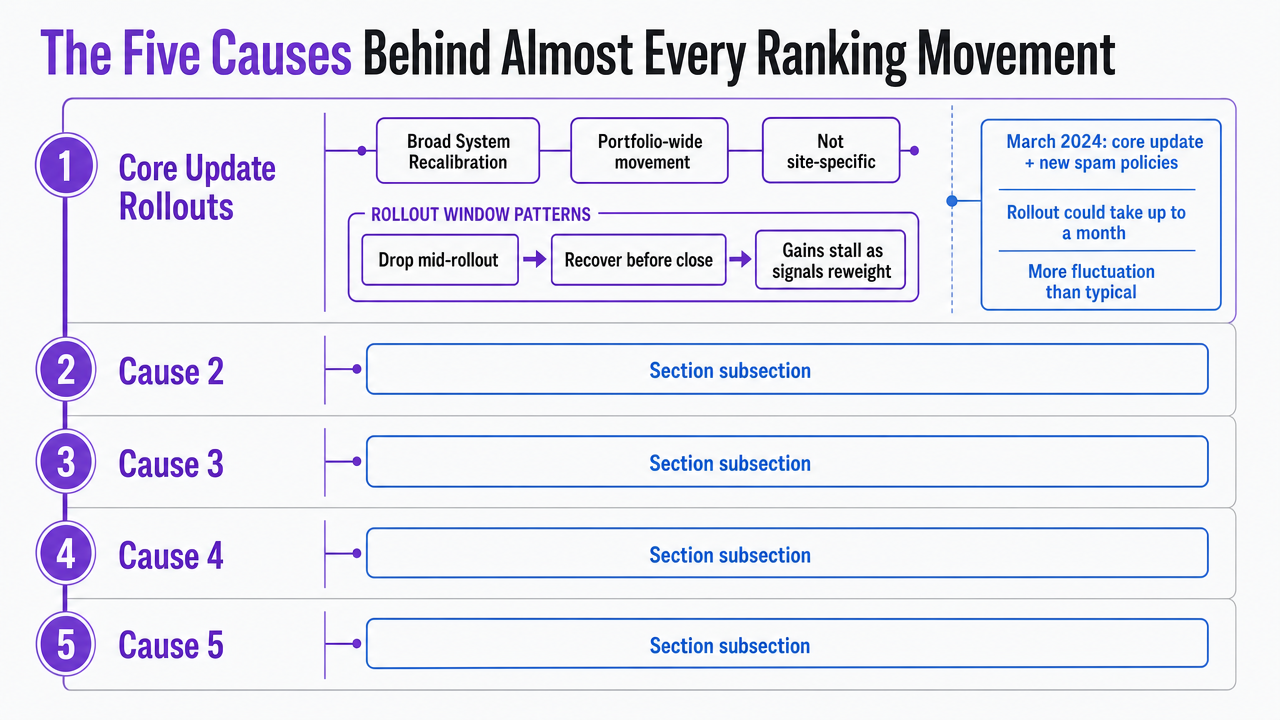
The agency advantage lies in a repeatable protocol that sorts each fluctuation into one of five causes: core rollouts, spam enforcement, ranking system interactions, query and seasonal drift, or location and personalization variance. Only after this classification is made should a decision be taken on whether analyst hours are warranted. This article will detail this taxonomy, the triage sequence, and the portfolio economics that make classification the most impactful strategy.
The Five Causes Behind Almost Every Ranking Movement
Core Update Rollouts and Broad System Recalibration
Core updates are a significant source of portfolio-wide ranking movement, yet they are frequently misinterpreted. When Google recalibrates how its ranking systems weigh signals across the entire index, positions shift for reasons unrelated to any specific client's site. The March 2024 rollout serves as a prime example: Google combined a core update with new spam policies and publicly stated that the rollout could take up to a month, leading to more ranking fluctuation than a typical core update 11.
Rollout windows often create three distinct movement patterns that analysts mistakenly attribute to site problems:
- Rankings might drop sharply mid-rollout and then recover before the rollout concludes.
- Pages that were previously gaining visibility can stall as the system reweights signals.
- Sites with no changes to content, links, or technical health may experience visibility loss for weeks, followed by a partial return.
All these scenarios are characteristic of rollout behavior, not site-specific issues.
Google also indicates that smaller core updates occur continuously between announced events, and improvements can appear without waiting for the next named update 9. Given both announced rollouts and unannounced adjustments, a client site is almost always within some form of active recalibration window. Treating every dip during these periods as a diagnosis-worthy event is an inefficient use of analyst time.
Spam Enforcement and Policy-Driven Demotions
Spam updates operate differently from core updates. They target specific patterns, such as scaled content abuse, expired domain abuse, site reputation abuse, and machine-generated content created primarily for ranking purposes. Demotions resulting from these updates are often severe and long-lasting 4. Google publishes each spam update on its ranking history dashboard 8, simplifying the diagnostic question: was a spam update active when the drop occurred, and does the client's site exhibit the targeted pattern?
The November 2024 site reputation abuse policy update is a relevant case. Google clarified that using third-party content to exploit a host site's ranking signals violates policy, regardless of the host publisher's involvement 5. Publishers with coupon sections, review directories, or partner-authored verticals that relied on host authority experienced sudden, section-level losses.
Agencies should maintain an exposure map for each client, noting any scaled programmatic content, expired-domain acquisition history, partner content sections, or AI-generated pages published without human oversight 6. If a spam update rolls out and a client on this exposure list experiences a drop, the ticket should be routed for immediate remediation. Clients not on the list should follow the same wait window as any other rollout.
Ranking System Interactions Without Site-Level Changes
Not all ranking movements can be traced to an announced event. Google's ranking systems guide describes results as the output of multiple interacting technologies, including detection and demotion systems that operate continuously alongside the ranking systems themselves 3. When one component adjusts how it weighs a signal, downstream results can shift even if nothing on the site or its backlink profile has changed.
This category often leads to challenging client conversations. The site is clean, content is intact, there are no manual actions, and no announced rollout, yet rankings still moved. The honest explanation is that the system itself shifted, and there is no site-level lever for the analyst to pull. Case studies on Google's ranking dynamics characterize this as constant minor changes with occasional major shifts 13—a pattern the team should anticipate rather than attempt to diagnose as a site issue.
Query-Level and Seasonal Intent Drift
A ranking drop can often be a disguised query change. When the intent behind a query shifts—for example, from informational to transactional, local to national, or text-first to video-first—Google reorders which page types best satisfy that intent. The client's page hasn't necessarily worsened; rather, the query now demands a different kind of answer.
Google's debugging guide advises analysts to inspect top queries and top pages separately, compare periods of equal length, and segment by search type before drawing conclusions about site health 1. Seasonal categories, such as tax services or home services, exhibit predictable annual patterns that appear as drops in week-over-week views but disappear in year-over-year comparisons. Analysts who rely solely on a seven-day comparison window will repeatedly misclassify seasonality as a decline.
Location, Personalization, and Rank-Tracker Disagreement
When two analysts check rankings for the same query on the same day and observe different positions, the site itself has not changed; the observers have. Academic research analyzing factors influencing search result mutability found that location has the greatest impact on volatility, followed by time, while safe search and privacy settings have the least 14. This ordering is operationally significant: geographic variance accounts for most of the observed differences agencies encounter weekly.
Rank trackers introduce their own dispersion on top of Google's variance. Different tools sample from various data centers, IP geographies, and personalization states. A client comparing a tracker report to their own incognito Chrome search from a home office in a different metro is essentially comparing three distinct queries.
The operational rule is clear: rank-tracker readings are directional, not authoritative. Search Console's Performance report is the definitive data source because it reflects actual impressions and clicks aggregated across the user population, not a synthetic query from a single location. When a client escalates based on a rank-tracker screenshot, the initial step is to pull the same query and page data from Search Console for the corresponding date range. This often resolves half of these escalations without further investigation.
 Visualize the five-cause taxonomy that the section explicitly enumerates, giving readers a scannable framework tied directly to the subsections
Baseline Volatility: What the Historical Record Actually Shows
Before any triage protocol can be effective, the team needs a robust answer to the client's underlying question: how much movement is normal? The honest answer begins with the historical record of search engine output, not with contemporary rank-tracker screenshots.
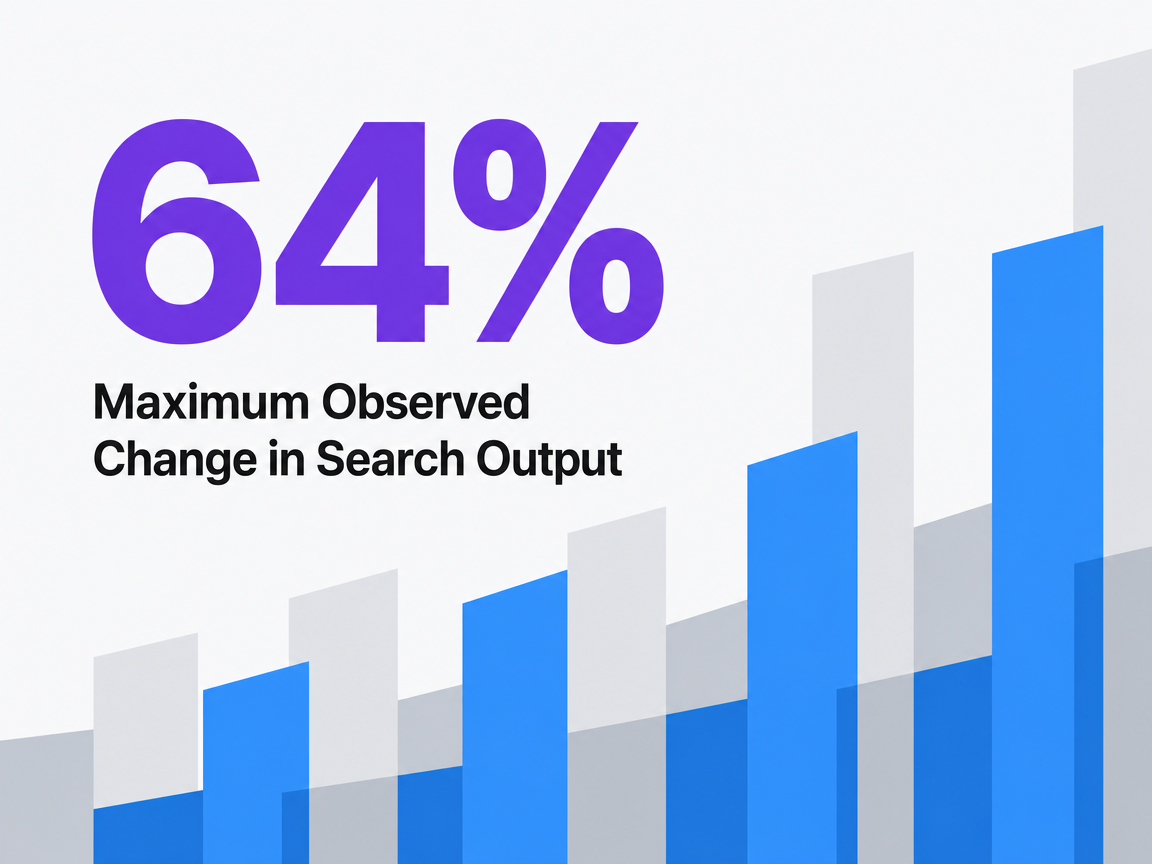
An early foundational study on web search engine instability measured how much returned result sets changed over time, finding that search output shifted by as much as 64%, with up to 49% of URLs in a top-ten set disappearing and later reappearing 12. It's important to note the scope: this paper predates the modern Google index by many years, examined multiple search engines, and measured result-set turnover, not ranked position drift. While not a current Google benchmark, it provides evidence that volatility has been a structural property of web search for as long as it has been measured.
More recent case-study work specifically on Google characterizes the pattern with less drama: constant minor changes to top results, punctuated by occasional major shifts 13. This description aligns well with what agency dashboards typically show week to week. Positions fluctuate by a rank or two most days, and every few months, a rollout or spam action produces a more significant shift.
The operational use of these numbers is specific. When a client asks why their position moved from four to six on a non-commercial query with no rollout in progress, the defensible reply is that this magnitude of movement is within the system's historical range. Analyst hours are better spent on revenue-generating queries. Baseline volatility is the fundamental reason for the triage protocol's existence, not a point to re-litigate with every ticket.
Stabilize SEO Performance with Real-Time Insights
Test live content strategies and monitor SERP fluctuations before committing to a long-term solution.
The Triage Protocol: From Ranking Alert to Analyst Decision
Step One: Check the Ranking Update Calendar Before Anything Else
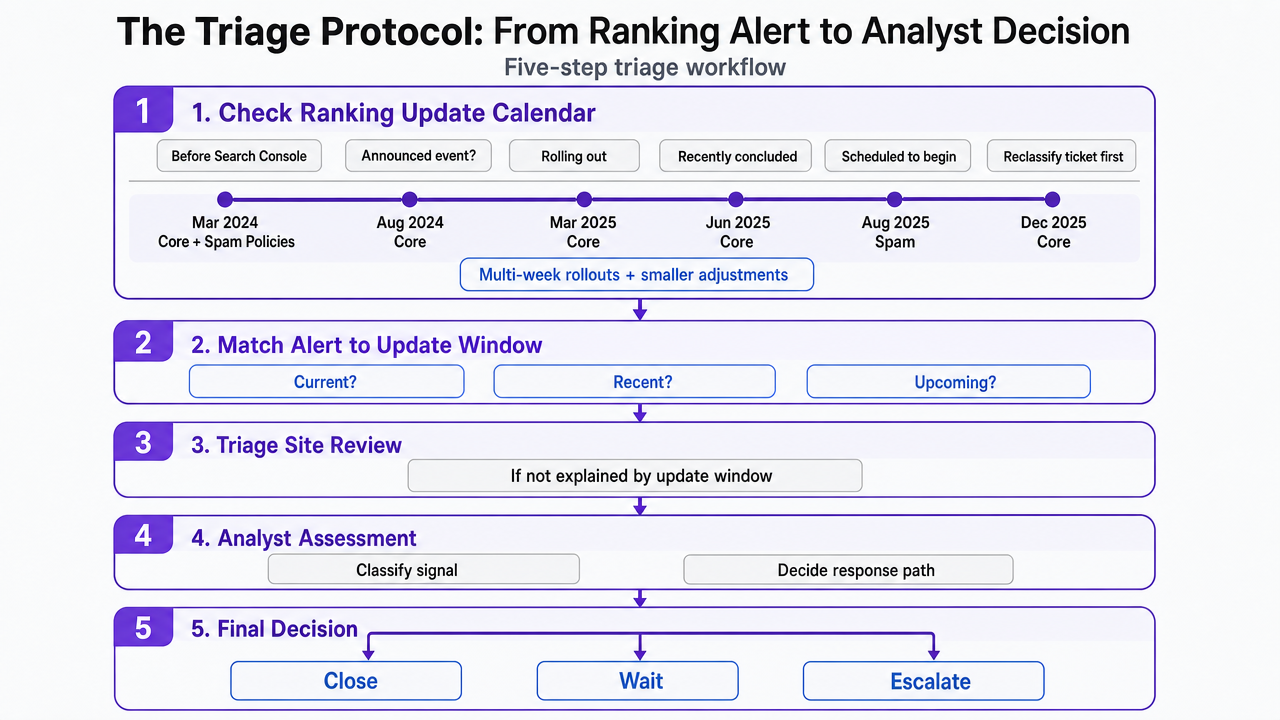
The first action for any ranking escalation is not to open Search Console. Instead, it's to consult Google's ranking update history dashboard to determine if an announced event is currently rolling out, recently concluded, or scheduled to begin 7. This single step reclassifies a substantial number of tickets before any analyst time is spent on the site itself.
The 2024-2025 window illustrates this point clearly. Google's ranking history records the March 2024 core update paired with new spam policies, the August 2024 core update, the March 2025 core update, the June 2025 core update, the August 2025 spam update, and the December 2025 core update 7. Multi-week rollouts combined with unannounced smaller adjustments mean a client site spends most of the year within some form of active recalibration window.
The protocol rule is straightforward: If a rollout is in progress on the date the drop began, the ticket is tagged as rollout-adjacent and moves to the wait window in step two. If no announced event overlaps the drop date, the ticket proceeds to Search Console diagnostics in step three. This dashboard check takes less than a minute and prevents the most common failure in agency triage: initiating a full investigation for movement that Google itself has already indicated is expected.
Step Two: The One-Week Post-Rollout Wait Window
Once a rollout tag has been applied, the next decision is not what to investigate, but when. Google's core update guidance explicitly states to wait at least a full week after a core update finishes rolling out before evaluating site changes in Search Console 2. This is because positions continue to shift as the system settles, and any analysis performed within the rollout window will be measuring a moving target.
Operationally, this means placing a hold flag on the ticket with a review date set one week past the announced rollout end. The client receives a brief update: rollout in progress, review scheduled for the specified date, and no interim changes recommended. This is not passive; it prevents a common failure mode—recommending content or link changes during a rollout, then mistakenly attributing eventual recovery to the intervention rather than to the system settling.
Step Three: Search Console Diagnostic Sequence
Tickets that pass the rollout check proceed to a standardized Search Console sequence. Google's debugging guide specifies the order:
- Compare periods of equal length.
- Separate the drop by search type before drawing conclusions.
- Inspect top queries and top pages to pinpoint where the movement occurred 1.
Skipping any step can lead to false diagnoses.
Date-range comparison is a frequent source of analyst errors. A seven-day drop compared against the prior seven days can conflate seasonality, day-of-week variance, and unrelated news cycles. The corrective is a year-over-year comparison for the same date range, run in parallel with the week-over-week view. If year-over-year is stable or increasing while week-over-week is down, the drop is likely seasonal drift, and the ticket can be closed.
Search type separation is the next crucial step. A drop in Web results combined with stable Image and Video results suggests a different cause than a uniform decline across all types. Once the search type is isolated, the analyst examines the top queries and pages contributing to the delta. If the drop is concentrated on a small set of queries with a specific intent shift, the finding is query-level, pointing to intent drift rather than site health. If the drop is broad across queries and pages, the ticket advances to step four for spam exposure review or step five for site-level investigation.
Step Four: Spam Policy Exposure Check
Broad drops that cannot be attributed to a rollout or a query-level finding require a spam exposure check against the client's pre-built profile. Google's spam policies outline the enforcement categories that lead to sudden visibility loss: scaled content abuse, expired domain abuse, site reputation abuse, and machine-generated content produced primarily for ranking 4. The check is a binary assessment against each category.
If a spam update was listed on the ranking history dashboard during the drop window 8 and the client has documented exposure to the pattern that update targets, the ticket routes directly to remediation with the specific pattern identified. If the client has no exposure on their profile, the ticket advances to step five, even if a spam update is active. Enforcement is pattern-specific, not sitewide, and treating every spam-update-adjacent drop as a penalty leads to expensive remediation work on sites that do not require it.
Step Five: Close, Escalate, or Wait — The Decision Rule
By step five, the ticket has a classification. The decision rule maps each classification to one of three outcomes, completing the loop.
- Close as normal variance when the movement is within the baseline range, no rollout overlaps the date, no query-level intent shift is visible, and no spam exposure applies. The client receives the classification, supporting data, and a note that no intervention is recommended.
- Close as seasonal or query drift when year-over-year comparison or query-level inspection identifies the cause; the recommendation is content or intent alignment work scheduled for the next planning cycle, not an emergency response.
- Wait when a rollout is active or within the one-week post-rollout window; a review date is set, and the ticket is held.
- Escalate to full analyst investigation only when the drop is broad, the rollout calendar is clear, query and page data show no intent explanation, and either a spam exposure applies or a site-level signal (crawl errors, security issues, manual actions) surfaces in Search Console. Escalation is the exception, not the default outcome.
 Visualize the five-step triage workflow described in the section, mapping ranking alert to final decision (close, wait, or escalate)
If You Manage a Portfolio: The Economics of Triage vs. Investigation
While the preceding discussion treated ranking movement as a per-ticket problem, the economics change at a portfolio scale. An agency managing 15 to 100 clients isn't deciding if one investigation is worthwhile; it's determining what share of the analyst bench will be consumed by fluctuation tickets, displacing other critical work.
The variables are straightforward and should be adjusted based on your own timesheets.
T : Fluctuation tickets per client per month.
H : Analyst hours consumed per ticket for a full investigation.
The total portfolio load is then clients × T × H hours per month. For example, with T = 2 tickets and H = 3 hours per full investigation, a 40-client portfolio absorbs 240 analyst hours monthly—equivalent to roughly 1.5 full-time analysts dedicated solely to fluctuation work.
| Portfolio Size | Full Investigation on Every Ticket (hours/mo) | Triage-First, 20% Escalation Rate (hours/mo) |
|---|---|---|
| 15 clients | 90 | 27 |
| 40 clients | 240 | 66 |
| 100 clients | 600 | 150 |
Assumptions: T = 2 tickets/client/month, H = 3 hours full investigation, triage classification = 0.25 hours per ticket, 20% of triaged tickets escalate to full investigation. Adjust the inputs against actual timesheets.
The efficiency gain isn't in shortening investigations, but in preventing the 80% that Google's own rollout calendar 7 and debugging sequence 1 would have classified as normal variance or rollout-adjacent before any deep work began. Classification is the inexpensive step; investigation is the costly one. Portfolios that default every escalation to investigation are paying full price for a decision that a fifteen-minute triage could have made.
Gain Predictable SEO Performance Amid Search Volatility
Connect with our team to see data-driven workflows for stabilizing rankings, mitigating algorithm shocks, and maintaining oversight across all client accounts—without expanding your SEO headcount.
What Not to Do When Rankings Move
Three behaviors account for most of the wasted analyst hours on fluctuation tickets. Each one feels like diligence but produces the opposite effect.
- Do not push content or link changes during an active rollout. Google's core update guidance explicitly states that evaluation should wait at least a full week after the rollout finishes 2. Interventions made within that window will be mistakenly credited or blamed for movement the system would have produced anyway.
- Do not diagnose from a seven-day comparison alone. Week-over-week views can conflate seasonality and day-of-week variance within the same signal. Google's debugging sequence pairs date-range comparison with search-type separation and top-query inspection for this precise reason 1.
- Do not treat every spam-update-adjacent drop as a penalty. Enforcement is pattern-specific 4. Remediating a site with no exposure to the targeted pattern wastes hours without improving rankings.
Standardizing Classification Across the Team
Triage only scales effectively when every analyst on the team reaches the same classification from the same inputs. Otherwise, the protocol devolves into individual judgment, and the portfolio economics discussed earlier no longer hold true.
Three key artifacts facilitate standardization:
- A shared classification sheet detailing the five causes, their diagnostic signals, and references to Google's official documentation—including core update and rollout timing 2, spam categories and enforcement patterns 4, ranking system interactions 3, query and search-type separation 1, and geographic variance ordering 14.
- A per-client spam exposure profile, updated whenever new content patterns emerge.
- A ticket template that mandates the analyst record the rollout calendar check 7, the year-over-year comparison, and the search-type split before any classification is entered.
An approval-first workflow is crucial for consistent classification decisions across a team. Platforms like Vectoron route each triage output for human sign-off before remediation work is approved. This is the point where a portfolio stops incurring the full investigation cost for movement that Google has already indicated is expected.
 Maximum Observed Change in Search Output
Maximum Observed Change in Search Output
Frequently Asked Questions
References
- 1.Debugging drops in Google Search traffic.
- 2.Google Search's Core Updates.
- 3.A Guide to Google Search Ranking Systems.
- 4.Spam Policies for Google Web Search.
- 5.Updating our site reputation abuse policy.
- 6.New ways we're tackling spammy, low-quality content on Search.
- 7.History for Ranking | Google Search Status Dashboard.
- 8.Google Search spam updates and your site.
- 9.Latest Google Search Documentation Updates.
- 10.Google Search Essentials (formerly Webmaster Guidelines).
- 11.our March 2024 core update.
- 12.On the Instability of Web Search Engines.
- 13.Dynamics of Search Engine Rankings – A Case Study.
- 14.FACULDADE DE ENGENHARIA DA UNIVERSIDADE DO PORTO.