
Key Takeaways
- Search Console paired with disciplined manual SERP sampling is the most defensible free way to log AI Overview activation, cited domains, and CTR displacement on question-form queries 1.
- Perplexity's visible citation list makes it the cleanest free surface for logging which domains an AI engine actually pulls from, though its behavior does not proxy for Google or ChatGPT 13.
- Bing Webmaster Tools reads back into Copilot grounding signals after Bing's 2026 guideline update naming GEO directly, but activation must be inferred through manual Copilot polling 11.
- ChatGPT free-tier polling measures share-of-mention rather than citation share, and requires at least three runs per prompt because single-point readings misrepresent the true distribution 14.
- Free schema validators and Google's Rich Results Test audit AI-eligible content structure, though preview controls do not guarantee exclusion from AI features 3.
- Open-source GEO prompt libraries give agencies a forkable, versioned query corpus that keeps citation and mention data comparable across Perplexity, ChatGPT, Copilot, and Google AI Overviews 15.
- Vectoron's two-week trial sits above the six sensors as an execution layer, coordinating briefing, drafting, and schema updates through an approval-first workflow aligned with NIST traceability controls 4.
Why classic rank trackers now miss a third of the picture
Classic rank trackers were built for a world where the top of the SERP predicted the top of the funnel. That world is gone for a specific and measurable slice of queries. A 2026 study of 55,393 trending Google queries observed over a 40-day window in March–April 2026 found that AI Overviews activated on 13.7% of queries overall, but on 64.7% of question-form queries 1. The same study reported that roughly 30% of domains cited inside AI Overviews did not appear in the traditional organic top 10 for the underlying query 1.
That second number is the one that breaks the report deck. A rank tracker pointed at positions 1–10 will confirm the client is ranking, while the AI Overview above it cites three domains the tracker never audits.
The gap is not uniform. It concentrates on informational and question-form intent, precisely where mid-funnel content lives. For an agency running SEO delivery across a book of accounts, the practical effect is that a growing share of high-intent research traffic is being answered, cited, or displaced inside an interface that classic tools do not sample. Free AI visibility tools exist to close that instrumentation gap, and the rest of this article scores seven of them against what an agency can actually put in front of a client.
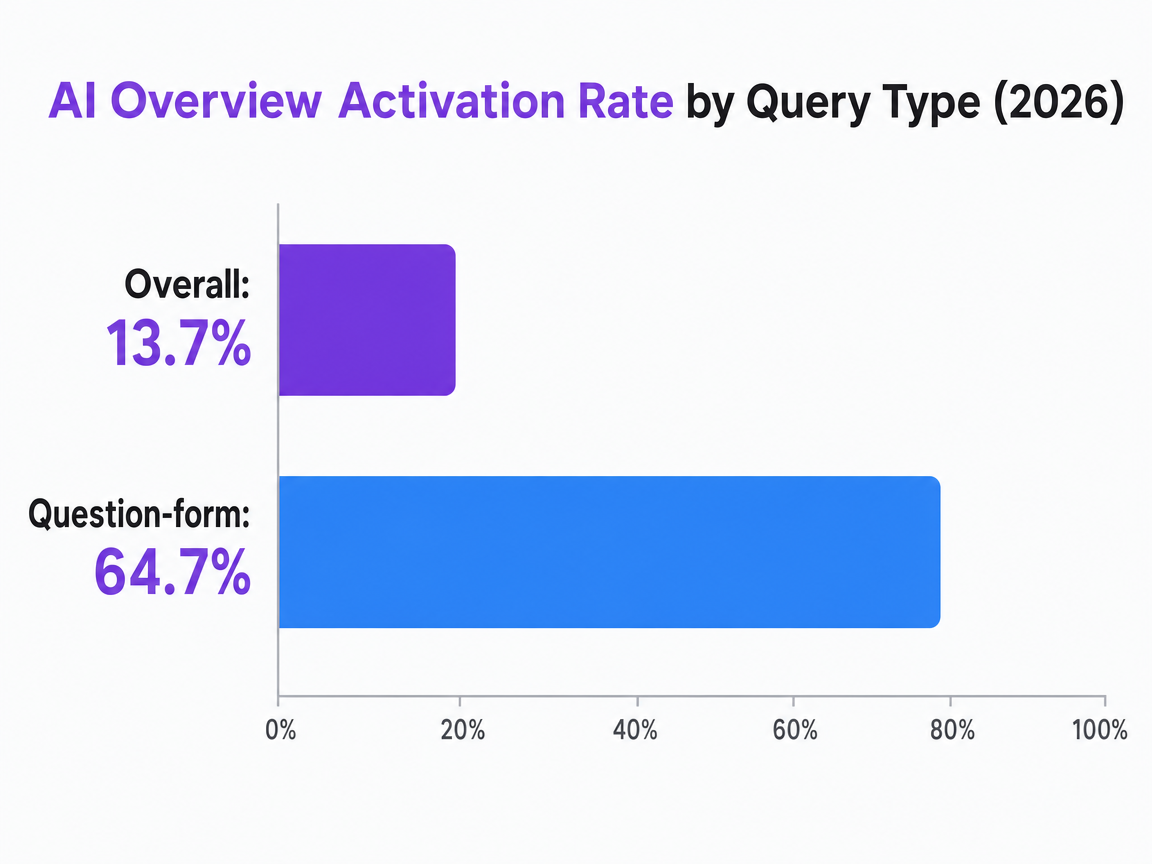 AI Overview Activation Rate by Query Type (2026)
Comparison of Google AI Overview activation rates for all trending queries versus just question-form queries, based on a study of 55,393 queries.
The rubric: what a defensible free AI visibility tool actually measures
Not every free tool that markets itself as "AI visibility" produces data an agency can defend in front of a client. The category is crowded with browser extensions that run a single prompt once and screenshot the result. That output survives a Slack thread; it does not survive a QBR.
A defensible free AI visibility tool has to score against six dimensions:
- What it measures: activation (does an AI answer appear at all), citations (which domains are named), mention share (how often a brand is referenced across a prompt set), prompt coverage (how many client-relevant queries are sampled), and provenance (whether the cited content actually supports the claim).
- Engines covered: Google AI Overviews, ChatGPT, Perplexity, Copilot, and Gemini each behave differently and none of them proxies for the others 13.
- Sampling frequency, because AI outputs vary by run, prompt phrasing, and time of day, and a single-point measurement misrepresents the true visibility distribution 14.
- Export or API access, so results can flow into a client deck without screenshot labor.
- Client-report readiness: does the output include timestamps, prompt text, and cited URLs, or just a score.
- The free-tier ceiling: how many queries, seats, or workspaces before the tool forces an upgrade.
The seven tools that follow are scored against exactly these six criteria.
The seven tools, scored
AI Overview Visibility Tracker (Google Search Console + manual sampling)
The most defensible free AI Overview monitor is the one Google already provides, used sideways. Search Console does not label AI Overview impressions distinctly, but the combination of Performance report filters, query-level CTR anomalies, and a disciplined manual sampling routine produces a signal that holds up in a QBR.
The method: export queries with impressions above a client-defined floor, isolate question-form queries (who, what, how, why, best, vs), and manually sample the live SERP for each in a clean session. Log activation as a binary, capture cited domains, and screenshot the panel with a timestamp. Repeat weekly. This mirrors the sampling logic used in the 55,393-query study that reported 13.7% overall activation and 64.7% activation on question-form queries 1, and it aligns with the argument that visibility must be treated as a distribution across repeated runs rather than a single point 14.
- What it measures: activation, cited domains, and CTR displacement.
- Engines covered: Google AI Overviews only.
- Sampling frequency: as often as an analyst runs it.
- Export access: full CSV from Search Console.
- Free-tier ceiling: unlimited on the Google side; the constraint is analyst hours.
The tradeoff is labor: this is a sensor, not an automation.
Perplexity Labs prompt console for citation logging
Perplexity's public interface exposes something most AI engines hide: a visible citation list attached to every answer. That transparency makes it the cleanest free surface for logging which domains an AI engine actually pulls from on a given prompt.
Operated as a monitoring tool, the workflow is straightforward. Build a prompt set of 20–50 client-relevant queries, run them in a fresh session with no personalization signals, and copy the answer plus the numbered citation list into a spreadsheet. Rerun on a fixed cadence. The output is a citation share table by domain, which is closer to what a client actually wants to see than a rank number.
Perplexity's citation behavior does not proxy for Google or ChatGPT. Brand visibility varies materially by platform and by brand maturity, so a domain cited heavily on Perplexity may be absent from Google AI Overviews for the same query 13.
- What it measures: citation presence, citation order, answer text for provenance review.
- Engines covered: Perplexity only.
- Sampling frequency: manual, unlimited on the free tier.
- Export access: copy-paste.
- Free-tier ceiling: daily query caps on Pro-model routing; the base model remains accessible.
Analyst discipline, not the platform, sets the limit.
Bing Webmaster Tools with Copilot grounding signals
Copilot is the engine most agencies underweight, and Bing Webmaster Tools is the free instrumentation layer that reads back into it. Bing updated its guidelines in 2026 to explicitly cover Copilot and grounding-API results, and it named generative engine optimization directly in the rewrite 11. That change matters because it defines what content is eligible to be grounded and what publisher signals Bing acts on.
The operator setup is unglamorous. Register client properties in Bing Webmaster Tools, submit sitemaps, and monitor the Search Performance report for query-level impression shifts that correlate with Copilot answer surfaces. Cross-reference with manual Copilot prompts run against the same query set used in the Perplexity console, so citation data is comparable across engines.
The gap: Bing does not distinguish Copilot impressions in the free interface, so activation must be inferred from prompt-side sampling.
- What it measures: indexation, impression trends, and eligibility signals for Copilot grounding.
- Engines covered: Bing search and Copilot (partial).
- Sampling frequency: daily aggregates.
- Export access: CSV.
- Free-tier ceiling: none on the reporting side; the ceiling is inference quality.
Pair it with manual Copilot polling or the signal is incomplete.
ChatGPT share-of-mention sampling via free-tier polling
ChatGPT does not publish citations the way Perplexity does, and its browsing behavior varies by model version. That makes share-of-mention the more reliable free-tier metric than citation share. The measurement is simple: does the brand appear in the answer body, and in what position relative to competitors.
The workflow polls a fixed prompt set across a fresh chat window per prompt, with browsing enabled where available. Analysts record brand mentions, competitor mentions, and answer sentiment for each run. Because outputs vary run to run, single-point measurement is not credible; the same paper that established the distribution-based framing applies directly here 14. A minimum of three runs per prompt over a rolling week is the working floor for reportable data.
One CRM vendor documented a 200% lift in brand mention tracking after building a systematic polling routine across ChatGPT, Claude, and Perplexity, alongside a 150% increase in leads attributed to AI-driven traffic, though attribution methodology in that case study was self-reported 22.
- What it measures: brand mention rate, competitor mention share, answer position.
- Engines covered: ChatGPT.
- Sampling frequency: manual.
- Export access: copy-paste to spreadsheet.
- Free-tier ceiling: daily message limits on the free plan; enough for ~30 prompts per analyst per day.
Schema and provenance auditors for AI-eligible content
Free schema validators, Google's Rich Results Test, and Schema.org's own markup validator are older tools now doing new work. AI engines lean on structured data and clear provenance signals when selecting content to summarize, and Google's own documentation frames AI Overviews as connected to Search ranking systems and the Knowledge Graph 17. Content without clean schema and clear authorship signals is competing with a hand tied behind it.
The audit routine covers four checks per client URL:
- Valid schema type for the content class
- Author and publisher markup present
- Canonical and hreflang correctness
- Preview controls set to the client's declared intent per Google's AI features documentation 3
A monthly sweep across a client's top 100 URLs is a defensible baseline.
Preview controls are worth calling out. Google states that preview controls may not fully prevent appearance in AI features, so the audit produces a compliance record, not a guarantee 3.
- What it measures: content eligibility for AI grounding, structural quality signals.
- Engines covered: all major engines that read schema.
- Sampling frequency: on-demand.
- Export access: per-URL reports; batch export requires scripting.
- Free-tier ceiling: none.
Open-source GEO prompt libraries for coverage testing
Prompt coverage is the metric most agencies skip because it is the hardest to build from scratch. A client-relevant prompt set has to span informational, comparative, and transactional intents, cover branded and unbranded variants, and refresh as query patterns shift. Open-source GEO prompt libraries on GitHub and academic repositories provide starting corpora that can be forked and adapted per client vertical.
The 2026 GEO survey covering 45 studies from 2023–2026 catalogs prompt taxonomies and measurement conventions that agencies can adopt directly rather than reinventing 15. Forking a published prompt set, tagging by intent, and versioning it per client gives every subsequent measurement a stable baseline.
The operational value is cross-engine comparability. When the same prompt set runs across Perplexity, ChatGPT, Copilot, and Google AI Overviews on the same day, the resulting citation and mention data becomes cross-engine comparable rather than four disconnected reports.
- What it measures: prompt coverage breadth and cross-engine comparability.
- Engines covered: engine-agnostic (a prompt library, not a monitor).
- Sampling frequency: tied to whichever engine runs the prompt.
- Export access: full source.
- Free-tier ceiling: none; the constraint is curation labor per client vertical.
Vectoron free trial as the execution layer above the sensors
The prior six tools are sensors. They report on visibility; they do not change it. That gap is where an execution layer sits, and Vectoron's two-week trial at $599/mo post-trial is included here on those terms rather than as another free monitor.
The functional distinction matters for an Agency Head of SEO. Free monitors produce a signal — activation gaps, missing citations, weak mention share on a target prompt set. Acting on the signal requires briefing, drafting, schema updates, internal linking, and publishing across a client book. Vectoron's specialist strategist model coordinates that execution through a Command Center approval workflow, where every recommendation includes the underlying reasoning and nothing ships without human sign-off. That approval-first structure directly addresses the governance concern NIST raises around generative AI deployment, where evaluation, monitoring, and traceability are treated as required controls rather than optional 4.
Trial-tier constraints apply: a 14-day window, a single workspace, and staged rollout of specialist strategists.
- What it does: executes on visibility signals across content, SEO, backlinks, and social.
- Engines covered: workflow-level, not engine-specific.
- Sampling frequency: continuous during trial.
- Export access: full audit trail.
- Trial ceiling: two weeks.
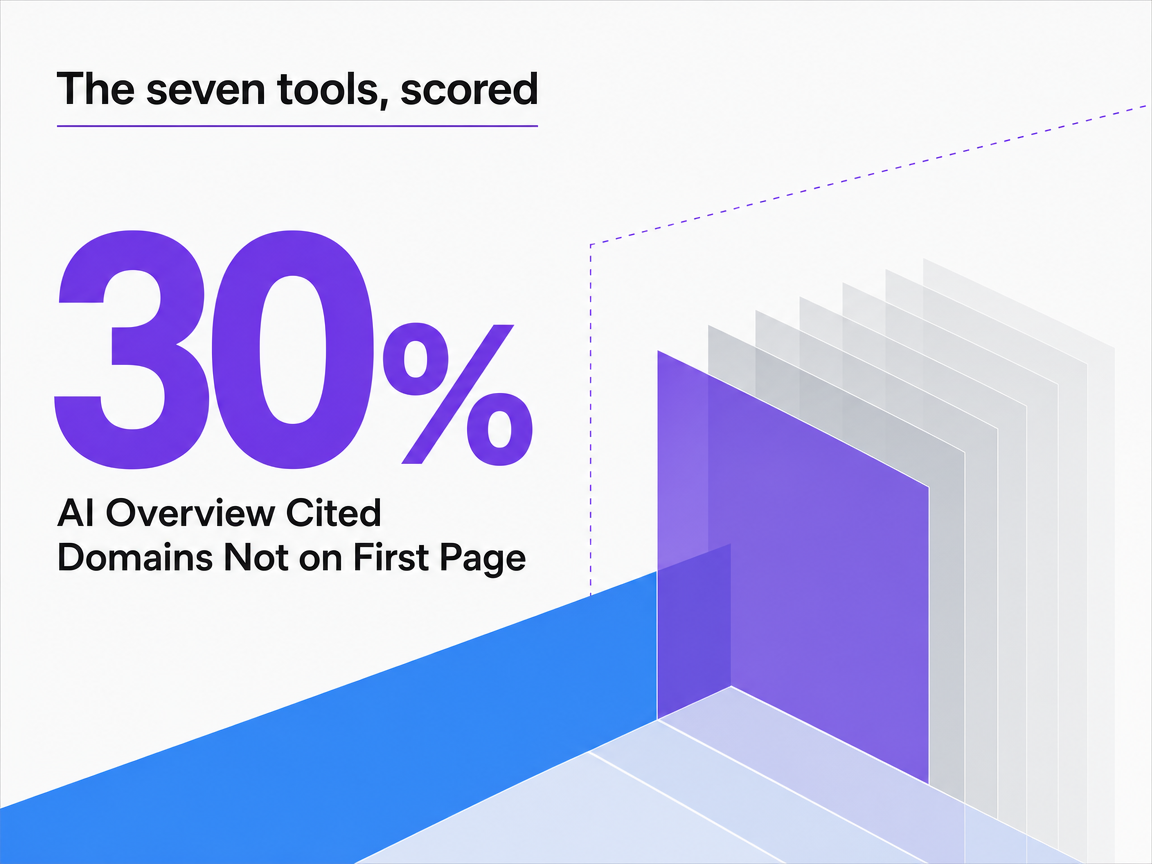 AI Overview Cited Domains Not on First Page
AI Overview Cited Domains Not on First Page
Experience full-featured AI workflow on live campaigns
Test advanced AI-driven visibility tools and publish real results before making any commitment.
Stacking two or three tools to approximate a paid platform
No free tool covers all five engines with citation tracking, mention share, and prompt coverage at reportable frequency. A defensible free stack picks three sensors that overlap on comparability and diverge on engine coverage, then accepts the manual stitching cost as the price of avoiding an enterprise license.
The minimum viable stack is three layers:
- Search Console plus manual sampling handles Google AI Overview activation and cited domains.
- The Perplexity console handles citation logging on a transparent engine.
- A forked open-source GEO prompt library keeps the query set stable across both, so week-over-week deltas mean something.
Add Bing Webmaster Tools and manual Copilot polling as a fourth layer when the client's audience skews toward Microsoft-surface search.
The coverage matrix below shows where each tool contributes and where the seams are.
| Tool | Engines | Sampling | Citations | Prompt coverage | Export |
|---|---|---|---|---|---|
| Search Console + manual | Google AIO | Weekly | Manual log | Analyst-set | CSV |
| Perplexity console | Perplexity | Manual | Native | Analyst-set | Copy-paste |
| Bing Webmaster | Bing/Copilot | Daily agg. | Inferred | Query-side | CSV |
| ChatGPT polling | ChatGPT | Manual | None | Analyst-set | Copy-paste |
| Schema validators | Engine-agnostic | On-demand | N/A | N/A | Per URL |
| GEO prompt library | All | Tied to runner | N/A | Native | Full source |
Coverage matrix for a stacked free-tier AI visibility toolkit.
The stitching cost is the tradeoff. A paid platform runs the prompt set on a schedule and returns a distribution; the free stack requires an analyst to run it, and visibility must be treated as a distribution across repeated runs, not a single-point score 14. That analyst hour count is the variable that decides whether the stack stays free in practice.
What free tools cannot do: sampling limits, prompt drift, and unsupported claims
The honest constraint on a free stack is not feature parity with paid platforms. It is that free tools sense the surface of AI answers without verifying what sits underneath them. Two figures from the 55,393-query, 40-day AI Overview study set the ceiling on what any free monitor can defend. First, 11.0% of atomic claims inside Google AI Overviews were not supported by the pages the Overview cited 1. Second, roughly 30% of the domains cited inside AI Overviews did not appear in the traditional organic top 10 for the same query 1. A free tool can log the citation. It cannot tell an analyst whether the cited page actually supports the sentence attributed to it.
That is the provenance gap, and it is the reason NIST's generative AI profile treats evaluation, monitoring, and traceability as required controls rather than optional add-ons for teams deploying AI in production workflows 4. Human review of citation-to-claim alignment is not a nice-to-have on a QBR slide; it is the check that keeps an agency from reporting a citation win that is actually a hallucination.
Sampling limits compound the problem. AI outputs vary by run, prompt phrasing, personalization signals, and time of day, so a single-point reading misrepresents the underlying distribution 14. Prompt drift is the slower version of the same issue: query patterns shift week over week, and a static prompt set decays as an accurate proxy for client-relevant demand. Neither problem is fixable inside a free tool. Both are fixable through analyst discipline — rerunning prompts, refreshing corpora, and spot-checking cited pages against the answers they supposedly ground. That labor is what the next section prices out.
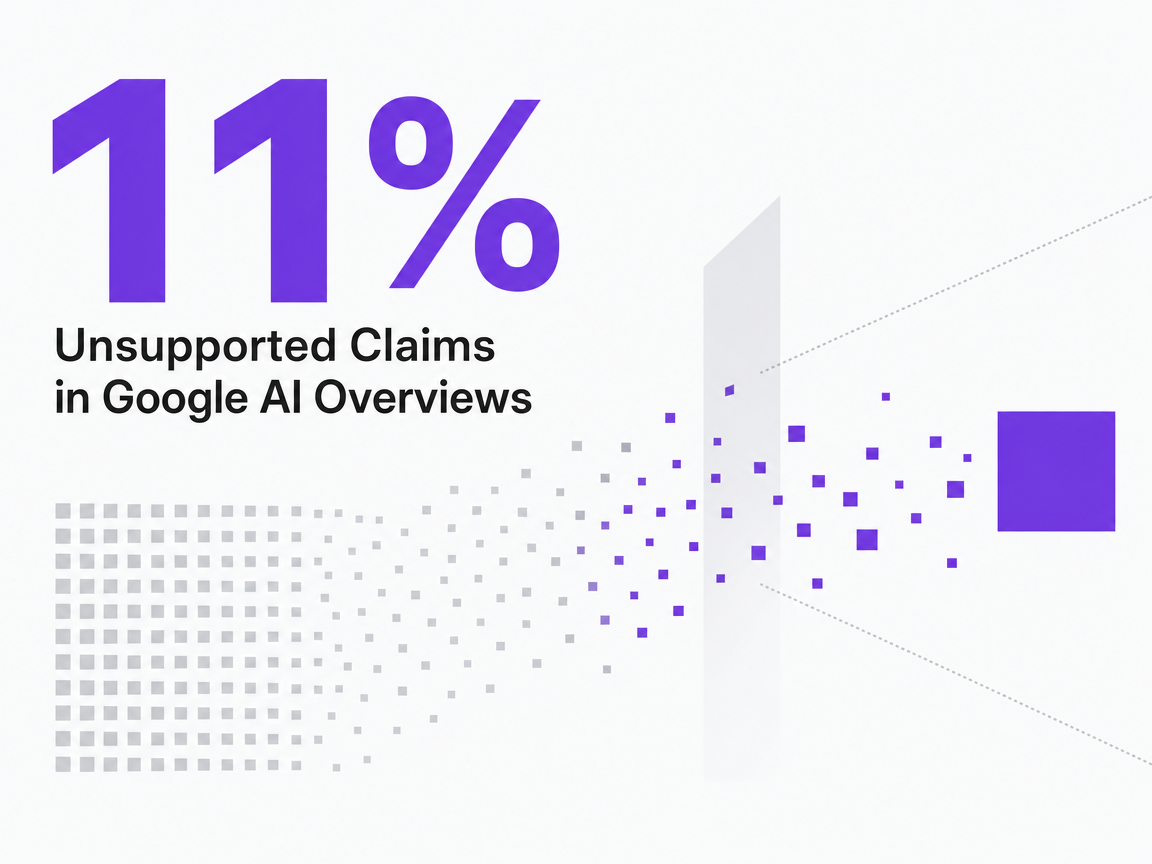 Unsupported Claims in Google AI Overviews
Unsupported Claims in Google AI Overviews
See How Leading Agencies Operationalize AI Visibility Tools at Scale
Speak with a specialist about benchmarking your current tech stack, aligning AI-driven visibility tools, and streamlining client delivery without adding headcount or sacrificing quality.
If you manage multiple client accounts: the free-stack break-even math
Scope shift: this section is for agency operators running the stack across a book of accounts, not a single brand running it in-house. The economics change when the analyst hours scale linearly with client count and the tooling cost does not.
The break-even calculation has three inputs:
H : The analyst hours per client per month required to run the free stack — Search Console sampling, Perplexity console runs, Copilot polling, ChatGPT polling, schema audits, and prompt library maintenance.
R : The agency's blended hourly rate for a mid-level SEO analyst.
N : The number of client accounts in scope.
The free stack's true monthly cost is H × R × N, plus zero in software license fees. A paid AI visibility platform sold on a per-workspace basis costs its stated monthly fee × N, plus a smaller residual analyst layer to interpret and package the output.
The free stack wins while H × R stays below the paid platform's per-workspace fee minus the residual analyst hours the paid tool still requires. It loses the moment prompt sets, engine coverage, or reporting cadence push H past that threshold. Forrester reports that 81% of US marketing agencies cite staff productivity as the primary goal for generative AI adoption, and 90% now use it in some form 9— an environment where H is exactly the variable under pressure.
Two thresholds matter in practice. When N exceeds roughly a dozen accounts on a weekly sampling cadence, the free stack stops scaling on labor alone. When client scope adds multi-engine citation review or provenance spot-checks, the residual analyst hours a paid platform requires do not disappear — they migrate to an execution layer that acts on the signal rather than reporting it again.
Wiring signals into a delivery workflow that survives a client QBR
Sensors produce data. A QBR needs decisions. The bridge between them is a delivery workflow that assigns every signal to a workstream, logs the action taken, and closes the loop when the next measurement confirms or rejects the change.
Four workstreams cover the field:
- Activation gaps on question-form queries route to content and schema updates on the underlying pages.
- Missing or weak citations route to on-page evidence density, source markup, and third-party mention building.
- Low mention share on comparative prompts routes to comparison pages, review acquisition, and structured Q&A blocks.
- Prompt coverage gaps route to editorial planning, where the client's demand curve is expanded to match the query set.
Each workstream needs a named owner, a weekly cadence, and a shared log where the pre-change measurement and the post-change measurement sit side by side. Without that log, the QBR becomes a screenshot tour rather than a defense of the retainer.
Two outcome benchmarks anchor what a wired workflow can produce over a 90–120 day window. One documented case reported a 6x lift in AI-referred trials, moving from 575 to over 3,500 trials attributed to ChatGPT, Claude, and Perplexity recommendations after a structured optimization sequence 25. Attribution in that case was self-reported and single-brand, so the number is a directional benchmark, not a forecast. The operational point holds: the free stack earns its keep only when its signals drive execution on a schedule the client can see.
Frequently Asked Questions
References
- 1.Measuring Google AI Overviews: Activation, Source Quality, Claim Fidelity, and Publisher Impact.
- 2.AI Overviews and AI Mode in Search - Google Search.
- 3.AI Features and Your Website | Google Search Central.
- 4.Artificial Intelligence Risk Management Framework: Generative Artificial Intelligence Profile.
- 5.Economic potential of generative AI.
- 6.Marketing and sales soar with generative AI.
- 7.How generative AI can boost consumer marketing.
- 8.The State Of AI Inside US Marketing Agencies, 2026.
- 9.Forrester: Nine In 10 US Marketing Agencies Use AI To Cut Costs At The Expense Of Creativity.
- 10.Predictions 2026: Marketing Agencies Resign Their Agency.
- 11.Bing Adds GEO To Official Guidelines, Expands AI Abuse Definitions.
- 12.How Generative AI Disrupts Search: An Empirical Study of Visibility Shifts.
- 13.Measuring Brand Visibility Across AI Search Engines.
- 14.Don't Measure Once: Measuring Visibility in AI Search (GEO).
- 15.Optimizing Visibility in Generative Engines: A Critical Survey of Generative Engine Optimization (2023-2026).
- 16.Generative Engine Optimization Creates Underexamined Risks, Governance Must Target Concentration, Disclosure, and Academic Blind Spots.
- 17.The Impact of Google AI Summaries and Google AI Overviews ....
- 18.Google AI Overviews - Search anything, effortlessly.
- 19.The State Of Generative AI Inside US Marketing Agencies, 2025.
- 20.Impact of gen AI on SEO 2023.
- 21.Case Study: How AI Increased Leads 3X for a Local Brand.
- 22.CRM Platform AI Visibility Case Study - 150% Lead Increase.
- 23.AI-Enhanced SEO: Tested Case Study Results in Auto.
- 24.How The Transition From SEO To GEO/AEO/AIO Is Transforming Digital Search.
- 25.AI Search Optimization Case Studies: Real Businesses That Went From Invisible to Recommended.
- 26.A marketing organization that thrives with AI.