
Key Takeaways
- Google Search Console anchors the first-party truth layer, giving agencies direct-from-Google impressions, clicks, and average position with no per-client ceiling 5, 4.
- Bing Webmaster Tools fills the second-engine monitoring slot most rank tracker lists ignore, closing a coverage gap without adding a paid tool.
- Looker Studio on the GSC connector is the free reporting surface, called the best 100% free tool for tracking specific Google queries when templated once and cloned per client 13.
- SERPWatcher's free entry covers competitive sampling for keywords the client does not yet rank on, reserving capped slots for 10 to 25 priority targets per account 13.
- Keyword.com belongs in the strategist playbook for on-demand SERP spot checks and ad-hoc verification, not recurring weekly reports 1.
- Serpstat's free tier serves as a shared workspace for smaller retainers where paid seats are uneconomical, making tiering a written decision rather than a per-client debate 8.
- SE Ranking's free trial handles geo-grid and multi-location audits for franchise and DSO clients, producing onboarding baselines and paid-seat justification 2.
- Vectoron sits in the AI execution and approval layer, consuming rank signals from the free stack to route prioritized work through human approval before shipping 6.
Why free rank tracking is now a portfolio design decision
Rankings still anchor the SEO budget conversation. WARC's measurement review found that marketers increasingly cite organic ranking gains and share of search when defending spend, and CMI's B2B benchmarks show search rankings and organic traffic remain among the most tracked KPIs 12, 11. That pressure lands on the head of SEO, not the client. The question is no longer whether to track rank, but how to track it across 15 or 40 clients without a paid seat for every project.
Independent 2026 reviews now name Google Search Console the best free source of Google performance data and describe it as essential for reading real SERP behavior 5, 7, 4. Free tiers and free trials from specialist trackers like Keyword.com and SERPWatcher cover the gaps GSC leaves, and Looker Studio built on GSC counts as a 100% free reporting layer for tracked queries 1, 13.
The shift is structural. Free rank tracking has moved from a stopgap for small accounts to a deliberate portfolio choice: reserve paid seats for the clients whose competitive intelligence justifies the cost, and route everything else through a standardized free stack that a single strategist can operate at scale.
The agency stack model: four layers, not a flat list
Ranked lists of rank trackers treat every tool as interchangeable. Agency delivery does not work that way. A head of SEO managing 20 accounts needs to know which tool absorbs which job, not which one scored 9.2 out of 10 in a vendor comparison. The 2026 tested-tool matrices increasingly sort trackers by target audience and unique selling point rather than raw feature count, which is a more useful frame for portfolio design 6.
Four layers organize the stack. The first-party truth layer holds Google Search Console and Bing Webmaster Tools, the direct-from-engine record of impressions, clicks, and average position for every client property 4, 7. The competitive sampling layer covers third-party trackers that pull SERP snapshots for keywords the client does not yet rank for, where free tiers from tools like SERPWatcher and Keyword.com carry the load on smaller accounts 1, 13. The local and multi-location layer handles geo-grid checks for franchise, DSO, and multi-site clients whose visibility varies by ZIP code 2. The AI execution and approval layer sits above all three, consuming rank signals to prioritize content and technical work rather than generating them.
Each tool below is placed in exactly one layer. That is the point.
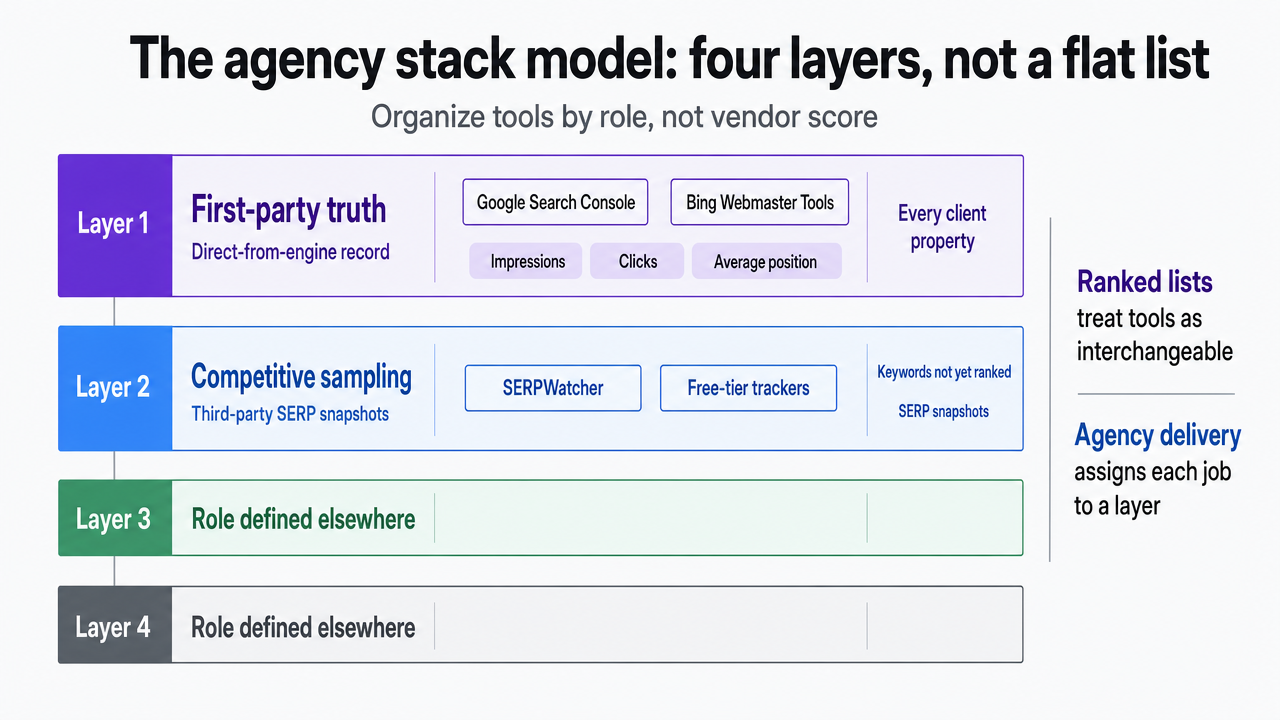 Visualize the four-layer stack model that organizes the eight free tools by role, directly reinforcing the section's framework
The 8 free rank trackers, mapped to stack role
Google Search Console: the first-party truth layer
Every independent 2026 review of rank tracking software puts Google Search Console in the same slot for the same reason. It is the direct-from-Google performance record, described as "free, direct-from-Google ranking data" 4and the "best free source of Google performance data" 5. Practitioners also call it essential for reading real visibility patterns and SERP behavior 7.
For an agency, GSC anchors the truth layer for one operational reason: it reports what actually happened in Google's index for a verified property, not what a third-party crawler sampled from a data center in Virginia. Impressions, clicks, click-through rate, and average position break out by query, page, country, and device 9. That granularity carries most of the diagnostic weight for content and technical prioritization decisions across a client roster.
The operational rule for scaled delivery is straightforward. Every client property gets verified at onboarding, and the property is connected to a persistent export destination on day one so backfill starts accumulating before it is needed. A head of SEO managing 20 accounts should treat any client not in GSC as a data blind spot, not a resourcing question. There is no keyword cap, no seat cost, and no per-client ceiling. The constraint is not GSC itself; it is how the data leaves GSC and reaches a reporting surface, which is the next entry.
Bing Webmaster Tools: the second-engine baseline
Bing Webmaster Tools rarely leads a rank tracker roundup, and that is precisely why it belongs in the stack. Most competing lists focus on Google-first tools 4, 7, which leaves the second engine as an unclaimed monitoring slot on every client property.
The role is narrow and useful. BWT provides first-party impressions, clicks, and average position for Bing, plus crawl and index diagnostics that occasionally surface issues Google's data will not flag. For clients whose audiences skew toward Bing-integrated surfaces, including enterprise desktops and Copilot-powered results, the second-engine baseline is not optional traffic; it is measured traffic that needs a defined owner.
Operationally, treat BWT the way GSC is treated: verify at onboarding, connect the export, and pull it into the same reporting surface as GSC. The overhead is minimal, and the coverage gap closes without adding a paid tool.
Looker Studio on GSC: the free reporting surface
The bottleneck in a free rank tracking stack is almost never the data. It is what an analyst has to do with the data every Monday morning. Looker Studio closes that gap. A 2026 practitioner review calls it the tool of choice when the goal is a 100% free query tracker: "If you want a 100% free tool and you just want to track specific search queries from Google, and no other search engine, Looker Studio is the best tool you can use" 13.
The native GSC connector pulls query-level performance directly into a dashboard that can be templated once and cloned per client. That is the scale move. Instead of an analyst opening 20 GSC properties every week and copying figures into a deck, one template exposes tracked query sets, page-level performance, and week-over-week deltas across the roster.
For an agency, three build decisions matter. Standardize the tracked-query list format so it can be reused across clients. Version-control the template so improvements propagate to every dashboard, not just the newest one. And add a filtered view for the client alongside an internal view for the strategist. That separation is what turns a free reporting layer into a delivery motion rather than a one-off experiment.
SERPWatcher free entry: lightweight competitive sampling
GSC and BWT report on queries a site already appears for. Competitive sampling covers the ones it does not. SERPWatcher, part of the Mangools stack, is called out in the 2026 practitioner review as a rank tracker that can be started for free, which puts it in the competitive sampling layer for agencies that need SERP snapshots without a paid seat for every client 13.
The stack role is specific. Load a short list of target keywords per client, most of which the site does not yet rank on page one for, and let the tool track weekly SERP position and estimated visibility. The output is not a substitute for the first-party truth layer; it is a directional signal about competitor movement and keyword opportunity that GSC cannot show because the client has no impressions there yet.
The free-tier constraint is real: keyword capacity is limited, and refresh cadence is throttled. That is a feature for portfolio use. Reserve the free slots for the 10 to 25 highest-priority target keywords on each client, and route lower-priority monitoring through the truth layer. The head of SEO's job here is to hold the line on what qualifies as a tracked competitive keyword, not to fill the cap for its own sake.
Keyword.com free analysis: on-demand SERP spot checks
Keyword.com occupies a different slot in the competitive sampling layer. A 2026 comparison lists it explicitly "for free keyword analysis," positioning it as an on-demand check rather than a persistent tracker 1. That framing matters for how it fits into agency operations.
The use case is spot checks, not roster-wide monitoring. When a strategist needs to verify a live SERP for a specific query, sanity-check a client claim that a competitor moved, or diligence a new keyword before adding it to a tracked list, an on-demand SERP tool absorbs that work without consuming a paid seat.
The operational rule: name the tool in the strategist playbook as the default for ad-hoc SERP verification, and keep it out of the weekly recurring report. That separation prevents the free-tier scope from creeping into deliverables it was not built to carry, and it preserves the analyst time saved by not opening a paid platform for every one-off check.
Serpstat free tier: shared workspace for small rosters
Serpstat scores well as a rank tracking option in broader software comparisons 8, and its free tier serves a specific slot in the stack: a shared workspace for smaller clients where the strategist wants keyword research, competitor lookups, and basic rank monitoring in a single interface rather than three.
The competitive sampling role is where it earns its keep for a scaled agency. Free-tier constraints on daily queries and tracked keywords mean it will not carry a 40-account roster on its own, and it is not meant to. Assign it to the tier of accounts where paid seats are not economical, most often smaller retainers or trial engagements, and use it as the consolidated view for those clients.
The head of SEO decision is a tiering decision, not a feature decision. Which client tier gets the free Serpstat workspace, which gets the paid platform, and where is the handoff line? Defining that line once, in writing, prevents strategists from defaulting to whichever tool they opened last.
SE Ranking free trial and local grid checks: multi-location coverage
A note on audience scope: this entry is written for agencies with franchise, dental support organization, home services, or other multi-location clients whose visibility varies by ZIP code. Single-location B2B accounts can skip most of it.
Local rank tracking is where free stacks strain hardest. Independent testing in 2026 flagged Google Search Console as the best free option overall but positioned other tools as necessary for advanced local rank tracking 2. SE Ranking sits in that gap. Its free trial provides a working entry point into geo-grid checks and multi-location rank views, which is the visualization DSO and franchise clients actually need to see: a map showing pack presence and organic position across a grid of points around each location.
The free-trial constraint means SE Ranking is not a permanent free layer for the whole roster. The stack role is targeted: use it for onboarding audits of multi-location clients, for periodic local visibility deep dives, and to validate whether a paid seat is justified for that client. When the answer is yes, the trial has already generated the baseline. When it is no, the audit still produced deliverables.
Pair this with the truth layer. GSC's country and device breakouts inform national performance; the geo-grid view informs local action. Neither substitutes for the other.
Vectoron: the AI execution and approval layer
The 2026 tested-tool matrices increasingly evaluate rank trackers on AI features and target audience, not just data accuracy, reflecting how anomaly detection and AI summarization now sit inside rank tracking workflows 6. That evolution defines the top layer of the agency stack. Rank data has to be consumed by something that ranks work.
Vectoron occupies the AI execution and approval layer. It does not duplicate the rank data produced by GSC, BWT, or the competitive sampling tools; it reads those signals, ranks content and technical priorities against live business data, and routes each recommendation to a human approver before anything ships. For a head of SEO, that removes the two tasks that scale worst: reviewing rank movement across 20 dashboards to decide what to work on next, and briefing analysts on the resulting queue.
The role in the stack is deliberate. Rankings feed prioritization; prioritization feeds an approval queue; approved work executes automatically. The free tools below Vectoron produce the truth. Vectoron turns it into a delivery motion the same strategist can run at double the client count without hiring.
Test live rank tracking workflows risk-free now
Validate accurate keyword tracking and reporting at scale before making any commitment.
Free-tier scope at a glance: an agency capacity comparison
The eight tools above do not compete with each other. They occupy different rows in a portfolio. A head of SEO reviewing this stack needs one view that shows where each tool earns its slot and where the free-tier ceiling sits, so tiering decisions are made once rather than re-litigated per client.
| Tool | Stack role | Free-tier scope (as sourced) | Agency capacity signal |
|---|---|---|---|
| Google Search Console | First-party truth layer | Best free source of Google performance data 5; direct-from-Google ranking data 4 | No per-client ceiling; scales across every verified property |
| Bing Webmaster Tools | Second-engine baseline | Free first-party Bing performance data | No per-client ceiling; requires the same export discipline as GSC |
| Looker Studio on GSC | Free reporting surface | 100% free for tracking specific Google queries 13 | Templated once, cloned per client; single strategist can operate at roster scale |
| SERPWatcher | Competitive sampling | Can be started for free 13 | Reserve capped slots for 10–25 priority target keywords per client |
| Keyword.com | Competitive sampling (on-demand) | Free keyword analysis 1 | Spot checks only; keep out of recurring reports |
| Serpstat | Competitive sampling (shared workspace) | Free tier with daily query and keyword caps | Assign to the smaller-retainer tier where paid seats are uneconomical |
| SE Ranking | Local and multi-location coverage | Free trial into geo-grid and local rank views 2 | Onboarding audits and paid-seat justification, not permanent monitoring |
| Vectoron | AI execution and approval layer | Consumes rank signals from the free stack | Requires cross-validation of upstream data before prioritization |
The reclaimed capacity is a formula, not a dollar figure: hours reclaimed per month equals clients × weekly reports × minutes per report saved by templated dashboards. That number is what the tiering decision protects.
What free will not do: the accuracy and coverage ceiling
The most common internal misread of a free stack starts with Google Search Console's average position column. The definitive GSC guide is explicit: average position is calculated over impressions across a reporting window, not a constant real-time rank for a query 9. A page that appears at position 3 for one impression and position 40 for another averages 21.5 in the report. That number describes a distribution, not a live SERP.
Two operational consequences follow. Week-over-week average position shifts should be read alongside impression volume, because a small change in low-volume queries can swing the reported number without any real ranking movement. And GSC will not show a rank for queries where the client had zero impressions, which is precisely the opportunity set an agency wants competitive sampling tools to cover 13.
The second ceiling is cross-validation. The 2026 practitioner review flags disagreement between trackers on which tool is most accurate, which is why free tiers are best used as directional signals rather than adjudicators 13. When a client escalates a specific ranking claim, the strategist verifies against the live SERP. The free stack sets the agenda; it does not close the argument.
The weekly reporting motion: stitching free tools into one approval-ready surface
The free stack only compounds if the reporting motion is templated. A head of SEO running 20 accounts cannot afford a bespoke Monday for each one. The weekly rhythm has to be identical enough that a strategist can move through the roster in a single working session, and structured enough that the output routes into a prioritization queue without a second pass.
Four steps carry it. First, the truth layer refreshes automatically: Google Search Console and Bing Webmaster Tools feed a versioned Looker Studio template that is cloned per client, with tracked query sets and page-level deltas surfaced on the first tab 13. Second, the competitive sampling layer pushes weekly SERP snapshots for the 10 to 25 priority target keywords per client, which the strategist scans for anomalies rather than reading line by line. The 2026 tested-tool matrices increasingly treat anomaly detection and AI summarization as core rank tracking features, which is the direction the manual review should mimic 6. Third, on-demand SERP checks and local geo-grid pulls happen only when the first two layers flag something worth verifying, not as recurring work.
The fourth step is where free stacks usually stall. Rank movement has to become a ranked queue of proposed actions, each tied to a page, a query, and a rationale a client would accept. Routing that queue through an approval-gated execution layer, rather than a shared doc, is what converts the reporting motion into shipped work. Everything upstream is measurement; this step is delivery.
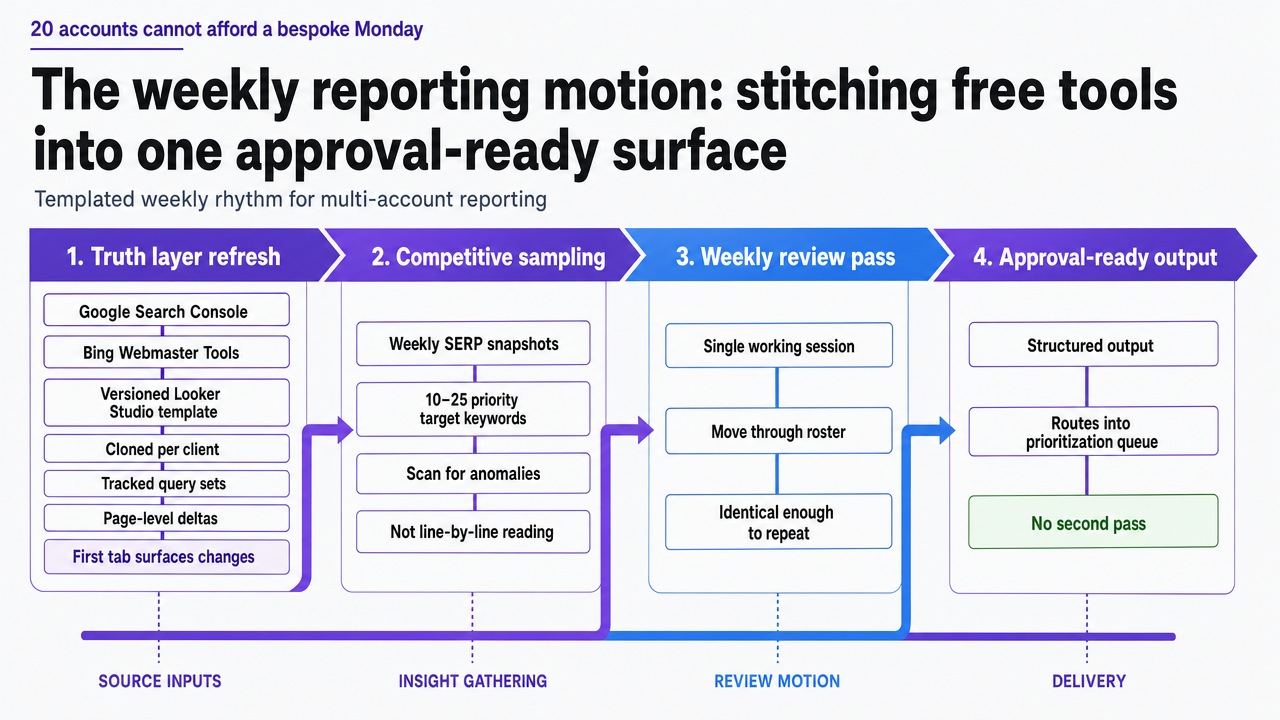 Illustrate the four-step weekly reporting workflow described in the section, showing how free tools feed into an approval-ready delivery motion
Scale Client Reporting With Enterprise-Grade Rank Tracking and Workflow Automation
See how top agencies eliminate manual rank tracking and streamline multi-client SEO oversight with an integrated platform—purpose-built for high-volume, multi-location search campaigns.
If you manage multi-location, franchise, or DSO clients
Scope shift: this section is for heads of SEO whose rosters include franchise systems, dental support organizations, home services brands with multiple service areas, or senior living portfolios. Single-location accounts can treat it as reference material.
Multi-location work breaks the standard free stack in a predictable place. Google Search Console reports impressions and average position at the property level, not the ZIP level, so a DSO with 40 practices sees national visibility patterns but not which locations are losing map pack share this week 9. Independent 2026 testing reached the same conclusion from the other direction: GSC is the best free option overall, but advanced local rank tracking requires purpose-built tools 2.
The workable pattern uses free layers for what they cover and reserves paid capacity for what they cannot. GSC and Bing Webmaster Tools handle brand-level performance across the roster. SE Ranking's free trial handles onboarding geo-grid audits and paid-seat justification for individual locations 2. The recurring monitoring gap for weekly per-location visibility is where a paid local rank tracker earns its slot, and the free stack quantifies exactly how large that gap is before the conversation with finance.
Tying rankings to budget defense and prioritization
Rankings only matter to the finance conversation when they connect to something a CFO recognizes. WARC's measurement review documents that marketers now defend SEO budgets by citing organic ranking improvements and share of search, but the same review flags CMO skepticism about SEO's direct sales impact 12. That skepticism does not go away with more dashboards. It goes away when ranking movement is presented alongside the work that produced it and the outcomes it drove.
The free stack described above generates the raw material for that argument. GSC and BWT show first-party visibility gains on tracked query sets. Competitive sampling shows position changes for keywords the client did not previously own. Looker Studio surfaces the deltas in a client-ready format 13. What converts those signals into a defensible budget conversation is the prioritization layer that ties each ranking move to an approved action, the page it changed, and the pipeline metric it influenced. That is the loop the Vectoron platform is designed to close, and it is the reason the free stack scales without another analyst hire.
Frequently Asked Questions
References
- 1.The 12 best rank tracker tools.
- 2.Best Rank Tracking Software 2026: 11 Tools Tested.
- 3.10 Top Rank Tracker Tools (for Serious SEOs) in 2026.
- 4.7 Best Search Engine Ranking Checker Tools.
- 5.15 Best Rank Tracking Software for 2026 (Tested on Real Data).
- 6.Best Rank Tracking Software 2026: 12 Tools Tested.
- 7.15 Best Rank Tracking Software We're Using for 2026.
- 8.Top 10 Best Search Ranking Software: 2026 Comparison.
- 9.Google Search Console: The Definitive Guide.
- 10.Search Engine Optimization (SEO) Starter Guide.
- 11.B2B Content Marketing: Benchmarks, Budgets, and Trends.
- 12.SEO investment and measurement trends.
- 13.14 best rank tracker software I'm using for SEO in 2026.