
Key Takeaways
- Google Search Console anchors any free stack, delivering first-party clicks, impressions, CTR, and average position with API access that scales into portfolio-wide dashboards 1, 3.
- Bing Webmaster Tools acts as a second-engine cross-check, helping distinguish Google algorithm shifts from site-side regressions and capturing Bing-heavy verticals Google data understates 7.
- SEO PowerSuite's free desktop tier handles point-in-time rank verification for a single analyst, complementing Search Console's smoothed averages with fresh on-demand SERP pulls 10.
- Keyword.com's free tier serves as a live SERP adjudication layer, resolving client disputes when Search Console's smoothed position data cannot answer a specific query 9.
- Nightwatch's trial validates neighborhood-level rank granularity for multi-location clients where Search Console's country-level view hides the real geographic performance picture 14, 16.
- Google Trends supplies demand-shift context, distinguishing category-level declines from ranking losses so impression drops get diagnosed correctly rather than misreported to clients 6.
Why free rank trackers earn a seat in the ROI stack
The economics of rank tracking have shifted. Agencies scaling delivery across a client portfolio no longer need to license a paid tracker just to see whether visibility is moving. Google Search Console reports clicks, impressions, CTR, and average position broken down by query, page, and country 1, and the Search Console API extends the same data into automated workflows with custom filters and dimensions 3. Independent 2026 comparisons name Search Console the best free rank tracking tool available to professional SEOs 11.
That does not make it a complete ROI system. Rank movement, taken alone, is a leading indicator with too much noise to defend a retainer. What free tools do well is form a telemetry layer: they surface directional signals early enough for a delivery team to intervene, then hand the data off to a conversion layer for the ROI story. Google's own documentation frames the pairing explicitly, noting that Search Console shows how a site performs in results while Google Analytics shows what visitors do after arrival 2.
The premise of this shortlist is portfolio-scale operational leverage. Free tools that compose cleanly into a reporting stack earn their seat. Free tools that require constant manual reconciliation do not.
The six free tools worth operationalizing
Google Search Console: the first-party rank baseline
Search Console is the anchor of any free rank tracking stack. It reports clicks, impressions, CTR, and average position with breakdowns by query, page, country, and device 1, which covers most of the diagnostic questions an agency lead needs to answer between reporting cycles. Independent 2026 testing across eleven trackers concluded that Google Search Console is the best free rank tracking tool available 11, and practitioners running mixed stacks describe it as the best source for first-party data and indexing signals 16.
The operational limits are known:
- Data lands with roughly a two-day delay 10.
- Average position is a smoothed metric rather than a live SERP snapshot.
- Query-level data is capped for privacy reasons.
None of those limits disqualify it for ROI work; they define what other tools need to solve.
For an agency running delivery across a portfolio, the Search Analytics API is the piece that turns Search Console from a per-client tab-switching exercise into a reporting layer. The API accepts custom filters and dimensions on the same clicks, impressions, CTR, and position data 3, which means daily pulls into a warehouse, per-client dashboards, and portfolio-wide anomaly detection can all run against one authenticated endpoint per property.
Bing Webmaster Tools: the second-engine cross-check
Bing Webmaster Tools is the free equivalent for the second-largest engine, and its performance report exposes the same core dimensions an agency already reads in Search Console 7. Bing's 2023 rebuild expanded that reporting with deeper visibility into search data, closing much of the gap with Google's interface 8.
Two reasons to wire it in:
- When Google clicks dip and Bing clicks hold, the anomaly is usually algorithm-side, not site-side, and that framing changes the client conversation.
- Verticals with older or desktop-heavy audiences — legal, senior living, certain healthcare specialties — see a materially higher Bing share than aggregate market data suggests, and ignoring it understates total organic contribution.
Treat Bing Webmaster as a cross-check rather than a primary source. The keyword coverage is thinner than Google's, and the freshness cadence differs, so the useful output is a weekly directional comparison against Search Console rather than a standalone ranking report.
SEO PowerSuite Rank Tracker (free desktop tier)
SEO PowerSuite's Rank Tracker is one of the few desktop-based free tools that still holds up for volume work. The free version handles rank checks against Google and other engines on the local machine, with the paid tier starting at $29.10 per month for teams that need scheduled projects, cloud storage, and multi-user access 10. For agencies with a single analyst running weekly checks on a defined keyword set, the free desktop tier can carry the load without a subscription.
The trade-off is operational. Desktop tools require a machine to be on and captchas to be handled, which is fine for one analyst and painful across ten clients. There is also no API on the free tier, so the output lives in exported CSVs rather than a live warehouse feed.
The pragmatic use case is heavy on-demand checks — for example, validating a suspected ranking drop against a fresh SERP pull before pinging the client. It complements Search Console's smoothed average position with a point-in-time reading on the exact keyword set the retainer is measured against.
Keyword.com free tier: on-demand SERP verification
Keyword.com is identified in Zapier's rank tracker comparison as the best option for free keyword analysis 9, which is a narrower claim than "free rank tracker" but the more accurate one for how agencies actually use it. The free tier is a verification layer rather than a monitoring layer: analysts run individual keyword lookups against a live SERP when Search Console's smoothed data is not granular enough to answer a specific question.
The workflow value is in adjudication. When a client claims a keyword "dropped" and Search Console shows an average position of 6.4, a live SERP check either confirms the drop from position 4 to position 8 or shows the keyword sitting at 5 with an AI Overview above the fold. Both outcomes change the response, and neither is visible in the smoothed average.
Nightwatch trial: local rank granularity when the client has locations
This one is for agency leads with multi-location clients — dental groups, senior living operators, home services franchises, law firm branch networks. Practitioner reviews name Nightwatch the best tool for local rank tracking 16, and its trial period is long enough to validate whether the geo-granularity holds up on a real client's keyword set before any budget conversation 14.
Search Console reports country-level data, not neighborhood-level. For a fifteen-location home services client, that gap is the difference between "we rank for emergency plumber" and "we rank for emergency plumber in seven of fifteen service areas and are invisible in the other eight." The trial window is enough to answer that question across a portfolio and decide whether a paid local tracker earns its line item on the specific accounts that need it.
Google Trends: the demand-shift context layer
Trends is not a rank tracker, and treating it as one is the fastest way to misread it. It pulls from a random sample of aggregated, anonymized Google and YouTube searches 6, which makes it a demand indicator, not a visibility indicator.
Its job in the stack is context. When Search Console shows impressions falling for a client's core query cluster, Trends answers whether the underlying search demand fell with it. If demand dropped 30% and impressions dropped 25%, the client actually gained share and the report should say so. If demand held flat and impressions dropped 25%, the diagnosis shifts to a ranking or SERP-layout issue. That single filter prevents a category of misdiagnosed reports.
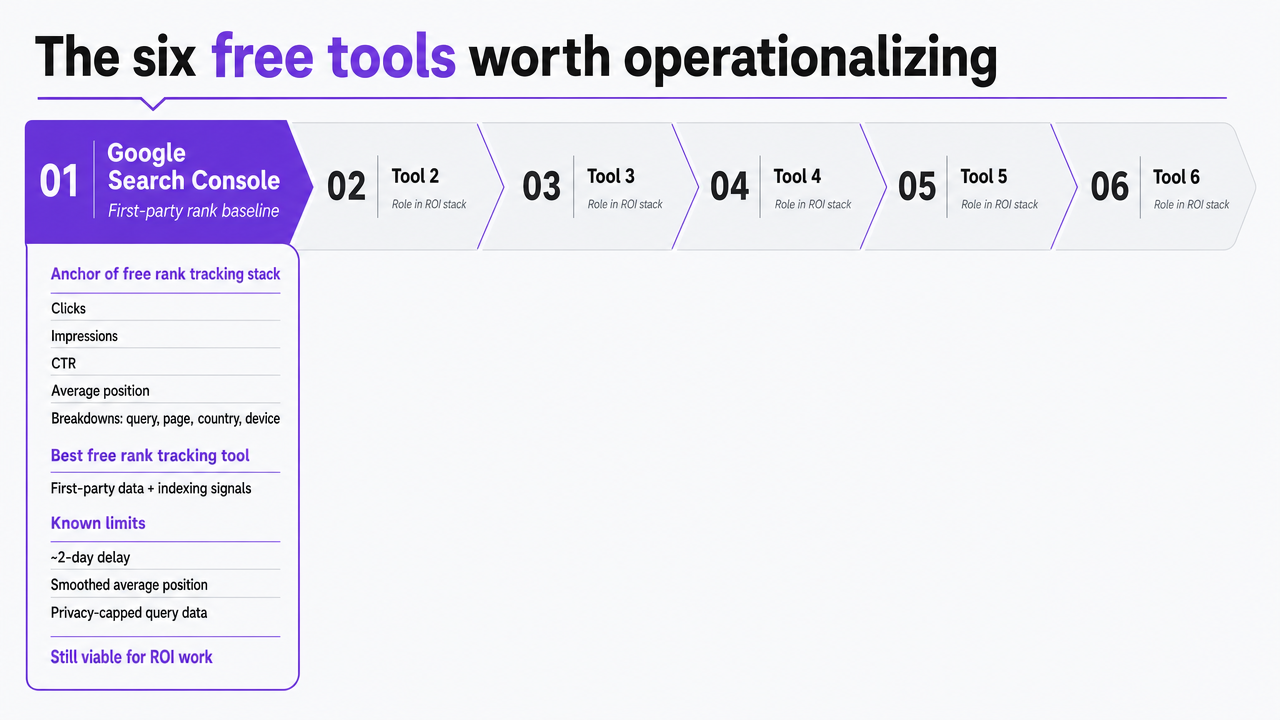 Visualize the six recommended free tools and their specific role in the ROI stack, matching the section's list structure
The free-tier decision matrix for agency delivery
Picking a free stack is a trade-off exercise across four axes:
- data freshness
- keyword volume ceiling
- locality granularity
- reporting fit
Independent 2026 testing across eleven trackers found Google Search Console the strongest free baseline, with SEO PowerSuite offering a free desktop tier alongside a $29.10 per month paid version, and Tooltester's 2026 SERP tracker guide identifies two fully free options within its twelve-tool comparison 10, 11, 12.
| Tool | Cost | Freshness | Keyword ceiling | Locality | Best delivery use |
|---|---|---|---|---|---|
| Google Search Console | Free | ~2-day delayed daily 10 | Unlimited on owned properties | Country-level | Portfolio baseline, API-fed dashboards 11 |
| Bing Webmaster Tools | Free | Daily | Unlimited on owned properties | Country-level | Second-engine cross-check |
| SEO PowerSuite (free) | Free / $29.10/mo paid 10 | On-demand | Desktop-bound, single analyst | City/language configurable | Point-in-time verification |
| Keyword.com free tier | Free analysis 9 | On-demand | Per-lookup | Location-configurable | Live SERP adjudication |
| Nightwatch trial | Trial only 14 | Daily | Trial-capped | Neighborhood-level 16 | Multi-location validation |
| Two free SERP trackers (2026 curated) | Free 12 | Varies | Varies | Varies | Supplemental SERP snapshots |
Read the matrix as a routing decision, not a ranking. Search Console and Bing Webmaster carry the always-on telemetry. SEO PowerSuite's free desktop tier and Keyword.com's free analysis handle verification against specific SERP claims. Nightwatch's trial is the audition for multi-location accounts where country-level data hides the real picture. The two curated free SERP trackers named in Tooltester's 2026 guide are candidates for spot-checks, not replacements for the baseline layer 12.
Track Keyword Movements With Live, Publishable Data
Monitor real ranking changes and publish actual campaign results during your unrestricted trial period.
Rank is not ROI: adjusting for SERP feature distortion
A jump from position 6 to position 3 used to mean a predictable click lift. That relationship has weakened. An academic analysis of organic click behavior across 67,000 keywords, more than 40 e-commerce domains, over 6 million clicks, and 24 million views found that SERP features materially reshape CTR independent of ranking position 5. The study's scope matters: it is e-commerce-heavy and predates the fullest rollout of AI Overviews, so the direction of the finding is more robust than any single coefficient. The direction is what changes agency reporting.
The operational consequence is that a rank-only chart in a client report can tell a story the click data will contradict. A page moving from position 4 to position 2 under an AI Overview, a featured snippet held by a competitor, and a shopping pack can lose clicks while the rank chart shows a win. A page holding position 5 through a SERP layout change that removed a sitelinks block above it can gain clicks while the rank chart shows nothing.
The adjustment is procedural, not tooling-heavy. Every ranking claim in a client report gets paired with the Search Console clicks and CTR for the same query cluster 1, and any material divergence — rank up, clicks flat or down — triggers a manual SERP pull to document the layout that explains the gap. That single discipline turns rank from a headline metric into a supporting one, which is where it belongs in an ROI narrative.
The ROI proof workflow: GSC + GA4 key events + Bing + Trends
Wiring GSC clicks and impressions to GA4 key events
Rank data proves visibility. Key events prove value. Google's own documentation is explicit that Search Console reports how a site performs in results while Google Analytics reports what visitors do after arrival 2, and the ROI workflow depends on treating those as two ends of the same pipe rather than two separate reports.
The wiring is straightforward. Pull Search Console clicks, impressions, CTR, and average position at the query and landing-page level via the Search Analytics API 3. Join that pull to GA4 sessions and key events on the landing-page URL, using organic-search as the channel filter. The output is one row per landing page per week: impressions, clicks, CTR, average position, sessions, and the count of the key events the client actually pays for — booked calls, form fills, qualified leads, transactions.
That join surfaces the pages that matter. A URL ranking in position 4 with 12,000 impressions and 3% CTR that produces zero key events is a content or intent problem, not a ranking problem. A URL in position 8 with 2,000 impressions and a 6% conversion rate is a scaling opportunity. Neither insight is visible in a rank-only view, and both drive the next sprint.
Using Trends and Bing data to explain anomalies before the client asks
Every weekly report has one or two lines that will trigger a client question. The workflow answers them before they get asked.
When Search Console shows impressions falling for a query cluster, the first check is Google Trends. Trends draws from a random sample of aggregated, anonymized Google and YouTube searches 6, which means it reads underlying demand rather than the client's share of it. If Trends shows a matching decline in the topic, the report frames the movement as a category-level demand shift and holds share as the metric that matters. If Trends is flat, the diagnosis moves to ranking or SERP layout.
Bing Webmaster Tools is the second filter. Its performance report exposes the same core dimensions as Search Console 7, and Bing's 2023 rebuild deepened that visibility 8. When Google clicks dip and Bing clicks hold on the same query cluster, the movement is almost always algorithm-side on Google, not a site-side regression. That single cross-check reframes a defensive client conversation into a diagnostic one.
Anchoring the report to a revenue ROI benchmark
Internal key-event totals need an external anchor. WARC's ROI benchmark reporting shows the cumulative median revenue ROI of successful campaigns moving from 3.86:1 to 4.25:1 over five years 4, which gives client reports a reference point that sits above any single channel's noise.
The application is narrow and useful. When the report ties Search Console clicks and impressions to GA4 key events and then to booked revenue, the resulting organic-search revenue-to-spend ratio has somewhere to land. A retainer producing a 5.1:1 revenue return on SEO fees clears the median. A 2.9:1 ratio is below it and needs a plan attached. The benchmark does not define success on its own — vertical, margin, and lifetime value all move the target — but it prevents the report from grading itself against a number the agency invented.
Publish the anchor once, at the top of the ROI page in the deck, and reference it as the year progresses rather than restating it every cycle.
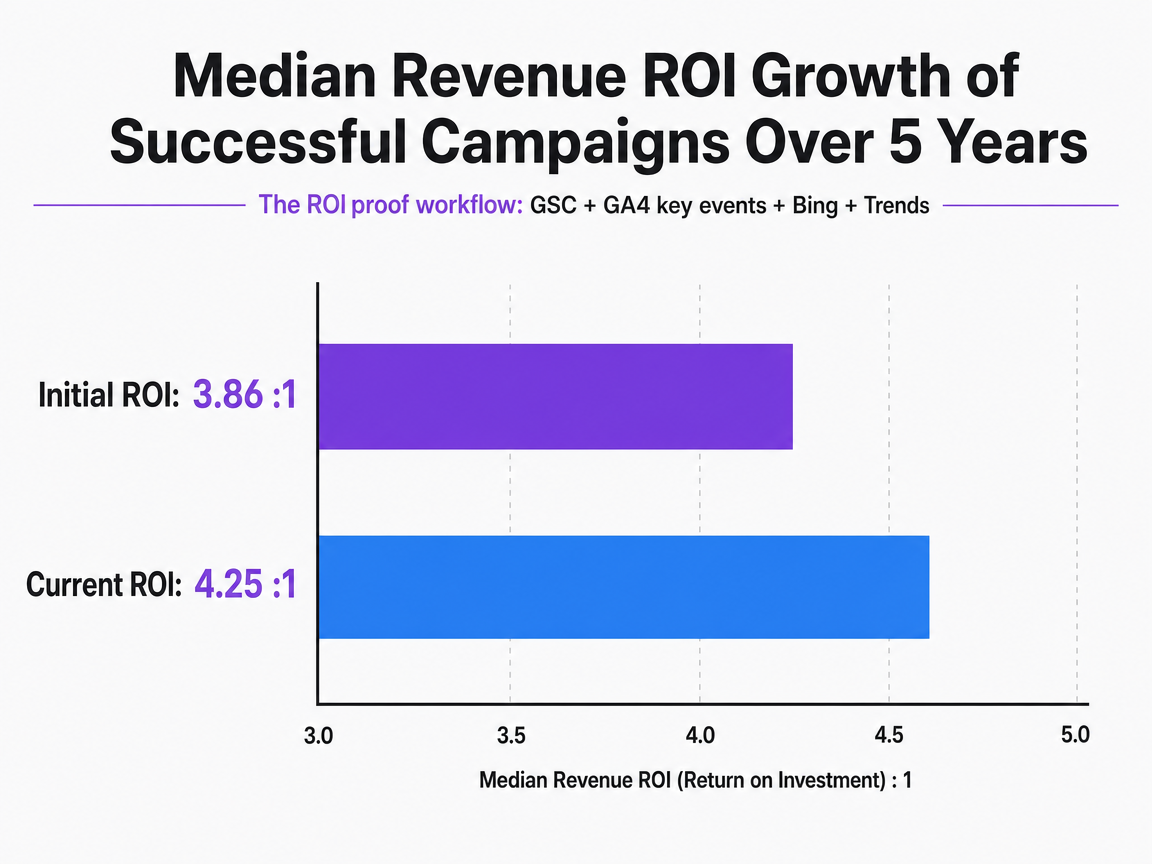 Median Revenue ROI Growth of Successful Campaigns Over 5 Years
Shows the growth of median revenue ROI for successful campaigns over a five-year period, from 3.86:1 to 4.25:1, providing context for how marketers measure return on investment.
If you manage multiple locations or a client portfolio
Scope shift: this section is written for agency leads running rank tracking across ten or more properties, or for in-house teams managing a franchise, DSO, or branch network. The single-site workflow described earlier collapses under that volume because the bottleneck moves from measurement to consolidation.
At portfolio scale, three things break:
- Search Console reporting is per-property, so an agency with forty clients has forty authentications, forty exports, and forty tabs unless the Search Analytics API is doing the pulling on a schedule 3.
- Country-level data hides the location-level story that a multi-site client actually cares about — a fifteen-branch operator wants to see rank per service area, not a national average.
- The free desktop tier of SEO PowerSuite, useful for a single analyst on one account, does not scale across a portfolio without a paid upgrade at $29.10 per month 10.
The consolidation pattern that works is narrow. Route all Search Console properties through one API pull into a warehouse or reporting tool, join to GA4 key events per property 2, and reserve Nightwatch's trial or a comparable local tracker for the accounts where neighborhood-level rank materially changes the retainer story 16. Two Minute Reports and comparable 2026 reporting integrations exist specifically to turn per-client pulls into portfolio dashboards without an internal build 15.
The economics variable is analyst hours per client per month. Multiply the loaded hourly rate by that number and the free stack has a real cost — one that only drops below the paid alternative once the API pipeline is built and stable.
See How Advanced Rank Tracking Drives Measurable ROI for Agencies
Connect with our team to access actionable insights on scalable rank tracking solutions that quantify client impact, streamline reporting, and support agency-wide SEO accountability—without increasing headcount.
The hidden cost of free: engineering hours, QA, and reporting overhead
Free is a licensing status, not a total cost. Every free tool in the stack shifts spend from vendor invoices to analyst and engineer hours, and that line item rarely appears in the retainer economics until an account manager is exporting Search Console data at 11 p.m. before a Monday review.
Three cost centers absorb the shift:
- Pipeline engineering: the Search Analytics API supports custom filters and dimensions on clicks, impressions, CTR, and position 3, but somebody has to build the authentication, scheduling, storage, and join-to-GA4 logic 2, then keep it running when properties are added or ownership changes.
- QA against SERP volatility. The research on SERP-feature CTR distortion establishes why a rank-only chart can mislead 5, and the practical response is a weekly manual SERP pull on any query cluster where rank and clicks diverge. That is analyst time, per client, every week.
- Reporting assembly — turning per-property pulls into a portfolio view — which is why 2026 integration platforms exist as a paid shortcut around the internal build 15.
The honest math is straightforward: multiply loaded analyst hours per client per month by portfolio size, and compare against the $29.10 per month entry point for the nearest paid alternative 10. Free wins on small portfolios with stable pipelines. It loses quietly on large ones with turnover.
Where an approval-first execution layer fits alongside free telemetry
Free rank tools produce signal. Signal is not action. Once Search Console clicks, GA4 key events, and Bing cross-checks are flowing into a dashboard 2, 7, the delivery bottleneck moves to what happens next: which URL gets rewritten, which cluster gets a new brief, which local page gets the schema fix, and who signs off before publish.
That is where an approval-first execution layer sits — not as a replacement for the free telemetry, but as the routing between the ranked recommendation and the shipped change. Platforms like Vectoron read those same rank, traffic, and conversion signals, surface prioritized work with the reasoning attached, and hold every action until a human approves it, letting a small team run more accounts without giving up oversight.
Frequently Asked Questions
References
- 1.How To Use Search Console.
- 2.Using Search Console and Google Analytics Data for SEO.
- 3.Search Analytics | Search Console API.
- 4.ROI of successful campaigns is on an upward trajectory.
- 5.Beyond Rankings: Exploring the Impact of SERP Features on Organic Click-through Rates.
- 6.Get started with Google Trends.
- 7.Search Performance - Bing Webmaster Tools.
- 8.Unlocking insights with the new Bing Webmaster Tools Performance Report.
- 9.The 12 best rank tracker tools.
- 10.10 Best Rank Trackers for Accurate SEO Data in 2026.
- 11.Best Rank Tracking Software 2026: 11 Tools Tested.
- 12.Best 12 SERP Rank Tracking Tools (2026) & 2 Free Ones!.
- 13.Top 10 Best Search Ranking Software: 2026 Comparison.
- 14.10 Top Rank Tracker Tools (for Serious SEOs) in 2026.
- 15.Top Rank Tracking Tools for SEO Success in 2026.
- 16.24 best SEO tools I'm using in 2026 (free + paid).