
Key Takeaways
- Google Search Console is the ground-truth query and index data source, and its real leverage comes from API pulls into a warehouse rather than manual dashboard checks 6.
- PageSpeed Insights ties Lighthouse lab data to real Chrome user field data, and only the 75th-percentile CrUX numbers determine whether LCP, INP, and CLS pass 2.
- Lighthouse removes strategist hours when run headlessly in CI against five to eight template URLs per client, turning manual spot-checks into deployment regression alarms 1.
- Keyword Planner supplies first-party demand volumes from Google Ads inventory, but its competition column reflects paid auction pressure, so pair it with Google Trends and SERP analysis 16.
- Bing Webmaster Tools contributes an independent index and crawl view that catches coverage issues Search Console misses, especially for Microsoft- and ChatGPT-connected search surfaces 7.
- Ahrefs Webmaster Tools gives free backlink telemetry that matters because the #1 result averages 3.8x more backlinks than positions 2–10, though Domain Rating measures popularity, not causation 12, 15.
- Screaming Frog's free tier caps at 500 URLs per site, which forces triage crawls on template subsets and becomes the trigger point for a paid license past 30 clients 7.
The Telemetry Layer Most Agencies Underuse
The agencies gaining ground on delivery margin are not the ones with the biggest tool licenses. They are the ones treating free, first-party data from Google and Bing as the load-bearing layer of their operation, then wrapping it in automation. Google Search Console alone is described by working SEOs as the single most important free data source for organic visibility 6. Yet inside many agency pods, it still gets checked once a month and screenshotted into a slide.
That underuse is the real cost problem. Peer-reviewed work on SEO process automation shows that free diagnostics, combined with automated monitoring and reporting, materially cut the human labor required per site 9, 10. The tools are not the constraint. The workflow around them is.
This article ranks the free stack by where it actually removes hours from a strategist's week, flags where each tier stops paying off at scale, and lays out how a Head of SEO wires Search Console, PageSpeed Insights, Lighthouse, Keyword Planner, and Bing Webmaster Tools into a delivery model that does not require another junior analyst for every ten new clients.
How to Rank a Free Tool: Labor Hours Removed, Not Feature Parity
Most free-tool roundups rank by feature checklists. That framing is useless to a Head of SEO carrying a 40-client portfolio. The relevant question is narrower: how many strategist hours per client per month does this tool remove when it is wired into a repeatable workflow?
Academic work on SEO process automation makes the case directly. Shcherbakova groups automatable tasks into two buckets — site-level SEO work (keyword collection, parsing, text analysis, search analytics, monitoring) and administrative functionality (reporting, task management, project costing) — and shows measurable labor reduction when tools handle both 9. Dysin and Popkova define the category with equal bluntness: SEO automation exists to reduce human labor through tools, software, and programs 10. A free diagnostic that surfaces the same data as a paid platform but requires a strategist to log in, export, and interpret every week is not free. It is a salary line item.
The ranking that follows applies one filter per tool. What decision does it automate, and at what portfolio size does that automation break? Feature depth matters only after that answer holds.
The First-Party Telemetry Stack
Google Search Console: The Non-Negotiable Ground Truth
Search Console sits at the top of the free stack because it is the only source of query-level impression and click data Google publishes. Search Engine Land's working roundup calls it the single most important free data source for anyone focused on organic visibility, and that framing holds up inside agency operations 6. Every other diagnostic is downstream of what Search Console reveals about impressions, clicks, average position, and index coverage.
For a Head of SEO managing dozens of properties, the practical value is not the interface. It is the API. Query and page performance data can be pulled into a central warehouse, blended with GA4 engagement metrics through Search Console Insights, and monitored for indexation drops, coverage errors, and manual actions across every client account on a single schedule 6. That is the difference between a strategist checking twelve dashboards on a Monday and a strategist reviewing one exception report that already flags the accounts that need attention.
The peer-reviewed literature on modern SEO tooling lists Search Console alongside Screaming Frog and the major paid platforms as the operational baseline for technical audits, keyword performance analysis, and content mapping 7. The scale ceiling is not the tool itself. It is the 16-month data retention window and the 1,000-row export cap per query, both of which push agencies to warehouse Search Console exports on a rolling cadence rather than pulling ad hoc.
PageSpeed Insights and the Core Web Vitals Report
PageSpeed Insights is where field data and lab data meet in one free interface. It pulls real-user measurements from the Chrome User Experience Report and pairs them with a Lighthouse lab audit, which is why Google itself points site owners here for Core Web Vitals diagnosis alongside Search Console's Core Web Vitals report 2.
The thresholds are worth restating precisely because agencies still get them wrong in client decks. Google's guidance calls for Largest Contentful Paint under 2.5 seconds, Interaction to Next Paint under 200 milliseconds, and Cumulative Layout Shift under 0.1, all measured at the 75th percentile of real Chrome users 2. That last clause is the one that trips teams up. A synthetic Lighthouse score of 95 does not mean the URL passes. Only the CrUX field data at the 75th percentile determines whether Search Console's Core Web Vitals report marks a URL group as good.
Core Web Vitals passing thresholds: LCP under 2.5s, INP under 200ms, CLS under 0.1, measured at the 75th percentile of real Chrome users 2.
For portfolio work, this changes the workflow. Search Console's Core Web Vitals report groups URLs by pattern, so a strategist can spot template-level failures across a WordPress theme or a Shopify collection layout without opening PageSpeed Insights URL by URL 2. The Mandarin-language practitioner guides on the same tooling reinforce the same operational habit: keep the field-data view in the green band across both mobile and desktop, and treat the lab score as a debugging hint rather than the pass criterion 14. The scale ceiling is honest here. PageSpeed Insights does not batch. Agencies that need to audit hundreds of URLs at once script the CrUX API or fall back to Lighthouse CI.
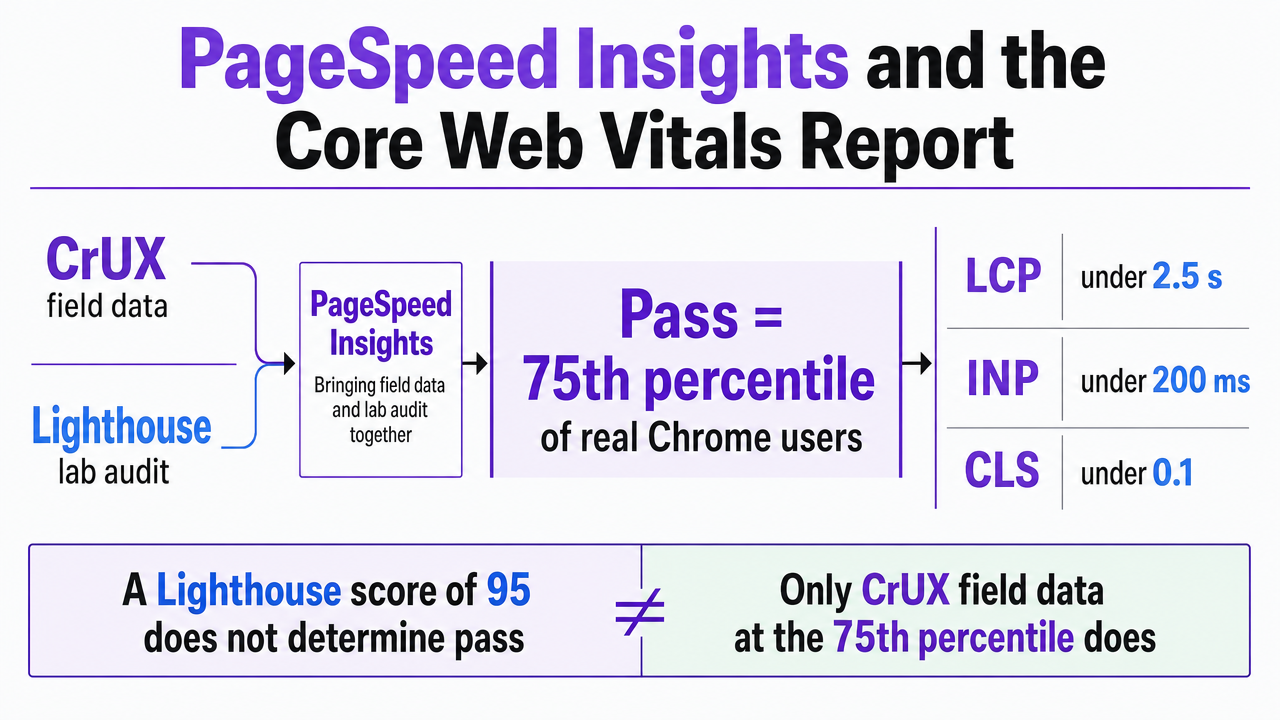 Visualize the three specific Core Web Vitals thresholds cited in the section and prose, grounding the 75th-percentile passing rule for LCP, INP, and CLS
Lighthouse: Auditing at the Template Level
Lighthouse is the audit engine underneath PageSpeed Insights, and Chrome's own documentation describes it as an open-source, automated tool that scores performance, accessibility, SEO, and best practices in a single run 1. That framing matters for delivery economics. A strategist does not need to buy a technical audit platform to catch missing meta descriptions, blocked resources, tap-target problems, or render-blocking scripts on a client's most trafficked templates.
The version most agencies underuse is Lighthouse CI. Running Lighthouse via Chrome DevTools or PageSpeed Insights is the entry point Chrome documents, but the same engine runs headlessly in a build pipeline, which lets a Head of SEO fire audits against a rotating set of template URLs on every client deployment 1. That converts Lighthouse from a manual spot-check into a regression alarm.
The practical rule for portfolio use: pick five to eight template URLs per client that cover home, category, product or service, article, and conversion. Audit them on a scheduled cadence rather than crawling every URL. Template-level fixes propagate to thousands of pages at once, which is where Lighthouse actually removes strategist hours instead of adding them.
Keyword Planner and Google Trends: First-Party Demand Data
Keyword Planner is the free demand signal that comes directly from Google's own ad inventory. Its product page describes it plainly: keyword suggestions, search volume, and trend data drawn from Google Ads, with historical trend analysis and forecasting built in 16. For an agency building keyword sets across many clients, that first-party grounding is the reason it stays in the stack even when paid platforms sit alongside it.
The honest limitation belongs in the same paragraph. Keyword Planner's volumes and competition scores are optimized for advertisers, not for organic difficulty 16. Volumes appear in ranges rather than exact counts unless an active ad account is spending, and the competition column reflects paid auction pressure rather than organic SERP saturation. Agency workflows treat Keyword Planner as the demand-truth source and hand off organic difficulty scoring to another tool or to SERP-based analysis.
Google Trends fills the gap Keyword Planner leaves. It normalizes search interest over time, exposes rising queries, and lets a strategist separate a durable topic from a spike driven by a news cycle. Practitioner guides catalog both tools inside the standard Google free stack alongside Search Console and PageSpeed Insights, which reflects how they actually get used in delivery: Planner for volume, Trends for shape and timing 13.
Bing Webmaster Tools: The Underused Second Signal
Bing Webmaster Tools rarely makes it into an agency's weekly rhythm, which is precisely why it earns its slot. It offers a free, independent view of index coverage, crawl behavior, and query-level performance that does not depend on Google's pipeline. For clients whose audiences skew toward Microsoft-integrated workplaces or ChatGPT-connected search surfaces, that second signal is the difference between spotting an indexation problem and missing it for weeks.
The peer-reviewed tool literature groups Bing Webmaster Tools with Search Console and Screaming Frog as part of the free operational baseline for technical audits and keyword performance analysis 7. Its practical role in a scaled delivery model is smaller but specific: verify property, submit sitemaps, and set an alert layer on top of its crawl and index reports so the tool surfaces exceptions instead of asking a strategist to log in and look.
Test AI-powered SEO workflows with real campaigns
Trial lets you launch and measure live SEO content at scale before committing to a new workflow.
The Third-Party Free Tier Layer and Where It Breaks
Ahrefs Webmaster Tools: Backlink Visibility Without a Seat
Ahrefs Webmaster Tools gives verified site owners free access to a slice of the Ahrefs index — referring domains, backlinks, top pages, and basic organic keyword data — without a paid seat. For an agency Head of SEO, that solves one specific problem: getting a defensible view of a client's link profile on day one of onboarding, before the budget conversation about paid platforms even starts. The peer-reviewed tool literature places Ahrefs alongside Search Console and Screaming Frog in the modern operational baseline for competitive link analysis and technical audits 7.
The reason to trust the signal at all comes from the correlation data. Backlinko's analysis of 11.8 million Google search results found that the number one result has an average of 3.8 times more backlinks than positions two through ten, with referring domains showing one of the strongest correlations to first-page rankings in the dataset 12. That is the case for putting backlink telemetry into the free stack at all.
Signal strength versus measurement confidence: the #1 result averages 3.8x more backlinks than positions #2–#10 across 11.8M search results 12, while methodological reviews caution that Ahrefs Domain Rating and Alexa-based metrics measure popularity proxies rather than direct ranking causation 15.
The caveat belongs in the same breath. Kevin Indig's methodological review of the same study flags that Ahrefs Domain Rating and Alexa-derived metrics measure domain popularity proxies, not causal ranking weight, and that correlations should not be read as levers 15. The operational rule for a portfolio: use Ahrefs Webmaster Tools to spot lost links, toxic-pattern spikes, and referring-domain trends per client, not to set a numeric DR target as a delivery KPI.
Screaming Frog Free Tier: The 500-URL Ceiling
The Screaming Frog free tier caps crawls at 500 URLs per site. That is the number an agency has to plan around, and it is where most portfolio delivery models quietly break. For a five-page local services client, the cap is invisible. For a mid-market ecommerce site with 40,000 product URLs or a multi-location brand with a thousand location pages, 500 URLs will not surface template-level canonical errors, orphaned pages, or redirect chains at the depth technical audits require.
The peer-reviewed tool literature includes Screaming Frog in the operational baseline for technical audits alongside Search Console and the major paid platforms, which is why it earns a slot even with the cap 7. The delivery move is to use the free tier as a triage crawler on a rotating template subset — home, category, product, article, conversion — the same discipline that keeps Lighthouse audits scalable. Combined with Search Console's Index Coverage report, which does not have a URL cap, a strategist can catch most template-level indexation issues without upgrading a license.
The scale ceiling is a straight line: past roughly 30 client sites, or any single site over 500 crawlable URLs where full-site audits are contractual, the paid license pays for itself in strategist hours.
The Ranking Impact Question: What the CWV Data Actually Supports
Client-facing decks routinely oversell Core Web Vitals as a dominant ranking lever. The primary sources do not support that framing, and a Head of SEO who repeats the overclaim eventually loses credibility when a green-band URL group fails to move positions.
Google's own guidance is careful. Core Web Vitals are used by ranking systems, and good scores are recommended for Search success, but Google states plainly that strong CWV alone do not guarantee top rankings 3. The 2020 page experience announcement framed CWV as one set of signals among many, quantifying real-world user experience rather than replacing content and link factors 17. Independent technical analysis lands in the same place: passing LCP, INP, and CLS at the 75th percentile of real Chrome users produces a small but consistent boost through the Page Experience system, not a decisive one 5.
The operational read for portfolio delivery is straightforward. CWV work belongs in the technical hygiene tier, alongside indexation and crawl health. It stabilizes rankings and protects against demotion, but the strategist hours that move needle rankings still sit in content depth and referring-domain acquisition. Free tools like PageSpeed Insights and Search Console's Core Web Vitals report are worth wiring into weekly monitoring precisely because the ranking impact is real but modest — automation is what makes that modest gain worth the cost to serve.
Scale SEO Delivery With Zero Additional Headcount—See Proven Free Tools in Action
Connect with our team for an in-depth walkthrough of free SEO tool workflows that streamline client deliverables and maximize efficiency across multi-site campaigns.
Wiring the Free Stack Into a Delivery Model
Where Automation Removes the Most Hours
The free stack pays off only when the workflow around it is automated. Shcherbakova's process-automation research separates the labor into two categories that map cleanly onto agency delivery: site-level SEO tasks (keyword collection, parsing, text analysis, search analytics, monitoring) and administrative functionality (monitoring, reporting, task management, project costing) 9. Dysin and Popkova frame the same point more bluntly — SEO automation exists to reduce human labor through tools that would otherwise require a strategist to perform the work by hand 10.
The five workflow stages where free telemetry plus automation compresses cost-to-serve are consistent across agency operations:
- technical audit
- keyword research
- Core Web Vitals monitoring
- indexation QA
- client reporting
Left manual, each of these stages consumes a strategist's calendar in predictable ways — logging into Search Console per property, exporting Keyword Planner sets, running PageSpeed Insights URL by URL, walking coverage reports, and rebuilding slide decks. Wired into a scheduled pipeline that pulls from the Search Console API, CrUX, Lighthouse CI, and Keyword Planner exports, the same stages collapse into exception review.
Free-tool delivery capacity per SEO strategist: manual versus automated hours per client per month across five workflow stages, grounded in the automation-of-administrative-functionality framing that groups monitoring, reporting, and task management as the categories where tooling most directly reduces human labor 9, 10.
The point of the comparison is not a dollar figure. It is the shape of the compression. Technical audits and CWV monitoring are the stages where free telemetry plus scheduling reclaims the most hours, because both are dominated by log-in, export, and interpret cycles that a scheduled pipeline eliminates. Reporting is the next-heaviest — the automation-of-administrative-functionality category Shcherbakova identifies covers monitoring, reporting, and task management, and those are the tasks that scale worst without tooling 9. Earlier automation research on SEO project workflows made the same observation: structured pipelines already covered data collection through client reporting a decade ago, and the free-tool APIs available now make that further feasible without a paid platform 11.
If You Manage a Portfolio of 30 or More Sites
Scope note: this subsection is written for the Head of SEO carrying 30-plus client properties. The single-site operator can skip it. At this portfolio size, the free stack stops being a starter kit and starts requiring engineering discipline.
The order of operations matters.
- Search Console API pulls come first, because 16-month retention and 1,000-row export caps force a warehousing decision — either data lands in BigQuery on a rolling weekly cadence or a strategist rebuilds history from screenshots.
- CrUX API queries for CWV field data come next, since PageSpeed Insights does not batch and per-URL clicks do not scale past a handful of properties.
- Lighthouse CI runs against a fixed set of five to eight template URLs per client, triggered on deployment or on a nightly schedule, so template regressions surface as alerts rather than surprises in a Monday review.
Screaming Frog's 500-URL cap becomes the forcing function for a paid license around the same portfolio size, particularly when a single client site exceeds that ceiling or when contractual audits require full-site crawls. Keyword Planner and Google Trends stay in the demand layer, pulled through the Google Ads API where authorized. The pod structure that supports this looks less like one strategist per ten clients and more like one strategist plus a pipeline supervising exception reports across the portfolio 7.
The Approval Layer: Where Vectoron Fits on Top of Free Telemetry
Free telemetry answers what changed. It does not decide what ships next. That gap — between an exception report and an approved production change — is where scaled agencies still lose margin, because a strategist has to translate signals into ranked recommendations, route them for review, and track whether the executed work moved the KPI.
An orchestration and approval layer sits above the free stack rather than replacing it. Search Console remains the query and index source. PageSpeed Insights and Lighthouse remain the performance diagnostics. Keyword Planner remains the demand signal. The layer above reads those signals, ranks recommendations by expected impact, routes each one for human sign-off, and executes only the approved work — with the strategic reasoning attached to every recommendation. Vectoron is built around that approval-first pattern, positioned as the workflow layer on top of first-party telemetry rather than a substitute for it. The free tools stay ground truth. The orchestration handles the ranking, routing, and execution that would otherwise consume the strategist hours the free stack was supposed to save.
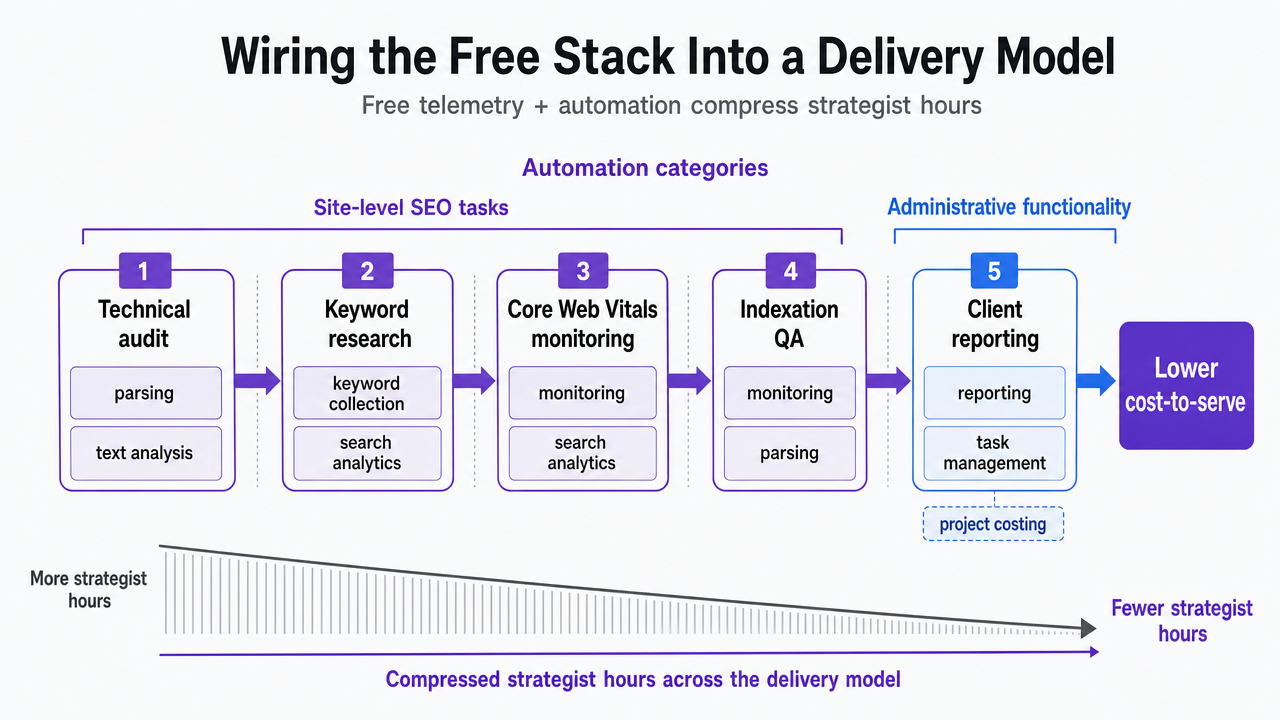 Process infographic visualizing the five workflow stages where free telemetry plus automation compresses strategist hours, directly supporting Shcherbakova's two-category automation framing cited in the section
Restructuring the Pod Around the Free Stack
The delivery-model implication of everything above is a pod redesign. The old shape — one strategist per eight to ten clients, with a junior analyst added for every ten new logos — assumes the strategist manually pulls Search Console exports, runs PageSpeed Insights URL by URL, and rebuilds a slide deck for every monthly review. Free tools do not fix that math on their own. Paired with scheduled pipelines against the Search Console, CrUX, and Lighthouse CI APIs, the same strategist supervises exception reports across a portfolio rather than producing them, which is the labor-reduction pattern the automation literature describes across monitoring, reporting, and task management 9, 10.
The pod that replaces the old shape has three roles instead of a headcount ladder. A senior strategist owns strategy, escalations, and client-facing judgment. A technical operator maintains the telemetry pipeline, the template audit set, and the Screaming Frog crawl rotation. An orchestration layer handles ranking, routing, and approval workflow on top of that telemetry. Vectoron is built for that third seat. Free tools stay the ground truth. The pod stops scaling by adding analysts and starts scaling by adding clients.
Frequently Asked Questions
References
- 1.Introduction to Lighthouse - Chrome for Developers.
- 2.Understanding Core Web Vitals and Google search results.
- 3.Evaluating page experience for a better web.
- 4.Como entender o Core Web Vitals e os resultados da Pesquisa Google.
- 5.Does Core Web Vitals Affect SEO? The Ranking Impact (2026 Guide).
- 6.11 of the best free tools every SEO should know about.
- 7.SEO Tools And Techniques To Unlocking Online Visibility.
- 8.Search engine performance optimization: methods and applications.
- 9.SEO process automation tools.
- 10.SEO automation tools overview (Andrei Dysin, Diana Popkova).
- 11.DESIGN PROCESS AUTOMATION SYSTEM SEO-OPTIMIZATION.
- 12.We Analyzed 11.8 Million Google Search Results. Here’s What We Learned About SEO.
- 13.5 Google SEO .
- 14.12Google SEO .
- 15.Dissecting the Backlinko study.
- 16.Get Campaign Keyword Suggestions with Keyword Planner.
- 17.Evaluating page experience for a better web.