
Key Takeaways
- Expert content patterns replace one-off briefs with repeatable structures, compressing briefing and revision time so mid-level writers can execute without senior editor rewrites 3.
- Intent-tiered keyword maps organized by problem-aware, solution-comparison, and provider-selection tiers outperform topic clusters in a search environment reshaped by AI Overviews 3.
- Technical hygiene as a monthly template with fixed check surfaces produces a diff against last month, letting one operator carry up to 90 accounts.
- Structured data shipped as a default JSON-LD library keyed to CMS and vertical eliminates schema as an upsell and gives AI summarizers a clean parse 1.
- E-E-A-T signals move upstream into a client credential library referenced by every content pattern, so bylines and reviewer blocks populate automatically across the site 3.
- Brand and navigational search deserves a templated defense across homepage metadata, Knowledge Panel, schema, and Google Business Profile to stop unforced margin leaks on acquisition 3.
- Local and multi-location fundamentals scale through one operating standard covering GBP, NAP consistency, vertical directories, location page templates, and review cadence across every entity 3.
- AI Overview readiness requires re-scoring informational pages and rewriting with extractive answers, question-shaped H2s, and dated citations after Pew found a roughly 47% relative CTR haircut 4.
- A production layer underneath senior judgment, with approval-in-the-loop routing, is what separates agencies executing all nine tactics at 8.5 hours from those stuck at 28.5 9.
Why free SEO plays decide agency margin in 2025
Agency gross margin in 2025 is a production question, not a strategy question. The nine free search optimization ideas that move rankings for service-vertical clients—expert content, intent-tiered keyword maps, technical hygiene, structured data, E-E-A-T signals, local fundamentals, earned mentions, brand-search defense, and AI Overview readiness—have been public knowledge for years. What separates agencies compounding revenue from agencies stalling at 15 to 20 accounts per senior operator is how cheaply and consistently those tactics get executed across a client book.
The economics are shifting quickly. McKinsey's 2025 survey found that revenue impact from generative AI is most commonly reported in marketing and sales use cases, and adoption in those functions more than doubled between 2023 and 2024 6, 2. Stanford's 2025 AI Index reports 71% of organizations now use generative AI in at least one business function, though realized financial gains for most adopters remain under 5% 7. That gap—broad adoption, modest measured return—is the operator opening. Agencies that industrialize free tactics with AI-assisted production capture the delta; agencies that keep pricing them as bespoke senior labor watch retainers reprice around them.
Free tactics also behave differently from paid media on the retainer P&L. Organic assets compound across renewal cycles, while paid spend resets every month a client pauses. That compounding is what makes low-cost SEO the margin lever, provided the production hours stay in check. The rest of this piece treats each of the nine ideas as a unit-economics problem: hours per client per month, ceiling per FTE, and where AI-assisted workflows change the math.
The agency economics of nine free tactics
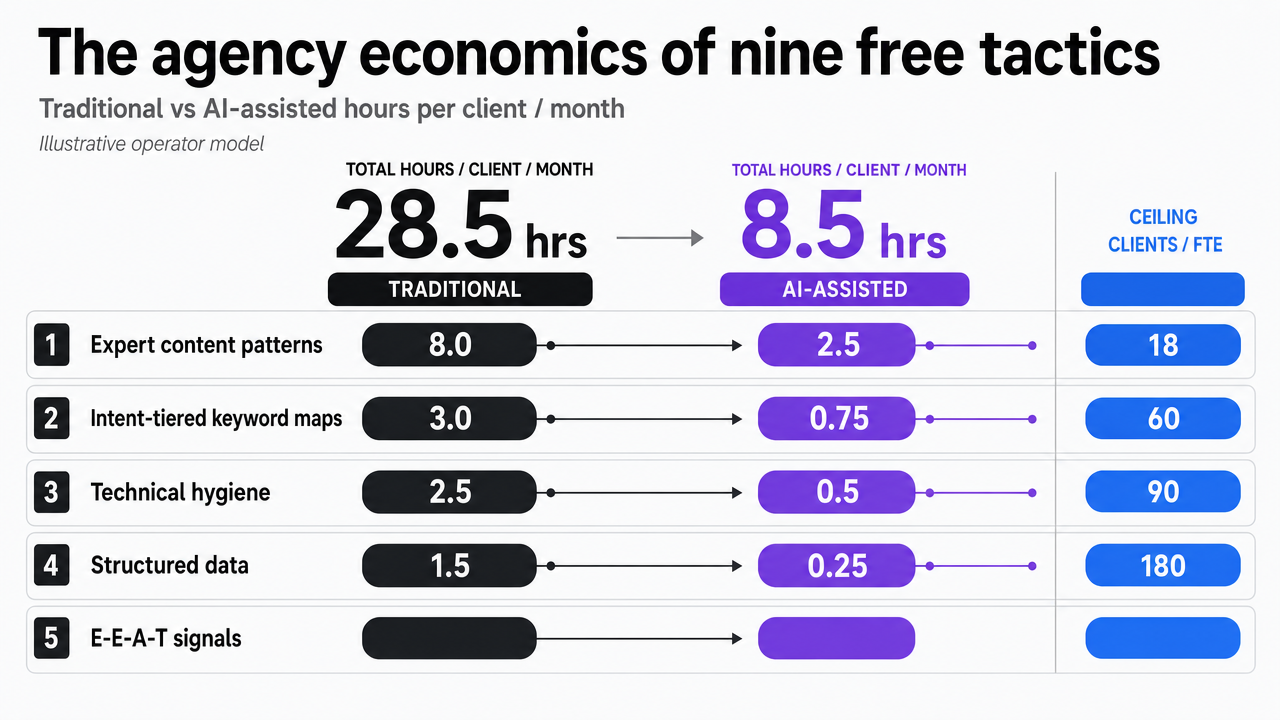
The table below models per-client monthly hours for the nine tactics under two operating models: traditional agency execution and AI-assisted execution with human approval in the loop. The scalability ceiling column estimates how many clients a single senior operator can carry when that tactic is their primary responsibility. The productivity delta between the two columns is anchored to McKinsey's estimate that generative AI could raise marketing productivity by 5% to 15% of total marketing spend, a model-based figure rather than audited outcomes 5. Treat this as an illustrative operator model, not a benchmark.
| Tactic | Traditional hrs/client/mo | AI-assisted hrs/client/mo | Ceiling (clients per FTE) |
|---|---|---|---|
| Expert content patterns | 8.0 | 2.5 | 18 |
| Intent-tiered keyword maps | 3.0 | 0.75 | 60 |
| Technical hygiene | 2.5 | 0.5 | 90 |
| Structured data | 1.5 | 0.25 | 180 |
| E-E-A-T signals | 2.0 | 0.75 | 60 |
| Local & multi-location | 4.0 | 1.0 | 45 |
| Earned mentions | 3.5 | 1.5 | 30 |
| Brand-search defense | 1.5 | 0.5 | 90 |
| AI Overview readiness | 2.5 | 0.75 | 60 |
| Total per client | 28.5 | 8.5 | — |
Illustrative agency model. Ceiling assumes single-tactic focus and does not stack; production layer anchored to the 5–15% marketing productivity range in McKinsey's estimate 5.
Two numbers matter more than any individual row. The bottom of the table, 28.5 hours versus 8.5 hours per client per month, is where retainer pricing pressure originates: a senior operator carrying 15 accounts under the traditional model is running at capacity around 425 monthly hours, while the same person under an AI-assisted model has room for 40 accounts before hitting the same wall. That is the compounding lever the rest of this piece unpacks tactic by tactic.
The ceiling column is deliberately shown at single-tactic depth because most agencies specialize senior roles that way—one person owns technical, another owns content, another owns local. Forrester's 2025 work on generative AI inside U.S. marketing agencies signals the shift is already underway inside the peer set 9. Agencies that hold traditional-column staffing through 2025 are underwriting a cost structure that competing shops no longer carry.
 Visualize the traditional vs AI-assisted hours-per-client comparison that anchors the section's operator model, reinforcing the 28.5 vs 8.5 hour totals cited in prose
Publish expert content patterns instead of one-off briefs
The highest-margin content operation on an agency floor is not a better brief. It is a repeatable pattern that a mid-level writer can execute without a senior editor rewriting the draft. Peer-reviewed work on SEO and brand positioning identifies valuable content as one of four core determinants of visibility, alongside niche differentiation, targeted keywords, and scalable link building 3. The operational read: content quality is a system output, not a per-piece heroic effort.
Patterns work because they compress two costs at once. The first is briefing time—senior operators typically spend 45 to 90 minutes framing a single custom piece for a service-vertical client. The second is revision time, which usually exceeds the briefing time when the writer is guessing at structure, evidence density, and expert-quote placement. A locked pattern for a service-page rewrite, a case-outcome explainer, or a treatment comparison collapses both.
Agencies running content patterns treat the following as fixed inputs per pattern:
- intent tier
- evidence sources allowed
- expert quote slots
- internal link targets
- schema type
- disallowed phrasing
Only the client-specific facts vary. McKinsey's 2025 survey found that revenue impact from generative AI is most commonly reported in marketing and sales use cases 2—the mechanism is exactly this kind of production compression, not novel creative output. One pattern, executed across forty clients, is where the margin lives.
Rebuild keyword maps around intent tiers
Most agency keyword maps are still organized by topic clusters, which was the right abstraction in 2018 and is the wrong one in 2025. Topic clusters were built for a search environment where informational, commercial, and transactional queries all resolved to a ten-blue-links page. That environment no longer exists at the top of the funnel, where AI Overviews now absorb a meaningful share of informational demand. The map that scales across forty clients is organized by intent tier first and topic second.
Three tiers cover most service-vertical work.
- Tier one is problem-aware informational ("why does my tooth hurt at night," "signs a parent needs memory care")—high volume, low CTR pressure, best treated as brand-awareness fuel and AI Overview citation bait rather than conversion pages.
- Tier two is solution-comparison ("invisalign vs braces cost," "assisted living vs memory care")—mid volume, high commercial value, where expert content patterns and structured data compound.
- Tier three is provider-selection and local ("dentist near me open saturday," "personal injury lawyer [city]")—lower volume, highest conversion rate, where local fundamentals and brand-search defense do the heavy lifting.
The academic case for this reorganization is straightforward: peer-reviewed work on SEO strategy identifies targeted keyword selection as one of four determinants of brand positioning, alongside niche differentiation, valuable content, and scalable link building 3. Targeted does not mean high-volume. It means matched to intent tier and to the asset that can actually rank for it.
Production leverage comes from templating the mapping process itself. One senior operator defines the three tiers per vertical once; mid-level analysts populate them per client from Search Console exports and competitor SERPs. The traditional model burns three hours per client per month on this work when every map is rebuilt from scratch. Under a templated model with AI-assisted clustering, the same output lands in under an hour, and the map becomes a living asset the whole account team reads from.
Test free search strategies on live campaigns now
Experiment with data-backed optimization ideas and publish real results during your trial—no commitment required.
Run technical hygiene as a monthly template, not a project
Technical audits are the most overpriced deliverable on the average agency floor. A senior consultant spends eight to twelve hours pulling a Screaming Frog crawl, cross-referencing Search Console, and writing a slide deck the client reads once. Six months later, another audit gets scoped as a fresh project. The work is identical in structure and mostly identical in findings.
The agencies scaling past thirty accounts per operator have converted the audit into a monthly template with a fixed check surface:
- crawl errors
- indexation drift
- Core Web Vitals regressions
- broken internal links
- orphan pages
- redirect chains
- canonical conflicts
- robots and sitemap integrity
- mobile rendering diffs
Same fields every month, same thresholds for what triggers a ticket. The output is not a deck. It is a diff against last month.
Peer-reviewed work on SEO for scientific journals makes the same operational point in a different context: disciplined attention to metadata, site structure, and indexing produces the measurable visibility gains, not one-off overhauls 1. Structure compounds when it is maintained, not when it is rediscovered.
Templated hygiene collapses the traditional 2.5 hours per client per month toward 30 minutes because the analyst is reading exceptions, not building the report. Ninety accounts per hygiene-focused operator becomes realistic. The client still sees monthly evidence of technical stewardship—just without the theater of a rebuilt audit.
Ship structured data as a default, not an upsell
Structured data is where agency pricing models still lag the actual production cost. Schema markup for FAQ, HowTo, LocalBusiness, Organization, Article, Person, Service, and Review is largely templated JSON-LD at this point, yet most agencies still scope it as a discrete deliverable priced against senior developer time. That framing made sense when schema required custom hand-coding per template. It does not survive contact with a client roster where forty sites share three or four CMS platforms.
The scale unlock is treating schema as a default publishing artifact, not a project. Every new page ships with the appropriate schema type prefilled from a library keyed to the client's vertical and page pattern. Service-page schema for a personal injury firm is not custom work; it is a filled-in template with case-type variables. LocalBusiness and Physician schema for a multi-location dental group are the same JSON structure across every location page, differing only in NAP fields and specialty enumerations.
Peer-reviewed work on SEO for scientific journals reached the same operational conclusion: disciplined metadata and structural markup produced measurable visibility gains without editorial rewrites 1. The mechanism is identical for service verticals—machine-readable structure gives crawlers and AI summarizers a clean parse, which matters more as more results resolve through generated answers rather than raw ranking.
Traditional scoping spends 1.5 hours per client per month keeping schema current across new pages and template changes. A defaulted library collapses that toward 15 minutes of exception handling. The billable-work story shifts from "schema audit" line items to schema as table stakes, which is where the retainer conversation is already headed.
Encode E-E-A-T signals into the production line
E-E-A-T is where most agency content operations quietly leak margin. Senior editors spend hours chasing attorney bios, citing case outcomes, verifying medical reviewer credentials, and hunting down author photos—work that should live in a client intake artifact, not in every draft cycle. The fix is not more diligence per piece. It is moving experience, expertise, authoritativeness, and trust signals upstream into the production line, where they attach automatically to every asset that ships.
The upstream artifact is a client credential library, built once per account during onboarding and maintained monthly. It holds:
- practitioner bios with verified credentials
- licensure and jurisdiction data
- board certifications
- years in practice
- published work
- awards
- verified case outcomes with dates
- medical reviewer assignments per topic cluster
- photograph rights
Every content pattern references this library by field, so an article on memory care assessments automatically pulls the correct clinical reviewer, disclosure language, and last-reviewed date without an editor rebuilding the byline block.
Peer-reviewed work on SEO strategy places valuable content and niche differentiation among the four determinants of brand positioning 3—E-E-A-T is the operational expression of both. Agencies encoding these signals as production defaults collapse the traditional 2 hours per client per month of trust-signal handling toward 45 minutes of library maintenance. The client-facing quality improves at the same time, because credentials appear consistently across the whole site rather than only on pages a senior editor touched.
Treat brand and navigational search as a defensible moat
Brand and navigational queries are the single most defensible asset on a service-vertical client's search footprint, and the one most agencies underprice. A prospect typing the firm name, a practitioner name, or a location-plus-brand phrase has already been converted somewhere upstream—paid social, a referral, a billboard, an intake call. Losing that click to a directory aggregator, a review site rewriting the SERP, or a competitor bidding the brand term is not an SEO problem. It is an unforced margin leak on the client's acquisition cost.
The defensible surface has six recurring components across verticals:
- the homepage title and meta wired to exact-match brand queries
- a complete Knowledge Panel with verified sameAs links
- Organization and Person schema tied to the practitioner library
- a monitored branded-SERP screenshot on a monthly cadence
- a Google Business Profile that owns the map pack for the branded-plus-city query
- a written policy on whether the client bids their own brand in paid search
Peer-reviewed work on SEO strategy names niche differentiation and scalable link building as two of four brand-positioning determinants 3—branded search is where both compound fastest, because every earned mention and directory citation reinforces the same navigational intent.
Traditional scoping burns 1.5 hours per client per month reacting to whatever moved on the branded SERP. A templated defense collapses it toward 30 minutes of exception review, and the retainer story gets stronger because renewal conversations turn on protected pipeline, not ranking screenshots.
See How Top Agencies Systematize Free Search Optimization at Scale
Request a data-driven walkthrough of workflow frameworks and approval processes designed for agencies managing large-scale SEO initiatives—eliminate production overhead while maintaining quality and full oversight.
Standardize local and multi-location fundamentals across the book
Local SEO is where multi-location clients quietly consume the most senior hours and where a templated approach pays back fastest. A single dental group with 22 offices, a home services franchise with 40 territories, or a senior living operator with 15 communities does not need bespoke local strategy per location. It needs one operating standard applied consistently across every entity, refreshed on a predictable cadence.
The standard has a fixed surface across verticals:
- Google Business Profile completeness and category accuracy per location.
- NAP consistency across the top citation sources and the vertical-specific directories that actually move rankings (Avvo and Justia for legal, Healthgrades and Zocdoc for medical, Angi and HomeAdvisor for home services).
- Location page templates with unique service copy, embedded map, reviews block, staff schema, and hours.
- Review generation cadence tied to the client's CRM or PMS export.
- Geo-modified query tracking per location, not per brand.
Peer-reviewed work on SEO strategy places scalable link building and niche differentiation among the four determinants of brand positioning 3—local citations and vertical directory presence are the operational expression of both at the location level. Every consistent citation reinforces the same navigational entity across the map pack and organic results.
Traditional scoping burns 4 hours per client per month on local across a multi-location account, most of it senior time reconciling NAP drift and rewriting location pages one at a time. A templated standard collapses that toward 1 hour of exception review, with the location page library and citation monitor handling the repeatable work. The retainer story becomes location-count coverage rather than hours logged.
Rewrite for AI Overviews before competitors reprice their retainers
The single largest change to organic search economics in a decade is now measurable. Pew's July 2025 study of 900 U.S. adults across roughly 68,000 queries found that users clicked a traditional search result on 8% of visits when an AI-generated summary appeared, compared with 15% when no summary was shown—and about 18% of Google searches in March 2025 produced an AI summary 4. That is a roughly 47% relative CTR haircut on the slice of queries most exposed to AI Overviews, and the exposure share is expanding, not contracting.
Two operational responses matter for client work.
- Triage: informational tier-one pages in the keyword map need to be re-scored for AI Overview risk, because a page that ranked well and drove trial traffic in 2023 may now feed the summary without earning the click.
- Rewrite discipline. Pages that survive as citation sources inside AI Overviews share recognizable traits—tight extractive answers in the first 80 words, explicit entity naming, question-shaped H2s that match query phrasing, dated source references, and structured data that gives the summarizer a clean parse.
Agencies that build a rewrite pattern for AI Overview readiness—one template covering answer block, entity coverage, citation density, and schema—can process the top 20 informational pages per client in under three hours. Agencies still hand-crafting each rewrite are quietly absorbing the CTR loss into unchanged retainer scopes, which is the moment competitors reprice. Peer-reviewed work on SEO strategy already flagged valuable content and targeted keywords as two of four brand-positioning determinants 3; AI Overviews raise the cost of getting either one wrong, because the summary either cites the client or it cites a competitor and the click is gone before the SERP loads.
The retainer story that lands in 2025 renewal conversations is not "we rank for more keywords." It is "we protected citation share on the queries most exposed to AI summaries," backed by a monthly diff showing which client pages appear inside Overviews and which competitor pages replaced them. That is a defensible line item. Ranking screenshots are not.
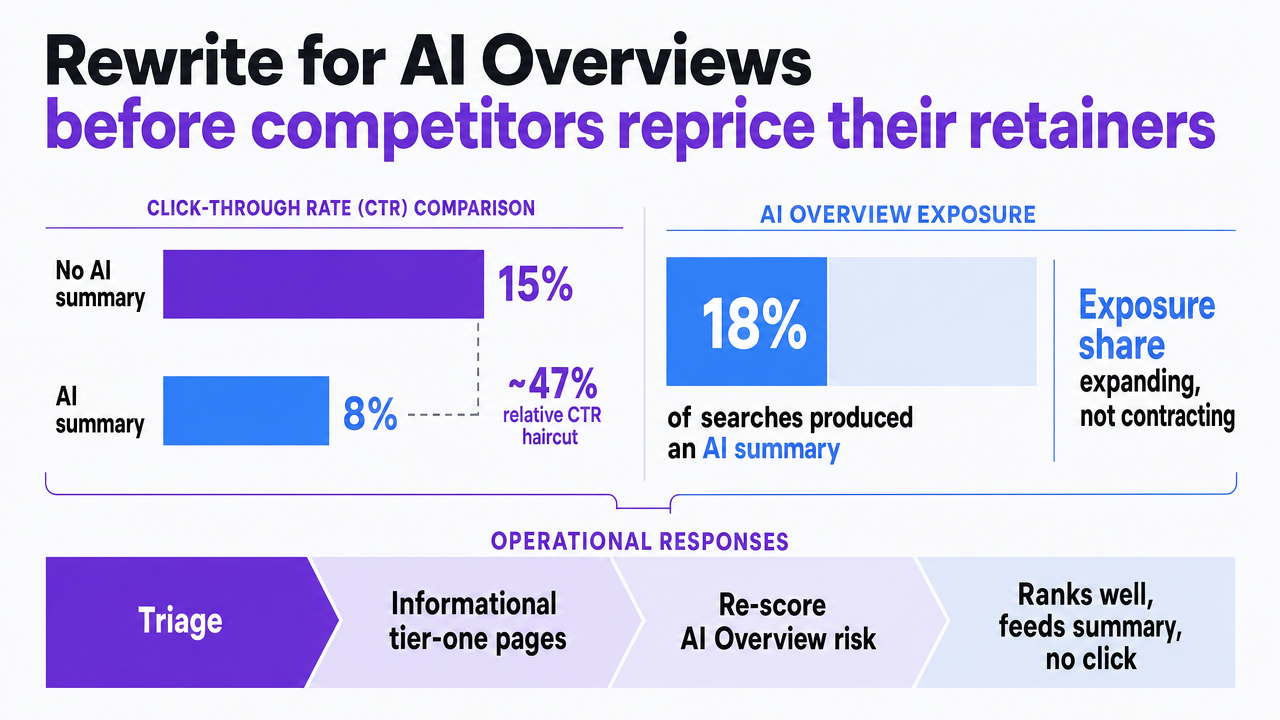 Chart the Pew 2025 CTR finding cited directly in the section: 15% click-through without AI summary vs 8% with, plus the 18% share of searches producing an AI summary
Vectoron and the production layer that makes free tactics scale
The nine tactics in this piece are not proprietary. Every competing agency has read the same Search Central documentation, run the same Screaming Frog crawls, and shipped the same FAQ schema. The differentiator in 2025 is not which tactics an agency knows. It is which agency executes all nine, on every client, every month, without the labor cost consuming the retainer.
Adoption data confirms the gap between knowing and executing. Stanford's 2025 AI Index reports that 71% of organizations now use generative AI in at least one business function, and 71% of respondents using AI in marketing and sales report revenue gains—yet the most common gain is under 5% 8. Broad adoption, thin realized return. The agencies pulling ahead are the ones treating AI not as a drafting shortcut but as a production layer sitting underneath the strategist's judgment: reading client signals, ranking work, executing approved output, and tracking KPI impact across the nine tactics simultaneously.
That is the category Vectoron operates in—specialist strategists for content, SEO, backlinks, and adjacent channels routed through an approval-first Command Center, so senior operators retain sign-off while the repeatable work compresses. It is one example of the production-layer approach; other tooling stacks aim at the same operating model. The point is not the vendor. It is that agencies still pricing the nine free tactics as 28.5 hours of senior labor per client per month are competing against agencies pricing the same output at 8.5. Renewal math resolves that comparison inside two quarters.
Frequently Asked Questions
References
- 1.Search engine optimisation as a tool for improving visibility of scientific journals.
- 2.The State of AI: Global Survey 2025.
- 3.Search engine optimisation (SEO) strategy as determinants to enhance online brand positioning.
- 4.Do people click on links in Google AI summaries?.
- 5.Economic potential of generative AI.
- 6.The state of AI in early 2024 - McKinsey.
- 7.The 2025 AI Index Report | Stanford HAI.
- 8.Economy | The 2025 AI Index Report | Stanford HAI.
- 9.The State Of Generative AI Inside US Marketing Agencies, 2025.
- 10.The State Of Artificial Intelligence And Machine Learning Adoption In B2B Marketing, 2025.