
Key Takeaways
- Fix the query set at onboarding and version it like code, so quarterly audits measure real competitor movement instead of analyst-driven method drift 1.
- Record five variables with every SERP capture—query, location, device, timestamp, and raw file location—and re-run on a schedule to treat the live web as a moving target 10.
- Split every deliverable into observed facts, derived metrics, and analyst hypotheses, with sign-off assigned per layer so senior review shifts from reconstruction to sampling.
- Map observed competitor review tactics against FTC guardrails and sort into recommend, do-not-recommend, or escalate, since the 2024 rule now prohibits purchased reviews, sentiment-conditioned incentives, and suppression 6, 9.
- Capture content, crawl, and link inputs using Search Console, view-source, site: operators, and free backlink tiers, keeping analysts on fields and off judgments at the fact layer.
- Score competitors with precision at the top of the query set, a rank-weighted score, and coverage count, defined once and applied identically so period-over-period change is comparable 11.
- Permit AI to summarize captures, cluster pages, and draft hypothesis language, but bar it from inventing facts or metrics, and log prompt, sources, and approver on every output 7, 8.
- The standardized pipeline pays back by cutting senior review from roughly 45 to 15 minutes per audit, keeping per-audit cost flat across 10 to 50 accounts.
Why competitor audits break at the 15th client
A single competitor audit built by a senior strategist looks defensible. Twenty of them, produced by three analysts over a quarter, rarely do. The breakage is not analytical talent. It is method drift. Each analyst picks a different keyword set, captures SERPs from a different location, and interprets what counts as a competitor differently. By the time the head of SEO reviews the fifteenth deliverable, comparing findings across accounts becomes guesswork.
The information-retrieval field solved a version of this problem decades ago. NIST's TREC program showed that meaningful comparison across search systems requires standardized query sets, consistent result collection, human relevance judgments, and repeatable measures applied the same way each cycle 1. Agencies that treat competitor analysis as artisanal research reinvent the query set every time and forfeit comparability.
The margin consequence is direct. Senior review time expands to catch inconsistencies that a shared template would prevent. Junior analysts mix observation with speculation because no structure forces the separation. Clients receive polished narratives that cannot be re-run next quarter to measure change.
Scaling free competitor analysis is not a tooling question. Search Console, live SERPs, and public site data are already free. The constraint is delivery discipline: a fixed evidence pipeline that any trained analyst can execute, and any reviewer can audit, across a book of accounts without losing the thread.
Borrowing the query-set discipline from IR evaluation
Fixed query sets, not ad-hoc keyword lists
The single change that makes competitor analysis comparable across a book of clients is fixing the query set before an analyst opens a browser. In TREC-style information-retrieval evaluation, systems are compared against a distributed, standardized set of queries with human relevance judgments applied the same way each cycle 1. The point is not that the queries are perfect. It is that they do not change between runs, which is what allows one measurement to be compared to the next.
Agencies that let analysts pick keywords on the fly forfeit that property. The Q2 audit for a dental client covers 40 procedure terms; the Q3 audit covers 32 different ones because the analyst thought they were more commercial. Nothing that comes out of those two reports can be compared. Change looks like signal when it is really method drift.
The operating rule: for each client, the head of SEO signs off on a fixed query set at onboarding, versioned like code. Additions and removals are logged with a reason. The set covers commercial intent, informational intent, branded terms, and local variants in known ratios, so the mix is deliberate rather than whatever felt urgent that week. Every subsequent audit runs against that same set until the next scheduled revision.
Sample size and conclusion stability in narrow markets
Sample size is where free competitor audits quietly fail. A single-location behavioral health clinic in a mid-sized metro may only have 12 to 20 commercially meaningful queries. An analyst who audits five of them and reports a competitive gap is describing a coin flip.
NIST research on evaluating web search when only a small number of relevant results exist addresses this directly. The work proposes methods for determining the minimum number of search topics needed to differentiate systems by a specified amount at a given error rate, and it shows that small topic samples produce unstable rankings between systems that would otherwise separate cleanly at larger sample sizes 2. Translated to competitor analysis: the fewer queries in the sample, the wider the confidence interval on any claim about who is winning.
The practical implications for a delivery lead are concrete:
- Query sets below roughly 25 to 30 terms in a narrow local market should carry an explicit stability caveat in the deliverable, not a ranked competitor verdict.
- Where the true addressable query universe is small, analysts should broaden by including adjacent intents and near-variants rather than manufacturing certainty from a thin sample.
- Repeat measurement over multiple time points is the other lever: a single small-sample snapshot is fragile, but the same small sample measured across three cycles begins to separate signal from noise.
The reproducible SERP capture protocol
The SERP is a moving target. NIST's work on dynamic test collections makes the point plainly: search effectiveness on the live web must be measured with the understanding that both content and results change over time, which is why a single one-shot snapshot cannot be treated as a stable observation 10. An analyst who screenshots a result page on Tuesday afternoon and files it as "the competitive landscape" has captured a moment, not a measurement.
A capture is defensible only when five variables are recorded together for every query in the fixed set:
- The query string, exactly as run.
- The geographic location, specified to the city or ZIP the client actually serves, not the analyst's home IP.
- The device class, mobile or desktop, because the two return meaningfully different result compositions.
- The timestamp, to the minute.
- The storage location of the raw capture itself, whether that is a dated folder in shared storage or a row in the audit database.
Miss any one of these and the capture cannot be re-run or compared.
The mechanics are unglamorous. Analysts use an incognito window, set location through the browser's developer tools or a location-emulation setting, run each query from the fixed set, and save the full-page capture along with a structured metadata row. The same query, from the same location, on the same device, run a week later, will produce a different result page. That is the finding, not a flaw in the process.
Two operating rules keep the protocol honest:
- Captures are timestamped and stored raw before any interpretation begins, so the reviewer can go back to the source.
- The same query set is re-run on a scheduled cycle, monthly or quarterly, so change is measured against the client's own prior captures rather than against an analyst's memory.
This is the same principle NIST applies to reproducible search evaluation: consistent measures applied the same way each cycle, on a substrate that is understood to be shifting 10.
Three layers: observed facts, derived metrics, analyst hypotheses
What each layer contains and who signs off
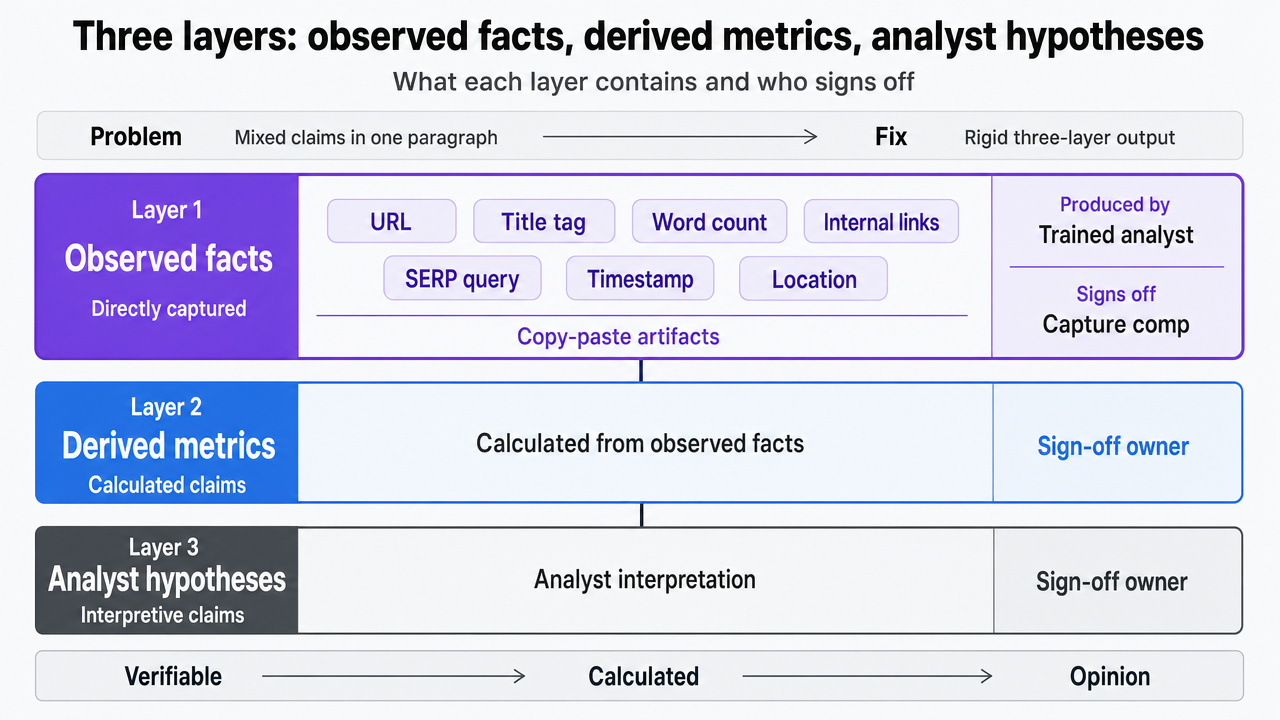
Most junior competitor audits fail review because they blend three different kinds of statements into one paragraph. A sentence that reports a competitor's H1 tag sits next to a sentence estimating their content velocity, which sits next to a sentence speculating about their editorial strategy. The reviewer cannot tell which claims are verifiable, which are calculated, and which are opinion. Every claim then gets checked from scratch.
The fix is a rigid three-layer output. The observed-facts layer contains only what an analyst captured directly: the URL, the title tag, the word count, the number of internal links on a page, the query the SERP was pulled for, the timestamp, the location. These are copy-paste artifacts. The trained analyst produces them and signs off on capture completeness against the fixed query set.
The derived-metrics layer contains calculations applied uniformly across the competitive set: share of SERP real estate across the query set, average content depth by intent bucket, referring-domain counts from a public source, indexed-page counts from a site: operator. The rules for each metric are written once and applied identically. A senior analyst or the delivery lead signs off on the calculation logic, not each number.
The hypotheses layer is where interpretation lives, and it is labeled as such. "Competitor A likely reallocated editorial toward bottom-funnel comparison content in Q2" is a hypothesis, not a fact. The head of SEO signs off on hypotheses before they reach the client, because that is where reputational risk sits.
How the layer split reduces senior review time
Senior review time collapses when the reviewer knows in advance which layer each claim belongs to. Facts are audited by sampling: pull ten rows from the observed-facts sheet, re-run the captures, confirm they match. Derived metrics are audited by checking the calculation rule once, not each output. Hypotheses get the reviewer's full attention, because that is the only layer where judgment is actually being exercised.
This mirrors the reproducibility logic NIST applies to search evaluation, where standard measures are calculated the same way each cycle so that comparisons between systems are meaningful rather than a function of who ran the analysis 1. When the calculation rules for share of SERP, content depth, or link coverage are fixed and versioned, a reviewer no longer has to relitigate methodology on every deliverable.
The operational consequence is measurable in review hours. A senior who previously spent 45 minutes reconstructing what a junior meant now spends 10 minutes sampling the fact layer, 5 minutes confirming the metric logic still holds, and the remaining time challenging hypotheses. That is the review time the pipeline is designed to recover, and it is what makes adding the sixteenth and twentieth client accretive instead of punitive.
 Visualize the three-layer output structure and sign-off ownership described in this section, since the section explicitly defines a governance framework with distinct layers and approvers
Trial Full-Scale Competitor Analysis Across Client Portfolios
Run and deploy real competitor insights to clients instantly during your first week—no limitations, no sandbox.
The reviews and reputation step, with FTC guardrails
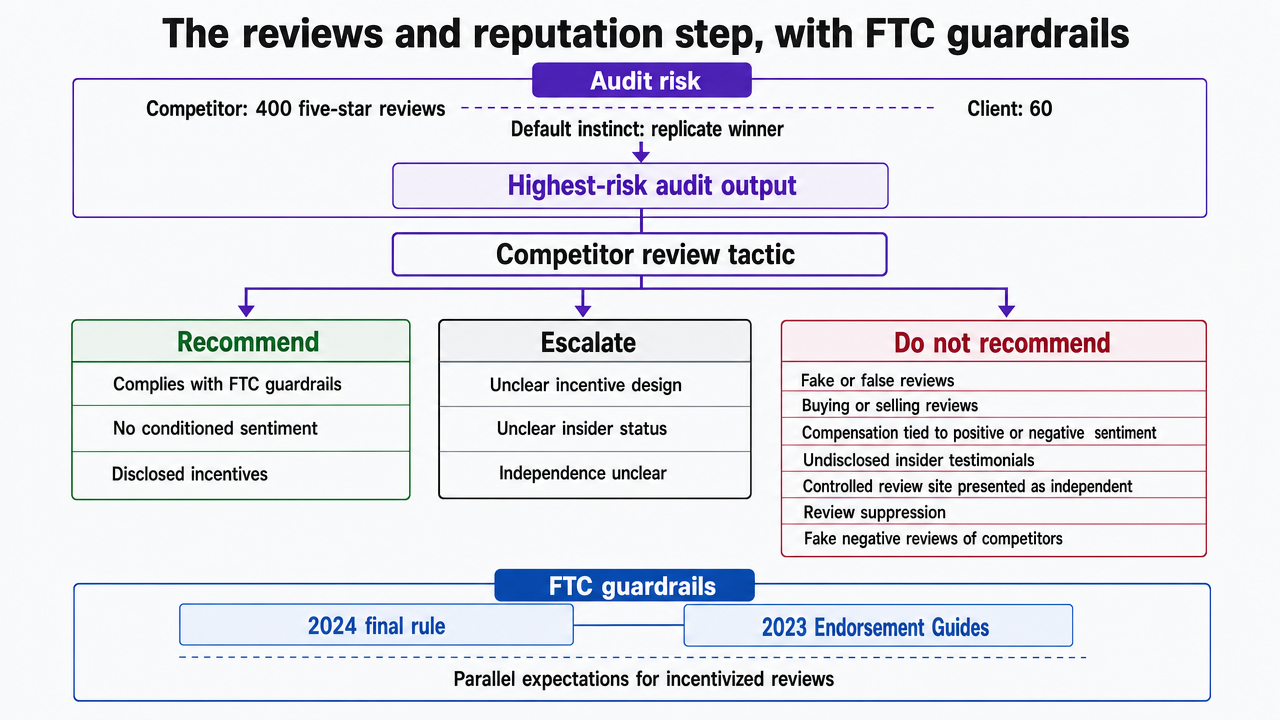
Competitor review audits are where a scaled process most often collides with law. A junior analyst looking at a competitor with 400 five-star reviews in a market where the client has 60 will, by default, recommend replicating whatever the winner appears to be doing. That recommendation is now the highest-risk output an audit can produce.
The FTC's final rule on fake reviews and testimonials, announced August 14, 2024 and effective October 21, 2024, prohibits fake or false reviews, buying or selling reviews, compensation conditioned on a particular positive or negative sentiment, certain undisclosed insider testimonials, controlled review sites presented as independent, review suppression, and fake negative reviews of competitors 6. The 2023 update to the Endorsement Guides added parallel expectations around incentivized reviews, employee reviews, and disclosure of material connections 9. Both apply directly to what an analyst observes on a competitor's Google Business Profile, testimonial page, or partner influencer roster.
The operational rule for the audit step: observed competitor tactics are recorded in the fact layer, mapped to a guardrail table, and sorted into three outcomes:
- Recommend covers tactics that remain lawful, such as prompting customers for honest reviews without sentiment conditioning and disclosing material connections plainly 3.
- Do not recommend covers tactics the rule now prohibits, including purchased reviews, incentives tied to positive sentiment, undisclosed employee or insider testimonials, and suppression of negatives 6, 9.
- Escalate to counsel covers ambiguous cases where the observed pattern is suggestive but not conclusive.
A competitor's visible review pattern is not proof of unlawful conduct, and the audit should not assert that it is. The deliverable records what was observed, cites the applicable rule, and stops there. The head of SEO signs off before any reputation recommendation reaches the client.
 Visualize the recommend / do-not-recommend / escalate decision framework for competitor review tactics, which the section explicitly defines against the 2024 FTC final rule and 2023 Endorsement Guides
Content, crawl, and link inputs juniors can capture without paid tools
Google Search Console, an incognito browser, view-source, and a handful of search operators cover most of what a competitor audit actually needs at the fact layer. The constraint is not access. It is telling a junior analyst exactly which fields to collect and where to paste them.
- For content inputs, analysts capture per-URL rows for each competitor's top-ranking pages against the fixed query set: title tag, H1, meta description, visible word count, publication or last-modified date if surfaced, presence of schema types visible in view-source, and internal link count from the body.
- For crawl and indexation inputs, a
site:operator returns an approximate indexed-page count, asite:plus intent modifier reveals how a competitor organizes a content cluster, and robots.txt and sitemap.xml are pulled raw. - For link inputs, free tiers of public backlink indexes return a referring-domain count and a top-linked-URL list; the number is directional, not authoritative, and the deliverable says so.
The rule that keeps this scalable: analysts capture the field, not a judgment about the field. "Title tag: 62 characters, includes primary query verbatim" belongs in the fact layer. "Competitor is optimizing for the primary query" is a hypothesis and moves to that sheet. The reviewer trusts the capture because the template forces the separation.
Scoring, precision, and comparing sites over time
Ranking-position averages hide more than they reveal. A competitor that owns positions one through three for 8 of 30 queries is not equivalent to one that holds position four across 24 of them, though a naive average obscures the difference. NIST's web-search evaluation work frames the alternatives directly: precision, ranking quality, and the contribution of link information are the standard effectiveness questions, applied the same way each cycle so results are comparable 11.
A workable scoring layer stays deliberately small:
- Precision at the top of the query set, calculated as the share of fixed queries where a competitor holds a top-three organic position, captures visible dominance.
- A rank-weighted score across the full query set captures depth.
- A coverage count records how many queries in the set the competitor ranks for at all.
Each metric is defined once, versioned, and applied identically to every competitor in the set.
Comparison over time is the payoff. Because the query set is fixed and captures are timestamped, the Q3 score can be subtracted from the Q2 score for the same competitor on the same substrate. Movement is measured against the client's own prior captures, not an analyst's recollection, which is what turns competitor analysis into a repeatable measurement rather than a fresh opinion each quarter.
Scale Competitor SEO Analysis Across Clients Without Resource Bottlenecks
Discover how leading agencies automate high-fidelity competitor analysis at scale—no additional hires required. Get tailored workflow recommendations and see how your team can eliminate manual data wrangling while maintaining strategic oversight.
AI-assisted scaling under a governance layer
Language models can accelerate the derived-metrics and hypothesis layers of a competitor audit, but only if their use is bounded. Left ungoverned, a model will fabricate a competitor's referring-domain count with the same fluency it uses for verified facts, and the deliverable that reaches the client cannot be defended.
NIST's AI Risk Management Framework organizes trustworthy AI around governing, mapping, measuring, and managing risk, and it is meant to be translated into account-level operating procedures rather than treated as a checklist 8. The Generative AI Profile, published in July 2024 as a companion resource, adds controls specific to generative systems: source provenance, human approval, error logging, privacy review, and monitoring of model outputs 7. Both translate cleanly to a scaled competitor-analysis pipeline.
The operating rule is where models are and are not permitted:
- Models are allowed to summarize captured content, cluster observed pages by intent, and draft hypothesis language from the facts sheet.
- Models are not allowed to introduce facts that were not captured by an analyst, name competitors that were not in the fixed set, or generate metrics that were not calculated by the versioned rules.
- Every model output carries the prompt, the source rows it was given, and the analyst who approved it, so a reviewer can trace any sentence back to its input.
Nothing reaches the client without human sign-off at the hypothesis layer, which is where the head of SEO already carries reputational risk.
Unit economics: where the pipeline pays back
The case for standardization is not aesthetic. It is arithmetic. Three delivery models produce competitor audits at very different unit costs, and the crossover point determines whether adding clients grows margin or erodes it.
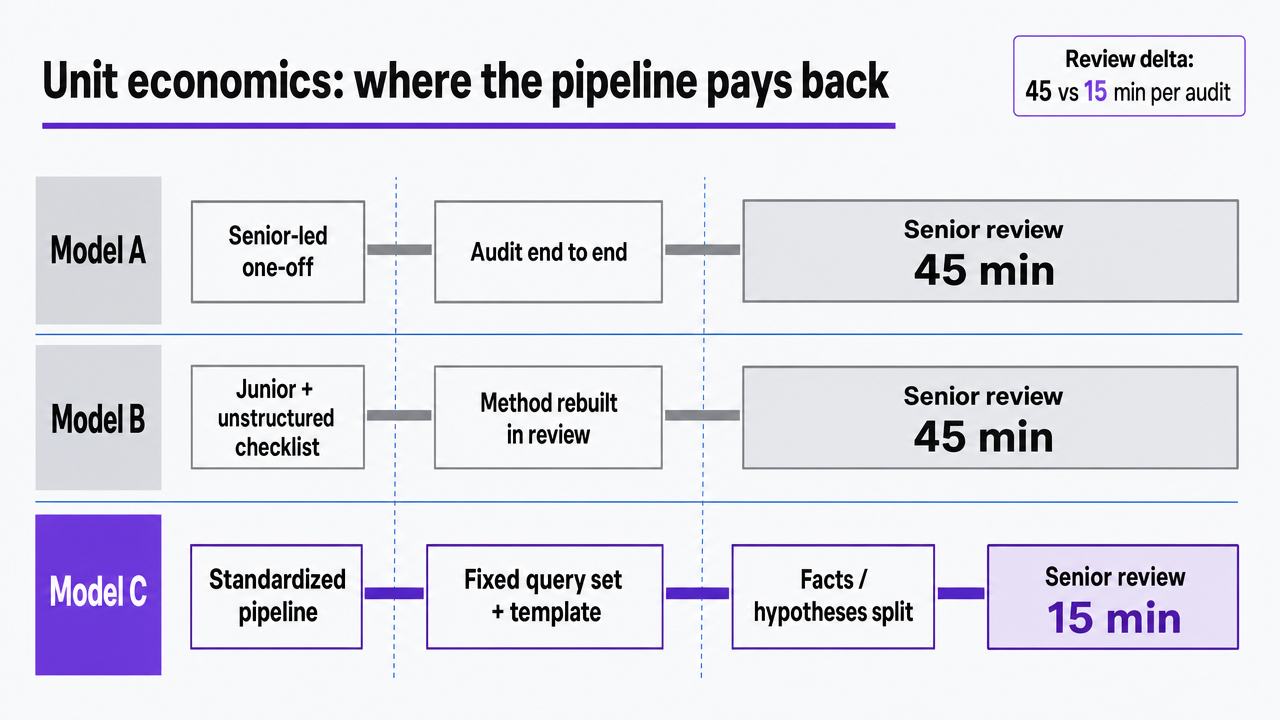
- Model A is the senior-strategist-led one-off. A senior runs the audit end to end, at their loaded hourly rate, with minimal review overhead because the reviewer and the analyst are the same person.
- Model B is a junior analyst working from an unstructured checklist. Cheaper per hour, but senior review time balloons because the reviewer has to reconstruct methodology on every deliverable.
- Model C is the standardized pipeline: junior analyst captures against a fixed query set and template, three-layer output separates facts from hypotheses, and the senior samples the fact layer and challenges the hypothesis layer.
The variables are the agency's own.
H_j and H_s : Loaded hourly rates for junior and senior.
T_a : Analyst hours per audit.
T_r : Senior review minutes per audit.
N : Audits per month.
Cost per client per audit is (T_a × H_j) + (T_r/60 × H_s). The pipeline model's payoff is not in T_a, which is broadly similar to Model B. It is in T_r, which drops because the reviewer audits by sampling, not reconstruction.
| Model | Analyst hours (T_a) | Senior review minutes (T_r) | Cost per audit |
|---|---|---|---|
| A: Senior-led one-off | 0 | T_a × 60 at H_s | T_a × H_s |
| B: Junior + unstructured checklist | T_a | ~45 per audit | (T_a × H_j) + (0.75 × H_s) |
| C: Standardized pipeline | T_a | ~15 per audit | (T_a × H_j) + (0.25 × H_s) |
The review-time deltas come from what the layer split makes possible: sampling the fact layer, confirming versioned metric logic once, and reserving judgment for the hypothesis layer. Between roughly 10 and 50 client accounts, Model C's per-audit cost stays flat while Model B's rises with senior bottleneck, and Model A stops being feasible entirely. The head of SEO who plugs in the agency's actual H_j, H_s, T_a, and N will find the crossover where the pipeline pays back its build cost, typically within the first quarter of running it across the book.
 Reinforce the comparison table already in the section by visualizing the senior review minutes delta across the three delivery models, which the article cites directly (45 vs 15 minutes per audit)
If the agency manages portfolio or multi-location clients
The scope shifts here. A dental group with 40 locations, a behavioral health network across three states, or a home services franchise with 120 territories is not one client. It is a portfolio of local markets that share a brand and diverge on almost everything else.
The pipeline holds, but the query set multiplies. Each location gets its own fixed query set, its own capture location, and its own scored competitive set, because a competitor in Cleveland is not a competitor in Cincinnati. The head of SEO signs off on a query-set template at the brand level and delegates location-level instantiation to analysts, who log deviations rather than reinvent structure.
Reporting rolls up differently than it does for a single account. Precision at the top of the query set, coverage, and rank-weighted score are calculated per location and aggregated to the brand, with variance flagged rather than averaged away 11. A location running two standard deviations below the network mean is the finding, not the average. That is how a portfolio audit produces operator-ready priorities instead of a hundred-page appendix.
Frequently Asked Questions
References
- 1.Information Retrieval: How NIST Helps You Find That ....
- 2.On Evaluating Web Search With Very Few Relevant.
- 3.Endorsements, Influencers, and Reviews - Federal Trade Commission.
- 4.Guides Concerning the Use of Endorsements and Testimonials in Advertising.
- 5.Guides Concerning the Use of Endorsements and Testimonials in Advertising.
- 6.Federal Trade Commission Announces Final Rule Banning Fake Reviews and Testimonials.
- 7.Artificial Intelligence Risk Management Framework: Generative Artificial Intelligence Profile.
- 8.AI Risk Management Framework.
- 9.Federal Trade Commission Announces Updated Advertising Guides to Combat Deceptive Reviews and Endorsements.
- 10.Dynamic Test Collections: Measuring Search Effectiveness on the Live Web.
- 11.Results and Challenges in Web Search Evaluation.