
Key Takeaways
- Scoring pages substitutes symptoms for diagnosis; tie every finding to a named metric and evidence source, then re-check performance within thirty days.
- Skipping Search Console evidence produces on-page fixes for URLs Google never indexed; verify index status, canonical selection, and query impressions before recommending changes.
- Rewarding keyword-heavy YMYL content without SME sign-off puts unreviewed claims under an expert byline; require a documented subject-matter review before publication 8, 9.
- Treating UX and accessibility as separate reports misses shared failures; evaluate the primary conversion path for discovery, WCAG conformance, and representative-user completion together 1, 6.
- Templated review and testimonial tactics can breach the FTC Consumer Reviews and Testimonials Rule; check acquisition, substantiation, and disclosure before any reputation recommendation ships 7, 11.
- Healthcare and behavioral-health accounts need HIPAA gates; route patient-identifying content to privacy contacts and hold tracking pixels on authenticated pages for compliance review 4, 10.
- Referring-domain counts are not a link strategy; document how each link will be acquired, what claim it makes, and whether the placement is defensible 2.
- Recommendations shipped without a documented approval gate leave no audit trail when rankings drop; record reviewer sign-off, expected metric, and rollback owner before implementation.
Why templated audits fail the accounts that matter most
Free SEO reviews are often the entry point for agency sales, but their inherent limitations pose significant risks. A tool designed for quick verdicts cannot differentiate between a critical redirect chain impacting rankings and a testimonial page that could lead to regulatory issues. Both are flagged similarly, without deeper context.
For an agency Head of SEO managing multiple accounts, this lack of depth can lead to client damage. Templated audits typically focus on easily automated checks like title tags, header hierarchy, page speed, and a crawl of the top hundred URLs. They often miss crucial checks that determine the true impact of recommendations, such as whether Search Console confirms pages are indexed as expected, if scaled content on a healthcare site meets quality standards 9, if a recommended review widget complies with the FTC Consumer Reviews and Testimonials Rule 7, or if client forms function for representative users 6.
The following seven failures are not tool errors but rather process shortcomings when free reviews are treated as lead magnets instead of diagnostic steps. Each has specific client consequences—lost rankings, revenue, or regulatory exposure—and each can be addressed with corrective checks in the delivery workflow.
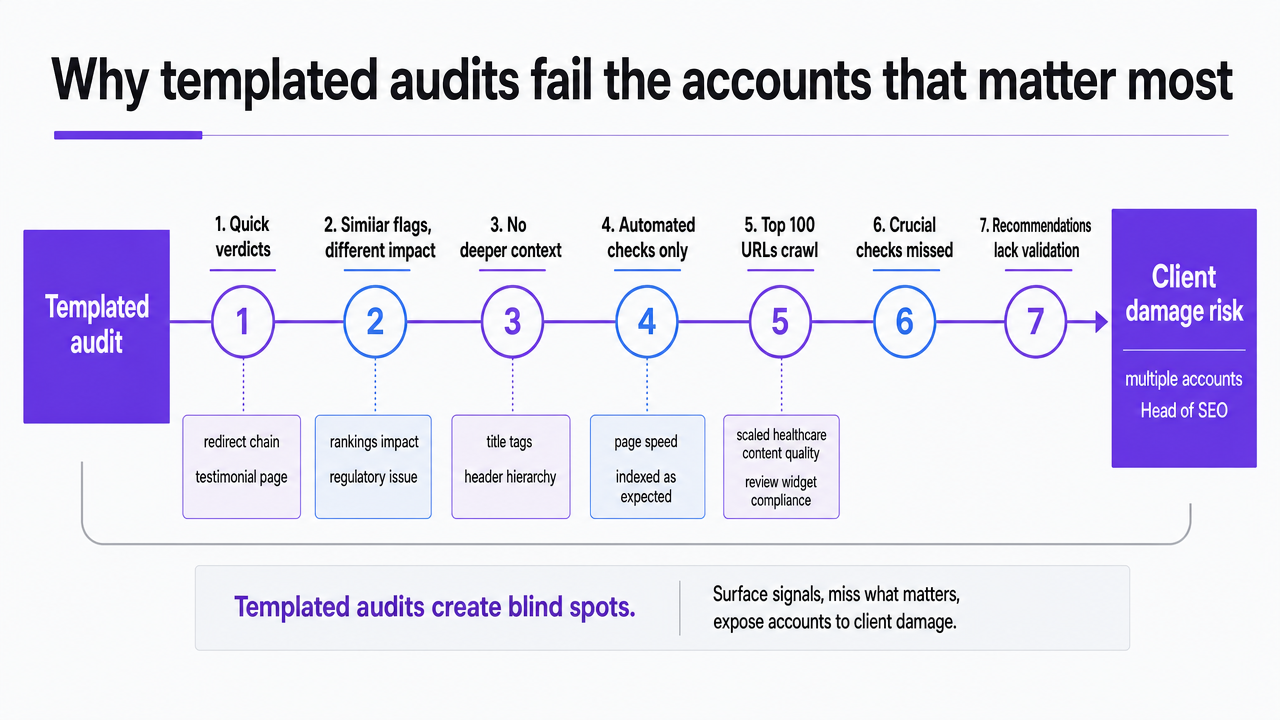 Visualize the seven mistakes as a scannable framework that mirrors the article's structure, giving readers an at-a-glance map of the operating failures discussed in each section
Scoring pages instead of diagnosing them
A score indicates a symptom, not a diagnosis. Most free SEO tools provide a numerical score and a checklist of issues. While these lists might accurately identify surface-level problems like a missing H1 or an oversized image, they fail to explain why a page underperforms or if a fix will achieve the client's actual goals.
An agency SEO lead reviewing such output risks conflating checklist compliance with actual page health. A technically perfect location page might still lose in local search results if its phone number doesn't match its Google Business Profile. A service page with a high score could cannibalize a more valuable URL. A blog post with a good readability grade might still fail a user trying to book an appointment because scoring engines evaluate attributes, not user tasks. NIST defines usability evidence by time on task, error rates, and successful completion by representative users 6, none of which are captured by a templated score.
Effective diagnosis involves linking each flagged item to a hypothesis about changes in traffic, rankings, or conversions, then testing this hypothesis against Search Console data, click data, and client records. A reviewer unable to articulate what changed, when, and which query cluster was affected is merely grading pages, not diagnosing them. The corrective standard is clear: no recommendation should be implemented without a named metric it aims to improve and an evidence source for re-checking in thirty days.
Ignoring crawl and indexing evidence in Search Console
Templated audits crawl a site based on the tool's preferences, not how Googlebot actually perceives it. This discrepancy often leads to recommendations that negatively impact performance.
A free scanner might report a page as returning a 200 status, having a canonical tag, and an indexable directive. However, it won't reveal if the URL is marked "Crawled — currently not indexed" in the Coverage report, if a duplicate cluster has consolidated signals onto an unintended canonical, or if a template change pushed thousands of thin archive URLs into the "discovered-not-crawled" category. Search Console provides this critical evidence, which audit tools typically miss.
The operational consequence is predictable: reviewers recommend internal links for pages Google has already chosen not to index, suggest rewrites for URLs never rendered, or flag "missing" sitemap entries for URLs Google intentionally excludes. Each such recommendation wastes client resources and yields no ranking improvements, as the root cause lies in crawl selection or index consolidation, not on-page factors.
The corrective check is precise and repeatable. Before any on-page recommendation, the reviewer must verify the URL's status using the URL Inspection API, the Page indexing report, and query-level performance data for the affected cluster. Three questions must be answered:
- Is the page indexed?
- Is it the canonical Google selected?
- Is it receiving impressions for the assumed queries?
Any finding that cannot answer these questions should not be sent to the client.
Rewarding scaled or keyword-heavy content without SME review
Templated audits often favor content that appears optimized: high word counts, appropriate keyword density, header-matching target phrases, and internal links to "money pages." The tool sees a green light, and the reviewer moves on. What it cannot assess is the content's accuracy, its alignment with clinical or legal realities, or whether a subject-matter expert would endorse it.
This oversight becomes particularly costly in YMYL (Your Money or Your Life) verticals. A 2025 study on rosacea-related queries found that even Google, which ranked highest among search engines and AI models for health information quality, produced content that a clinical reviewer would consider mediocre. The study used DISCERN and JAMA criteria, with Google achieving mean scores of 3.33 ± 0.53 (DISCERN) and 3.70 ± 0.44 (JAMA), and all content exceeding recommended public-health reading levels 8. This indicates that ranking prioritizes relevance and authority signals over accuracy or readability. Earlier research on patient information similarly concluded that Google rank does not consistently predict higher-quality health information, making search position a strong proxy for reach but a poor one for quality 9.
The operational failure in free SEO reviews is treating on-page optimization scores as sufficient evidence for content publication. Recommending more of the same—expanding articles, adding FAQ blocks, targeting related keywords, and publishing under a practitioner's byline—increases exposure without ensuring proper review. For clients like law firms, behavioral-health groups, or medical practices, this practice places unreviewed claims under an expert's name and behind schema markup that instructs search engines to trust it.
The corrective check distinguishes two aspects that templated audits conflate:
- First, does the page meet a defensible content-quality standard for its topic, including sourced claims, current guidance, accurate statistics, and appropriate reading level?
- Second, has a qualified subject-matter expert reviewed and approved the content before publication, with that review documented?
Neither check is unusual, yet both are absent from most free scanners. A reviewer who recommends content expansion for a YMYL client without identifying the SME who will approve the draft shifts risk from the tool to the client's reputation.
Test Real-Time SEO Content Production at Scale
Experience hands-on, full-volume SEO execution and publish live content during your seven-day trial—no delays or simulators.
Treating UX and accessibility as separate boxes from SEO
Free SEO tools and accessibility scanners operate in parallel, rarely converging. SEO scanners report on Core Web Vitals, mobile viewport settings, and tap-target sizes. Separate accessibility tools flag contrast ratios, missing alt text, and unlabeled form fields. Delivery teams often categorize these outputs under different disciplines, presenting clients with two disconnected reports.
The pages Google ranks are the same ones a screen reader must parse and a keyboard user must navigate to complete a form. The DOJ's web accessibility guidance for public-facing businesses highlights elements already familiar to SEO reviewers: sufficient color contrast, text alternatives for images, synchronized video captions, and accessible form labels and keyboard navigation 1. An image lacking alt text is both a discoverability and an accessibility failure. A low-contrast CTA button is a conversion problem, a WCAG issue, and an SEO problem if it fails to convey its purpose to assistive technology or rendering engines.
The operational flaw in most free reviews is scoring pages based on attributes rather than user tasks. A form can pass all SEO checks—indexed, mobile-friendly, fast—yet fail a user attempting to book an appointment if error states are only indicated by color, required fields aren't programmatically associated with inputs, or the confirmation screen loads without focus management. NIST defines usability evidence by time on task, error rates, and successful completion by representative users 6. A templated audit reports page content, not user accomplishment.
The corrective check integrates these two lanes into a single evaluation. Reviewers assess the primary conversion path—service inquiry, appointment request, quote form, click-to-call—against three criteria simultaneously:
- Does the page and its structured data support search discovery?
- Does the flow meet accessibility conformance for keyboard and screen-reader users?
- Can a representative user complete the task without errors verifiable by client analytics?
A finding that satisfies only one criterion is incomplete and not ready for implementation. Traffic directed to a page that a subset of users cannot complete represents wasted client investment.
Recommending review, testimonial, and reputation tactics that trigger FTC exposure
Reputation management, when handled by free SEO reviews, often transitions from an SEO exercise to one that creates unforeseen legal exposure for the client. Templated audits typically identify low review counts on Google Business Profiles, short testimonial pages, and competitors with high ratings. Recommendations often follow a predictable script: launch review campaigns, add testimonial widgets, embed third-party ratings in schema, incentivize feedback, or ghostwrite case studies. While these appear to be local SEO tactics, several now fall under direct FTC regulation.
Reviewers must be aware of recent enforcement timelines:
- In November 2022, HHS issued guidance on online tracking technologies for HIPAA-covered entities, impacting review widgets and third-party embeds that transmit identifiers from authenticated healthcare pages 10.
- In June 2023, the FTC updated its Endorsement Guides, emphasizing truthful reviews and disclosure of material connections 3.
- On August 14, 2024, the FTC finalized a rule prohibiting fake or false reviews, buying/selling reviews, undisclosed insider reviews, AI-generated fake reviews, and review suppression 11.
- The FTC's Consumer Reviews and Testimonials Rule became effective October 21, 2024, with knowing violations potentially leading to civil penalties 7.
Given this timeline, several common audit recommendations become problematic. Incentivizing reviews without disclosure, filtering negative feedback, publishing testimonials from employees without disclosure, using unsubstantiated outcome claims in case studies, and embedding AI-generated quotes as customer voices all fall under the 2024 rule 11. Testimonials describing atypical results without adequate substantiation, or relying solely on "results may vary" disclaimers, violate long-standing FTC advertising principles 5.
The corrective check reframes the reputation section around three questions for the delivery team before any recommendation ships:
- Is the acquisition method (request cadence, incentive, platform, moderation) consistent with FTC endorsement guidance and the Consumer Reviews and Testimonials Rule 5, 7?
- Are specific claims in testimonials and case studies substantiated by client records the agency has reviewed?
- Is the material connection between the reviewer and business clearly and conspicuously disclosed where the endorsement appears?
A reputation recommendation failing these checks is a compliance issue, not a local SEO tactic, and requires client counsel review before publication.
Skipping vertical-specific compliance in healthcare and behavioral health
While the previous section covered general compliance, healthcare and behavioral-health accounts have an additional layer of regulation that general SEO reviews often miss, with operational consequences falling on the client.
Two recommendation categories require specific attention in these verticals. First, any content drawing on patient experience. HHS defines marketing under HIPAA as communications encouraging product or service use, generally requiring written authorization if protected health information is used, unless an exception applies 4. A reviewer recommending patient stories, before-and-after galleries, case studies from intake conversations, or location pages with named patient quotes is suggesting content that a covered entity cannot legally publish without documented authorization the agency has not seen. The recommendation is problematic not because it fails to rank, but because it's legally unpublishable under the audit's assumptions.
Second, measurement and tracking infrastructure. HHS guidance states that regulated entities must configure tracking on authenticated webpages to comply with the HIPAA Privacy Rule regarding ePHI use/disclosure and the Security Rule for ePHI protection 10. Free SEO reviews frequently recommend conversion pixels on appointment-confirmation pages, call tracking with dynamic number insertion on service pages leading to patient portals, session recording on symptom-checker flows, and remarketing tags on condition-specific landing pages. Each recommendation can raise privacy concerns that the delivery team cannot address without involving the client's compliance function and vendor business-associate agreements.
The corrective check adds two gates before any deliverable reaches the client. Content recommendations referencing patient identity, condition, treatment, or outcome are routed to the client's privacy or compliance contact for a marketing-authorization determination before drafting 4. Tracking and measurement recommendations on authenticated or condition-specific pages are held for a tracking-technology review covering the vendor, data elements transmitted, page context, and BAA posture 10. A reviewer unable to name the compliance contact for a healthcare or behavioral-health account cannot responsibly implement these recommendations, and the audit should explicitly state this rather than transfer the risk to the client.
Get an Evidence-Based Audit of Your SEO Review Process
Request a tailored assessment highlighting the seven most common free SEO review pitfalls impacting client rankings, with actionable data-backed recommendations for agency teams managing multi-account SEO delivery.
Suggesting link tactics without a risk read
Link recommendations in free SEO reviews often exceed the reviewer's evidence. The tool might report a competitor's higher number of referring domains, identify anchor text distribution gaps, and generate a target list from third-party indexes. However, it cannot determine which of these links Google actually values, which belong to unvetted networks, or which the client's counsel would reject if the acquisition method were disclosed.
The operational failure is treating referring domain counts as a strategy. Recommending guest-post campaigns on sites that sell placements, digital-PR pitches based on unsubstantiated client claims, or reciprocal arrangements with portfolio neighbors boosts a metric the audit measures but creates unassessed exposure. For law firms and healthcare accounts, this exposure is compounded: a link acquired through an unsubstantiated testimonial or outcome claim is both a spam policy risk and an advertising substantiation problem, which the FTC considers the client's responsibility, not the agency's 2.
The corrective check answers three questions per target before outreach:
- How the link will be acquired.
- What claim the linking content will make about the client.
- Whether the source's audience and editorial stance make the placement defensible.
A target list lacking these answers is merely a volume plan, not a risk-assessed recommendation.
Shipping recommendations without a documented approval gate
The preceding six failures are amplified by recommendations reaching the client's CMS without a named person's sign-off. A reviewer flags a canonical change, a copywriter implements it, a developer pushes it, and no one on the delivery team can explain who approved the trade-off between consolidating a duplicate cluster and losing long-tail impressions from the secondary URL. When rankings drop, the audit trail ends at the ticket.
An approval gate is not just a status meeting; it's a documented step where the recommendation, its supporting evidence, the expected metric impact, and the reviewer's sign-off are recorded before implementation. For YMYL accounts, this gate expands: a subject-matter expert signs off on content, a privacy contact clears recommendations involving patient identity or authenticated pages 4, 10, and a compliance reviewer confirms testimonial and review changes against FTC guidance 7. For link, redirect, and canonical work, the gate identifies who owns rollback if the change underperforms.
An agency unable to produce this record for a given recommendation lacks a defense when a client questions an outcome. This gate is the artifact that distinguishes a thorough review from a mere lead magnet.
If you run reviews across a portfolio: a governed workflow instead of a templated audit
While the seven mistakes above apply to any delivery team, the economics shift when a Head of SEO manages reviews across a large portfolio—e.g., twenty law firm sites, forty dental locations, or a behavioral-health group with a franchise footprint—each with unique compliance requirements. A templated audit scales linearly with headcount, whereas a governed review scales through process optimization.
The operational difference isn't the checklist; both approaches inspect titles, canonicals, Core Web Vitals, and internal linking. The key distinction lies in what happens between identifying a finding and implementing it on the client's CMS. A governed workflow assigns a named reviewer per site, incorporates compliance checkpoints that route to the appropriate function before drafting, requires representative-task usability evidence for the primary conversion path instead of just attribute scores 6, and mandates a documented approval gate for every recommendation before implementation.
The table below contrasts these two approaches across dimensions controllable by a portfolio operator, focusing on reviewer allocation, senior time investment, compliance function involvement, and re-audit cadence, rather than dollar figures.
| Dimension | Templated free-tool audit | Governed review workflow |
|---|---|---|
| Reviewer time per site | Automated scan plus junior write-up | Named reviewer per site, senior sign-off on findings |
| Senior-strategist touchpoints | Escalation only when a client complains | Scoped review of indexing evidence, YMYL content, and link risk on every pass |
| Accessibility check | Separate scanner report filed alongside SEO | Merged into conversion-path review against DOJ web guidance elements 1 |
| Usability evidence | Attribute scores only | Representative users completing representative tasks on the primary flow 6 |
| Review and testimonial compliance | Not addressed | Acquisition, display, and disclosure checked against the FTC Consumer Reviews and Testimonials Rule effective October 21, 2024 7 |
| HIPAA tracking review | Not addressed | Analytics, pixels, call tracking, and session recording on authenticated or condition-specific pages held for privacy review per HHS 2022 guidance 10 |
| Approval gate before publish | Ticket handoff to implementer | Named sign-off with recommendation, evidence, target metric, and rollback owner recorded |
| Re-audit cadence | Ad hoc, usually on client request | Fixed interval per account tier with a delta report against the prior gate |
The critical question for a portfolio is not whether a governed workflow costs more per site, but whether the delivery team can defend every recommendation when a ranking drops, a testimonial draws a complaint, or a pixel appears where it shouldn't. Platforms that route specialist recommendations through a unified approval workflow—like Vectoron—are built precisely because such a record differentiates a robust review from a mere lead magnet at scale.
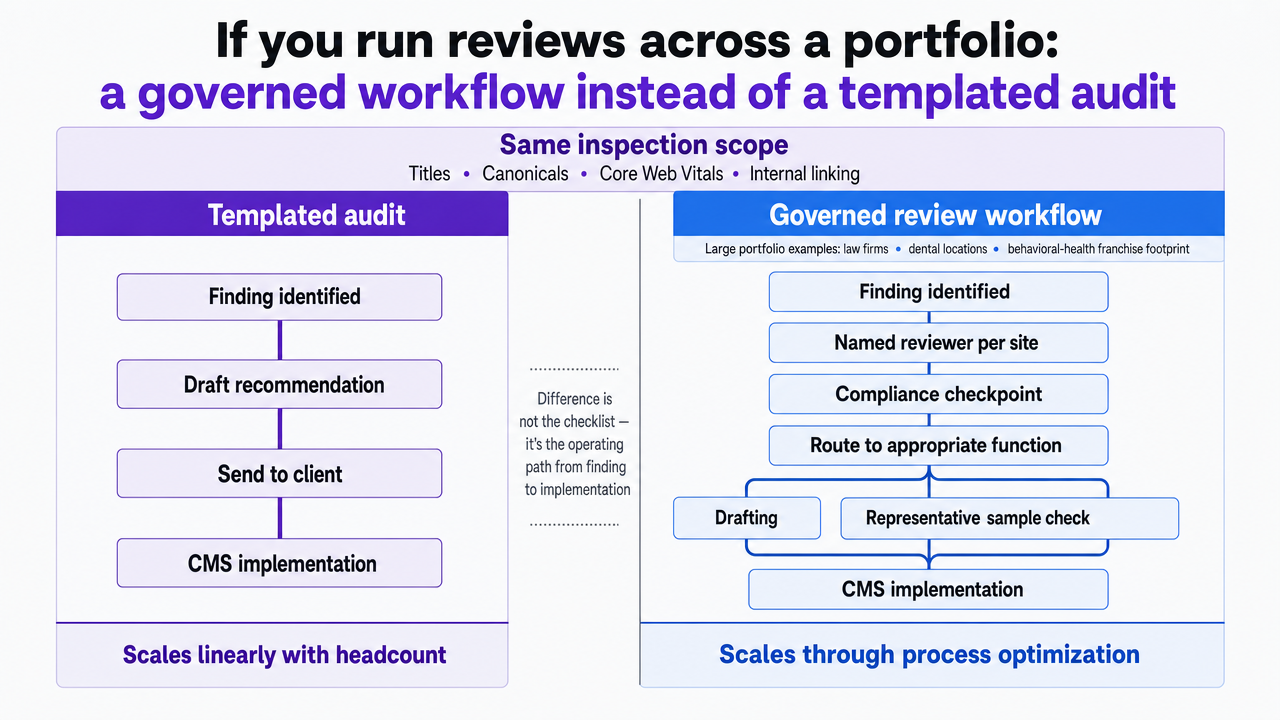 Translate the section's comparison table into a side-by-side visual contrasting templated audits with a governed review workflow across the same operational dimensions cited in the prose
Frequently Asked Questions
References
- 1.Guidance on Web Accessibility and the ADA.
- 2.Advertising FAQ's: A Guide for Small Business.
- 3.Federal Trade Commission Announces Updated Advertising Guides to Combat Deceptive Reviews and Endorsements.
- 4.Marketing.
- 5.Endorsements, Influencers, and Reviews.
- 6.Usability Testing.
- 7.The Consumer Reviews and Testimonials Rule: Questions and Answers.
- 8.The Reliability Gap: How Traditional Search Engines and Large Language Models Compare in Health Information Quality.
- 9.Quality of patient health information on the Internet: reviewing a ....
- 10.Use of Online Tracking Technologies by HIPAA Covered Entities and Business Associates.
- 11.Federal Trade Commission Announces Final Rule Banning Fake Reviews and Testimonials.