
Key Takeaways
- Crawl and index failures like robots.txt asset blocks, stray noindex tags, orphan URLs, and soft 404s strip pages from the index; junior analysts fix template defects while suspected compromise escalates same-day 7.
- Canonicalization defects and redirect chains split ranking signals across duplicate URLs; collapse chains to single 301 hops and let a specialist decide which URL keeps equity when both hold backlinks.
- Desktop-only scans miss mobile-rendered DOM gaps where lazy-loaded content, JS-injected canonicals, and consent overlays break parity; require mobile-rendered scans and route parity gaps to front-end owners with reproduction paths.
- Structured data errors quietly disqualify pages from rich results without changing rank; fix syntax at the template level, route semantic conflicts to a specialist, and validate after every deploy.
- Security flags such as expired certificates, mixed content, and deprecated TLS suppress click-through and expose connections; translate findings into infrastructure tickets targeting TLS 1.3 and strong cipher suites 8.
- A green accessibility score is false confidence because automated tools cover only 30-35% of Section 508 requirements 1; pair scans with keyboard and screen-reader validation and drop the phrase "accessibility compliant" from deliverables.
- Scans miss authenticated content, intent mismatch, link topology, content quality, log-file behavior, and business-context defects; name these blind spots in every deliverable so silence is not read as a passing grade.
- Portfolio triage means mapping each finding category to automation, specialist validation, or client escalation, keeping specialist hours off rule-based fixes and automation away from judgment calls 3.
- Embed scans as recurring sensors on a fixed cadence with rescans triggered by CMS or plugin changes, combining automated and manual testing across the lifecycle rather than staging pre-launch checks 5.
- Convert defect lists into queues ranked by client revenue exposure, attach a disposition and owner to every category, and include a scope sentence naming what the scan did and did not inspect 1.
What a Triage Instrument Actually Sees
A free SEO scan is a diagnostic layer, not an audit. It parses HTML, follows links, checks response codes, evaluates on-page signals, and produces a ranked list of defects. What it does not do is decide which of those defects will cost a client revenue this quarter, which are cosmetic, and which sit inside a category the tool cannot inspect at all.
For an agency lead running scans across a portfolio, the useful mental model is triage. The scan sorts findings into buckets an analyst can act on quickly: broken canonicals, missing titles, orphan URLs, redirect chains, structured data errors, mixed-content warnings, and expired certificates. Federal accessibility guidance formalizes this pattern by describing automated tools as instruments that cover only a portion of the requirement surface and must be paired with hands-on validation for anything that requires human judgment 3.
That framing matters because scans reliably surface four things and reliably obscure a fifth. They surface machine-readable defects, configuration drift, deprecated protocols, and template-level regressions. They obscure business impact. A single broken canonical on a top revenue page outranks two hundred missing meta descriptions on tag archives, but the scan report will not say so.
The rest of this article treats each recurring finding category as a triage decision: what the scan sees, what mechanism produces the defect, what the downstream consequence is, and whether the fix belongs to automation, a specialist, or a client-side escalation.
Crawl and Index Failures That Scans Catch First
Crawl and index defects are where free scans earn their keep. The parser hits a URL, reads the response headers, evaluates robots directives, and either follows the links or logs why it stopped. That mechanical work catches four failure modes that recur across nearly every client portfolio:
- robots.txt disallowing critical assets
- noindex directives left on canonical pages after a staging push
- orphan URLs with no internal links pointing at them
- soft 404s where a page returns 200 OK but serves an empty or error-state template
Each has a specific mechanism. A robots.txt disallow on CSS or JS directories prevents rendering-dependent crawlers from reconstructing the page, which downgrades how the content is interpreted. A stray noindex meta tag on a category or service page removes it from the index within a crawl cycle, taking its rankings with it. Orphan URLs get discovered through sitemaps or external links but accumulate no internal signal, so they drift down the priority queue. Soft 404s waste crawl budget and dilute topical relevance because the engine treats them as thin content rather than errors.
The less obvious variant scans surface is the compromised site. Injected redirects, spam pages generated inside a hacked CMS, and unauthorized template modifications appear in crawl reports as unexpected new URLs, foreign-language content, or 302 chains routing to third-party domains. CISA's website-security guidance emphasizes that keeping site software current, monitoring for compromise, and applying secure configuration are baseline controls precisely because these intrusions damage both user trust and search visibility 7.
For an agency lead, the operator move is standardization. A junior analyst should resolve robots.txt asset blocks and stray noindex tags in place using a documented change ticket. Orphan URLs and soft 404s route to a specialist for content or architecture decisions. Any pattern suggesting compromise—unexplained new URLs, redirect chains to unknown domains, template drift—escalates to the client's security contact the same day, not the next reporting cycle.
Canonicalization, Redirect Chains, and Duplicate Signal Leakage
Canonicalization defects are the category where a clean-looking scan report often hides the most revenue exposure. The tool flags them as low-severity warnings because the pages still return 200 OK and still render. What the warning does not say is that ranking signals are being split, consolidated on the wrong URL, or bled off to a redirect target the client never intended to promote.
Four patterns recur across portfolios:
- Self-referencing canonicals missing on paginated or filtered URLs let parameter variants compete with the primary page.
- Cross-domain canonicals point from a client site to a syndication partner, quietly handing over authority.
- Canonical tags conflict with hreflang, sitemap entries, or internal linking, so the engine picks its own preferred URL and ignores the declaration.
- Redirect chains—three, four, or five hops from an old campaign URL to a current product page—dilute link equity and inflate crawl cost on templates that were never meant to be permanent.
The mechanism behind duplicate signal leakage is straightforward. When two or more URLs serve substantially the same content without a clear canonical instruction, the engine consolidates signals against one representative URL of its choosing. That choice rarely aligns with the client's revenue priority. A product page and its print variant, an HTTPS and HTTP pair left over from migration, or a trailing-slash and non-trailing-slash version each split internal PageRank and external backlinks across duplicates.
For an agency lead, the operator move is to treat canonicalization findings as a two-tier queue. Tier one is template-level: a junior analyst corrects missing self-referencing tags, collapses redirect chains to single 301 hops, and reconciles sitemap-canonical mismatches using documented rules. Tier two is judgment work for a specialist: deciding which of two competing URLs should win canonical status when both have earned backlinks, and when a cross-domain canonical reflects an intentional syndication contract rather than a configuration error. Scans surface the pattern; specialists decide which URL keeps the equity.
Mobile and JavaScript Rendering Gaps a Desktop Crawl Misses
A default free scan pulls the desktop HTML response and evaluates what it finds there. That is the wrong surface for most modern client sites. Search engines index the mobile-rendered DOM after JavaScript executes, and the gap between what a desktop crawler reads and what a mobile renderer produces is where a significant class of ranking defects lives untouched.
Three patterns recur:
- Content parity breaks: the mobile template hides or lazy-loads sections that carry the primary keyword targeting, so the indexed version of the page has less relevant content than the desktop version the client reviews.
- Client-side rendering swallows critical elements: canonical tags, hreflang declarations, structured data, and internal links injected by JavaScript may not appear in the initial HTML, and if the rendering pipeline fails or times out, those signals never reach the index.
- Interstitials, cookie banners, and consent overlays covering the primary content on mobile viewports degrade both usability signals and how the rendered page is interpreted.
The mechanism is straightforward. A scan that only reads the initial HTML response cannot see what the rendered DOM contains, and a scan that renders but ignores viewport differences reports a page as healthy while the mobile version is missing half its links. Tap-target spacing, font-size defaults, and viewport meta configuration compound the issue because they degrade usability metrics even when the content is technically present.
For an agency lead, the operator move is to require mobile-rendered scans on any account where the CMS or theme depends on JavaScript for navigation, product listings, or content injection. A junior analyst compares the desktop-source HTML against the mobile-rendered DOM for a sample of revenue pages and flags any element present in one and missing in the other. Parity gaps route to a specialist. Interstitial and viewport defects go straight to the front-end owner with a documented reproduction path, not a screenshot in a status meeting.
Run a Live SEO Audit and Fix Issues Instantly
Identify and resolve critical SEO errors on real client sites within your first week, no delays.
Structured Data Errors That Silently Suppress Rich Results
Structured data defects rarely trigger loud warnings. A scan flags them as informational, the page still renders, and the client sees no traffic drop on the dashboard. What disappears is the eligibility layer: review stars, FAQ accordions, product pricing, event details, breadcrumb paths, and local business panels that would otherwise occupy space above the ten blue links.
Four patterns account for most of the damage across a client portfolio:
- Required properties are missing from an otherwise valid schema block, so the markup parses but fails eligibility.
- Optional-but-recommended properties are omitted, which drops the listing out of enhanced treatments even when the page technically qualifies.
- Multiple schema types on the same page conflict—an Article marked as a Product, a LocalBusiness with a Service parent—and the engine either picks the wrong interpretation or ignores the block entirely.
- Markup contradicts visible content: prices in JSON-LD that no longer match the page, review counts pulled from a stale plugin, or FAQ answers that were rewritten in the CMS but not in the schema.
The mechanism is a quiet one. Structured data does not rank a page; it qualifies a page for a display treatment. When the qualification fails, the traffic loss is invisible in rank-tracking reports because the URL still ranks in position four. The lost inventory sits in the SERP feature the client never earned.
For an agency lead, the operator move is to separate schema findings into two queues. Syntax and required-property errors resolve at the template level through a junior analyst working from a validator. Semantic conflicts—which schema type a page should carry, which entity a LocalBusiness should reference, how a FAQ block should map to a support article—route to a specialist who can decide before markup is deployed. Every schema deploy gets a post-change validation pass, because a scan that ran yesterday will not catch the plugin update that broke every product page overnight.
The Security Findings SEO Scans Surface But Rarely Explain
Security-adjacent findings are where a free scan produces the most technically accurate flags and the least useful client-facing language. The report lists an expired certificate, a mixed-content warning, a deprecated TLS version, or a weak cipher suite as a red row in the security column. The client sees a score drop and asks what it means. The junior analyst repeats the flag name back. Nothing gets fixed because nothing got translated.
Four scan-detectable defects recur across client portfolios and map cleanly to federal hardening guidance:
- Expired or soon-to-expire certificates trigger browser warnings that suppress organic click-through and interrupt conversion flows.
- Mixed content—HTTPS pages loading HTTP assets—breaks the padlock indicator and blocks certain resources in modern browsers.
- Deprecated protocol versions such as TLS 1.0 and TLS 1.1 fail modern compatibility checks and expose the connection to downgrade attacks.
- Weak cipher suites and inconsistent HTTPS deployment across subdomains leave gaps that authenticated crawlers and security scanners both catch.
CISA's hardening guidance is direct about the target state: TLS 1.3 on TLS-capable protocols, strong cryptographic cipher suites, public-key-infrastructure certificates, and processes to renew certificates before they expire 8. That framing gives an agency lead defensible remediation categories to hand a client instead of a color-coded score. "Renew before expiration" is a workflow. "Retire TLS 1.0 endpoints" is a ticket. "Score improved from 72 to 84" is not.
The scan does not, and cannot, establish that a site is secure. CISA's website-security fundamentals cover software updates, authentication, backups, monitoring, and incident response—none of which surface in a crawl of the public HTML 7. The operator move is to separate the two conversations. Certificate and protocol findings go into the standard remediation queue with a documented owner on the client side. Anything suggesting compromise or authentication exposure routes to the client's security contact with a note that a public scan is not a substitute for authenticated testing.
Why a Green Accessibility Score Is the Most Dangerous Finding
A passing accessibility score in a free scan is the finding most likely to end up in a client deck and least likely to survive scrutiny. The tool ran, the badge is green, the report exports cleanly. What the report does not say is how much of the accessibility surface the tool was capable of inspecting in the first place.
Section508.gov states that automated scanning tools cover only 30-35% of accessibility requirements at best, and that finding refers specifically to the Section 508 requirement set that federal agencies test against—not to SEO defects, page-speed metrics, or every possible barrier a user with a disability might encounter 1. Governmentwide assessment findings reinforce the same limit from a different angle: automation omits more than half of Section 508 requirements, and relying only on automated results creates a documented risk of inflated conformance scores 6. The scan is measuring a fraction and reporting on the whole.
That gap is what an agency lead should treat as false confidence debt. Keyboard traps, illogical focus order, missing programmatic labels on custom controls, video without captions, form errors that only appear visually, and reading-order defects in single-page applications sit outside what a parser can evaluate. So do context-dependent judgments about whether a link's purpose is clear from its text or whether an ARIA role has been used correctly. Federal testing guidance is explicit that these categories require hands-on validation using a repeatable, systematic methodology, not a rerun of the same automated pass 2.
The consequences differ by client vertical. For a private-sector site, the Department of Justice's ADA web guidance treats inaccessible content as a barrier to goods, services, and information regardless of what a scan tool reports 9. For a state or local government client, the 2024 DOJ rule establishes technical accessibility requirements for web content and mobile applications with phased compliance timelines, and a green automated badge does not satisfy that obligation 10. Legal exposure is a client-and-counsel conversation, but the operator move is upstream of it.
The operator move has three parts:
- Never export a raw accessibility score to a client without a scope sentence naming what the tool covered and what it did not.
- Route accessibility findings into two queues: template-level defects a junior analyst resolves against a validator, and judgment-dependent barriers a specialist confirms through keyboard and screen-reader passes.
- Retire the phrase "accessibility compliant" from every scan-derived deliverable. The scan produces risk indicators. Compliance is a separate assertion the client's counsel decides whether to make.
Pinpoint Costly SEO Gaps with a Data-Driven Site Audit
Request a tailored technical SEO scan revealing missed optimization, crawl errors, and ranking barriers—delivered with actionable, prioritized recommendations for large-scale sites and multi-client portfolios.
Findings Scans Systematically Miss
The categories a scan surfaces are only half the operator picture. The other half is what the parser cannot see at all, and mistaking silence for absence is where portfolio-level risk accumulates.
Six blind spots recur:
- Content behind authentication—member portals, patient logins, gated resource libraries—sits outside a public crawl entirely, and any SEO or accessibility defect inside those flows goes unreported until a specialist runs authenticated testing. NIST's digital identity guidance covers the proofing, authentication, and federation controls that govern those surfaces, and none of it shows up in a public HTML crawl 11.
- Search intent mismatch is invisible: a page can be technically clean and still target the wrong query class, which no scan will flag.
- Internal link equity distribution requires topology analysis the free tier rarely performs.
- Content quality, entity coverage, and E-E-A-T signals require judgment.
- Log-file evidence of how crawlers actually behave sits in server infrastructure the scan does not touch.
- Business-context defects—wrong service area on a local page, outdated pricing, discontinued products still indexed—look like healthy URLs to a parser.
The operator move is to name the blind spots in every scan-derived deliverable. A findings report that lists what was inspected and what was not prevents a client from reading silence as a passing grade, and it protects the specialist queue from being sized against an incomplete picture.
If You Manage Multiple Client Accounts: A Portfolio Triage Model
Mapping Scan Categories to Automation, Validation, and Escalation
The shift from one-client thinking to portfolio operations changes what a scan report is for. A single-site audit rewards depth. A book of twenty or eighty client accounts rewards a triage taxonomy that keeps specialist hours off findings a documented rule can resolve, and keeps automation away from findings that require judgment. Federal accessibility guidance frames the same principle: automated tools reduce identification effort but require manual validation for anything requiring human judgment 3.
The table below maps recurring scan categories to a three-tier disposition. Effort tiers and validation hours per 100 URLs are left as variables because they depend on the agency's own rates, tooling, and template complexity.
| Scan Finding Category | Automation Suitability | Specialist Validation Required | Client-Impact Tier ||---|---|---|---|| Crawl blockers (robots.txt asset disallow, stray noindex, soft 404s) | High — templated fix, rule-based | Low — spot-check on revenue URLs | High if on money pages, low on archives || Canonicalization and redirect chains | Medium — collapse chains automatically; canonical selection requires judgment | Medium — specialist decides which URL keeps equity when both have backlinks | High on commercial templates || Mobile and JS rendering parity | Low — comparison logic can be automated, remediation cannot | High — front-end owner and specialist reproduce and prioritize | High when JS controls navigation || Structured data syntax errors | High — validator-driven fix | Low — post-deploy validation pass | Medium — affects SERP feature eligibility, not rank || Structured data semantic conflicts | Low | High — schema type and entity decisions | Medium to high depending on vertical || Security flags (expired certs, mixed content, deprecated TLS) | Medium — ticketed to client infrastructure owner | Low — verify post-remediation | High on transactional and authenticated flows || Accessibility findings (automated flags) | Low — risk indicators only | High — keyboard, screen-reader, task validation | Escalate for regulated and public-sector clients 10|| Suspected compromise (injected redirects, foreign content, template drift) | None | Escalate to client security contact same day 7| Critical |
The taxonomy is what turns a commoditized tool into a repeatable production line. A junior analyst works the top rows against documented rules. A specialist owns the judgment rows. The escalation row bypasses the reporting cycle entirely.
Embedding Scans Into Recurring Delivery Instead of Pre-Launch Checks
A scan run once before launch measures a snapshot that stops being true the moment a plugin updates, a template ships, or a marketing team publishes a new landing page. Portfolio operations require the opposite pattern: scans embedded into the recurring delivery lifecycle so drift is caught within a cycle rather than a quarter.
Section 508 assessment guidance makes the same argument from the accessibility side, recommending that automated and manual testing be combined throughout the technology lifecycle rather than staged as a single pre-launch event 5. The same lifecycle logic applies to canonicalization, structured data, and security findings that regress silently between reporting periods.
Three cadence rules travel well across a client book:
- Run full scans on a fixed weekly or biweekly schedule per account, not on demand.
- Trigger targeted rescans automatically after any CMS update, template deploy, or plugin change flagged in the client's change log.
- Tie scan output to the specialist queue directly, so findings that clear the automation tier generate tickets without an analyst manually transcribing them.
The operator move is to treat the scan not as a deliverable but as a sensor feeding a governed workflow, with specialists reviewing what the automation tier surfaces before anything reaches the client.
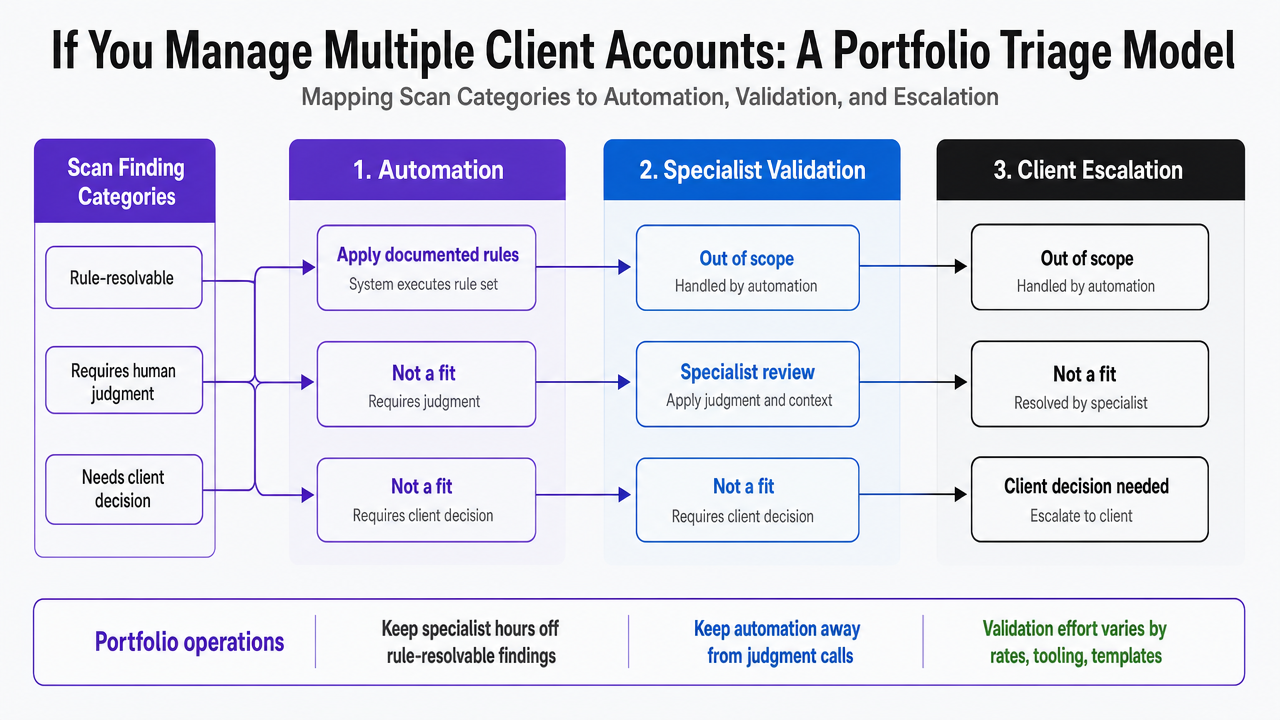 Visualize the section's triage taxonomy mapping scan finding categories to disposition tiers (automation, specialist validation, client escalation), directly supporting the table in the prose
From Scan Output to Prioritized Client Work
The final step is the one most scan-derived deliverables skip: converting a defect list into a ranked queue that specialists work in order of client revenue exposure, not issue count. A report that shows 1,847 findings sorted by severity color is a report the client will not read and the team will not finish.
Three operator rules make the conversion repeatable:
- Rank findings against the pages that drive commercial outcomes for that client, not against the site as a whole—a broken canonical on a top service page outranks four hundred missing alt attributes on blog archives.
- Attach a disposition to every category before the report leaves the analyst's desk: automation tier, specialist queue, or client escalation, with the owner named.
- Require a scope sentence on every deliverable that names what the scan inspected and what it did not, so silence is not misread as a passing grade 1.
That discipline is what turns a free tool into production infrastructure. Platforms like Vectoron exist to run this loop across a client book with specialists validating what automation surfaces before anything reaches approval.
Frequently Asked Questions
References
- 1.Track and Report Conformance.
- 2.Overview of Testing Methods for 508 Conformance.
- 3.Play 10: Conduct Information and Communication Technology Accessibility Testing.
- 4.Play 10: Conduct Section 508 Testing | Section508.gov.
- 5.Accessibility Conformance Testing and Technology Lifecycle.
- 6.Governmentwide Findings: Key Compliance Outcomes.
- 7.Website Security.
- 8.Enhanced Visibility and Hardening Guidance for Communications Infrastructure.
- 9.Guidance on Web Accessibility and the ADA.
- 10.Fact Sheet: New Rule on the Accessibility of Web Content and Mobile Apps Provided by State and Local Government Entities.
- 11.NIST Special Publication 800-63-4.