
Key Takeaways
- Screaming Frog anchors technical audits with a 500-URL crawl ceiling per session, enough for prospecting and section spot-checks but not full crawls on mid-size client sites 4.
- Google Search Console provides unlimited index diagnostics on verified properties, though its 16-month data window forces scheduled exports for year-over-year audit continuity 6.
- Bing Webmaster Tools covers the non-Google index feeding Copilot, ChatGPT search, Edge, and DuckDuckGo—critical for diagnosing AEO gaps agencies otherwise miss 2.
- Lighthouse and PageSpeed Insights run roughly 60 automated checks per page on Core Web Vitals and hygiene, but leave AEO and GEO signals uncovered 1, 7.
- Freemium SaaS site auditors cap near 100 pages per scan and typically ship no project saving on the free tier, limiting historical comparison across audit runs 3, 9.
- AI-orchestrated audit layers fill the sixth slot by consolidating outputs and covering the 260-plus check surface, including AEO and GEO dimensions the free stack misses 7, 9.
Why Only 14 of 54 SEO Platforms Actually Ship a Free Tier
The math is thinner than most tool roundups admit. Of 54 SEO software platforms tracked in a 2026 market comparison, only 14 offer any form of free plan. The other 40 are paid-only, with entry-level tiers starting between $49 and $139 per month 5. For an agency Head of SEO auditing a portfolio of client sites, that ratio matters more than the marketing copy on any single vendor's homepage. Roughly three-quarters of the category is gated.
The 14 that do ship free access rarely ship it evenly. Some grant a permanent free tier on verified properties, some cap crawls at a specific URL count, some offer one-shot diagnostic reports with no project saving 9, and some run a time-boxed trial dressed up as a free plan. The label "free" hides at least four different distribution models, and each one has a different failure point when a delivery team tries to run 20 client audits in parallel.
This piece aims to identify which combinations of free tools actually hold up under agency load, where each free tier hits its ceiling, and at what point the aggregation cost of running six separate consoles exceeds the $49-to-$139 monthly upgrade path or an AI-orchestrated alternative. The reference points throughout are sourced ceilings, not estimates.
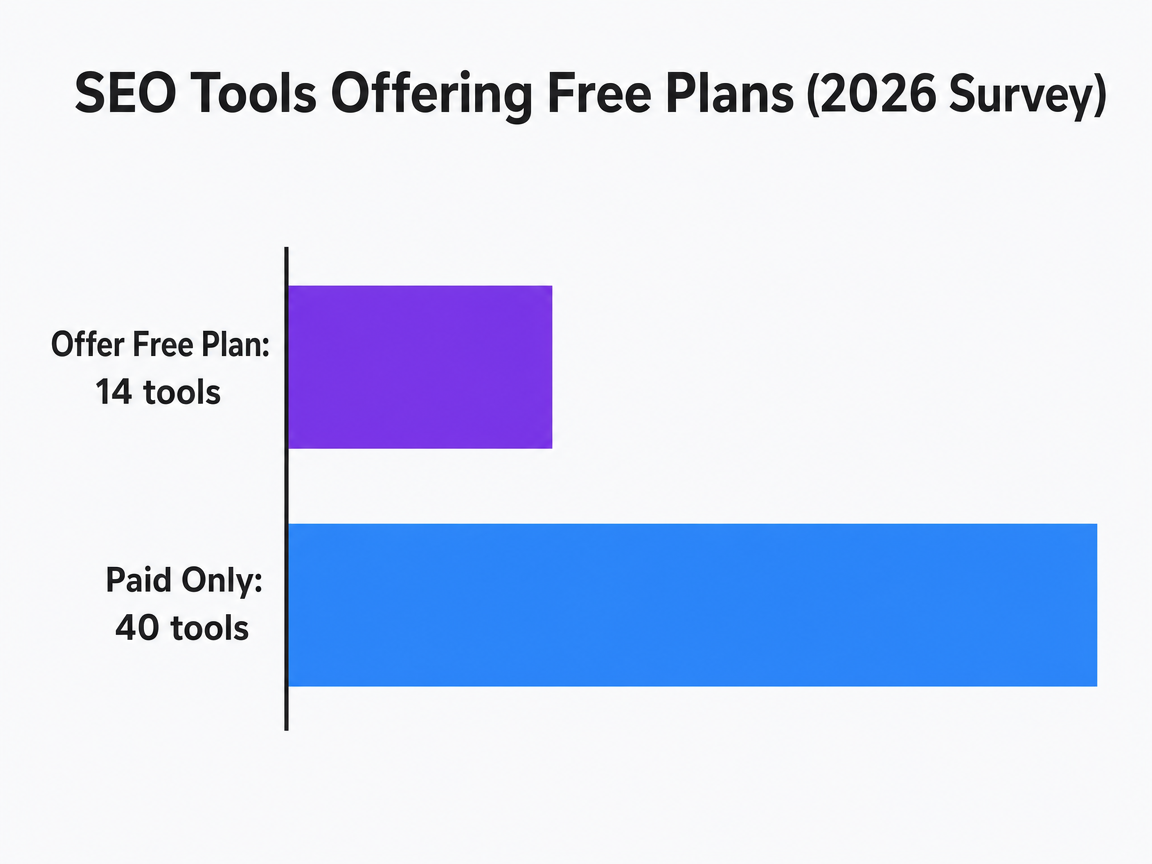 SEO Tools Offering Free Plans (2026 Survey)
Breakdown of 54 SEO software tools surveyed in 2026, showing that 14 offered some form of free plan or trial.
The Coverage Map: Six Audit Functions, Six Free Tools
A defensible free stack covers six distinct audit functions, each with a natural free-tier owner:
- Technical crawling belongs to Screaming Frog, whose free license audits up to 500 URLs per crawl 4.
- Google-side index diagnostics belong to Google Search Console, which stays free forever on verified properties 6.
- The non-Google index layer belongs to Bing Webmaster Tools, which provides free indexing and search performance reports for sites in Bing's index 2.
- Page-speed and Core Web Vitals diagnostics belong to Lighthouse and PageSpeed Insights, running roughly 60 automated checks across performance, accessibility, best practices, and SEO 1, 7.
- On-page auditing at the freemium SaaS tier belongs to a site auditor capped near 100 pages per scan 3.
- The sixth slot, orchestration, is where AI-driven audit layers now compete with manual aggregation 9.
Mapped this way, the question is not which tool is best but whether each function has exactly one owner. Duplicates waste license seats and reviewer hours; gaps leave client deliverables exposed. The next six sections work through each slot in that order.
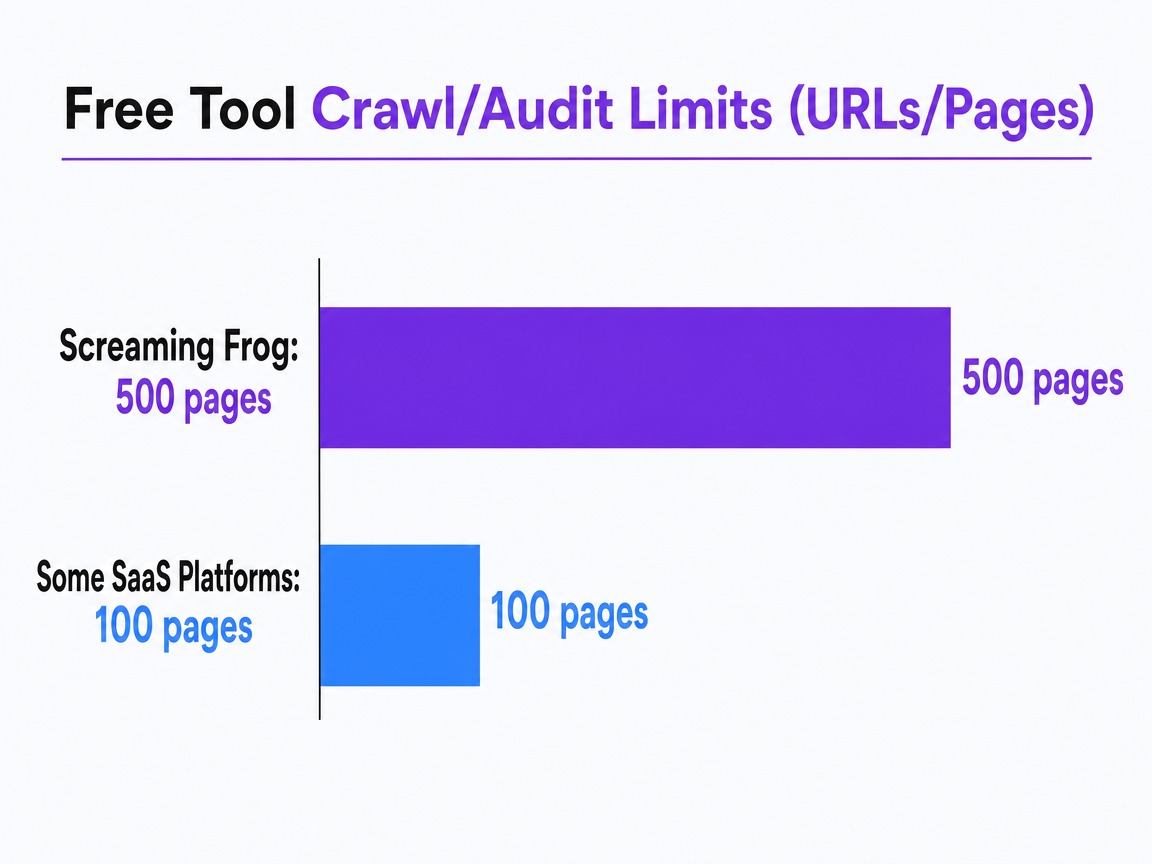 Free Tool Crawl/Audit Limits (URLs/Pages)
Comparison of free tier limitations for SEO audit tools. Screaming Frog's free crawler is limited to 500 URLs, while some freemium SaaS platforms limit free site audits to 100 pages.
Screaming Frog: The 500-URL Crawler That Anchors Technical Audits
Screaming Frog's free license crawls up to 500 URLs per session before the paywall trips 4. For a single mid-size client site—say, a regional law firm with practice-area pages, attorney bios, blog archives, and location pages—500 URLs can be reached before the crawler finishes discovering the sitemap. For anything above a small brochure site, one crawl equals one client, and only if the site fits.
Screaming Frog remains positioned across 2026 reviews as the strongest free option for detailed site auditing with crawling capability 8, returning redirect chains, response codes, canonical conflicts, meta directives, hreflang errors, orphaned pages, and internal link depth in a single export. No freemium SaaS auditor matches that field density inside its free tier. This tool produces the raw technical inventory every other tool in the stack annotates.
Agency delivery leads typically use it in two ways. For prospecting audits, 500 URLs is enough to surface headline issues—broken internal links, indexation traps, thin templated pages—for a pitch deck. For live client work, it functions as a spot-check crawler for specific site sections: the blog archive, a product category tree, a newly migrated subdomain. Full-site crawls on portfolios with 5,000-URL clients require the paid license or a supplementary crawler.
The 500-URL ceiling of Screaming Frog contrasts with other hard limits in this free stack: Lighthouse's roughly 60 automated checks per page 7, the ~100-page cap common to freemium SaaS site auditors 3, and the effectively unlimited scope of Google Search Console and Bing Webmaster Tools on verified properties 2, 6. This comparison highlights the operational reality. Two tools in the stack are gated by volume, one by check depth, and two are gated only by verification status. Sequencing crawls against these ceilings—rather than running every tool on every client—is what keeps the free layer usable at portfolio scale.
Google Search Console: Unlimited Index Diagnostics on Verified Properties
Google Search Console is the one slot in the stack with no URL cap, scan quota, or project count on any verified property 6, 8. It returns coverage data, sitemap status, indexation errors, mobile usability signals, Core Web Vitals field data, and query-level performance. For a Head of SEO running audits across a portfolio, this changes how the tool is used. It is not a spot-check console; it is the persistent telemetry layer that every other free tool references.
The audit workflow follows from that. Screaming Frog's 500-URL crawl surfaces what the site technically looks like. GSC surfaces what Google actually did with it—which URLs entered the index, which were excluded and why, which received impressions, and which templates lost visibility after a deployment. Crawl output without index confirmation is a diagnosis without a lab result. Agencies that run technical audits solely off a crawler tend to over-report on issues Google has already resolved or under-report on pages Google refuses to index for reasons the crawler cannot see.
Two operational notes matter at portfolio scale. First, verification has to be structured for delegation. Domain-property verification via DNS is the version that survives client turnover and lets an agency add or remove specialist users without losing history. URL-prefix verification tied to one person's Gmail account is where continuity dies. Second, GSC's 16-month data window is the hard ceiling that most delivery leads forget. Anything older than that has to live in a warehouse or a BI export scheduled before the window closes. On multi-client work, that scheduled export is the difference between a real year-over-year audit and a reconstructed one.
Run end-to-end SEO audits at scale now
Access full audit workflows and publish actionable SEO insights during your trial—no limitations, real results.
Bing Webmaster Tools: The Non-Google Index Layer Agencies Skip
Bing Webmaster Tools is often overlooked in agency audit checklists, an omission that goes unexamined until a client asks why their brand terms surface differently on Edge or inside Copilot answers. The platform is free forever on verified properties and delivers indexing status, search performance data, and diagnostic reports for sites in Bing's index 2, 8. It offers the same category of telemetry as Google Search Console, but for a different index, at no additional cost.
The strategic case is not about market share arithmetic. It is about surface coverage. Bing's index feeds Microsoft Copilot, ChatGPT search integrations, Edge's default results, DuckDuckGo, and Yahoo. When a client's competitors show up in an AI-generated answer and the client does not, the diagnostic trail starts in Bing Webmaster Tools, not GSC. Audit reports that omit non-Google index status increasingly leave AEO questions unanswered—which matters, because 2026 audit criteria are now expected to cover answer-engine and geographic dimensions, not just traditional SEO 7.
Operationally, the setup cost is measured in minutes per client. Bing accepts a direct import of verified properties from GSC, which collapses onboarding to a single OAuth step. Once imported, the console returns crawl errors, sitemap submission status, backlink data, and query-level performance without a scan quota. For a Head of SEO running audits across 15 or 20 clients, that is 15 or 20 additional data feeds unlocked with roughly one afternoon of delegated setup work, and no line item on the software budget. The tools that get skipped at agency scale are rarely skipped for cost reasons. They get skipped for reporting friction—which is the theme the next section picks up.
Lighthouse and PageSpeed Insights: ~60 Checks for Core Web Vitals
Lighthouse is the diagnostic layer that turns Core Web Vitals from a GSC line graph into a set of prescriptive fixes. Google's own documentation defines it as an open-source, automated auditing tool covering performance, accessibility, best practices, SEO, and Progressive Web App features 1. In practice, that translates to roughly 60 automated checks per page across those categories 7, run either through Chrome DevTools, the PageSpeed Insights web interface, or a CI pipeline hitting the Lighthouse Node module.
Sixty checks is a specific ceiling, and it matters for how the tool fits into agency workflows. Some 2026 audit platforms now run more than 260 checks per page, spanning traditional SEO, answer-engine optimization, and geographic dimensions that Lighthouse does not touch 7. The gap is not a defect. Lighthouse was scoped to page-level engineering hygiene—Largest Contentful Paint, Interaction to Next Paint, Cumulative Layout Shift, render-blocking resources, image sizing, tap-target spacing—and it does that scope well. It was not scoped to schema completeness across AEO surfaces, geographic content parity across location pages, or entity coverage inside knowledge panels. Delivery leads who expect Lighthouse to flag those issues will file audit reports that look complete and are not.
The 60-check Lighthouse surface contrasts with the 260-plus check surface emerging in newer audit tooling 7. The delta represents audit territory that a free page-speed layer leaves uncovered.
Two workflow notes keep Lighthouse useful at agency scale. Run it via the PageSpeed Insights API rather than the DevTools panel for anything above a handful of URLs; the API returns both lab and field data in one JSON payload and can be scripted against a URL list exported from Screaming Frog. And treat the SEO category inside Lighthouse as a hygiene checklist—title tags, meta descriptions, crawlable anchors, valid hreflang—not a substitute for on-page auditing. The next slot in the stack covers the on-page layer explicitly.
Freemium SaaS Site Auditors: The 100-Page Cap and What It Buys
The freemium SaaS auditor slot is where vendor economics show through most clearly. Free site audits at this tier commonly cap at roughly 100 pages per scan 3, with daily search limits, no white-label export, and no scheduled recrawls on most plans 9. That ceiling sits above Screaming Frog's 500-URL crawl in interpretive layers but below it in raw coverage—the 100 pages come back with prioritized issue scores, severity flags, and remediation copy that a crawler's raw export does not produce.
For an agency Head of SEO, the useful frame is what those 100 pages actually buy. On a prospecting audit, 100 pages is enough to render a client-ready summary report with issue counts, priority tiers, and estimated impact language—the deliverable that closes a scope conversation. On a live client site above 100 URLs, the same scan returns a sampled diagnostic, which is useful for trend monitoring but not for a full technical audit. The tool is a report generator, not a crawler substitute.
Two vendor behaviors matter at this tier. First, some 2026 platforms ship a complete SEO plus AI-visibility audit with no signup or email gate on a per-URL basis 9, which makes them viable for one-shot competitor checks without adding another account to the stack. Second, most freemium SaaS auditors offer no project saving on the free tier 9, meaning historical comparison across audit runs requires manual export and warehousing. That single missing feature—persistent project state—is what separates a freemium auditor from an agency reporting layer, and it is the pressure point the next section's orchestration argument turns on.
AI-Orchestrated Audits: Where the Sixth Slot Earns Its Place
The sixth slot in the stack has changed most between 2024 and 2026. Manual aggregation across a crawler, two webmaster consoles, a page-speed diagnostic, and a freemium SaaS auditor used to be the default agency workflow. It still functions, but the audit surface it produces has fallen behind the surface clients now ask about. Free tools in the traditional stack run somewhere between 60 checks per page in Lighthouse and roughly 100 in mid-tier webmaster tooling, while newer audit platforms are running more than 260 checks per page across traditional SEO, answer-engine optimization, and geographic content dimensions 7. The gap is not marginal.
AI-orchestrated audit layers earn the sixth slot by resolving two constraints the first five tools cannot resolve on their own. The first is coverage. AEO signals—schema completeness, entity coverage, answer-block eligibility—and GEO signals like location-page parity across a multi-market client are not scoped into Lighthouse or Screaming Frog and only partially surface in GSC and Bing Webmaster Tools 7. The second is state. Most freemium SaaS auditors ship no project saving on the free tier 9, which means historical comparison lives in spreadsheets a delivery lead maintains by hand.
Vendor acquisition tactics have adjusted accordingly. Some 2026 platforms now expose a complete SEO plus AI-visibility audit with no signup and no email gate on a per-URL basis 9, which makes the orchestration slot testable before it becomes a line item. For an agency Head of SEO, the practical read is that the sixth slot is no longer a duplicate auditor. It is the layer that consolidates the outputs of the other five into a persistent, comparable, client-ready view—and it is the point at which approval-first AI workflows, of which Vectoron is one, begin to displace manual aggregation as the default agency posture.
Scale Agency SEO Audits With Unified AI-Driven Workflows
Discover how leading agencies are leveraging AI-powered platforms to automate, coordinate, and accelerate multi-client SEO audits—without increasing headcount or sacrificing strategic oversight.
The Stacked Free Layer at Portfolio Scale
Assembled correctly, the free layer covers real ground. A crawler for technical inventory, two webmaster consoles for Google and Bing index diagnostics, a page-speed diagnostic for Core Web Vitals hygiene, a freemium SaaS auditor for client-ready summary reports, and an orchestration layer for consolidation. Six tools, six audit functions, zero software line items on the P&L.
The table below maps each slot to its owning tool, the sourced ceiling on that free tier, and what breaks first when a delivery team scales the same setup across a client portfolio.
| Audit Function | Free Tool | Free-Tier Ceiling | Break Point at Portfolio Scale |
|---|---|---|---|
| Technical crawl | Screaming Frog | 500 URLs per crawl 4 | One mid-size client site per session; sampling required above |
| Google index diagnostics | Google Search Console | Unlimited on verified properties, 16-month data window 6 | Historical audits beyond 16 months require scheduled exports |
| Non-Google index | Bing Webmaster Tools | Free forever on verified properties 2 | Per-client verification and reporting friction, not cost |
| Page speed / Core Web Vitals | Lighthouse / PageSpeed Insights | ~60 automated checks per page 7 | AEO and GEO signals uncovered above the 60-check surface |
| On-page auditing | Freemium SaaS auditor | ~100 pages per scan 3 | No project saving on free tier; sampled diagnostics only 9 |
| Orchestration | AI-audit layer | Per-URL audits with no signup on some platforms 9 | Free tier tests the layer; persistent state requires upgrade |
Read down the third column and the pattern is clear. Two slots are gated by volume, one by check depth, one by data retention, one by project state, and one by verification labor. No single ceiling forces the upgrade decision. The aggregation of all six does.
Where the Free Stack Breaks: The Aggregation Tax
The individual ceilings are not what breaks the free stack. Reviewer time is. Six tools mean six logins, six export formats, six data models, and six versions of the same client URL list that have to be reconciled by hand before a single audit deliverable ships.
Consider the mechanics across a 20-client portfolio. Screaming Frog exports CSV per crawl session and has to be re-run per client because of the 500-URL cap 4. Google Search Console exposes performance and coverage data on 40 verified properties—two per client, on average, once staging and www variants are counted—each with its own 16-month retention window. Bing Webmaster Tools mirrors that count on a separate console. Lighthouse returns per-page JSON, which multiplies against however many priority URLs a delivery lead pulls from the crawl. The freemium SaaS auditor caps at roughly 100 pages per scan and offers no project saving on the free tier 9, so historical comparison lives in a spreadsheet a specialist maintains manually.
None of that is technically difficult. It is just labor that scales linearly with client count while the software line item stays at zero. A delivery lead running the full stack across 20 clients spends the first two hours of every audit cycle exporting, normalizing, and joining data before any analysis begins. That is the aggregation tax, and it is what the free layer's price tag conceals.
Two secondary costs sit on top. White-label reporting is absent from most freemium tiers 9, which pushes agencies into a deck-building step that adds hours per client. And AEO plus GEO coverage—now standard 2026 audit criteria—only partially surfaces in the free stack 7, meaning the deliverable clients see is already narrower than what competitors ship. The upgrade decision follows from that arithmetic, not from any single ceiling.
The Upgrade Decision: $49-$139/mo or Orchestration
The upgrade decision resolves to a single question: does the aggregation tax exceed the entry price of a paid platform or an orchestration layer? Starting tiers across the 40 paid-only SEO platforms tracked in 2026 begin between $49 and $139 per month 5. Against a 20-client portfolio absorbing two hours of manual export and reconciliation per audit cycle, that price band clears the bar quickly. One paid crawler license replaces the 500-URL Screaming Frog ceiling. One consolidated auditor replaces the ~100-page freemium scan and its missing project state 9.
The orchestration path resolves the same math differently. Instead of purchasing a deeper single-function tool, an AI-orchestrated layer consolidates crawl, index, page-speed, on-page, and AEO plus GEO outputs into one persistent, approval-gated workflow. The free stack stays useful as an input layer. The delivery lead stops being the aggregation engine. For agencies scaling audit volume without adding a senior specialist headcount, that shift—from six consoles reconciled by hand to one governed view—is what Vectoron is built to occupy.
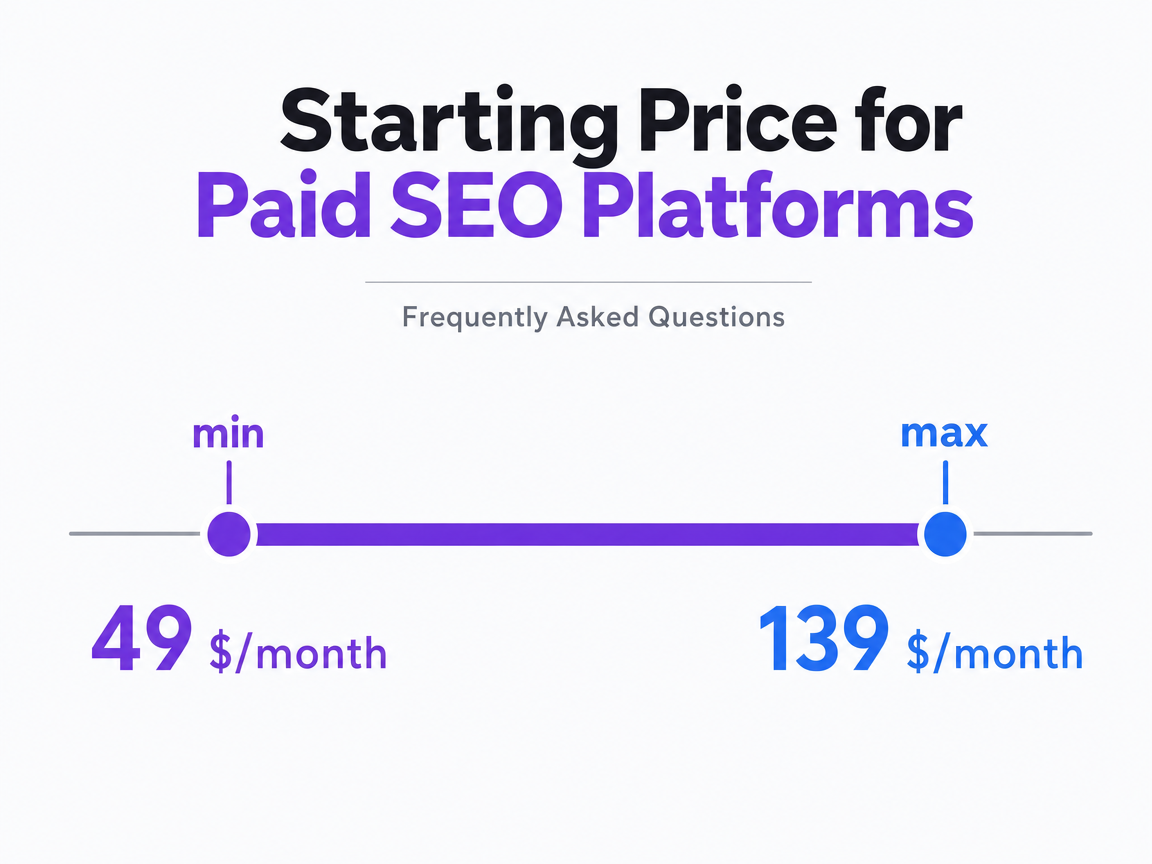 Starting Price for Paid SEO Platforms
Starting monthly cost for upgrading from free tiers to paid SEO software platforms, based on a 2026 market comparison.
Frequently Asked Questions
References
- 1.Lighthouse | Tools for Web Developers | Google Developers.
- 2.Bing Webmaster Tools - Get Started.
- 3.10 Best Free SEO Tools for Small Businesses I Reviewed.
- 4.21+ Best SEO Software Tools Compared (+3 Free Ones).
- 5.28 Best SEO Software (2026) | TMB.
- 6.The 19 Best SEO Tools to Boost Organic Traffic in 2026.
- 7.Best Free SEO Audit Tools 2026 Compared: Which Ones Check ....
- 8.10 Best Free SEO Tools Reviewed In 2026.
- 9.Best Free SEO Audit Tools in 2026: An Honest Comparison.
- 10.Best Free SEO Tool: 20 Services Tested and Reviewed.