
Key Takeaways
- Google Search Console anchors indexation SLAs across a client book, turning first-party coverage data into portfolio-wide alerts when paired with the URL Inspection API and BigQuery exports 9.
- Bing Webmaster Tools adds cross-engine verification through Site Scan and crawl diagnostics, catching structured data and robots issues that Google reports differently or misses entirely 10.
- Screaming Frog's free tier handles 500-URL audits for onboarding triage, while the $259/year paid tier remains the cheapest hour swap against specialist time 8.
- Google Analytics closes the outcome loop only when every client property shares a standardized event schema before AI summarization jobs are layered on top 9.
- MarketMuse's free plan scaffolds individual briefs with defensible topic models, but throughput caps make the $149/month seat the honest comparison for portfolio-wide planning 8.
- AirOps free utilities compress competitor discovery and content diffing from 30-45 minutes of manual reading into structured comparisons a strategist reviews rather than authors 7.
- Vectoron serves as the paid orchestration layer above the six free tools, routing signal through a Command Center approval queue that addresses the effectiveness erosion Forrester flagged 3.
The agency scaling problem free tools alone can't solve
The bottleneck at a growth-stage SEO agency is rarely tool access. Forrester's 2026 study of US marketing agencies found that nine in ten already use generative AI and roughly half use agentic AI for marketing execution, with SEO strategy and content production among the most cited use cases. The same research flagged a hard tradeoff: agencies are deploying AI primarily to cut costs, and that focus is eroding marketing effectiveness, creativity, and brand growth 3.
That finding reframes the question a Head of SEO should ask when scanning free AI tools. The interesting variable is not which crawler or brief generator to add. It is whether the free layer plugs into a governed workflow that protects quality across a 30- or 60-account book, or whether it accelerates the exact problem Forrester identified.
The oversaturation signal is already visible in agency data. AgencyAnalytics' 2025 benchmarks reported that 73% of agency leaders say generative AI has permanently changed content discovery, fueling reduced organic reach 5. Free AI utilities can absorb repetitive work like technical audits, indexation checks, and topical clustering, but they do not decide what should ship, in what order, or against which client's revenue priority.
The seven tools below are treated as roles in a production line rather than entries on a shopping list. Six are free or freemium and cover crawl signal, indexation, cross-engine coverage, technical audit, topical planning, and competitive discovery. The seventh handles the coordination layer where most agencies lose margin.
Reading the stack as a production line, not a shopping list
Most free-tool roundups treat SEO software as interchangeable inventory. That framing breaks down at 30 clients, where the bottleneck is not which crawler an agency owns but how signal moves from crawl to publish without a specialist manually shuttling data between tabs. A production line has stations, sequencing, and a quality gate. A shopping list does not.
Six functional stations define what a scaled SEO practice actually runs:
- Crawl signal capture
- Indexation monitoring
- Cross-engine coverage
- Technical audit
- Topical planning
- Competitor discovery
Each free tool below is evaluated by what it contributes at its station and what it hands off to the next one. A tool that produces excellent output but cannot export cleanly, or that requires a specialist to babysit it per client, fails the scaling test regardless of feature depth.
This is where the Forrester finding matters operationally. When nine in ten agencies deploy AI primarily for cost reduction and see effectiveness decline as a result 3, the failure point is almost always the same: tools that generate output faster than the approval layer can review it. Reading the stack as a production line forces the question of who signs off, on what, in what order, before any of the six free tools ships work to a client site.
The 7 tools mapped to agency workflow roles
Google Search Console for indexation SLA across a client portfolio
Google Search Console is the anchor of any agency indexation SLA because it is the only free source of first-party data on how Google actually treats a client's URLs. Search Engine Journal's authoritative list of SEO tools identifies it as a foundational free utility that agencies should treat as baseline infrastructure rather than an optional add-on 9.
At 30-plus client accounts, the operational question is not what Search Console reports but how quickly a Head of SEO can see indexation drift across the entire book without opening each property. The three surfaces that turn Search Console from a per-client dashboard into a portfolio monitoring system are:
- The Coverage report
- The URL Inspection API
- Bulk data export to BigQuery
Agencies that pipe the URL Inspection API into a scheduled job can flag any client whose indexed-URL count deviates more than a set threshold week over week, which converts a manual login pattern into a queued alert.
The AI layer here is not inside Search Console itself. It is the classification logic an agency runs on top of the export: grouping soft 404s, canonical conflicts, and crawl anomalies by client priority so a specialist opens the right property first. Search Console supplies the signal; the agency decides what constitutes an SLA breach and who reviews it before the day's queue is set.
Bing Webmaster Tools for cross-engine coverage and Site Scan diagnostics
Bing Webmaster Tools is the free counterweight to Google-only monitoring. Microsoft's documentation states the platform lets operators
"see how Bing sees your site and learn about issues that could affect your performance in Bing search results,"
with URL inspection, sitemaps, backlink data, and crawl diagnostics available at no cost 10. For an agency, the underrated feature is Site Scan, a built-in technical audit that runs against a submitted property and returns categorized issues without a desktop crawler.
Cross-engine coverage matters more in 2026 than it did five years ago. Bing indexes power a share of the AI answer surfaces that clients are starting to ask about, and its crawl diagnostics often catch structured data and robots directives that Search Console reports differently or not at all. Running the same client property through both tools gives an agency two independent readings on the same technical fault, which shortens the argument during a client escalation.
The role Bing Webmaster Tools plays in a scaled stack is verification, not primary reporting. Site Scan output feeds a shared audit queue where a specialist reconciles any Bing-flagged issue against the Google-side data before writing a ticket. The tool costs nothing to add, and it removes the blind spot that Google Search Console alone creates.
Screaming Frog free tier for technical audit throughput
Screaming Frog remains the default crawler for agency technical work, and its free tier crawls up to 500 URLs per site without a license. The paid ceiling is $259 per year for unlimited crawling and integrations 8. For a book of small and mid-sized client sites, the free tier covers a meaningful share of routine audits, and the paid tier is one of the lowest-cost upgrades in the entire agency stack when a specialist's time is factored in.
The throughput problem at 30 clients is not the crawler itself. It is the audit report a specialist writes after each crawl. Screaming Frog's structured export of response codes, canonical mismatches, hreflang errors, and redirect chains is designed to feed downstream automation. Agencies that pair the export with an AI classification step can compress the audit narrative from a two-hour manual pass to a reviewed draft in fifteen minutes, then route the draft to a senior specialist for sign-off.
What the free tier will not do is handle scheduled crawls, JavaScript rendering at scale, or cross-site comparison. Agencies typically run the free version for triage on new client onboarding and a small number of paid seats for portfolio-wide monthly crawls. The distinction matters when the stack is being priced against specialist hours.
The tool's value in the production line is upstream signal quality. If Screaming Frog exports are wrong or incomplete, every downstream brief, ticket, and QA check inherits the error. Agencies that skip this station lose the audit trail that supports later strategic recommendations to the client.
Google Analytics for outcome signal on published work
Google Analytics is on the Search Engine Journal free-tools list for a reason: it is the free measurement layer that closes the loop between what an agency published and what the client's audience did 9. In a production line, its role is outcome verification, not planning.
The scaling question for Analytics at 30 accounts is standardization. Every client property should carry the same event schema for organic entrances, engaged sessions, conversion events, and assisted conversions before any AI reporting layer is attached. Without a common schema, the AI summarization that agencies typically build on top of Analytics produces reports that read fluently but compare properties that were never instrumented the same way.
The tool's AI-adjacent value comes from feeding standardized event data into a weekly summarization job that flags any client whose organic engaged-session trend breaks by more than a set threshold. That job is not Analytics itself. It is a scheduled export the agency owns, which lets a Head of SEO see the entire book's outcome signal in one queue before the Monday client call. Analytics supplies the raw truth; the agency decides what deserves a specialist's attention this week.
MarketMuse free plan for topical planning and brief scaffolding
MarketMuse offers a free tier for topic authority planning, with paid plans starting at $149 per month 8. For an agency, the free plan is a useful scaffolding tool for individual briefs, not a portfolio planning system. The distinction is worth stating clearly because most roundups conflate the two.
What the free plan does well is give a strategist a defensible topic model for a single client's cluster before a brief goes to production. It surfaces related subtopics, question intents, and coverage gaps against competitor URLs, which shortens the research pass a senior editor would otherwise run manually. That saves time per brief, which compounds across a book.
The scaling limit is throughput. Free-tier query caps mean the tool is not the right choice for weekly cluster refreshes across 30 clients, and the upgrade to $149 per month per seat becomes the honest comparison against specialist hours. Agencies that treat MarketMuse's free plan as the topical planning station for select high-priority clients, and use lower-cost keyword research for the rest, keep the license spend proportional to the client's fee.
The output that matters downstream is the brief itself. A MarketMuse-informed brief that still routes through an editor's approval before it hits a writer preserves the quality gate. A brief that bypasses that gate is the exact pattern Forrester flagged when it warned that AI-driven cost cutting is eroding effectiveness 3.
AirOps free utilities for competitor discovery and content diffing
AirOps sits in the newer category of AI SEO utilities that offer free access to specific workflow templates rather than a full platform license 7. Its useful role in an agency stack is competitor discovery and content diffing: pulling the top-ranking URLs for a target query, extracting the entity coverage of each, and returning a structured comparison against the client's existing page.
The reason this station belongs in the production line is that it removes the most repetitive part of competitive research. A senior strategist previously spent 30 to 45 minutes per query manually reading competitor pages and noting coverage gaps. An AirOps template returns the same structured output in a few minutes, which the strategist then reviews rather than authors.
The free utilities have caps on runs per month, which makes them appropriate for high-priority client queries rather than bulk cluster analysis. Agencies that run AirOps as a queued job against the twenty highest-revenue queries per client per quarter get the throughput benefit without hitting the paid tier. The output feeds directly into the MarketMuse-informed brief at the previous station, which is where the production line begins to look like a line and not a folder of tabs.
Vectoron as the orchestration layer above the six free tools
The six tools above cover the stations. None of them coordinate the stations. That is the seventh role, and it is honest to say upfront that the tool that fills it is paid, not free.
Vectoron is an AI marketing execution platform that sits over the free stack as an orchestration and approval layer. Its role in the production line is not to replace Search Console, Screaming Frog, or MarketMuse. It reads signal from those tools, ranks the work by client priority and revenue impact, drafts the execution, and routes every recommendation through a Command Center where a human approves before anything ships. That approval-first design is the specific control that addresses the Forrester finding that agencies deploying AI for cost cutting are losing effectiveness 3.
For a Head of SEO managing 30 to 60 accounts, the operational value is the collapse of coordination overhead. Briefing cycles, status meetings, and per-tool handoffs are where margin evaporates in a traditional agency model. An orchestration layer that connects signal capture, ranking, execution, and QA in a single governed loop is what the six free tools cannot do on their own, no matter how well each one performs at its station.
Free tools solve access. The coordination layer solves scale. Both are needed; only one is a line item.
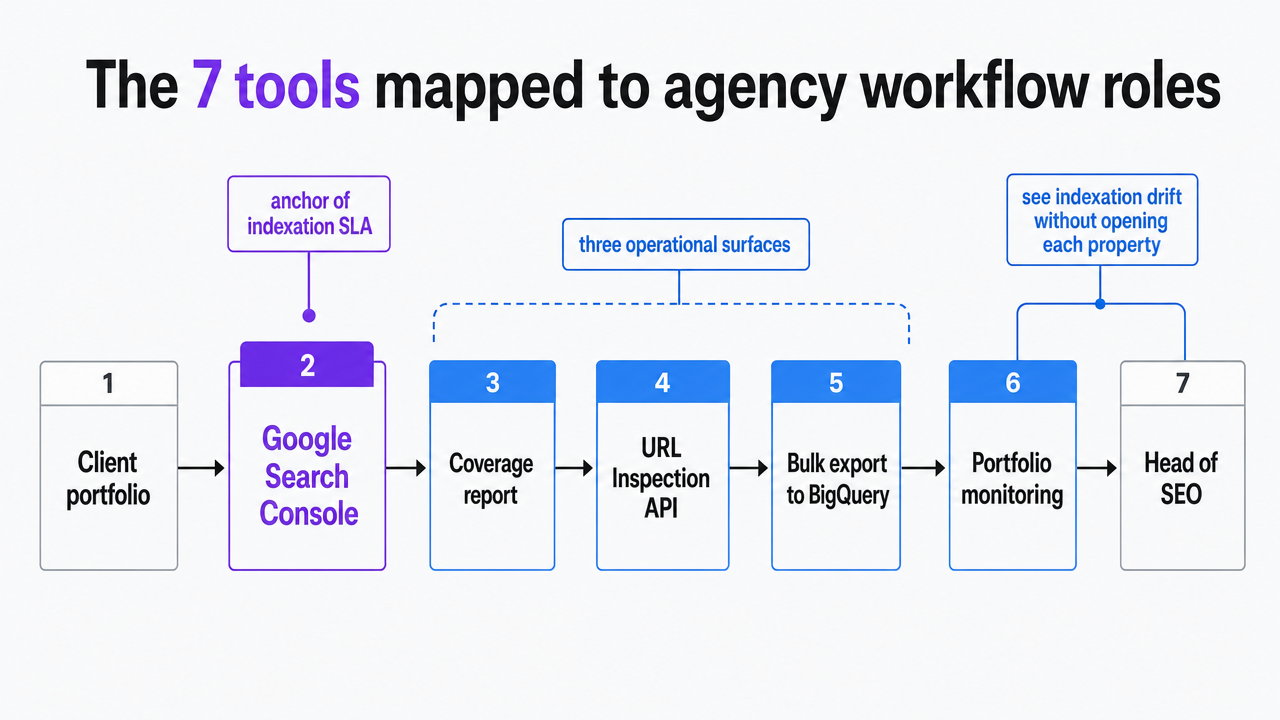 Visualize the seven workflow stations as a sequential production line, directly supporting the section that maps each tool to a role
Test real-time AI SEO execution risk-free
Experience full-scale AI-driven SEO workflows and publish live client content before you commit.
Free stack coverage vs. specialist hours for a 30-client book
The honest way to price a free AI SEO stack is not by the license line. It is by the specialist hours that remain after the free tier absorbs what it can. For an agency running 30 client sites, the table below maps each workflow station to its free tool, the sourced tier limit, and the residual hours per client per month that a specialist still owns. Labor is expressed as variable H per client because loaded specialist cost varies by market and seniority.
| Workflow station | Free tool | Sourced tier / ceiling | Residual specialist hours per client / month |
|---|---|---|---|
| Indexation monitoring | Google Search Console | Free, no cap 9 | 0.5H review + escalation triage |
| Outcome measurement | Google Analytics | Free, no cap 9 | 0.75H schema QA + weekly read |
| Cross-engine coverage | Bing Webmaster Tools + Site Scan | Free, no cap 10 | 0.25H reconciliation vs. Google |
| Technical audit | Screaming Frog free tier | 500 URLs free; $259/yr for unlimited 8 | 1.5H per audit at free cap, 0.75H at paid |
| Topical planning | MarketMuse free plan | Free tier capped; $149/mo per seat 8 | 2H per brief cluster at free cap |
| Competitor discovery | AirOps free utilities | Capped runs per month 7 | 1H review of returned diffs |
| Orchestration | Not covered by free tools | N/A | Coordination overhead absorbed elsewhere |
The pattern is visible without a dollar figure attached. Free tiers cover roughly 6H of specialist work per client per month at the audit and planning stations, which is where MarketMuse at $149 per seat and Screaming Frog at $259 per year become the cheapest hours in the stack 8. What no free tool retires is the coordination hour between stations. That residual is the line item the seventh tool addresses.
The approval layer: governance the free tools don't provide
Search Console reports indexation. Screaming Frog exports crawl data. MarketMuse returns a topic model. None of them decide whether a specific brief ships to a specific client this week, or who is accountable if it ships wrong. That decision is governance, and it is the gap where agency margin and quality both leak.
NIST's AI Risk Management Framework, including its generative AI profile released in July 2024, organizes that gap into four functions: govern, map, measure, and manage. The profile exists specifically to help organizations identify risks unique to generative AI 1. For a Head of SEO running 30 to 60 accounts, the practical translation is a written approval policy that names who signs off on AI-assisted briefs, AI-drafted meta content, and AI-generated technical recommendations before any of it touches a client property.
The operational shape is a queue with a named reviewer per client tier, a logged approval per artifact, and a rollback path when a specialist flags an issue post-publish. Free tools feed that queue; they do not run it. Agencies that skip the approval layer end up producing the pattern Forrester documented, where speed compounds and effectiveness declines 3. The station that closes the loop is the one no free utility ships with.
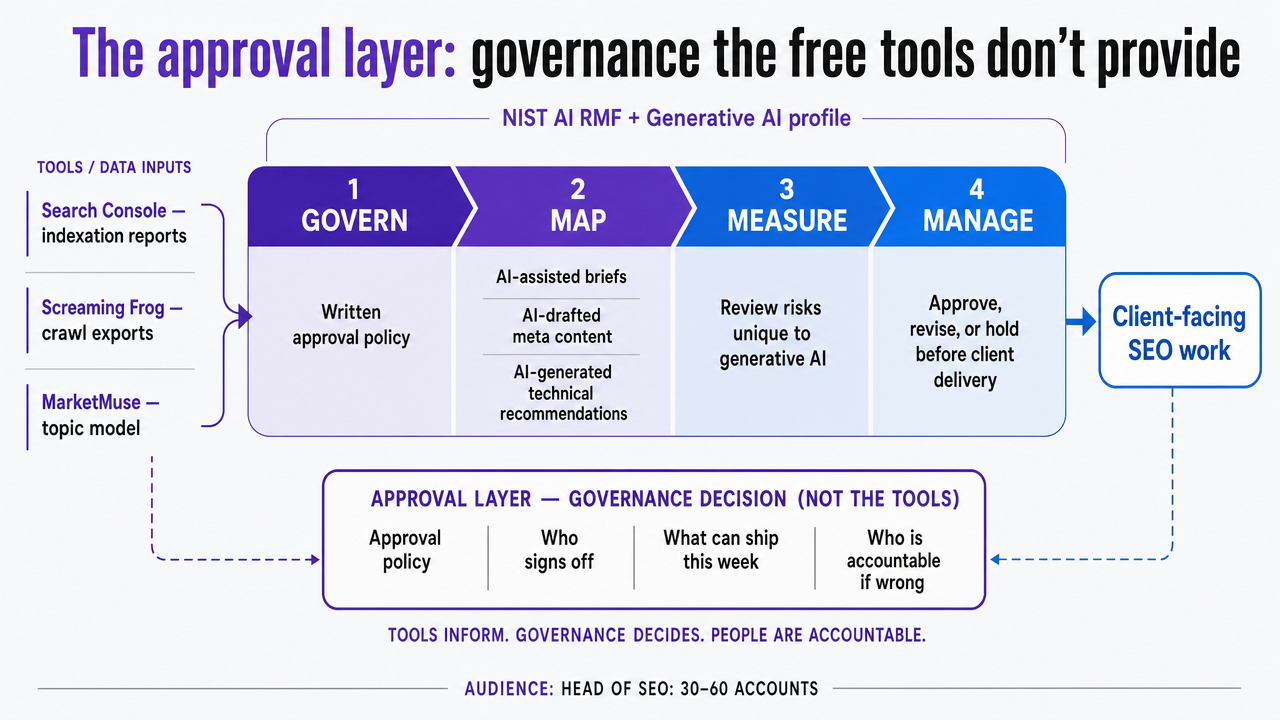 Visualize the NIST AI RMF four-function governance model applied to agency SEO approval workflow, supporting the section's governance framework
See How Leading Agencies Scale SEO Delivery With AI-Driven Tools
Connect with our team for a live walkthrough on integrating AI-powered workflows that centralize approvals and automate execution—enabling your agency to increase SEO output and maintain quality across multiple clients, without expanding your specialist team.
One focused note on Generative Engine Optimization
Generative Engine Optimization has moved out of the experimental column faster than most agency stacks have adjusted. The 2026 State of Generative Engine Optimization in B2B Marketing study from GNW Consulting and Demand Metric found that 92% of organizations are already experimenting with or operationalizing GEO, and 78% of those investing report measurable return on investment 6. Those numbers change what a free SEO stack has to answer for.
None of the six free tools in the production line above were built for GEO. Search Console reports Google's organic index, not citations inside AI answer surfaces. Bing Webmaster Tools gets closer because Bing indexes power a share of those surfaces 10, but even that is coverage, not measurement of whether a client's content is being cited by a generative engine. MarketMuse and AirOps can inform entity-level content structure that generative engines tend to reward, but neither closes the measurement gap.
The operational implication for a Head of SEO is narrow and worth stating directly. Add a monitoring routine that tracks brand and product mentions inside AI answer outputs for the top twenty commercial queries per client, and route findings through the same approval queue that governs the rest of the stack. GEO is not a separate practice. It is a new signal the existing production line has to read.
Sizing the productivity opportunity without over-promising it
McKinsey estimates generative AI could add $2.6 trillion to $4.4 trillion annually to the global economy, with marketing and sales flagged as one of the highest-value functions 11. That number is worth citing once, at the end, for a specific reason: it sizes the ceiling, not the floor. The floor for a Head of SEO running 30 to 60 accounts is whatever the six free tools plus a governed approval layer actually retire in specialist hours next quarter.
The honest read of the research is that free AI SEO tools do compress repetitive work at the audit, planning, and discovery stations. The Forrester finding that AI-driven cost cutting is eroding effectiveness 3is the boundary condition on how far that compression can go before quality slips. Agencies that treat the free stack as leverage under an approval queue capture the productivity gain. Agencies that treat it as headcount replacement without governance produce the pattern the research already documented.
The next step for a Head of SEO is narrower than the McKinsey number suggests: pick one station, wire it into the approval queue, measure the residual hours, and move to the next. Vectoron's role in that sequence is the coordination layer, not another tool at another station.
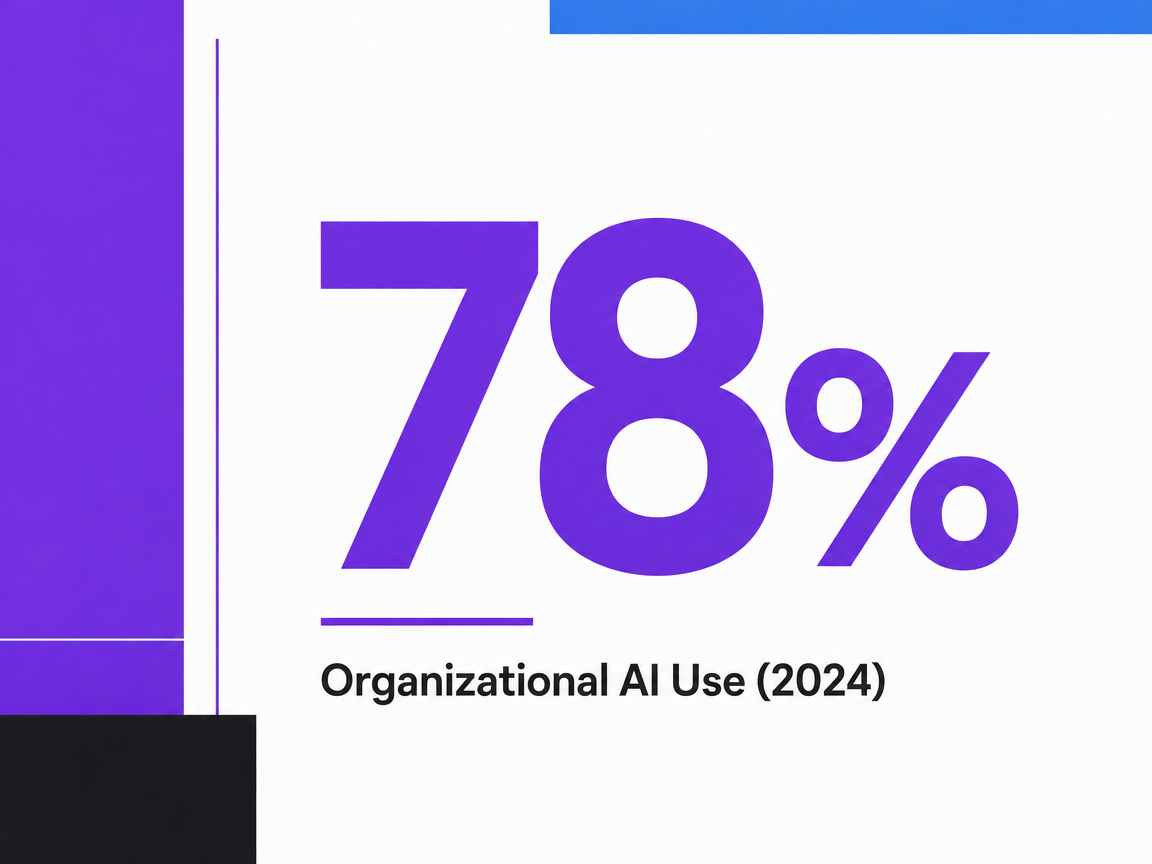
Organizational AI Use (2024)
Frequently Asked Questions
References
- 1.AI Risk Management Framework.
- 2.The 2025 AI Index Report | Stanford HAI.
- 3.Forrester: Nine In 10 US Marketing Agencies Use AI To Cut Costs — At The Expense Of Marketing Effectiveness.
- 4.The State Of Generative AI Inside US Marketing Agencies, 2025.
- 5.AgencyAnalytics Releases 2025 Marketing Agency Benchmarks Report.
- 6.New Research from GNW Consulting and Demand Metric Finds GEO Adoption Accelerating Across B2B Marketing.
- 7.We Tested 12 of the Best AI SEO Tools in 2026.
- 8.Best AI SEO Tools in 2026: We Tested 15+ Tools.
- 9.SEO Tools: The Complete List (Free & Paid).
- 10.Bing Webmaster Tools and Guidelines.
- 11.The economic potential of generative AI: The next productivity frontier.