
Key Takeaways
- Answer engines have doubled the optimization target: pages must still rank for commercial queries while also being quotable and attributable inside synthesized AI responses.
- Citation-worthiness rests on four compounding inputs — retrievable structure, verifiable original evidence, authoritative third-party signals, and a documented human review layer that models can trust.
- FTC review rules, NIST's Generative AI Profile, and Copyright Office guidance form a single governance layer that doubles as the evidence trail retrieval systems reward 2, 9, 5.
- Portfolio-scale GEO works when briefing, production, and QA collapse into one approval loop, and measurement reports visibility, branded search, and pipeline as three layers with named lag between them.
Why answer engines changed the optimization target
For two decades, the optimization target was a ranked link. A page competed for a slot, a user clicked, and the session belonged to the destination. Answer engines break that contract. The model reads the corpus, composes a response, and cites a subset of sources inline. The click becomes optional, and the surface area an agency can influence narrows to whatever the model decides to lift, paraphrase, or attribute.
The corporate context behind the shift is not speculative. Stanford's AI Index reports that the share of surveyed organizations using AI rose from 55% in 2023 to 78% in 2024, and reported use of generative AI in at least one business function climbed from 33% to 71% over the same window 6. That figure measures organizational deployment among survey respondents, not consumer query volume, and it does not by itself prove that buyers have moved to AI search. What it does establish is that the infrastructure feeding answer engines, and the internal willingness to trust generative output, expanded materially inside one year.
For agency SEO leaders, the practical consequence is a change in what a page has to do. A service page for a personal injury firm, a DSO landing template, or a home services location hub can still rank and still convert. But the same page is now also being read by a retrieval system that decides whether a passage is quotable, whether the claim is attributable, and whether the source is credible enough to name. Those are different tests than a ranking algorithm applies, and they reward different production choices.
The optimization target has not disappeared. It has doubled. The rest of this article treats that doubling as a delivery problem, not a philosophical one.
GEO defined against classic SEO, without the 'SEO is dead' theater
Generative Engine Optimization is the practice of shaping content, evidence, and signals so that AI answer systems retrieve, quote, and attribute a source accurately. Classic SEO optimizes for a ranked position in a list of links. GEO optimizes for inclusion inside a synthesized response. The two share a substrate — crawlable pages, clean markup, real authority — but the exit criteria differ. A ranking algorithm asks whether a page deserves a slot. A retrieval-and-generation system asks whether a passage is worth lifting and whether the source is credible enough to name.
The 'SEO is dead' framing collapses under contact with the evidence. Organic rankings still route commercial-intent traffic to booking flows, intake forms, and phone lines. AI answers increasingly intercept informational and comparison queries earlier in the journey, and the sources they cite are drawn from the same technically indexable web that classic SEO already contests 10. Removing structured pages, schema, or link equity to chase GEO would degrade both surfaces at once.
What GEO adds is a stricter evidentiary bar. Retrieval systems reward passages that make a specific, attributable claim, name the entity behind it, and date the assertion. They penalize hedged, unsourced, or contradictory copy because such text raises the model's confabulation risk — a named category in the NIST Generative AI Profile 9. For an agency SEO lead, the practical read is direct: keep the SEO production line running, and layer a second set of tests on top of it that ask whether each page is quotable, attributable, and safe to cite.
The dual-surface model: ranked links and AI answers as separate jobs
Treat the ten blue links and the AI answer panel as two distinct products competing for two distinct queries. McKinsey's 2025 consumer research reports that roughly half of surveyed consumers now intentionally seek AI-powered search, and that about 50% of Google searches surface AI summaries — figures drawn from a proprietary survey and forward-looking trend analysis, not universal browsing telemetry 10. The number is directional, not gospel. What it does confirm is that upper-funnel discovery has bifurcated: a meaningful share of research happens inside a synthesized response before the user ever sees a SERP.
The job of a ranked link has not changed. It routes commercial-intent traffic — someone typing a city-plus-service query, a competitor comparison, or a pricing question — into a booking flow, an intake form, or a call. Conversion rate, cost per qualified lead, and pipeline attribution remain the honest measures of that surface. A first-page ranking for 'estate planning attorney [city]' or 'invisalign near me' still does economic work no AI answer replaces.
The job of an AI answer is different. It intercepts informational, comparative, and exploratory queries earlier in the journey, and it settles them without a click a growing share of the time. Success on that surface is measured by whether the client is named, whether the summary is accurate, and whether the mention seeds downstream branded search, direct visits, and call volume weeks later.
Running one measurement stack across both surfaces produces false signals. Ranked-link KPIs will look flat while AI-answer visibility quietly compounds, or vice versa. Split the reporting, staff the production line for both, and stop asking a single dashboard to explain two different user behaviors.
Test AI-powered geo optimization in real campaigns
Validate AI’s impact on local search performance using your own live content and locations.
The four inputs that make a page citation-worthy in AI answers
Retrievable structure: how models parse and lift a passage
Retrieval systems do not read a page the way a human skims it. They chunk it. A well-formed passage — a self-contained claim under a descriptive H2 or H3, bounded by clean HTML, with the entity, action, and qualifier in the same sentence — is easier to lift intact than a paragraph that buries the answer three clauses deep. Pages built for retrieval front-load the answer, then support it. Pages built for narrative flow bury it.
The structural fundamentals that already serve classic SEO carry over: semantic headings, schema markup for organizations, services, FAQs, and reviews, descriptive anchor text, and pages that resolve to a single primary intent. What GEO adds is a passage-level test. For each priority page, an editor should be able to point at the sentence a model would quote to answer the target query, and that sentence should stand on its own if pulled out of context. If it cannot, it will not be cited cleanly.
For agency teams retrofitting a client library, the fastest structural gains come from breaking up compound paragraphs on money pages, adding scannable question-and-answer blocks under service descriptions, and making sure each location page names the location, the service, and the provider in the first fifty words.
Verifiable original evidence: first-party data, named sources, dated claims
Answer engines discount pages that recycle the same industry talking points every competitor also publishes. What they reward is specificity a model cannot synthesize from the crowd: a case volume figure the firm actually tracks, an intake conversion rate from the last quarter, a treatment protocol named by its clinical designation, a response-time benchmark the home services operator measures on Tuesdays. Original evidence gives the model a reason to attribute the passage to a specific source rather than average it away into a generic summary.
Every quantitative claim on a client page should carry three properties: what was measured, who measured it, and when. A behavioral health provider stating that its intensive outpatient program has an average length of stay of eleven weeks, based on 2024 admissions data, is quotable. The same provider stating that it offers a comprehensive outpatient program is not. The first passage names an entity, a metric, and a date. The second is boilerplate.
For agency SEO leads, this reframes the content brief. The unit of work is no longer a 1,500-word article on a topic; it is a page that surfaces three to five original, dated, attributable claims a competitor cannot copy without lying.
Authoritative third-party signals: citations, mentions, and review integrity
Retrieval systems weigh a page's credibility partly by what the rest of the web says about the entity behind it. Named mentions in trade publications, bar association directories, state licensing boards, clinical registries, and local news carry more weight than link-farm placements because the model can cross-reference the same entity across independent sources. For agency portfolios, the practical work is entity consolidation: one canonical name, address, and set of credentials across every third-party surface the model might read.
Reviews sit inside this input, not outside it. AI answers routinely summarize third-party review content when a user asks whether a provider is any good, and the FTC's final rule on fake reviews prohibits creating, buying, or disseminating fabricated reviews, including AI-generated reviews that misrepresent a reviewer or an experience the person did not have 2. Agencies remain responsible for the truthfulness of endorsements and testimonials they publish or facilitate, and unrepresentative testimonials can mislead when they are presented without context about typical outcomes 8.
The operational read: review programs that solicit honest feedback from actual clients strengthen the third-party signal. Programs that shortcut the process expose the client and the agency to enforcement risk and to summarization errors the model will attribute back to the brand.
Reviewed provenance: human oversight the model can trust
The fourth input is the one most agency workflows underinvest in: a documented human review layer behind every page a model might cite. NIST's Generative AI Profile identifies confabulation, information integrity, privacy, and accountability among the risk categories that require named management actions and human oversight when generative systems produce or shape content 9. Each of those categories maps directly to one of the citation-worthiness inputs. Confabulation risk is what retrievable structure and dated evidence reduce. Information integrity is what third-party signals and review integrity reinforce. Privacy and accountability are what a documented review layer proves.
Reviewed provenance means a page carries evidence of who wrote it, who verified the claims, when the last substantive edit occurred, and what source material supports each factual assertion. That evidence lives partly on the page — bylines with credentials, review dates, citations to primary sources — and partly in an internal record the agency can produce if a client, a regulator, or a plaintiff asks. Complementary technical approaches such as content authentication and provenance tracking give organizations a way to authenticate content and track its history over time 1.
For an agency running production across dozens of accounts, this input is where governance stops being a compliance chore and starts becoming a retrieval advantage.
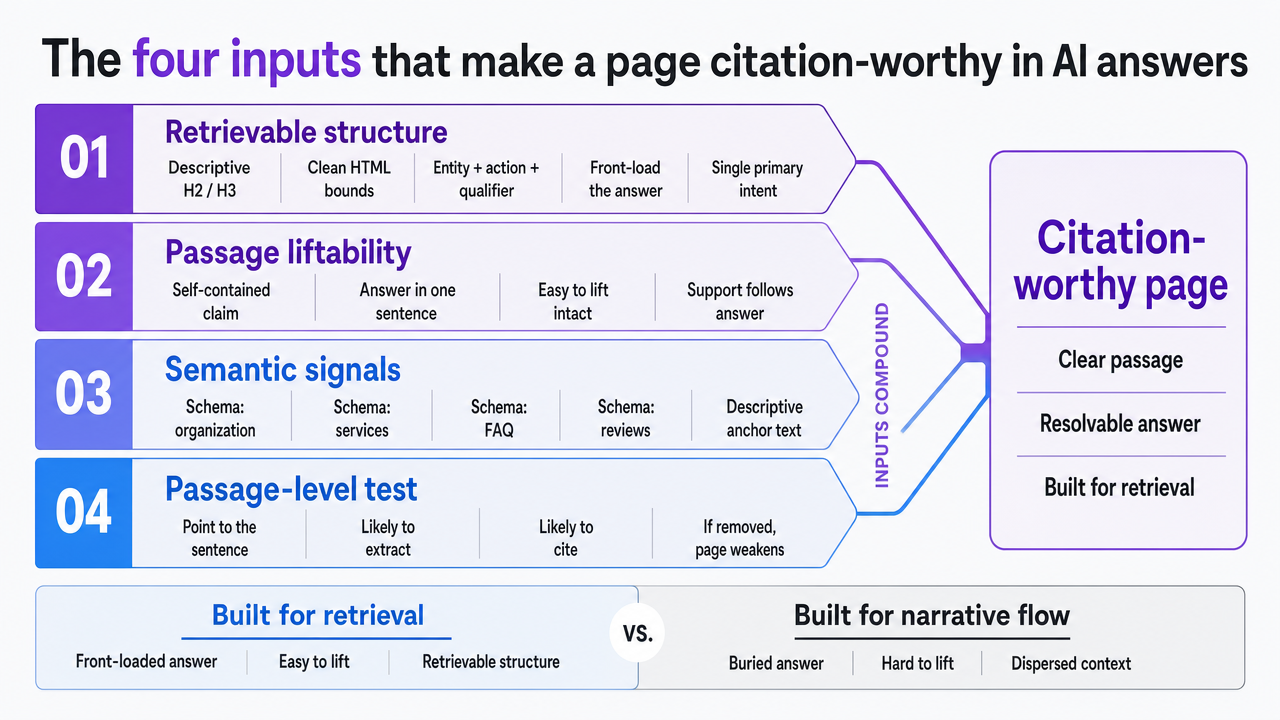 Visualize the four compounding inputs that determine whether a page gets cited in AI answers, matching the four subsections that follow
The single governance layer: FTC, NIST, and Copyright Office as GEO inputs
Three federal sources define the guardrails for any GEO program that touches regulated verticals, and treating them as separate compliance chores misses the point. Consolidated, they form the governance layer that also strengthens what retrieval systems trust.
Start with the FTC. The final rule on consumer reviews and testimonials, effective October 21, 2024, prohibits creating, selling, purchasing, or disseminating fake or false reviews, including AI-generated reviews that misrepresent a reviewer or an experience the person did not have, and it allows civil penalties for knowing violations 2. The FTC has clarified that a business may be liable when it creates or purchases fake reviews or uses reviews it knew or should have known were false 3. Because AI answer engines routinely summarize third-party review content, any shortcut in a reputation program becomes both an enforcement exposure and a source of summarization errors the model will attribute back to the client.
NIST's Generative AI Profile supplies the operational vocabulary. It names confabulation, information integrity, privacy, and accountability as risk categories that require management actions and human oversight when generative systems produce or shape content 9. Complementary NIST work on synthetic-content provenance describes authentication and history-tracking as controls that must be tested and audited in combination — no single technique solves misinformation on its own 1. For an agency, that translates into a documented review layer, source records for factual claims, and a way to prove what a human verified and when.
The Copyright Office closes the loop on ownership. Part 2 of its AI report concludes that AI outputs may be copyrightable where a human author determines sufficient expressive elements, but merely providing prompts is not enough by itself 4, 7. Its policy guidance instructs applicants to identify human contributions and exclude more-than-de-minimis AI-generated material from the copyright claim 5. For scaled content production across a client book, that means bylines, edit records, and asset ownership terms have to distinguish human authorship from AI-assisted drafting on every deliverable.
Rolled together, these three sources are not a legal appendix. They are the specification for the human review layer that makes a page citation-worthy, defensible, and owned.
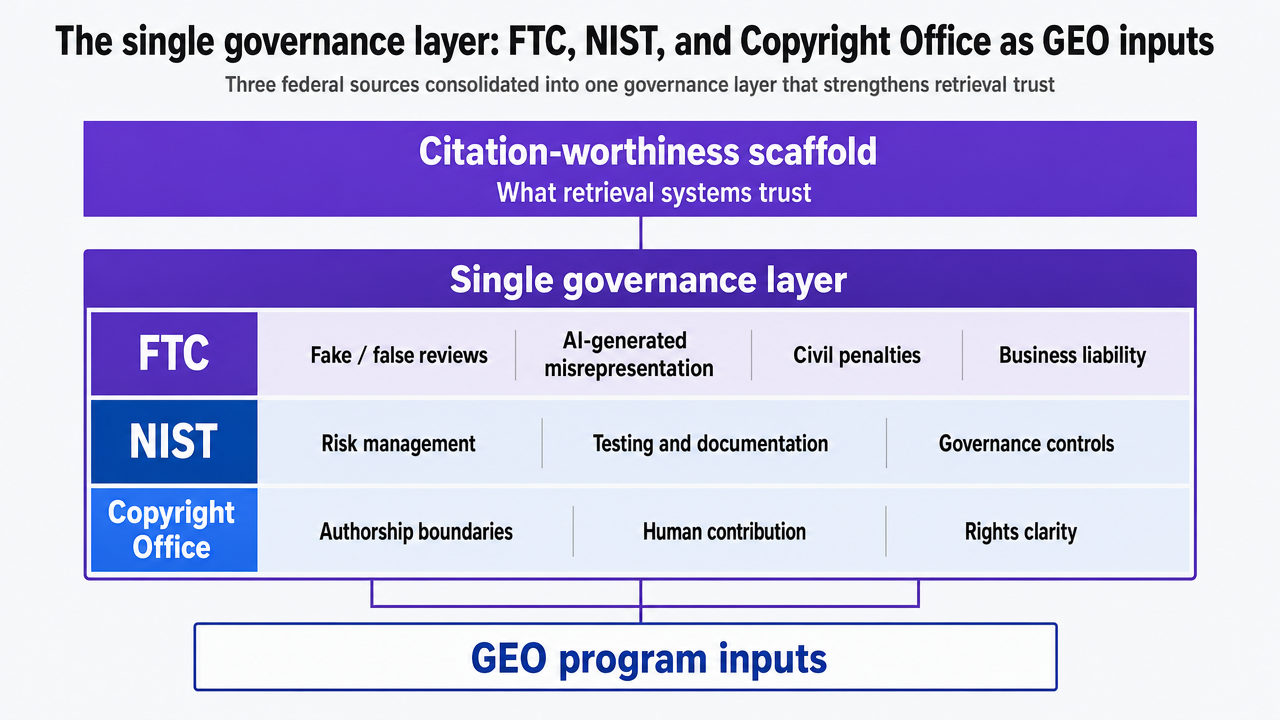 Consolidate the three federal governance sources into a single stacked layer that doubles as a citation-worthiness scaffold, mirroring the article's argument
See How AI-Powered Geo Optimization Outpaces Traditional Link-Building
Request a walkthrough of AI-driven geo optimization workflows that surface local intent signals, automate precision content, and deliver measurable lift across multi-location search performance—without expanding your SEO team.
Running GEO across a client book without adding specialists
Collapsing briefing, production, and QA into one approval loop
The traditional agency delivery model separates briefing, production, and quality review into sequential handoffs. A strategist writes a brief. A writer drafts. An editor reviews. A compliance reviewer checks for regulated-vertical exposure. A senior specialist approves. Each handoff burns hours, and each queue introduces drift between the strategic intent and the published page. For a team running GEO across dozens of accounts, that model does not scale — not because the work is harder, but because the number of pages that need retrofit against the four citation-worthiness inputs multiplies faster than headcount.
The alternative is to collapse the loop. Strategy, drafting, evidence verification, and legal-adjacent review live inside one queue where each artifact carries its own provenance record: who supplied the source claim, what dated evidence supports it, which human reviewed it, and when it was approved for publish. That record is not administrative overhead. It is the same documentation NIST's Generative AI Profile calls for when generative systems shape content that will be published under a client's name 9, and it is the same evidence trail that lets a senior reviewer approve at volume without re-reading every draft from scratch.
The operational shift is from writing more briefs to approving more decisions. A senior specialist stops drafting and starts ruling on ranked recommendations, flagged claims, and evidence gaps. Throughput rises because the bottleneck moves from production capacity to reviewer judgment, which is where an agency's actual expertise lives.
If you manage multiple locations or a portfolio of accounts: the utilization math
This section shifts scope from single-account GEO to the portfolio operator — the agency SEO lead responsible for 20, 40, or 80 client books, or the in-house team managing a multi-location brand with hundreds of location pages. The economics of retrofitting for answer-engine citation look different at that scale, and the honest way to see them is a variables exercise rather than a fabricated benchmark.
The retrofit workload for any GEO program can be expressed as a simple product: clients (or locations) in the portfolio, multiplied by priority pages per client that warrant retrofit, multiplied by hours per page under the current production model. The comparison variable is hours per page under a unified approval loop where drafting, evidence verification, and review compress into one queue. The table below is a planning template, not a pricing claim — the reader supplies their own values.
| Variable | Sequential handoff model | Unified approval loop |
|---|---|---|
| Clients or locations in portfolio | N | N |
| Priority pages per client warranting GEO retrofit | P | P |
| Senior specialist hours per page (brief + draft + edit + compliance + approve) | H₁ | H₂ (approval + exception handling only) |
| Total senior specialist hours | N × P × H₁ | N × P × H₂ |
| Reviewer role | Drafts, edits, approves | Approves ranked recommendations, rules on flagged claims |
Two numbers govern whether the portfolio math works. The first is H₂ relative to H₁ — how much of a senior specialist's per-page time is genuine judgment versus mechanical production the reviewer would rather approve than produce. The second is what the freed hours get reallocated to: net-new strategy for high-value accounts, additional retrofits deeper into the client book, or reduced utilization stress on a team already at capacity. The savings are real only if the reallocation is deliberate. Otherwise the hours evaporate into meeting overhead, and the portfolio ends up in the same place with a new tool bill.
A measurement stack that survives a QBR
A GEO measurement story that walks into a quarterly business review with a single number — citation share, mention count, answer-panel appearances — will not survive the second question the client asks, which is always some version of whether any of it moved the pipeline. The stack has to connect the answer surface to the phone line, and it has to do so without pretending that AI-answer visibility is a direct-response channel.
Three layers, reported together, hold up under scrutiny. The top layer is answer-engine visibility: how often the client is named in AI responses for a defined set of target queries, whether the summary is accurate, and which competing sources the model cites alongside. This is the layer most agencies obsess over, and it is the least meaningful in isolation. It belongs at the top because it is a leading indicator, not a business outcome.
The middle layer is the referral and branded-search signal. When an AI answer names a client, a share of readers act on it later — a branded query, a direct visit, a location-page entrance from an unattributed source. Search Console branded impressions, direct traffic to named service pages, and referral spikes from AI platforms that pass a source header form the honest read on whether the top layer is doing any work.
The bottom layer is the one that decides the QBR: qualified calls, booked consults, and pipeline. Call intelligence that reads recorded intake conversations, tags qualified inquiries, and flags missed opportunities closes the loop between an AI mention weeks ago and a signed matter, a booked hygiene appointment, or a scheduled estimate today. Without that layer, GEO reporting devolves into vanity metrics the client cannot defend to a CFO.
The measurement discipline is to report all three layers side by side, refuse to average them, and name the lag between them. AI-answer visibility this quarter shows up as branded search next quarter and as booked revenue the quarter after. A stack that respects that lag survives the QBR. A stack that promises linear attribution from citation to conversion does not.
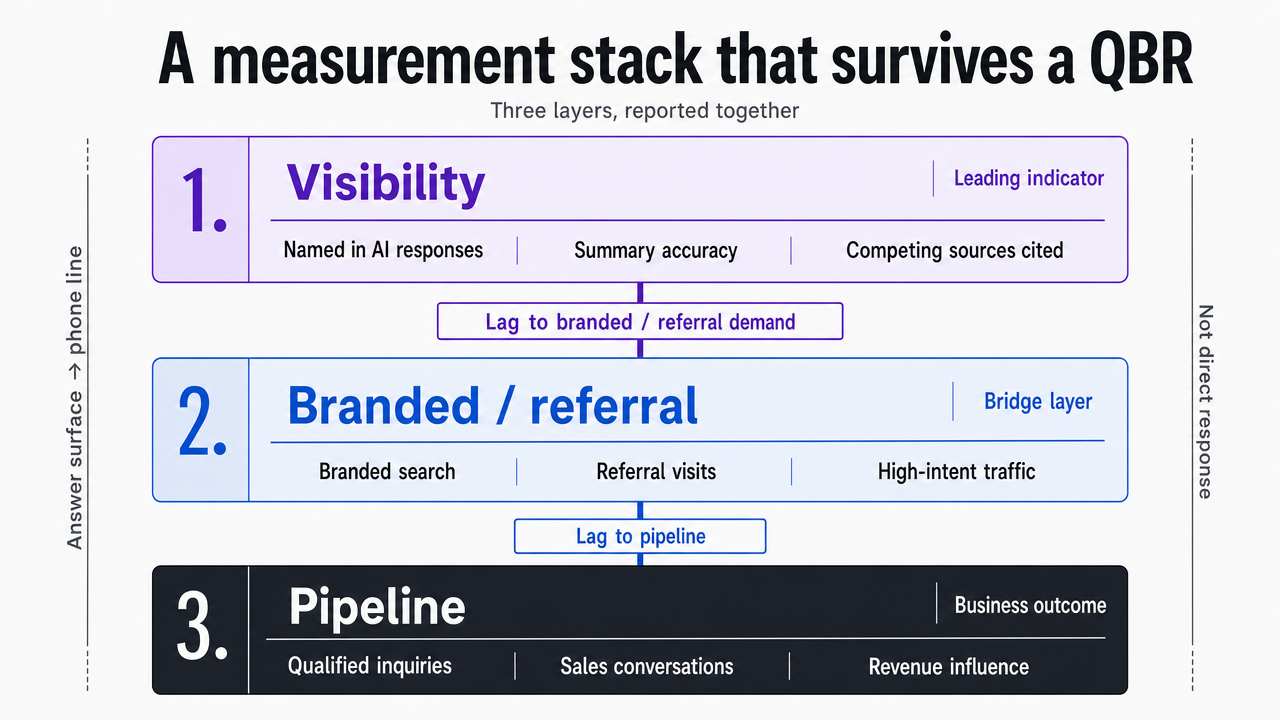 Diagram the three-layer measurement stack (visibility, branded/referral, pipeline) with the named lag between layers, directly supporting the section's core framework
Frequently Asked Questions
References
- 1.Reducing Risks Posed by Synthetic Content: An Overview of Technical Approaches to Digital Content.
- 2.Federal Trade Commission Announces Final Rule Banning Fake Reviews and Testimonials.
- 3.The Consumer Reviews and Testimonials Rule: Questions and Answers.
- 4.Copyright Office Releases Part 2 of Artificial Intelligence Report.
- 5.Works Containing Material Generated by Artificial Intelligence.
- 6.AI Index 2025: State of AI in 10 Charts.
- 7.Copyright and Artificial Intelligence, Part 2: Copyrightability.
- 8.Endorsements, Influencers, and Reviews.
- 9.Artificial Intelligence Risk Management Framework: Generative Artificial Intelligence Profile.
- 10.New front door to the internet: Winning in the age of AI search.