
Key Takeaways
- Cross-border expansion is a separate operating model, not a translation project, because language, regulators, and accessibility rules stop behaving as swappable variables across units.
- Locale architecture must be governed centrally, with ISO 639 language codes and ISO 3166 country codes mapped identically across CMS, analytics, URLs, and hreflang output 6.
- Content ownership splits cleanly: the center owns templates, schema, and substantiation logic, while franchisees supply credentials, services, pricing, and consented local assets a claim can be tied to 9.
- Market readiness depends on six sequential gates covering demand, locale architecture, translation memory, substantiation, accessibility, and measurement, and a market that fails any one is not close to launch.
Why Market Expansion Breaks the SEO Playbook Franchise Systems Already Use
The domestic multi-location playbook rewards repetition. One template, one schema pattern, one review-collection workflow, one measurement dashboard, cloned across 200 units with city and state variables swapped in. It scales because the underlying rules of the market, from language to advertising law to accessibility expectations, hold constant across every unit.
Cross-border expansion breaks that assumption at every layer. Language is no longer a variable to swap; it is a governance surface with competing code standards. The Library of Congress documents ISO 639-1 alpha-2 codes, ISO 639-2 alpha-3 codes, and ISO 3166 country codes as separate systems that a CMS, analytics stack, translation memory, and hreflang implementation may each interpret differently 4, 6. A franchise system that let 200 domestic units share one en template now has to reconcile en-US, en-CA, and en-GB variants that behave as distinct locales in search but share most of the underlying content.
The substantiation layer breaks too. FTC guidance requires that advertising claims be truthful, non-deceptive, and supported by evidence, and that endorsements reflect honest experience 9. Those rules governed the domestic templates. In new jurisdictions they do not automatically apply, and local equivalents may be stricter, differently scoped, or enforced by a different regulator entirely.
Market expansion is therefore not a translation project bolted onto the existing playbook. It is a separate operating model with its own architecture, its own approval gates, and its own unit economics.
Market Selection Before Architecture: The Economic Filter
Demand Validation Signals That Survive Translation
Keyword volume in a target language is the weakest signal in market selection. It confirms that people type words; it does not confirm that a franchise system can convert them into booked appointments at unit economics that clear.
Three signals survive translation and deserve weight before any locale architecture is drawn.
- The first is intent density in the vertical's high-value queries, measured against the number of same-vertical operators already indexed in that market. A dental support organization looking at Toronto faces a different competitive floor than the same DSO looking at Halifax, even though both are
en-CA. - The second is the availability of local proof inputs a franchisee can actually supply: named practitioners, credentials recognized by the local regulator, verifiable pricing, and appointment inventory. Without those, the location page cannot meet the FTC's baseline that claims be truthful and supported by evidence 9, and the equivalent local rule will usually be stricter.
- The third is measurement continuity. If call tracking, form handling, and consent capture cannot be wired the same way as in the domestic footprint, per-unit pipeline attribution breaks and the market cannot be compared to the rest of the system on the same dashboard.
Regulatory and Vertical Screens Before a Domain Is Bought
A behavioral health group opening across state lines and a home services brand entering the United Kingdom face the same architectural question and completely different regulatory ones. Domain selection, subfolder strategy, and hreflang can all be corrected later at a cost. A regulated-claim violation on a launched location page cannot.
The screen runs before procurement. For each candidate market, the central team confirms three things:
- Which regulator governs advertising for the vertical, and does it publish substantiation standards a template can be built against.
- Which credentials, license numbers, and disclosures must appear on any page offering the service, and whether the franchisee can supply them at the granularity the page requires.
- Whether reviews, testimonials, and any AI-generated creative are permitted in the format the domestic templates use; FTC guidance treats AI-generated avatars as potentially testimonial depending on use 3, and non-US regulators often go further.
Markets that fail any of the three do not get deferred to a later phase. They get reclassified: either the template is rebuilt for that jurisdiction before entry, or the market is removed from the expansion queue until a compliant version exists.
Locale Architecture as a Governance Problem, Not a Technical Choice
URL Structure, ISO 639, and ISO 3166 Across the Stack
Locale architecture fails in franchise systems for a predictable reason: the code standards were never governed in one place. A CMS may store language as en. The translation management system may require eng. GA4 may report locale as en-US. The hreflang implementation may combine language and country as en-CA. Each system is internally consistent. Together they produce mismatches that break reporting, misroute users, and disqualify pages from the correct search index.
The underlying standards are separate and deliberately so. The Library of Congress documents ISO 639-1 as the two-letter alpha-2 language code and ISO 639-2 as the three-letter alpha-3 language code, maintained as distinct lists for different technical uses 4. Country is a different dimension entirely, governed by ISO 3166, and the Library of Congress explains that language codes and country codes may be combined to represent a regional variant such as en-US but are not interchangeable 6. One country runs multiple languages. One language spans multiple markets with different terminology, regulators, and consumer expectations.
A franchise system entering three English-speaking markets and one bilingual market illustrates the governance load. The URL layer needs a single decision on subfolder pattern, applied identically across all four markets, before the first location page is drafted. The CMS locale field needs one code standard, mapped to the URL pattern, mapped to the analytics property, mapped to the hreflang output. When 200 franchisees each request their own URL variant, the mismatch surface grows faster than any manual audit can keep up with.
The operational rule is that locale codes are a central-team decision documented once and enforced through the publishing pipeline, not a per-market preference. Franchisees supply market inputs. They do not select code standards.
Hreflang Reciprocity and the 200-Franchisee Problem
Hreflang is a reciprocal declaration. Each locale variant of a page must point to every other variant, and every variant must point back. In a two-market system that is a handshake. In a franchise system with 200 units across six locales, it is a matrix with thousands of edges, and any single missing return-link can invalidate the cluster.
The failure mode is not technical illiteracy at the franchisee level. It is distributed authorship. When a Toronto operator publishes a new service page and a London operator publishes an equivalent page a week later, the reciprocal declarations on the other four locale variants do not update themselves. Without a central publishing pipeline that regenerates the full hreflang set on every change, the cluster degrades page by page.
Three controls hold the matrix together:
- Hreflang generation runs from a single source of truth mapping each canonical page to its locale siblings, not from franchisee-edited templates.
- Publishing is blocked until reciprocity validates across the affected cluster.
- Locale codes in the hreflang output match the CMS, analytics, and URL layer exactly, using the code standards fixed in the prior section 6.
A DSO expanding from the United States into Canada does not need a hreflang policy per unit. It needs one policy, enforced at publish time, that treats each franchisee submission as an input to the central pipeline rather than an independent release.
Test Global SEO Execution on Real Campaigns
Experience live international SEO workflows and publish content across multiple markets with full platform access for seven days.
Content Production: What the Center Owns and What the Franchisee Supplies
The Split: Templates, Schema, and Substantiation vs. Local Proof
The failure mode in localized content production is not translation quality. It is unclear ownership. When a franchisee is asked to produce a Toronto orthodontics page from scratch, the result is 200 different pages across 200 units, each with its own schema errors, missing disclosures, and inconsistent trust signals. When the central team produces all content without local input, the pages read as generic and cannot substantiate a single credential-specific claim.
The split is not negotiable and it is not by market.
The central team owns : the page template, the structured data schema, the URL and locale code pattern, the hreflang output, the accessibility conformance baseline, and the substantiation logic that governs what claims a page is allowed to make.
The franchisee owns : the inputs that make a specific location page truthful: the practitioner names and their credentials as recognized by the local regulator, the specific services offered at that unit, verifiable pricing where the vertical requires it, appointment availability, and consented photography of the actual location and staff.
This mapping matters because the FTC requires advertising claims to be truthful, non-deceptive, and supported by evidence 9. A centrally written outcome claim that no franchisee can substantiate is a template defect. A franchisee-supplied credential that no central reviewer verifies is an approval defect. The split fixes responsibility so that each defect has one owner and one place to correct it.
Approval Gates for AI-Assisted Localization at Scale
AI-assisted drafting is the only realistic mechanism for producing localized content across dozens of markets without hiring a per-market specialist. It is also the mechanism most likely to produce plausible-sounding text that violates a substantiation rule, misstates a credential, or drops a required disclosure. Both statements are true, and the reconciliation is not a better model. It is a sequence of approval gates that make the risks legible before publication.
The NIST AI Risk Management Framework and its Generative AI Profile, released July 26, 2024, provide the governance structure for this sequence. The framework treats AI risks as identifiable, measurable, and manageable through defined controls rather than eliminated by model selection 1. For a franchise system localizing hundreds of pages, that translates into six sequential gates a draft must pass before it publishes.
- Franchisee input arrives first as structured fields, not free text: practitioner roster, credentials with issuing body, service list, pricing where applicable, hours, and location assets.
- The central template merges those inputs into the locale-appropriate schema and URL pattern.
- An AI-assisted draft produces the on-page copy in the target language, working from the template's substantiation logic and the franchisee's supplied evidence, not from open-ended prompts.
- Substantiation review then checks every factual, credential, outcome, and pricing claim against the supplied evidence; claims that cannot be tied to a franchisee-supplied source are removed rather than reworded, consistent with the FTC requirement that advertising be truthful and evidence-backed 9.
- Accessibility validation runs against the conformance baseline.
- Hreflang generation regenerates the reciprocal cluster. Only then does the page publish.
Two temptations degrade the sequence. The first is treating AI-detection scores as a quality signal; NIST's own text-to-text evaluation work shows detector performance varies widely and does not measure factual accuracy or localization fitness 2. The second is collapsing substantiation review into the same step as drafting. When the drafter and the reviewer are the same pass, the reviewer inherits the drafter's assumptions and the gate stops functioning.
Human approval sits at the substantiation step, not at every step. The framework's value is that it isolates where judgment is required and automates the steps where it is not, which is what makes the sequence hold up at 50, 200, or 500 units.
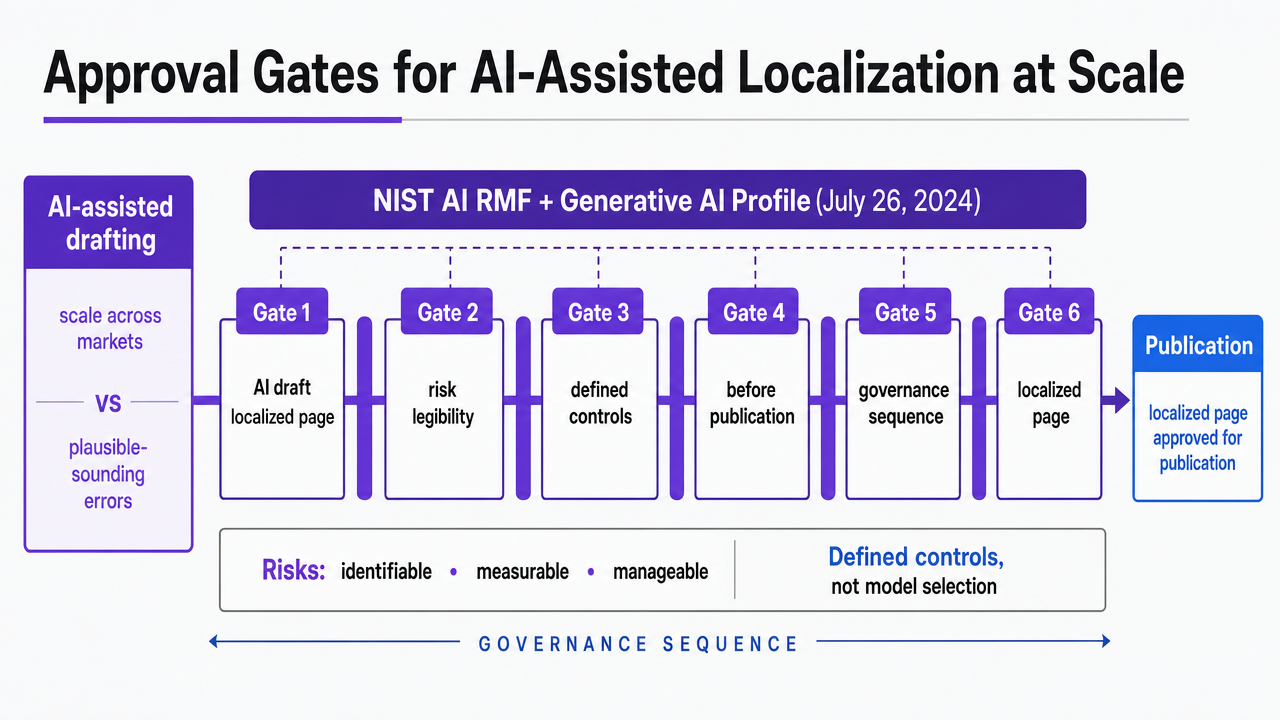 Visualize the six sequential approval gates a localized page must pass, which the section explicitly enumerates and ties to the NIST AI RMF governance structure
Reviews, Testimonials, and Local Proof Under FTC Scrutiny
Reviews are the highest-conversion asset on a location page and the highest-risk one. The FTC's 2023 Endorsement Guides require that testimonials reflect the endorser's honest experience and that material connections be disclosed 10. The Consumer Reviews and Testimonials Rule extends the exposure to fake reviews, suppressed negative reviews, and AI-generated avatars used in ways that function as testimonials 3. None of this is new to a domestic franchise system. What changes at market entry is the concentration of risk in the launch window, when a new location has few authentic reviews and franchisees are tempted to seed the page.
The operating rule for localized location pages holds franchisee-supplied reviews to three conditions:
- Each review is tied to a verifiable service event at that unit.
- Any incentive offered in exchange for a review is disclosed on the page where the review appears 8.
- AI-generated imagery of practitioners or patients is not used in a testimonial position, since the FTC treats an avatar's function, not its origin, as the trigger for testimonial rules 3.
US FTC guidance does not automatically govern non-US markets. A DSO entering Canada or the UK inherits a stricter local floor on health-adjacent claims, and the central review-approval step must load the correct jurisdictional ruleset before a launch page publishes.
Accessibility as a Market-Entry Gate
Accessibility is treated in most franchise expansion plans as a legal risk to be patched after launch. That framing understates the discoverability and conversion cost. Pages that fail basic conformance rank worse for the same query, convert worse for the same visitor, and expose the brand to jurisdiction-specific claims the central legal team may not track across every new market.
The U.S. Department of Justice identifies WCAG as the technical guidance businesses open to the public should follow to make websites accessible under the ADA 7, and its 2022 guidance explains the same expectation for public-facing sites 5. Those are U.S. rules. A DSO opening in Ontario or a home services brand launching in the UK inherits separate local requirements that the central team documents once and enforces through the same publishing pipeline that handles hreflang and substantiation.
The operating rule is that accessibility conformance is a pre-publish gate, not a post-launch audit. A localized page that cannot pass the baseline does not go live in the new market.
See How Centralized AI Execution Accelerates Global SEO for Multi-Location Brands
Connect with our team to explore data-backed workflows for scaling SEO strategy, localization, and approvals across international markets—without adding regional specialists or increasing operational overhead.
If You Manage Multiple Locations: Consolidation Economics of Market Entry
This section shifts scope. The rest of the plan applies to any operator crossing into a new market. The economics below apply specifically to franchise systems, DSO parent groups, home services brands, senior living portfolios, behavioral health networks, and multi-office legal groups entering more than one new market on a schedule the corporate team owns.
Three cost structures dominate the market-entry decision. Each one has a different scaling curve as the number of new markets N grows and the number of localized pages per market P grows with the vertical's service catalog. The choice is rarely made explicitly. It emerges from whatever was already in place when the first international unit opened, and it compounds from there.
The variables below are deliberately left as formulas rather than invented totals.
R : the monthly retainer of an in-market SEO agency in the target country, which varies widely by market and vertical.
F : the fully loaded annual cost of an in-house SEO specialist assigned to that market, including benefits, tooling, and management overhead.
P : the number of localized pages required per market at launch.
The only fixed dollar figure below is the disclosed $599 per month post-trial platform price for a centralized approval-gated model.
| Model | Monthly cost across N markets | Time to first launched page per market | Governance surface ||---|---|---|---|| Per-market agency retainer | R × N | 60–90 days per market, gated by retainer onboarding | N separate vendor contracts, N substantiation reviews, N hreflang implementations || In-house per-market SEO FTE | (F ÷ 12) × N | 90–180 days per market, gated by hiring | N specialists, one policy per hire, coordination cost grows with N || Centralized approval-gated platform with local franchisee inputs | $599 flat + variable franchisee input time | 14–30 days per market once template exists | One template library, one substantiation gate, one hreflang pipeline |
The first two models scale linearly in cost with N. The third scales linearly in franchisee input time only, because the template, the schema, the hreflang pipeline, and the substantiation logic are produced once and reused across markets. That is the consolidation the model earns.
The governance layer is what makes the third model defensible rather than reckless. The NIST AI Risk Management Framework treats AI risks as identifiable, measurable, and manageable through defined controls rather than eliminated by tool choice 1. Applied to market entry, that means the centralized model is not cheaper because it removes review. It is cheaper because it removes duplication of the same review across N vendor relationships, while keeping the human approval step where the substantiation risk actually sits.
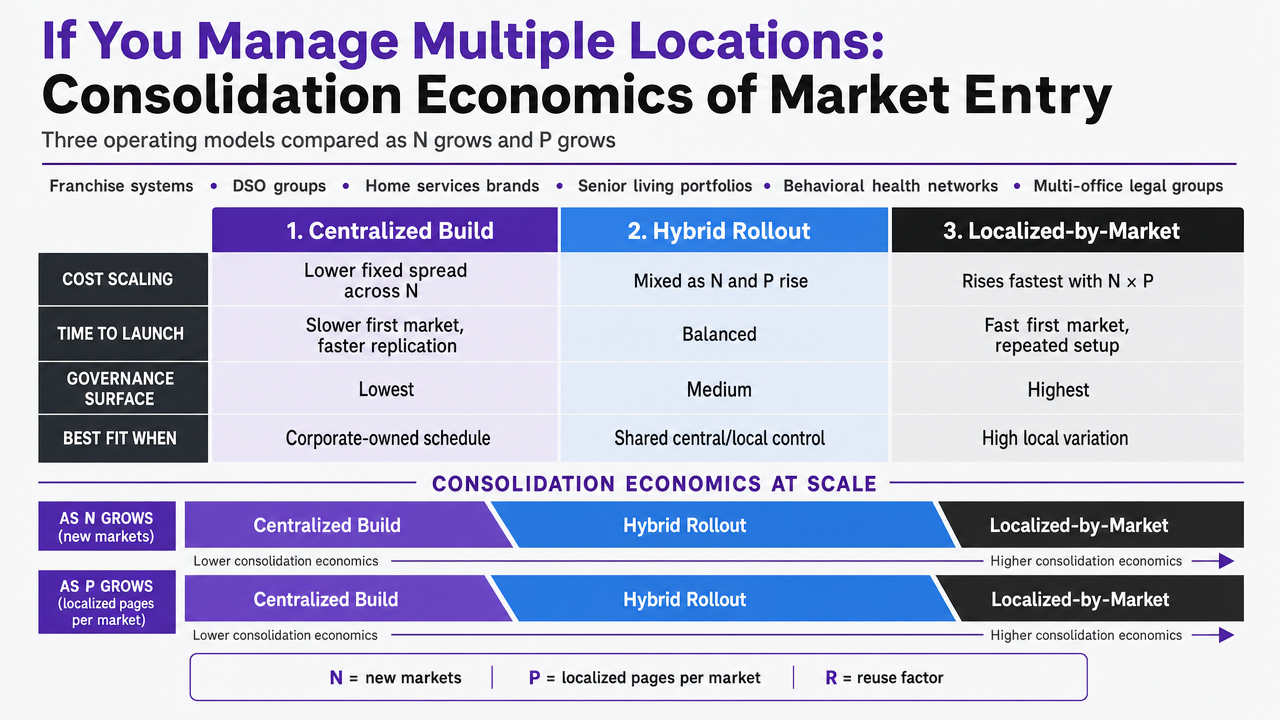 Render the section's comparison table of three market-entry operating models so readers can scan cost scaling, time-to-launch, and governance surface side by side
Measurement: One Layer From Locale Rankings to Unit Pipeline
Measurement fragments faster than any other layer of a market-entry program. A UK subfolder gets its own GA4 property because a franchisee's agency insisted on it. A Canadian subdomain reports call conversions in a separate Looker view because the local call tracking vendor was cheaper. Six months in, the corporate team cannot answer whether the Toronto units are converting locale traffic at the same rate as the Cleveland units, because the two numbers are not calculated the same way.
One measurement layer means three things enforced centrally:
- Locale codes in analytics match the codes in the URL, CMS, and hreflang output exactly, using the ISO 639 and ISO 3166 standards fixed earlier in the pipeline 6.
- Conversion definitions are identical across markets: a qualified call is qualified by the same criteria in Halifax and in Houston, or the two markets cannot be compared.
- Attribution runs to the unit, not to the market, so a franchisee in Manchester sees the same pipeline view as a franchisee in Miami.
The reporting output a franchise development VP needs at market entry is narrow: locale ranking movement on the vertical's high-value queries, page-level conversion rate against the domestic baseline, cost per qualified lead by unit, and time from first indexed page to first booked appointment. Everything else is diagnostic. When those four numbers are calculated the same way across every market, the expansion queue becomes a ranked list rather than a debate.
A Six-Gate Market-Entry Readiness Checklist
A market is ready to launch when six gates close in sequence, not when any single one clears. Skipping a gate does not accelerate entry; it pushes the failure downstream, where a substantiation defect or a broken hreflang cluster costs more to unwind than to prevent.
- Search demand validated in the target locale against the vertical's high-value queries and the count of same-vertical operators already indexed.
- Locale architecture defined: URL pattern, ISO 639 language code, and ISO 3166 country code fixed centrally and mapped across CMS, analytics, and hreflang output 6.
- Translation memory seeded with vertical-specific terminology the franchisee can review, not open-ended machine output.
- Substantiation reviewed against the local regulator's rules for credentials, outcomes, pricing, and testimonials, using FTC baselines only where the market is US 9.
- Accessibility conformant to the jurisdiction's applicable standard, verified pre-publish 7.
- Measurement wired so locale rankings, page conversion, cost per qualified lead, and time-to-first-appointment report on the same definitions as the domestic footprint.
A market that fails one gate is not close. It is not ready.
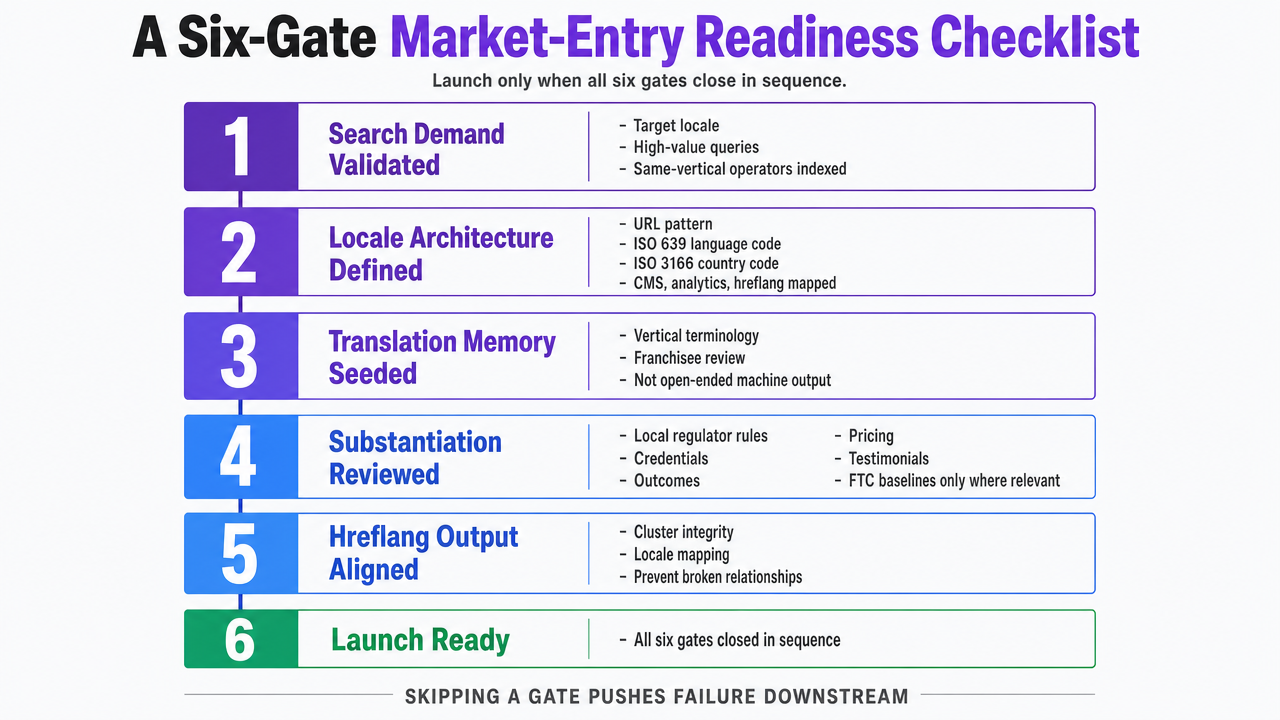 Convert the section's six sequential readiness gates into a scannable checklist infographic that mirrors the article's stated launch criteria
Frequently Asked Questions
References
- 1.AI Risk Management Framework.
- 2.2024 NIST GenAI (Pilot Study): Text-to-Text Evaluation Overview and Results.
- 3.The Consumer Reviews and Testimonials Rule: Questions and Answers.
- 4.ISO 639-2 Language Code List - The Library of Congress.
- 5.Justice Department Issues Web Accessibility Guidance Under the Americans with Disabilities Act.
- 6.Frequently Asked Questions (FAQ) - Codes for the Representation of Names of Languages.
- 7.Guidance on Web Accessibility and the ADA.
- 8.Endorsements, Influencers, and Reviews - Federal Trade Commission.
- 9.Advertising FAQ's: A Guide for Small Business.
- 10.Advertisement Endorsements - Federal Trade Commission.