
Key Takeaways
- Predictable growth depends on three audited capabilities working together: search-quality alignment, regulatory substantiation, and closed-loop attribution from query to revenue inside the buyer's own systems.
- Search-quality alignment requires operationalizing credibility signals like named authorship, external sources, expert review dates, and readability at the template level, not leaving them to individual writer judgment 2.
- Regulatory substantiation maps HIPAA, FDA OPDP, FTC endorsement rules, and AMA truth-in-advertising obligations to specific SEO activities, with vendors expected to produce artifacts rather than policy language 4, 6, 9, 11.
- Closed-loop attribution means tracing a query through landing page, sessions, lead events, and CRM or EMR outcomes; reporting that stops at sessions and assisted conversions is not growth.
- Weight the three axes against your risk profile, score on evidence rather than vendor claims, and set per-axis floors so a strong category cannot mask a failing one.
- Contract language should convert each axis into enforceable obligations, including business associate agreements, OPDP-style reviews, disclosure standards, and termination rights if closed-loop reporting is not delivered within 90 days 6.
- For multi-location operators, per-location retainers multiply coordination hours, compliance audits, and credential-update paths, often making account-level programs cheaper once duplicate data flows and reporting reconciliation are counted 6, 9.
- A genuine reporting stack joins GA4, Search Console warehouse exports, call tracking, and CRM or EMR identifiers inside the buyer's systems, so attribution survives after the vendor contract ends.
What predictable growth from search actually requires
Predictable growth from Google SEO services is not a ranking outcome. It is the product of three audited capabilities working in sequence: content that aligns with how Google evaluates quality, work that holds up under the regulators governing the buyer's industry, and measurement that connects a query to revenue inside the buyer's own systems. Vendors that can evidence all three produce results a CFO can defend. Vendors that can only show position tracking and traffic curves produce volatility.
Search engines remain the dominant entry point for the audiences SaaS and healthcare buyers care about, which is why Google-aligned execution still anchors most acquisition programs 7. Users also bring an assumption of neutrality to those results, placing the burden of accuracy on publishers rather than the algorithm 8. That burden is operational, not philosophical. It shapes what an SEO partner can safely write, schema, and promote.
The sections that follow give directors a weighted scoring rubric, contract language, and reporting-stack requirements that translate these capabilities into a vendor review any procurement team can run.
The three axes most buyers underweight
Search-quality alignment beyond rankings
Most vendor decks treat search-quality alignment as a content calendar plus an E-E-A-T bullet list. That framing misses what readers actually do on a results page. A systematic review of online health information seeking found that users rely on search engines as their primary entry point, then struggle to judge credibility once they land, often defaulting to surface signals like named authors, citations, source type, and recency to decide whether to trust what they read 2. A vendor that cannot operationalize those signals at the page level is producing content that may rank briefly and convert poorly.
Directors should ask any prospective SEO partner to walk through a live page and point to four things:
- who authored it and how that authorship is exposed in markup and on-page byline,
- what external sources back the substantive claims,
- when the page was last reviewed by a named subject expert,
- and how the source type (clinical, editorial, commercial) is disclosed.
If the answer reduces to internal links and meta descriptions, the vendor is optimizing for crawlers without addressing how the reader evaluates the page.
Readability is part of the same axis. The scoping review on digital health literacy treats the design and quality of online information as a determinant of comprehension and decision-making, not a stylistic preference 1. Vendors should be able to produce content samples graded for reading level, structured for scanability, and tested against the literacy profile of the buyer's actual audience. Keyword density alone does not satisfy this criterion.
Regulatory substantiation as a procurement criterion
The second axis treats regulators as procurement inputs, not legal afterthoughts. Five bodies govern what an SEO or PPC vendor can safely produce for a healthcare or regulated-SaaS buyer, and each one maps to a specific activity inside a standard SEO scope of work.
HIPAA marketing rules govern any data flow that touches protected health information. HHS guidance requires written authorization, with limited exceptions, before PHI can be used or disclosed for marketing purposes, which directly constrains analytics tag placement, audience building, remarketing pixels, and lead-form handling on pages that capture clinical intent 6. A vendor that places third-party tags on appointment pages or builds remarketing audiences from condition-specific URLs without a documented data agreement has already failed the test.
FDA OPDP governs how prescription drug names and condition-treatment pairings can appear in promotional content, requiring truthful, balanced communication of benefit and risk 4. FDA's industry guidance on internet and social media extends those expectations to character-limited environments, user-generated content moderation, and correction of misinformation on properties the brand controls 5. Any vendor running branded search or producing condition pages tied to specific drug or device claims should be able to show a review workflow that addresses both.
FTC endorsement rules cover review generation, testimonials, and influencer-style case studies. The Commission's guidance bars buying, suppressing, or editing reviews to distort consumer impressions and requires clear disclosure of material connections 11. Local SEO providers that pitch review-velocity tactics should be asked specifically how they comply.
AMA Truth in Advertising obligates accurate representation of clinician training, licensing, and credentials in advertising and on websites 9. That obligation extends into structured data: a Physician schema entry that overstates board certification or specialty is the same misrepresentation as a misleading bio paragraph. The AMA's DTC guidelines, developed with FDA, add the requirement that risk information appear in balance with benefit claims 10.
Closed-loop attribution from query to revenue
The third axis is the one that separates predictable from reported. A vendor's monthly deck can show rankings, sessions, and assisted conversions while the buyer's CRM or EMR shows flat qualified pipeline. Closed-loop attribution exists when a query can be traced through landing page, session, lead event, and downstream revenue event inside systems the buyer already controls.
At minimum, that means:
- GA4 configured with server-side or consent-mode events that respect the buyer's privacy posture,
- Search Console connected at the property level with query-to-page mapping retained beyond the 16-month default through warehouse export,
- call tracking that attributes inbound calls to the entry query and landing page rather than to the channel bucket,
- and a CRM or EMR-side identifier that ties the lead to a closed-revenue or scheduled-appointment outcome.
Without all four, the vendor is reporting traffic, not growth.
For buyers subject to HIPAA, the analytics stack itself becomes a compliance artifact. Tag placement on PHI-adjacent pages must be reconciled with the marketing rules governing how that data can be used 6. Vendors that propose standard GA4 implementations on appointment-request or condition-specific funnels without addressing this should be treated as a procurement risk, not a technical detail.
The practical test during vetting: ask the vendor to produce a sample report that shows, for a single keyword cluster, the page that ranked, the sessions it drove, the leads it created in the CRM, and the revenue or appointment value those leads produced over a defined window. If the vendor cannot produce that path on a current client, the program being sold is not predictable growth. It is rank reporting with a marketing layer.
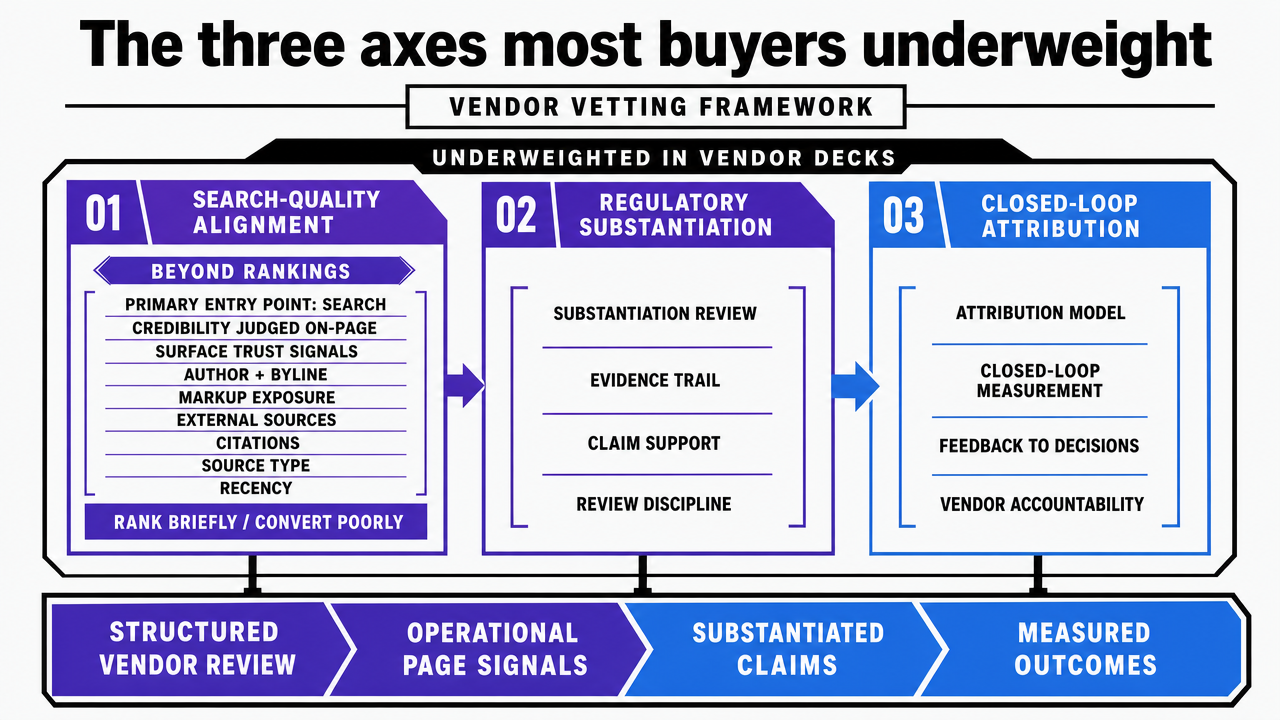 Visualize the three-axis vetting framework (search-quality alignment, regulatory substantiation, closed-loop attribution) that structures the entire vendor review, since this section defines the framework referenced throughout the article
A weighted scoring rubric you can run in a vendor review
Weighting the three axes against your risk profile
The three axes do not carry equal weight in every buying context. A SaaS director selling a non-regulated developer tool can weight search-quality alignment heavily and treat regulatory substantiation as a lighter screen. A multi-location healthcare operator cannot. The rubric should reflect that asymmetry rather than averaging the scores.
A defensible starting weight set for a regulated buyer: 35% search-quality alignment, 35% regulatory substantiation, 30% closed-loop attribution. For a non-regulated SaaS buyer with a long sales cycle: 40% search-quality alignment, 15% regulatory substantiation (FTC endorsement rules still apply to review and testimonial work 11), 45% closed-loop attribution, because the pipeline math is what the CFO will challenge. For a healthcare buyer running paid search alongside organic on condition-treatment pairings, regulatory substantiation rises to 40% because FDA OPDP exposure on noncompliant claims is enforcement-grade, not reputational 4.
Score each axis on a 1 to 5 scale against evidence the vendor produces during the review, not against what they describe. A vendor that claims HIPAA-aware analytics but cannot produce a tag map for a current client scores a 2 on that axis, not a 4. Multiply, sum, and rank. Vendors below a pre-set floor on any single axis should not be averaged into contention.
Interview questions tied to each axis
Interview questions should force the vendor to produce artifacts, not narrate process. The following set maps directly to the three axes and the regulators that govern each one.
Search-quality alignment. Walk through a current client's top-performing page and identify the named author, the credential exposure in markup, the external sources backing substantive claims, and the last subject-expert review date. Show a content sample graded for reading level and explain how that grade was matched to the audience's literacy profile 1. Describe how credibility signals like authorship, citations, and source type are operationalized at the template level rather than left to writer judgment 2. Explain the editorial review step that prevents misinformation from being published on a property the brand controls 3.
Regulatory substantiation. Produce the tag map and data flow diagram for a HIPAA-covered client, including where written authorization is required and how remarketing audiences are constructed 6. Describe the review workflow for any page or ad referencing a prescription drug or condition-treatment pairing, including how risk and benefit are balanced 4, 5. Show the disclosure pattern used for testimonials, reviews, and case studies, and explain how material connections are surfaced to the reader 11. Produce the Physician or LocalBusiness schema entry for a current client and explain how credential accuracy is verified before publication 9, 10.
Closed-loop attribution. Produce a single-keyword report that traces query, landing page, session, lead event, and CRM or EMR-side outcome on a current client. Identify any gaps in that path and explain how they would be closed in the first 60 days of engagement.
Red flags that should fail a vendor automatically
Some findings during a vendor review should end the conversation rather than reduce a score. They indicate either a knowledge gap that will create exposure or a sales posture that will not survive contact with a CFO or compliance officer.
- Guaranteed rankings or guaranteed traffic volumes within a fixed window. Google's ranking systems do not support that guarantee, and the promise usually maps to tactics that create volatility or manual-action risk.
- Standard GA4 or third-party tag implementations proposed for HIPAA-covered pages without a data agreement, authorization framework, or discussion of how PHI-adjacent events will be handled 6. This is the most common disqualifier inside healthcare procurement and the one vendors most often try to defer.
- Review-generation tactics that involve incentives, gating negative reviews, or templated testimonial language without disclosure of material connections 11. Local SEO providers pitching review velocity should be asked specifically how they comply; vague answers fail.
- Branded drug or device content with no described OPDP review step, or social and search ad copy that presents benefit without balanced risk 4, 5.
- Credential or specialty claims in on-page bios or Physician schema that the vendor cannot tie to a verification source 9.
- Inability to produce closed-loop reporting on any current client. Reporting that stops at sessions and assisted conversions is not predictable growth.
Experience AI-Led SEO Execution in Real Time
Trial delivers live content output for your SEO program, allowing immediate assessment of workflow speed and quality.
Contract language that protects predictable outcomes
Scoring a vendor well does not protect the buyer if the contract leaves the three axes unenforced. Master services agreements and statements of work should convert each axis into a specific obligation, with remedies that bite before the renewal date rather than after.
On search-quality alignment, require named-author bylines, credential exposure in markup, and a documented editorial review step on every published asset, with the vendor warranting that content is reviewed against misinformation standards before publication 3. Include a takedown and correction window measured in business days, not quarters.
On regulatory substantiation, the SOW should name the regulators in scope and assign responsibility for each. A HIPAA business associate agreement is mandatory wherever the vendor touches systems handling protected health information, with an explicit prohibition on remarketing audiences built from PHI-adjacent URLs absent written authorization 6. For any branded drug or condition-treatment content, require a documented OPDP-style review with balanced risk presentation 4, 5. For review generation and testimonials, require FTC-compliant disclosure of material connections and a prohibition on incentivized or gated reviews 11. For credential claims and Physician schema, require verification against a primary source before publication 9, 10.
On attribution, require monthly closed-loop reporting tied to CRM or EMR outcomes, with termination-for-cause rights if the path cannot be produced within 90 days of kickoff.
If you manage multiple locations or service lines
Per-location retainer vs. account-level program economics
This section shifts scope from single-property SaaS buyers to multi-location healthcare operators and any growth team running SEO across more than one site, brand, or service line. The vetting axes from earlier sections still apply, but the unit economics underneath them change in ways that should force a structural review of how SEO services are bought.
The traditional retainer model bills per location or per property, with each engagement carrying its own kickoff, keyword research, content calendar, and reporting cadence. The account-level program model bills once for a single growth plan that spans every location and service line under one strategy. The math is not abstract. Operators can compare the two models using four labeled variables drawn from their own contracts:
L : number of locations or sites in scope,
R : per-location monthly retainer,
C : internal coordination hours per month required to keep per-location work aligned,
A : the account-level monthly fee for a single program covering all L locations.
| Cost driver | Per-location retainer | Account-level program |
|---|---|---|
| Monthly vendor spend | L × R | A |
| Internal coordination load | C hours × L (scales with sites) | C hours (fixed at the account) |
| Strategy duplication | Repeated per engagement | One plan, applied across L |
| Compliance review surface | L separate data flows to audit | One data flow, audited once |
| Reporting reconciliation | L decks to normalize | One report rolled up by location |
The compliance row is the one most procurement teams miss when modeling cost. HHS guidance requires written authorization, with limited exceptions, before protected health information can be used or disclosed for marketing 6. Each per-location vendor relationship is a separate data flow to audit, a separate tag map to review, and a separate authorization framework to maintain. The account-level model consolidates that surface into one agreement, which materially changes the total cost of ownership even when L × R is close to A on paper.
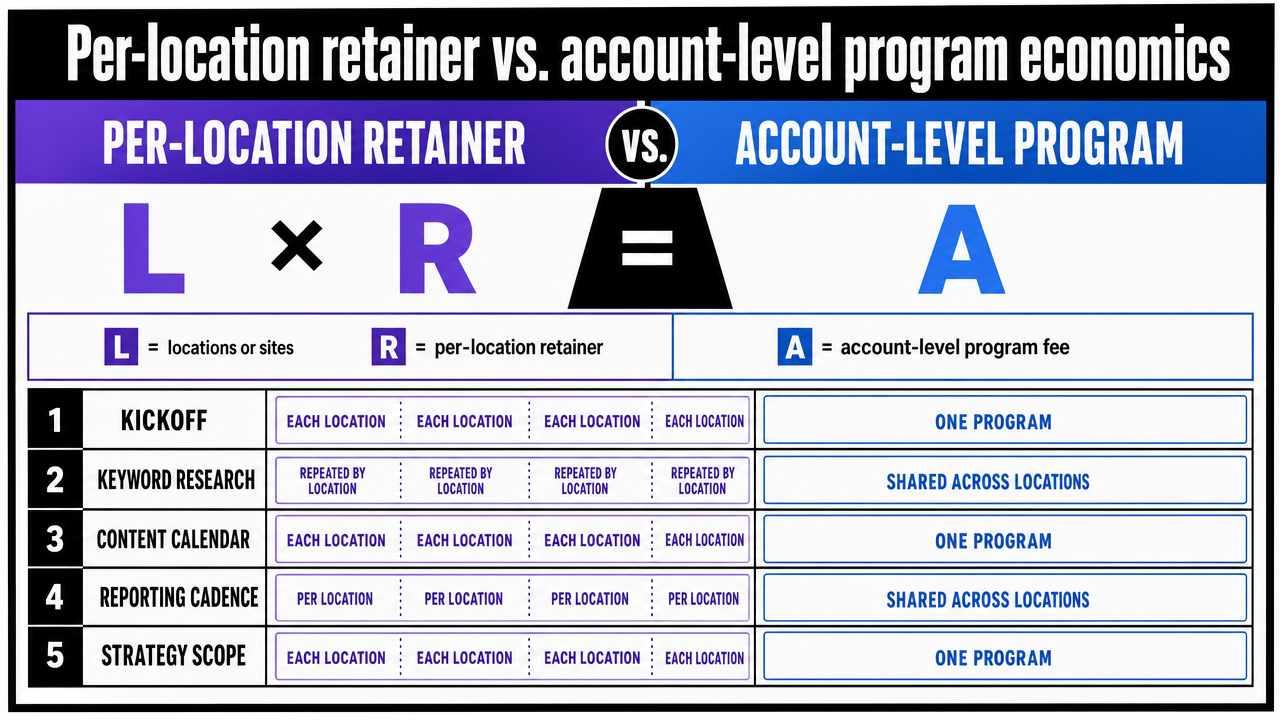 Visualize the side-by-side cost comparison table from the section, including the L × R vs A math and the five cost-driver rows, so readers can scan the structural economic difference between the two operating models
Coordination drag and credential accuracy across sites
Coordination drag is the second cost the retainer model hides. Every per-location engagement produces its own approval queue, its own editorial calendar, and its own reporting format. A growth director running ten sites is reconciling ten versions of the same monthly conversation, which is where deadlines slip and brand voice fragments. The internal hours captured by C in the prior table are real headcount, not overhead.
Credential accuracy is the operational risk that compounds with scale. AMA Truth in Advertising obligates accurate representation of clinician training, licensing, and specialty across every communication channel, which includes provider bio pages, location pages, and Physician schema on each site 9. When a clinician moves between locations, adds a board certification, or changes practice scope, the update has to propagate to every page and every structured-data entry referencing that provider. A per-location vendor structure means L separate teams are each responsible for catching that change, and the failure mode is a misrepresented credential surviving in production on the locations no one updated.
A vetting question that surfaces this risk: ask the vendor how a single credential change for a single clinician propagates across all sites and schema entries under the contract, and how that change is verified before publication 10. Vendors that cannot describe a one-touch update path are selling coordination drag as a service.
See How Leading SaaS Teams Standardize Google SEO for Predictable Results
Request a walkthrough of data-driven workflows that eliminate manual SEO handoffs, ensure consistent execution, and deliver forecastable growth—purpose-built for agencies and enterprise-scale brands managing multiple domains or service lines.
Reporting stack requirements that separate predictable from reported
A vendor's monthly deck is not a reporting stack. The stack is the system of record that connects a search query to a revenue event without manual reconciliation. Four components have to be in place, and each one carries a configuration test a director can run during vetting.
GA4 must be configured with explicit lead and conversion events tied to the buyer's actual pipeline stages, not the platform defaults. For healthcare buyers, event design has to reconcile with HIPAA marketing constraints on how PHI-adjacent interactions are captured and used 6. Search Console should be connected at the property level with query and page data exported to a warehouse, since the native interface retains only 16 months and discards the granularity needed to attribute outcomes back to specific clusters. Call tracking has to attribute inbound calls to the entry query and landing page, not to a channel bucket labeled organic. CRM or EMR-side identifiers have to tie the lead to a closed-revenue or scheduled-appointment outcome on the buyer's system, not the vendor's dashboard.
The vetting test is concrete. Ask the vendor to produce a current-client report that traces one keyword cluster through landing page, sessions, lead events, and downstream outcome value, with the data joined inside the buyer's warehouse or CRM rather than a vendor-hosted view. Vendors that route this through proprietary dashboards retain the attribution layer as a switching cost. Vendors that build the join inside the buyer's stack produce reporting the buyer can still run after the contract ends, which is the operational definition of predictable.
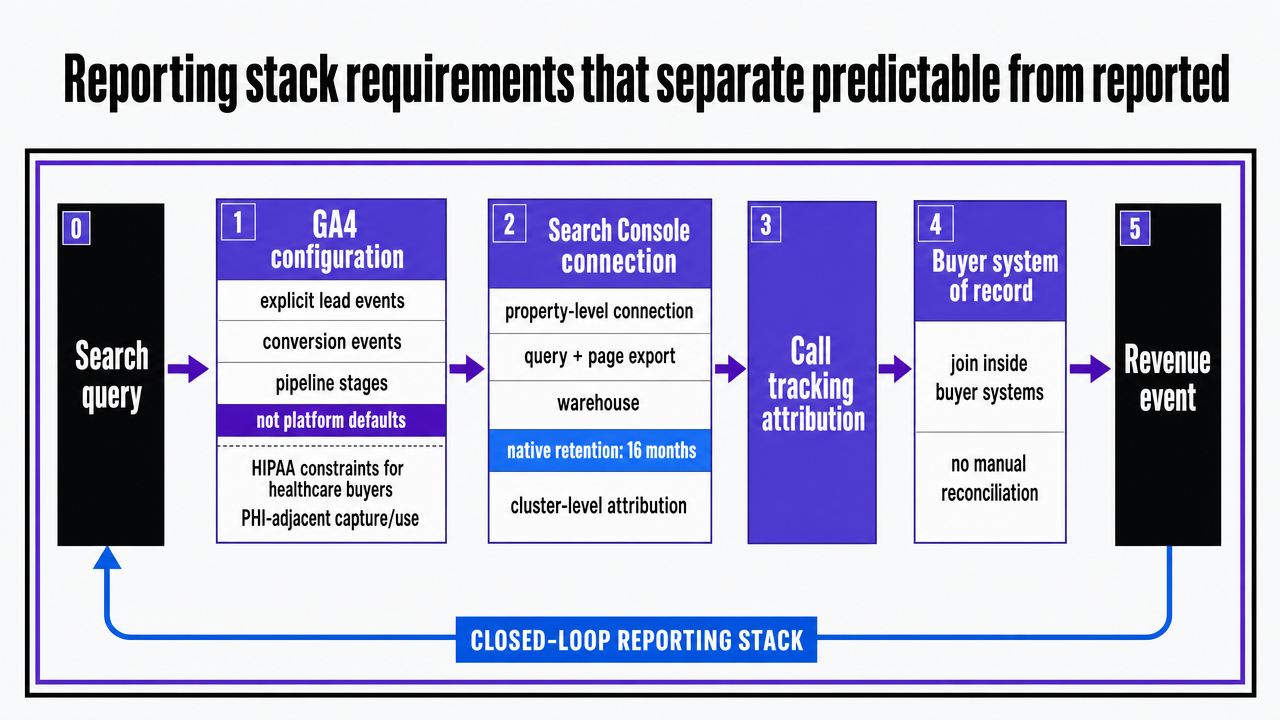 Visualize the four-component closed-loop reporting stack as a left-to-right data flow from query to revenue, since the section explicitly defines the four required components and the join inside the buyer's systems
Where retainer agencies and autonomous execution platforms diverge
Retainer agencies and autonomous execution platforms are not two flavors of the same offering. They differ in where strategy lives, how work moves from approval to publication, and what the buyer owns at the end of the contract. Retainer agencies sell hours staffed against a scope, with strategy concentrated in account managers and execution distributed across writers, link builders, and analysts who rarely see the same client deck. The coordination tax shows up as missed deadlines, drifting brand voice, and reporting that lags the work by 30 to 60 days.
Execution platforms invert that structure. Strategy is encoded in the system and applied uniformly across every page, location, and channel under one account-level plan. Approval workflows replace status calls. Content production, technical optimization, and review generation run against the same compliance ruleset, which materially reduces the audit surface for HIPAA-covered buyers and the disclosure surface for FTC-governed review work 6, 11. The buyer retains the data layer, the schema, and the closed-loop reporting after the engagement ends, rather than handing it back to the vendor's dashboard.
Vectoron operates in this second category, built for growth teams that need execution capacity without the retainer math.
Frequently Asked Questions
References
- 1.Digital literacy as a new determinant of health: A scoping review.
- 2.Online Health Information Seeking Behavior: A Systematic Review.
- 3.Health Misinformation.
- 4.The Office of Prescription Drug Promotion (OPDP).
- 5.For Industry: Using Social Media.
- 6.Marketing | HHS.gov.
- 7.Main findings | Search engine use.
- 8.Search Engine Users.
- 9.Truth in advertising.
- 10.American Medical Association guidelines on direct to consumer advertising.
- 11.FTC's Endorsement Guides: What People Are Asking.