
Key Takeaways
- No single site checker scales across a client portfolio; agencies need a pipeline anchored to Google's own surfaces, with human review reserved for genuine exceptions.
- A three-tier pipeline works best: account-level pattern detection first, template-level sampling and rendered-output validation second, and URL Inspection only for ambiguous exceptions.
- URL Inspection's 2,000 queries per day per site 2makes full-site scans impractical, forcing change-based sampling prioritized by modifications, pattern shifts, and template escalations.
- Apply Core Web Vitals as template-level pass/fail gates using the 75th percentile thresholds 8, since a failing template affects every URL rendered through it.
- Duplicate clusters surface in Page Indexing states and should be resolved by following the canonical signal hierarchy, where redirects and rel=canonical outweigh sitemaps 5.
- Split structured data audits into automated syntax and regression monitoring versus quarterly human spot-checks that confirm markup matches visible content 10.
- AI can execute template-scale remediations when a reviewer confirms genuine user value, but thin variations across locations or queries risk scaled content abuse 12.
- Measure analyst output by templates gated and exceptions routed, not URLs reviewed; portfolios routing under 5 percent to senior review scale with junior headcount.
Why No Single Checker Scales an Agency Book
The idea of a single "google seo site checker" that grades a site and provides a fix list is impractical for agencies managing multiple clients. This approach fails when applied to 50 clients using different technology stacks and template inventories. A scalable solution is a pipeline that leverages Google's own tools as the primary source of truth, reserving human intervention for genuine exceptions.
Google Search Console offers the essential data for a robust audit: Page Indexing for coverage, Crawl Stats for host behavior, URL Inspection for page-specific validation, the Performance report for query impact, Core Web Vitals for user experience, and structured-data status for rich result eligibility 1. The challenge isn't data availability but throughput. The URL Inspection API is limited to 2,000 queries per day and 600 per minute per site 2. This constraint makes daily inspection of a 50,000-URL client, let alone multiple clients, impossible for an agency.
Therefore, scaling an audit becomes a problem of sampling and routing. Account-level reports identify patterns, templated sampling validates them, and URL Inspection confirms ambiguous cases. Automation handles the rest. Agencies that achieve high coverage per analyst hour have shifted from seeking a better checker to designing pipelines around Google's exposed data, its rate limits, and what it doesn't provide.
The Three-Tier Audit Pipeline Built on Google's Own Surfaces
Tier 1: Account-Level Pattern Detection
Pattern detection is crucial for audit scalability. At this level, auditors analyze distributions rather than individual pages. They examine the number of URLs in each Page Indexing state, trends in Crawl Stats host statuses, weekly impression losses in Performance queries, and drops in valid structured-data items after template updates. Google recommends combining Page Indexing and Crawl Stats to identify different URL sets and failure modes 3.
In Tier 1, no individual URL is examined. A junior analyst regularly pulls account-level reports and notes significant changes:
- an increase in "Crawled - currently not indexed" URLs,
- a decrease in average response time,
- a spike in 5xx errors,
- or a reduction in valid structured-data items for a specific type.
Each change leads to a hypothesis about a template, directive, redirect chain, or deployment. Search Console's Index Coverage view provides sufficient signals to investigate a hypothesis without opening any URLs 1.
Agencies that bypass this tier and immediately inspect individual URLs waste quota and analyst time on symptoms. The account-level pass transforms the audit into a series of pattern investigations instead of thousands of page reviews. For an agency managing twenty clients, this approach allows one analyst to produce weekly summaries for the entire portfolio, a stark contrast to three analysts providing partial coverage for only five sites.
Tier 2: Template-Level Sampling and Validation
Tier 2 converts hypotheses into actionable evidence. Once Tier 1 identifies a pattern, the next step is to sample the affected templates, not the entire site. For an e-commerce client, this involves selecting a few product, category, and editorial URLs per pattern, prioritizing templates with the most impressions in the Performance report. For large publishers, sampling aligns with sitemap segmentation, a method Google suggests for guiding crawlers on extensive sites 4.
Validation at this tier focuses on rendered-output checks, not just source HTML. On JavaScript-heavy sites, Google renders pages after crawling and may fail to execute scripts from blocked resources 6. An auditor comparing server HTML to the rendered DOM can identify missing canonicals, links, or content that never reaches the index. A template-level render check on ten representative URLs is more reliable than a source-only scan of ten thousand.
Sample sizes are determined by the required confidence, not by tool defaults. Typically, ten to twenty URLs per template suffice to distinguish a template defect from a content-specific edge case. If the sample reveals inconsistencies, the issue escalates to Tier 3. If the sample is consistent, the finding is documented as a template fix with a clear owner and deployment path.
The efficiency gain here is structural: fixing a template resolves issues for all URLs rendered through it, whereas fixing URLs individually is a one-by-one process. Agencies that excel at audit delivery prioritize identifying template-level root causes in Tier 2, as these fixes offer compounded benefits.
Tier 3: Page-Level Exception Routing
Tier 3 addresses URLs that cannot be resolved in Tier 1 or Tier 2. These are ambiguous cases: a single high-value page dropping from the index while its template is fine, a canonical Google ignores, a structured-data item flagged invalid on one product but valid on others, or a URL returning 200 in a browser but a soft 404 to Googlebot. URL Inspection is ideal for these situations, providing current index status, live-test results, and loaded-resource information for the specific URL 1.
Operationally, URL Inspection is reserved for exceptions and verifying changes, not for scanning. Each inspection at this tier should answer a specific question: why is this URL excluded, did the fix deploy correctly, or does the rendered output now include the canonical. If the answer requires a senior specialist, the ticket is escalated with the Tier 1 pattern, Tier 2 template evidence, and Tier 3 inspection result already attached.
This disciplined routing prevents senior SEOs from spending time on routine tasks. A well-managed pipeline should direct less than 5 percent of flagged URLs to human review, and these should arrive fully diagnosed.
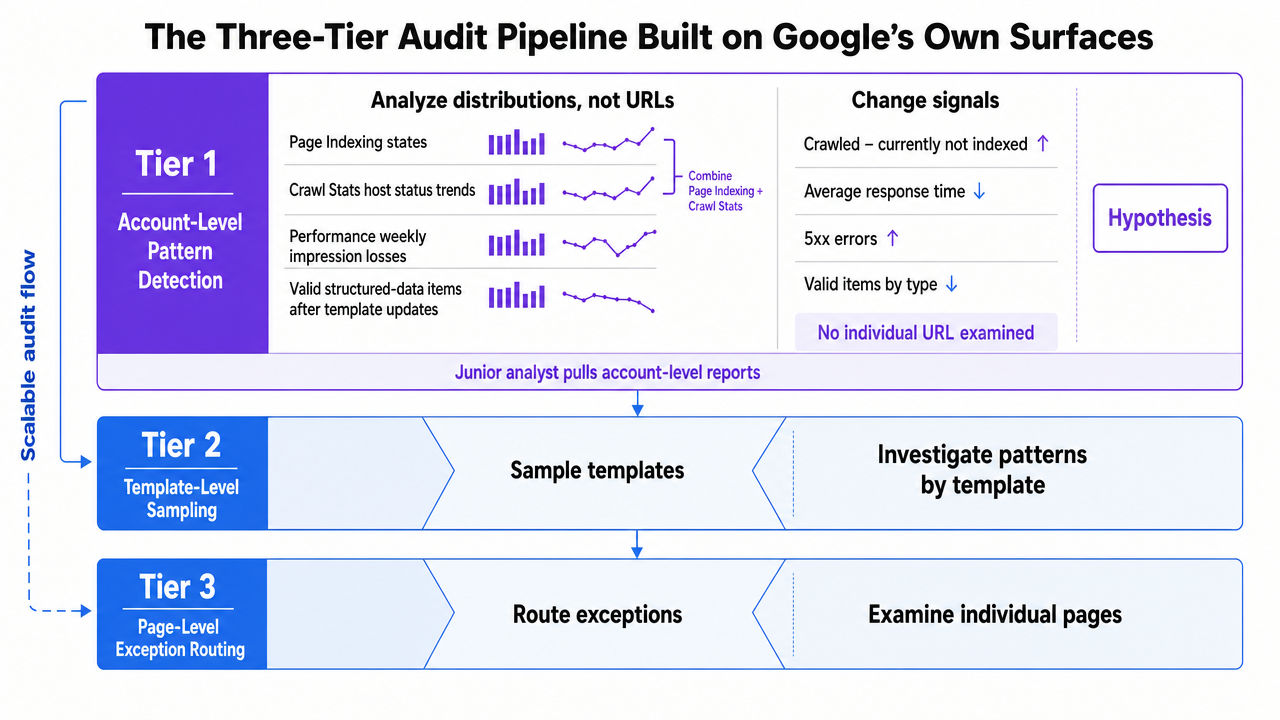 Visualize the three-tier audit pipeline (account-level pattern detection, template-level sampling, page-level exception routing) that structures the entire section
Quota Math: Why URL Inspection Forces a Sampling Design
The URL Inspection API's limit of 2,000 queries per day and 600 queries per minute per site 2 dictates how an agency structures its audit pipeline. This ceiling is per-site, not per-agency, and does not scale with client size or ambition.
Consider a mid-sized client: a 50,000-URL e-commerce site. Inspecting it fully at the daily maximum would take 25 days of continuous API usage, assuming no retries, failed calls, or other inspections. A 200,000-URL publisher would take 100 days. By the time such a pass completes, the index would have changed, templates would have shipped, and the results would be outdated. Full-site inspection is not merely slow for agencies; it's an unworkable strategy.
The solution is change-based sampling. Inspections are prioritized for three queues:
- URLs modified since the last crawl (based on sitemap lastmod deltas, CMS publish events, or redirect map updates),
- URLs flagged by Tier 1 pattern shifts (e.g., an increase in "Discovered - currently not indexed" or a drop in valid structured-data items),
- and URLs escalated from Tier 2 template samples.
Other URLs wait. For a 50,000-URL site with a regular release cadence, this typically keeps daily inspection load under 300 calls, leaving room for retries and ad-hoc client requests within the same quota.
Per-minute pacing is also critical. The 600-per-minute limit means unthrottled batch jobs will encounter 429 errors and lose calls due to backoff. Production pipelines queue inspections with a fixed rate limiter and allocate a portion of the daily quota (10 to 20 percent is a reasonable default) for the exception routing handled in Tier 3. Agencies that treat the quota as a strict budget maintain current audit outputs, while those that use it as a scanning tool exhaust their calls by mid-morning, providing clients with outdated data.
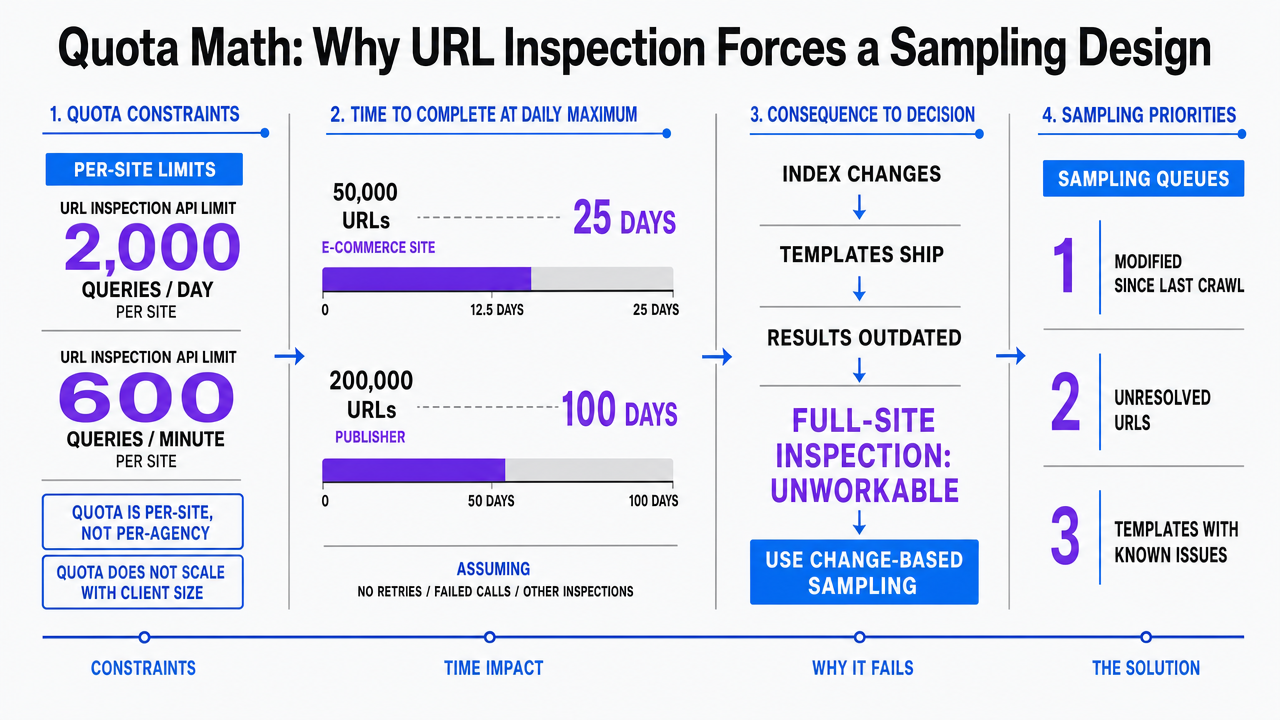 Show the URL Inspection API quota limits that the section explicitly discusses and cites
Run Full-Scale SEO Audits in One Week
Audit and publish real SEO improvements across multiple sites during your trial, with measurable impact from day one.
Core Web Vitals as a Template-Level Pass/Fail Gate
Core Web Vitals provide clear pass/fail criteria within Google's audit framework, making them ideal for template-level rather than URL-level application. Google defines three thresholds, measured at the 75th percentile across mobile and desktop:
Largest Contentful Paint (LCP) : 2.5 seconds or better (good), up to 4 seconds (needs improvement), and worse than 4 seconds (poor);
Interaction to Next Paint (INP) : 200 milliseconds or better, up to 500 milliseconds (needs improvement), and worse than 500 milliseconds (poor);
Cumulative Layout Shift (CLS) : 0.1 or better, up to 0.25 (needs improvement), and worse than 0.25 (poor) 8.
These benchmarks are consistent across clients, page types, and agencies, serving as a definitive gate.
Applying these metrics at the template level ensures scalability. A product template failing LCP will cause every product URL rendered through it to fail. A category template with a hero carousel that triggers CLS will affect it site-wide. An auditor who groups CrUX data by template and checks the 75th percentile against the three thresholds generates one row per template, not one per URL. This approach allows for defensible weekly deliverables instead of an endless backlog.
Field data has a coverage limitation: CrUX only reports on publicly discoverable and sufficiently popular pages and origins 9. Consequently, long-tail templates and low-traffic clients may only show origin-level data or no data at all. In such cases, the audit relies on lab tests of representative URLs per template, explicitly labeling the findings as lab-derived in client deliverables to differentiate them from field passes.
While Core Web Vitals influence ranking, passing them does not compensate for poor content, blocked resources, or indexing issues 7. The pipeline treats them as a gate: failing templates receive a fix ticket, passing templates are monitored, and senior time is reserved for templates where field and lab data diverge.
Canonicalization and Duplicate Clusters as Detectable Patterns
Duplicate content clusters are a major source of wasted crawl budget for many client sites and can be identified at the account level before examining any specific URL. The Page Indexing report reveals these patterns through rising counts in these statuses:
- "Duplicate without user-selected canonical,"
- "Duplicate, Google chose different canonical than user,"
- and "Alternate page with proper canonical tag" 1.
Each status indicates a cluster where Google is making a canonical decision not explicitly declared by the site, and each requires a distinct fix.
The solution depends on understanding Google's signal weighting. Redirects and rel=canonical are strong canonicalization signals, while sitemap inclusion is weaker. robots.txt is not a canonicalization mechanism and should not be used as such 5. This hierarchy guides triage. If a duplicate cluster shows Google selecting a different canonical than declared, the auditor investigates whether a stronger signal is contradicting the rel=canonical, such as an internal redirect chain, inbound internal links favoring the alternate, or the declared canonical missing from the sitemap while the alternate is included.
Detection scales because the pattern is evident in the report, not in individual URLs. A junior analyst can weekly pull duplicate states, group affected URLs by directory or template, and escalate the top three clusters to Tier 2 for template-level render checks. Clusters resolved by sitemap corrections or redirect map updates do not require senior specialist intervention. Those where a strong signal conflicts with the declared canonical are routed with supporting evidence.
Structured Data: Automatable Syntax, Human Content-Match
Structured data audits are divided into two distinct tracks: one scalable through automation and the other requiring human review. Syntax validation, required-property coverage, and post-deployment regression checks are machine-driven tasks. However, verifying that the markup accurately reflects visible content on the page requires human judgment. Google's structured-data policy explicitly states that markup must match visible content, and violations can lead to manual actions that remove rich-result eligibility, even if the JSON-LD parses correctly 10.
The automated track aligns with Google's release workflow. This involves validating schema with the Rich Results Test, testing sample live URLs, submitting updated sitemaps, and monitoring valid and invalid item counts in Search Console status reports after deployment 11. A pipeline that pulls enhancement reports weekly can detect template regressions immediately if a CMS release removes a required property or a developer changes a schema type. Drops in valid items are initially treated as deployment issues, preventing the common error of escalating a template rollback as a search problem.
The human track is more focused and cost-effective than many agencies realize. A senior reviewer spot-checks one URL per schema type per client quarterly, comparing the markup's claims against the rendered page. Discrepancies like prices not matching visible prices, review counts not aligning with visible aggregates, or event dates contradicting on-page schedules are failures automation cannot catch and are often the cause of manual actions. All other issues remain within the automated release-and-monitor loop.
See How Leading Teams Automate Google SEO Audits at Scale
Request a walkthrough of workflow-driven SEO audit automation—benchmark your current process, reduce manual bottlenecks, and maintain oversight across multiple client sites with measurable efficiency gains.
Where AI-Assisted Remediation Ends and Policy Begins
AI can streamline repetitive remediation tasks, such as rewriting title tags across a template, generating alt text for product catalogs, drafting FAQ blocks from support transcripts, or refining meta descriptions for category trees. These applications are permissible. Google prohibits scaled content abuse, defined as generating numerous pages primarily to manipulate rankings rather than benefit users, regardless of whether humans, automation, or a combination produced them 12. The method of production is not the violation; the purpose and user value are.
This distinction provides audit leads with a clear operational boundary. AI can execute approved changes at template scale when a human reviewer confirms that the change genuinely enhances the user experience—e.g., a clearer answer, a missing specification, a corrected price, or an improved internal link. AI crosses the line when used to create thin variations of the same page across different cities, services, or long-tail queries without substantive underlying content. The former strategy expands coverage, while the latter risks a manual action.
The pipeline enforces this through an approval gate, not a content filter. Every AI-drafted remediation undergoes review by a designated person before deployment, with a fixed question: does this change offer the user something the previous version did not? Approved changes go live. Rejected or rewritten changes are sent back. If a reviewer is uncertain, the change is escalated to a senior editor. This gate differentiates AI-assisted execution from scaled content abuse and provides a defensible answer when clients inquire about the safety of the agency's automation.
Portfolio Economics: Coverage per Analyst Hour
The economics of audit delivery change significantly when an agency measures analyst output by templates gated, patterns resolved, and exceptions routed, rather than by URLs reviewed. A senior SEO working manually across a portfolio can typically manage two to four clients at a consistent weekly cadence before quality declines. A pipeline built on Google's own surfaces, incorporating an AI execution layer for drafting and regression monitoring, can increase this ratio to double digits per analyst. This is because the work shifts from individual URL review to pattern-based approval.
The table below illustrates this shift using coverage variables instead of monetary figures. Coverage is defined as the number of sites a single analyst can manage weekly.
| Audit layer | Google surface | Manual coverage (sites/analyst/week) | Pipeline + AI coverage (sites/analyst/week) | Constraint |
|---|---|---|---|---|
| Indexing pattern scan | Page Indexing 1 | 3–5 | 20–30 | Report freshness |
| Crawl behavior | Crawl Stats 3 | 3–5 | 20–30 | Host-level aggregation |
| Page-level validation | URL Inspection 1 | 2–4 | 10–15 | 2,000 requests/site/day 2 |
| Core Web Vitals gate | CrUX + Web Vitals 8 | 2–4 | 10–20 | CrUX popularity threshold 9 |
| Structured data regression | Rich Results + status reports 11 | 3–5 | 20–30 | Deployment cadence |
The specific ratios are less important than the overall trend. Manual coverage declines most rapidly at the page-level layer because URL Inspection directly pits quota against human attention. Pipeline coverage also declines fastest at this layer for the same reason, which is why the design emphasizes exception routing over broad scanning. Increasing the number of analysts does not raise the per-site quota; only disciplined sampling does.
For an SEO head, the economic implication is that portfolio growth is limited by the exception rate, not by tool selection. An audit book that routes less than 5 percent of flagged URLs to senior review can scale linearly with junior headcount. One that routes 30 percent requires scaling with senior hiring, a model most agencies aim to move away from. Coverage per analyst hour is the key metric that reveals which model an agency is truly operating under.
Running the Weekly Cadence Without Senior Bottlenecks
A consistent weekly cadence relies on a fixed schedule and clear ownership.
- Monday is dedicated to Tier 1: a junior analyst pulls Page Indexing, Crawl Stats, Performance, Core Web Vitals, and structured-data status for all clients, generating a one-page delta report per site.
- Tuesday and Wednesday are for Tier 2: template samples are pulled for flagged patterns, rendered-output checks are performed on JavaScript-heavy stacks 6, and duplicate clusters are triaged based on the canonical signal hierarchy 5.
- Thursday focuses on Tier 3 and remediation drafting: URL Inspection is used for change verification and exception diagnosis, and AI-drafted fixes are queued for approval.
- Friday is for deployment, monitoring, and client-facing summaries.
Three rules prevent bottlenecks:
- Senior specialists never review Tier 1 reports; they receive escalations with the pattern, template evidence, and inspection results already attached.
- The URL Inspection quota is budgeted at the start of the week, not consumed opportunistically.
- Any client whose exception rate exceeds 5 percent for two consecutive weeks triggers a root-cause review, not more inspections.
Managed this way, an SEO head reviews decisions, not individual URLs, establishing a sustainable cadence for a growing portfolio.
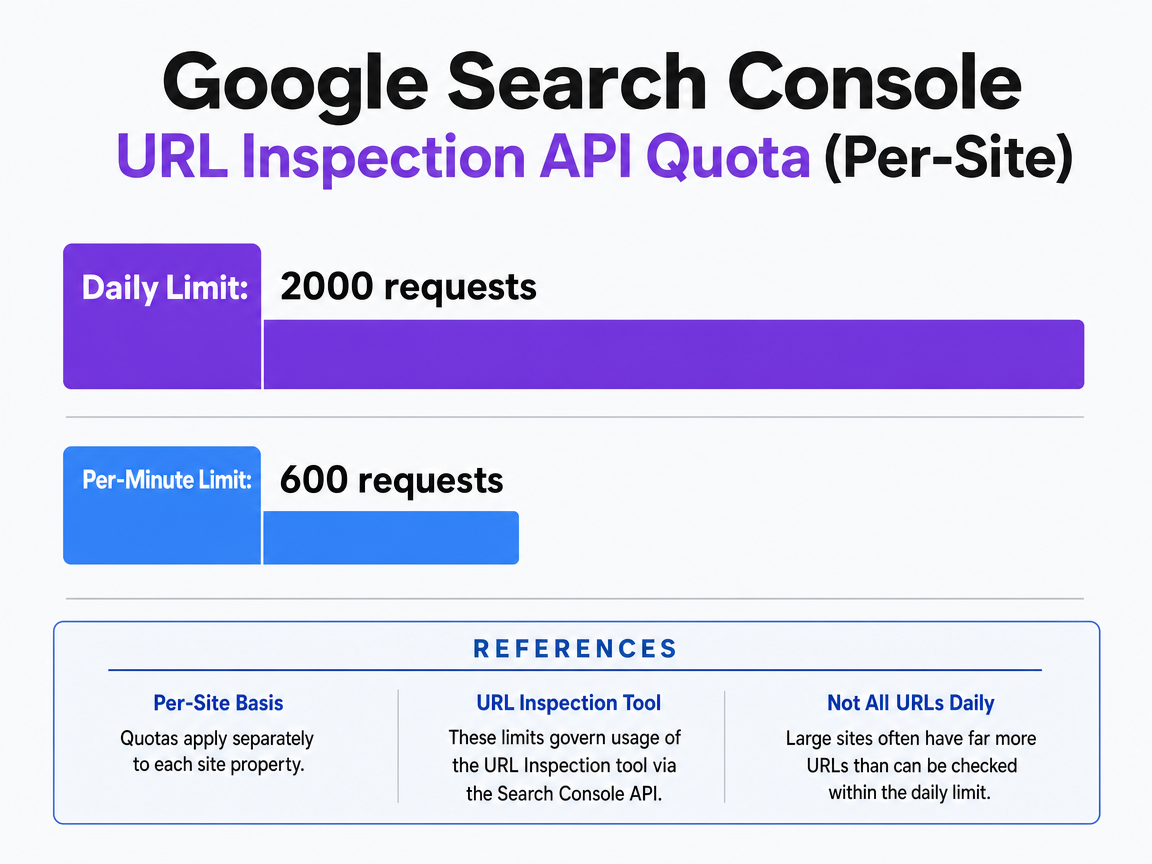 Google Search Console URL Inspection API Quota (Per-Site)
The usage limits for the URL Inspection tool within the Search Console API, applied on a per-site basis. This limits the ability to check every URL on a large site daily.
Frequently Asked Questions
References
- 1.How To Use Search Console.
- 2.Usage Limits | Search Console API - Google for Developers.
- 3.Google Search Technical Requirements.
- 4.Technical SEO Techniques and Strategies.
- 5.How to Specify a Canonical with rel="canonical" and Other Methods.
- 6.Understand JavaScript SEO Basics.
- 7.Understanding Core Web Vitals and Google search results.
- 8.Web Vitals.
- 9.CrUX methodology.
- 10.General Structured Data Guidelines.
- 11.Dataset Structured Data.
- 12.Spam Policies for Google Web Search.